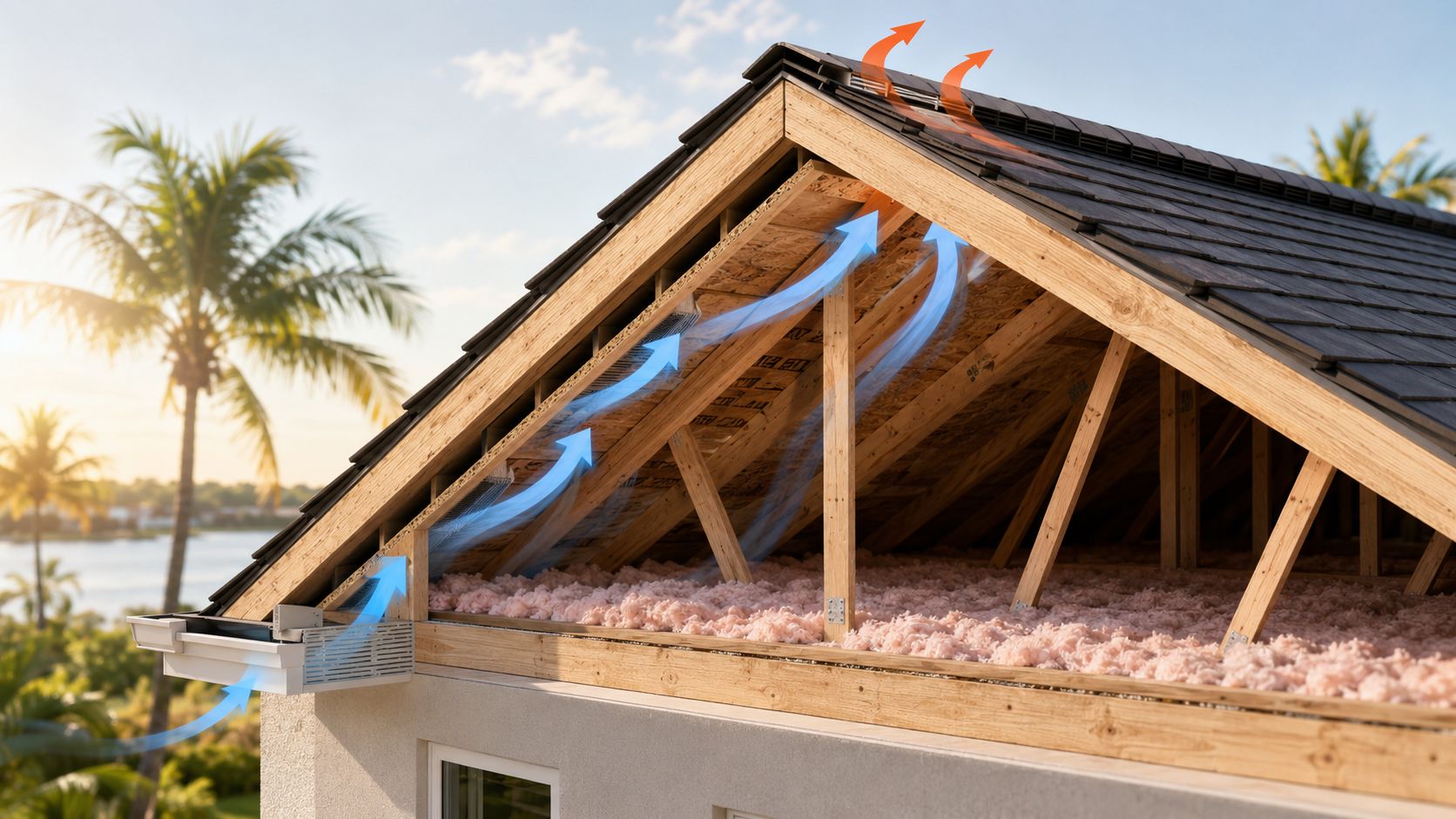
Your AC runs all day, the upstairs still feels sticky, and the house never seems to settle into a comfortable temperature. That's a common South Florida complaint. A lot of people assume the problem starts and ends with the air conditioner, but the attic is often part of the reason the system never gets ahead.
In this climate, a bad attic acts like a heat reservoir and a moisture trap at the same time. The roof gets hammered by sun, afternoon humidity hangs in the air, and every little air leak at the ceiling gives that attic more to work with. If the ventilation layout is wrong, blocked, or unbalanced, the roof system and the rooms below it both pay for it.
I've seen homeowners chase the wrong fix for months. They lower the thermostat, add insulation without checking airflow, or replace equipment while the attic keeps cooking above them. Sometimes the problem is the roof vent layout. Sometimes it's an air leakage issue at the ceiling plane. Sometimes it's both. A useful companion on the HVAC side is this guide to duct sealing, because leaky ducts and a poorly managed attic often show up together in hot homes.
If you want a quick visual of the kind of roof profile and vent planning that affects performance, this roof image reference helps frame what you're looking at. The key is understanding what the code requires, what works in South Florida, and where roofs fail when those two things drift apart.

Table of Contents
- Is Your Attic Working Against Your AC
- Why a Hot Attic Is a Costly Problem in Florida
- Decoding Florida's Roof Ventilation Requirements
- A Step-by-Step NFA Calculation Example
- Home Inspection Checklist for Poor Ventilation
- Solutions and Maintenance for a Healthy Roof
- Frequently Asked Questions About Roof Ventilation
Is Your Attic Working Against Your AC
A South Florida attic can work like a parked car in the sun. The roof absorbs heat all day, and if that heat has no clean path out, it settles over the house. The AC below keeps trying to pull heat and humidity out of the living space while the attic keeps pushing in the other direction.
That doesn't just affect comfort. It puts stress on insulation, roofing materials, and the ceiling assembly that separates the attic from the rooms below. In a humid climate, that same trapped air can also carry moisture where you don't want it.
Most homeowners first notice the symptoms, not the cause. The bonus room feels hotter than the rest of the house. Closet ceilings smell musty. The AC seems to run forever in the afternoon. Those are clues that the attic may not be moving air the way it should.
A well-vented roof doesn't make the attic cold. It gives heat and moisture a controlled way to leave, instead of letting them collect over your house.
The hard part is that roof ventilation requirements sound more technical than they are. Once you understand intake, exhaust, and net free vent area, the code starts to make sense. The better question isn't “Do I have vents?” It's “Do I have the right vents, in the right places, working together?”
Why a Hot Attic Is a Costly Problem in Florida

By August in South Florida, I can step into some attics for five minutes and tell the house is paying for it. The AC is running hard downstairs, the ceiling drywall feels warmer than it should, and the air up top is heavy instead of flushing out. That combination costs money and shortens the life of the roof assembly.
Florida makes this problem worse because heat is only part of it. We deal with intense solar gain all day, then high outdoor humidity, then afternoon storms that can drive rain sideways. If the attic is poorly vented, or vented with the wrong products for our climate, it can hold heat, trap moisture, and invite wind-driven rain at the same time.
A hot attic raises the temperature of everything around it. Ductwork loses efficiency. Insulation does less effective work when the temperature difference across the ceiling stays high for hours. Rooms under the roof, especially west-facing bedrooms and bonus rooms, tend to drift uncomfortable late in the day even when the thermostat says the house is cooled.
The moisture side is where repair bills start to climb.
In South Florida, attics get wet without a roof leak. Humid outdoor air enters through vents. Interior air leaks up through can lights, attic hatches, bath fan penetrations, and top plates. If that moisture has poor airflow and hot roof sheathing above it, the attic can cycle between damp and overheated. That is how you end up with musty insulation, stained roof decking, rusty fasteners, and mold growth on wood surfaces.
Practical rule: A musty attic is a warning sign. Check for blocked soffits, unsealed ceiling penetrations, disconnected bath fans, and vent openings that let weather in without moving enough air out.
Poor ventilation also affects the roof covering itself. Extra heat held under the deck puts more stress on asphalt shingles and speeds up the wear that already comes from Florida sun. On tile and metal roofs, the failure point is often the assembly underneath. The underlayment, fasteners, and roof deck still take the heat load, and those are expensive components to repair once moisture gets involved.
The trade-off is simple. An attic needs to release heat and moisture, but in South Florida it also has to resist wind-driven rain and hold up during storms. More vent openings do not automatically mean a better system. Badly placed box vents, short-circuited airflow, clogged soffits, or oversized powered fans can create new problems instead of solving the old ones.
Here's what I see most often when attic ventilation is underperforming in Florida homes:
- Higher cooling demand: The AC runs longer because the ceiling assembly is taking heat from above for most of the afternoon.
- Uneven room temperatures: Upstairs rooms and areas under low-slope sections usually show the problem first.
- Moisture staining and odor: The attic smells stale, wood darkens, and insulation can mat down after repeated damp periods.
- Premature material wear: Shingles, underlayment, sealants, and metal components all age harder in a hotter, wetter attic.
- Storm-related vent problems: Some vent types perform poorly when rain is pushed uphill by wind, which is a real South Florida concern.
Ignore those signs long enough and the repair list spreads from the attic into the house. What starts as a ventilation problem can turn into insulation replacement, drywall repairs, mold cleanup, duct issues, and a shorter service life for the roof system itself.
Decoding Florida's Roof Ventilation Requirements
A South Florida attic can pass inspection on paper and still perform badly in the field. I see that on homes with plenty of vent openings but poor airflow, blocked soffits, or vent products that are a bad match for wind-driven rain. The code gives the minimum target. Good roof work is making that target function in real weather.
The measurement that matters is Net Free Ventilating Area, or NFVA. That is the actual open area available for air to move after screens, louvers, baffles, and the vent body reduce the raw opening. A vent that looks large from the driveway can deliver less airflow than a smaller product with a better tested rating.
What the code is measuring
The baseline rule is the 1/150 ratio. For enclosed attics and enclosed rafter spaces, the vent system needs at least 1 square foot of net free ventilation for every 150 square feet of attic or rafter area, unless the assembly qualifies for a code exception.
That requirement is easy to misread. The code is not counting how many vents are installed. It is counting how much rated open area those vents provide as a system.
The code also expects balanced ventilation. In plain terms, that means intake low and exhaust high, with the total vent area split so the system can pull air through the attic instead of letting it stall. On most homes, intake belongs at the soffits and exhaust belongs at the ridge or high roof area.
When the 1/300 ratio can apply
The reduced 1/300 ratio is allowed in some attic assemblies, but it is not a free pass. The assembly has to meet specific conditions, including the right vapor retarder location and the right distribution between upper and lower ventilation.
That exception deserves extra caution in South Florida. We spend more of the year cooling than heating, and our attic problems are not just about heat buildup. Humid air leakage from the house, outside moisture, and poor intake pathways can all leave an attic damp even when the vent math looks acceptable. A roof can meet the reduced ratio and still have condensation on fasteners, musty insulation, or hot pockets above the ceiling if the airflow path is broken.
In other words, the ratio is only part of the job.
What usually goes wrong in real houses
The common failure point is not the code formula. It is the layout.
A ridge vent paired with clogged or undersized soffits will underperform because the exhaust has nothing to pull from. Too many box vents scattered across the slope can short-circuit the system by drawing air from the closest opening instead of from the eaves. Gable vents can also interfere with a soffit-to-ridge design if they let wind push air sideways through the attic instead of up and out. In hurricane season, vent selection matters even more because some products handle wind-driven rain better than others.
This is why roof shape matters. Hip roofs, valleys, low-slope transitions, and cut-up attic spaces often have dead zones that a simple vent count will miss. The code gives the minimum area. The installer still has to place intake and exhaust where air can travel.
A good ventilation system is balanced, connected, and weather-appropriate. If one part is weak, the whole attic pays for it.
Common vent types and typical NFA
Manufacturers publish the NFVA for each vent product, and that listing should drive the layout. Outside dimensions do not tell you enough. Two vents with similar size and appearance can have very different usable airflow.
| Vent Type | Common Placement | Typical NFA Rating |
|---|---|---|
| Ridge vent | Along roof ridge | Varies by manufacturer product listing |
| Continuous soffit vent | Under eaves | Varies by manufacturer product listing |
| Individual soffit vents | Under eaves between framing bays | Varies by manufacturer product listing |
| Off-ridge box vent | High on roof slope | Varies by manufacturer product listing |
| Gable vent | Exterior gable wall | Varies by manufacturer product listing |
The right process is straightforward. Start with the code ratio. Confirm the intake and exhaust split. Then check the rated NFVA of the actual products being installed, and make sure the roof design gives air a clear path from the soffits to the high exhaust points. In South Florida, I would add one more check. Make sure the vent type can handle our rain and wind exposure without trading airflow for leaks.
A Step-by-Step NFA Calculation Example

A South Florida attic can look fine on paper and still run hot, damp, and uneven if the vent math is sloppy. I see that a lot after re-roofs. The contractor adds exhaust up high, leaves marginal intake down low, and the attic never gets the air path it was supposed to have.
Use a simple example. Say the vented attic area is 1,500 square feet and the design is based on the 1/150 ratio.
Start with total attic area
Divide the attic floor area by 150.
1,500 ÷ 150 = 10
That means the attic needs 10 square feet of total NFVA. NFVA means net free ventilating area, which is the actual open area air can move through after screens, louvers, and vent design reduce the gross opening.
For a Florida roof, this is the number that matters. The outside size of the vent does not tell you enough.
Split intake and exhaust correctly
A balanced layout starts by dividing that total between low intake and high exhaust.
- Intake at soffits: 5 square feet of NFVA
- Exhaust at ridge or high roof area: 5 square feet of NFVA
That balance matters in our climate. Strong exhaust with weak soffits can pull conditioned air from the house if ceiling leaks are present. Too much intake with limited exhaust leaves hot air trapped high in the attic. Either way, the attic stays hotter than it should, and during storm season the wrong vent choice can also increase the chance of wind-driven rain getting where it does not belong.
As noted earlier, some attics can qualify for the reduced 1/300 ratio. If the attic does not clearly meet that exception, I would size from 1/150 and verify the layout carefully.
Turn the math into a vent plan
Estimates frequently prove to be inaccurate. The requirement has to be converted into actual vent products with listed NFVA, then checked against the roof shape and the local weather exposure.
A practical sequence looks like this:
- Measure the vented attic floor area. Use the attic floor area for the ratio calculation, not the roof surface area.
- Choose the correct code path. Use 1/150 unless the attic clearly qualifies for the reduced exception.
- Divide the NFVA between intake and exhaust. Keep the system balanced.
- Use manufacturer-listed NFVA for each product. Ridge vent, soffit vent, and box vent ratings vary a lot.
- Check the airflow path through the attic. Baffles, insulation depth, and framing breaks can choke intake even when the vent count looks right.
- Match the vent type to South Florida exposure. A vent that performs well in a mild climate may be a poor choice on a low-slope roof facing wind-driven rain.
On a simple gable roof, that math is usually straightforward. On a hip roof, a cut-up plan, or an attic with separated pockets, the layout gets trickier fast. Hips reduce ridge length, which limits ridge vent capacity. Deep insulation at the eaves can block soffit intake unless baffles keep that air channel open. You can hit the target NFVA on paper and still miss the goal in the field.
If you want a visual reference for the kind of roof conditions that complicate vent layout, this roof inspection image showing common problem areas is useful. For homeowners also dealing with indoor comfort or musty-air complaints, Purified Air Duct Cleaning covers related warning signs inside the house.

If a proposal lists vent counts but never shows the NFVA math, ask for the calculation. In South Florida, that is not paperwork. It is how you catch the mistakes that lead to heat buildup, moisture trouble, and callbacks after the first hard summer.
Home Inspection Checklist for Poor Ventilation

Most homeowners don't need to climb on the roof to spot a ventilation problem. The house usually gives warnings first. You just need to know which clues matter and which ones point to something else.
For a broader whole-house perspective, this guide from Purified Air Duct Cleaning is a useful companion read, especially when indoor air issues overlap with attic problems. If you want a visual reference tied to roof conditions, this inspection image helps show the kind of areas worth checking.
What you can notice from inside the house
Start with comfort and finishes. Those signs are easy to overlook because they build slowly.
- Rooms near the ceiling stay hotter: Upper bedrooms that never cool down can signal heat buildup above the ceiling plane.
- Musty smells show up upstairs: That often points to moisture lingering where air movement is poor.
- Paint or ceiling finishes look stressed: Peeling paint or staining near exterior wall and ceiling intersections can be a warning that moisture is collecting.
- Your cooling system never seems satisfied: The attic may be adding heat load even when the equipment is running properly.
Industry guidance collected by ARMA and NRCA treats the 1:150 vs. 1:300 choice as conditional on climate zone and vapor retarder details, and it also emphasizes that in hot-humid climates an airtight ceiling plane can matter more than adding more vents alone, as summarized by ARMA's ventilation guidance.
What to look for in the attic and at the roofline
If you can safely look inside the attic from an access hatch, pay attention to smell, staining, and airflow obstructions.
- Dark spotting on the roof deck: This can indicate repeated moisture exposure.
- Insulation packed into soffit edges: That can choke off intake air before it ever enters the attic.
- Rust on fasteners or damp-looking wood: Moisture doesn't have to drip to cause trouble.
- Shingles that look worn before their time: Excess attic heat can add stress from below.
- Sagging or warped decking: That suggests a bigger roof-system issue that needs professional attention.
If the attic has vents but the soffit openings are blocked by insulation or paint, the system is vented on paper and starved in real life.
One more point matters here. Adding vent openings won't fix a ceiling that leaks air into the attic. If recessed lights, attic hatches, or mechanical penetrations are letting indoor air rise into that space, the attic can still run damp and hot even with a decent vent count.
Solutions and Maintenance for a Healthy Roof
The best fix usually isn't “add more vents.” It's build a balanced system that the roof can use. In South Florida, that often means improving low intake first, then matching it with high exhaust, then checking the ceiling plane for air leakage that keeps feeding humidity into the attic.
What usually works best
For many vented attics, the most reliable setup is continuous soffit intake paired with ridge exhaust. That gives air a low entry point and a high exit point. The path is simple, and simple tends to perform better than mixed vent styles scattered around the roof.
On older homes, the retrofit challenge is often at the soffit. Paint, repairs, insulation drift, or old construction details can limit intake. If intake is weak, adding more high vents won't solve the underlying problem.
A careful contractor also needs to think about South Florida weather. Wind-driven rain can expose weak vent layouts fast. The goal isn't just to move air. It's to move air while keeping the roof assembly weather-tight.
When powered attic ventilators help and when they backfire
Powered attic ventilators can work, but only when they're sized and installed correctly. The Home Ventilating Institute says powered attic ventilators should provide at least 0.7 CFM per square foot of attic floor, and it specifies that these systems must be paired with soffit intake vents only, not gable vents, to prevent the fan from pulling conditioned air from inside the house, according to HVI's guide on how to buy a fan.
That warning matters in Florida. If the fan can't get enough makeup air from the soffits, it may pull from wherever it can. That can mean through ceiling penetrations, attic hatches, and other leaks from the living space. Then you're paying to cool indoor air, only to have the attic fan drag it upward.
If you're reviewing proposals, organized takeoff and scope detail matter. A tool like Exayard roofing estimating software can help contractors present clearer measurements and line items, which is useful when ventilation upgrades are bundled into a reroof. A visual roof reference like this ventilation planning image can also help homeowners understand how those parts fit together.

Simple maintenance that protects the system
Ventilation systems don't stay effective by accident. A few checks go a long way.
- Keep soffits open: Insulation baffles should preserve the intake path so insulation doesn't plug the edge.
- Check vent screens and openings: Debris, paint, and insect nesting can reduce real airflow.
- Watch after roof work: New underlayment, fascia work, or repainting can accidentally close off intake areas.
- Inspect after storms: In hurricane-prone areas, wind and debris can damage vent components or shift materials around them.
A roof system lasts longer when the airflow path stays open and the ceiling below it stays tight.
Frequently Asked Questions About Roof Ventilation
Do tile and metal roofs follow different roof ventilation requirements
The code ratio concept still applies. What changes is the roof assembly detail and the vent products used with that roofing material. Tile and metal systems may have different accessory profiles and attachment methods, but the attic below still needs intake, exhaust, and a workable air path.
What about hip roofs, valleys, and complicated attic shapes
These are the roofs where simple calculators can mislead you. NRCA guidance says large-volume attic spaces, including steep roofs with slopes greater than 8-in-12, may need more ventilation than the minimum, and it notes that complex roof geometry can make balanced ventilation harder to achieve, as described in NRCA's roofing guidelines.
Hip roofs often have less ridge length available for exhaust. Valleys and compartmentalized attic spaces can interrupt airflow. In those cases, the right answer usually comes from looking at the actual framing and airflow path, not just applying a generic vent formula.
Do cathedral ceilings need attic ventilation too
They often need a different approach. NRCA specifically recommends ventilating cathedral ceilings with a space between the roof deck and insulation. That dedicated air space is important because there may be no conventional attic volume above the ceiling to buffer heat and moisture.
A cathedral ceiling that lacks that air channel can trap heat and dampness close to the roof deck. On these assemblies, product choice and installation detail matter as much as the code math.
If you want a professional opinion on whether your attic ventilation meets code and is effective in South Florida conditions, Paletz Roofing and Inspections can help. Their team handles roof inspections, repairs, replacements, and ventilation-related roofing evaluations across Broward, Miami-Dade, and Palm Beach counties, with practical guidance for shingle, tile, metal, and flat roof systems.