
A roof repair coming in below the insurance estimate usually means the claim was priced for a bigger scenario than the roof needs. That sounds backward to homeowners, but it's common. In Verisk's 2025 U.S. roof report, average residential repair cost was $4,699 and average residential replacement cost was $17,631, with repair costs up 25% and replacement costs up 33% versus the 2021 to 2024 average, which helps explain why insurer pricing and contractor bids can land far apart when standardized estimating systems are involved (Verisk roof cost figures summarized here).
The mistake is treating the insurance estimate like a final contractor price. It isn't. It's a claim document built from an adjuster's inspection, policy terms, and valuation method. A contractor's number is a work plan for what has to happen on your roof.
If your roof repair cost is less than the insurance estimate, two questions matter more than anything else. Is the repair scope complete? And is the payout adequate for the work that needs to be done? If the answer to both is yes, the lower bid is often good news, not a problem.
Table of Contents
- Why a Lower Repair Estimate Is Usually Good News
- How Insurance Estimates Are Built and Why They Differ
- Where the Real Gap Lives in Your Claim Documents
- The Homeowner Playbook for Handling the Estimate Gap
- Three Paths Forward When Repair Costs Come In Below the Estimate
- Understanding the Payout Mechanics Behind Your Check
- Making the Right Call for Your South Florida Roof
Why a Lower Repair Estimate Is Usually Good News
A lot of homeowners expect bad news when they hear, “Your roofer came in lower than insurance.” In practice, that often means the roof can be restored without doing everything the claim pricing assumed.
When the insurance number is bigger than the actual job
A storm claim might be written around a broad replacement scenario, while the roof only needs a targeted repair. That happens with isolated slope damage, limited flashing failure, or component-specific issues where the surrounding roof is still serviceable.
The key point is simple. An insurance estimate is not a price tag. It's an adjuster's assessment of covered loss under the policy. A repair proposal is the field version of what a crew needs to install, replace, seal, remove, haul off, and document.
Practical rule: A lower contractor estimate is only a red flag if it leaves out necessary work. If the scope is complete, lower cost is a win.
The two questions that keep you out of trouble
When I review this kind of claim file, I don't start by asking who's right on price. I start with scope and settlement.
- Scope completeness: Does the contractor's repair include the materials and labor needed to restore the roof correctly?
- Claim adequacy: Does the insurer's payment structure support that repair once deductible and policy valuation are applied?
- Hidden conditions: Is there a reasonable chance the roof will reveal added damage once work begins?
Homeowners get into trouble when they chase the biggest number instead of the correct scope. If a smaller repair handles the damage properly, you may avoid unnecessary tear-off, extra disruption, and a larger project than the roof requires.
That's why a roof repair cost less than insurance estimate often signals efficiency, not underbidding. The job is making sure the cheaper number isn't cheap because something important got skipped.
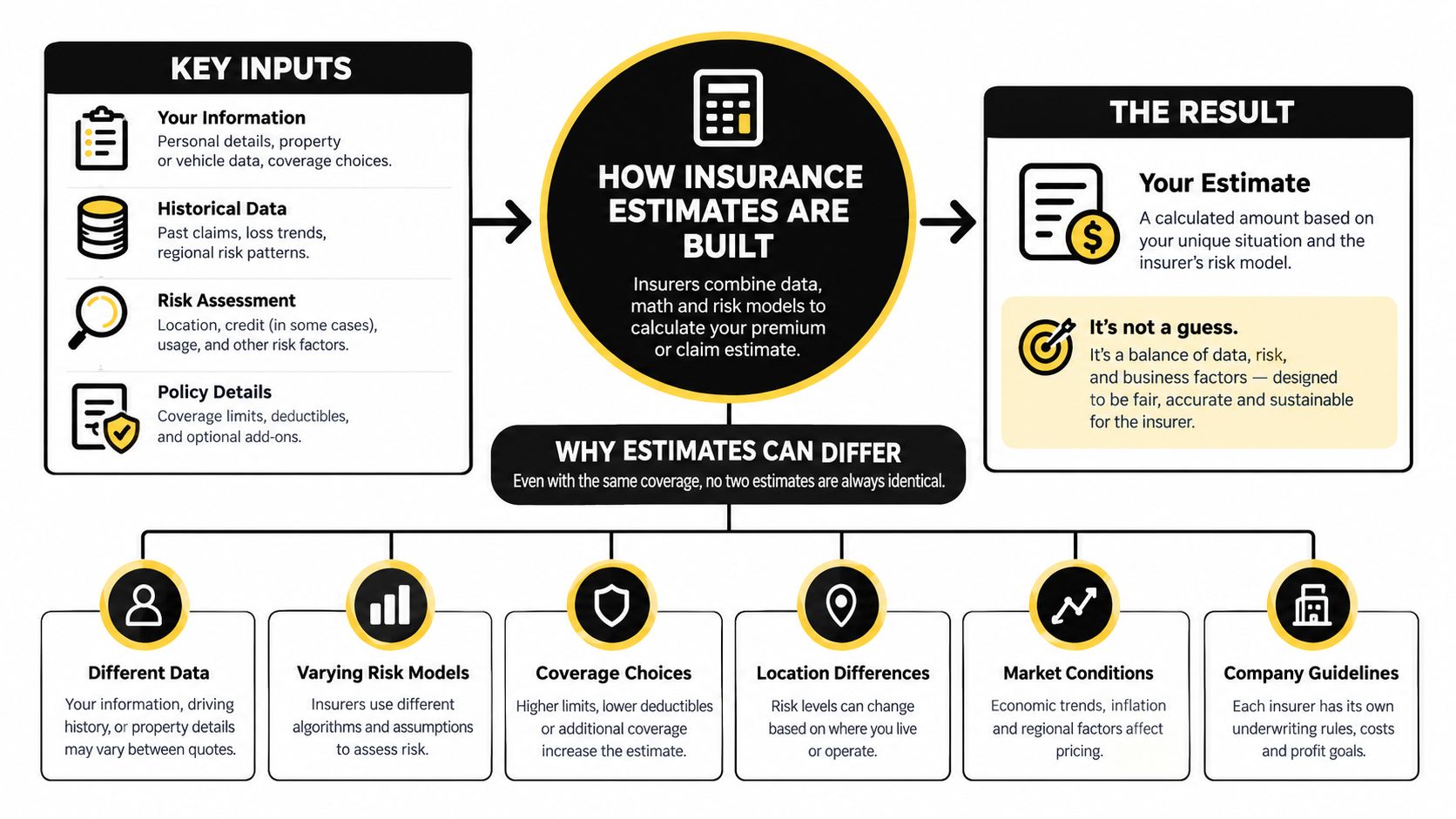
How Insurance Estimates Are Built and Why They Differ
Insurance estimates and roofing estimates look similar on paper, but they come from different systems. One is a claims document. The other is a construction document.
Scope first, then valuation
A major reason numbers split is that the insurer's scope of work is not the same as a contractor's complete repair plan. The carrier's document comes from the adjuster's inspection and policy interpretation, while a contractor may include hidden damage, code-required materials, and supplement items that weren't captured initially (scope-of-work explanation).
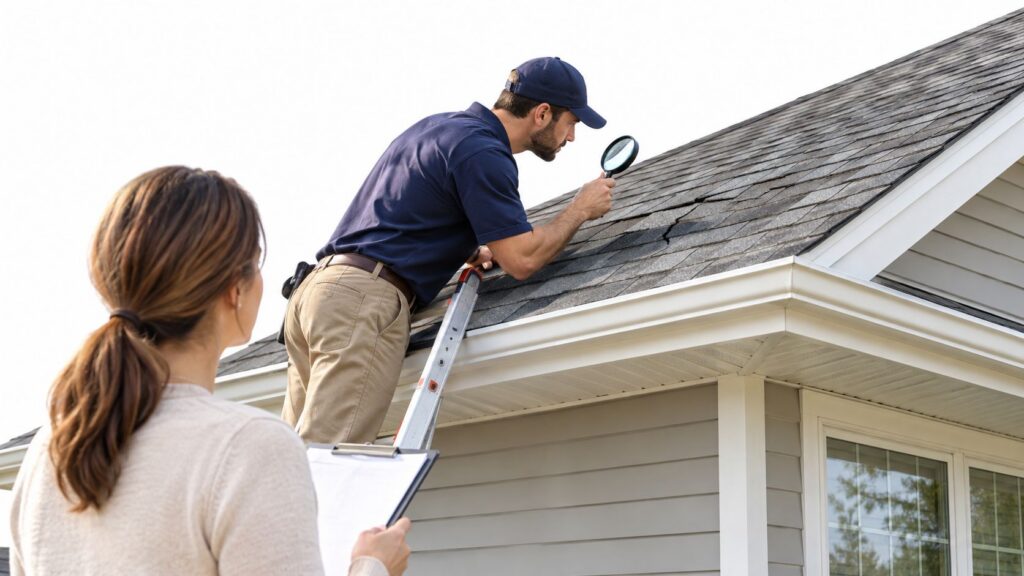
A careful roof review matters here. Even a basic visual reference like this roof inspection example image shows why inspection quality drives estimate quality. If the first inspection misses a flashing transition or underlayment issue, the first estimate won't reflect it.
RCV, ACV, and depreciation
Most roof claims revolve around replacement cost value (RCV) and actual cash value (ACV). RCV is the current cost to repair or replace with like kind and quality, without depreciation. ACV is the depreciated value after wear and age are deducted, as outlined by the NAIC's explanation of replacement cost and actual cash value.
Depreciation changes what the insurer pays and when it pays it. Travelers gives a concrete example for a 25-year composition shingle roof. A 10-year-old roof would be depreciated by 40% using 4% per year (Travelers depreciation example).
That doesn't automatically mean your repair should cost more. It means the claim valuation may reflect age-adjusted policy math, while the actual field repair may be narrower.
Overhead and profit can widen the gap
Insurance estimates also sometimes include an overhead-and-profit convention of 20%, commonly shown as 10% overhead plus 10% profit when multiple trades are involved (insurance claim calculator discussion of depreciation and overhead/profit).
If your actual roof repair is a tight single-trade job with fewer mobilizations and less coordination, a roofer can land below that estimate without cutting corners.
Don't assume “higher insurance estimate” means “better scope.” Sometimes it just means the claim was built around a broader replacement model than the roof needs.
Where the Real Gap Lives in Your Claim Documents
The useful question isn't whether two totals match. It's why they don't.
Price gap versus scope gap
A price gap means both documents describe the same work, but one side priced it differently. A scope gap means the documents are calling for different work altogether.
That distinction changes your next move. Price gaps usually call for explanation and comparison. Scope gaps usually call for a supplement.
The most common places to look are:
- Material quantities: Shingle, tile, or membrane counts may differ.
- Underlayment details: One document may include replacement where the other doesn't.
- Flashing and ridge components: These line items are often missed or grouped too broadly.
- Disposal and labor categories: Dump fees, detach-reset tasks, and labor breakdowns can shift totals fast.
- Collateral damage items: Storm claims often miss what only becomes visible after tear-off begins.
Why storm claims often change after work starts
On replacement-cost policies, insurers commonly pay in two stages: first the ACV check, then recoverable depreciation after repairs are completed and proof of payment is submitted (two-stage payment explanation). That structure matters because the initial documents are often incomplete by design. They're based on what the adjuster could see at inspection time.
Once a crew opens the roof, the damage pattern gets clearer. That's where homeowners often discover the “gap” was never about markup. It was about omitted work.
If you're sorting out first steps after storm damage, this guide on how to file a homeowners insurance claim in Miami is useful because it helps frame the paperwork side before line-item disputes start.
Compare the insurer's scope and the contractor's estimate line by line. If the work descriptions don't match, stop arguing about totals. You're looking at different jobs.
The Homeowner Playbook for Handling the Estimate Gap
Most estimate problems become manageable once you put the documents in the right order. Homeowners who stay organized usually make better decisions, whether they accept the lower repair number or push for revisions.
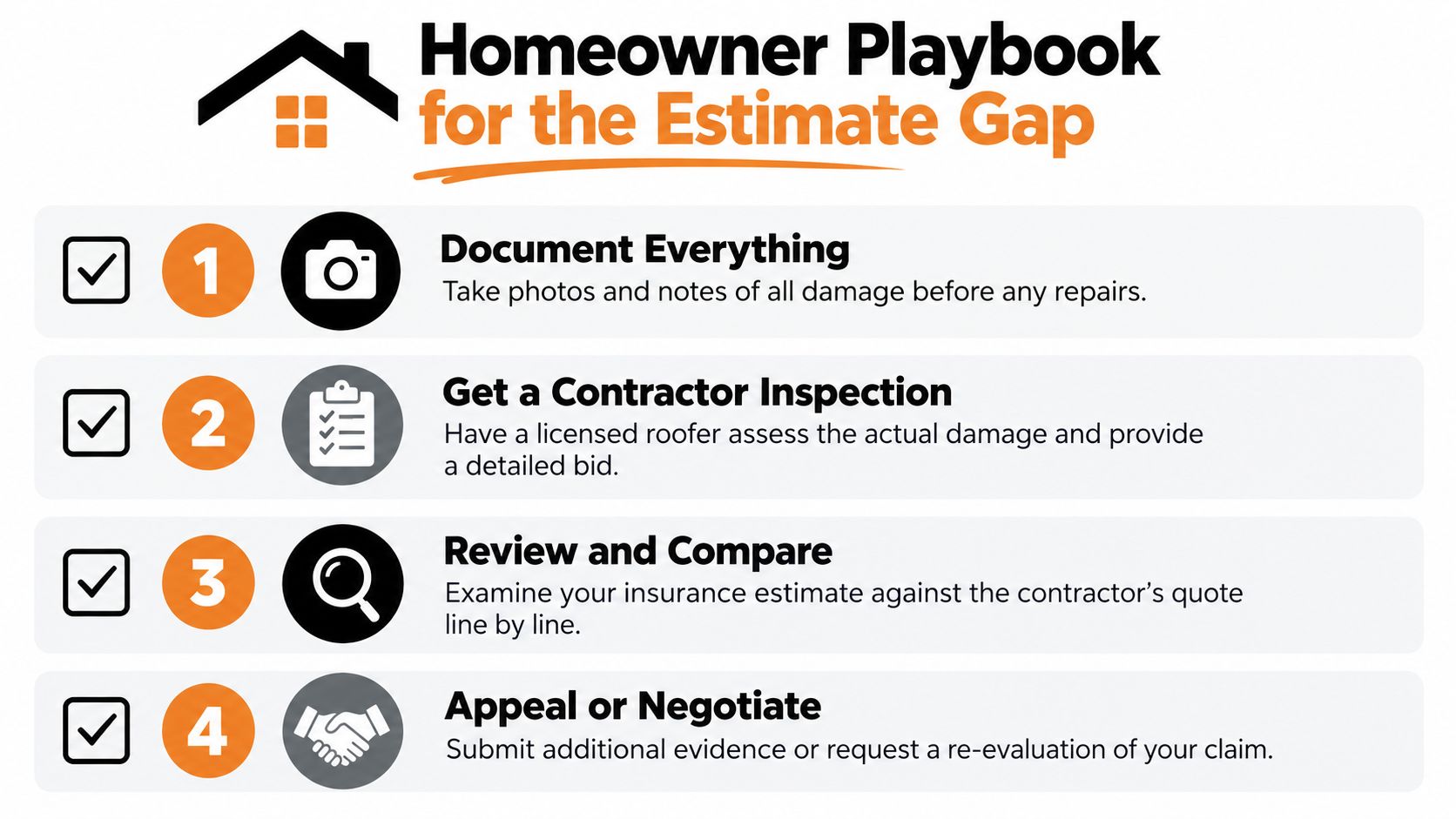
The four-document workflow
Start with the actual file, not a phone summary from the adjuster or a top-line number from the roofer.
Document the damage before repairs
Take dated photos from multiple angles. Save every claim email, check stub, scope sheet, and contractor note. If the roof leaks, keep records of where water entered and what interior areas were affected.
Get detailed contractor estimates
You want itemized proposals, not a one-line “repair roof” total. Ask for materials, labor categories, removal, disposal, flashing, underlayment, ridge components, and any code-related items to be broken out.
A visual checklist helps keep the process straight:
How to compare and when to supplement
Review both documents line by line
Mark every mismatch. A repair education image like this roof tile repair reference can help homeowners understand how component-level repairs differ from broad replacement language in a claim.
Submit a supplement if the gap is missing scope

Many claims turn. Recent guidance emphasizes line-by-line comparison and omitted-item documentation, and one 2026 industry guide says supplements commonly recover about $3,000 to $15,000 per claim, with averages around $7,000 to $8,000 on residential claims and $15,000+ on commercial claims (supplement benchmarks and line-item guidance).
That doesn't mean every claim should be pushed higher. It means supplements are normal when the first scope missed real work.
For contractors trying to keep these conversations organized, systems for 24/7 lead capture for trades can help document inspection requests and claim follow-up without losing homeowner notes between calls.
What works and what doesn't
- What works: Written scopes, clear photos, itemized contractor bids, and a calm supplement package.
- What doesn't: Arguing from the total alone, sending vague complaints, or starting repairs with no paper trail.
- One practical option: A company like Paletz Roofing and Inspections can provide written damage assessments and repair estimates for claim documentation, which is useful when you need a contractor scope that can be compared directly to the adjuster's paperwork.
Three Paths Forward When Repair Costs Come In Below the Estimate
Once you know whether the gap is pricing or scope, the decision usually falls into one of three lanes.
Decision Framework Which Path Fits Your Situation
| Path | When It Applies | Typical Outcome | Effort Required |
|---|---|---|---|
| Accept the lower repair estimate | The contractor's scope is complete, no hidden damage is expected, and the settlement structure still supports the work | Faster project start and less back-and-forth | Low |
| Submit a supplement | The contractor identifies omitted items, code-driven materials, or concealed damage not captured in the first scope | Revised claim scope and possible added payment | Moderate |
| Escalate the dispute | The insurer continues to undervalue clearly supported items or applies the wrong valuation logic under the policy | Formal review, extended negotiation, or higher-level dispute process | High |
Path one works more often than homeowners think
A frequently missed point is that a roof repair can cost less than the insurer's estimate, but the payout still depends on valuation method, depreciation rules, deductible, and whether the claim is ACV or replacement cost, not just on the invoice amount (claim payout mechanics overview).
So if the repair scope is solid and the claim mechanics are workable, acceptance may be the right call. Not every gap needs a fight.
When to supplement and when to escalate
Supplement when the documents show missing scope. That includes omitted flashing, underlayment, ridge work, or damage that only became visible after removal began.
Escalate when the insurer has the information and still won't correct clear line-item problems. At that stage, the issue is no longer confusion. It's position.
A good claim file answers one question cleanly: “What work is required to restore this roof correctly?” If your documents answer that, the next step usually becomes obvious.
Understanding the Payout Mechanics Behind Your Check
The number on your insurance check doesn't always tell you what the claim is worth in total. It tells you what the carrier is paying at that stage of the claim.
Why the first check can feel short
Under ACV-only coverage, the policyholder doesn't recover withheld depreciation. That can leave a real gap between insurance proceeds and the actual invoice. A legal briefing on roof claims notes that ACV is generally calculated as replacement cost minus depreciation, and one example shows a $10,000 roof estimate with a $1,000 deductible and 30% depreciation producing a $4,000 out-of-pocket cost (ACV example and legal briefing).
That's why homeowners can't judge the claim by saying, “My contractor is lower, so I'm ahead.” You might be ahead on repair pricing and still exposed on policy structure.
The recommendation that usually saves trouble
Before you decide whether to accept a lower repair figure, verify three things in writing:
- Policy valuation method: Is this ACV-only or replacement cost?
- Depreciation treatment: Is any holdback recoverable after work is documented?
- Deductible impact: What part of the total remains your responsibility no matter what the contractor charges?
If those answers are clear and the contractor scope is complete, taking the lower repair cost can be the cleanest outcome. If those answers are muddy, pause before authorizing work.
The biggest mistakes happen when homeowners mix up a construction decision with an insurance accounting decision. They're connected, but they're not the same thing.
Making the Right Call for Your South Florida Roof
In South Florida, this usually shows up after a wind event or fast-moving storm. A homeowner in Broward County gets an insurance estimate, then receives two repair proposals that both come in lower. At first glance, that looks like an overpayment issue. It usually isn't.
A realistic local scenario
The homeowner compares the contractor bids to the insurance scope and finds one important difference. The insurer grouped a transition area too broadly and didn't clearly account for a flashing category the contractors both included. Now the decision becomes practical.
If the missing flashing item is essential to restore the roof properly, that's a supplement situation. If the rest of the scope aligns and both contractors agree the damage is otherwise limited, the homeowner may accept the lower repair approach while still asking for the omitted line item to be reviewed.

What matters in this market
South Florida roofs don't forgive sloppy inspections. Tile profiles, flashing details, and moisture pathways need a contractor who understands local code expectations and how insurers read storm damage files. If you're evaluating roof age and service life in this region, even a simple Florida tile roof lifespan reference can remind you why repair versus replacement decisions have to be system-specific.

Homeowners make better claim decisions when they work with licensed, insured roofers who can separate three issues clearly: what is damaged, what is covered, and what is necessary to fix the roof. That's the whole game.
A roof repair cost less than insurance estimate isn't a puzzle you're supposed to solve alone. It's a routine part of claim handling. Read the scope carefully, verify the payment mechanics, and choose the path that matches the actual condition of the roof.
Paletz Roofing and Inspections handles South Florida roof inspections, storm-damage documentation, and detailed repair estimates that help homeowners compare contractor scope against insurance paperwork. If you need a clear second look before you accept, supplement, or dispute a claim, visit Paletz Roofing and Inspections.