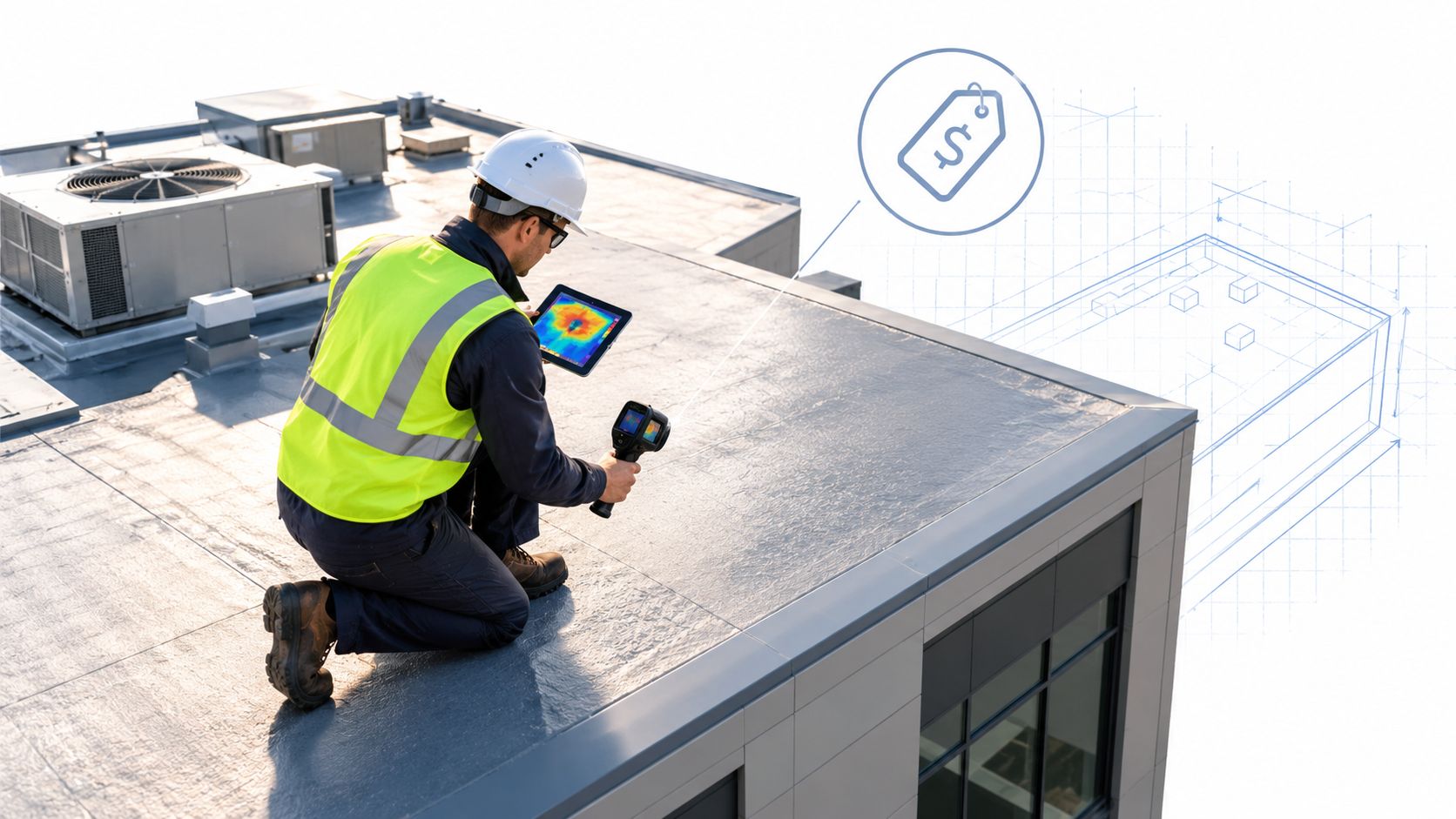
A standard commercial roof inspection typically costs between $250 and $800, while thorough diagnostic assessments with thermal imaging can range from $1,500 to over $4,000, depending on roof size and complexity. The right commercial roof inspection cost depends less on a single flat fee than on how far the contractor must investigate the roof system.
A facility manager in South Florida often discovers this when three contractors provide three very different quotes for the same building. One price covers a visual walkover. Another includes photographs, a written condition report, and repair priorities. The highest quote may include infrared moisture detection, core sampling, difficult access, or detailed documentation for a purchase, insurance file, or capital-planning decision.
Table of Contents
- Understanding the Baseline Commercial Roof Inspection Cost
- Physical and Logistical Factors That Drive Your Final Quote
- Visual Walkovers Versus Advanced Diagnostic Testing
- South Florida Climate Demands and Regional Pricing Realities
- Strategic Cost Management and Preventive Maintenance Programs
- Choosing the Right Inspection Tier for Your Property Lifecycle
Understanding the Baseline Commercial Roof Inspection Cost
A facility manager comparing three commercial roof inspection quotes may be comparing three different services. One contractor may price a safe visual walkover of the membrane, drainage, flashings, penetrations, rooftop equipment, and visible water-entry signs. Another may include extensive photographs, repair priorities, and a formal condition report. A technical assignment can add specialized equipment, extra field time, laboratory work, or documentation for a purchase, insurance file, or capital decision.
Current benchmarks place a standard commercial inspection at roughly $250 to $800, while larger or more technical assignments often reach $1,500 to $4,000 or more, according to commercial roof inspection pricing guidance for 2026. Use those figures only to screen whether a quote is for a visual walkover or a diagnostic tier, then compare the listed deliverables line by line.
What the baseline service usually covers
A visual inspection fits a straightforward, accessible roof with no persistent leak pattern and a need for general condition information. The inspector normally checks:
- Surface damage: Punctures, open seams, blisters, worn coatings, loose materials, and soft areas.
- Drainage problems: Blocked drains, scuppers, gutters, debris, and ponding locations.
- Details and transitions: Parapet walls, curbs, skylights, vents, pipes, edge metal, and wall transitions.
- Interior evidence: Ceiling stains, damp odors, peeling finishes, and recurring leak locations.
- Previous repairs: Failed sealant, reopening patches, and areas with repeated maintenance.
The baseline service answers what is visibly wrong. It does not necessarily establish whether moisture has moved below the membrane, how far a leak extends, or what repair budget the owner should reserve.
Pricing rises when the owner needs a photo-indexed report, repair prioritization, budget guidance, or records suitable for a transaction. Coordination can also add time when the contractor must arrange roof access, tenant access, safety procedures, or files from previous roofing companies.
Practical rule: Compare inspection scopes before comparing prices. A low quote may confirm only visible damage, while a higher tier can investigate concealed moisture and provide findings that support a maintenance, repair, or asset-management decision.
Facility managers who need broader context on building condition and risk can also review this resource on building consultancy for trades. The same principle applies to roof inspections: pay for deliverables that answer the property's actual decision, not a vague promise of a “full inspection.”
Physical and Logistical Factors That Drive Your Final Quote
A low, single-story warehouse in Palm Beach County may take less time to inspect than a smaller downtown Miami complex. The difference is usually access, layout, and roof congestion. Multiple elevations, restricted staging, rooftop units, parapets, and fragile surfaces can turn a straightforward visit into a carefully sequenced job.
Square footage sets the starting point, not the final price. Contractors usually review four practical cost drivers before issuing a firm quote.
Start with access and safety
Can the inspector reach the roof through a safe hatch, or will the crew need lift equipment, additional fall protection, or special coordination? Difficult access adds 1-2 hours for hatch and ladder setup, fall-protection anchoring, and staged movement around RTUs and parapets, which contractors price as a separate access fee. Height, roof sections, tenant activity, and limited staging space can add preparation and travel time as well.
Roof congestion creates another labor variable. Each HVAC curb, exhaust vent, pipe penetration, skylight, electrical support, and roof edge requires a closer review because these details create more potential entry points and flashing conditions. An open membrane area is faster to cover than a crowded roof with repeated transitions.
The report also changes the deliverable and the fee. A short field summary is different from a photo-indexed report that maps deficiencies, ranks repairs, records moisture findings, and supports replacement budgeting. Major cost drivers include access difficulty, roof height, penetrations, report detail, infrared testing, and core sampling. Full assessments can reach $1,500 to $5,000 or more, according to this commercial inspection cost calculator and scope guide.
Use the property profile to test the quote
Use size bands to question the estimate, not to treat them as fixed prices. A smaller building may carry a minimum charge, while a large property may require a custom proposal based on access, roof sections, and testing.
| Roof size category | What usually changes the quote |
|---|---|
| Under 10,000 square feet | Minimum mobilization and access costs can represent a larger share of the total. |
| 10,000 to 50,000 square feet | More walking time, roof sections, equipment, and documentation typically increase labor. |
| Above 50,000 square feet | The contractor may price by area or prepare a customized technical scope, particularly when advanced testing is requested. |
Ask whether travel, lift access, safety equipment, moisture testing, laboratory analysis, and report production are included. These exclusions explain many low opening quotes. A transparent proposal should identify the inspection area, access plan, testing method, report format, and any separate fees before the crew arrives.
Visual Walkovers Versus Advanced Diagnostic Testing
A visual walkover answers a visible-condition question. It can identify membrane damage, ponding, open seams, blisters, failed flashing, exposed fasteners, and obvious signs of interior leakage. It can't reliably confirm whether insulation beneath an apparently intact surface contains trapped moisture.

Match the test to the question
For routine maintenance, a visual inspection may be enough. The inspector can walk the accessible roof areas, review drainage and edge conditions, examine penetrations and equipment curbs, document defects, and recommend repairs. That approach works when the owner needs a condition snapshot and there's no reason to suspect hidden wet insulation.
Infrared testing serves a different purpose. Thermal imaging can identify temperature patterns associated with moisture beneath the roof assembly, but the scan must be performed under suitable conditions and interpreted by someone who understands the roof system. It may narrow the suspect area, while core sampling can physically verify the layers and moisture condition.
Specialty testing is a separate cost decision. Infrared moisture inspections are commonly listed at $500 to $3,000 or more, showing why thermal imaging shouldn't be assumed to be part of a basic walkover, as described in this commercial roof inspection cost guide.
The expensive mistake: Ordering a basic visual review for a roof with recurring leaks, then treating the absence of visible damage as proof that the assembly is dry.
Core sampling can help confirm what sits below the membrane, but it creates openings that must be properly sealed and may involve laboratory fees. Thermal scanning and cores make more sense when the roof has repeated unexplained leaks, suspected wet insulation, a complicated repair history, or a pending acquisition that requires defensible documentation.
Before approving the scope, ask three direct questions:
- What problem are we trying to answer? General condition, active leak tracing, moisture mapping, or replacement planning?
- What evidence will the report provide? Photos, marked roof plans, thermal images, core results, repair priorities, or only narrative observations?
- What happens after testing? Confirm who will seal sample locations, explain findings, and separate urgent repairs from longer-term capital work.
A practical checklist can help the owner and inspector use the same terminology. Review this flat roof inspection checklist before the appointment, especially if several tenants or contractors share roof access. The same habit used in restaurant grand opening inspection tips applies here, document the conditions that could disrupt operations before they become an emergency.
South Florida Climate Demands and Regional Pricing Realities
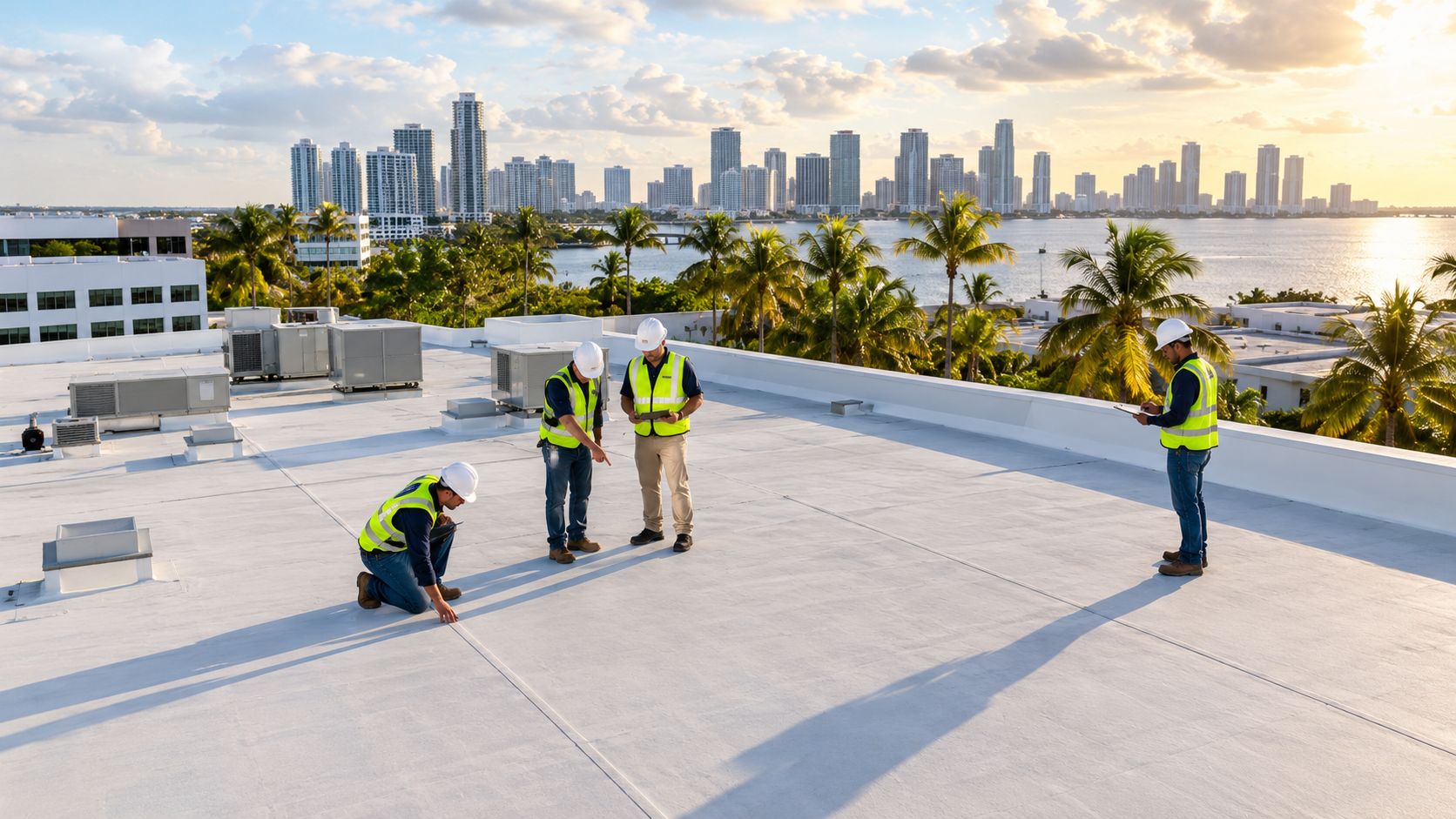
A South Florida roof doesn't get a mild operating environment. In Broward, Miami-Dade, and Palm Beach counties, intense ultraviolet exposure, torrential summer rain, salt-laden air in coastal areas, and hurricane-force winds place repeated stress on membranes, coatings, flashings, edge metal, and rooftop equipment connections.
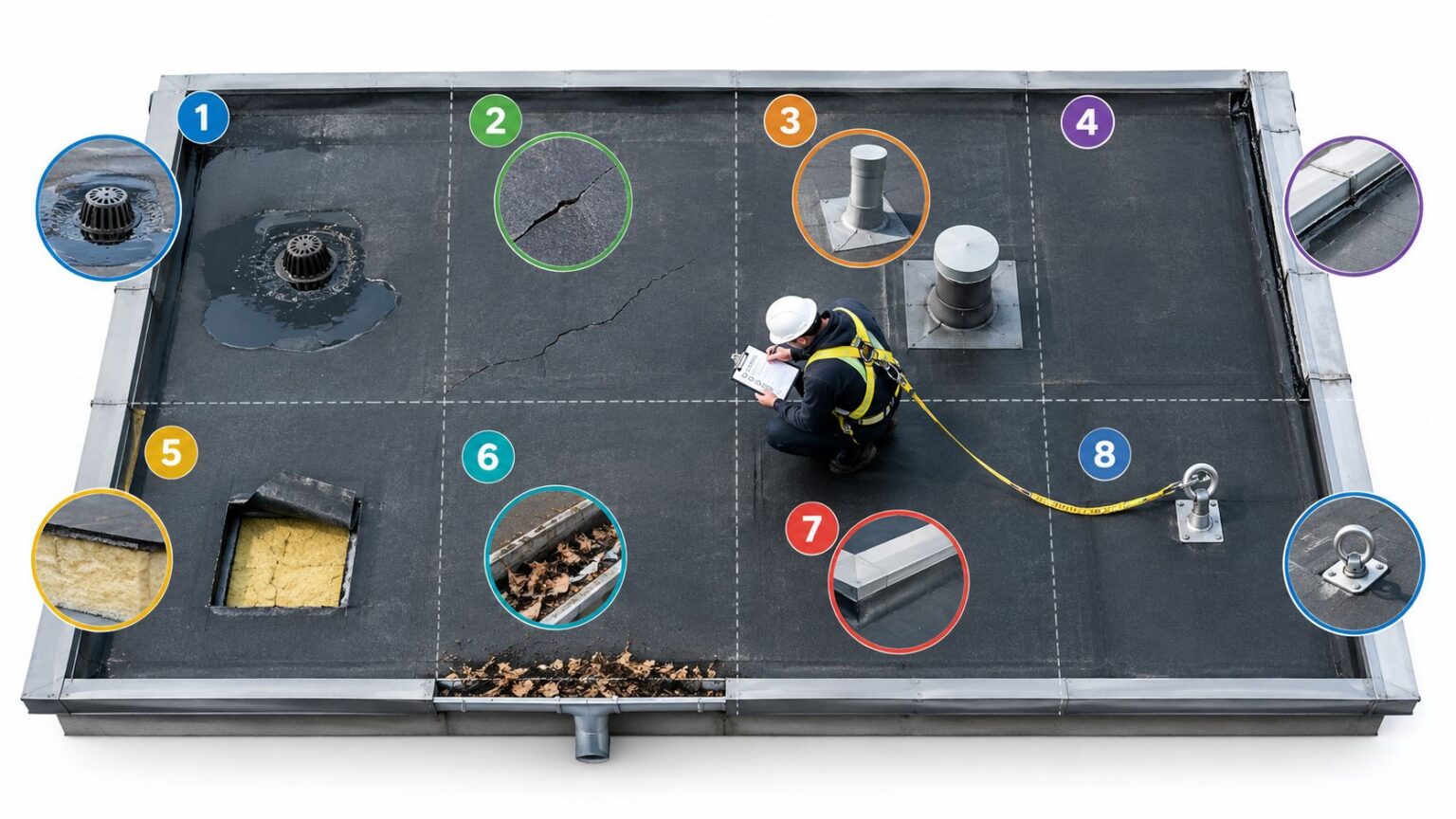
That regional exposure changes what a competent inspection should emphasize. The contractor needs to examine drainage paths, low areas, seams, wall transitions, parapet caps, perimeter details, penetrations, and signs of wind-driven rain intrusion. A roof can look acceptable from a distance while failing at a curb, scupper, pipe boot, or repaired seam.
Inspect for the weather you actually receive
Heavy rain exposes drainage weaknesses quickly. Inspectors should look for debris at drains and scuppers, evidence of standing water, displaced components, and staining that indicates repeated water movement. Wind events put special attention on perimeter attachment, flashing, coping, seams, and rooftop equipment supports.
The local question isn't just whether the membrane has a hole. It's whether the roof assembly can continue managing water and wind at its vulnerable details. A report that ignores those areas may be inexpensive, but it gives the facility manager an incomplete basis for repairs.
South Florida owners shouldn't buy a generic checklist and assume it covers local risk. The inspection should reflect the building's exposure, roof design, service history, and access conditions.
Scheduling also matters. Regular inspections allow the owner to identify drainage and flashing problems before the next period of severe weather. An inspection after a major storm, roof-mounted equipment project, or reported leak can be more targeted than a routine review, but it should still document the surrounding roof area rather than only the spot where water appeared.
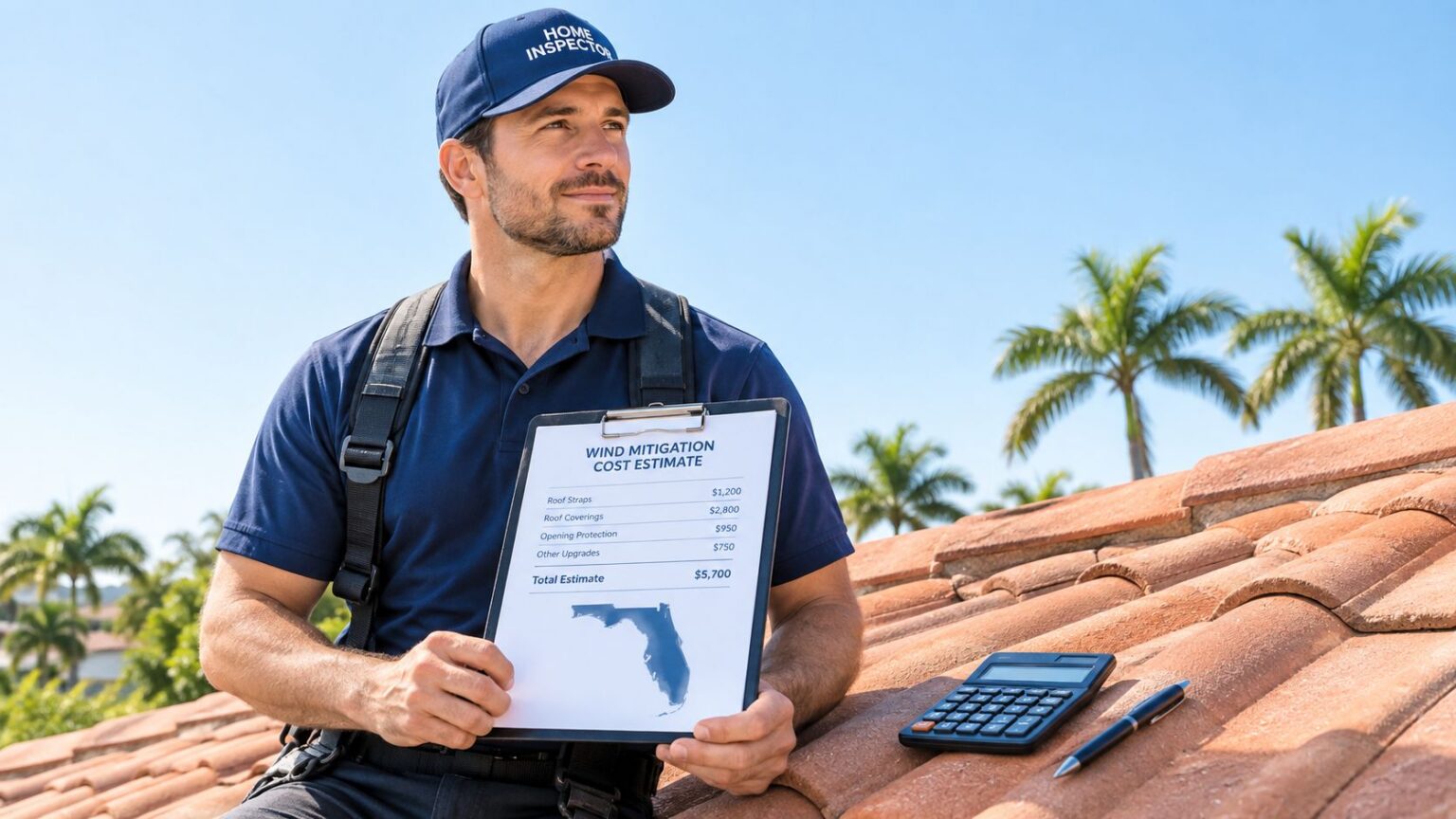
Facility teams can also review this wind mitigation inspection cost resource when they need to understand how wind-related documentation differs from ordinary roof condition reporting. The two tasks may overlap, but they don't answer identical questions.
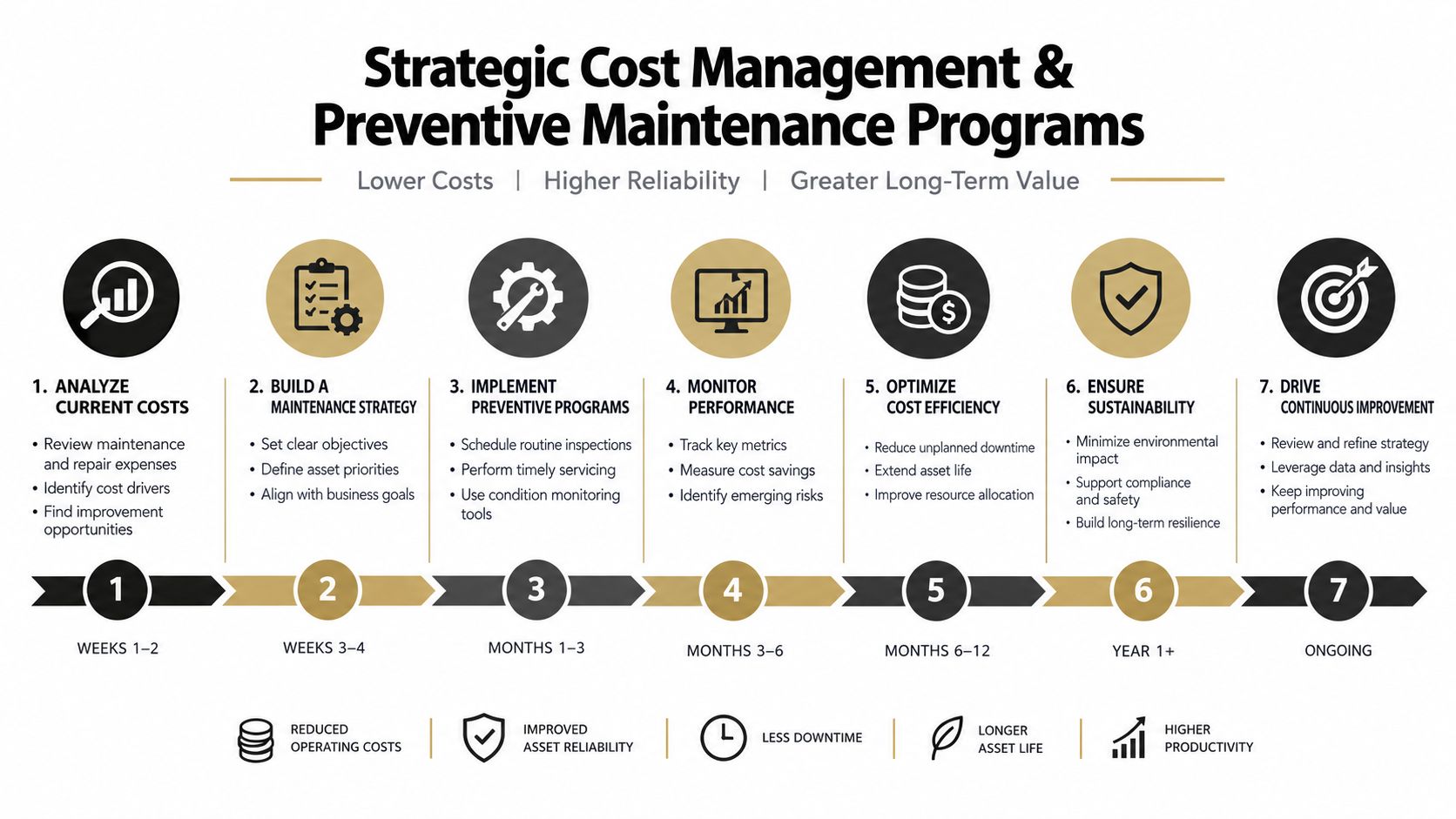
Strategic Cost Management and Preventive Maintenance Programs
Reactive roof spending puts the facility manager at the mercy of weather, tenant complaints, and contractor availability. Preventive maintenance creates a record of condition, lets the owner prioritize small repairs, and reduces the chance that every roof problem becomes an urgent interior-water event.
For a 20,000-square-foot building, a biannual maintenance program can total about $600 to $1,600 per year in inspection costs, according to this commercial roof maintenance inspection analysis. That structure offers a predictable alternative to commissioning a thorough assessment only after damage has spread.
Build a usable roof record
A maintenance program works only when the reports lead to decisions. Require photographs tied to roof locations, a list of observed deficiencies, recommended action, and a clear distinction between immediate repair, planned repair, and monitoring.
Bundle related work when the roof is already accessible. A contractor may be able to review drains, rooftop penetrations, flashing, sealants, and equipment curbs during the same scheduled visit. Ask for separate prices for repairs and testing so the maintenance report doesn't become a vague sales document.
Use the report to manage the capital plan. A recurring seam issue may warrant planned repair. Wet insulation may require targeted investigation. A failing perimeter detail may deserve priority because wind and rain can exploit it quickly. The point is not to repair everything at once. The point is to rank work according to evidence and operational risk.
Budgeting principle: Pay for information before you pay for disruption. A documented condition report gives you leverage when planning repairs, replacements, and tenant coordination.
The same preventive mindset applies to other building systems. Guidance on preventive commercial HVAC maintenance offers a useful parallel, scheduled service helps facility teams address known wear before an avoidable failure interrupts operations. For roofing, the equivalent is a consistent inspection history rather than a series of disconnected emergency calls.
When reports repeatedly show widespread deterioration, compare repair planning with replacement options instead of extending the same failing details indefinitely. This roof replacement options reference can support that conversation without treating every defect as an automatic replacement recommendation.
Choosing the Right Inspection Tier for Your Property Lifecycle
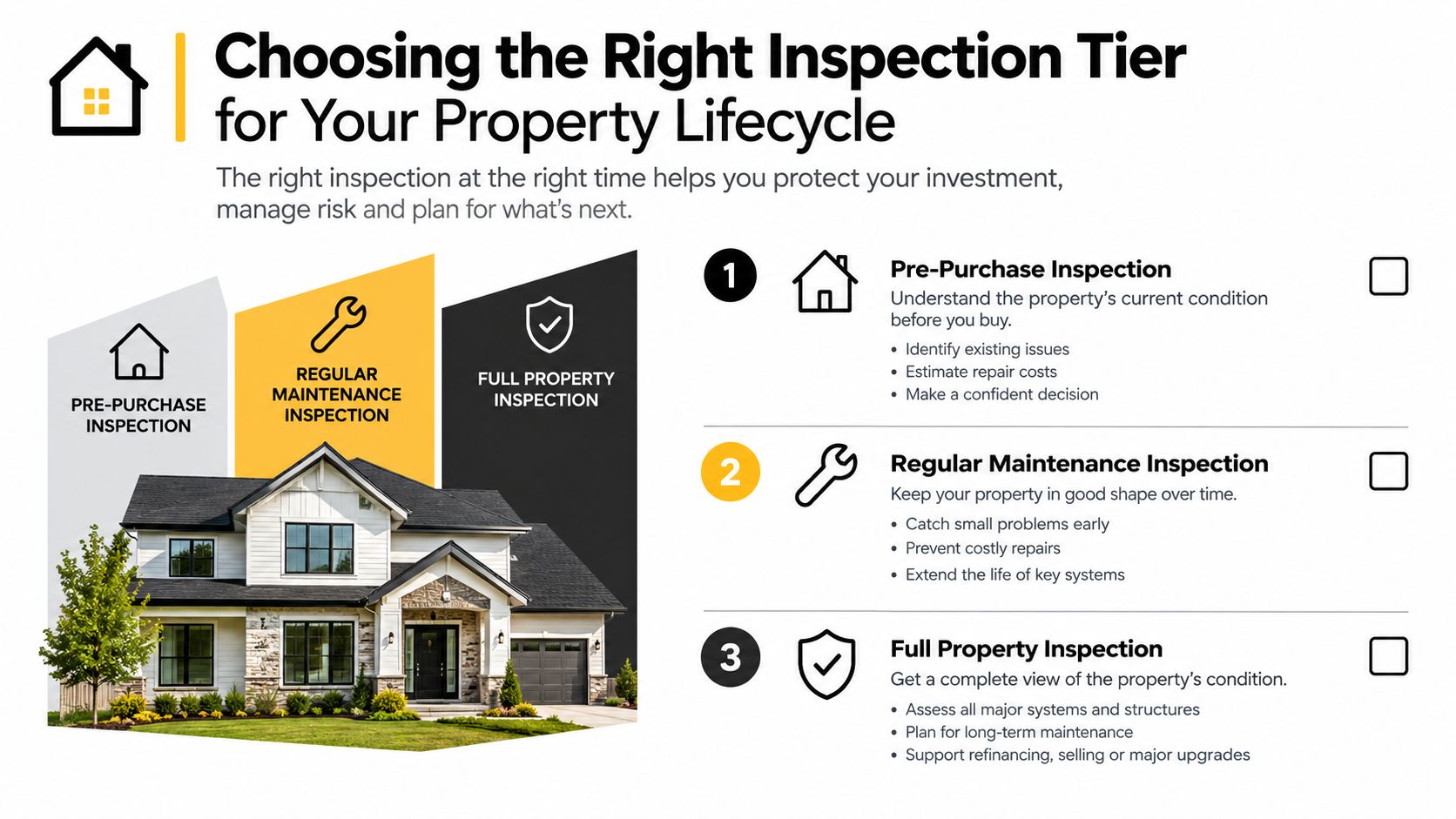
The right tier depends on the decision in front of you. A facility manager preparing a routine maintenance plan needs a different deliverable from a buyer evaluating an unfamiliar building or an owner investigating recurring leaks.
Use the decision, not the label
For routine ownership, choose a visual inspection with photographs, drainage review, detail inspection, and repair priorities. The goal is to maintain a reliable condition record and catch visible deterioration before it affects operations.
For pre-purchase due diligence, request a more detailed assessment. The inspector should review available roof records, investigate prior repairs, document deficiencies, and identify whether additional moisture testing is justified. A buyer needs enough detail to price risk, negotiate repairs, and plan near-term capital work.
For recurring leaks or suspected hidden moisture, skip the assumption that a walkover will settle the issue. Ask whether infrared scanning, targeted core sampling, or another diagnostic method is appropriate. The report should explain what was tested, what the findings mean, and what remains uncertain.
For storm preparation or post-storm review, focus on perimeter details, flashing, seams, drainage, rooftop equipment attachments, and visible displacement or punctures. Make sure the inspection includes safe access and interior coordination where water has entered.
Request an itemized proposal that names the roof areas, access requirements, testing methods, report format, exclusions, and repair recommendations. Licensed and insured professionals with local commercial experience should be able to explain why the proposed tier fits the building instead of just quoting the highest available service.
Paletz Roofing and Inspections provides commercial roof inspections, written estimates, repairs, replacements, and maintenance support across Broward, Miami-Dade, and Palm Beach counties. To match the inspection scope to your building's condition and lifecycle decision, visit Paletz Roofing and Inspections and request a customized evaluation.