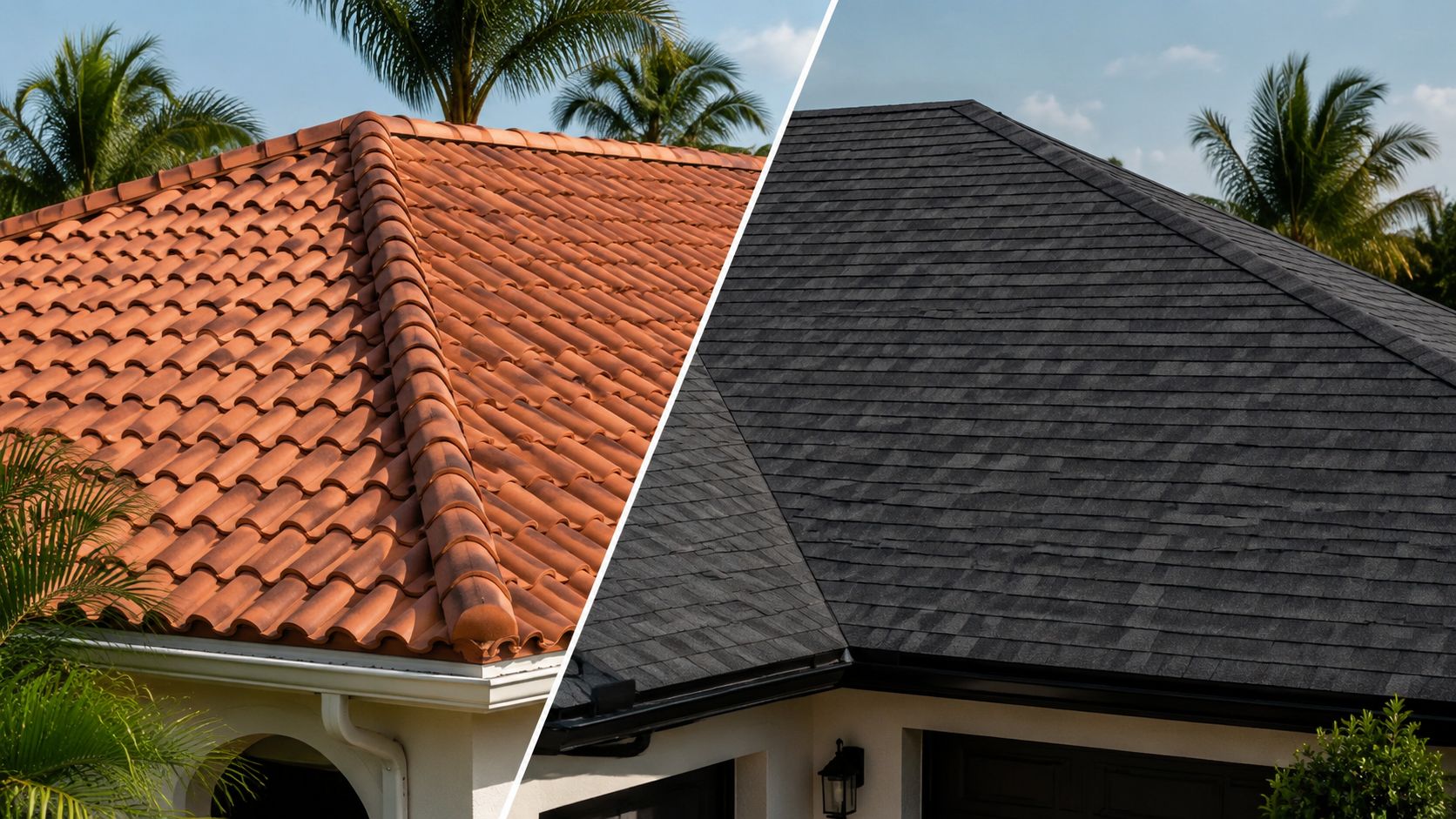
For most South Florida homeowners, the tile roof vs shingle roof decision isn't really about looks first. It's about whether you want to pay less now or replace sooner, or pay much more now and potentially stretch that roof cycle far longer. On a 1,500-square-foot roof, asphalt shingles are estimated at $4,720 to $16,250, while tile runs $21,708 to $74,016, according to This Old House's tile vs shingle cost and lifespan comparison. The same source says a well-maintained tile roof typically lasts 25 to 100 years, while asphalt shingles generally last 15 to 30 years.
That's the headline. In South Florida, it's not the whole story.
After three decades around roofs in Broward, Miami-Dade, and Palm Beach counties, the mistakes I see are usually the same. Homeowners focus on the material on top and miss the system underneath. They compare quotes without asking about structure, fastening, flashing, underlayment, ventilation, and what happens after years of sun, salt air, heavy rain, and hurricane exposure. Generic roofing articles don't help much because they don't deal with the specific conditions of this market.
A South Florida roof has to handle heat, moisture, and storm pressure at the same time. That's why the right answer depends less on trends and more on your house, your budget horizon, and your tolerance for future repair cycles.
Table of Contents
- Choosing Your Roof The Central South Florida Dilemma
- Tile and Shingle Roofing At a Glance
- Hurricane Durability and Moisture Performance
- Complete Cost Analysis From Installation to Replacement
- Roof Structure and Pitch Considerations
- Aesthetic Energy and Insurance Impacts
- Maintenance Repair Needs and The Underlayment Factor
- Your Decision Checklist and Getting an Expert Opinion
Choosing Your Roof The Central South Florida Dilemma
The central dilemma is simple. Shingles usually win the upfront budget conversation. Tile usually wins the longevity conversation. But South Florida adds pressure to both sides of that decision because roofs here don't age gently.
A homeowner in this region isn't just buying a roof for shade and rain protection. You're buying a system that has to live through long UV exposure, high attic heat, wind-driven rain, tropical weather, and insurance scrutiny. That changes how you should think about value. A roof that looks affordable on day one can become expensive if it needs earlier replacement, repeated repairs, or creates problems after storms. A roof that looks expensive at the contract stage can also become the wrong choice if the structure underneath isn't built for it.
Here's the cleanest way to frame the tile roof vs shingle roof question for South Florida:
- Choose shingles if you need a lower entry cost, faster replacement, and broader structural compatibility.
- Choose tile if you're prepared for a much bigger capital expense and you want a longer-term roofing cycle.
- Pause the whole decision if nobody has clearly addressed structure, fastening, underlayment, and flashing.
Practical rule: In South Florida, the right roof material on the wrong assembly still fails.
That's why broad national advice falls short here. A roof in Arizona, Ohio, or Georgia doesn't live under the same combination of coastal humidity, hurricane exposure, and insurance pressure. South Florida homeowners need a decision based on what occurs on local roofs after years in the field, not just what looks good in a brochure.
Tile and Shingle Roofing At a Glance
If you want the fast answer, use this table first. It won't replace an inspection, but it gives you the practical shape of the decision.
| Attribute | Tile Roof (Concrete/Clay) | Shingle Roof (Asphalt) |
|---|---|---|
| Upfront cost | Much higher initial cost | Lower initial cost |
| Expected service life | Longer overall potential life | Shorter replacement cycle |
| Weight | Heavy and may require structural review | Lighter and easier to install on many homes |
| Wind performance | Strong when correctly installed and mechanically secured | More vulnerable to blow-off and edge damage |
| Appearance | Distinctive, often preferred on Mediterranean and Spanish-style homes | Flexible look that fits many home styles |
| Heat behavior | Better reflectivity and thermal behavior in hot climates | Tends to absorb more heat, especially darker products |
| Repair profile | Individual pieces can crack and require matching replacement | Spot repairs are often simpler, but aging can spread across a slope |
| Hidden risk | Underlayment condition can control real lifespan | Surface wear is easier to see from the exterior |

What homeowners usually notice first
Most homeowners notice two things right away. Tile looks heavier, more custom, and more expensive. Shingles look familiar, easier to budget, and easier to replace.
That first impression isn't wrong. It's just incomplete.
In practice, the better question is whether the roof system matches the house and the owner's timeline. If you expect to hold the property for many years and you're prepared for a more involved installation, tile often makes more sense. If you need to control initial spending or you're replacing a roof quickly after damage or age-out, shingles often fit better.
For a visual reference on how different roofing systems affect a home's overall profile, this roofing style image from Paletz Roofing is useful because shape and roofline matter almost as much as color when you're choosing between these materials.
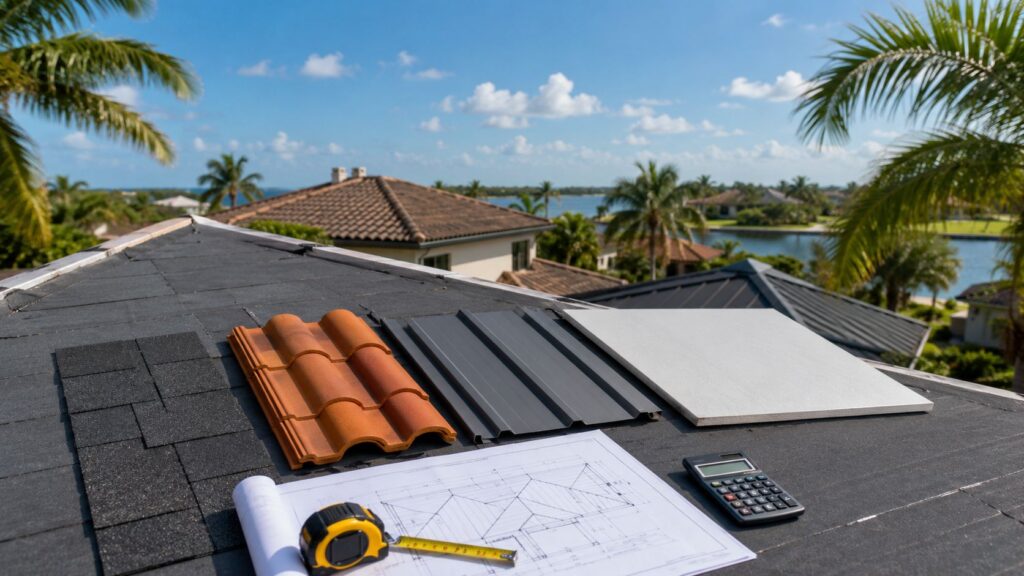
The short version
- Tile fits owners thinking long-term
- Shingles fit owners managing near-term cost
- Neither choice works well if the roof assembly details are weak
That last point matters more in South Florida than many people realize.
Hurricane Durability and Moisture Performance
South Florida storms expose weaknesses fast. The roof doesn't get tested only by wind speed. It gets tested by uplift, fastener performance, flashing quality, water shedding, and what happens when rain gets pushed sideways under pressure.

How tile and shingles usually fail in storms
Well-installed concrete or clay tile systems can last 50 to 75 years or more, with some high-quality installations exceeding 75 years in warm climates like South Florida, and they're commonly rated for 110 to 150 mph wind resistance when properly nailed and clipped, according to Eagle Roofing's comparison of tile and shingle roof performance. That same source notes asphalt shingles are more susceptible to granular loss, edge curling, and blow-off, especially in hurricane-prone regions.
That distinction matches what roofers see in the field. Shingles tend to show progressive storm wear. You may lose tabs, see creased areas, or find sections where the seal line has let go. Tile behaves differently. The field of the roof may stay intact very well, but individual tiles can crack, shift, or let water track through vulnerable spots if the installation details weren't handled correctly.
This is why I tell homeowners not to reduce hurricane performance to one sentence like “tile is stronger” or “shingles are safer.” Storm performance depends on the failure point.
- Shingles often fail at edges and seal lines
- Tile often fails at broken pieces, attachment points, and accessories
- Both systems fail early when flashing and underlayment details are weak
A roof usually leaks at the transition, not the middle of a clean field.
Moisture control is about the whole assembly
South Florida rain finds openings other climates never test. Valleys, wall intersections, penetrations, ridge details, and skylight transitions matter as much as the field material itself. Homeowners who focus only on the tile or the shingle miss where leaks often begin.
That's also why flashing workmanship matters so much. If you want a good technical reference on how roof-to-penetration waterproofing should be approached on tiled systems, Vivid Skylights' roof flashing expertise is a useful example of the kind of detail work that separates a durable assembly from one that develops chronic leak points.
What works in real South Florida conditions
For homeowners who prioritize storm resilience, tile has a real advantage when it's designed and installed correctly. Its mechanical attachment, mass, and long-term durability give it a stronger profile in hurricane country. But “correctly” is doing a lot of work in that sentence. Poor fastening, mismatched repairs, broken tiles left in place, and neglected flashings can undo the advantage.
Shingles still have a place, especially when budget, speed, and structural simplicity matter. A properly installed shingle roof can perform well, but it usually asks more from the owner over time in this climate because the material is more prone to visible weathering and storm wear.
If you want peace of mind when a storm is offshore, don't just ask what material is on the roof. Ask how the system is attached, where water would enter first, and who inspected the flashings last.
Complete Cost Analysis From Installation to Replacement
A roof that looks cheaper on signing day can cost more over the years. In South Florida, that happens all the time.
Tile and shingles follow two different cost paths. Shingles usually win on upfront price, faster installation, and easier replacement. Tile asks for a much bigger check at the start, but the system can stay in service much longer if the underlayment, flashings, and repairs are handled properly.

The cost mistake homeowners make
The common mistake is comparing one proposal to another as if the contract total is the whole story. It isn't, especially in Miami-Dade, Broward, and Palm Beach, where sun, salt air, heavy rain, and named storms punish roofing systems year after year.
As noted earlier, shingles on a 1,500-square-foot roof typically cost far less to install than tile, and tile can run several times higher upfront. The trade-off is service life. Shingles usually move to replacement sooner. Tile often stays in place longer, but that does not mean the roof goes untouched for decades. In South Florida, the waterproofing layer under the tile often becomes the actual replacement driver before the tile itself is finished.
That is the line item generic articles miss.
What ownership cost actually includes
A real cost comparison has to cover more than material and labor on day one. It should cover how the roof behaves over the time you expect to own the house.
How long you plan to keep the property
A shorter ownership window often favors shingles because the lower entry cost is easier to justify. A long hold can favor tile, especially on higher-value homes where owners want fewer full roof replacements.
Whether tile triggers added construction costs
A tile conversion can involve more than roofing. Engineering review, framing upgrades, and deck corrections can push the true price well above the initial tile quote.
How the system will be repaired after storms
Shingle repairs are usually simpler and easier to price. Tile repairs can be straightforward too, but matching profile and color gets harder on some older roofs, and cracked or slipped tiles after a storm are not always a one-visit fix.
Insurance and code-related costs
In South Florida, roof age affects renewals, inspections, and what carriers are willing to write. A cheaper roof that ages out of insurability sooner can create a very expensive problem at renewal time.
The cost of the next tear-off
Every reroof brings dumpster fees, permit costs, staging, disruption, and weather risk. If you plan to stay in the home for a long time, the number of times you have to go through that process matters.
Ownership lens: The right question is not which roof is cheaper today. The right question is which roof will cost less to own, insure, repair, and replace over the years you expect to keep the house.
The underlayment issue changes the math
On shingle roofs, the visible roof covering and the waterproofing layer usually age on a similar track.
On tile roofs, they often do not.
That means a tile roof can reach the point where the underlayment needs replacement while many of the tiles are still usable. Homeowners hear “tile lasts 50 years” and assume the whole assembly lasts that long without major expense. In the field, that is not how many South Florida roofs age. The tile may survive. The system underneath is what drives the next major bill.
That future work is not cheap because the contractor has to remove tile, protect reusable pieces, replace the waterproofing components, and reinstall the system correctly. If you do not budget for that possibility, tile ownership can feel a lot more expensive than the original sales pitch suggested.
Which roof makes more financial sense
Here is the plain-language version.
| Homeowner situation | Usually the better fit |
|---|---|
| Need to keep upfront spending lower | Shingle roof |
| Expect to sell in the near or medium term | Often shingle roof |
| Plan to keep the home for many years | Often tile roof |
| Own a higher-end home where appearance and lifespan matter more | Often tile roof |
| Want the simplest replacement and repair path | Shingle roof |
| Need to watch future underlayment costs closely | Shingle roof, or tile with eyes open |
Hidden costs that show up later
The expensive surprises usually come from scope, not from the shingle bundle or the tile profile itself.
- Structural review and possible reinforcement before a tile retrofit
- Underlayment replacement on tile systems well before all tiles are worn out
- Accessory work at hips, ridges, valleys, penetrations, and wall tie-ins
- Tile matching problems on older roofs after repairs
- Higher labor intensity for careful tile removal and reset during future work
- Insurance friction if roof age or condition becomes an underwriting issue
For South Florida homeowners, the strongest budget decision is usually the one that matches the house, the ownership timeline, and your tolerance for future disruption. Shingles are often the practical choice for lower upfront cost and simpler service. Tile can make financial sense, but only if you account for the bigger first investment and the very real chance that underlayment work becomes the major cost before the tile itself is done.
Roof Structure and Pitch Considerations
A house might be a good candidate for shingles and a bad candidate for tile before anyone even talks about color or style. That's because tile changes the load on the structure in a serious way.
Roof tiles typically weigh 900 to 1,200 pounds per square of roofing area, while asphalt shingle systems run around 250 to 450 pounds per square, according to Hollister Roofing's structural comparison of shingle and tile roofs. The same source notes that tile can be roughly 2 to 4 times the weight of asphalt systems, which is why retrofits often require engineered reinforcement and structural review.
Why the framing matters before the roofing does
Many homeowners are surprised when they receive a tile quote, compare it to a shingle quote, and assume the difference is only material and labor. Sometimes it isn't. Sometimes the house itself needs work before tile is even a responsible option.
On retrofits, the right sequence is usually:
- Inspect the existing framing
- Evaluate decking and support conditions
- Determine whether engineering review is needed
- Confirm the roof can carry the added dead load safely
If that process gets skipped, the roof choice is being made backward.
Pitch changes the practical fit
Pitch matters too, though the issue isn't just style. It affects water shedding, installation detail, service access, and how forgiving the system will be over time. Some roofs are easy to work on and inspect. Others are steeper or more cut up, with valleys, hips, and transitions that increase installation complexity.
Tile often works best when the roof design, slope, and framing all support it from the start. Shingles are more adaptable across a wider range of existing homes. That doesn't automatically make shingles better. It makes them easier to fit onto houses that weren't designed around a heavier premium system.
Questions to ask before choosing tile
If you're seriously considering tile, ask these before you sign anything:
- Was this house originally built for tile or for a lighter roof system
- Has anyone evaluated the framing for added load
- Will the quote include any engineered reinforcement if required
- How will the installer handle cut-up areas, ridges, valleys, and penetrations
- What roof access issues will affect future maintenance
A homeowner doesn't need to become an engineer. But you do need to know whether the roof you want is compatible with the house you own.
Aesthetic Energy and Insurance Impacts
Roofing choices affect more than weather performance. In South Florida, they change curb appeal, attic heat, and sometimes how smoothly the house moves through insurance conversations.
Curb appeal is not a small issue here
Tile has a visual authority that shingles usually don't. On Mediterranean, Spanish, Mission, and many custom South Florida homes, tile often looks like the roof the architecture was built to carry. Put shingles on the wrong house and the roof can look like a downgrade even if the installation is clean.
Shingles have their own advantage. They're visually flexible and fit a wider range of homes without calling attention to themselves. On many ranch homes, transitional homes, and straightforward suburban layouts, a well-chosen shingle color can look exactly right.
For homeowners comparing appearance, this South Florida roofing visual from Paletz Roofing helps show how roof material changes the entire character of the home, not just the top surface.
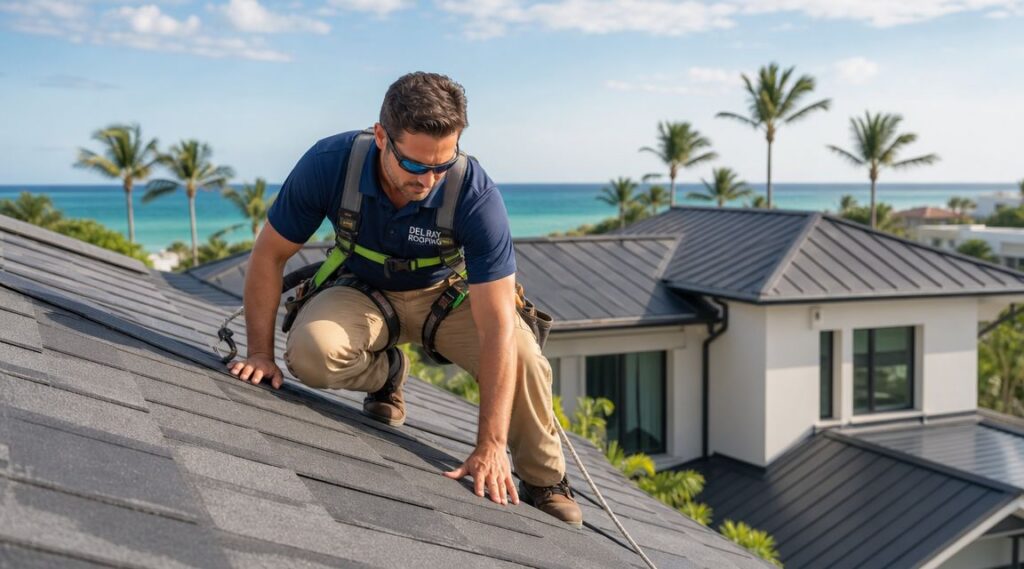
Heat performance matters in South Florida
The roof is the first thing the sun hits all day. That matters when cooling systems are already working hard for much of the year.
The U.S. Department of Energy notes that a reflective roof can stay more than 50°F cooler than a conventional roof, and roof-comparison research reports that tile roofs, especially in lighter colors, can reflect 40 to 70% of solar radiation versus 5 to 15% for standard asphalt shingles. That same research says tile can reduce summer cooling costs by about 10 to 15% in some cases. Those figures come from this roof reflectivity and cooling analysis.
In practical terms, lighter tile often gives South Florida homeowners a real heat-management advantage. That doesn't mean every tile roof saves the same amount, and it doesn't mean every shingle roof performs poorly. Color, attic conditions, ventilation, insulation, and overall roof design still matter. But when the goal is reducing heat load, tile starts with a stronger profile.
Lighter, reflective roofing matters most when the house spends month after month fighting solar gain.
Insurance is less about material alone than people think
Homeowners often ask whether tile always lowers insurance or whether shingles always create a problem. That's too simplistic. Insurers usually care about roof age, condition, compliance, visible vulnerability, and whether the system appears dependable in a storm-prone market.
A newer roof with solid details and no obvious red flags generally puts you in a better position than an aging roof with deferred maintenance, regardless of material. But in South Florida, durable materials, proper attachment, and clear inspection records can make a real difference in how the roof is perceived during underwriting or renewal review.
If insurance is one of your main concerns, don't ask only what material is on the roof. Ask what documentation exists, how old the system is, what shape the visible components are in, and whether the roof presents obvious storm or leak risk.
Maintenance Repair Needs and The Underlayment Factor
This is the part most generic articles miss. A tile roof can look strong for years and still be close to trouble. The reason is simple. The tile you see is not the whole waterproofing system.
The underlayment often decides the real lifespan
A key factor in tile roof longevity is the underlayment beneath the tile. Builder-grade tile underlayment may start failing around 15 years, while upgraded systems can last 20 to 50 years, according to this industry explanation of tile roof underlayment lifespan. That means a tile roof can appear sound long after its waterproofing layer is compromised.
This catches homeowners off guard all the time. They look up, see a roof that still appears solid, and assume everything underneath is fine. Sometimes it is. Sometimes it isn't. In South Florida heat and UV exposure, hidden aging under the tile can become the issue.
What maintenance actually looks like
Tile and shingles age differently, so maintenance doesn't look the same.
With shingles, the warning signs are often easier to spot from the exterior. You may see missing pieces, curl, granule loss, or storm damage. With tile, the field can still look respectable while the underlying vulnerability sits below the visible surface.
For homeowners who want to understand what tile components and condition issues can look like in the field, this tile roofing reference image from Paletz Roofing helps illustrate the type of system you're maintaining.
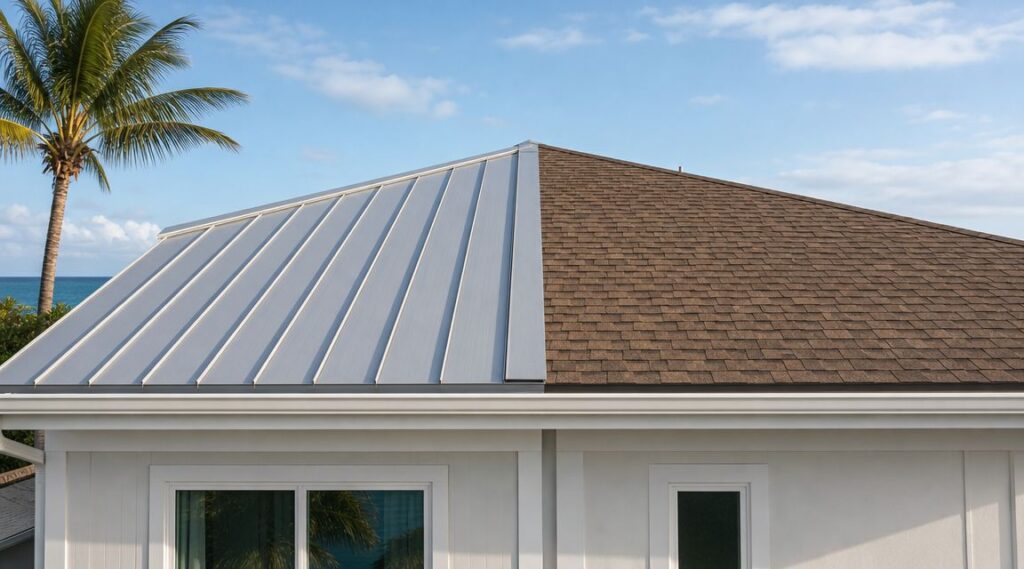
What does and doesn't work
What works:
- Regular inspections after major storms and as the roof ages
- Replacing cracked or displaced tiles promptly so water doesn't reach vulnerable areas
- Watching flashing and transitions closely because leak paths often begin there
- Planning for underlayment reality instead of assuming the visible tile tells the whole story
What doesn't work:
- Assuming tile is maintenance-free
- Walking carelessly on tile roofs, which can create damage
- Waiting for interior stains before investigating
- Treating underlayment replacement as an afterthought
Field advice: On a tile roof, what you can't see often matters more than what you can.
Shingle roofs have their own maintenance burden, but it's more intuitive. The roof surface itself usually tells you more about its current condition. Tile requires a different mindset. You're not just preserving the visible material. You're protecting the hidden waterproofing layer that makes the system functional.
Your Decision Checklist and Getting an Expert Opinion
In South Florida, a roof decision can affect storm repairs, insurance conversations, and resale far more than homeowners expect.

Use this checklist before you choose
- How long will you keep the home? If this is a shorter ownership window, shingles often fit the math better. If you plan to stay for many years, tile may justify the higher upfront cost.
- What is the complete budget, not just the install budget? Ask for the full picture, including tear-off, underlayment, flashing work, ventilation changes, disposal, and future repair cost.
- Can the structure carry tile without expensive upgrades? Older homes in Broward, Miami-Dade, and Palm Beach County do not always have the framing for it.
- How exposed is the house to wind and wind-driven rain? Open lots, coastal areas, and neighborhoods with less protection raise the stakes.
- What will your insurer focus on? Ask how age, roof type, attachment method, and inspection condition may affect renewals or premiums.
- How much maintenance are you willing to stay on top of? Tile can last a long time, but broken pieces, slipped tiles, and aging underlayment still need attention.
- Does the roof shape work well with the material? Valleys, dead zones, low-slope sections, and complex transitions can change the best choice fast.
- What look fits the house and the neighborhood? Curb appeal matters, especially if resale is part of the plan.
The practical answer for most homeowners
For a lot of South Florida homes, shingles are the cleaner answer when the goal is lower upfront cost, lighter weight, and a simpler reroof process. They are easier to price, easier to repair in many cases, and easier for homeowners to understand at a glance.
Tile makes sense for owners who want the architectural look, expect to stay put, and are ready for the true cost of a tile system. That means not just the tile itself, but the underlayment, specialized repairs, and the labor that comes with a heavier, more detailed roof assembly.
Before you sign a contract, get answers to four questions. Can the structure support the material? Is the estimate spelling out underlayment and flashing clearly? How will this roof choice affect insurance inspections? What is the likely cost point when this system needs major work again?
That is where an expert opinion matters. A good roof inspection should look at the decking, roof geometry, drainage design, attachment details, weak transitions, and signs that past repairs were only cosmetic.
Paletz Roofing and Inspections is one local company homeowners may call for that kind of property-specific evaluation across South Florida. The main point is simple. Do not choose between tile and shingles from a brochure or a price per square alone.
A good decision still needs to make sense after the next hurricane season, not just on install day.