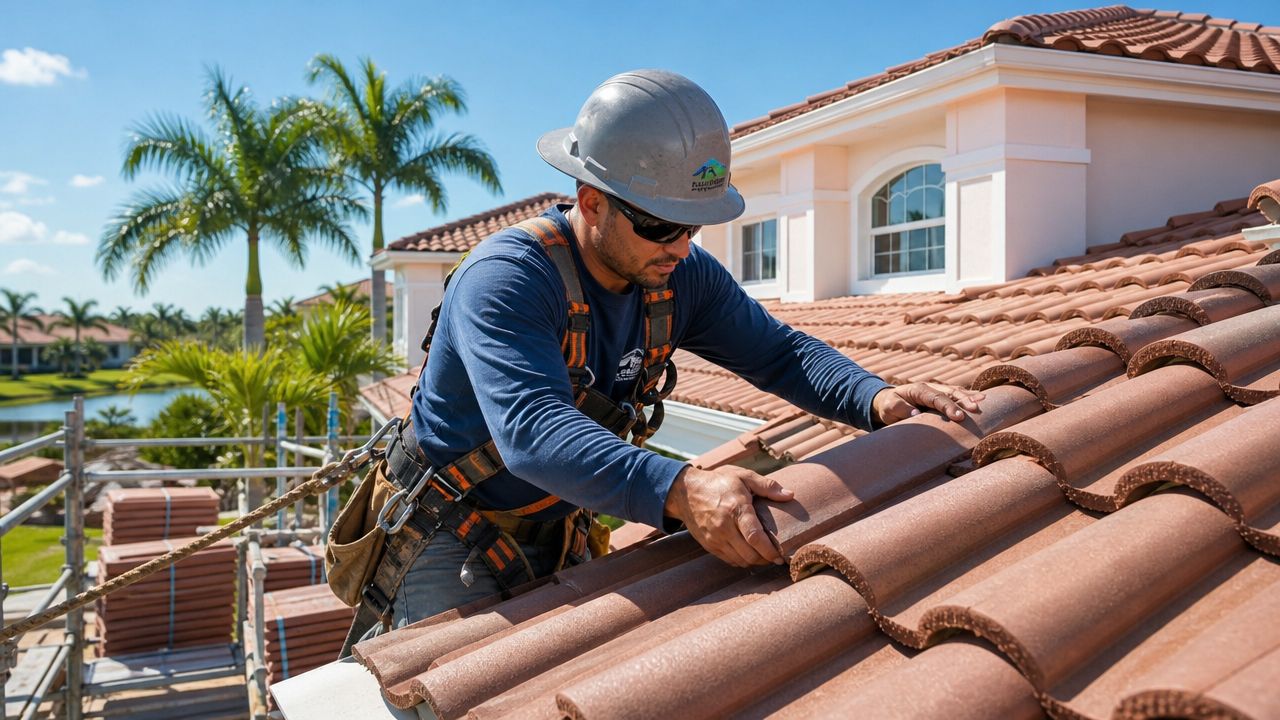
If you're staring at a stained ceiling, a few shifted tiles, or shingles that never really settled back after the last storm, you're probably past the point of asking whether the roof needs attention. In Cooper City, that question often turns into a bigger one fast, because a roof replacement here isn't just about looks. It's about wind-uplift resistance, code compliance, and whether the home is ready for the next hurricane season.
That's why a roof replacement Cooper City project needs to be handled like an engineered upgrade, not a cosmetic refresh. A good reroof should close the weak points at the perimeter, protect the deck, and leave you with documentation that can stand up later when an insurer or buyer asks what was installed and how it was permitted. The work on the roof matters. The paperwork after the work matters too.
Table of Contents
- Why Cooper City Roofs Often Need Full Replacement
- What a Roof Replacement Costs in 2026
- The Replacement Timeline From Inspection to Final Walkthrough
- Choosing the Right Roofing Material for South Florida
- Permits, Florida Building Code, and Insurance Realities
- How to Choose the Right Roofing Contractor in Cooper City
- After the Installation Documentation That Protects Your Investment
- Your Roof Replacement Action Plan and Final Thoughts
Why Cooper City Roofs Often Need Full Replacement
A Cooper City homeowner usually does not start out planning a full reroof. It begins with something minor, a ceiling stain after a hard rain, a tile that shifted at one corner, or a shingle tab that curled just enough to stand out from the driveway. Then the inspection reveals a wider problem, because South Florida heat, humidity, storm cycles, and salt exposure wear roofing systems in ways that milder climates do not. As a realistic Florida timeline notes, asphalt shingles often reach their practical limit sooner in this climate, and tile roofs can hide underlayment failure even when the visible surface still looks acceptable. Florida roof lifespan timeline
Repair helps only when the failure is isolated
A repair makes sense when the damage is limited, such as one leak path, a flashing problem, or a small section lifted by wind. Full replacement makes more sense when the roof shows age-related wear, repeated leak history, or damage patterns across multiple slopes. On older Cooper City homes, especially those built in the 1980s and 1990s, the issue is usually cumulative stress, not one dramatic event.
Practical rule: if the roof keeps finding new ways to fail, the problem is usually the whole system, not one broken piece.
That is why replacement gets treated as a system decision. The visible surface is only part of the roof. Underlayment, fasteners, edge metal, flashings, and penetrations all have to work together, especially after the first serious wind event. A roof that still sheds water today can still be a poor candidate for another short-term patch if the materials underneath are near the end of service.
Storm cycles make that choice harder to avoid. Each wind event, rain surge, and hot season puts more strain on the same weak points, so a roof can look acceptable from the street while the layers underneath keep losing ground. In that situation, the cost of repeated patches often buys time, but it does not reset the system.
If you are deciding between repair and replacement, look at recurrence, age, and storm exposure together. One repair can buy time. Repeated repairs usually only delay a larger failure.
What a Roof Replacement Costs in 2026
A Cooper City homeowner planning a full asphalt-shingle roof replacement on a 2,000-square-foot home is usually looking at about $8,500 to $18,000, with a midpoint near $12,500. Permit costs can add roughly $120 to $300 (Cooper City roof cost range). That local range lines up with a broader 2026 industry average roof replacement cost of $9,530, with typical projects ranging from $5,870 to $46,000 depending on size, material, and roof complexity.
Installed cost ranges by roofing material
| Material | Low End | High End |
|---|---|---|
| Asphalt shingles | $5,800 | $20,000 |
| Tile | $8,500 | $26,400 |
| Metal | $5,700 | $25,000 |
Those material ranges matter because the final quote is never just “roofing.” It usually includes tear-off, underlayment, disposal, flashing work, and code-related upgrades, and every one of those pieces changes the number on the proposal. On a Cooper City reroof, the roof is being treated as a storm-resilience system, not only a surface layer, so the scope has to cover the parts that keep water and wind from getting under the new covering.
The spread comes from roof shape, access, slope, and deck condition. A simple single-story roof is easier to price than one with hips, valleys, skylights, or hidden rotten sheathing. The quote can also shift if a contractor has to upgrade components for code compliance or replace damaged wood after tear-off.
A good estimate should separate labor, materials, tear-off, disposal, flashing, and permit handling. If a bid is only one lump sum, it is harder to tell whether it is lean because the contractor is efficient or because key scope items are missing. Homeowners should also ask what documents come with the job, because insurers often want permit sign-off, final inspection records, warranty paperwork, and proof that the roof was installed to the approved scope.
The Replacement Timeline From Inspection to Final Walkthrough
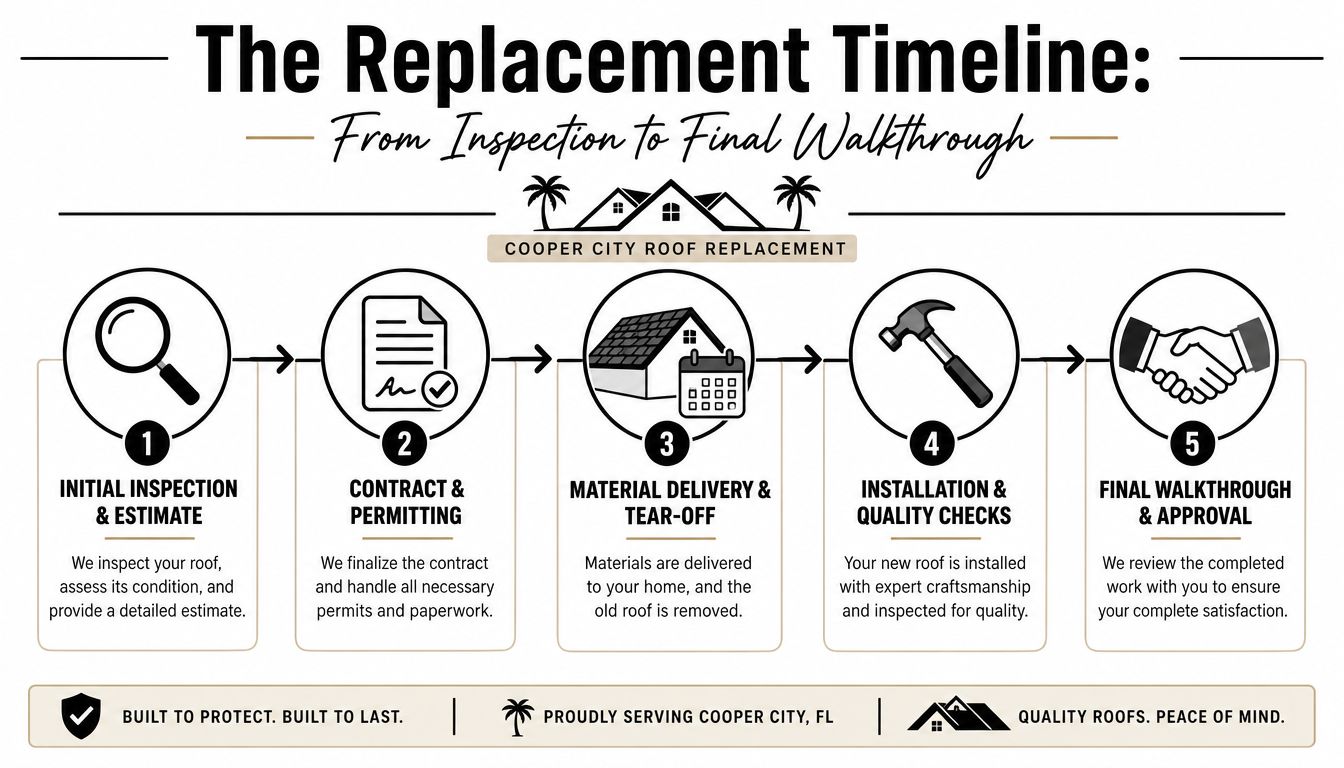
A roof replacement moves fastest when the homeowner knows what each stage is for. The process usually begins with an inspection, where the roofer checks the surface, underlayment clues, flashing, and likely deck condition. After that comes the estimate, the contract, and the permit work. In Cooper City, the permit step isn't optional for a full reroof, so the schedule always has to account for that paperwork.
From roof check to dry-in
Once the job is scheduled, materials are delivered and the tear-off starts. That's the loudest phase, and it's also when hidden problems show up. If the deck needs patching, the crew has to dry the roof in quickly so the home isn't exposed overnight. On a real project, the cleanest jobs are the ones where the contractor stages materials well and keeps the roof section-by-section protected.
The attached internal reference with roof replacement staging shows how much a solid plan matters on a live job, especially when weather can change quickly in South Florida: roof replacement staging example.
Keep the driveway clear, move vehicles early, and make sure attic access is available. Those three things save time on almost every residential reroof.
Final inspection and handoff
After installation, the crew should clean up nails, debris, and leftover materials, then walk the roof and property for loose edges, missed fasteners, or debris in gutters. The final walkthrough is where you verify what was installed, where the warranty paperwork is headed, and whether any punch-list items remain. If the contractor can't explain the sequence of the work in plain language, that's a problem.
Homeowners should ask for progress updates after tear-off and again before final cleanup. That keeps surprises small and makes it easier to catch details before the crew leaves. A roof replacement is disruptive, but it shouldn't feel mysterious.
Choosing the Right Roofing Material for South Florida

The right material for Cooper City depends on the house, not just the homeowner's preference. A roof on a low-slope section has different needs than a steep-pitched home with visible front elevations. In South Florida, the decision usually comes down to how each system handles heat, wind, water, and weight over time.
South Florida roofing materials compared
| Material | Typical Lifespan | Wind Performance | Best Use |
|---|---|---|---|
| Asphalt shingles | Varies by system and exposure | Good when installed as a tested assembly | Budget-conscious pitched roofs |
| Concrete or clay tile | Long-lasting surface, underlayment still needs attention | Strong when the full system is properly engineered | Homes where curb appeal and weight capacity fit the design |
| Standing-seam metal | Long service life with proper detailing | Strong resistance when fastening and edges are correct | Homes wanting storm performance and a cleaner profile |
| Modified bitumen or TPO for flat sections | Built for low-slope conditions | Depends on assembly and edge detailing | Flat or low-slope roof sections |
The trade-off is never just price
Asphalt shingles usually make the most sense where budget matters and the roof pitch is straightforward. Tile fits many South Florida homes visually, but it also adds weight and makes underlayment quality more important than most homeowners expect. Metal can be a smart fit where the goal is storm performance and long-term durability, but details like flashing and penetrations have to be handled carefully.
Flat roof sections deserve their own system. Modified bitumen and TPO are not interchangeable with sloped-roof products, and the edges, seams, and drainage points need to be designed for that geometry. That's where a contractor's installation discipline matters as much as the product label.
A material choice should match the structure, the neighborhood look, and the homeowner's maintenance tolerance. The wrong roof isn't always the cheapest one. Sometimes it's the one that looks fine on day one but fights you for years.
Permits, Florida Building Code, and Insurance Realities
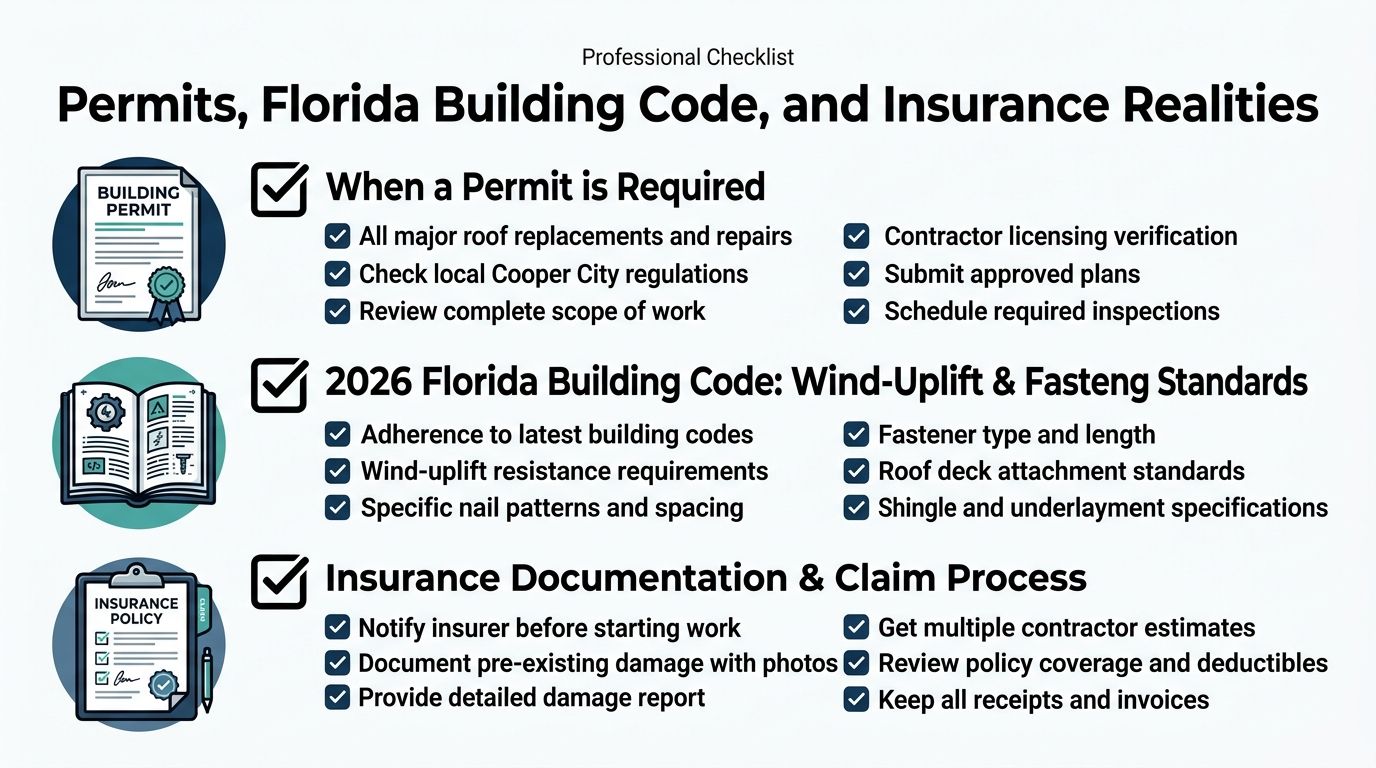
A full roof replacement in Florida requires permits, and the paperwork isn't busywork. Florida roofing permits are required for complete replacements, tear-off and re-roofing, roof-overs, structural roof repairs, and switching roof types such as shingles to metal or tile. Applications commonly require product approvals, a roof sketch or site plan, and proof of contractor insurance and license, with residential re-roof permit fees often reported in the $200 to $800 range (permit guidance).
What the code change means in practice
Florida's revised roof-replacement rule changed the old “replace the whole roof if more than 25% is repaired” approach. If an existing roofing system or roof section was built, repaired, or replaced in compliance with the 2007 Florida Building Code or any later edition, then only the repaired, replaced, or recovered portion has to be brought up to the current code, even when that portion is 25% or more of the roof section (legal summary of the rule change).
That matters because a replacement in South Florida is about more than swapping surface materials. Code compliance around fastening, edge metal, underlayment, and system testing is what helps the roof resist wind uplift and wind-driven rain. In hurricane-exposure zones, the assembly has to work as a system.
Keep the records insurers may ask for
The documentation trail should include the permit, final inspection sign-off, product approvals, and photos of the finished roof. That paper trail helps when an insurer wants to know whether the roof was permitted, what components were installed, and whether the work met code at the time it was done. It also helps if the home is sold later and the buyer's inspector asks for proof of a clean reroof.
The attached visual checklist is useful because it puts the permit side of the project in one place, instead of scattering it across emails and job folders: building checklist reference.
Unpermitted roof work can create a paperwork problem long after the crew is gone.
How to Choose the Right Roofing Contractor in Cooper City
A good contractor makes the job feel organized. A weak contractor makes every decision feel urgent. Start with the basics, licensing, insurance, local work history, and a written estimate that separates labor, materials, tear-off, disposal, and code upgrades. If a roofer can't explain what's included, the quote isn't really comparable.
Questions worth asking before you sign
- License and insurance: Ask for proof of license and current insurance before discussing price in detail.
- Scope clarity: Ask what happens if decking is damaged after tear-off, and how that will be priced.
- Permit handling: Confirm who pulls the permit and who schedules inspections.
- Warranty terms: Separate manufacturer warranty coverage from workmanship coverage.
- Local references: Ask for nearby jobs with the same material and roof type.
For contractor insurance basics, a practical overview of roofing contractor coverage from insurance from Schneider and Associates can help homeowners understand why coverage details matter before work starts.
Red flags that usually show up early
A contractor who pressures you to sign the same day is usually trying to skip comparison shopping. A bid that's unusually low can hide missing scope, and a vague contract makes it easy for change orders to pile up later. If the company has no physical presence, no local references, or avoids direct answers about permit handling, walk away.
The best bids are readable. You should be able to tell what material is being installed, who handles disposal, what warranty applies, and whether the job includes code-driven upgrades. If two proposals are close in price, the one with better scope detail is usually the safer bet.
Paletz Roofing and Inspections is one local option homeowners may run into when comparing bids, and the value in that comparison is not the logo, it's whether the proposal spells out the work clearly enough to stand on its own.
After the Installation Documentation That Protects Your Investment
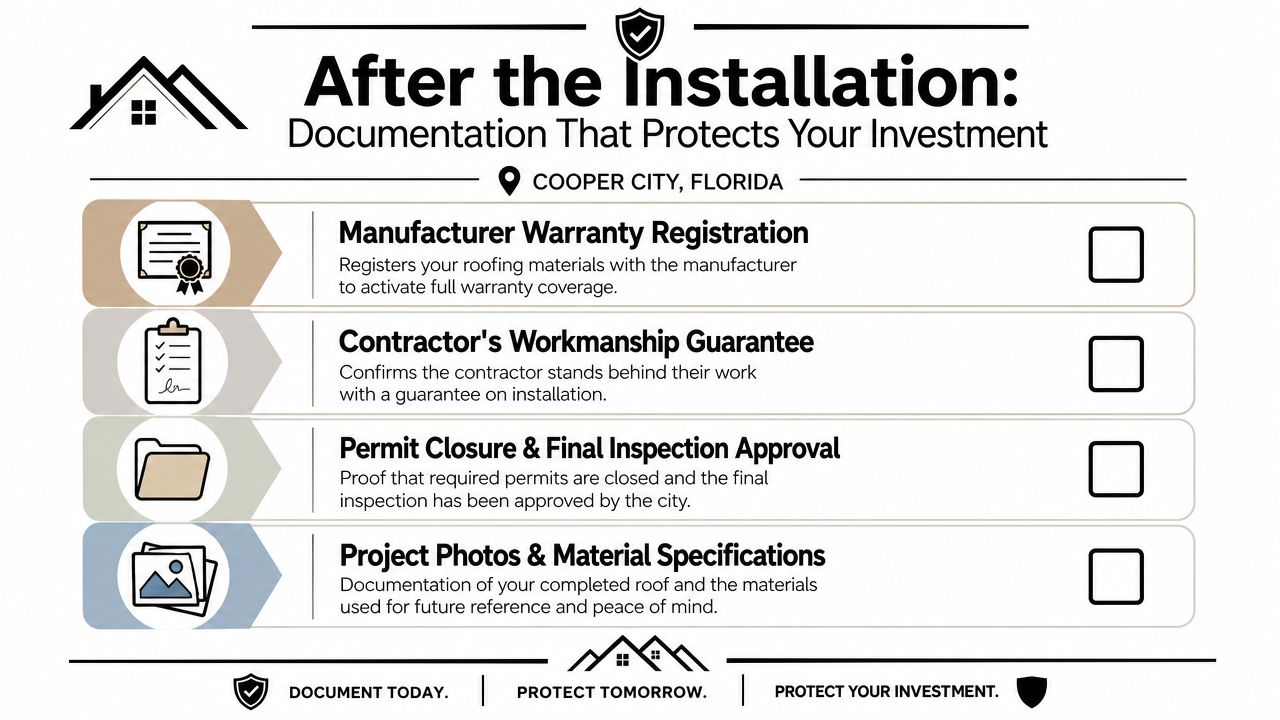
Once the crew leaves, the roof should come with a paper trail strong enough to survive a storm claim, a refinance, or a future sale. That means keeping the final permit, the certificate of completion or final inspection approval, the manufacturer warranty registration, the contractor's workmanship warranty, and photos of the dry-in and finished roof. It also helps to store the product approval numbers for the exact assembly installed, not just the brand name.
Why those records matter later
Adjusters care about proof. Future buyers care about proof. A clean folder showing the permitted work, the materials installed, and the final approval is much easier to use than trying to reconstruct a reroof from old texts and partial emails. In practice, good documentation often makes the difference between a smooth conversation and a long follow-up chain.
The photo record matters too. Keep shots of the roof before work, during dry-in, and at completion, because those images show what was changed and what was protected. The logo file below is a useful reminder that the project files should live in one organized place, not scattered across devices: project file reference.

File the records the same week the job closes. Waiting until the next storm season makes it harder to find them when you need them.
What to save in one folder
- Permit closure: Final sign-off, inspection record, and permit number.
- Product details: Manufacturer sheets, approval numbers, and installed system info.
- Warranty papers: Both material and workmanship coverage.
- Photo set: Before, during, and after photos in one dated folder.
A properly permitted roof doesn't just look finished. It leaves a trail that supports insurability and resale, which is part of the value homeowners often miss when they think only about shingles or tile.
Your Roof Replacement Action Plan and Final Thoughts
If you think a replacement is close, start with two or three inspections and ask each contractor for an itemized scope. Compare the quote against the Cooper City cost ranges above, then verify license, insurance, permit handling, and warranty terms before you sign. That keeps the conversation grounded in facts instead of sales pressure.
A code-compliant reroof pays off over time because it's built to handle South Florida conditions as a system. You're not just buying a surface layer. You're buying better wind performance, cleaner documentation, and fewer problems when the next insurer, adjuster, or buyer starts asking questions.
The smartest move is usually the simplest one. Get the roof inspected, gather your records, compare the bids line by line, and choose the contractor who can prove the work will be permitted, documented, and installed as a complete assembly.
A CTA for Paletz Roofing and Inspections.