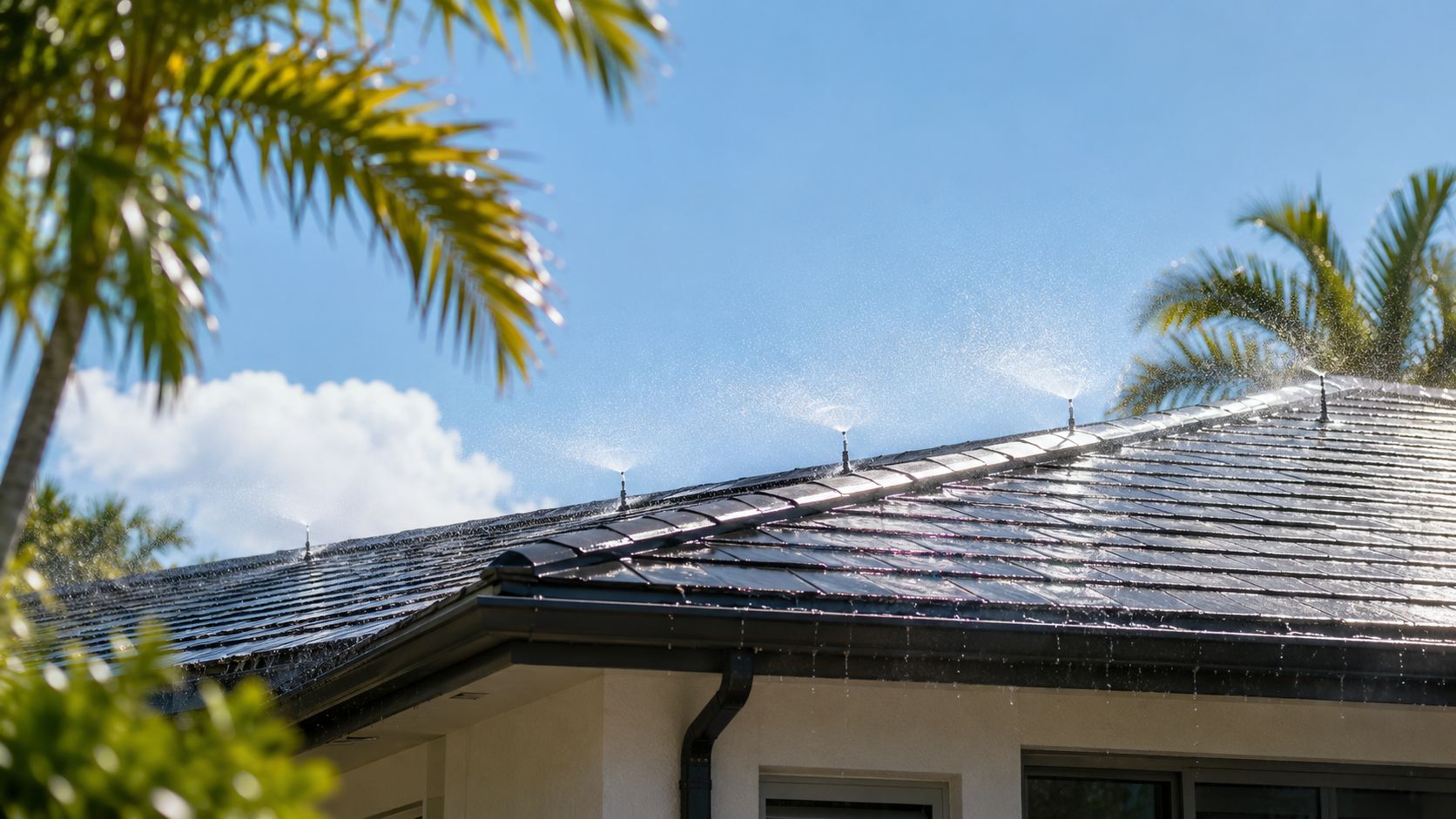
Your roof takes a beating in South Florida. By midafternoon, the shingles or tile are baking, the attic is hot, and your air conditioner may feel like it never gets a break. At the same time, many homeowners hear about roof sprinkler systems and wonder if they can cool the house, protect the roof, or even add a layer of fire safety.
That question gets confusing fast because people use the same phrase for very different systems. Some setups are meant to wet a roof during a wildfire ember event. Others are used for roof cooling. And many homeowners mix both of those up with the fire sprinklers installed inside a house or building.
If you own a home in Broward, Miami-Dade, or Palm Beach County, the practical answer is usually local, not generic. South Florida has intense sun, heavy humidity, salt air in many neighborhoods, hurricane exposure, and a very different fire risk profile than western wildfire zones. That changes whether a roof sprinkler system makes sense.
Table of Contents
- Protecting and Cooling Your Home in South Florida
- What Is a Roof Sprinkler System
- How Different Roof Sprinkler Systems Operate
- Pros and Cons for Properties in South Florida
- Florida Codes Costs and Better Alternatives
- Your Next Steps with Paletz Roofing
Protecting and Cooling Your Home in South Florida
A roof sprinkler system gets attention in South Florida for one main reason. Heat. Homeowners want a cooler house, less heat pushing into the attic, and fewer stretches where the AC seems to run all day.
That makes sense here. A roof is your home's first shield against sun, rain, and wind. If that surface gets extremely hot, the heat doesn't just stay outside. It moves down into the roof assembly, attic, and living space.
Some homeowners also think about fire, especially during dry spells or if their property backs up to brush or open land. That concern is understandable, but in South Florida the roof cooling question is usually more relevant than the wildfire question. The challenge is knowing which system addresses your problem.
Why homeowners look into these systems
A roof sprinkler system can serve different goals:
- Cooling the roof surface: Water can cool roofing materials as it evaporates, similar to how sweat cools skin.
- Reducing indoor heat gain: If the roof stays cooler, the rooms below may feel more comfortable.
- Adding peace of mind: Some owners like the idea of another protective layer on the house.
Practical rule: If your main concern is summer heat, judge a system first as a cooling tool, not as a fire solution.
The catch is that water on a roof isn't automatically a smart upgrade. In South Florida, moisture management matters just as much as heat control. A poorly designed system can leave wet areas behind, encourage algae staining, or create maintenance headaches on a roof that was never meant to be sprayed regularly.
The South Florida lens
Local decisions should stay grounded in local conditions. Our region deals with humid air, frequent rain, storm debris, and roofing materials that already have to work hard. A system that sounds helpful in theory can become wasteful or rough on the roof if it isn't matched to the material, drainage pattern, and actual reason you want it.
That's why the best approach is simple. Define the goal first. If you want lower roof temperatures, treat this as a cooling discussion. If you want life safety from an indoor fire, that's a different code issue. If you're thinking about wildfire defense, the answer is more limited and more situational than many articles make it sound.
What Is a Roof Sprinkler System
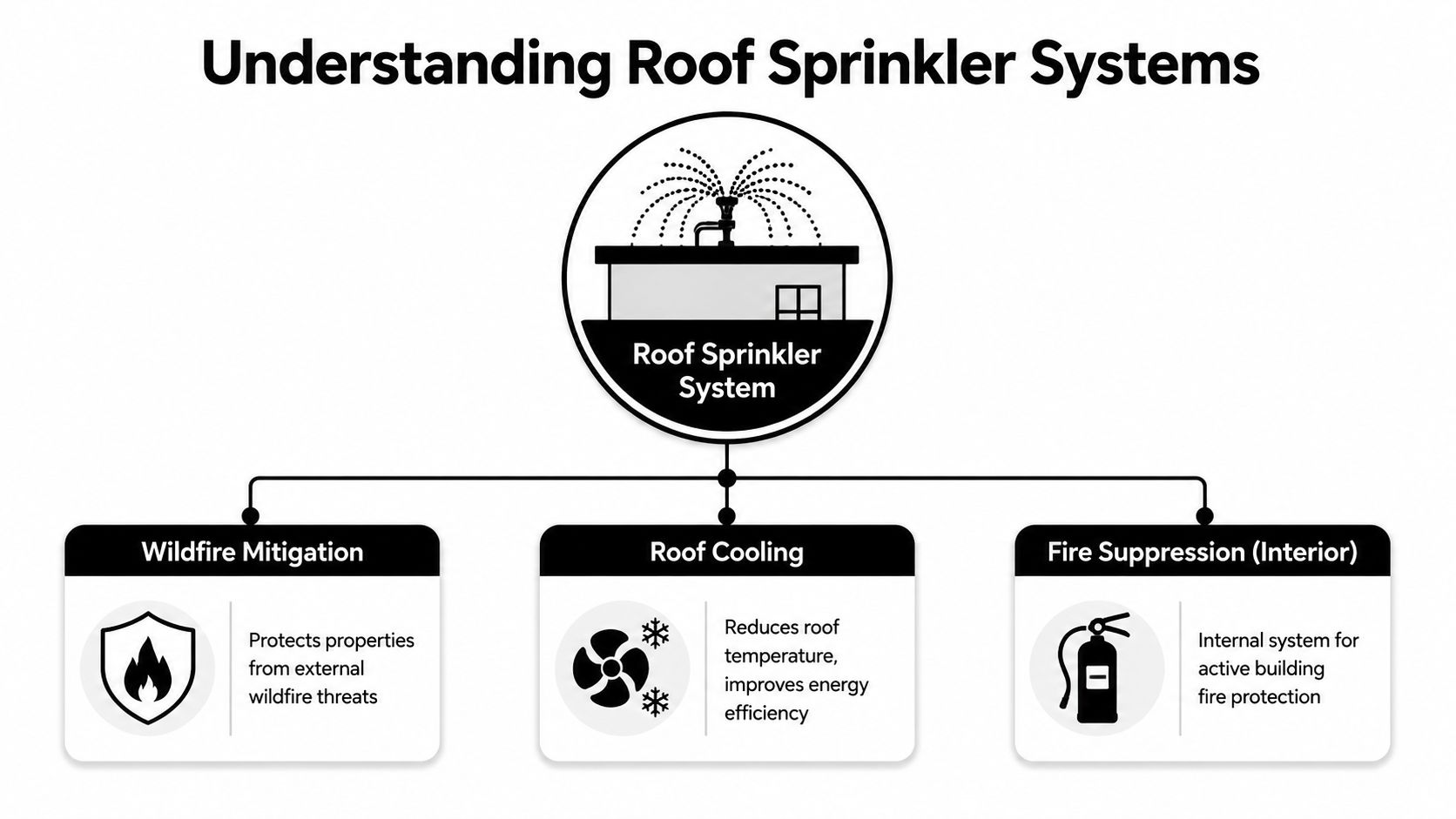
A roof sprinkler system isn't one product. It's a catch-all phrase people use for several systems that do very different jobs.
Three very different systems get grouped together
The first type is an exterior wildfire mitigation system. Its job is to wet the roof and nearby surfaces when embers are a threat. Think of it as an outside spray system intended to reduce ignition risk during an exterior fire event.
The second type is a roof cooling system. This is the one most South Florida homeowners are asking about, even if they don't use that term. It applies water to reduce roof surface temperature through evaporation. The basic idea is familiar. When moisture evaporates, it removes heat.
The third is interior fire suppression. These are the sprinkler systems inside a home or building that activate during a fire inside the structure. They aren't roof cooling systems, and they aren't the same as exterior roof sprays.
Why the distinction matters in Florida
If you confuse these categories, you can spend money on the wrong solution.
A homeowner with a hot upstairs bedroom may not need an exterior fire setup at all. That person may be better served by insulation improvements, ventilation corrections, a reflective roof surface, or a carefully designed cooling spray system. On the other hand, a buyer reading code language about required sprinklers in new residences might assume Florida requires exterior roof sprinklers. It doesn't. That code issue applies to interior fire sprinkler systems, not exterior roof watering.
A practical way to sort it out is to ask one question first.
| Primary concern | System people usually mean | Main purpose |
|---|---|---|
| Hot roof and attic | Roof cooling system | Lower roof temperature |
| Embers landing on roof | Exterior wildfire mitigation | Reduce ignition risk |
| Fire starting inside building | Interior fire suppression | Control interior fire |
Homeowners often say "roof sprinkler" when they really mean "anything involving water and fire protection." That shortcut causes most of the confusion.
Some heavy-duty spray systems are also marketed as adding protection against impact or severe weather exposure, but that shouldn't be the starting point for a South Florida homeowner. Here, the main debate is usually whether cooling benefits justify water use, upkeep, and possible roof wear.
How Different Roof Sprinkler Systems Operate
The mechanics matter because two systems can look similar from the ground and behave completely differently in real life.
How activation works
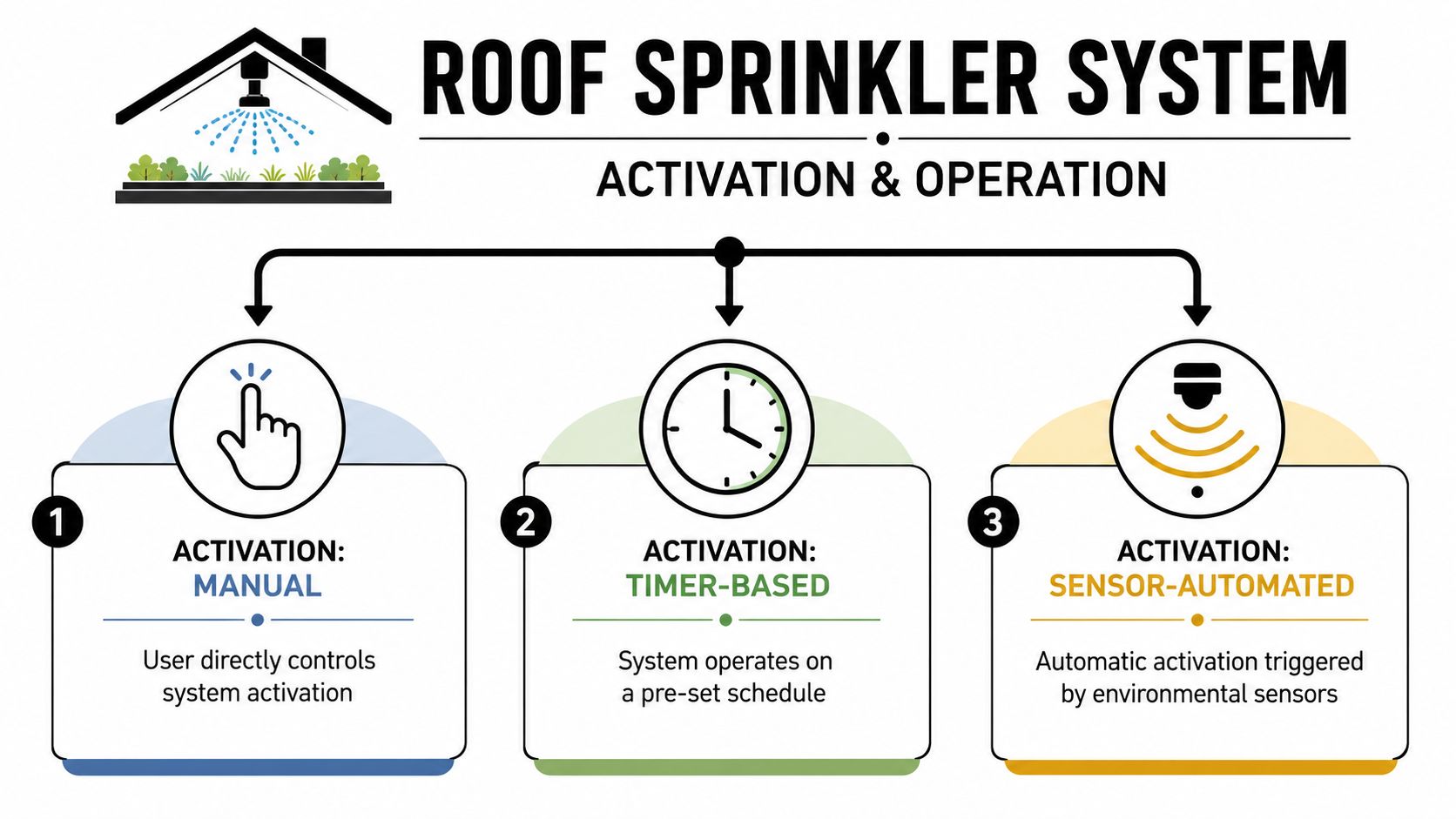
Most roof sprinkler systems activate in one of three ways:
- Manual control: You turn the system on yourself when conditions call for it.
- Timer-based scheduling: The system runs at preset times, often used for cooling applications.
- Sensor-based automation: Sensors trigger the system when heat or environmental conditions reach a set point.
Each method has tradeoffs. Manual activation gives the owner control but depends on someone being present. Timers are simple for routine cooling but can waste water if they run when weather doesn't justify it. Sensors can be smarter, but they also add complexity and more parts that need upkeep.
The common hardware is straightforward. You have sprinkler heads or nozzles, piping, valves, a water source, and sometimes a pump. The differences show up in how durable those pieces must be.
What a wildfire setup requires
An exterior wildfire defense system is the demanding version. According to installation guidance for external roof watering systems, these setups must use a petrol or diesel-powered pump, draw from an independent water supply of at least 22,000 liters, and use copper piping because municipal water and electricity often fail during a fire. That same guidance also gives exact placement benchmarks for Butterfly and Metal Impact sprinklers, along with spacing, spray radius, and pipe requirements.
That tells you something important. A real wildfire-ready roof sprinkler system isn't a garden hose with a few heads clipped to the gutter. It's a purpose-built emergency system with its own supply and heat-tolerant components.
Field insight: If a system depends on city water and household electricity during a regional emergency, don't assume it'll keep working when you need it most.
Because these systems use valves, shutoffs, and control points, homeowners should also understand the basics of managing your sprinkler system valves before any installation discussion gets serious. That matters for testing, maintenance, and emergency shutdowns.
How cooling systems stay simpler
A roof cooling setup is usually less rugged because it's not designed for a full emergency scenario. It may rely on a timer, municipal pressure, and smaller spray components aimed at cooling rather than saturation. The idea isn't to survive a fire event after power failure. It's to operate predictably during hot periods.
That simplicity is attractive, but it also creates a temptation to oversimplify. If the spray pattern is wrong, the water may miss the hottest area, oversoak one section, or leave runoff where it shouldn't. If the roof drains poorly, regular spraying can turn a cooling idea into a moisture problem.
The takeaway is simple. The word "system" matters. Performance depends on the layout, controls, material compatibility, drainage, and purpose. A roof sprinkler system only works well when all those pieces match the reason it was installed.
Pros and Cons for Properties in South Florida
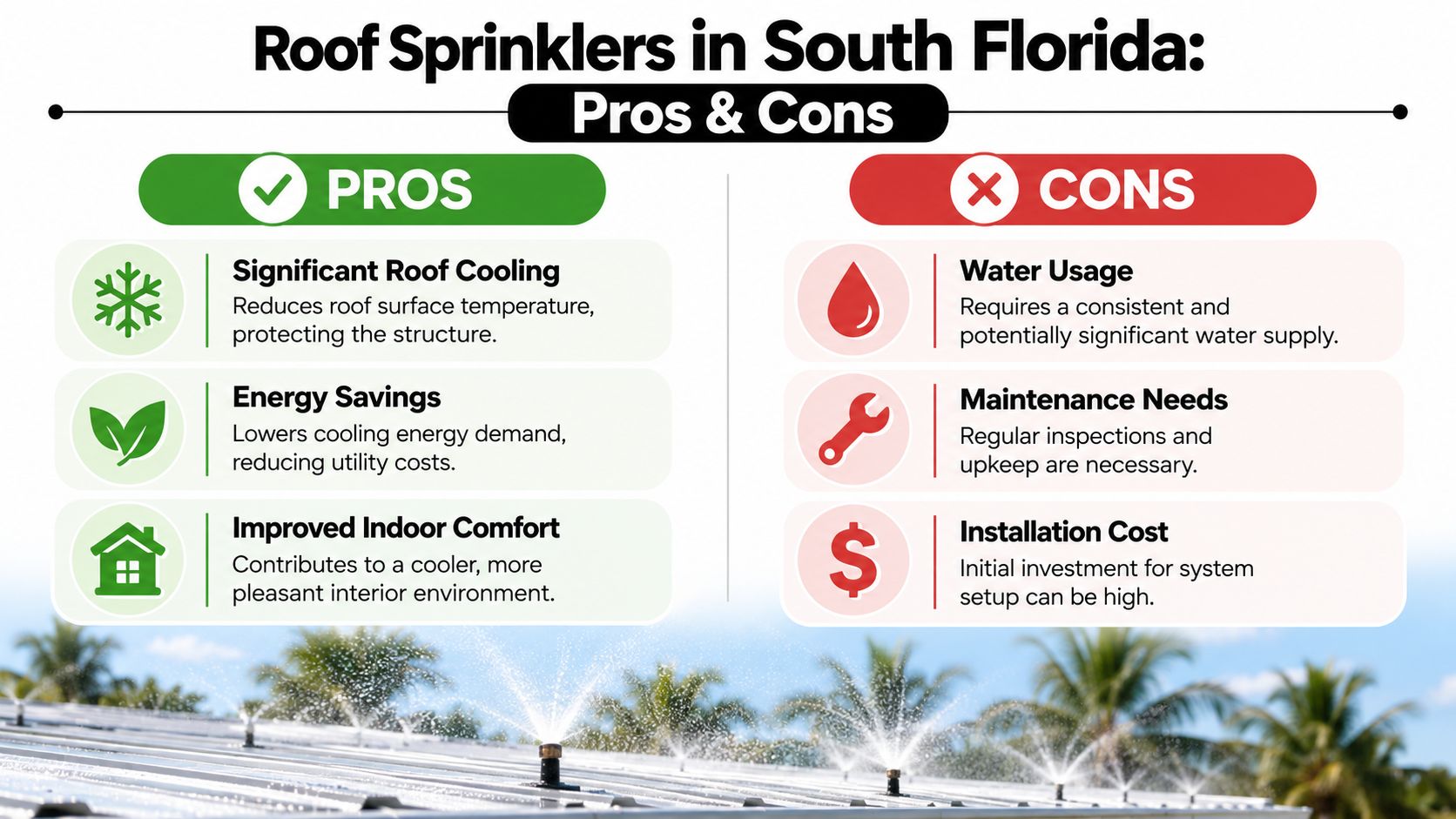
For South Florida properties, the strongest argument for a roof sprinkler system is cooling. The weakest argument, in most neighborhoods, is wildfire defense.
Where a roof sprinkler system can help
On a brutally hot day, reducing roof surface temperature can help the home feel less stressed. The roof absorbs less heat, the attic may not build heat as aggressively, and upper rooms may feel more manageable.
For some homeowners, that benefit has nothing to do with fire. It's about comfort. If you have a dark roof, limited shade, or a room that always runs warmer than the rest of the house, a cooling-based roof sprinkler system can sound appealing because it targets the part of the house taking the most direct sun.
A second benefit is roof surface rinsing in specific situations. Light, controlled water application can temporarily cool and wash dust or salt residue from certain surfaces. That doesn't mean routine spraying is ideal for every roof material, but it explains why some owners see these systems as doing double duty.
Where the downsides show up
The downsides are practical, and in South Florida they matter.
- Water demand: Any system that sprays the roof has to use a consistent water supply. If you run it often for cooling, that becomes an operating cost issue.
- Material compatibility: Not every roof responds well to repeated wetting. Tile, shingle, metal, underlayment details, fasteners, and flashing conditions all matter.
- Humidity side effects: A roof that stays damp longer than intended can become a better host for algae staining, surface grime, and moisture-related wear.
- Maintenance burden: Nozzles clog. Valves fail. Spray patterns drift. A system that's ignored can become useless or damaging.
Water on a roof is only helpful when it leaves the roof quickly and predictably.
Another issue is false confidence. Homeowners sometimes assume that if water is spraying overhead, the home is broadly protected. It doesn't work that way. If the roof has flashing defects, open penetrations, aging sealant, or drainage trouble, adding more water exposure can highlight every weak spot.
The fire protection reality check
Many articles tend to be too optimistic. Fire Safe Marin advises against installing roof sprinklers for wildfire defense on homes with fire-resistant Class A roofing and says proven strategies such as defensible space and home hardening are more effective. That matters because modern fire-resistant roofing already changes the value of an exterior spray system.
For a South Florida homeowner with a newer, code-compliant roof, the practical wildfire case may be limited unless the property has a very specific exposure profile. If your real goal is cooling, it's better to say that directly and judge the system on cooling economics, maintenance, and roof compatibility.
A balanced view looks like this:
| Good fit signals | Caution signals |
|---|---|
| Main complaint is excessive roof heat | Roof already has drainage or leak history |
| Owner understands upkeep is ongoing | Roof material may not tolerate repeated wetting well |
| Property has a very specific exterior exposure concern | Owner expects broad fire protection from a simple spray setup |
That's why I'd treat a roof sprinkler system in South Florida as a niche tool. It can help in the right setting. It can also become a maintenance-heavy compromise when a passive roofing upgrade would solve the same comfort problem more cleanly.
Florida Codes Costs and Better Alternatives
The code question is easier than is often assumed once you separate interior fire sprinklers from exterior roof sprays.
What Florida requires and what it does not
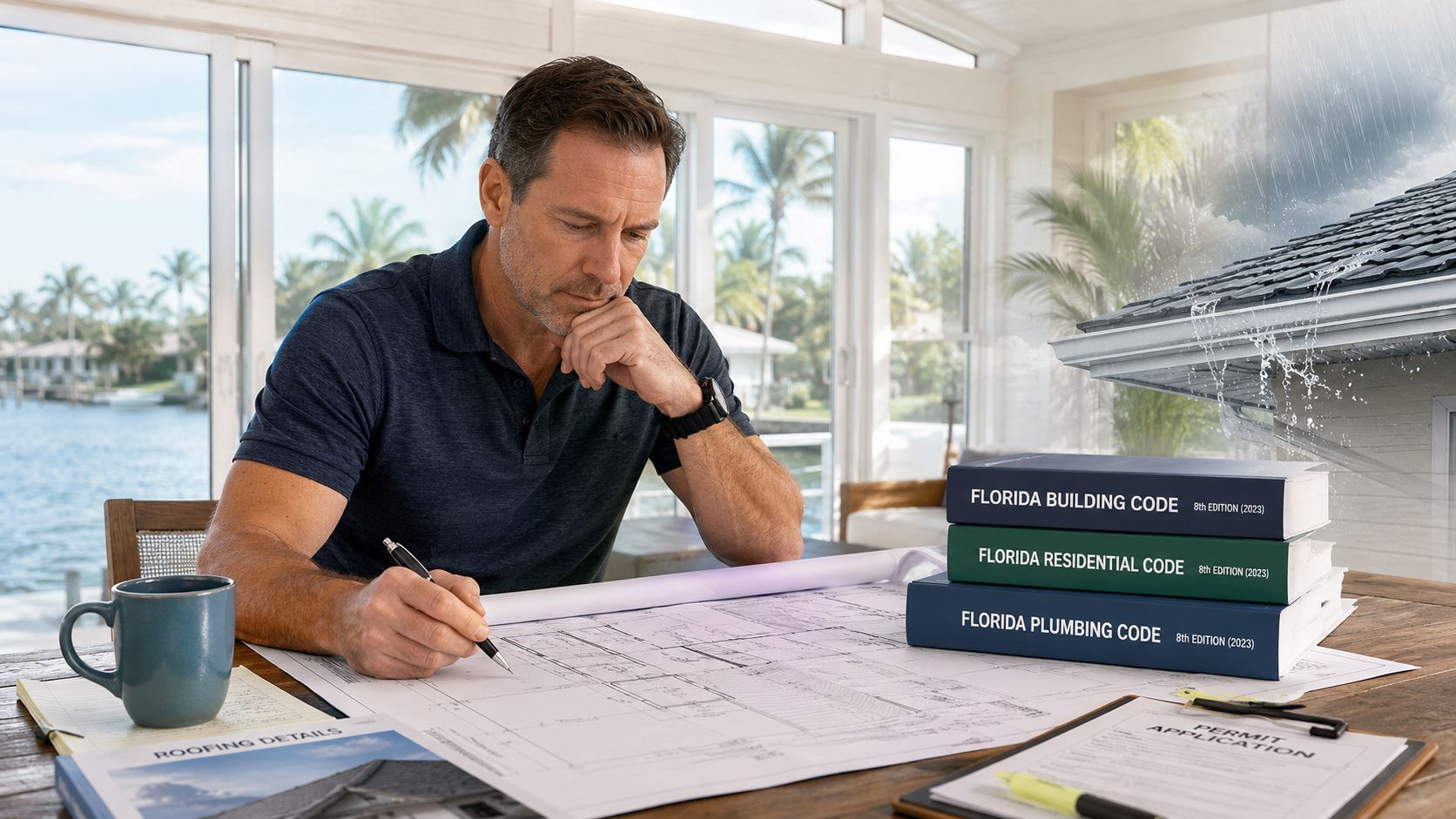
Florida Building Code Section 903.2.11.3 requires interior fire sprinkler systems in all new one- and two-family residences, and that requirement is separate from exterior roof sprinkler systems, which are not mandated. That distinction matters because homeowners often hear "sprinklers are required" and assume the roof must be sprayed from outside. That isn't what the code is saying.
For larger or specialized buildings, fire sprinkler rules can be more involved, especially for high-rise properties and condominiums. But for a typical homeowner asking about a roof sprinkler system, the key takeaway is straightforward. Exterior roof sprinklers are generally an optional feature, not a basic residential code requirement.
Code takeaway: Required interior fire protection and optional exterior roof spraying are separate decisions.
Cost and insurance questions homeowners miss
When discussing costs, candor is essential. Installation cost depends on roof design, access, plumbing route, controls, and whether the system is a simple cooling setup or a hardened emergency design. Ongoing expense also matters because the system uses water and needs periodic attention.
I can't give you a reliable universal price because roof type, system design, and property layout vary too much. But the pattern is consistent. The more you ask the system to do, the more expensive and maintenance-heavy it becomes.
Insurance is worth discussing before installation, not after. Some carriers may view a specialized system as a positive risk-management feature. Others may focus on water damage exposure, roof moisture concerns, or whether the system could fail and create a claim. Ask direct questions in writing so you know how the insurer sees it.
Better passive options for many South Florida roofs
In this climate, passive cooling often makes more sense than active spraying. A reflective metal roof, properly selected shingles, a roof coating where appropriate, better attic insulation, and stronger ventilation strategy can all reduce heat gain without introducing routine water exposure.
Those upgrades work every day without pumps, nozzles, scheduling, or shutdown procedures. They also avoid the problem of cooling one symptom while ignoring a weak roof assembly.
If your goal is a cooler garage or bonus room under the roofline, don't overlook insulation. Many homeowners get more practical benefit from thermal improvements below the roof deck than from water above it. For a simple homeowner-level primer, discover garage roof insulation before deciding that a spray system is the only path to comfort.
A smarter short list for South Florida usually includes:
- Reflective roofing materials: Good for reducing solar heat absorption.
- Attic improvements: Ventilation and insulation can address heat where it enters the living space.
- Roof condition repairs: A sound roof handles heat and rain better than a compromised one with added water exposure.
- Targeted cooling analysis: If a spray system still interests you, compare it against passive upgrades first.
For many homes, the best answer isn't a roof sprinkler system. It's a roof that naturally stays cooler and sheds water the way it was designed to.
Your Next Steps with Paletz Roofing
Before you price pumps, pipes, or nozzles, look at the roof itself. That's the part many homeowners skip.
Start with the roof, not the sprinkler catalog
A roof sprinkler system only makes sense if the roof can handle it. The material, age, flashing condition, drainage pattern, underlayment history, and existing wear all matter. A roof with unresolved weak points shouldn't get more routine water exposure.
If your house runs hot, don't assume the roof surface is the only issue. Heat problems can come from poor attic ventilation, weak insulation, duct losses, dark roofing materials, or a roof assembly nearing the end of its useful life. In those cases, spraying water may treat the symptom while missing the better long-term fix.
A local inspection is the logical first move because it answers the questions that affect value. Is the current roof healthy enough for extra moisture exposure? Is a passive cooling upgrade a better investment? Would a replacement material solve the heat problem without adding maintenance?
Use a simple decision path
Keep the decision process practical:
- Identify the goal: Cooling, fire concern, or both.
- Check roof condition first: Don't add complexity to a roof with unresolved defects.
- Compare active and passive options: Water-based cooling should compete against reflective materials, ventilation, and insulation.
- Review maintenance reality: If you won't inspect and maintain the system, don't install it.
- Confirm property-specific fit: South Florida homes vary by exposure, roof style, and neighborhood conditions.
A visual check of a company's background can help too. You can see the brand asset for Paletz Roofing and Inspections while reviewing local service information, but the more important step is getting a real roof assessment tied to your home's condition.

A roof sprinkler system can be useful. It just isn't a universal upgrade. In South Florida, the best answer often comes from matching the roof system, heat load, and maintenance tolerance before a single component gets installed.
If you're weighing a roof sprinkler system against a cooler roof upgrade, a repair, or a full replacement, talk with Paletz Roofing and Inspections. Their team serves South Florida homeowners with roof inspections, repairs, replacements, and practical guidance on what makes sense for your specific roof, not just what sounds good on paper.