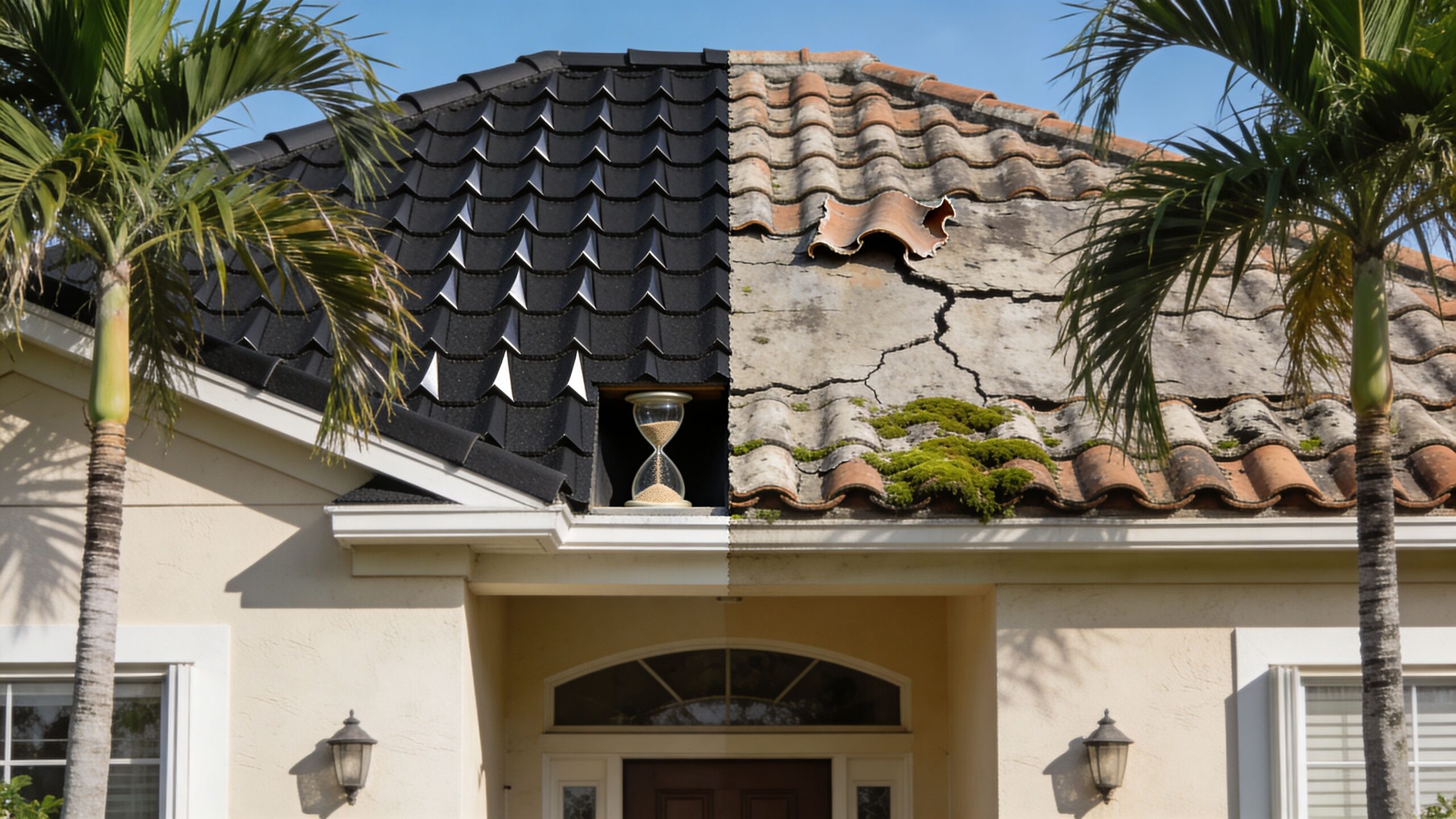
In South Florida, roof age isn’t just a maintenance detail. It can decide whether your policy keeps replacement cost value coverage, shifts to actual cash value, or gets scrutinized for renewal. Insurance analyses note that roofs over 15 to 20 years old are often considered too old for full RCV coverage, and in hurricane-prone regions visible damage rates rise from 40% at 5 years to over 90% by 15 years (insurance roof-age analysis).
That’s why “how old is too old for a roof” is the wrong question if you treat it like a single number. A roof can be old on paper and still serviceable with the right material and maintenance. Another can be younger, but already worn out from UV, salt air, ponding water, bad ventilation, or one rough storm season too many.
After more than three decades working on roofs across Broward, Miami-Dade, and Palm Beach, the pattern is clear. South Florida shortens margins for error. Heat dries materials out. Salt air attacks metal components. Hurricane seasons expose every weak fastener, seam, flashing joint, and brittle shingle edge. Homeowners who wait for a dramatic leak usually pay more than the ones who act when the roof first starts showing age.
The Critical Question Every Homeowner Faces
Most homeowners ask about roof age because they’re trying to avoid a big bill. In South Florida, that question is also about insurability, storm readiness, and whether the roof can still protect the structure when wind-driven rain starts finding weak points.
A roof doesn’t fail all at once. It loses resilience first. Shingles get brittle. Tile underlayment gets tired. Flat-roof seams loosen. Flashings corrode faster near the coast. By the time a stain shows up on the ceiling, water has usually been working behind the scenes for a while.
Age matters, but condition matters more
A roof can reach an age where insurers and roofers both start looking at it differently, but the material tells part of the story and the local environment tells the rest. South Florida isn’t kind to roofing systems. The sun is intense year-round, afternoon storms are common, and hurricane exposure changes the standard replacement timeline.
Practical rule: If your roof is getting into the age range where insurers start asking questions, don’t guess. Get the condition documented before renewal season or storm season forces the issue.
Another problem is bad age data. Verified roof-age analysis shows homeowners often understate roof age, with ages underestimated by an average of 5 years across 66% of cases, and 20% off by 15 years. The same analysis ties roof-age misclassification to $1.31 billion in annual premium leakage and notes that over 25% of roofs are wrongly listed as under 15 years (verified roof-age underwriting data).
For a homeowner, that means two things. First, memory isn’t documentation. Second, if your roof is older, you need a decision based on the actual system on your house, not what someone thinks was installed “about fifteen years ago.”
Decoding Roof Lifespans by Material
Roof age only makes sense in context. A metal roof and a three-tab shingle roof don’t live on the same timeline. A flat commercial membrane near the coast doesn’t age like a steep-sloped tile roof inland. Material sets the baseline, then South Florida adjusts it.
Standard lifespan versus real local wear
Asphalt shingles are still the most common residential choice, and verified data places their typical lifespan at 15 to 30 years, while metal roofs can last up to 70 years (roof lifespan overview). For asphalt specifically, the “too old” range is usually 20 to 25 years (asphalt roof age guidelines). Flat roofs commonly reach that point between 10 and 25 years, depending on the membrane type (flat roof age guidance).
That’s the book answer. South Florida often moves the practical answer earlier.
| Roofing Material | Standard Lifespan | Estimated South Florida Lifespan | Key Considerations |
|---|---|---|---|
| Asphalt shingles | 15 to 30 years | Often earlier than national expectations, especially with strong sun and storm exposure | UV exposure, wind uplift, granule loss, insurance scrutiny as age climbs |
| Metal roofing | Up to 70 years | Can still perform for decades, but coastal exposure makes details critical | Salt air, fastener condition, flashing corrosion, panel attachment |
| Tile roofing | Long-lasting when maintained | Often highly dependent on underlayment, flashing, and storm history | Broken tiles, slipped tiles, aging underlayment, penetrations |
| Flat roofing systems | 10 to 25 years | Frequently shortened by heat, ponding water, and seam stress | TPO, EPDM, PVC, drainage, edge securement, rooftop traffic |
What usually works best by roof type
For asphalt shingle roofs, age alone doesn’t condemn the roof, but shingles don’t hide wear well in this climate. Once they start losing granules, curling, or cracking, the decline usually speeds up. On homes close to the water, that wear tends to show up harder around ridges, hips, exposed slopes, and flashing transitions.
For tile roofs, the covering itself may look better than the waterproofing beneath it. That’s where homeowners get fooled. A tile roof can still look respectable from the street while the underlayment, flashings, and fastening points are already at the point where a heavy storm can open the system up.
Why paperwork and inspection history matter
Roof age isn’t just a physical issue. It’s an underwriting issue. Verified insurance data says many carriers inspect or exclude properties with roofs over 15 to 20 years for RCV eligibility, especially when age records are weak or conflicting (roof age and underwriting accuracy).
That’s why permit history, prior reports, and inspection notes matter. A roof with documented maintenance usually gives a homeowner more options than a roof with no paper trail and obvious weathering. In practice, the roof that “might have a few more years” is often the most expensive roof to ignore, because it can trigger both repair costs and insurance headaches at the same time.
7 Telltale Signs Your Roof Is Past Its Prime
Age matters, but condition leaves fingerprints. You don’t need to climb onto the roof to spot many of them. In fact, for most homeowners, a ground-level visual check and a look in the attic tell you enough to know whether it’s time to call for an inspection.

What to look for from outside
Missing, lifted, or curled shingles
Shingles should lie flat and seal tightly. When corners lift or edges curl, wind gets an opening. In South Florida, that’s not cosmetic wear. It’s a storm vulnerability.Granule loss
Granules are the sunscreen for an asphalt roof. Once they wash off, the asphalt layer takes direct UV punishment. For asphalt shingle roofs, “too old” is typically 20 to 25 years, and after that granule loss accelerates, exposing the asphalt core to UV degradation. In subtropical climates, leak initiation rates can rise 3 to 5 times per decade as shingles become brittle (asphalt aging and leak risk).Gutters full of shingle grit
If the gutters are collecting a heavy amount of shingle particles, the roof is shedding protection. That’s one of the clearest signs an asphalt system is aging out.Cracked, slipped, or broken tiles
Tile roofs often fail at isolated points first. One broken field tile may be repairable. A pattern of cracked or displaced tiles usually means the roof needs a broader evaluation, especially after a windy season.
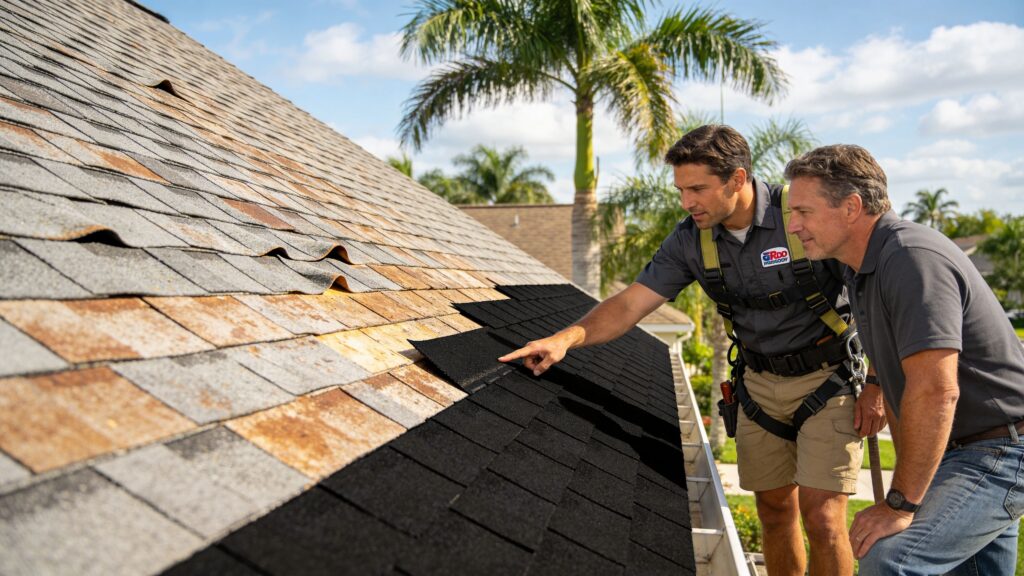
For an example of the kinds of surface conditions professionals look for, this roof damage visual reference shows the kind of wear that often signals a roof is no longer aging gracefully.
What shows up inside the house
Ceiling stains or attic moisture
Water stains aren’t always directly below the entry point. Water travels. By the time you notice discoloration on drywall, the roof system may have been compromised for a while.Sagging lines or uneven roof planes
A roofline should look straight. If you see a dip, wave, or low spot, that can point to deck deterioration, trapped moisture, or framing issues. On flat roofs, similar distress may show up as chronic ponding.Moss, algae, or dark streaking
Growth on the roof traps moisture and often hides what’s happening below. In South Florida’s humidity, biological growth doesn’t just discolor the roof. It keeps surfaces wet longer and can accelerate breakdown around laps, fasteners, and penetrations.
A roof past its prime usually stops giving one warning sign and starts giving several at once.
If you see one isolated issue on a relatively young roof, a repair may still make sense. If you see several of these together, especially on an older roof, the smarter move is usually a full evaluation instead of another patch.
The South Florida Factor How Climate Accelerates Aging
National lifespan charts are useful, but they can mislead South Florida homeowners. The roof on your house in Fort Lauderdale, Miami, or Boca Raton isn’t aging under average American conditions. It’s aging under strong sun, humidity, salt exposure, heavy rains, and hurricane pressure.

Sun and salt shorten the useful life of roofing parts
UV is relentless here. It dries out asphalt compounds, fades coatings, and hardens materials that need flexibility to survive thermal movement. Salt air adds another layer of trouble. It attacks metal flashings, fasteners, clips, and edge details. On coastal properties, those components often determine how long the whole assembly remains dependable.
This is why a roof can look “mostly fine” from the driveway and still be near the end of practical service life. The field material may survive longer than the attachments and transitions. Once those weak points start failing, water gets in where roofs are hardest to repair cleanly.
Flat roofs take a different kind of beating
South Florida has many low-slope and flat roofs on homes, condos, multifamily buildings, retail properties, and warehouses. These systems don’t age the way steep roofs do. Their enemy is often standing water combined with UV and seam fatigue.
Verified guidance notes that flat roofs are often “too old” at 10 to 25 years due to seam adhesion loss from ponding water and UV-induced embrittlement. In high-UV zones, alligatoring cracks can appear after 12 to 15 years, increasing leak probability by 4 times (flat roof seam and UV performance).
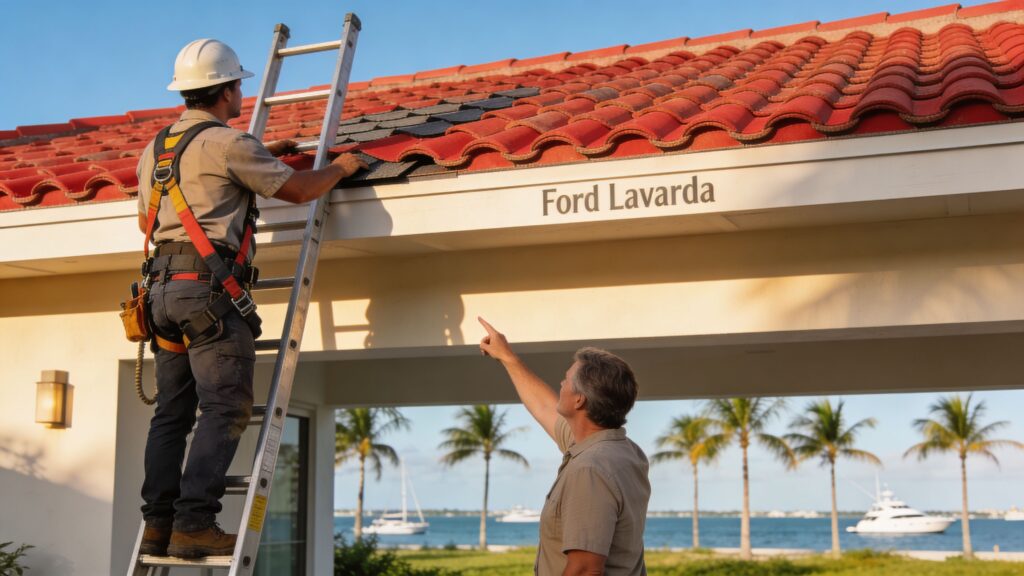
A photo set like this damaged roof condition example is the kind of wear pattern we often compare against during inspections, especially where roof edges or exposed sections have taken repeated weather.
Hurricanes don’t create all the damage. They reveal it.
Strong winds don’t need a brand-new problem to cause failure. They exploit the small ones already there. A loose shingle tab, a brittle seal strip, a hairline crack in tile, or a tired flashing boot may hold through normal weather and then open up during one bad storm.
That’s why waiting for a post-storm leak is expensive logic. Hurricane-readiness starts before the season, when there’s still time to secure vulnerable details, replace failing sections, and document condition. The older the roof, the less tolerance it has for deferred maintenance.
Field reality: In South Florida, roofs rarely retire gracefully. Most are pushed out by weather stress, insurance pressure, or both.
If you live near the coast, the timeline gets even tighter. Salt, humidity, and driving rain don’t just age the visible roof covering. They wear down the hidden parts that determine whether the system still has fight left in it.
Navigating Florida's Tough Insurance Landscape
Many homeowners first start asking how old is too old for a roof after they get a renewal notice, a questionnaire, or a request for inspection photos. That’s understandable. In Florida, roof age affects not only whether you’re insured, but how you’re insured.

Why older roofs draw insurance scrutiny
Verified insurance data shows roofs over 15 to 20 years old are often considered too old for full replacement cost value, and age-related damage rates climb from 40% for 5-year-old roofs to over 90% by 15 years in hurricane-prone regions (Florida roof insurance risk data).
That matters because RCV and ACV aren’t small wording differences.
- Replacement Cost Value means the policy is designed to cover replacement cost for a covered loss, subject to policy terms.
- Actual Cash Value factors in depreciation, which can leave the homeowner covering a much larger share of the bill.
If your roof is older and showing wear, the insurer may not see it the way you do. A roof that still “isn’t leaking” may still be treated as a higher risk because the next major wind event could turn minor age-related weakness into a substantial claim.
Florida’s legal changes helped, but they didn’t remove the problem
Florida changed the rules so insurers can’t reject coverage solely because of age for roofs under 15 years, and if a roof is older, homeowners can use an inspection showing more than 5 years of remaining service life to avoid denial based on age alone. The same verified guidance also notes that, for roofs built to the 2007 Florida Building Code standards, if damage exceeds 25%, owners may be able to choose repairs rather than a full replacement in certain situations (Florida roof law and roof-age rules).
That gave homeowners more protection, but not a free pass. Carriers still evaluate condition. They still ask for evidence. They still look hard at older roofs in South Florida because storm exposure here is constant.
What homeowners should do before renewal
A practical insurance review usually includes these steps:
- Check the roof age in your records so it matches permits, invoices, and prior reports.
- Read the loss settlement language to see whether your roof is covered on an RCV or ACV basis.
- Document visible condition early instead of waiting for the carrier to raise concerns.
- Address fixable items like flashing defects, isolated damage, blocked drainage, or missing pieces before an underwriter sees them first.
The smartest time to clarify insurability isn’t after a nonrenewal warning or right after a storm. It’s when the roof is still serviceable and you still have options.
Repair or Replace A Homeowner's Decision Framework
A roof rarely gives a perfect yes-or-no answer. Most homeowners are deciding between spending less now on a repair or spending more now to avoid repeated repairs, insurance issues, and storm exposure later. The right call depends on age, condition, damage spread, and how long you plan to keep the property.

When a repair still makes sense
Repairs are usually reasonable when the roof still has meaningful remaining life and the problem is localized.
- Isolated damage on a younger roof often justifies targeted work.
- One section affected by a fallen branch or a small wind event can often be corrected without redoing the whole system.
- A limited flashing issue or penetration leak may not mean the field of the roof is worn out.
For homeowners sorting through that decision, this guide on choosing roof repair or replacement is a useful outside resource because it frames the choice around scope, recurrence, and long-term cost instead of emotion.
When replacement is the safer financial move
Replacement becomes the better decision when the roof is near the end of its expected service life, shows widespread wear, or creates insurance friction. In those cases, a patch often buys only a short delay.
A full replacement is usually the smarter choice when you’re dealing with conditions like these:
| Situation | Better fit |
|---|---|
| One small issue on a roof with solid remaining life | Repair |
| Repeated leaks in different areas | Replace |
| Broad surface wear plus failing flashings or seams | Replace |
| Roof age is creating insurance limitations | Replace |
| You plan to hold the property long-term | Often replace |
The South Florida lens changes the math
In Florida, waiting too long can turn an elective replacement into an urgent one. A roof that might survive another mild season can still fail in a hurricane season. If that roof is already old, heavily repaired, or difficult to insure, delay doesn’t save money. It shifts the risk onto the homeowner.
For roofs where condition is uncertain, a documented inspection is the cleanest way to decide. Services such as the inspection reporting offered by Paletz Roofing and Inspections can help identify whether you’re looking at a repairable issue, an aging system with limited remaining life, or a roof that should be replaced before the next major storm cycle.

If you’ve repaired the same roof more than once for related problems, you’re usually not fixing the roof anymore. You’re financing its decline.
Take Control of Your Roof's Future Today
Roof age matters. In South Florida, it never tells the whole story by itself. Material, maintenance, storm exposure, salt air, drainage, flashing condition, and insurance rules all shape the answer.
The useful takeaway is simple. Don’t ask only how old the roof is. Ask whether it’s still reliable, still insurable, and still strong enough for the next hurricane season.
Three smart next steps
Do a visual check from the ground
Look for missing shingles, broken tiles, sagging lines, dark streaks, gutter granules, and anything that looks uneven or recently changed.Review your insurance documents
Check how your roof is valued and whether your carrier has raised any questions about age, condition, or documentation.Schedule a professional inspection
A real inspection gives you a condition-based answer, not a guess based on age alone.
Verified South Florida guidance adds an important reality check. While 70% of claims come from roofs over 15 years, proactive maintenance like flashing repairs and regular cleaning can add 5 to 10 years of life in some cases, which is why inspection and maintenance matter so much (South Florida roof maintenance and claim trends).
For homeowners who like planning preventive tasks by season, even a region-specific checklist from outside Florida can help build good habits. A simple example is this Arizona home upkeep schedule, which is useful as a reminder system even though South Florida owners should adapt it for hurricane prep, roof drainage, and coastal wear.
If your roof is getting older, don’t wait for the ceiling stain, the denied claim, or the emergency tarp call. Get clear on its condition while the decision is still yours.
If you want a condition-based answer instead of a rough guess, contact Paletz Roofing and Inspections for a professional roof evaluation in Broward, Miami-Dade, or Palm Beach County. A documented inspection can help you understand remaining life, spot storm vulnerabilities, and decide whether repair, maintenance, or replacement makes the most financial sense.