In South Florida, the problem usually shows up fast. The sky opens, water starts racing down the roof, and suddenly the front door turns into a shower entrance. You step outside, the walkway splashes, mulch washes out, and the gutter that looked fine in dry weather seems to be doing nothing at all.
That's when homeowners start searching for rain diverters gutters. Sometimes that's exactly the right fix. Sometimes it isn't. A diverter can solve a very specific runoff problem, but it can't magically give an overloaded gutter system more capacity during a hard tropical downpour. The trick is knowing which problem you have before you bolt metal to the roof edge.
Table of Contents
- That Waterfall Over Your Door Is Not a Feature
- Understanding Rain Diverters and Gutter Systems
- Choosing the Right Rain Diverter for Florida Weather
- Strategic Placement to Solve Common Water Problems
- Rain Diverters vs Torrential Downpours A Reality Check
- Installation Costs and When to Call a Roofing Professional
That Waterfall Over Your Door Is Not a Feature
One of the most common calls after a summer storm goes like this: “The gutter is there, but water still pours right over the entry.” That's not cosmetic. It's roof runoff missing the collection path and landing exactly where people walk, doors swing open, and slab edges stay wet longer than they should.

If this keeps happening, the issue can spread beyond the inconvenience. Wet entry areas often lead to staining, slippery surfaces, washed-out planting beds, and moisture migration near walls. If interior dampness follows, it helps to understand what causes musty smells from water because that smell often points to moisture sitting where you can't see it.
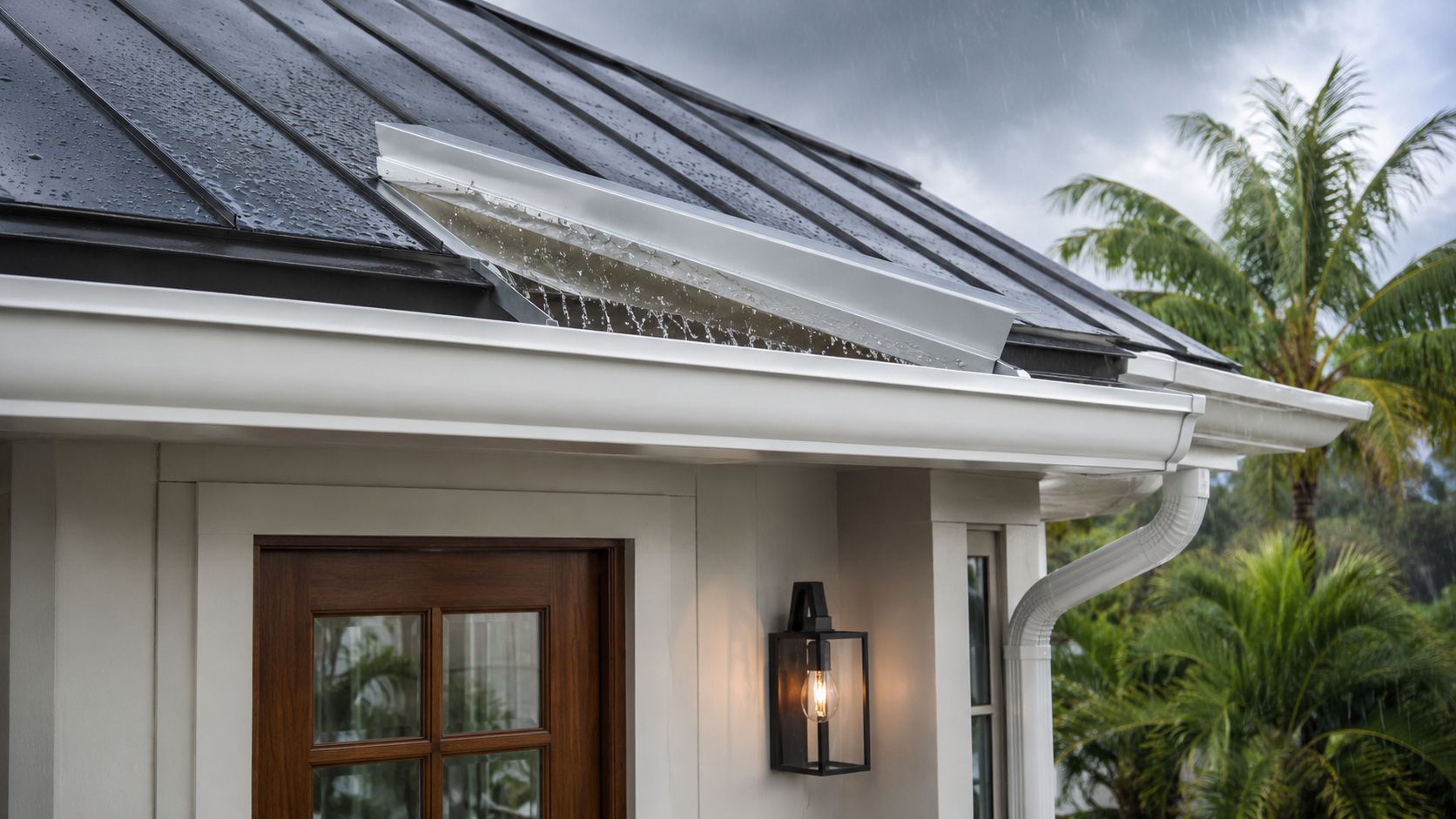
A rain diverter is one of the simplest tools for this kind of trouble spot. It intercepts runoff at a specific point on the roof edge and sends it somewhere safer, usually back toward a gutter section that can catch it or away from a doorway that keeps getting drenched. A useful visual example appears in this roof drainage image reference, where the problem isn't the rain itself but where concentrated runoff lands.
Practical rule: If water always falls in the same narrow strip over a door or walkway, you're usually dealing with a targeted redirection problem, not a whole-roof drainage failure.
That distinction matters in Florida. Afternoon storms hit hard, and roof water doesn't drift politely. It drives sideways with wind, sheets off steeper slopes, and exposes every weak point in the drainage path.
Understanding Rain Diverters and Gutter Systems
A rain diverter is a small water-control piece installed to intercept runoff before it falls where you don't want it. Its operation resembles that of a low curb on a road. It doesn't stop traffic. It changes where traffic goes.

Rain control on a house works the same way. The roof sheds water, the diverter nudges it sideways, the gutter catches it, and the downspout moves it down and away. If one part fails, the whole chain gets sloppy. If you want a clean primer on the parts of a rain gutter system, that breakdown helps homeowners see how each part supports the next.
What a rain diverter actually does
Rain diverters aren't new gadgets. Historical references to gutter-like drainage go back to around 2000 B.C., and a modern sizing guideline says to measure the protected area and add at least 4 inches on each side, with high-volume areas sometimes needing diverters up to 48 inches long, according to this roofing guide on gutter history and diverter sizing.
On a house, that usually means one of these jobs:
- Protecting an entry point: A short diverter can break up that sheet of runoff that drops right over a front or side door.
- Redirecting concentrated flow: Water running off a roof plane may need a small metal guide to push it toward a stronger gutter section.
- Shielding a vulnerable edge: Some trouble spots don't need a new gutter line. They need the runoff shifted a few inches or a few feet.
A diverter works best when the water problem is local and predictable. If the entire gutter line is overwhelmed, the diverter isn't the main fix.
Roof-edge diverters and downspout diverters are not the same thing
Homeowners often use one term for two different products.
A roof-edge diverter sits at or near the roof edge and redirects runoff before it drops. This is the component typically referred to when discussing rain diverters gutters for doors, windows, valleys, or wall intersections.
A downspout diverter belongs lower in the system. In rainwater harvesting, it acts as an automatic flow selector. It sends water into a barrel, tank, or cistern until the water level reaches the diverter elevation, then routes extra flow back through the original downspout. These systems are commonly sized for standard residential downspouts such as 2" x 3", 3" x 4", and round 3" to 4" diameters, as explained in this downspout diverter guide for rain barrels.
That difference matters because the fix has to match the failure point. If the water problem starts at the roof edge, a barrel diverter won't help. If the goal is collecting rainwater at the downspout, a roof kick-out piece won't solve it.
Choosing the Right Rain Diverter for Florida Weather
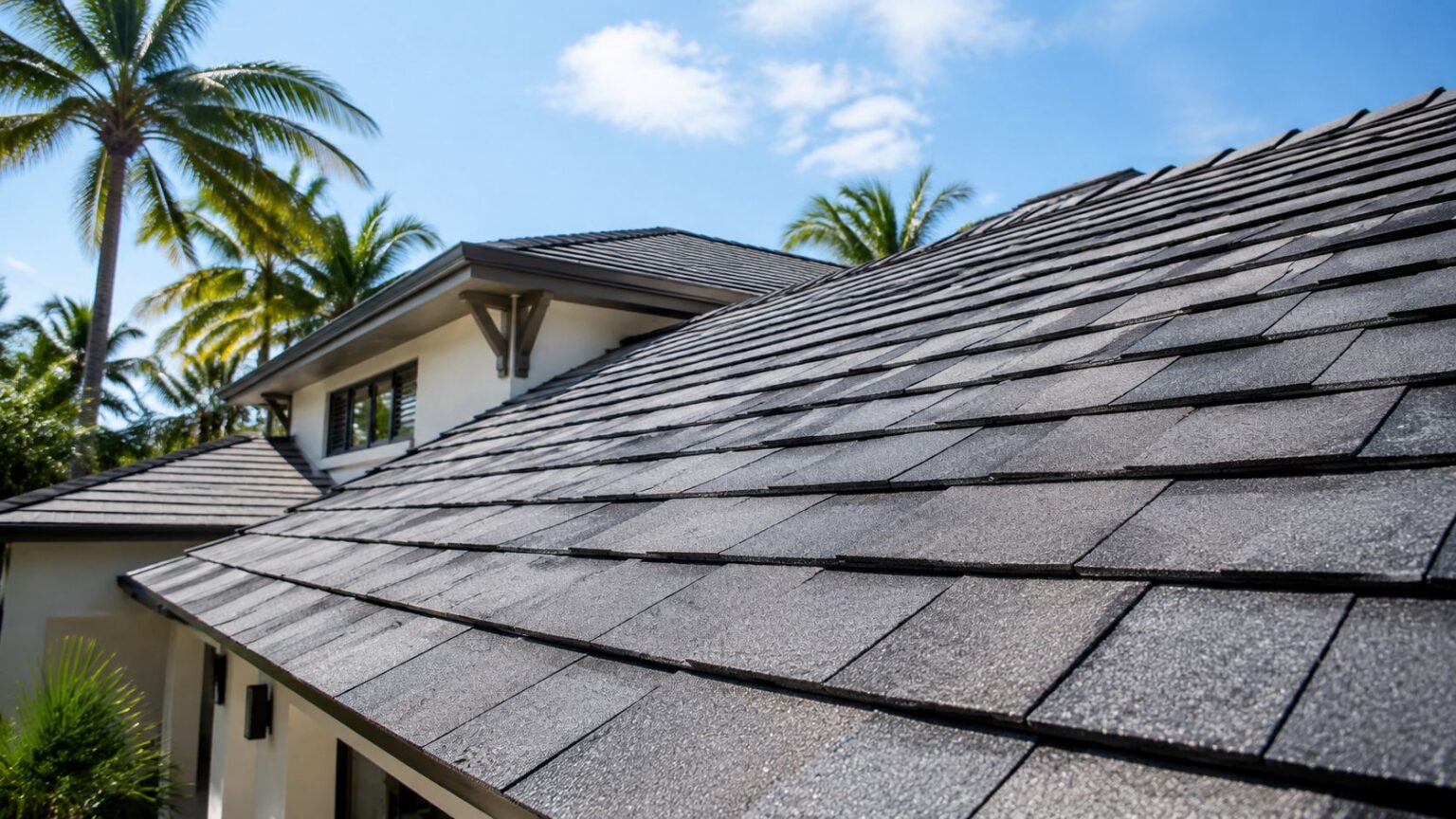
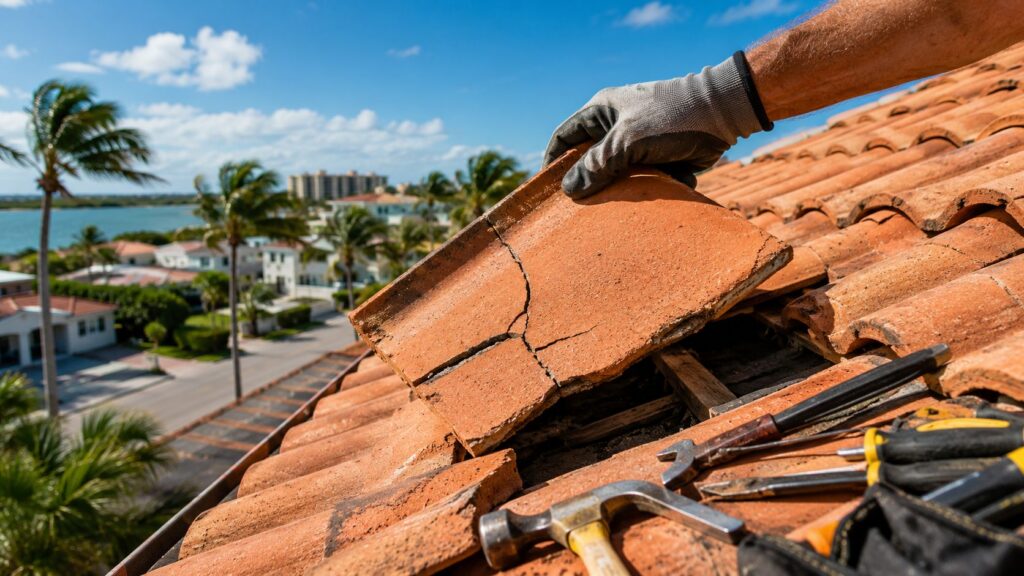
South Florida is hard on metal. Salt air, heat, UV exposure, humidity, and storm cycles all test the fasteners, sealants, and metal itself. A diverter that looks fine on the shelf can fail early if the material doesn't match the environment.

Material matters more in South Florida
The Copper Development Association specifies a minimum suitable fabrication gauge of 16 oz. cold rolled copper for water diverters, which shows how much durability matters when runoff is concentrated, according to the Copper Development Association diverter standard. In coastal and storm-prone climates, roofing guidance commonly points to aluminum and galvanized steel as practical material choices.
Here's the practical view from the roof:
| Material | What it does well | Where it can disappoint |
|---|---|---|
| Aluminum | Resists rust, stays lightweight, fits many residential gutter systems | Can deform if installed poorly or hit hard |
| Galvanized steel | Feels sturdier in concentrated flow areas | Needs proper finish and installation attention in coastal exposure |
| Copper | Premium durability, strong option when detailed correctly | Higher material cost and usually not necessary for every house |
| Vinyl or plastic | Easy to find and simple for light-duty use | Less confidence in harsh sun and storm exposure |
That's why I rarely treat material as an afterthought. In Florida, the diverter is a working part exposed to rough weather, not just trim.
A helpful visual for homeowners comparing roof edge conditions appears in this Florida roof drainage photo reference. It's easier to understand diverter choices when you can see how water loads one area more than another.
Shape and use case should match the problem
Different shapes solve different failures. L-shaped pieces, kick-out style diverters, and simple roof-edge deflectors all redirect water, but not in the same way.
Use this decision lens:
- For an entry drench problem: A straightforward roof-edge diverter often does the job if the gutter itself is sized and pitched properly.
- For roof-wall junction trouble: A kick-out style detail is the right idea because the goal is to kick water away from the wall and toward the gutter instead of letting it sneak behind siding or trim.
- For a valley dump: You may need a wider, stronger diverter or a combination approach, because valley water behaves more like a narrow firehose than a gentle roof sheet.
The right diverter shape follows the water path. If you can't trace the path clearly from roof plane to gutter to downspout, guessing at the shape usually leads to a callback.
The biggest mistake is buying by appearance. The diverter should be chosen by runoff behavior, roof geometry, and gutter capacity. In South Florida, the wrong material or the wrong profile might survive a light shower but fail the first time wind-driven rain stacks pressure on that edge.
Strategic Placement to Solve Common Water Problems
A lot of searches for rain diverters gutters are really searches for “Why is water landing here?” That's the right question. One neutral guide notes that diverters are used when water overshoots gutters, bypasses an entryway, or gets behind siding, and that's different from problems caused by clogged or undersized gutters, as explained in this guide to identifying diverter problems versus gutter problems.
Placement is everything. Put a diverter in the wrong location and it's decoration. Put it at the actual failure point and it can change how the entire edge performs in heavy rain.
Above doors and walkways
This is the most obvious use. Water pours off the roof edge in one narrow band and lands right where people enter the house or cross a slab.
A diverter belongs just upslope of that runoff path so it can split the sheet of water and push it sideways. The point isn't to stop water. The point is to stop that one miserable waterfall over the threshold.
Watch for these clues:
- Consistent splash zone: The same pavers or concrete strip stay soaked every storm.
- Door-side staining: You see recurring splash marks or dirt wash on trim and nearby wall surfaces.
- Mulch migration: Beds near the entry keep getting carved out by falling water.
At roof-wall intersections
When runoff rides down the roof and meets a wall, it needs a controlled exit path. Without the right detail, water can ride behind siding, trim, or cladding instead of entering the gutter where it should.
A kick-out style diverter makes sense here. It acts like the flared end of a funnel. Instead of letting water cling to the wall line, it throws it outward into the gutter.
If water is disappearing behind a wall finish, don't assume the gutter is the only issue. The roof-to-wall transition may be the real weak point.
Under roof valleys that dump too much water
Valleys create concentrated flow. Two roof planes feed the same channel, then release water at one edge. In a mild rain, that may look manageable. In a Florida downpour, it can overshoot the gutter or slam one spot so hard that splashback and overflow start immediately.
A diverter can help by reshaping where that burst of water lands. But this is also the place where site drainage starts to matter. If the overflow lands near a slab edge or low foundation area, the grading and runoff path around the house matter too. For that side of the problem, R.E. and Sons drainage expertise gives a useful homeowner-level view of how surface water should move away from the structure.
Valley problems often need a broader diagnosis:
- Is the valley discharge too concentrated for the gutter opening?
- Is the gutter clean, pitched correctly, and able to move water away fast enough?
- Does the downspout location help or bottleneck the whole system?
That's the difference between a proper fix and a patch that only relocates the mess.
Rain Diverters vs Torrential Downpours A Reality Check
A rain diverter can be the right answer and still not be enough. That's the part many homeowners don't hear until after the next big storm.
In some valley-overload cases, an industry source says a roof water diverter is “likely the best” option, but it also warns that “there's still no guarantee that it will work as desired”. That caution comes from this industry discussion of roof valley overload and diverter limits. It's a fair warning for South Florida, where extreme rain can test every weak point at once.
What a diverter can do well
A diverter is good at redirection. It can take water that lands in the wrong place and guide it toward a better path. That makes it useful for:
- Doorway runoff
- Localized gutter overshoot
- Roof-to-wall transitions
- Some valley concentration problems
In these situations, the diverter acts like traffic control. It reduces a choke point by changing the angle or landing zone of the water.
Where the limits show up
What it can't do is increase the total carrying capacity of the gutter system. If too much water reaches a gutter that's too small, badly pitched, clogged, or paired with poor downspout placement, the diverter just changes where the overload starts.
That's why some homes show the same pattern after a diverter goes in:
- Water no longer falls over the door, but now the gutter spills at the corner.
- The valley lands more cleanly in the gutter, but the downspout can't evacuate fast enough.
- The entry stays drier, but runoff shifts toward a low spot near the foundation.
A diverter solves a directional problem. Capacity problems still belong to the gutter, downspout, and drainage layout.
In hurricane season, realistic expectations matter. Wind-driven rain can push water under, over, and around components that perform fine in ordinary weather. If a roofline is already asking too much from one gutter section, a diverter may buy control in moderate storms and still lose the fight in a slow, hard deluge. That doesn't mean the diverter was useless. It means the house needed a larger water-management correction all along.
Installation Costs and When to Call a Roofing Professional
A rain diverter can be a low-cost fix. It can also become an expensive detour if it gets installed on the wrong problem.
That is the part homeowners in South Florida need to hear clearly. The price is shaped less by the diverter itself and more by what the water is doing, how hard the roof is to reach, and whether the job stops at redirecting runoff or turns into correcting gutter pitch, downspout flow, flashing, or roof edge details. Without verified local pricing, the practical way to judge cost is by job complexity, not a made-up flat number.

DIY can work on simple jobs
A careful homeowner may be able to install a basic diverter on a one-story section with safe ladder access and one clear trouble spot, like water falling over a side door. Even on a simple roof edge, the margin for error is small. One bad fastener location, one poor sealant choice, or one piece set at the wrong angle can trade a runoff problem for a roof leak.
Fit matters too. Diverters and downspout components need to match the existing gutter profile and size, or the fix starts loose and gets worse under heavy rain.
Once a roof has multiple slopes, a valley dumping into one short gutter run, or water crossing from one section to another, the job changes. A good example is this multi-point drainage layout. At that point, installing a diverter without tracing the full runoff path is like putting a traffic sign at one intersection while the highway ahead is still blocked.
When professional installation is the smart move
Call a roofing professional when any of these are true:
- The roof is steep, high, or hard to access: A small drainage repair is never worth a fall.
- Water is showing up behind trim, at soffits, around wall joints, or inside the house: That points to a roof edge or flashing problem, not just surface overflow.
- The gutter may be undersized, clogged, or pitched wrong: A diverter will not add carrying capacity to a weak system.
- A valley, wall transition, or flashing detail is involved: These areas need roofing judgment, not just handyman work.
- The goal is storm performance, not just a quick redirect: South Florida storms expose weak spots fast.
Professional installation has value for three reasons. Diagnosis comes first. Safe access comes second. Long-term performance comes third. On many homes, the real question is not whether a diverter can be attached. The real question is whether that section of roof and gutter will still control water during a long summer downpour or a wind-driven storm.
Paletz Roofing and Inspections handles roof repairs, inspections, and drainage-related edge conditions in South Florida. For homeowners in Broward, Miami-Dade, and Palm Beach counties, that means getting the runoff path checked before the next storm decides whether the diverter is the right fix or just a temporary patch for a larger roofline or gutter problem.