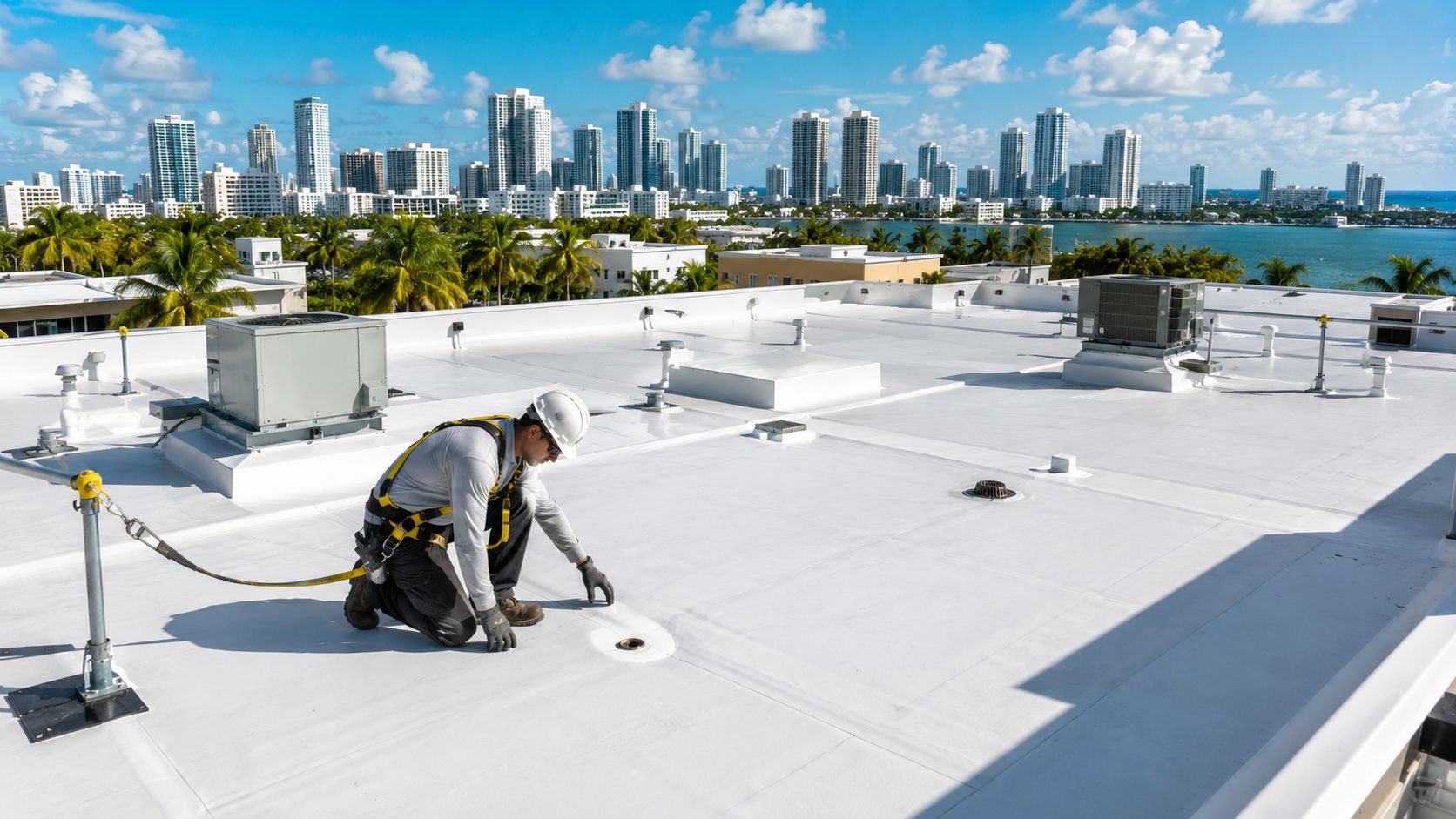
A leaking ceiling over a leased office suite in Miami changes the day fast. The tenant wants to know if their files are safe, the engineer wants to know if the deck is wet, and the owner wants to know whether this is a patch, a dry-in, or a full reroof. In South Florida, that same leak can also trigger a code conversation, because commercial roofing in Miami is never just about stopping water. It's about wind, drainage, access, tenant disruption, and whether every product on the roof has the right paperwork to survive permit review and inspection close-out.
Table of Contents
- What Makes Commercial Roofing in Miami Different
- Commercial Roof Systems That Perform in South Florida
- Cost Ranges and Budget Line Items for Miami Projects
- Code Compliance in the High Velocity Hurricane Zone
- Drainage Design and the Hidden Reason Flat Roofs Fail
- Inspection and Maintenance Schedule That Actually Works
- Warning Signs Beyond the Obvious Leak
- Emergency Repair Workflow and Choosing a Miami Contractor
What Makes Commercial Roofing in Miami Different
A property manager in a leased office tower usually finds out about roof trouble the hard way, when a tenant emails a ceiling stain photo in the middle of the day. In Miami, that stain is usually only the symptom. The roof is fighting salt air, UV exposure, seasonal storms, and code pressure at the same time, and those forces shape every repair decision. In occupied high-rise and mixed-use buildings, the job is never just about stopping water. It is also about keeping tenants informed, staging work so daily operations keep moving, and limiting the noise, odor, and access interruptions that create complaints before the first rain even reaches the deck.
Wind, water, and heat are the real design drivers
Florida's roofing market reflects that reality. The roofing contractors industry in the state is valued at $9.0 billion in 2026, supported by 8,757 businesses and 36,627 employees. Business count and employment were both growing from 2021 to 2026, which tells you the market is mature, busy, and built around constant replacement, repair, and compliance work in places like Miami and South Florida (IBISWorld).
Miami also sits inside a compliance-heavy environment that most cities never face. Miami-Dade is part of Florida's High Velocity Hurricane Zone, so roofing products must carry a valid Miami-Dade Notice of Acceptance, and that approval trail extends to membranes, adhesives, fasteners, insulation boards, edge metal, underlayments, flashing, tiles, and shingles. A product that looks fine in a brochure can still fail inspection if the documentation does not match the assembly. That is why owners and property teams need a contractor who understands both field execution and the paper trail, not just a crew that can start tearing off material.
Practical rule: In Miami, the cheapest roof on paper is often the most expensive roof in the field if it cannot pass wind, drainage, and documentation review.
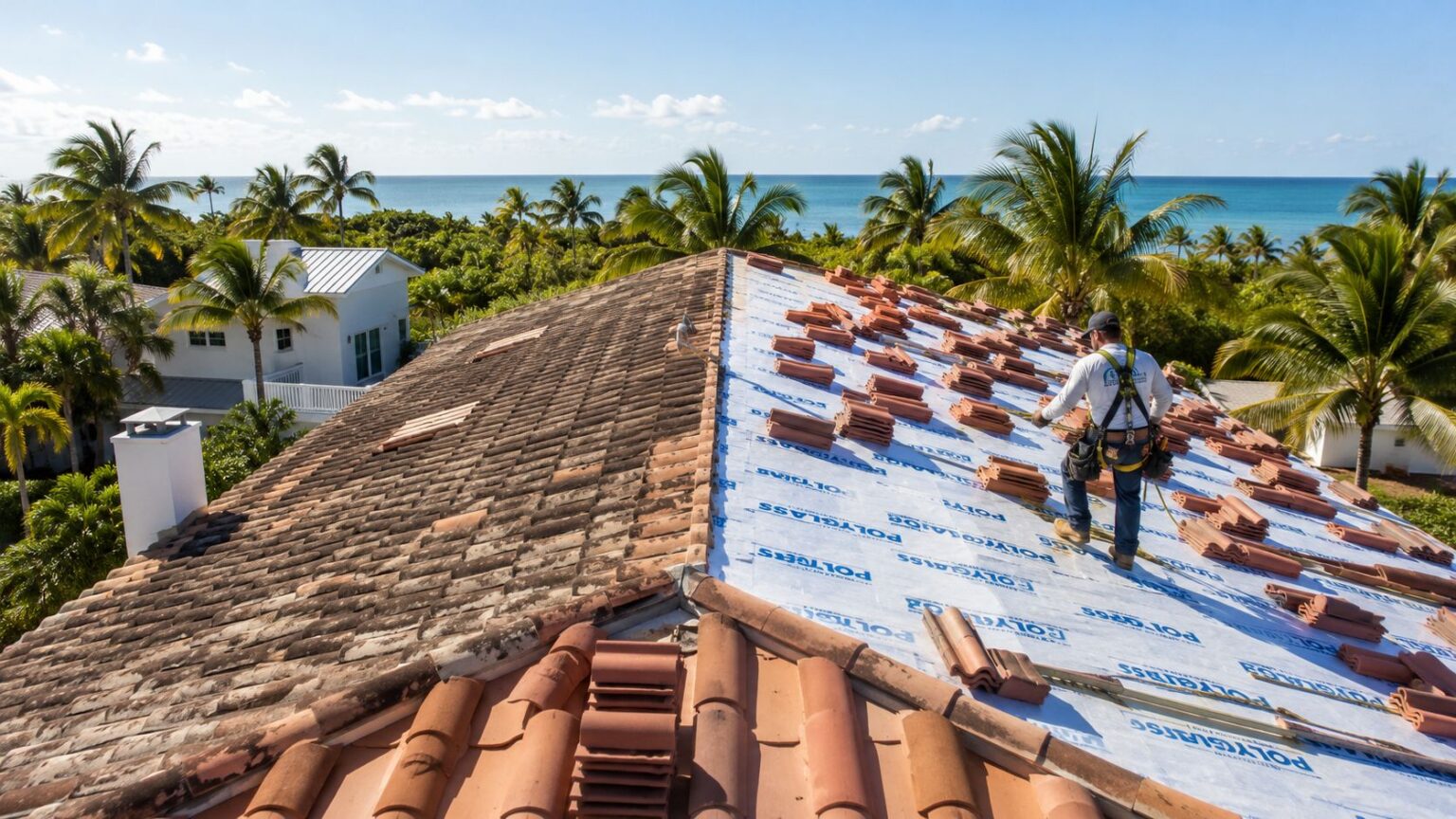
A roof program also has to account for how the building stays open while the work happens. On an office tower, that may mean night work, phased tear-offs, protected walk paths, and clear notices to tenants before crews move equipment above occupied space. On a mixed-use property, it may mean coordinating roof access with loading docks, rooftop equipment shutdowns, and quiet hours so one repair does not turn into a business interruption complaint. A visual reference for that kind of staged work is available in this South Florida roof replacement project photo.
If you are trying to vet contractors or improve how your building appears in search and lead channels, the playbook for optimizing online presence is a useful companion read for the sales side of the equation.
Why Miami is its own discipline
A roof in Miami is built around three forces, wind, water, and heat. Wind drives fastening patterns and edge detailing. Water drives slope, drain layout, and overflow planning. Heat drives membrane selection, seam quality, and maintenance discipline.
That is why the common assumption that any licensed roofer can handle any commercial project falls apart here. A roofer can be licensed and still be wrong for a Miami-Dade high-rise, a coastal retail center, or a mixed-use building with occupied tenants underneath. The building does not care about generic experience. It responds to details, and those details decide whether the roof survives the next storm season or starts leaking into tenant space at the worst possible time.
Commercial Roof Systems That Perform in South Florida
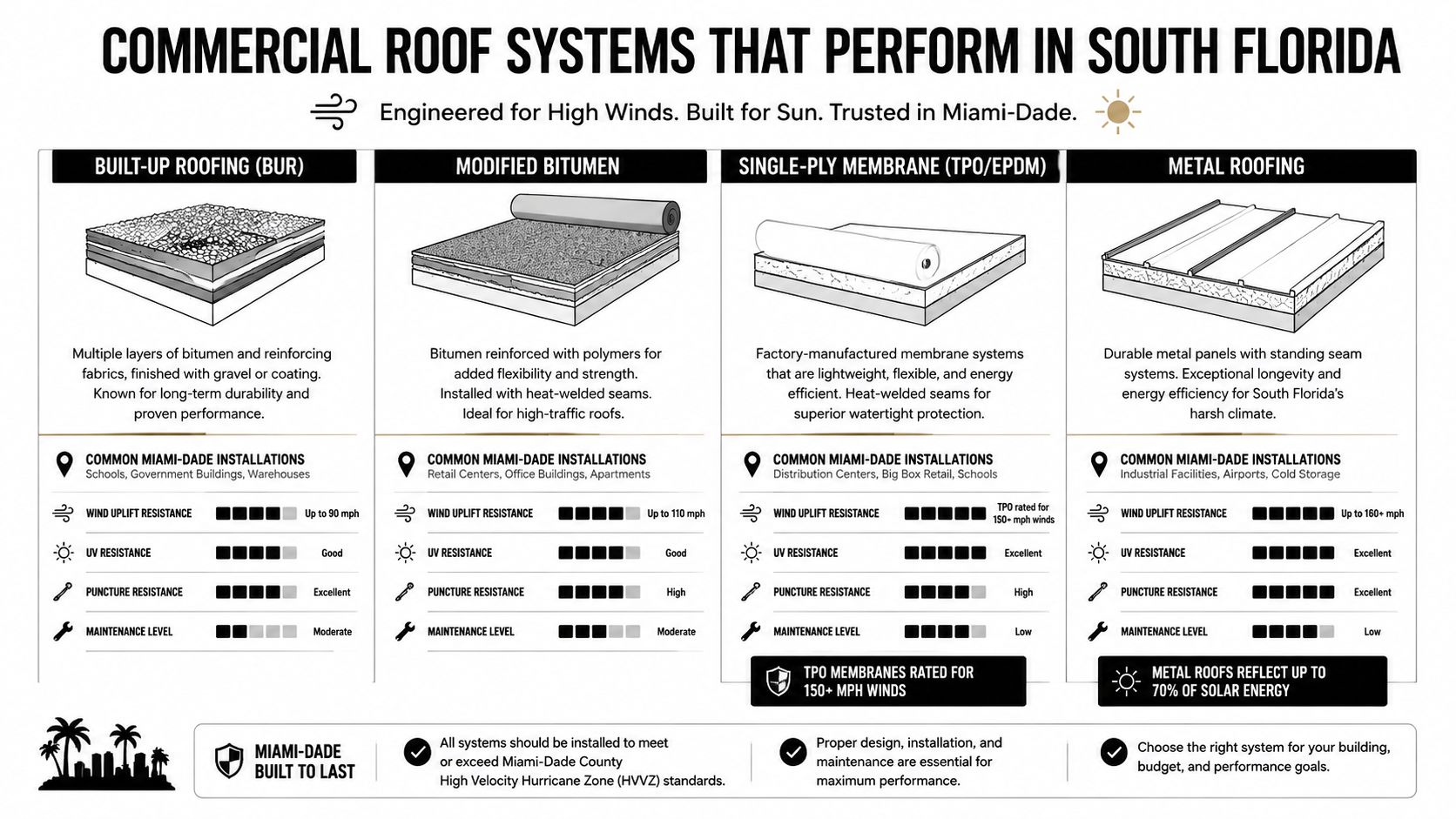
A Miami roof has to work around weather, tenant schedules, and the reality of getting crews, materials, and debris in and out of an occupied building without creating a second problem. The right system depends on exposure, slope, occupancy, and how much interruption the building can tolerate. Single-ply membranes are common because they can be heat-welded at seams and detailed for wind performance, while metal and modified systems still have a place when the building shape or operating model calls for them. There is no universal answer, and anyone selling one is simplifying the job.
On occupied towers and mixed-use buildings, the system choice also affects how work is staged. A roof that can be phased in smaller sections, with clear access routes and short shutdown windows, is easier to complete without tenant complaints, lost operating hours, or last-minute access conflicts. That is a practical consideration, not a marketing one.
What each system is really good at
TPO and PVC are frequent choices on low-slope commercial roofs because they are practical for large areas, fast to install, and compatible with welded seams that hold up well when the work is done correctly. In coastal or highly exposed locations, 80-mil membranes are often specified because durability and seam integrity matter more than membrane thickness alone. A roof that looks similar on paper can perform very differently once wind uplift, heat, and maintenance access are part of the equation.
EPDM can work in South Florida, but it is less often the first choice on high-exposure jobs where heat-welded seams and white reflective surfaces are priorities. Modified bitumen still shows up on smaller commercial buildings and some multifamily properties because it is familiar, repairable, and workable around complicated penetrations. Built-up roofing has its place too, especially on older structures, but it asks for careful maintenance and clean detailing. Standing seam metal is attractive where slope, aesthetics, and uplift resistance matter, though it brings different flashings, attachments, and cost dynamics.
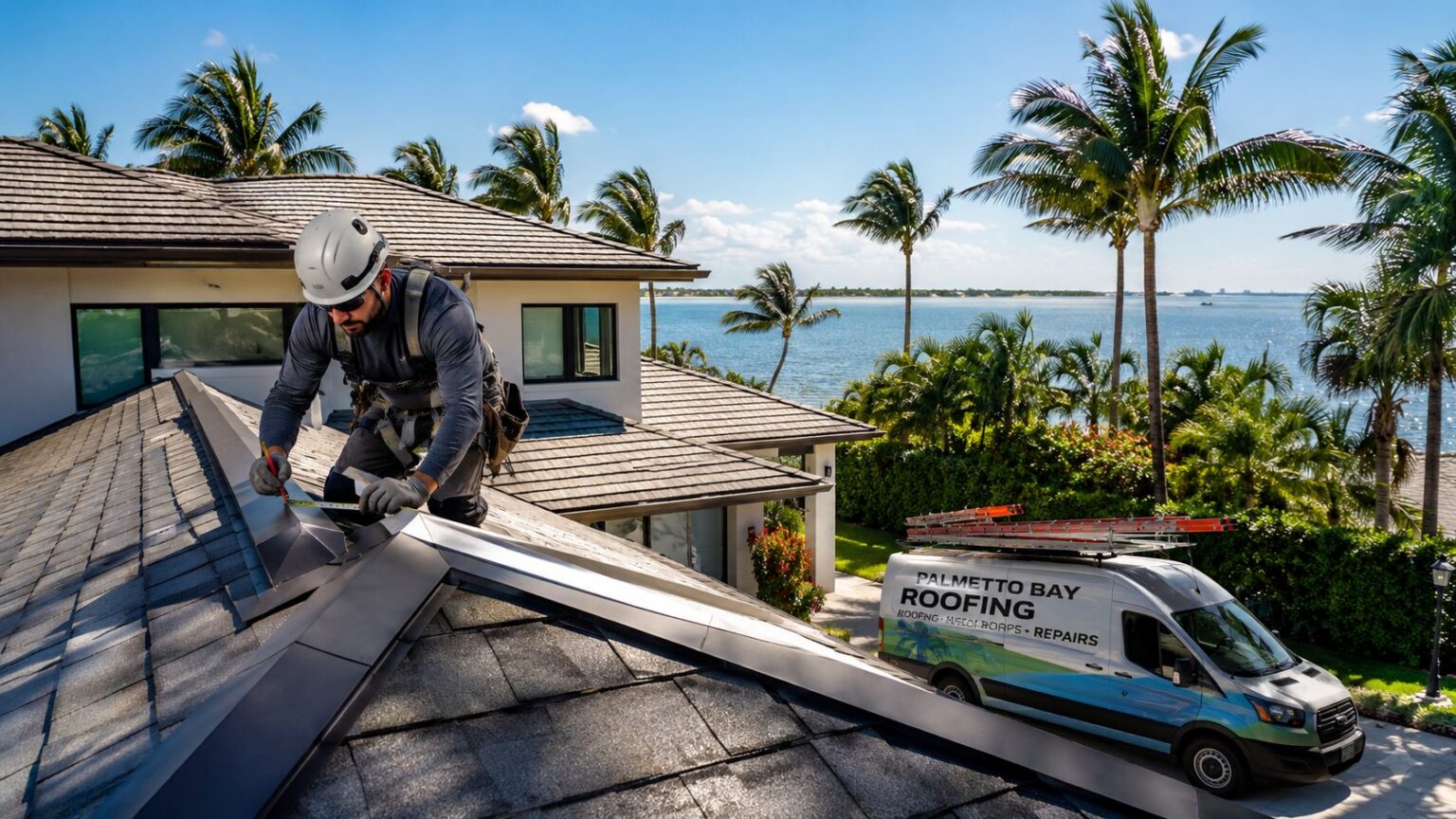
For projects where crews need to verify layout before membrane work starts, the field setup matters as much as the spec. A roof-measurement crew on a South Florida commercial property is the kind of preparation that reduces surprises once tear-off or re-cover work begins.
Bottom line: The system is only as good as the detailing at seams, edges, curbs, and penetrations.
How to choose without guessing
A workable selection framework looks like this.
- Slope: Low-slope roofs point you toward membrane systems, while steeper commercial sections can accept metal or tile.
- Exposure: Coastal wind and constant sun push owners toward tougher seams, stronger edges, and cleaner maintenance access.
- Occupancy: If tenants cannot tolerate noise or long closures, staging and installation speed matter as much as material choice.
- Budget: Lower upfront cost only makes sense if the roof assembly, drainage, and access logistics match the building.
| System | Installed Cost per sq ft | Typical Service Life | Best Fit |
|---|---|---|---|
| Built-Up Roofing | Not stated in the verified data | Not stated in the verified data | Older low-slope buildings that need layered waterproofing |
| Modified Bitumen | Not stated in the verified data | Not stated in the verified data | Small commercial and multifamily roofs with many penetrations |
| Single-Ply Membrane, TPO or PVC | Not stated in the verified data | 25 to 30 years with routine maintenance | Large low-slope roofs, especially exposed coastal sites |
| Metal Roofing | Not stated in the verified data | Not stated in the verified data | Sloped commercial sections, visible buildings, high-wind applications |
Cost Ranges and Budget Line Items for Miami Projects
Budget conversations in Miami get distorted when owners compare only the membrane price. The actual number depends on what's underneath, what the code requires, and how hard it is to move material, equipment, and people around the building. A roof can look affordable until deck work, drainage correction, or access constraints show up.
What pushes the price up
The quiet budget drivers are usually the ones nobody wants to talk about at the first bid meeting. Deck remediation can change the entire scope if the substrate is damaged. Tapered insulation is often part of a proper drainage fix, not a luxury add-on. Code-driven edge metal and NOA-documented fasteners can also increase labor and material costs because Miami-Dade expects the assembly to match approved documentation, not just look complete.
Dense neighborhoods add another layer. Crane staging, dumpster placement, tenant coordination, and restricted work windows all affect how fast crews can move and what the building can tolerate while the work is happening. On occupied towers and mixed-use properties, disruption management is part of the roof cost, whether it's written clearly or buried in the contractor's overhead.
How owners should read a proposal
A good proposal separates the roof assembly from the conditions of the building. If two bids are far apart, compare the line items, not just the bottom line. One may include drainage correction, access logistics, and compliance documentation, while the other assumes the deck is perfect and the building is empty.
| Typical South Florida Commercial Roof Cost Ranges | |||
|---|---|---|---|
| System | Installed Cost per sq ft | Typical Service Life | Best Fit |
| TPO or PVC | Not stated in the verified data | 25 to 30 years with routine maintenance (Extreme Roofing Miami) | Low-slope commercial roofs |
| Modified Bitumen | Not stated in the verified data | Not stated in the verified data | Small commercial and multifamily roofs |
| Built-Up Roofing | Not stated in the verified data | Not stated in the verified data | Layered waterproofing applications |
| Metal Roofing | Not stated in the verified data | Not stated in the verified data | Sloped commercial roofs and exposed buildings |
For a facilities leader, the key question isn't “What's the cheapest system?” It's “What does this roof need beneath the surface to survive Miami conditions without repeated disruption?”
Code Compliance in the High Velocity Hurricane Zone
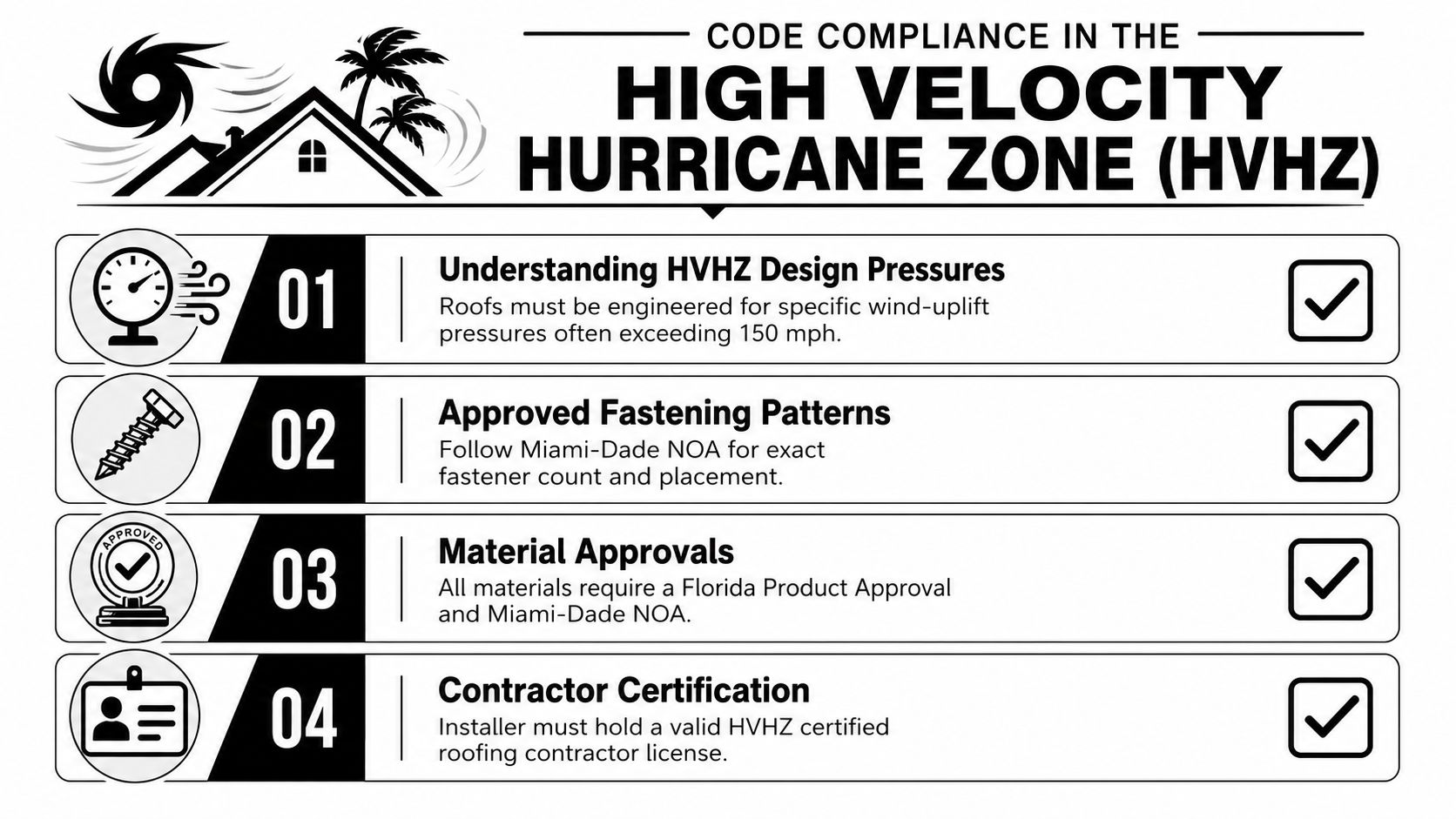
A Miami roof lives under a different rulebook. Miami-Dade sits inside the High Velocity Hurricane Zone, so the code conversation starts with uplift, fastening, and approved assemblies, not with color, brand, or sales copy. A commercial roof here has to be accepted as a complete system under the Florida Building Code, and that changes how owners should read every proposal from the first page to the last detail sheet (Miami Roof Tech).
What the paperwork has to prove
A Miami-Dade Notice of Acceptance is the record that ties a product to the HVHZ. If the membrane, adhesive, fastener, insulation board, edge metal, underlayment, flashing, tile, or shingle does not match the approved documentation, inspection can stop there, even if the roof looked fine during the install. The same problem shows up when a contractor swaps a listed component for a similar one that was never tested in that assembly (HVHZ guide).
Practical rule: If it isn't in the submittal package, it doesn't exist for inspection purposes.
What owners should demand before signing
Before you approve a contract, ask for the documents that connect the roof to the code and to the actual field work.
- Miami-Dade NOA for each major product: Membrane, fastening system, edge metal, and underlayment should all be traceable.
- Florida Product Approval documents: The installed system should match the approved assembly, not a generic product sheet.
- Fastener pattern details: You need the exact attachment layout, not a verbal assurance.
- Wind-uplift design basis: The proposal should show that the roof is engineered for the required pressures.
- Installer qualification: The contractor should show HVHZ experience on similar buildings.
Owners make the same mistake over and over. They hear “Miami-Dade approved” and treat it like a product badge. It is really a chain of proof. That proof only holds when the field installation matches the approval, from the first fastener to the last piece of edge metal.
Drainage Design and the Hidden Reason Flat Roofs Fail
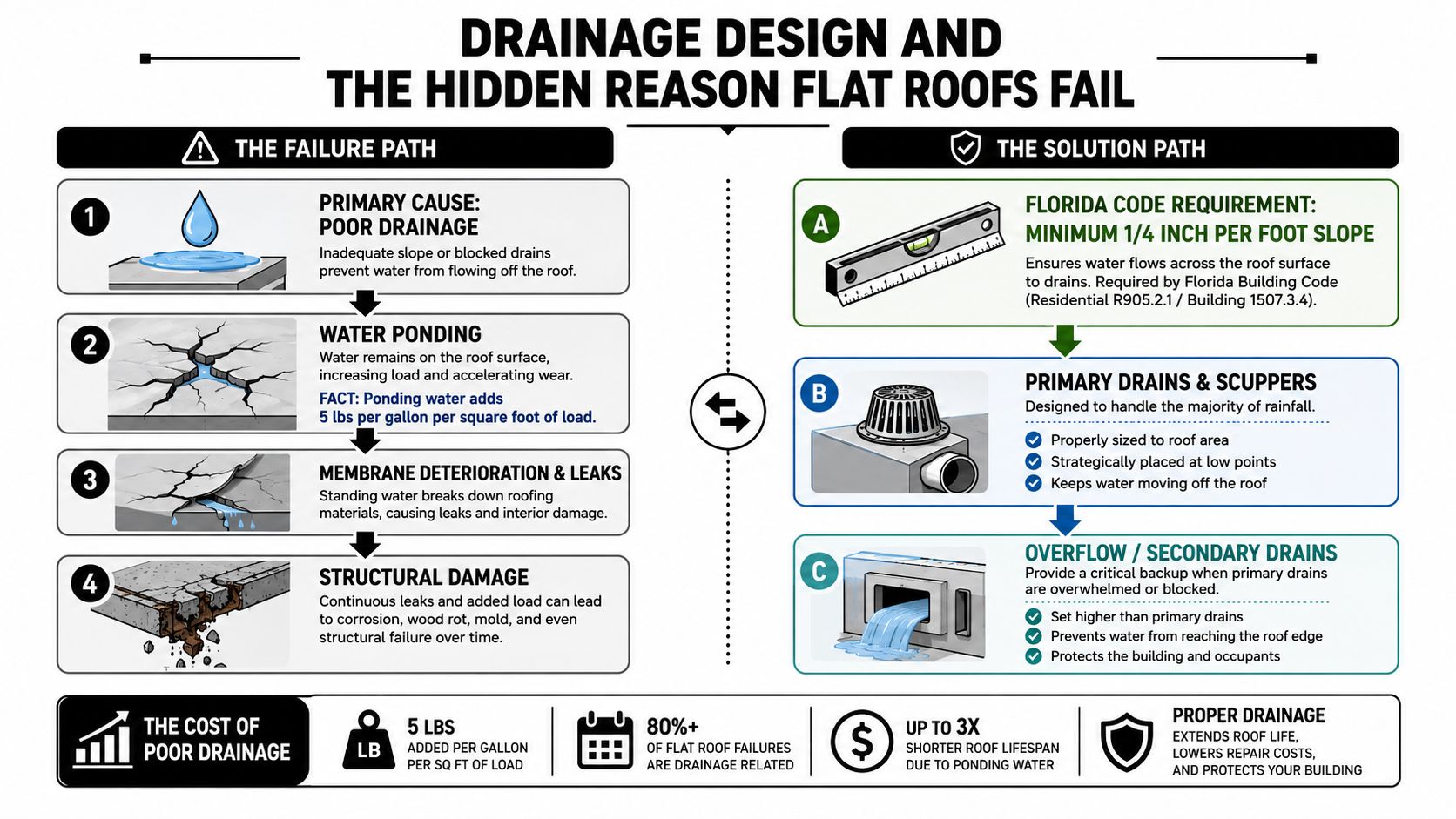
Most Miami flat roofs don't die because the membrane was born bad. They fail because water sits where it shouldn't, the roof loads up, and the membrane gets punished until seams, flashings, and transitions start breaking down. Drainage is not a finishing touch in South Florida. It's a structural decision.
Why ponding is a system problem
Florida commercial low-slope roofs in Miami typically must be designed with a minimum slope of 1/4 inch per foot, and the drainage layout must include primary drains and emergency overflow drainage. The code guidance also calls for tapered or cricketted drainage behind obstructions wider than 24 inches, with overflow outlets set at least 2 inches above the primary outlet (Florida commercial flat roof regulations guide).
That matters because ponding water shortens the life of the roof. It adds load, holds heat, and keeps seams wet longer than they should be. If a membrane system is otherwise decent but the roof has dead spots near curbs or parapets, the weak point becomes the drainage pattern, not the sheet itself.
What to watch on inspections
A competent walkthrough should focus on where water goes, not just on whether the membrane looks clean.
- Drains and scuppers: Clear debris, check for slow flow, and look for staining that shows backup.
- Curbs and equipment pads: Watch for water collecting behind HVAC units or other obstructions.
- Ponding zones: Repeated dark areas or residue rings often tell you where the roof is holding water.
- Overflow outlets: Make sure they're not blocked and that they sit at the correct elevation.
If tapered insulation shows up in a reroof quote, it usually belongs there. In Miami, leaving drainage “as is” is how a good membrane gets dragged into early failure.
Inspection and Maintenance Schedule That Actually Works
Annual inspection language sounds fine until a summer storm leaves debris in the drains or a spring heat cycle opens a seam at the wrong spot. Florida's practical cadence is twice per year, ideally in the spring and fall (Weather Guard Roofing). That schedule works because it catches seasonal wear before it turns into concealed damage.
What a real inspection should include
The best reports are specific. They should show photos by roof zone, drain condition, seam status, flashing condition, edge metal, and a written action list. If a contractor only says “roof looks good,” you don't have a maintenance record. You have a conversation.
- Spring review: Look for winter storm damage, clear drains, and inspect flashings.
- Fall review: Check before hurricane season, test emergency drains, and secure loose items.
- After major storms: Start with a ground-level visual check, then bring in a professional if anything looks off.
A maintenance contract should tell you what was checked, what was cleaned, what was repaired, and what still needs attention.
Why concealed damage matters
Water problems often show up as indoor staining, musty odors, or slight sagging before anyone sees a major leak. That's why a wall stain should trigger more than a towel under the drip. It should trigger a moisture review, especially if the area is near a roof penetration or a space that gets repeated ponding above it (Salomon Roofing).
For occupied buildings, the maintenance plan should also tell tenants when crews will be on the roof, which access points will be used, and how noise or roof traffic will be handled.
Warning Signs Beyond the Obvious Leak
By the time water stains a ceiling tile, the roof has usually been failing for a while. The expensive part is often the delay, not the patch. That delay lets moisture move into insulation, deck materials, finishes, and sometimes the air quality of the space below.
The signals owners miss
Indoor staining is the easiest clue to spot, but it is not the only one. Musty odors, subtle sagging, and mold growth near rooftop penetrations often show up before anyone notices an active drip. On a flat roof, repeated dampness around curbs and penetrations usually points to a chronic problem above the ceiling line rather than a one-time storm event.
A simple interior walkthrough can catch a lot early. Focus on conference rooms, top-floor corridors, storage areas, and perimeter offices where staining often appears first. Look at the ceiling line near HVAC chases, plumbing stacks, and other roof penetrations. If a building is occupied, I also tell property teams to coordinate access so the inspection does not disrupt tenants or create a safety issue, because missed warning signs usually cost more than a careful walk-through.
What to do when you see a sign
- Document the condition immediately. Take photos from the room and note the time and location.
- Isolate the area if needed. Move contents away from the wet zone and protect flooring.
- Request a roof and moisture assessment. A visible stain is not enough to define the repair scope.
- Track the recurrence. If the same area stains again, treat it as a roof system problem, not a cosmetic one.
For owners dealing with occupied space, the response should also include tenant notices, roof access planning, and a clear work window for any repairs. That keeps the issue contained instead of turning a localized leak into a day of complaints, wet inventory, or elevator traffic around a repair crew. For a broader planning view, see expert advice on SBA brokers when you are weighing how a repair or replacement will affect cash flow.
If the same area keeps showing signs of moisture, bring in a qualified roofer and ask for a written scope that separates temporary drying from permanent repair. A roof that keeps staining is telling you the system needs more than a patch, and the final repair plan should be built around that reality. For example, a staged repair plan in an occupied building may also need to account for staging equipment and access routes, as shown in this roof replacement installation reference.
In occupied Miami buildings, the interior condition often gives you the first clue that the roof needs more than a patch. If you wait for the leak to become dramatic, you are usually paying for hidden damage that started much earlier.
Emergency Repair Workflow and Choosing a Miami Contractor
When water is coming through the ceiling, the building has two jobs at once. The interior needs to be stabilized fast, and the roof needs a temporary dry-in that holds until permanent work can be scheduled. A tarp and a promise will not protect occupied space, inventory, or tenant operations.
What the first 24 hours should look like
Start with the building, not the roof. Protect tenants, move sensitive items, and shut down any area that could take more water. Then photograph the damage, note the affected zones, and set access points so the contractor can stage safely without interrupting normal operations.
The response should also include tenant notices, rooftop access planning, security coordination, and a noise window for occupied buildings. That applies to a high-rise condo, a mixed-use property, and an office tower. The repair has to stop the leak without turning a localized problem into elevator backups, wet stock, or a day of complaints.
How to vet the contractor
Choose on documentation and relevant experience, not the fastest pitch. A contractor should be able to show a valid Florida roofing license, insurance coverage, HVHZ familiarity, and a written scope that matches the roof's approval path. If they have worked on similar buildings in Miami-Dade, Broward, and Palm Beach counties, they usually understand access, staging, and post-storm pressure better than a generalist.
For owners planning a larger capital project, financing can also affect timing and scope. The expert advice on SBA brokers can help owners think through that side of the decision when the roof is part of a broader building investment.
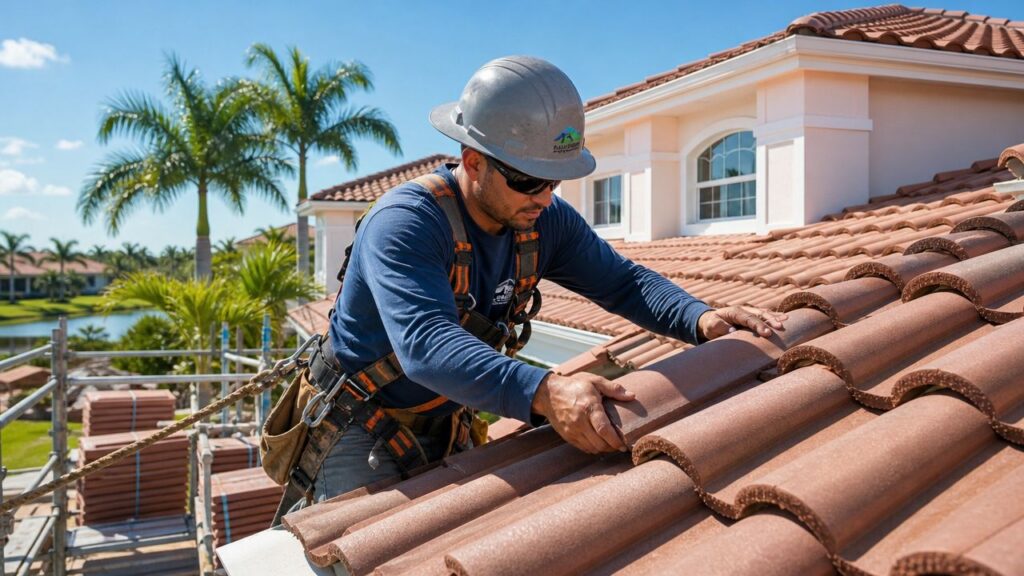
A staged roof replacement in an occupied area has to account for equipment placement, worker access, tenant movement, and the path materials take across the site. That planning shows up in the roof replacement installation reference, and it is the same kind of control a commercial owner should expect from any contractor working around active operations.
Paletz Roofing and Inspections handles commercial roofing, inspections, repairs, and reroofing across Broward, Miami-Dade, and Palm Beach counties, which makes it a practical option when a building needs both code-aware scope and occupied-building coordination. Ask for an on-site assessment, a written scope tied to the required approvals, and a clear warranty path before you sign.