The average roof replacement cost in Florida usually lands somewhere between $7,000 and $18,000 for a typical home. Of course, that’s just a ballpark—prices can dip as low as $6,000 or climb well over $30,000 depending on the materials you choose, your home's size, and the project's complexity.
Understanding Florida Roof Replacement Costs
Trying to pin down the cost of a new roof in the Sunshine State isn't a simple, one-size-fits-all calculation. It’s more like putting together a puzzle; the final price depends on several unique pieces clicking into place. Your home’s specific needs, your location, and the materials you pick all play a huge role in the final quote you'll receive.
Because of Florida's wild weather and incredibly strict building codes, a roof replacement is a major—but absolutely necessary—investment. For a standard 2,000-square-foot home, most homeowners should budget between $7,000 and $18,000. If you opt for high-end materials or have a more complicated roof design, you could see that number push toward $30,000. You can discover more insights about Florida roofing costs to get a deeper dive into the numbers.
A Quick Look at Average Costs
To give you a clearer starting point, it helps to see how the price tag shifts based on your home’s square footage. A smaller, single-story home naturally needs fewer materials and less labor, keeping the costs down. On the other hand, a sprawling two-story house will definitely command a higher budget.
Key Takeaway: While materials are a huge cost driver, don't forget that roughly 40% to 60% of your total bill pays for skilled labor. That's a critical investment to ensure your roof is installed correctly and meets Florida's demanding hurricane codes.
To help you get started, here's a simple breakdown of what you might expect to pay for a standard asphalt shingle roof. It's by far the most common choice for budget-conscious homeowners across the state.
Estimated Roof Replacement Cost in Florida by Home Size
This table offers a quick overview of typical cost ranges for standard asphalt shingle roofs based on the square footage of the home.
| Home Size (Square Feet) | Average Cost Range |
|---|---|
| 1,500 sq. ft. | $6,000 – $11,000 |
| 2,000 sq. ft. | $7,000 – $18,000 |
| 2,500 sq. ft. | $9,000 – $22,000 |
| 3,000 sq. ft. | $11,000 – $27,000 |
Think of this table as a solid baseline for your budget. In the next sections, we'll dig into the specific factors that push these numbers up or down, from material choices to regional price differences you'll find around the state.
What Really Drives the Cost of a New Roof
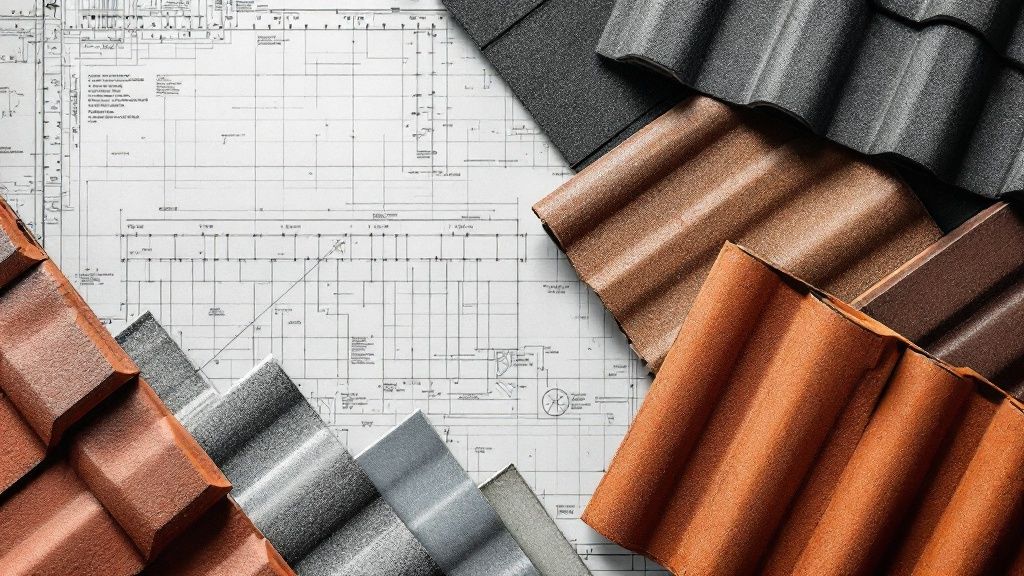
Trying to understand the final roof replacement cost Florida homeowners will pay is a bit like decoding a recipe. The total price isn't one single item; it's a mix of several key "ingredients" that all contribute to the final quote you see. While the materials themselves are a big piece of the puzzle, they’re only part of the story.
The biggest cost drivers often have nothing to do with the shingles you choose and everything to do with the unique challenges your home presents. These details dictate the amount of time, labor, and specialized work needed to get the job done right.
Your Roof’s Unique Characteristics
The size of your roof is the most obvious factor—a bigger surface area needs more materials and more hours of labor. Simple enough. But the complexity of your roof is just as important, if not more so.
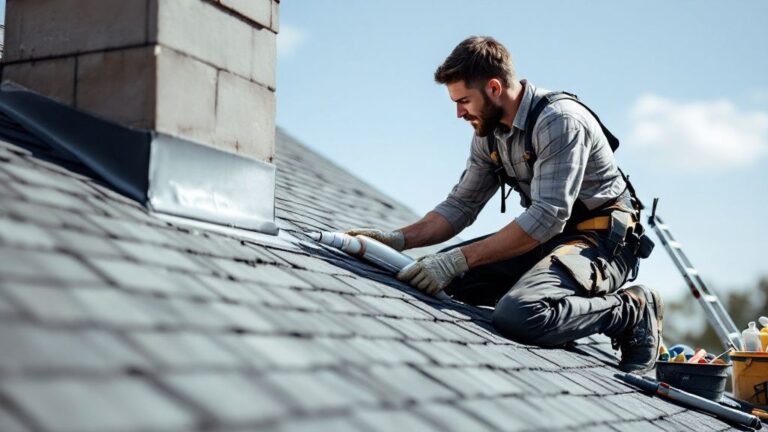
Picture a straightforward, single-story ranch home. Now, compare that to a two-story house with multiple peaks, valleys, dormers, and skylights. That intricate design demands a whole different level of skill and time from the installation crew. Every single angle, chimney, and vent has to be precisely cut, flashed, and sealed to keep water out.
This added complexity directly bumps up the labor costs, which can easily account for 40% to 60% of your total bill.
The roof's pitch, or its steepness, also plays a huge part. A steep roof is more dangerous and much harder to work on. It requires extra safety equipment and a slower, more deliberate approach from the roofers. All of that translates to higher labor charges compared to a low-slope roof you can easily walk on.
Labor Rates and Essential Services
Beyond the roof itself, a professional quote bundles in several other non-negotiable services that are essential for a proper replacement.
- Tear-Off and Disposal: Your old roofing material has to be completely stripped off and hauled away. This is a tough, labor-intensive job that can add $500 to $1,500 to the cost, especially if you have heavy materials like tile.
- Permits and Inspections: Florida has some of the strictest building codes in the country, and for good reason. Your contractor has to pull the right municipal permits and pass inspections, which is mandatory. These fees usually run from $150 to $400 and ensure your new roof is ready to face a hurricane.
- Underlying Damage Repair: You never really know what’s hiding under the old shingles until they come off. If the crew finds rotted decking or damaged trusses, those structural problems have to be fixed before the new roof goes on. If your replacement is due to storm damage, using a homeowner's guide to property damage assessment can give you a better idea of what to expect.
Florida Code Compliance: A huge portion of Florida is classified as a High-Velocity Hurricane Zone (HVHZ), which means roofs have to meet incredibly stringent standards. This often requires specific fasteners, stronger underlayment, and other reinforcements that add to the cost but are absolutely vital for protecting your home.
When you understand where all these individual costs come from, a contractor's quote starts to make a lot more sense. You can see exactly where your money is going. It’s not just about buying shingles; it's about investing in a complete roofing system built to stand up to Florida’s wild weather.
How Your Choice of Roofing Material Shapes the Price
If there's one decision that will make or break your roofing budget, it's the material you choose. It's the single biggest factor shaping the final price tag.
Think of it like buying tires for a car you plan to drive through Florida's wild weather every single day. A basic set gets the job done for now, but a premium set gives you far better performance and lasts a whole lot longer—for a price. The same logic applies directly to your roof. The roof replacement cost Florida contractors quote you will hinge on this choice, forcing you to balance your upfront budget with long-term goals for durability and storm resistance.
The Main Contenders in Florida Roofing
In the Sunshine State, a few key players dominate the residential roofing scene. Each one comes with its own price point and set of benefits, so understanding their profiles is the first step toward a smart investment.
- Asphalt Shingles: This is the undisputed champion of budget-friendly roofing. It's the go-to for countless Florida homeowners who need a reliable roof without a massive initial layout.
- Metal Roofing: Gaining serious traction for good reason, metal offers incredible durability and a seriously long lifespan. It's a solid mid-to-high-range option that pays for itself over time.
- Tile Roofing (Clay or Concrete): The premium choice, tile gives you that classic Florida aesthetic and can last for generations. It comes with the highest upfront cost but offers timeless value.
The price differences aren't small. For example, economical and popular asphalt shingles usually run between $5 and $10 per square foot installed. If you step up to a durable metal roof, you're looking at the $7 to $15 per square foot range. At the top of the ladder, classic tile roofing commands anywhere from $10 to $25 per square foot, a price that reflects its premium quality and the skilled labor needed to install it.
To help you compare these options side-by-side, we've put together a quick reference table.
Florida Roofing Material Cost and Feature Comparison
This table breaks down the price, lifespan, and key advantages of the most popular roofing materials you'll find here in Florida.
| Material Type | Cost Per Square Foot | Average Lifespan | Key Advantages |
|---|---|---|---|
| Asphalt Shingles | $5 – $10 | 15-20 Years | Most affordable upfront cost, wide variety of colors and styles, quick installation. |
| Metal Roofing | $7 – $15 | 40-70 Years | Excellent durability, high wind resistance, energy-efficient, low maintenance. |
| Tile (Clay/Concrete) | $10 – $25+ | 50-100+ Years | Superior longevity, classic aesthetic, fireproof, excellent in coastal/salty air. |
As you can see, the relationship between cost, lifespan, and benefits is pretty clear. Each material offers a distinct value proposition for Florida homeowners.
Weighing Initial Cost Against Long-Term Value
It’s incredibly tempting to just look at the initial quote and pick the lowest number. But a cheaper roof today can easily lead to more headaches and expenses down the road. An asphalt shingle roof might only survive 15-20 years under the relentless Florida sun, while a metal or tile roof can cruise past the 50-year mark with ease.
This infographic gives you a great visual of how roof replacement costs can shift depending on where you are in Florida, a factor driven by both labor rates and common material choices.
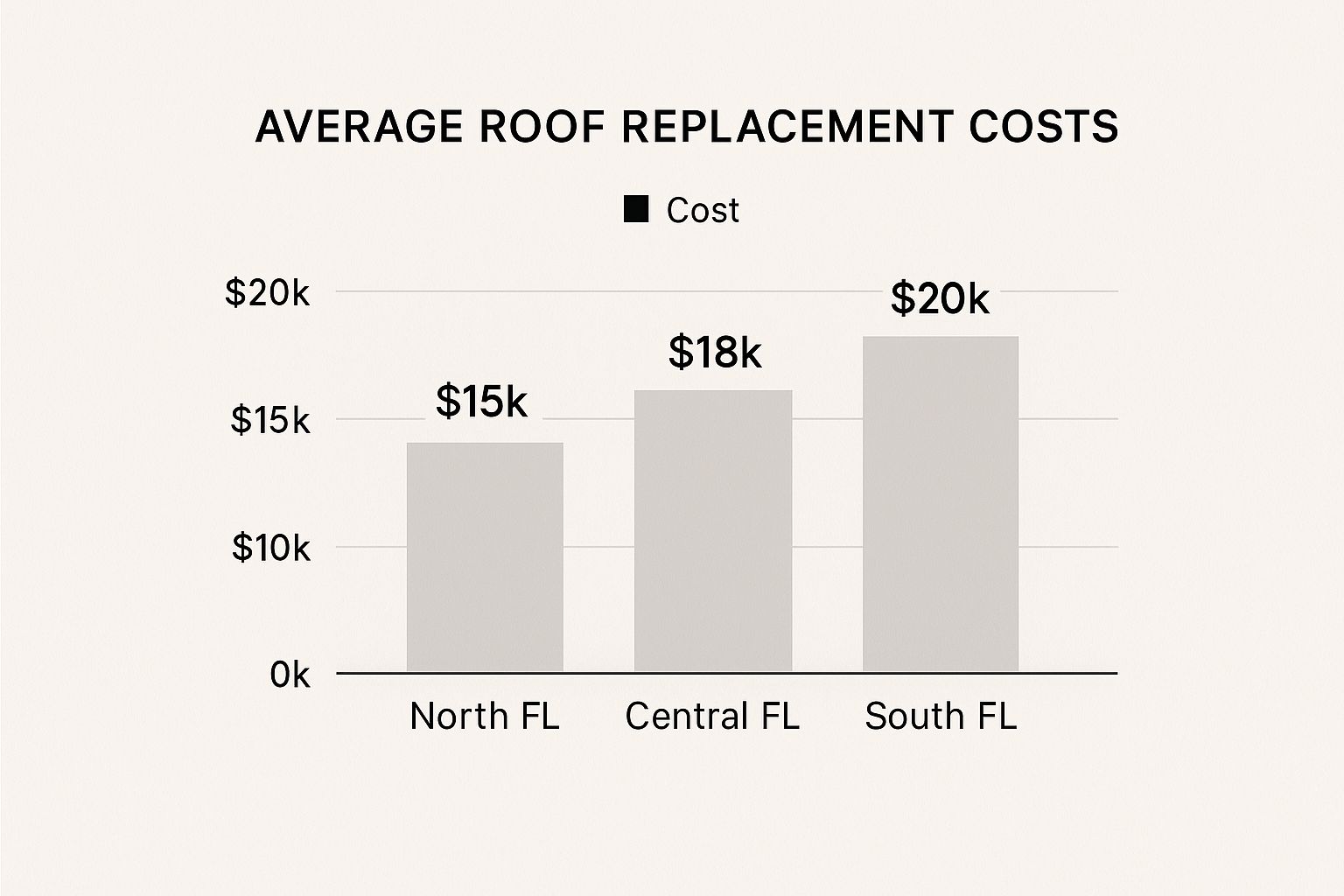
As the chart clearly shows, prices tend to climb as you head south. Stricter building codes and higher demand for labor in South Florida often push the total project cost up. This is a key piece of the puzzle to consider along with your material choice. You can explore our gallery of completed roofing projects to see how these different materials look on homes right in your area.

The Long-Term Equation: A $12,000 asphalt roof that you have to replace in 20 years really costs you $600 per year of service. A $25,000 metal roof that lasts 50 years? That comes out to just $500 per year, delivering much better long-term value despite the higher sticker price.
Ultimately, the "best" material is the one that fits your budget and lines up with how long you plan to be in your home. Every option here provides a solid path to a safe, secure roof over your head.
Why Roofing Costs Vary Across Florida

It’s a common mistake to think the roof replacement cost Florida homeowners pay is the same from the Panhandle down to the Keys. In reality, your zip code plays a massive role in the final quote you'll get. A new roof in Miami simply doesn't carry the same price tag as an identical one in Jacksonville, and the reasons go far beyond just the materials.
The Sunshine State is a diverse economic landscape, and that directly impacts your roofing budget. Think about it: local labor rates, the cost to transport materials, and city-specific building codes all create a unique pricing environment in each region. A roofer in a high-cost-of-living area like Naples will naturally have higher overhead than one in a more rural part of Central Florida.
This regional difference is especially true when it comes to labor, which often makes up the biggest chunk of your total bill.
Labor Markets and Post-Storm Demand
Labor is the most fluid part of any roofing estimate, and it’s heavily influenced by simple supply and demand. In a densely populated area like South Florida, the pool of skilled, licensed roofers is larger, but so is the demand for their services. This competition can sometimes keep prices stable, but it can also drive them up for the best, most reputable crews.
But everything changes after a major storm.
When a hurricane barrels through a specific region, the demand for qualified roofers skyrockets overnight. This sudden surge creates a major labor shortage, causing prices to spike in the affected areas as contractors are stretched thin. Homeowners in these hard-hit zones often find themselves paying a premium for immediate, quality work. This is a critical factor to remember when planning for potential roof damage during hurricane season.
Key Insight: After a major storm, the cost for the exact same roofing job can jump by 10-20% or more in affected counties. It's a direct result of the sudden, overwhelming demand for both labor and materials.
A Tale of Two Cities Price Comparison
To see this in action, let's look at some real-world numbers. While the statewide average for a new roof in 2025 is around $25,080, the local figures tell a much more precise story. For example, homeowners in Miami and Fort Lauderdale can expect to see an average cost closer to $26,220, with labor alone accounting for over $15,700 of that total.
Now, head north to Orlando or Daytona Beach, and the average total dips to $23,940. That difference is a perfect illustration of how local economies and building regulations directly impact your bottom line. Statewide, labor consistently makes up about 60% of the total project expense, which really drives home its significant role in the final price. You can learn more about Florida roofing cost calculations to see how your city stacks up.
Understanding these regional differences is the key to setting a realistic budget. It ensures you’re not just guessing but are basing your financial plans on what homeowners in your specific area are actually paying.
Smart Ways to Manage Your Roofing Budget
Knowing what goes into the roof replacement cost Florida homeowners pay is one thing; actually getting a handle on those costs is another. A new roof is a big-ticket item, no doubt about it. But with the right game plan, you can make it more affordable without ever sacrificing the quality and safety your home needs.
Thinking strategically can turn a necessary expense into a smart long-term investment. It’s not just about chasing the lowest price—it's about locking in the best possible value for your money.
Get Multiple Itemized Quotes
Whatever you do, don't just sign off on the first quote that lands in your inbox. Make it a rule to get at least three to five detailed, itemized estimates from reputable, licensed contractors. An itemized quote is crucial because it breaks down everything—materials, labor, permits, debris disposal—so you can see exactly where every dollar is going and make a true apples-to-apples comparison.
This simple step helps you instantly spot bids that are way too high or suspiciously low. Both are red flags, signaling either overcharging or dangerous corner-cutting.
Consider Scheduling and Material Choices
Timing can be everything. If you have the flexibility, try to schedule your roof replacement during the off-season. In Florida, that’s usually late fall through early spring. Contractors aren't as swamped as they are during the post-hurricane rush, which means you’ll likely find more competitive pricing and better availability.
Investing a little more in certain materials upfront can also unlock some serious long-term savings.
- Energy-Efficient Shingles: Choosing reflective shingles or cool-roof coatings can dramatically lower the temperature in your attic. That translates directly to lower air conditioning bills, often by 10-15%, during those brutal summer months.
- Impact-Resistant Materials: Opting for stronger materials like metal or specially rated shingles can make you eligible for hefty discounts on your homeowners insurance premiums. In many cases, the insurance savings pay for the initial upgrade in just a few years.
Expert Insight: It’s a classic trade-off. A higher upfront cost for durable, storm-rated materials almost always leads to a lower lifetime cost. You'll spend less on repairs down the road, enjoy lower utility and insurance bills, and you might just avoid a premature replacement after the next big storm rolls through.
Explore Financing and Long-Term Savings
Don't let the initial sticker shock put your project on hold. Many established roofing companies offer flexible financing options that let you break down the cost into manageable monthly payments. This makes getting a high-quality roof much more accessible without having to drain your savings account.
Of course, implementing smart strategies to keep expenses in check is essential for any homeowner; you can dive deeper into these expert strategies to reduce construction costs.
By pulling all these tactics together—getting detailed quotes, scheduling strategically, choosing smart materials, and looking into financing—you can take firm control of your roofing budget. You’ll turn a daunting expense into a manageable and wise investment in your home’s future.
Choosing the Right Contractor and Avoiding Mistakes
Let’s be honest—even the best roofing materials on the market won’t do you any good if they’re installed poorly. Shifting your focus from what you buy to who you hire is the single most important decision you'll make. It’s what separates a smart investment from a costly nightmare.
Finding the right team isn't about crossing your fingers and hoping for the best. It’s a deliberate process. A true professional will have no problem showing you their credentials, while a shady operator will get cagey or vague. That’s your first filter.
Your Contractor Vetting Checklist
Before you even think about signing a contract, make sure any potential roofer can tick these boxes. This isn't just paperwork; it's your protection against shoddy work, future repair bills, and legal trouble.
- Florida Licensing: They must have a current Certified Roofing Contractor (CCC) or Certified General Contractor (CGC) license. You can and should verify this with the Florida Department of Business and Professional Regulation (DBPR).
- Proof of Insurance: Ask to see the actual certificates for both general liability (to protect your property) and worker's compensation (to cover their crew). Don't just take their word for it.
- Local Experience: A roofer who knows your city’s building codes and unique hurricane requirements is non-negotiable. This local knowledge is what ensures a smooth, compliant, and headache-free project.
Red Flag Warning: Be extremely skeptical of "storm chasers." These are the out-of-town crews that magically appear right after a hurricane. They often use high-pressure sales tactics, offer deals that are too good to be true, and then vanish when you need them for warranty work.
Spotting Common Contractor Scams
Beyond the paperwork, you have to trust your gut. Certain behaviors are universal red flags that should have you walking away immediately. A proper quote requires a thorough inspection, so be wary of anyone who gives you a price without even getting on your roof. You can learn more about what that involves by checking out our guide on professional roofing inspections.

Run, don't walk, from any contractor who:
- Demands a huge cash deposit upfront. While a small, reasonable deposit is standard, paying a large chunk of the total cost before any work begins is a massive risk.
- Pressures you to sign a contract on the spot. A legitimate professional will always give you the time and space to review quotes and make a decision.
- Hands you a vague, one-line quote. You need to see a detailed, itemized breakdown of all costs—labor, materials, permits, everything.
Taking the time to hire a qualified, trustworthy contractor isn't just a step in the process—it is the process. It's the best way to protect your home and ensure your new roof is built to last for decades.
Common Questions About Florida Roof Costs
As you get closer to a decision, a few final—but critical—questions usually pop up. Getting straight answers to these common concerns is the last step in feeling confident and fully prepared for your roof replacement. Let's tackle them head-on.
Will Insurance Cover My New Roof?
This is the big one, and for good reason. In Florida, your homeowners insurance will typically only cover a roof replacement if the damage was caused by a specific, covered event like a hurricane, major hail storm, or a fire.
Policies almost never pay for a new roof just because it's getting old or showing normal signs of wear and tear. That’s why it’s so important to have a professional roofing contractor inspect your roof first—they can document the exact cause of the damage before you even think about filing a claim.
How Long Will the Project Take?
For a typical home around 2,000 square feet, a full roof replacement usually takes between 2 to 5 days. But in Florida, that timeline can definitely shift based on a few key variables.
Timeline Factors: The project schedule can easily change due to Florida's unpredictable afternoon thunderstorms, the complexity of your roof’s design, and the materials you choose. A tile roof, for example, is a much more intensive and time-consuming installation than standard asphalt shingles.
What Kind of Warranty Should I Expect?
You should always walk away with two separate warranties—if a contractor only offers one, that's a red flag.
The first is the manufacturer's warranty. This covers the actual roofing materials (the shingles, tiles, etc.) against defects and can last anywhere from 20 years to a lifetime.
The second is the contractor's workmanship warranty. This is just as critical because it protects you from any mistakes made during the installation process itself. A reputable, established Florida roofer will always stand by their work and offer a workmanship warranty of 5 to 10 years.
Ready to get a clear, no-nonsense quote for your South Florida home? The team at Paletz Roofing and Inspections has over 30 years of experience protecting homes just like yours. Contact us today for your free, detailed estimate.