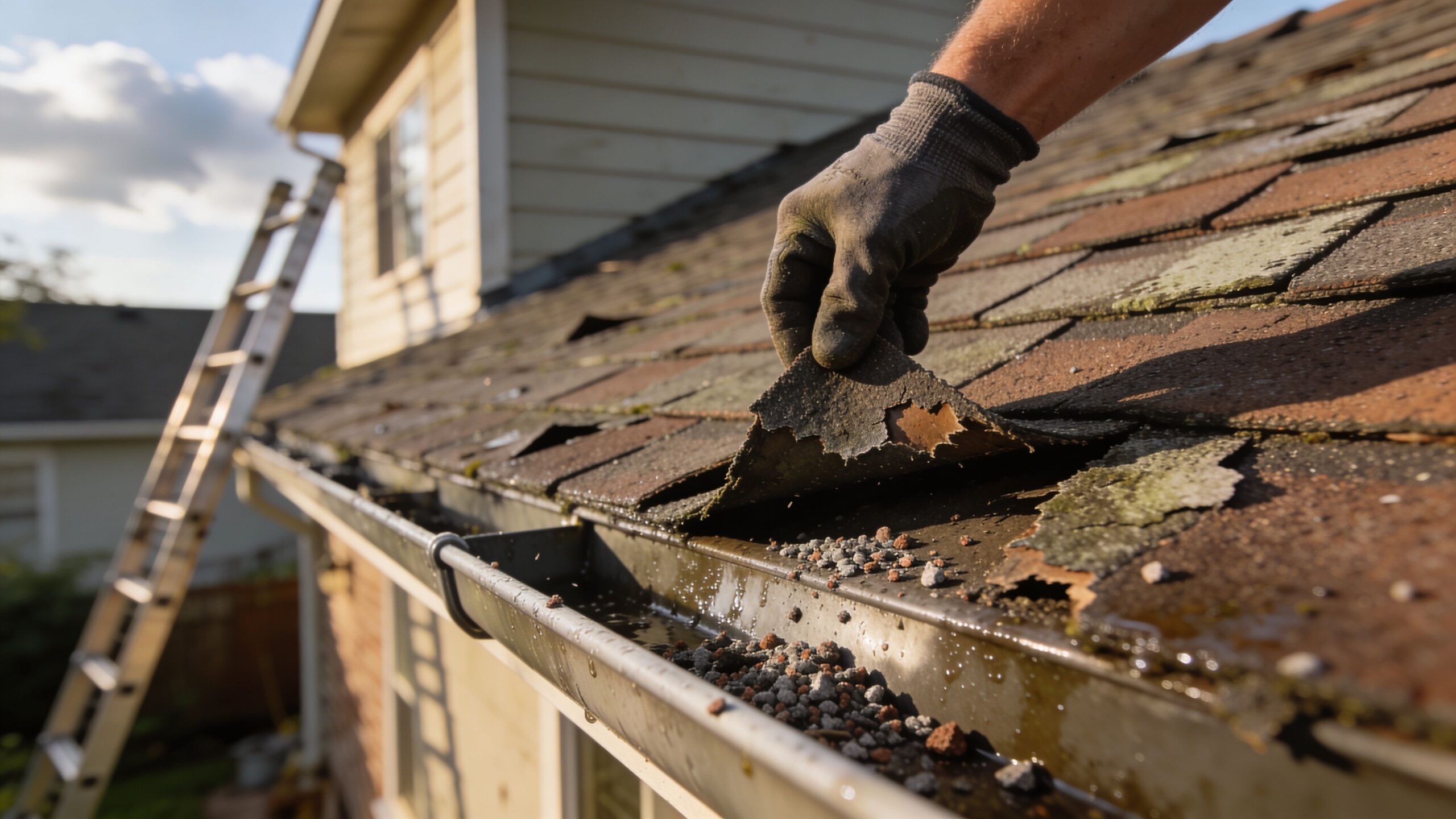
In South Florida, a single hurricane can damage roofs across entire neighborhoods, and storms like Irma in 2017 and Ian in 2022 affected more than 1.5 million structures statewide according to the Florida preparedness reference. That scale matters because your roof usually takes the first hit from wind, debris, and driven rain. If you wait for a clear indoor leak before acting, you're often already behind.
Homeowners in Broward, Miami-Dade, and Palm Beach counties ask the same question after a storm passes. What are the signs of roof storm damage, and which ones mean you can monitor the situation versus call for help right away? The answer isn't just a generic checklist. South Florida roofs get hit by wind uplift, salt exposure, tropical downpours, and debris impacts that can damage shingles, tile, metal, flashing, gutters, and roof decking in very different ways.
The biggest mistake I see is assuming storm damage has to be dramatic to be real. It doesn't. A few lifted shingle edges, a line of missing granules, a bent gutter run, or a stain that appears days later can be enough to start a chain of leaks, wood rot, and mold. In this climate, moisture doesn't wait around.
Use the list below as a post-storm action plan. Start from the ground. Check the outside, then the inside. Photograph what you see before anything gets moved or cleaned up. And know the exact point where DIY inspection stops. If you see structural movement, active leaking, widespread shingle loss, or signs that water has reached the attic, it's time to call Paletz Roofing and Inspections for a professional assessment and emergency service.
1. Missing or Damaged Shingles

If you only check one thing after a storm, check for missing or damaged shingles first. This is one of the clearest answers to what are the signs of roof storm damage because it often shows up fast and from the ground. You may see bare patches, uneven roof lines, torn tabs, or shingles in the yard.
High winds are the usual cause. The Florida storm preparedness reference notes that winds in the 50 to 74 mph range during hurricanes can lift and tear shingles away, exposing the underlayment and roof deck to water intrusion, and it identifies missing or damaged shingles as one of the most prevalent and obvious indicators of roof storm damage in Florida conditions.
What it looks like in South Florida
On homes in Broward, Miami-Dade, and Palm Beach, damage often shows up on the slope that faced the storm. That's important because storm damage usually looks localized. Normal aging tends to look more even across the whole roof. If one section looks stripped, curled, or rough while the rest still looks uniform, that leans toward wind damage.
You might also notice curling or lifted edges. Roofers often call that fish-mouthing. Those raised edges create openings for wind-driven rain, and once water gets below the shingle surface, the problem can move quickly into the decking and attic.
Practical rule: If you can see exposed underlayment, bare wood, or a cluster of torn shingles from the ground, stop there and schedule a professional inspection. That's no longer a watch-and-wait situation.
A common real-world scenario after a tropical system is this: the front roof slope looks fine from the street, but the rear slope over the patio or pool enclosure has scattered missing shingles. Homeowners miss it because they only check what they can see from the driveway.
What works and what doesn't
What works is a ground-level scan with binoculars, photos from multiple angles, and a slow walk around the property for shingle debris. Check both front and back elevations. Also look near fence lines, hedges, and around the AC pad where shingles or fragments may have landed.
What doesn't work is climbing onto the roof to push a shingle back down or applying caulk as a temporary fix. That usually hides damage without sealing the system. It can also create insurance documentation issues if the original damage pattern gets disturbed before a contractor records it.
If shingles are missing, cracked, or visibly lifted, Paletz Roofing should inspect the roof before the next rain band hits. On South Florida homes, the gap between a straightforward repair and a larger interior damage claim can be short.
2. Hail Damage and Impact Marks
Hail isn't the first thing most South Florida homeowners think about, but when it hits, it can leave subtle damage that many people overlook. Unlike missing shingles, hail damage often doesn't announce itself with a dramatic hole. It shows up as bruises, divots, cracked surfaces, chipped tile edges, or dents on metal components.
That subtlety is why this kind of damage gets missed. A roof can still look mostly intact from the yard while the protective surface has already been compromised.
The marks to look for
On asphalt shingles, one of the most useful technical clues is granule loss that forms a distinct horizontal line just beneath the overlapping shingle above. Owens Corning describes this as a diagnostic marker of broken shingle seals caused by wind flapping, and notes that the pattern helps distinguish wind-related damage from other storm damage during documentation for insurance in its storm damage guidance.
On tile or metal systems, impact may show up differently. You may see chipped tile corners, circular marks, or dents on ridge caps, vents, flashing, or gutters. Those accessory hits matter because they support the story of roof impact even when the field of the roof is harder to inspect from the ground.
For a real-world South Florida example, think about a hail-producing thunderstorm moving through western communities near Weston or western Palm Beach County. A homeowner may only notice a few dents on the metal vents and some fresh grit at the base of downspouts. A roofer gets up there and finds scattered impact bruising across the slope.
Damage to soft metals often gives away what the shingles are hiding.
When DIY stops
You can check for supporting signs from the ground or from a safe upstairs window. Look at gutter faces, vent caps, and metal flashing for fresh dents or scrapes. If you can safely see the roof surface, watch for dark spots, circular impact areas, or broken surface texture that doesn't match the surrounding roof.
Use this quick filter after a hail event:
- Check roof accessories: Dented vents, flashing, or gutters often confirm the roof took impacts too.
- Photograph close-up patterns: Granule loss and repeated impact marks are more useful than one wide photo.
- Don't wash or sweep evidence away: Fresh granules in gutters and downspouts can support the inspection record.
What doesn't work is waiting for a leak before calling someone. Hail damage often shortens service life before it creates obvious indoor signs. If you suspect impact damage, especially on shingle, tile, or metal roofs that already had some age on them, get Paletz Roofing involved early so the inspection record is clean and timely.
3. Leaks and Water Stains on Ceilings and Walls

Interior stains usually show up after the storm has passed. By then, water may have traveled from the actual roof opening, down the decking, along framing, and into a ceiling or wall several feet away from the entry point.
That pattern fools a lot of homeowners in South Florida. A small brown spot in a bedroom can trace back to flashing at a vent, a roof-to-wall transition, or a weak point around a low-slope section over a patio or addition. In Broward, Miami-Dade, and Palm Beach County homes, heat and humidity speed up drywall damage, insulation saturation, and mold growth once moisture gets trapped.
What interior signs usually point to
Watch for yellow or brown ceiling stains, bubbling paint, swollen drywall, damp baseboards or trim, musty odor, and dripping around light fixtures, vents, skylights, or the upper corners of exterior walls. Staining near a window does not always mean the window failed. Roof leaks often follow framing paths and show up at headers, closets, and wall corners before the main ceiling stain gets your attention.
Check the rooms next to the obvious problem too.
A practical step while you wait for a roofer is to document spread inside the home and learn how to detect water leaks without tearing into finishes that may still be holding water in place.
If the stain gets darker or larger after each rain, treat it as an active roof leak.
What to do right away
Protect the interior first. Move furniture, put down towels or plastic, place a bucket under drips, and photograph every wet area before cleanup. If water is close to a light fixture, fan, outlet, or panel, shut off power to that area only if you can do it safely.
Do not start cutting drywall to "help it dry out" until the source is identified. I have seen plenty of post-storm calls where the first leak was manageable, then a homeowner opened the ceiling, disturbed wet insulation, and turned a contained problem into a larger cleanup.
Stop the DIY inspection and call Paletz Roofing for same-day help if you see any of these conditions:
- Active dripping during or after rain: The roof system is still taking on water.
- Sagging ceiling drywall: Wet gypsum can fail with very little warning.
- Leak near electrical components: Fixtures, wiring, and panels raise the safety risk fast.
- Multiple stains in different rooms: Water may be entering at more than one roof detail.
- Musty attic or ceiling odor after a storm: Moisture may be sitting above the visible stain.
For South Florida homeowners, interior staining is the point where observation needs to turn into action. Once water reaches ceilings and walls, the problem is no longer limited to the roof covering. Paletz Roofing should be called for professional assessment, moisture-path tracing, and emergency protection when the leak is active, expanding, or anywhere near electrical systems.
4. Debris and Vegetation Accumulation
After a storm, debris on the roof often gets treated like a cleanup issue. Sometimes it is. Sometimes it's also the clue that tells you where the roof took a hit.
Palm fronds, branches, seed pods, roof gravel, shattered tile pieces, and even shingles from a neighboring property can all end up lodged in valleys, behind chimneys, around vents, and inside gutters. In South Florida, where tropical landscaping sits close to many homes, this happens all the time after strong wind events.
Why debris matters more than it seems
Debris traps moisture. It slows drainage. It hides punctures, cracked tiles, lifted flashing, and worn seal lines. On low-slope sections and flat roofs, it can also hold water in place longer than the roof was designed to handle.
A common local scenario is a Miami-Dade home with a tile main roof and a flatter rear section over a patio or addition. After a storm, the owner sees leaves and palm debris piled near the scupper or drain but assumes it can wait until the weekend. Then the next rain comes through, drainage backs up, and water finds an opening under the roofing surface.
Debris can also tell you something about wind direction and impact location. If branches are concentrated on one roof plane or piled in one valley, that's where a roofer should look closely for surface damage.
Safe action after the storm
Before anything gets removed, take photos from the ground and from any safe window vantage point. Show where the debris sits and how much is there. Those images help connect cleanup findings to storm exposure.
Then make smart choices:
- Leave heavy debris alone: Large limbs can shift weight suddenly and damage the roof more during removal.
- Clear the perimeter first: Yard cleanup helps reveal whether shingles, flashing pieces, or tile fragments came off your own roof.
- Ask for inspection after cleanup: The damage under debris is often more important than the debris itself.
The temptation is to send someone up with a blower or rake. That's exactly how hidden punctures get worse and how people get hurt. Wet roofs, loose branches, and storm residue make footing unpredictable.
If debris is extensive, especially around valleys, drains, or roof penetrations, this is a good point to bring in Paletz Roofing. Cleanup without inspection misses too much. In South Florida, debris rarely tells the whole story by itself.
5. Flashing and Chimney Damage
A lot of storm leaks don't come through the middle of the roof field. They start at the joints. Flashing is what seals the places where the roof meets something else, including chimneys, walls, vents, skylights, and plumbing penetrations. When flashing lifts, separates, bends, or corrodes, water gets a path inside.
This type of damage is common after high wind because metal edges and seal lines take direct pressure. In coastal Broward and Miami-Dade areas, salt exposure can also weaken flashing over time, which makes it more vulnerable during a storm.
The failure points homeowners miss
From the ground, flashing damage can be hard to spot unless you know where to look. Watch for a metal edge that looks lifted, uneven, or out of line. Look below roof-to-wall transitions and chimneys for fresh staining, displaced trim, or debris that suggests something tore loose.
Chimneys add another layer of risk. If the masonry shifts, even slightly, flashing can separate from the chimney base and create a leak path that doesn't show up right away. The same goes for skylights and vent stacks. The opening itself may still look intact while the surrounding seal has failed.
The gap in many homeowner inspections is documentation. Guidance focused on insurance often misses the difference between storm-related uplift and ordinary wear. A roofing industry discussion on distinguishing storm damage from normal wear points out how often subtle uplift and granule loss get misread, especially in hurricane-prone areas, and why proper photographic documentation matters during claims in this overview of roof damage signs.
Field note: If the leak shows near a chimney, wall intersection, or vent pipe, flashing is high on the suspect list even when the shingles still look decent.
What to check without climbing
Use binoculars and inspect these areas from the ground:
- Chimney base: Look for gaps, bent metal, or staining on the siding or stucco below.
- Wall intersections: Step flashing failures often show up where roof planes run into vertical walls.
- Roof penetrations: Vent boots and pipe collars can crack, pull loose, or separate after wind stress.
What doesn't work is adding roof cement around visible metal edges and calling it fixed. That may slow a leak for a short time, but it usually doesn't restore proper overlap, fastening, or drainage. If flashing is loose, separated, rusted through, or pulled away from masonry, the repair needs to be done correctly and in sequence with the surrounding roofing material.
For South Florida homes with chimneys, skylights, rooftop equipment, or complex roof geometry, flashing problems are one of the first reasons to move from homeowner inspection to a Paletz Roofing service call.
6. Sagging or Visibly Stressed Roof Structure
Some storm damage is cosmetic. Sagging is not. If the roof line dips, waves, bows, or looks lower in one area than it used to, treat that as a structural warning sign.
This is one of the most important points where DIY has to stop. The issue may be soaked decking, weakened framing, broken truss members, ponding stress on a flat section, or movement caused by uplift forces during the storm.
What sagging really tells you
On sloped roofs, a sag may appear along the ridge, in the center of a plane, or near eaves where water found its way into the decking. On flat or low-slope roofs, you may notice a depression that seems to hold water or a section that looks uneven compared to the surrounding field.
The concern isn't just the roof covering. It's the load path underneath. Once framing or decking starts to deform, the roof may no longer be distributing weight the way it should. Another storm, a heavy rain event, or even routine foot traffic can make the condition worse.
A practical local example is a carport conversion or rear addition with a flatter roof section in Palm Beach County. After a storm, the main tile roof may appear fine while the lower section develops a visible dip from trapped water and hidden deck damage.
When to call immediately
If you see any of these conditions, don't wait:
- Roof line changed shape: Compare with older photos if you're unsure.
- Ceiling is bowing indoors: Wet drywall and compromised framing can fail.
- Doors or windows start sticking: Roof-frame movement can shift the structure enough to affect openings.
A contractor can assess this from the exterior first. You shouldn't walk beneath a sagging interior ceiling or enter an attic under that area unless professionals confirm it's safe.
One underused clue is checking the building from a distance. Stand across the street and look at the roof against a straight background line. That's often the easiest way to spot a dip that isn't obvious when you're standing directly below it.
If structural movement is visible, call Paletz Roofing for emergency assessment. This isn't the stage for patching, hoping, or waiting for the next dry day.
7. Gutters and Downspout Damage
Gutters don't just carry water away. They also tell you a lot about what the storm did to the roof edge. If a gutter run is bent, pulled away, twisted, dented, or overflowing at one section, pay attention. That damage often means the fascia, drip edge, or roof perimeter took stress too.
In South Florida's heavy rain, gutter failures show up fast. Water spills over the side, washes down walls, saturates planting beds, and can back up near the roof edge instead of draining away.
What to notice from the ground
Start with alignment. A straight gutter should still look straight after the storm. If one section bows outward or sits lower, the hangers may have loosened or the fascia may have been stressed. Downspouts should also stay firmly connected at elbows and wall brackets.
Granules matter here too. The Premier Roofing discussion of wind damage highlights granule loss in gutters and downspouts as a useful clue after a storm, especially when combined with other signs and safe, non-climb inspection habits in its guide to spotting wind damage. If you see an unusual amount of shingle grit collecting at discharge points, don't assume it's just age.
You can also look for splash patterns. Fresh dirt marks on exterior walls, washout near the foundation, or water tracks under a gutter seam can show that drainage failed during the storm.
Gutters are often the first visible sign that the roof edge got hit harder than the homeowner realized.
Repair decisions that make sense
A small dent with no drainage issue may be mostly cosmetic. A separated gutter, a crushed downspout, or a section pulling off the fascia is different. That can redirect water into soffits, wall assemblies, and entry points around the roof edge.
A good post-storm response includes:
- Photographing the run: Capture the full section, not just one close-up.
- Checking discharge: Watch where water exits during the next rain if it's safe to do so.
- Scheduling cleanup after inspection: If the gutter is packed with debris, the roof likely needs a broader look too.
If you need help maintaining drainage after storm season, professional gutters and roof cleaning can be part of a maintenance plan. But after a storm, inspection comes before routine cleaning. You want the roof evaluated in the same condition the storm left it.
For homeowners in Broward, Miami-Dade, and Palm Beach, damaged gutters are a good reason to ask Paletz Roofing to inspect both the roof perimeter and the drainage system together.
8. Attic Moisture, Mold Growth, and Insulation Damage

Some of the worst storm damage isn't visible from the street. It shows up in the attic as damp decking, wet insulation, mold growth, or a musty smell that wasn't there before. In South Florida, once moisture gets trapped above the ceiling, conditions can change quickly.
The Florida preparedness reference notes that mold growth can develop within 48 to 72 hours if storm-related moisture goes unaddressed, especially after shingles lift or water reaches the wood components of the roof system. That's why attic signs matter even when interior ceilings still look mostly normal.
What you may notice before you see a leak
You might smell moisture before you see staining. You may also notice the house feels more humid than usual, certain rooms run warmer, or the AC seems to work harder after the storm. Wet insulation loses effectiveness, and once that happens, comfort and energy performance often drop with it.
Visible clues include dark roof decking, damp rafters, compressed or matted insulation, mold spotting, rusting fasteners, or light coming through places that should be sealed. On tile and metal roofs, these hidden attic clues can be the first sign because the outer surface may not show obvious damage from the ground.
Safe inspection limits
Be careful here. The research behind safe, non-climb inspection methods warns that homeowners often underestimate attic hazards after storms, including dust and mold exposure, and recommends safer visual checks where possible rather than assuming attic access is routine. If you open the attic hatch and get a strong musty odor, see visible mold, or suspect the ceiling around the opening is damp, close it back up and call for help.
Use this filter before entering any attic:
- No visible mold: If you see mold immediately, don't go in.
- No sagging ceiling near the hatch: Moisture can weaken the surrounding drywall.
- Adequate light and dry footing: Never step into a dark attic after storm damage without certainty about the walking path.
If the attic is wet, the roof leak has already moved beyond the exterior covering. That's the point where a proper roofing inspection and, if needed, coordinated drying or remediation should happen together. Paletz Roofing can assess the roof source so you're not just treating the symptom inside the attic while the exterior opening remains active.
8-Point Roof Storm Damage Comparison
| Item | Complexity 🔄 | Resources & Speed ⚡ | Expected Outcomes 📊 | Ideal Use Cases 💡 | Key Advantages ⭐ |
|---|---|---|---|---|---|
| Missing or Damaged Shingles | Low–Moderate: visual diagnosis, simple replacement; matching older shingles can be tricky | Low cost, fast turnaround (hours–days); requires shingles and roofer | Restores weather barrier; prevents leaks; effectiveness ⭐⭐⭐ | Wind- or debris-driven shingle loss visible from roof or gutters | Easy to spot, straightforward repairs, commonly covered by insurance |
| Hail Damage and Impact Marks | Moderate: subtle "soft spots" need professional inspection | Moderate resources; may require targeted shingle or metal repairs; timeline depends on insurance | Slows material degradation and prevents future leaks; effectiveness ⭐⭐ | Post-hail events with dents, granule loss, or impact patterns | Documentable for claims; multiple impacts prove storm causation |
| Leaks and Water Stains on Ceilings and Walls | High: trace entry path and repair both roof and interior damage | High resources and urgency; interior restoration often required; immediate response advised | Stops active water intrusion and halts interior deterioration; effectiveness ⭐⭐⭐ | Active drips, ceiling/brown stains, bubbling paint or mold | Conclusive evidence for claims; mandates prompt professional action |
| Debris and Vegetation Accumulation | Low: removal straightforward but may conceal other damage | Low cost and quick to clear; safer when done by professionals | Reduces trapped moisture, improves drainage; effectiveness ⭐⭐ | After storms with branches, palm fronds, or clogged valleys/gutters | Easy to document, preventive, and relatively inexpensive |
| Flashing and Chimney Damage | Moderate–High: specialized flashing/masonry repair; hidden failure points | Moderate cost; targeted repairs faster than full re-roof; requires skilled crew | Restores seals at penetrations and prevents concentrated leaks; effectiveness ⭐⭐⭐ | Gaps around vents/chimneys, rust stains, visible separation | Often repairable without full roof replacement; clear cause-effect to storms |
| Sagging or Visibly Stressed Roof Structure | Very High: structural assessment and major reconstruction | Very high cost and time; emergency stabilization often needed | Addresses life-safety risk and structural failure; effectiveness ⭐⭐⭐ (with full remediation) | Visible roof dips, interior ceiling sagging, doors/windows jamming | Unambiguous sign for emergency intervention; typically covered by insurance |
| Gutters and Downspout Damage | Low–Moderate: visible, accessible repairs but must coordinate with roofing | Low–Moderate cost; quick replacement or realignment | Restores drainage, prevents foundation/landscape damage; effectiveness ⭐⭐ | Bent or detached gutters, water pooling near foundation | Easily visible/documented; repairs are fast and restore function |
| Attic Moisture, Mold Growth, Insulation Damage | High: requires safe attic access, moisture testing, and remediation | High resources and specialized contractors; remediation and replacement time-consuming | Restores indoor air quality, energy efficiency; prevents health issues; effectiveness ⭐⭐⭐ | Musty odors, visible mold, wet or compressed insulation after storms | Reveals hidden damage; critical for health and long-term building performance |
Don't Wait for a Drip Secure Your Roof Today
Spotting roof storm damage early is what gives you options. Miss the signs, and the repair usually grows from an exterior fix into an interior problem with drywall, insulation, framing, paint, flooring, and sometimes mold cleanup layered on top. In South Florida, that progression can happen fast because heat, humidity, and repeated rain events don't give damaged roofs much time to recover.
The most useful approach is simple. Start with a safe exterior walk-around. Look for missing shingles, bent gutters, debris concentration, flashing issues, and any change in the roof line. Then move indoors and check ceilings, wall corners, and attic access points for stains, odor, dampness, or visible moisture.
What works is documentation and speed. Take photos before cleanup. Save pictures of yard debris, granules, interior stains, and any visible roof changes from the ground. If you need to file an insurance claim, clear photo evidence of the condition right after the storm is far more useful than trying to reconstruct the story later.
What doesn't work is guessing based on one symptom. Homeowners often focus on the most obvious sign and miss the related damage. A bent gutter may mean roof edge stress. A small ceiling stain may trace back to flashing. A pile of palm debris in a valley may be hiding a puncture or blocked drainage point. One problem often points to another.
It's also important to know when to stop inspecting and start calling. If shingles are missing, if water is actively entering the house, if the attic is damp or moldy, if flashing has pulled loose, or if the roof looks sagged or shifted, don't try to handle it with a ladder and a tube of sealant. That's where professional assessment matters. Temporary patching by a homeowner can hide evidence, miss the actual entry point, or create a false sense of security before the next rain.
For homeowners, property managers, real estate professionals, and commercial building owners in Broward, Miami-Dade, and Palm Beach counties, the right next step after a significant storm is usually a qualified inspection. Paletz Roofing and Inspections serves South Florida and provides residential and commercial roofing services across those counties. If you need a roof evaluation after a storm, a repair recommendation, or emergency help for an active leak, they're one relevant local option to contact.
The key takeaway is straightforward. Don't wait for the damage to prove itself twice. Once through the storm, and again through the ceiling. If you've noticed any of the signs above, document them, protect the interior if needed, and get a professional roofer involved before the next round of weather puts the roof under more stress.
If your roof may have storm damage, contact Paletz Roofing and Inspections for a free quote or emergency inspection in Broward, Miami-Dade, or Palm Beach County.