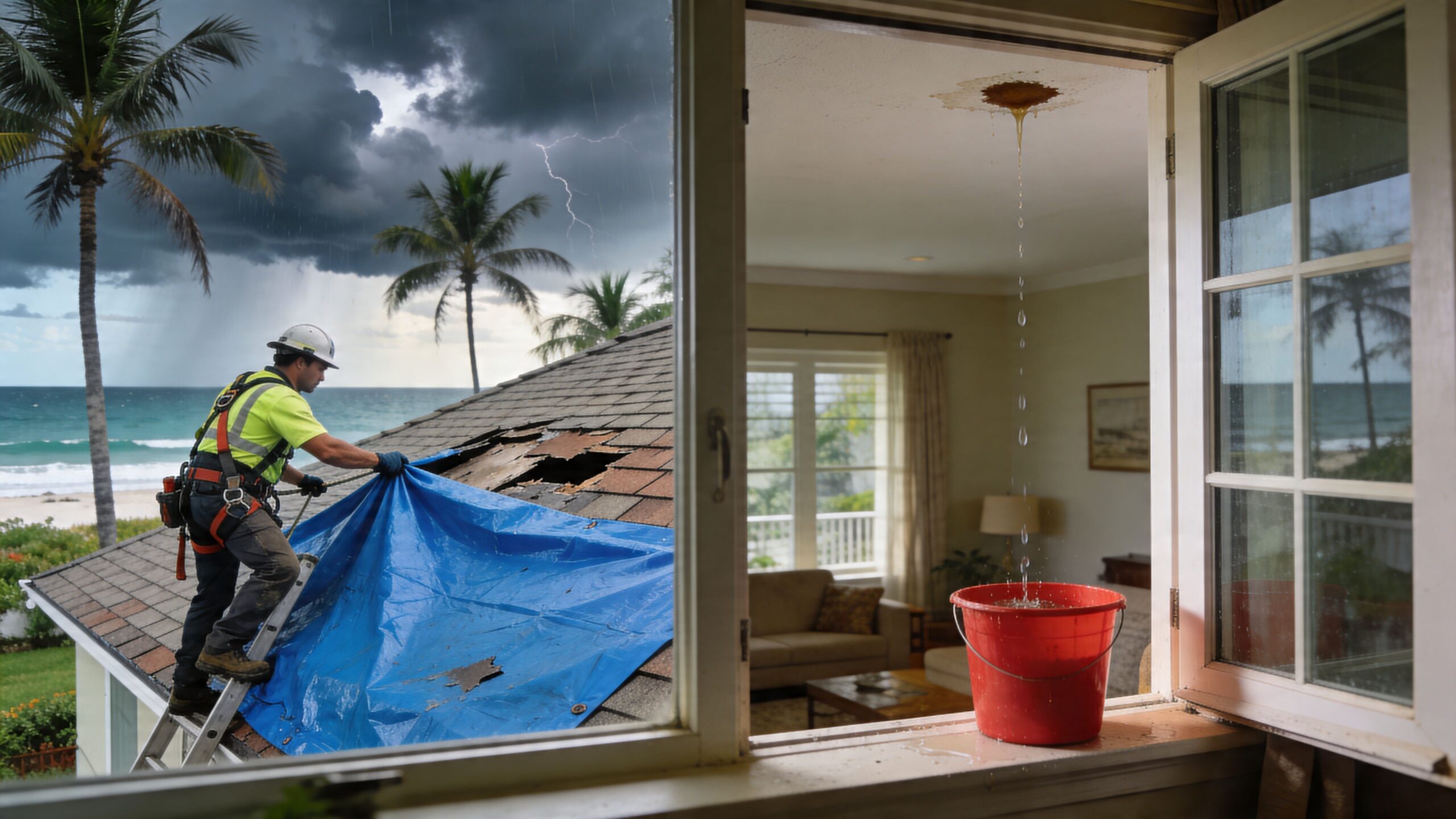
Rain on the windows in Boynton Beach is normal. Water landing in a bucket in your living room is not. When a ceiling starts dripping during a storm, most homeowners do the same three things in the first minute. They stare up, they grab towels, and they wonder if they should climb up and try to stop it themselves.
That stress is real, especially in South Florida where one hard storm can turn a small flashing failure into soaked insulation, stained drywall, and a much bigger repair. After Hurricane Ian, Palm Beach County saw a 40% increase in roofing claims, and emergency roof replacements in Boynton Beach ranged from $8,000 to $16,500, which is exactly why fast action matters for both your home and your budget, according to this Boynton Beach emergency roofing report.
That Drip You Hear is an Emergency
A leak rarely announces itself at the actual point of entry. In Boynton Beach homes, water often travels along underlayment, roof decking, truss members, or the back side of drywall before it finally shows itself over a hallway, bedroom, or living room. By the time you see the drip, the roof system has already failed somewhere above it.
That matters because coastal weather doesn't give you much margin for error. Wind-driven rain pushes water sideways. Salt air wears on metal components. Tile roofs, common throughout Palm Beach County neighborhoods, can hide cracked sections or underlayment failures until one storm exposes them.

What counts as a real emergency
Some roof problems can wait for a scheduled repair. Others can't.
An emergency roof repair Boynton Beach call is warranted when you have active water intrusion, visible ceiling bulging, storm-torn roofing materials, exposed underlayment, fallen tree impact, or water entering around penetrations like vents, skylights, or chimney flashing. Commercial flat roofs have their own version of this problem. Ponding and membrane splits can send water into insulation and interior finishes fast.
Practical rule: If water is actively entering the home, if part of the roof system is exposed, or if you see sagging inside, treat it like an emergency even if the leak seems small.
Control starts with the next right move
The good news is that panic doesn't help, but a short sequence of smart actions does. The first hour is about safety, interior protection, documentation, and getting a qualified roofer moving toward your address. That's the playbook that works in this area.
In Palm Beach County, experience with storm response matters because the emergency isn't just the leak. It's also the permit process, the material choice, the wind exposure, and the fact that a rushed patch done wrong can trap moisture in the system and make the next storm worse.
Your First Moves to Control the Damage
Most homeowners think the first move is to get on the roof. It isn't. The first move is to protect people, then contents, then interior finishes. In Boynton Beach, emergency roof repair services typically respond within 2-4 hours, and immediate indoor action can help prevent the thousands of dollars in water damage that can build up during that window, as noted in this Boynton Beach emergency response overview.
Start inside, not outside
If water is dripping from the ceiling, assume the area above is compromised. Drywall can soften. Light fixtures can become hazards. Flooring can cup or swell. Start by clearing the space.
Move what you can quickly. Pull rugs, electronics, furniture, artwork, and anything porous away from the leak path. If something is too large to move, cover it with plastic sheeting and raise it off the floor if possible.
Catch the water properly. Use buckets, deep bins, or clean trash cans. Put towels around the base to stop splash spread, not to absorb the leak itself.
Relieve a bulging ceiling carefully. If water is pooling above drywall and the ceiling is visibly sagging, many roofers will tell you to contain that water in a controlled way rather than letting a larger section collapse unexpectedly. Only do this if the area is clear, the electricity is safe, and you can do it from stable footing with eye protection. A small puncture can release trapped water into a bucket. If you're unsure, leave it alone and wait for the roofer.
Know when electricity becomes the bigger problem
Water and electricity don't negotiate. If the leak is near recessed lights, ceiling fans, switches, outlets, or your breaker panel, stop thinking about cleanup and start thinking about isolation.
Use this quick judgment guide:
- Shut off the circuit if water is dripping through a light fixture, running down a wall with outlets, or entering near visible wiring.
- Shut off main power if you can't identify the circuit safely, or if water is spreading broadly across a ceiling with electrical components.
- Call an electrician after the roof is stabilized if the leak involved fixtures, attic wiring, or repeated saturation near power.
If you hear buzzing, see sparking, or smell something burning, leave that area immediately and cut power if you can do it safely.
Limit secondary damage while you wait
A roof leak is rarely just a roof problem. It's also a flooring, paint, drywall, insulation, and indoor air problem if it sits. What works in the waiting period is simple and practical.
- Vent the room if weather allows. Air movement helps, but don't open windows on the storm-facing side and invite more rain inside.
- Use fans carefully. Aim them across wet surfaces, not up into an active ceiling leak.
- Take down wet wall art and window treatments. These hold moisture and stain fast.
- Protect wood floors. Get standing water off them quickly. Don't let buckets overflow and don't leave soaked towels in place for hours.
What not to do in the first hour
This list is short because the mistakes are predictable.
- Don't climb onto a wet roof during active rain or wind. Tile, shingles, and metal all become dangerous underfoot.
- Don't smear roof cement from the inside. It won't fix the breach and can make later diagnosis harder.
- Don't assume the leak point is directly overhead. Water often travels before it appears.
- Don't wait until morning because the drip slowed down. Leaks often pause and then restart with the next band of rain.
Keep a simple emergency kit ready
In South Florida, this is less a luxury than basic home preparedness.
| Keep on hand | Why it helps |
|---|---|
| Plastic sheeting | Covers furniture and flooring fast |
| Buckets and bins | Contains active drips |
| Old towels and mops | Manages splash and floor water |
| Flashlight | Helps in attics and power-loss conditions |
| Painter's tape or labels | Marks leak locations for the roofer |
| Phone charger | Keeps photos, calls, and claim communication moving |
Emergency roof repair Boynton Beach calls go more smoothly when the interior is controlled before the roofer arrives. That buys time. It also preserves evidence.
Documenting Evidence and Attempting Temporary Fixes
Once you've stabilized the room, stop cleaning for a few minutes and start recording. Homeowners often make the same mistake here. They mop everything up, toss the damaged items, and only then think about insurance. That removes useful evidence.
Detailed documentation of roofing discrepancies can support insurance claims with an 85% success rate in preventing denials, and delays in temporary mitigation can increase interior damage by 40-60% within 48 hours, according to this roof damage documentation and mitigation guide.

What to photograph before anything changes
Take wide shots first, then close-ups. Think like someone who has never seen your home before and needs to understand what happened.
Photograph these areas:
- The interior ceiling damage. Get the stain, active drip, bubbling paint, sagging drywall, and any crack lines.
- The floor and contents below. Show soaked rugs, wet furniture, damaged electronics, and water lines on baseboards.
- The attic if it's safe to enter. Wet decking, daylight through the roof, saturated insulation, and staining around penetrations all matter.
- The exterior roof from the ground. Missing tiles, displaced shingles, debris impact, bent flashing, or anything visibly out of place.
- The weather event aftermath. Fallen branches, scattered roof pieces, or fence and yard damage can help establish storm context.
Video helps too. A short clip of active dripping or wind-driven entry around a window or ceiling line gives useful context that still photos can miss.
Keep a written timeline
A simple note on your phone is enough if it's accurate.
Record:
- When you first noticed the leak
- Which room or rooms were affected
- Whether the leak worsened during heavier rain
- What actions you took to reduce damage
- When you called a roofer and your insurer
- Any visible exterior condition you observed from the ground
If interior materials stay wet after the roof is stabilized, drying becomes its own project. In broader flood or saturation situations, a service focused on water damage restoration can give you a useful model for what proper extraction, drying, and material salvage should look like, even though your roof repair remains a separate trade.
Temporary fixes that are actually temporary
Homeowners often use the phrase "patch the roof" when they really mean "keep more water out tonight." Those are different goals. A true repair addresses the failure. A temporary fix buys short-term protection until materials, access, and weather allow proper work.
If conditions are unsafe, don't go up. If the roof is steep, tiled, storm-wet, or still under wind pressure, stay off it. Temporary exterior mitigation is best handled by a roofer with the right ladder setup, fall protection, and materials.
The temporary fix should reduce intrusion, not create a second problem that tears loose in the next gust.
If you attempt a ground-safe or low-risk stopgap
There are only a few situations where homeowner action makes sense. For example, if a single-story area allows safe access from a secured ladder, weather is calm, and you have experience working at height. Even then, think in terms of covering, not repairing.
A cautious temporary approach usually looks like this:
- Confirm conditions are calm. No active rain, no slick surface, no lightning, no wind pushing you around.
- Use proper covering material. A heavy-duty tarp works better than thin plastic because it won't shred as easily.
- Cover beyond the damaged area. Water travels. The cover needs to extend uphill and past the sides of the suspected breach.
- Secure without creating more holes if possible. Poor fastening can make the roof leak in new places.
- Check inside immediately after. If dripping slows, you've bought time. If not, the leak path may be elsewhere.
This is still not a repair. On tile roofs, especially, the visible break may not be the only problem. Underlayment, flashing, valley transitions, and fastener penetrations can all be part of the same event.
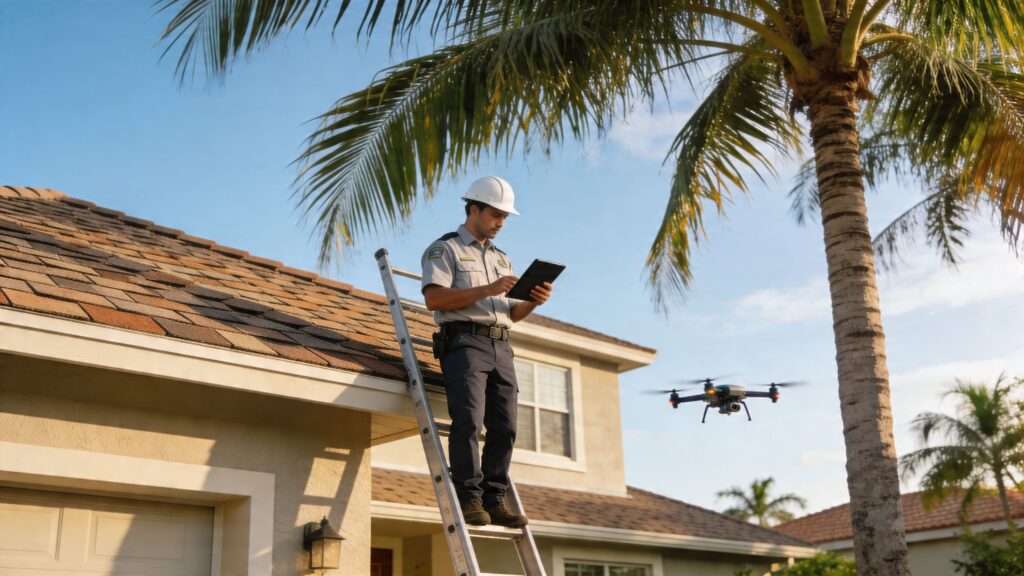
For a visual example of how roof conditions can look during emergency assessment, this inspection image reference shows the kind of damage pattern homeowners often struggle to identify from the ground.
Three temporary-fix mistakes that backfire
- Using indoor caulk as a roof solution. It fails fast in weather exposure.
- Tarping only the visible hole. The water entry point may sit upslope.
- Walking directly on cracked tile or soft decking. That can turn a leak into a structural hazard.
Insurance wants evidence, but your house needs mitigation at the same time. The right sequence is record first, protect second, and leave dangerous access work to the crew equipped for it.
Why a Professional Emergency Roofer is Non-Negotiable
A lot of bad roof outcomes in South Florida start with good intentions. Someone sees a small breach, runs to the hardware store, smears on a sealant, and assumes the problem is handled. Then the next storm drives water under tile laps, around flashing, or through fasteners that were never the underlying problem.
Emergency roof work isn't general handyman work. It demands diagnosis under pressure, knowledge of local roof systems, and material choices that stand up to coastal weather. Professional interventions using hurricane-rated materials save an average of 60% on total costs compared to delayed full replacements, and expert sequencing that starts with valleys and penetrations produces a 92% first-time success rate, according to this Palm Beach County repair methodology overview.
What pros do that improvised fixes don't
A trained emergency roofer doesn't just cover the stain. The roofer traces the path. That usually means checking penetrations first, then valleys, flashing transitions, underlayment conditions, uplift damage, and any area where wind could have opened a path beneath the main roofing surface.
In Boynton Beach, salt exposure matters too. The wrong fastener or metal component can corrode early. A patch that looks fine for a month can fail long before the roof itself should.
Why Florida conditions punish shortcuts
South Florida roofs take a different beating than roofs in milder climates. Even when the storm passes, the combination of heat, UV, humidity, and salt keeps working on every weak detail.
What tends to fail after a rushed repair:
- Improperly sealed penetrations that reopen under thermal movement
- Low-grade metal components that don't hold up near the coast
- Missed decking damage that stays wet beneath the surface
- Badly fastened temporary covers that peel back in wind
- Wrong material combinations that don't bond or shed water correctly
A roof leak stopped for one night is not proof the roof was repaired. It only means the water didn't find that path again yet.
The permit and code side matters too
In Palm Beach County, emergency roofing isn't just about swinging a hammer. Materials, attachment methods, and the scope of the work all affect what comes next. A contractor who knows the local process can separate what needs immediate stabilization from what needs formal permit handling and documented permanent repair.
That's one reason a real emergency roofer is different from a general contractor who occasionally does roof work. The job requires system knowledge, not just labor.
Signs you're talking to the right kind of roofer
Listen for specifics when you call. A qualified emergency roofing company should ask about active leaking, structural sagging, roof type, number of stories, interior electrical exposure, and whether the damage followed wind, impact, or prolonged rain.
It should also be able to explain:
- how it stabilizes the opening,
- how it documents visible damage,
- what temporary versus permanent repair means,
- and what materials are appropriate for your roof type.
That clarity is part of the service. So is refusing to do something unsafe or misleading.
Navigating the Repair with Paletz Roofing and Inspections
Once you've made the emergency call, homeowners usually want one thing most of all. They want to know what happens next and whether the process will feel chaotic. It shouldn't.
A competent emergency roof repair Boynton Beach process follows a sequence. Information comes first. Stabilization comes second. Diagnosis, scope, paperwork, and permanent repair follow in that order. One local option that handles residential and commercial roofing across Palm Beach County is Paletz Roofing and Inspections, which works on shingle, tile, metal, and flat roof systems.


What to have ready when you call
The fastest calls are the clearest ones. You don't need roofing vocabulary. You need a clean description of what you're seeing.
Have these details ready:
- Your address and callback number
- Whether water is actively entering
- The roof type if you know it, such as tile, shingle, metal, TPO, or flat
- Which room is leaking
- Whether the leak is near electrical fixtures
- Whether a tree limb, flying debris, or visible roof loss is involved
- Photos if the company can receive them by text or email
This helps the crew decide whether to bring tarping materials, specialty sealants, replacement tiles, membrane materials, or additional safety gear.
What the site visit should include
Good emergency service is part triage, part investigation. The crew should look inside and outside because the leak symptom and the roof failure are often in different places. Moisture meters, thermal imaging, and direct visual inspection all help identify how far the water has spread and where the true entry likely sits.
On tile and shingle systems, valleys, penetrations, ridge transitions, and flashing details often tell the story. On low-slope and flat sections, seams, drains, ponding areas, and edge securement become more important.
The best emergency inspection answers two questions. How do we stop the water now, and what failed so it doesn't happen again?
What a clear quote should look like
After the assessment, the next step should be a written scope that separates immediate stabilization from permanent repair. Homeowners get frustrated when those are blurred together. They are different tasks, often with different materials and timelines.
A useful estimate usually identifies:
- the damaged roof area,
- the visible cause or likely failure points,
- the temporary work already performed or recommended,
- the permanent repair method,
- and any open items that depend on hidden conditions found during tear-out.
If a permit is needed, the company should tell you that plainly. In Boynton Beach, local process knowledge matters because waiting on approvals, coordinating materials, and sequencing crews all affect how quickly your property gets fully protected.
What you should do while the repair is underway
You don't need to hover, but you do need to stay organized. The easiest way is to separate homeowner responsibilities from things that should be left to the roofing crew.
| Do | Don't |
|---|---|
| Keep access clear for ladders, trucks, and debris removal | Don't walk under active work zones or try to inspect from below while crews are moving overhead |
| Save all photos, invoices, and notes in one folder | Don't throw away damaged materials early if your insurer may want documentation |
| Ask whether the work is temporary stabilization or permanent repair | Don't assume a tarp means the claim or repair is complete |
| Report any new interior drip locations immediately | Don't wait to mention fresh staining or odors |
| Confirm permit status when applicable | Don't push for shortcuts that skip code or proper attachment |
What final sign-off should feel like
A proper finish doesn't mean someone packs up and leaves. It means the roofer verifies the repaired area, checks related transitions, and walks you through what was done. You should understand whether surrounding roof sections are still serviceable, whether additional maintenance is recommended, and what warning signs to watch for after the next storm.
That final walkthrough is where confusion gets cleared up. It turns an emergency into a documented repair process with next steps you can follow.
How to Prevent the Next Emergency Before Hurricane Season
The smartest emergency roof repair Boynton Beach strategy starts before the next emergency exists. In this climate, prevention isn't cosmetic maintenance. It's storm preparation.
Florida building code updates effective Jan 2026 mandate specific impact-rated materials for repairs in Palm Beach County, and choosing a modern metal roof over traditional shingles can reduce emergency calls by 40% in high-wind zones, according to this South Florida roof material guidance.

Inspect before the weather forces the issue
In Boynton Beach, waiting until the first tropical system is named puts you behind. Roof problems that are manageable in dry weather become emergency calls when wind starts lifting edges and driving water under vulnerable details.
A useful pre-season inspection checks:
- loose or slipped tiles,
- cracked sealant at penetrations,
- flashing movement,
- exposed fasteners where they shouldn't be exposed,
- soft decking signs,
- and drainage performance on flat or low-slope sections.
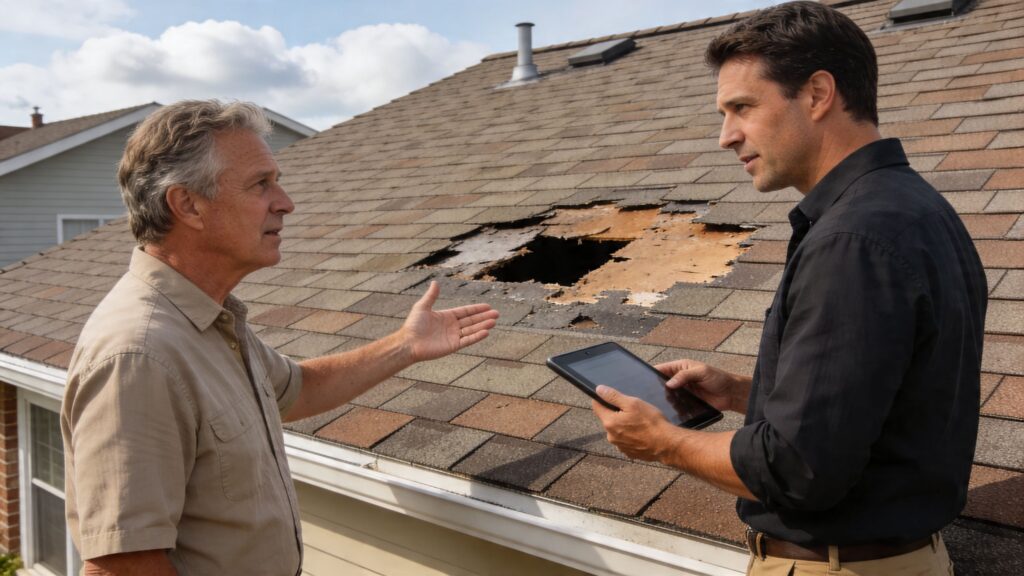
If you want a visual sense of what a professional field check can involve, this roof inspection image example gives a practical reference point.
Material choices in coastal South Florida
Not every roofing material performs the same way here. The right choice depends on your budget, roof design, HOA constraints, and how long you plan to stay in the home. But the trade-offs are real.
Asphalt shingles
Shingles are familiar and often the first option homeowners consider because replacement logistics can be simpler on many homes. The downside in this region is that wind exposure, UV intensity, and repeated storm stress can reveal weakness sooner, especially on roofs with many transitions and penetrations.
Tile roofs
Tile is common in Boynton Beach for a reason. It suits local architecture and can perform well, but tile systems only work as well as the components beneath them. Broken tile replacement alone doesn't solve underlayment aging, flashing failure, or fastening issues. Many emergency calls on tile homes come from hidden problems, not dramatic roof collapse.
Metal roofs
Modern metal roofing deserves a serious look in high-wind coastal zones. The upfront decision can be harder because aesthetics, cost expectations, and installer experience all come into play. But in terms of storm resilience, fast water shedding, and reduced emergency exposure, metal often makes strong practical sense.
Field observation: Homeowners usually ask which roof is cheapest to install. A better question is which roof is least likely to need a midnight tarp call in August.
Small maintenance steps that prevent big calls
Not every roof emergency starts with a major storm. Some start with neglect around the edges.
Focus on the simple items:
- Trim overhanging branches before they scrape surfaces or drop limbs in a storm.
- Keep valleys and drains clear so water doesn't back up where it shouldn't.
- Watch for ceiling stains after smaller rains because those often show the earliest warning.
- Check attic conditions periodically for damp insulation, staining, or musty odor.
- Address minor flashing issues promptly instead of waiting for a broader failure.
Think in systems, not isolated repairs
This is the biggest mindset shift homeowners can make. A roof isn't just tile, shingles, or metal panels. It's decking, underlayment, flashing, fasteners, sealants, drainage design, and the workmanship tying them together. If one element keeps failing, replacing only the visible surface may not solve the pattern.
That's especially true after an emergency. The best time to discuss upgrades is often right after the immediate repair, when the damaged area is open and the actual condition of the system is visible.
A leak during a Boynton Beach storm feels sudden. Most of the time, the cause wasn't sudden at all. It was a weak detail waiting for the right weather event.
If your home has an active leak, storm damage, or signs that your roof won't make it through the next round of weather, contact Paletz Roofing and Inspections. A prompt inspection, clear repair scope, and proper emergency stabilization can help protect the structure now and put you in a better position before hurricane season returns.