A lot of South Florida homeowners read the warranty line in a roofing contract right before storm season and feel two things at once. Relief, because they think the paper protects them. Confusion, because terms like lifetime, limited, labor, and manufacturer-backed don't tell you much when you're staring at a roof that just took wind, rain, and flying debris.
That's where people get into trouble. A roof repair warranty can protect your investment, but only if you know what it covers, what voids it, and who's responsible when something fails. In Broward, Miami-Dade, and Palm Beach, those details matter more because post-storm patch jobs, rushed repairs, and resale assumptions can wipe out warranty protection fast.
Table of Contents
- That 'Ironclad' Warranty in Your Roofing Contract
- Manufacturer vs Workmanship Warranties
- What Your Warranty Actually Covers and Excludes
- How to File a Successful Warranty Claim
- Critical Warranty Pitfalls and Red Flags
- Special Warranty Considerations for South Florida
- Your Pre-Hire Checklist and Warranty FAQs
That 'Ironclad' Warranty in Your Roofing Contract
A common South Florida scene goes like this. A storm warning is on the news, the roof already had a leak last season, and now a contractor hands over a proposal with bold language about a strong warranty. The homeowner sees that line and thinks, good, if anything goes wrong, I'm covered.
Not so fast.
The contract might say lifetime. It might mention labor. It might say limited manufacturer coverage. None of that means much until you know what event triggers the warranty, what work voids it, and whether the contractor followed the system the manufacturer required in the first place.
I've seen homeowners focus on the bold print and miss the lines that matter. Who can touch the roof later. Whether emergency patching by someone else voids coverage. Whether the warranty shrinks over time. Whether a sale of the home cuts off protection.
Practical rule: A roofing warranty isn't a promise in the everyday sense. It's a contract with conditions.
That's why contract language matters as much as shingles, tile, underlayment, and flashing. If you want a good plain-English primer on how liability language works inside agreements, this expert advice on contract risk management is worth reading before you sign anything.
What homeowners usually miss
- The headline term isn't the actual protection. “Lifetime” sounds strong, but the exclusions and transfer rules decide whether it has value.
- A storm doesn't automatically create a warranty claim. Wind damage, impact damage, installation defects, and product defects are handled differently.
- Emergency decisions have consequences. After a storm, people call the first handyman who answers. That's often where warranty trouble starts.
A roof repair warranty is useful. But paper alone won't protect a South Florida home. The terms, the installer, the documentation, and the follow-up maintenance are what make it real.
Manufacturer vs Workmanship Warranties
A roof can have solid materials and still leak if the crew missed the flashing, fastener pattern, or tie-in. It can also be installed correctly and fail because the product itself was defective. Those are two different problems, and they usually fall under two different warranties.
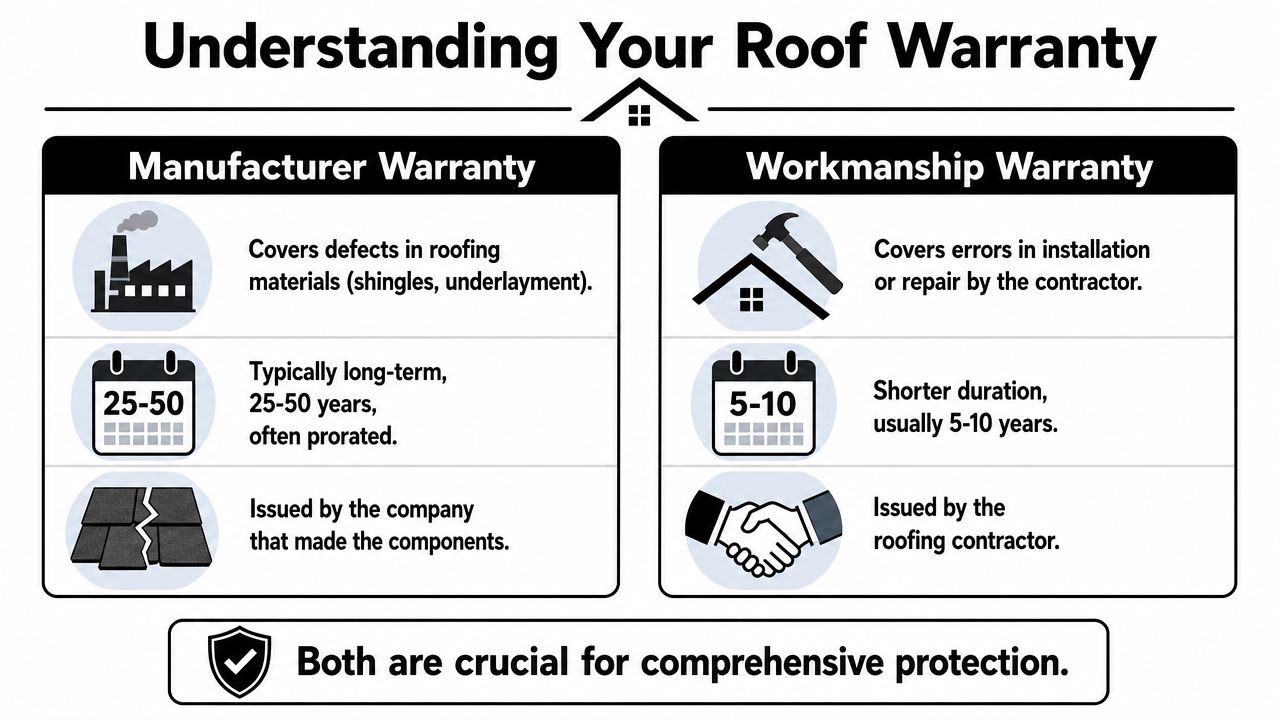
A manufacturer warranty covers defects in the roofing product. A workmanship warranty covers installation or repair errors made by the contractor. According to Roof Maxx's roof warranty guide, manufacturer warranties usually apply to material defects, while contractor workmanship warranties typically address leaks or damage tied to installation mistakes.
Side-by-side comparison
| Warranty type | What it usually covers | What it usually doesn't cover | Who issues it |
|---|---|---|---|
| Manufacturer warranty | Defective shingles, tile, membrane, or other roofing components | Installer error, neglected maintenance, many weather-related events | The company that made the roofing product |
| Workmanship warranty | Leaks and failures caused by improper installation or repair methods | Damage outside the contractor's scope, events excluded by the contract | The roofing contractor |
In South Florida, workmanship claims come up more often than homeowners expect. The leak is often at a valley, wall flashing, vent penetration, ridge detail, or edge metal, not in the field of the roof. I see far more failures from how the system was put together than from a bad bundle of shingles or a defective roll of underlayment.
That distinction matters after a storm. If a handyman, water mitigation crew, or unapproved roofer does a quick patch, reseals penetrations, or swaps out broken tile without authorization, the manufacturer can argue the system was altered and deny the claim. A contractor can also deny workmanship coverage if someone else worked on the roof and muddied the cause of the leak.
Home sales create another problem. Homeowners hear “lifetime” and assume the next owner gets the same protection. Sometimes they do not. Many manufacturer warranties have a narrow transfer window, and many workmanship warranties do not transfer at all unless the contract says so in writing.
What to check before you rely on either warranty
Manufacturer warranty
- Ask for the actual warranty form for your product line, not a sales summary.
- Confirm whether the warranty is standard material-only coverage or an upgraded system warranty.
- Check the transfer terms before a sale. Deadlines and fees can kill the value fast.
Workmanship warranty
- Verify who is standing behind the labor. A warranty from a contractor with no local track record is weak paper.
- Read the exclusions for repairs by others, storm-related emergency work, and maintenance obligations.
- Get clear language on leak response time, because a slow callback during rainy season can turn a small issue into interior damage.
For owners who manage mixed-use or commercial property, these same principles show up in service contracts and inspection logs. Good maintenance tips for facility roofs can also help you avoid disputes over whether the issue came from neglect, storm damage, or installation.
The practical rule is simple. Match the problem to the warranty. If the material failed, the manufacturer matters. If the roof detail was built wrong, the contractor matters more than the brand name on the wrapper.
What Your Warranty Actually Covers and Excludes
Most homeowners read the cover page and skip the fine print. That's backwards. The exclusions tell you more than the marketing language does.
According to Home Genius Exteriors' warranty overview, most roof warranties last between 25 to 50 years, and to keep them valid, homeowners typically must hire licensed and manufacturer-certified contractors, follow manufacturer installation guidelines, maintain ventilation requirements, and keep detailed maintenance records.
What usually falls under coverage
Material coverage usually applies when the product itself fails earlier than it should under normal, approved conditions.
- Defective roofing materials such as shingles or other components that show manufacturing problems.
- Premature product failure when the issue traces back to the material rather than how it was installed.
- Replacement of defective components under the terms of the manufacturer policy.
Workmanship coverage usually applies when the crew created the problem.
- Improper installation details like bad flashing integration, fastening mistakes, or poor shingle placement.
- Repair-related errors if a prior repair was done incorrectly and that mistake led to leakage.
- Property damage tied to installation work if the workmanship warranty says that kind of loss is included.
What usually gets excluded
At this point, South Florida homeowners need to slow down and read every line.
- Storm and impact events. Wind-driven rain, flying debris, tree strikes, and similar events are commonly handled outside standard warranty language.
- Lack of maintenance. If drainage, debris buildup, or neglected minor issues contribute to failure, the claim can get denied.
- Unauthorized changes. Satellite mounts, solar attachments, patch jobs, or other alterations by the wrong party can cause problems.
- Ventilation issues. Manufacturers often require specific attic or roof ventilation conditions.
- Cosmetic complaints. Not every appearance issue counts as a covered defect.
What isn't covered is often more important than what is.
What keeps the warranty valid
If you want your roof repair warranty to stay usable for decades, treat it like a file you maintain, not a paper you throw in a drawer.
- Save the contract and warranty documents. Keep digital and printed copies.
- Document all service visits. Inspection notes, invoices, photos, and repair records matter.
- Use qualified roofers for follow-up work. Don't let an unapproved worker touch the system.
- Address maintenance early. Small issues become bigger arguments during claims.
- Keep proof of routine care. For owners managing larger properties, these maintenance tips for facility roofs are useful because the same record-keeping habits help residential claims too.
A warranty doesn't fail only when the roof fails. It also fails when the homeowner can't prove the roof was installed, maintained, and repaired the way the warranty required.
How to File a Successful Warranty Claim
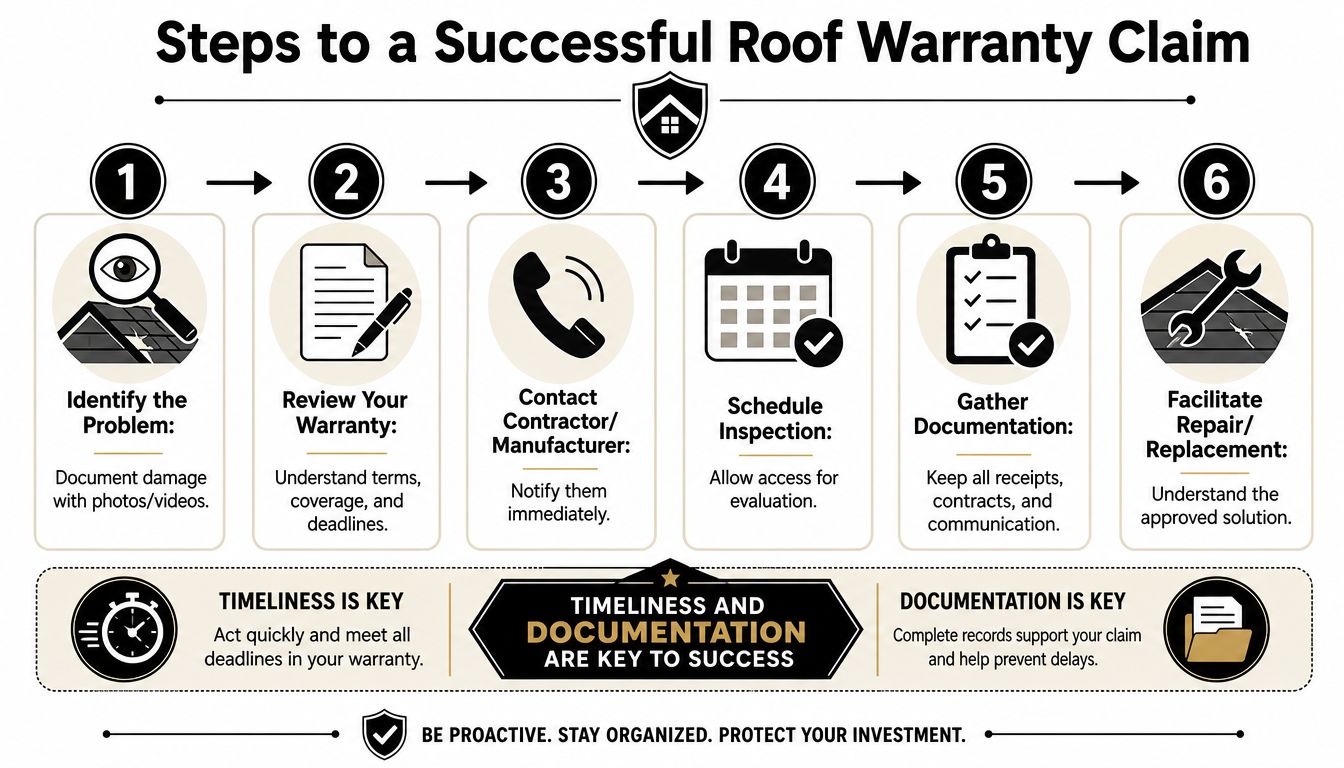
When you spot a leak, missing material, water stain, or soft ceiling area, the first mistake is letting someone start “just a quick fix” before the claim is documented. Once the condition changes, the proof changes too.
Leaks are often blamed on materials by default, but that's not how roofing claims usually shake out. As explained in this roofing discussion of how roof warranty work is typically handled, leaks are predominantly attributed to workmanship failures rather than material defects, as standard manufacturer policies explicitly exclude installation-related damage.
Start with documentation before anyone touches the roof
Take wide photos and close-up photos. Photograph the interior damage, the ceiling stains, wet insulation if visible, and the roof area from safe ground angles if possible. Write down the date, what you observed, and whether the issue appeared after rain, wind, or routine wear.
If your paperwork is scattered, gather it now. Contract. Invoice. Warranty certificate. Repair receipts. Inspection notes. Manufacturer paperwork.
Call the right party first
If the issue looks like leakage around a repair area, flashing, vent, valley, wall tie-in, or another installation detail, start with the contractor who performed the work. That's usually the fastest path because labor-related failures belong there.
If you need a roof inspection image reference while organizing records, this Paletz Roofing and Inspections logo asset is also where some homeowners first identify the inspection company listed in their service paperwork.

Don't start with assumptions. Start with evidence, dates, and the contract language.
Build a claim file
Use a simple checklist so nothing goes missing.
- Damage record: Photos, videos, notes, weather timing.
- Contract file: Proposal, signed agreement, warranty pages, proof of payment.
- Communication log: Who you called, when, and what they said.
- Inspection access: Be available so the roof can be examined promptly.
Then ask for the findings in writing. If the contractor says it's workmanship, get the repair scope in writing. If they say it's a material issue, ask how they want the manufacturer claim submitted and what supporting photos they need.
The homeowners who do best with roof repair warranty claims aren't the loudest. They're the most organized.
Critical Warranty Pitfalls and Red Flags
A common South Florida call goes like this. The storm passed, a few shingles lifted, water showed up on the ceiling, and someone knocked on the door offering a quick patch for cash. That decision can cost more than the leak.
The small repair that blows up a big warranty
I have seen homeowners act fast for the right reason. They are trying to stop interior damage. The problem starts when the first person on the roof is not the original contractor, not manufacturer-approved, or not even licensed.
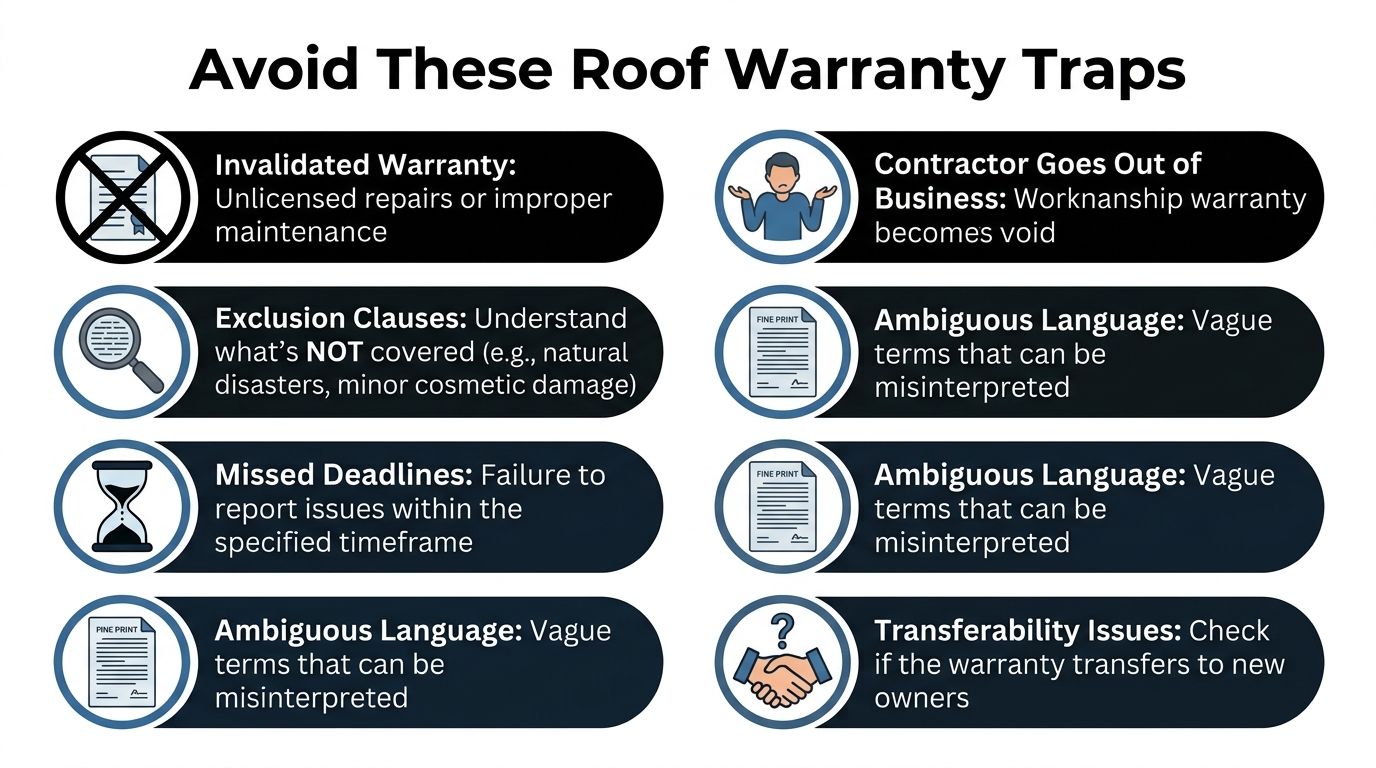
That patch can change the claim. Once another party alters the roof, the contractor and manufacturer may argue over who caused what. In practice, that gives both sides room to deny responsibility.
According to Jamar Roofing's warranty analysis, unauthorized repairs are a frequent reason warranty claims get rejected, especially after storm events. South Florida homeowners are exposed to this more than many markets because storm-chasing crews, handymen, and cash repair offers show up fast after wind events.
The safer move is simple. Protect the inside of the house, document the condition, and get written direction before anyone performs non-emergency roof work.
Field lesson: A tarp to limit interior damage is one thing. An unapproved repair is another.
Why “lifetime” can disappoint during a home sale
“Lifetime” is one of the most misunderstood words in roofing. In many contracts, it means the material line has a long limited warranty for the original owner under specific conditions. It does not automatically mean the next owner gets the same coverage.
I tell sellers to read the transfer language before they mention the warranty in a listing. Some warranties require a transfer fee, a deadline after closing, or a formal inspection. Some do not transfer at all. If the paperwork is missing, the value of that warranty drops fast in a real estate deal.
That matters in South Florida, where buyers and insurers look closely at roof age, permits, and prior storm history. A non-transferable “lifetime” warranty sounds strong in conversation and weakens quickly once the buyer asks for the actual certificate.
Contract red flags I tell homeowners to catch early
A warranty problem usually starts in the contract, long before a claim.
- Vague workmanship terms. The labor warranty should say what installation defects are covered and for how long.
- No written transfer rules. If you may sell the house, confirm whether the warranty follows the property, the original purchaser, or no one.
- Loose language about repairs by others. Look for clauses that void coverage if another roofer, handyman, satellite installer, or solar crew penetrates or alters the system.
- Undefined maintenance duties. If the contract requires maintenance, it should spell out what that means.
- Missing claim deadlines. Some warranties require notice within a short window after the problem appears.
- Promises made only during the sales call. If it is not in the signed paperwork, do not count on it later.
One more red flag belongs high on the list in South Florida. Post-storm work done without the warrantor's approval can turn a valid defect issue into a finger-pointing match. That is how homeowners lose time, lose coverage, and still end up paying for the repair.
Special Warranty Considerations for South Florida
Roofing in South Florida isn't the same as roofing in most other places. Broward and Miami-Dade homes face stricter wind-related expectations, tougher inspections, and more confusion after storm events because homeowners are often dealing with both insurance questions and warranty questions at the same time.
Hurricane damage and warranty damage are not the same claim
This is the first thing I explain after a major storm. If wind tears off roofing, sends debris into the system, or drives rain into areas that were physically damaged, you may be looking at an insurance issue rather than a warranty issue. If the roof leaks because flashing was installed wrong, a repair seam failed, or fastening was done poorly, that points back toward workmanship.
Homeowners get into trouble when they file one type of claim and ignore the other. They tell the insurer it's all storm damage when part of the problem may be faulty prior work. Or they call it a warranty issue when the roof clearly suffered direct storm impact.
Local code and approved installation matter
South Florida roofs need to be installed in a way that matches local code requirements and the manufacturer's approved methods. Those two things are connected. If a roofer substitutes components, skips required details, or uses a repair approach that doesn't fit the roofing system, the warranty may not respond well later.
For homeowners in the High-Velocity Hurricane Zone, the practical takeaway is simple.
- Use licensed roofers who understand local approvals.
- Keep permit and inspection records with your warranty papers.
- After a storm, separate temporary interior protection from permanent roof repair decisions.
A good local contractor should also explain whether the issue you're seeing belongs under a workmanship discussion, a manufacturer review, or an insurance claim. Those lanes overlap in South Florida, but they are not the same thing.
Your Pre-Hire Checklist and Warranty FAQs
A lot of warranty fights start before the crew ever loads the roof.
A homeowner in South Florida signs a contract, sees the word "lifetime," and assumes the roof is protected for as long as they own the house. Then a storm hits, someone makes a quick patch without approval, or the home goes up for sale and the buyer learns the warranty does not transfer. That is how a good-looking warranty turns into a bad surprise.
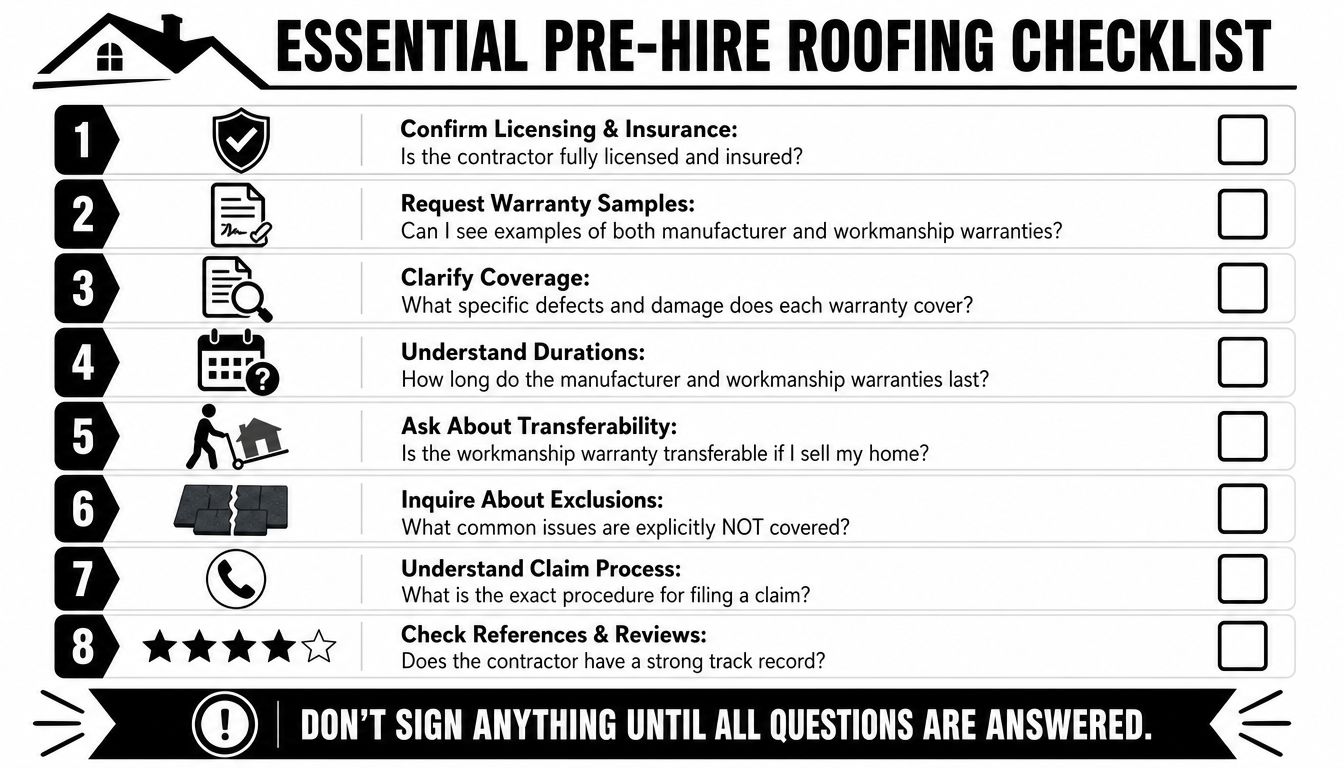
Questions to ask before you sign
Ask these questions before you hand over a deposit. If a contractor gives vague answers, treats the warranty as a sales slogan, or will not show you sample documents, slow down.
- Who covers what? Ask for a sample manufacturer warranty and a sample workmanship warranty, then compare the language.
- Who is allowed to perform later repairs? In South Florida, this matters after every named storm and every urgent leak call.
- What voids the warranty? Get the exclusions in writing, especially around post-storm repairs, foot traffic, pressure washing, and work by other trades.
- What records do I need to keep? Save the contract, permit, final invoice, photos, inspection paperwork, and any maintenance receipts.
- Does the warranty transfer if I sell the home? Do not assume a "lifetime" warranty follows the house. Many do not, or they transfer only if you meet a deadline and pay a fee.
- How do I file a claim? Ask who gets called first, what proof is required, and how fast you must report a problem.
- Who is registering the manufacturer warranty? Some systems require registration or specific paperwork after completion.
- What products are being installed, by exact name? A warranty is tied to the approved system, not to a general promise in a proposal.
If you're comparing contractors, one factual example in the local market is that Paletz Roofing and Inspections offers residential and commercial roofing services in Broward, Miami-Dade, and Palm Beach and provides inspection and repair work that can be matched to written workmanship terms when discussed in the proposal stage.
South Florida warranty FAQs
Does a lifetime roof repair warranty always transfer to the next owner?
No. As noted earlier, transfer rights are often limited or lost during a home sale. Read the transfer section before you count it as a selling point.
If my roofer goes out of business, is the workmanship warranty still useful?
It becomes much harder to collect on. A workmanship warranty is only as strong as the company standing behind it, which is why contractor stability matters.
After a hurricane, should I call insurance or the roofer first?
Document the condition right away with photos and video. If there is visible storm damage, contact your insurer and a qualified roofer so the cause of the problem is documented before permanent repairs are made.
Can I let a handyman do a quick patch to stop a leak?
Temporary interior protection is one thing. Unapproved roof work is another. I have seen warranties fall apart because a well-meaning patch changed the evidence or used materials the roof system did not allow.
What is the best way to protect the warranty over time?
Keep every document. Use approved roofers for follow-up work. Get repair authorization in writing after storms or leak events, especially before anyone opens up the roof.
If you want a straight answer about your current roof repair warranty, a leak after a storm, or whether a repair will void existing coverage, talk with Paletz Roofing and Inspections. They serve Broward, Miami-Dade, and Palm Beach counties and can review the roof condition, the repair history, and the warranty language so you know what protection you have before making the next move.