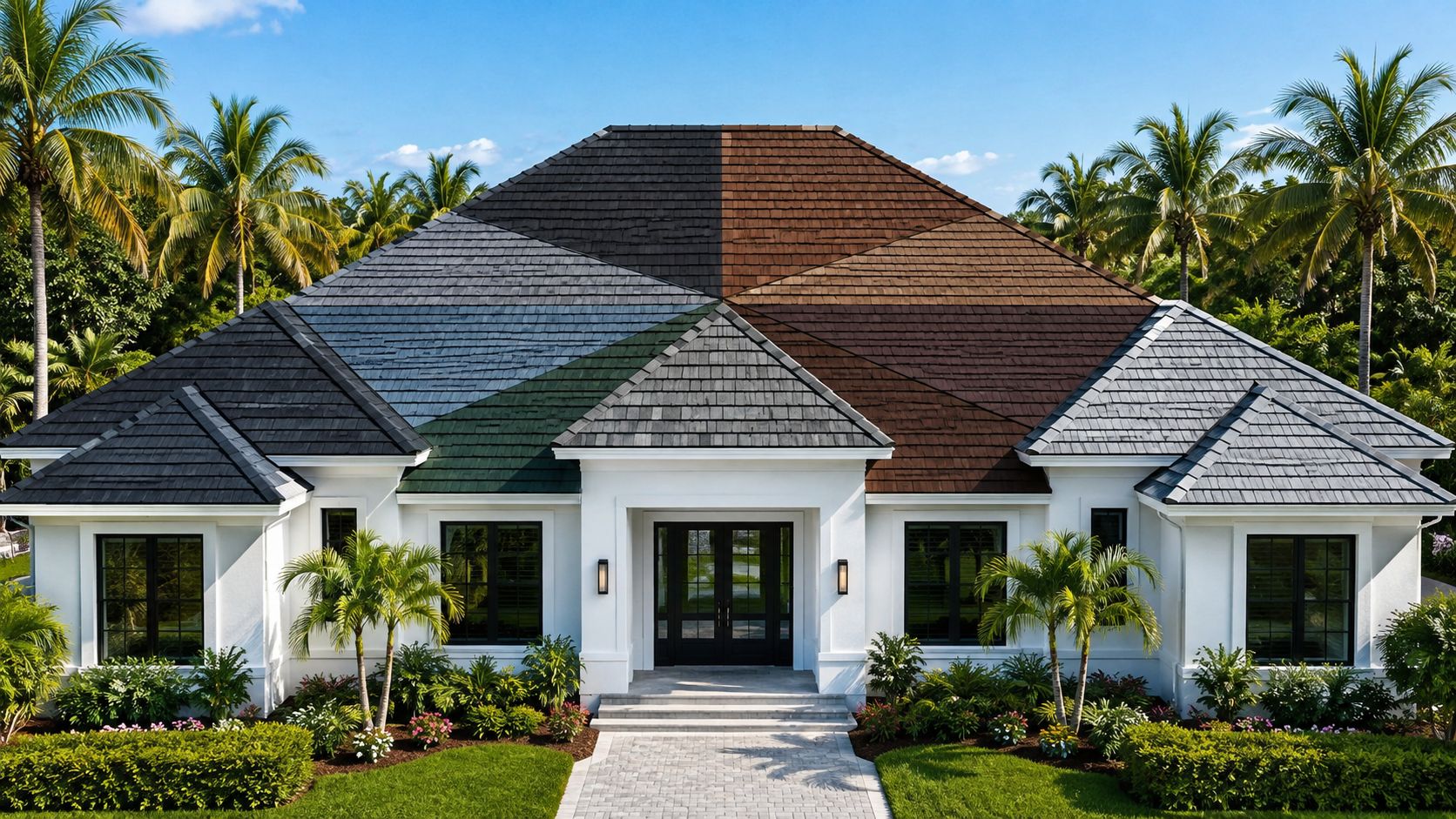
White exteriors offer a flexible backdrop, but the best color shingles for a white house aren't chosen by curb appeal alone. The right roof depends on contrast, the white's undertone, architectural style, landscaping, trim, and South Florida's intense sun and humidity. Darker colors can create dramatic definition, while lighter, reflective options may better support cooling goals. This list compares charcoal, slate black, weathered gray, brown, blue-gray, green-black, espresso, and cool silver, each solving a different design problem. For broader exterior planning, review this guide to hardscaping and budget advice. Paletz Roofing and Inspections also provides color guidance, inspections, installations, and material discussions for homeowners in Broward, Miami-Dade, and Palm Beach counties.
Table of Contents
- 1. Charcoal Gray with Dimensional Shading for Modern Contrast and Energy Efficiency
- 2. Architectural Slate Black with Weathered Undertones for Timeless Elegance
- 3. Deep Brown with Copper Accents for Warm Traditional Appeal and Weathering Character
- 4. Weathered Gray with Blue-Black Undertones for Coastal Contemporary Style
- 5. Soft Charcoal with Green-Black Undertones for Eco-Conscious and Natural Harmony
- 6. Slate Blue-Gray for Sophisticated Contrast and Coastal Connection
- 7. Rich Espresso Brown for Warm Luxury and Premium Distinctive Appeal
- 8. Cool Gray Silver for Modern Minimalist Aesthetic and Reflective Energy Performance
- 8-Color Shingle Comparison for White Houses
- Choose the Shingle Color That Fits Your Whole Exterior
1. Charcoal Gray with Dimensional Shading for Modern Contrast and Energy Efficiency
Charcoal gray gives a white house the definition of black without making the roof look completely flat or severe. Its layered gray character works with white columns, dark-framed windows, metal railings, and modern garage doors, so it's a practical choice for both traditional and contemporary façades.
A Palm Beach Colonial with white columns can use charcoal to emphasize symmetry and roof lines. In Broward, white board-and-batten siding paired with dimensional charcoal shingles creates a clean modern farmhouse appearance. On a Miami-Dade home with Mediterranean influences, the same palette can sharpen stucco forms without competing with arches, stone, or decorative details.
Why charcoal works in South Florida
Charcoal remains a dark roof, so it can absorb more solar energy than lighter roofing. Berkeley Lab guidance summarized by The Roofing Brief explains that nominally white asphalt shingles may reflect only about 25% of sunlight, while lighter roof products can reflect substantially more. The choice is therefore a design and heat-management trade-off, not a universal energy-efficiency recommendation.
If you prefer charcoal, use ventilation, insulation, and a properly installed roofing system to manage attic heat. Consider a weathered charcoal blend when you want contrast with a slightly softer appearance.
Practical rule: Use charcoal when the roof needs to anchor the exterior, then soften the composition with white gutters, pale stone, or warm landscaping.
Choose dimensional or architectural shingles to give the dark field more movement. White, aluminum, or copper gutters can reinforce the design, while zinc or copper-based algae-control treatments may help in South Florida's humid conditions. Always view samples against the actual white exterior, because a cool charcoal can look blue beside warm cream paint.
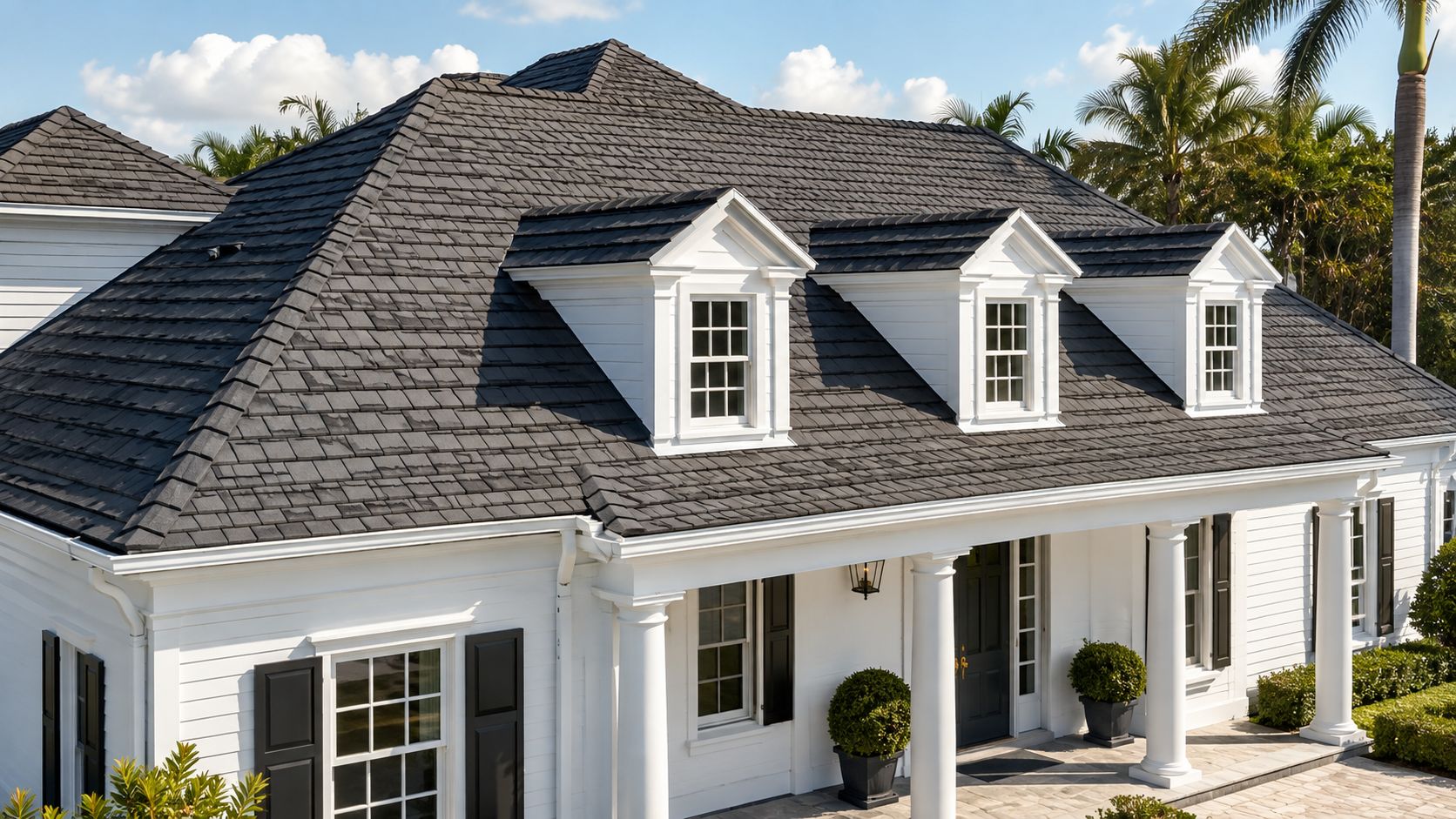
2. Architectural Slate Black with Weathered Undertones for Timeless Elegance
Slate black is the choice for homeowners who want high contrast but don't want a roof that looks like a single, uninterrupted black plane. Quality architectural blends often include charcoal and dark gray variation, creating depth that works especially well on large roofs and upscale homes.
A white Mediterranean estate in Miami-Dade can pair slate black with pale stone, bronze details, and restrained landscaping. In Palm Beach, the combination of slate black, white masonry, and copper accents creates a formal appearance. Broward executive properties can use the same palette for a resort-like exterior, particularly when the roof has visible dimensional shading.
Match the roof to the level of detail
Slate black needs supporting materials. Copper or bronze gutters can warm the contrast, while black window frames and ironwork can repeat the roof color across the elevation. If the home already has cool gray windows, stainless hardware, and blue-gray stone, choose a slate blend with cooler undertones. If the façade includes cream trim or natural wood, a charcoal-black blend may look more balanced than a blue-black product.
Ask to see several full-size samples, not only a small color chip. Granule distribution changes the roof's appearance from the street, and direct sunlight can reveal undertones that aren't visible in a showroom.
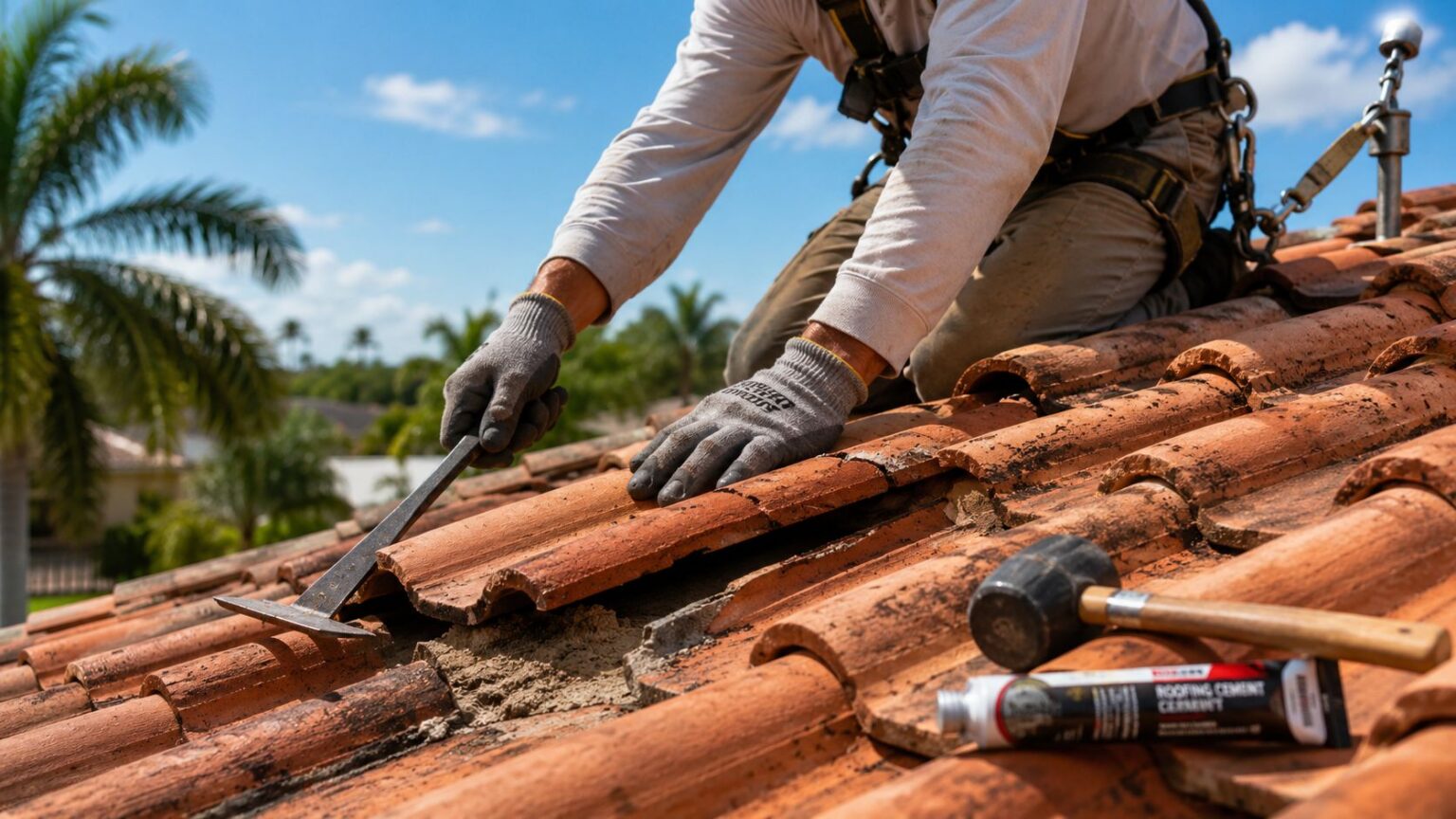
For a visual reference during a roofing discussion, review this shingle roof replacement image.
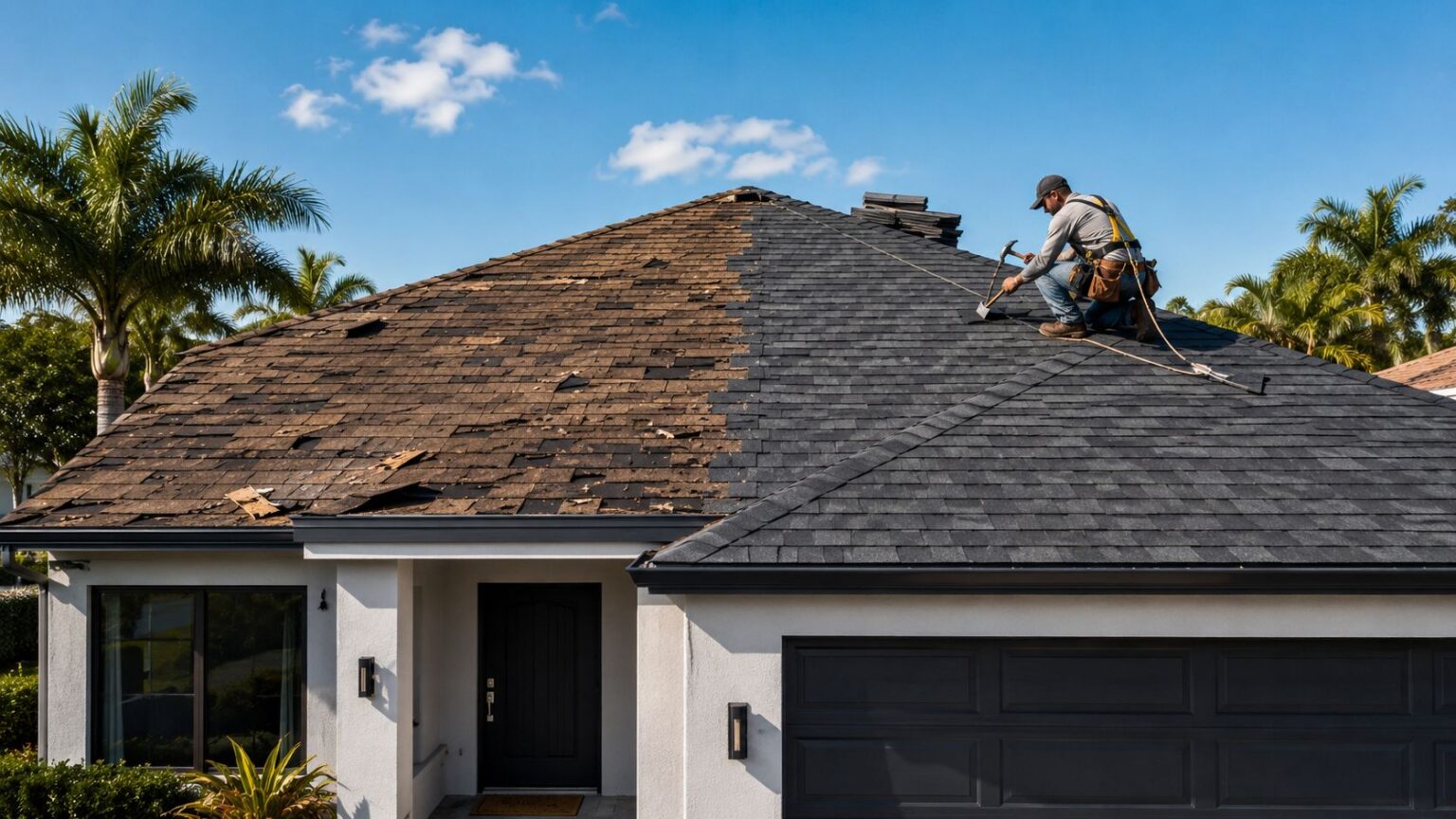
Premium architectural shingles can carry a higher material and installation commitment than basic three-tab products, so confirm the contractor's experience with the exact product line. Review warranty terms, color consistency between bundles, flashing details, and ventilation before approving the final color.
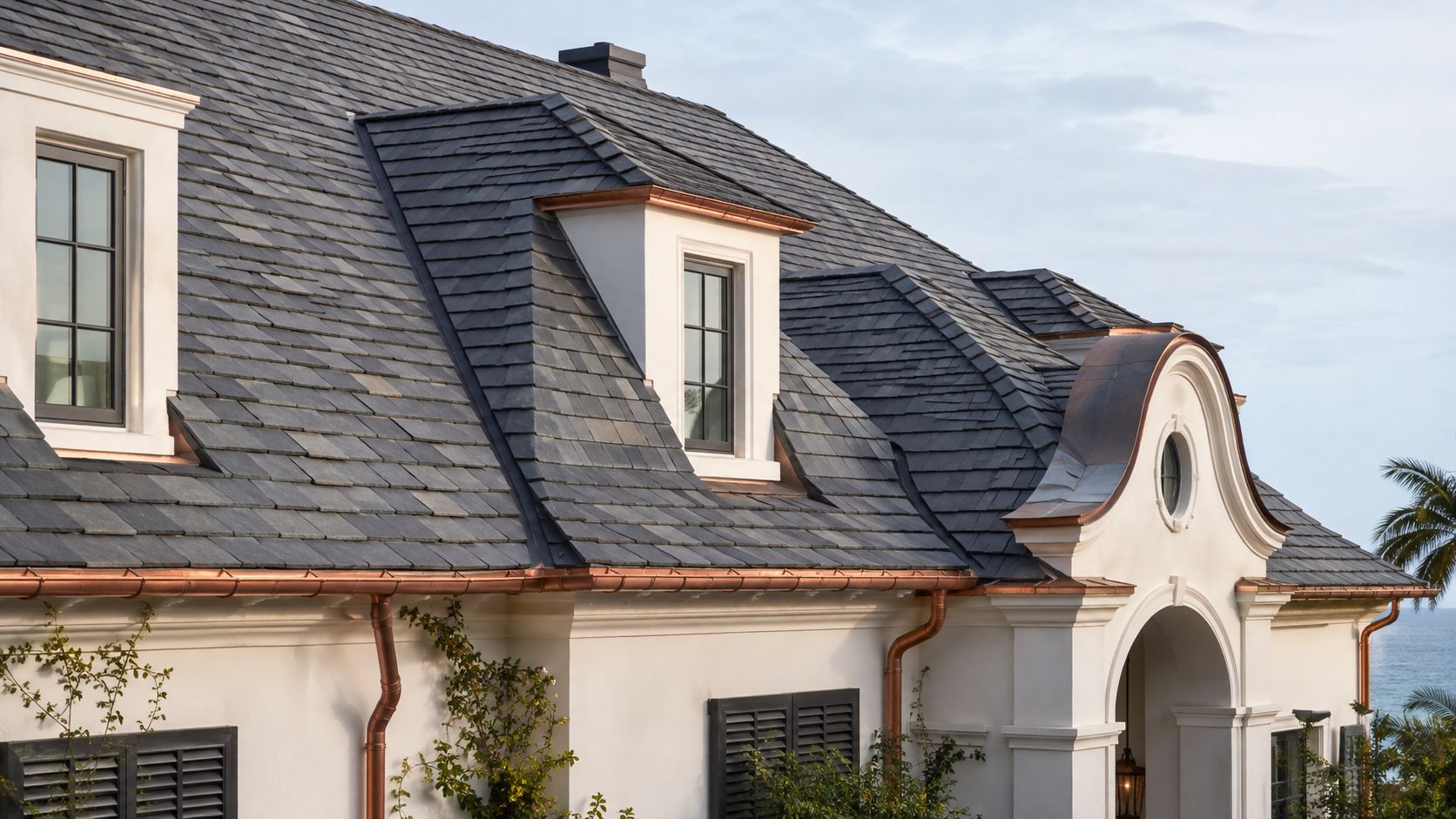
3. Deep Brown with Copper Accents for Warm Traditional Appeal and Weathering Character
Deep brown solves a common problem with white homes: the exterior can look too stark when every accent is cool, bright, or sharply contrasting. A brown roof adds warmth and connects the house to wood trim, stone, mulch, mature trees, and tropical planting.
This palette suits cottages, Craftsman-influenced homes, and transitional properties. A Broward cottage with white walls and natural wood trim can use deep brown shingles to make the façade feel settled rather than newly assembled. In Miami-Dade, brown shingles with copper downspouts bridge white stucco and warm masonry. A Palm Beach Craftsman-style residence can use the same combination to emphasize brackets, beams, and porch details.
Build around the landscape
Brown works best when it appears elsewhere in the exterior, even in small amounts. Natural wood soffits, cedar-look accents, bronze lighting, copper gutters, and earth-toned planting can make the roof feel intentional. If the property has gray stone, blue shutters, or very cool white paint, a brown roof may appear disconnected unless the selected blend includes gray or muted neutral granules.
Choose dimensional shingles with visible variation rather than a flat brown field. That variation helps the roof coordinate with irregular materials such as stone, brick, wood, and layered landscaping.
- Use copper carefully: Copper accents can reinforce the roof's warmth without requiring every fixture to match.
- Coordinate the ground plane: Trees, shrubs, stone borders, and mulch can make brown feel integrated with the lot.
- Preview weathering: Ask for installed examples in similar South Florida neighborhoods before committing to a blend.
The goal isn't to make the roof look artificially aged. Select a product whose variation will remain attractive as dust, pollen, and weather alter the surface over time.
4. Weathered Gray with Blue-Black Undertones for Coastal Contemporary Style
Weathered gray with blue-black undertones gives a white house a coastal identity without turning the roof bright blue. Gray keeps the exterior controlled, while the blue undertone can connect with water, sky, shutters, doors, and maritime finishes.
On a Miami Beach contemporary home, this palette echoes the setting while preserving clean architectural lines. In Broward new construction, it pairs with white trim, stainless details, and modern metal accents. A Palm Beach modern farmhouse can combine it with white board-and-batten siding, pale wood, and restrained blue-gray doors.
Test the blue before installation
Blue undertones may disappear in shade and become obvious in direct sun. Place samples beside the actual siding in morning light, afternoon light, and shadow. Compare them with gutters, window frames, driveway materials, and nearby trees. A sample that looks neutral indoors may appear distinctly blue beside a warm white wall.
The weathered finish makes a new roof look less stark, but it does not prevent staining or discoloration. South Florida humidity still makes installation quality, drainage, ventilation, and maintenance important. Review roof maintenance guidance before treating appearance as the only selection factor.
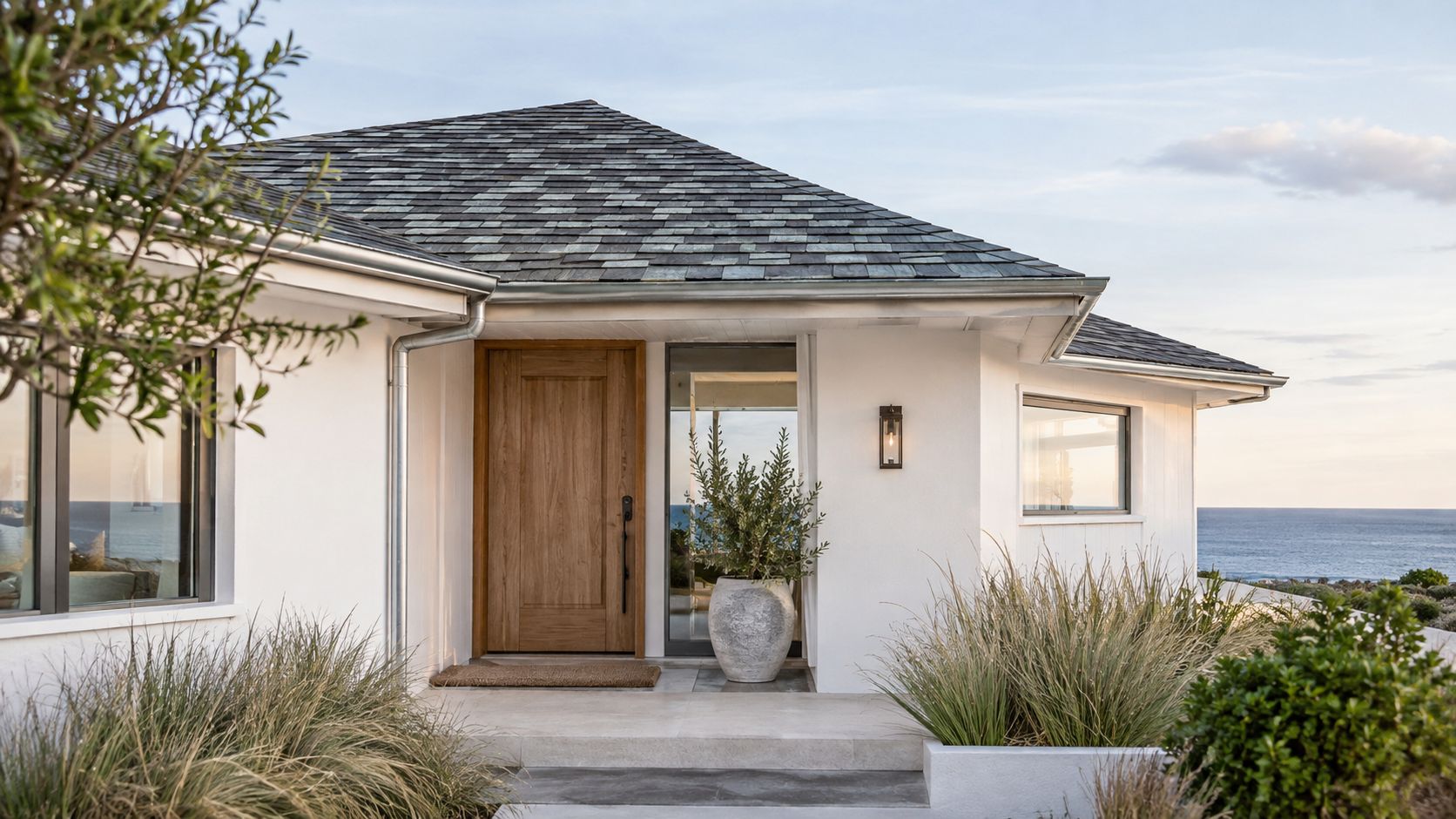
A blue-gray roof should connect at least two other exterior elements, such as shutters and a front door, or metalwork and planting materials.
Use dimensional or premium architectural shingles when the roof is highly visible. Granule variation gives weathered gray more depth than a uniform field and helps it coordinate with white walls, pale wood, and blue-gray details.
5. Soft Charcoal with Green-Black Undertones for Eco-Conscious and Natural Harmony
Soft charcoal with green-black undertones connects a white home to native planting, mature trees, reclaimed wood, natural stone, and other organic materials without making the roof look distinctly green. It solves the design problem of a roof that feels too stark against a property with established greenery or natural finishes.
A Miami-Dade home surrounded by palms and native plants can use this palette to relate the roof to foliage while preserving contrast against white walls. In Broward, reclaimed wood accents, stone, and other sustainable exterior materials can reinforce the undertone. A Palm Beach property with white fiber-cement siding and layered garden beds may benefit from the quieter, more grounded effect of soft charcoal-green shingles.
Let the property determine the green level
Green undertones change with surrounding colors and light. Beside blue-gray windows, the shingles may read nearly neutral. Against warm wood, palms, or dense tree canopies, the green can become more apparent. Request samples showing the complete granule mix, then inspect them in morning sun, afternoon sun, and shade.
The softened charcoal usually appears less severe than a pure black roof, especially on a large or highly visible roof plane. Appearance alone does not confirm heat performance. If heat management is part of the decision, ask the installer or manufacturer for documented product information rather than assuming that a green or gray blend has high reflectance.
Coordinate the roof with natural stone, reclaimed wood, matte bronze, or one restrained planting color. Repeating the green-black family in planting or a single architectural detail creates a clearer connection than adding several unrelated accents. Also compare the sample with gutters, window frames, driveway materials, and nearby trees.
- Test beside foliage: Palms, hedges, and dense tree canopies can make green undertones appear stronger.
- Choose texture over shine: A dimensional, low-gloss shingle generally suits an organic exterior better than a flat-looking surface.
- Confirm the material system: Review ventilation, flashing, drainage, and moisture-management details with the installer, particularly in humid South Florida conditions.
6. Slate Blue-Gray for Sophisticated Contrast and Coastal Connection
Slate blue-gray gives a white house color without becoming bright or playful. It's a strong choice for waterfront properties, nautical architecture, colonial details, and homes with blue doors or shutters.
A Miami Beach residence can use slate blue-gray with white walls, simple trim, and maritime hardware. In Broward, the roof can coordinate with water views, blue-toned landscaping, and stainless accents. Palm Beach homes often benefit from the pairing when white trim and blue shutters already define the exterior palette.
Make the undertone deliberate
Slate blue-gray should support the home's existing colors, not introduce a disconnected new family. Compare it with the front door, shutters, pool finishes, window frames, and stone. A warm white exterior may need a more muted slate blend, while a crisp cool white can handle a clearer blue-gray contrast.
Stainless steel, anodized aluminum, and restrained blue-tone hardware reinforce the coastal effect. Warm copper can also work, but it changes the mood from nautical and crisp to more traditional and layered.
Color consistency matters across a large roof. Ask the contractor how bundles will be distributed and whether the selected product has visible variation. Review samples from more than one bundle when possible, especially if the roof has multiple planes that will catch light differently.
The best blue-gray roofs look connected to the property, not imported from a color chart.
This choice is especially effective when the surrounding setting already includes water, pale stone, blue shutters, or coastal landscaping. Without those connections, slate blue-gray may look more decorative than architectural.
7. Rich Espresso Brown for Warm Luxury and Premium Distinctive Appeal
Espresso brown gives a white home warmth and depth while avoiding the severity of black. It has more visual richness than a basic brown and works well with natural stone, copper, bronze, warm lighting, and established landscaping.
Miami-Dade luxury homes with white Mediterranean walls can pair espresso shingles with stone columns and controlled outdoor lighting. In Broward, espresso works with white walls, copper gutters, and warm exterior fixtures. A Palm Beach traditional residence can use the color to complement manicured grounds without introducing the stronger contrast of slate black.
Use the roof as the warm anchor
Espresso is most successful when the façade includes at least a few warm materials. Natural stone, wood garage doors, bronze lighting, copper details, and beige-gray paving can repeat the roof's warmth. If every other exterior element is blue, silver, or stark white, espresso may appear too isolated.
Select architectural shingles with more than one brown tone. Small granule variations can prevent the roof from looking like a heavy dark block and can help it relate to irregular stone or wood textures.
- Repeat warm metals: Copper, bronze, and muted gold can make the roof feel integrated.
- Balance the white: Cream trim or warm stone can soften the contrast, while pure white trim makes the roof look more formal.
- Check batch variation: Ask to compare samples from multiple manufacturer batches before ordering.
Espresso suits homeowners who want a distinctive roof but prefer warmth over drama. It's also a sensible visual bridge for transitional homes that combine traditional forms with updated exterior materials.
8. Cool Gray Silver for Modern Minimalist Aesthetic and Reflective Energy Performance
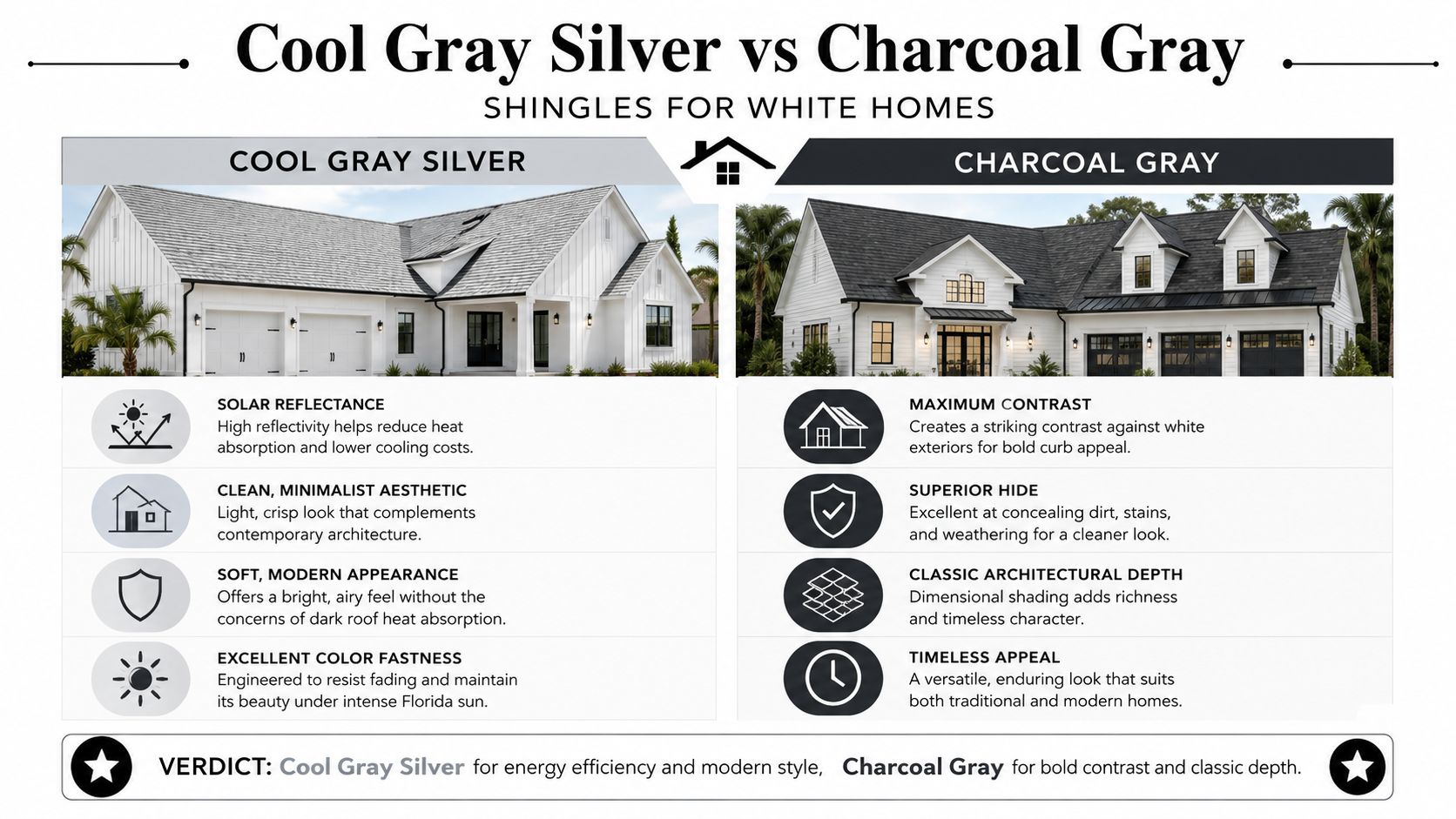
Cool gray silver is the clearest choice in this list for homeowners who want a pale, modern roof with a stronger focus on reflectivity. It keeps the white exterior bright while adding enough contrast to define the roof plane.
The performance case deserves careful attention. Technical guidance summarized by EZ Home Search states that dark roof materials typically reflect 5% to 20% of incoming sunlight, while light-colored materials reflect about 55% to 90%. Asphalt shingles usually perform within a narrower range, so ask for the specific product's solar reflectance information rather than judging performance by color alone.
Keep silver from feeling sterile
Cool silver works on Miami-Dade minimalist homes with clean lines, limited ornament, and contemporary windows. Broward new construction can use it to support a bright exterior and a reflective roofing strategy. In Palm Beach, warm landscaping, wood accents, or pale stone can prevent the combination from feeling too institutional.
Use warm doors, timber details, textured planting, or bronze hardware to add balance. Architectural lighting can emphasize roof texture, but consider glare for neighboring properties and nearby streets. A product marketed with solar reflectance information is preferable when cooling performance is part of the decision.
A University of Central Florida roofing publication found that asphalt shingle samples across colors ranged from about 3% to 26% solar reflectance, while a white cement shingle reached 77%, as reported in this solar reflectance comparison. That comparison shows why material selection can matter as much as the shade itself.
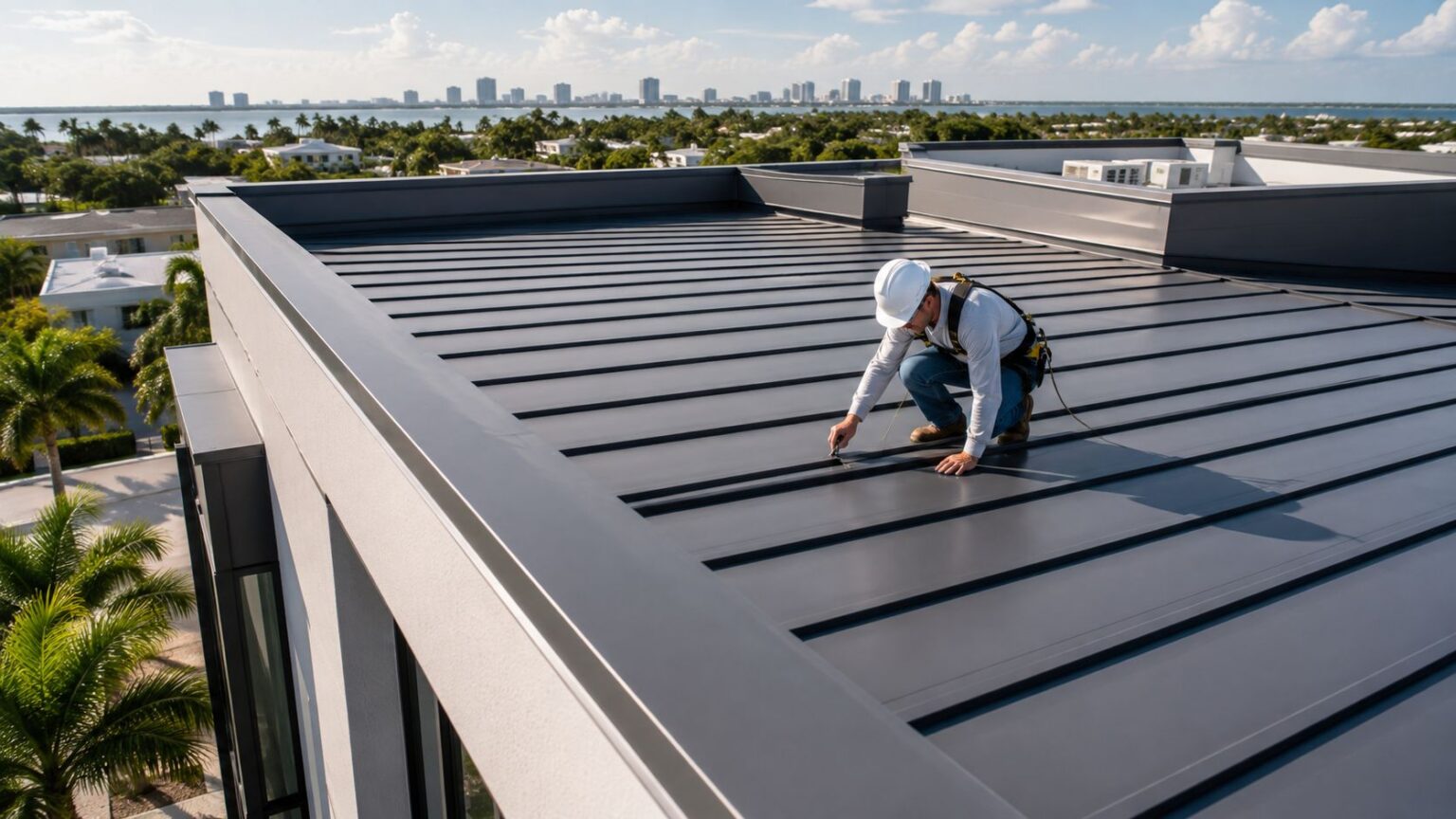
For a broader installation reference, review this commercial metal roofing installation image.
8-Color Shingle Comparison for White Houses
| Option | Implementation Complexity 🔄 | Resource & Cost ⚡ | Expected Outcomes ⭐ | Ideal Use Cases 💡 | Key Advantages 📊 |
|---|---|---|---|---|---|
| Charcoal Gray with Dimensional Shading | 🔄 Low–Medium, standard shingle install; ventilation recommended | ⚡ Medium, widely available architectural styles; moderate maintenance (algae treatment) | ⭐ Strong contrast with white; good UV colorfastness; increased heat absorption possible | 💡 Colonial, modern farmhouse, white-trim homes in South Florida | 📊 High curb appeal; hides dirt/weathering; versatile with many sidings |
| Architectural Slate Black with Weathered Undertones | 🔄 Medium–High, heavier premium product; needs experienced installers | ⚡ High, premium material costs; possible structural assessment for older roofs | ⭐ Luxury slate-like appearance; superior durability, wind/impact resistance | 💡 High‑value estates, luxury renovations requiring upscale appearance | 📊 Premium aesthetic rivaling slate; long-lasting color and performance |
| Deep Brown with Copper Accents | 🔄 Low–Medium, standard install; designed for intentional weathering | ⚡ Medium, less common color, may require specific granules; low upkeep | ⭐ Warm, inviting appearance that develops patina over time | 💡 Craftsman, cottage, transitional homes with natural materials | 📊 Warm curb appeal; gains character with age; pairs well with wood/stone |
| Weathered Gray with Blue‑Black Undertones | 🔄 Medium, specify product to avoid unwanted hue shifts | ⚡ Medium–High, premium/limited availability; select samples in varied light | ⭐ Contemporary coastal aesthetic; established (pre-aged) look; strong UV/salt resistance | 💡 Coastal contemporary, new construction, modern renovations | 📊 Modern, sophisticated look; blue undertones add depth without starkness |
| Soft Charcoal with Green‑Black Undertones | 🔄 Medium, undertone evaluation recommended before purchase | ⚡ Medium, limited manufacturers; eco-certified options available | ⭐ Subtle natural harmony; refined contrast without pure black heat issues | 💡 Eco‑conscious homes, sustainable designs emphasizing landscape integration | 📊 Environmentally aligned appearance; soft matte finish reduces glare |
| Slate Blue‑Gray for Coastal Connection | 🔄 Medium, color batch verification advised | ⚡ Medium, specialized color, moderate availability constraints | ⭐ Sophisticated coastal contrast; strong performance in salt‑spray/UV | 💡 Waterfront and maritime-influenced properties, coastal neighborhoods | 📊 Distinctive nautical aesthetic; balances contemporary and traditional |
| Rich Espresso Brown for Warm Luxury | 🔄 Low–Medium, standard install; batch sample checks recommended | ⚡ Medium–High, premium color complexity; less common inventory | ⭐ Deep warm luxury look that complements white without starkness | 💡 Upscale homes, premium renovations emphasizing warm materials | 📊 Distinctive premium appearance; pairs well with stone, copper, wood |
| Cool Gray Silver for Reflective Performance | 🔄 Medium, may need glare and lighting coordination | ⚡ Medium–High, reflective coatings or specialty products increase cost | ⭐ Genuine energy savings via solar reflectance; clean minimalist aesthetic | 💡 Modern/minimalist and energy‑conscious homes in hot climates | 📊 Lowers cooling demand; contemporary look with sustainability benefits |
Choose the Shingle Color That Fits Your Whole Exterior
There isn't one universal winner among the best color shingles for white house projects. Charcoal gray delivers strong modern contrast. Slate black suits formal luxury and high-impact architecture. Deep brown and espresso add warmth, with espresso providing a richer premium effect. Weathered gray and slate blue-gray fit coastal homes, while soft charcoal with green-black undertones works best when landscaping and natural materials are central to the design. Cool gray silver is the most direct option when a homeowner wants a pale minimalist appearance and is also evaluating reflective performance.
Start with the actual white exterior, not a digital rendering. Place full-size samples against siding, stucco, trim, stone, shutters, and the front door. Check them in morning and afternoon light, because a warm white can make blue-gray shingles look cooler, while a cool white can make brown or green undertones appear more pronounced.
Next, evaluate the supporting materials. White gutters keep a dark roof crisp. Aluminum and stainless steel reinforce cool modern palettes. Copper and bronze warm up slate black, brown, and espresso. Landscaping matters just as much. Dense greenery can support green-black or brown, while coastal planting and water views often make blue-gray and weathered gray feel more natural.
South Florida conditions should influence the final decision. Berkeley Lab's roofing references use a standard white surface with 0.80 solar reflectance, 0.90 thermal emittance, and an SRI of 100 under ASTM E1980 conventions, while typical cool asphalt shingles generally fall well below that benchmark, as summarized by the Lawrence Berkeley National Laboratory reference. Darker shingle colors can still be appropriate, but ventilation, insulation, roof pitch, product formulation, algae resistance, and installation quality deserve review before color approval.
Confirm product availability and color consistency, especially for dimensional blends. Ask the roofing professional to assess ventilation, flashing, drainage, roof condition, and installation requirements at the same time as the color consultation. Paletz Roofing and Inspections can provide inspections, estimates, replacements, installations, and material guidance for homeowners across Broward, Miami-Dade, and Palm Beach counties.
Paletz Roofing and Inspections offers roof inspections, color guidance, estimates, shingle replacements, and installations for South Florida homes. Visit Paletz Roofing and Inspections to discuss which shingle palette, roofing material, ventilation plan, and installation approach fit your white house.