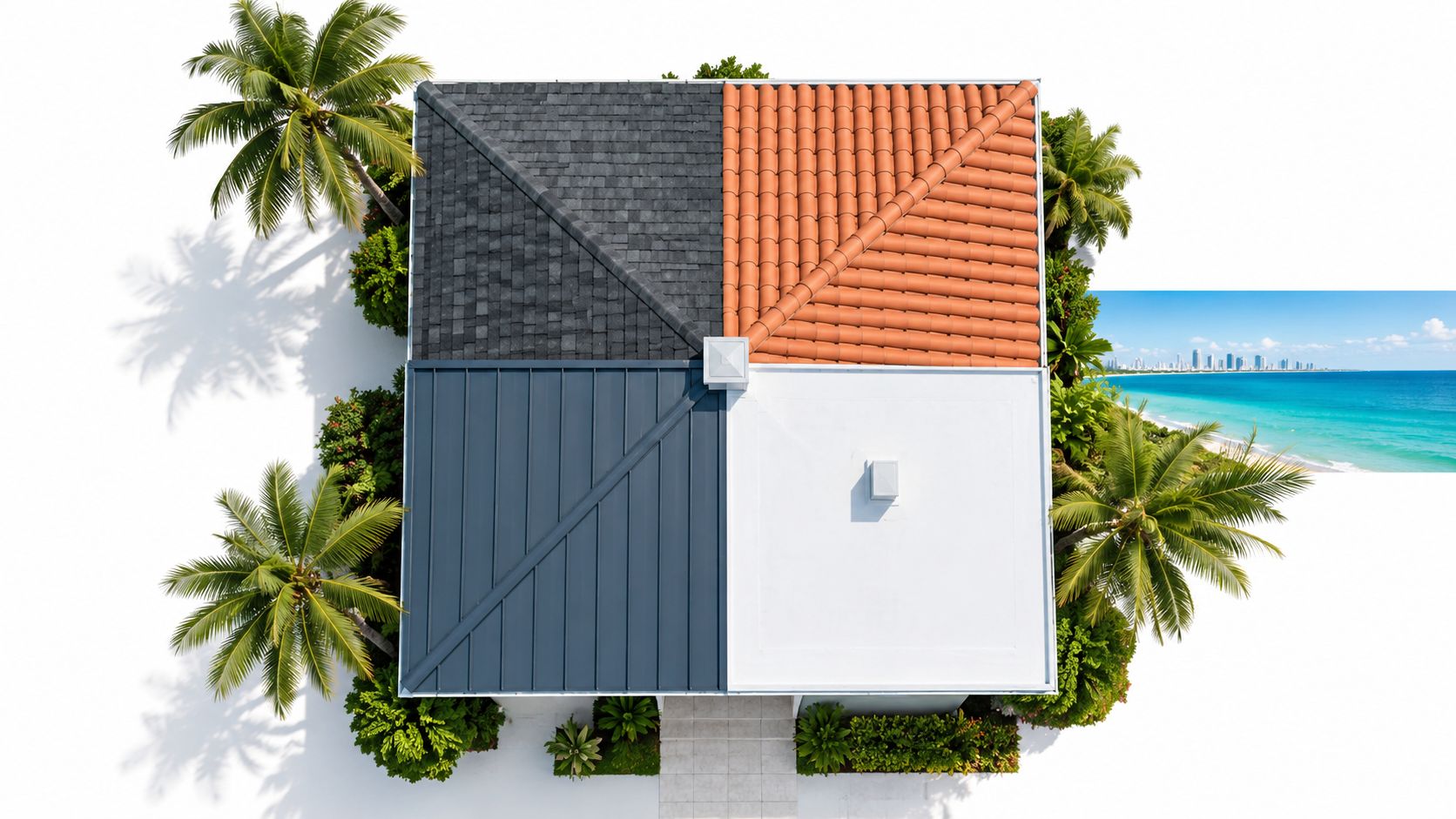
Most roofing comparisons get the biggest question wrong. A roof's advertised lifespan isn't the same as the service life a South Florida property owner should expect. A field-data report says marketing and realistic performance can diverge by 10 to 20 years for many asphalt products, with “lifetime” architectural shingles marketed at 50 years but showing a realistic field lifespan of only 22 to 28 years in actual service (field-data report on roofing material lifespan).
That distinction changes the recommendation. Asphalt may win the initial-price argument, but standing-seam metal, tile, or a properly designed membrane system can win the ownership argument. After three decades on South Florida rooftops, I judge materials by the roof beneath them, the installation details holding them down, and the number of replacement cycles the owner is willing to fund.
Table of Contents
- Why the Right Roofing Material Changes Everything in South Florida
- Lifespan Realities Versus Marketing Claims
- Installation and Lifecycle Costs Across Materials
- How Each Material Handles Heat, Salt, and Hurricane Winds
- Matching Materials to Property Type and Roof Geometry
- Energy Performance and Reflectivity in a Hot Climate
- Choosing the Right Material for Your Situation
Why the Right Roofing Material Changes Everything in South Florida
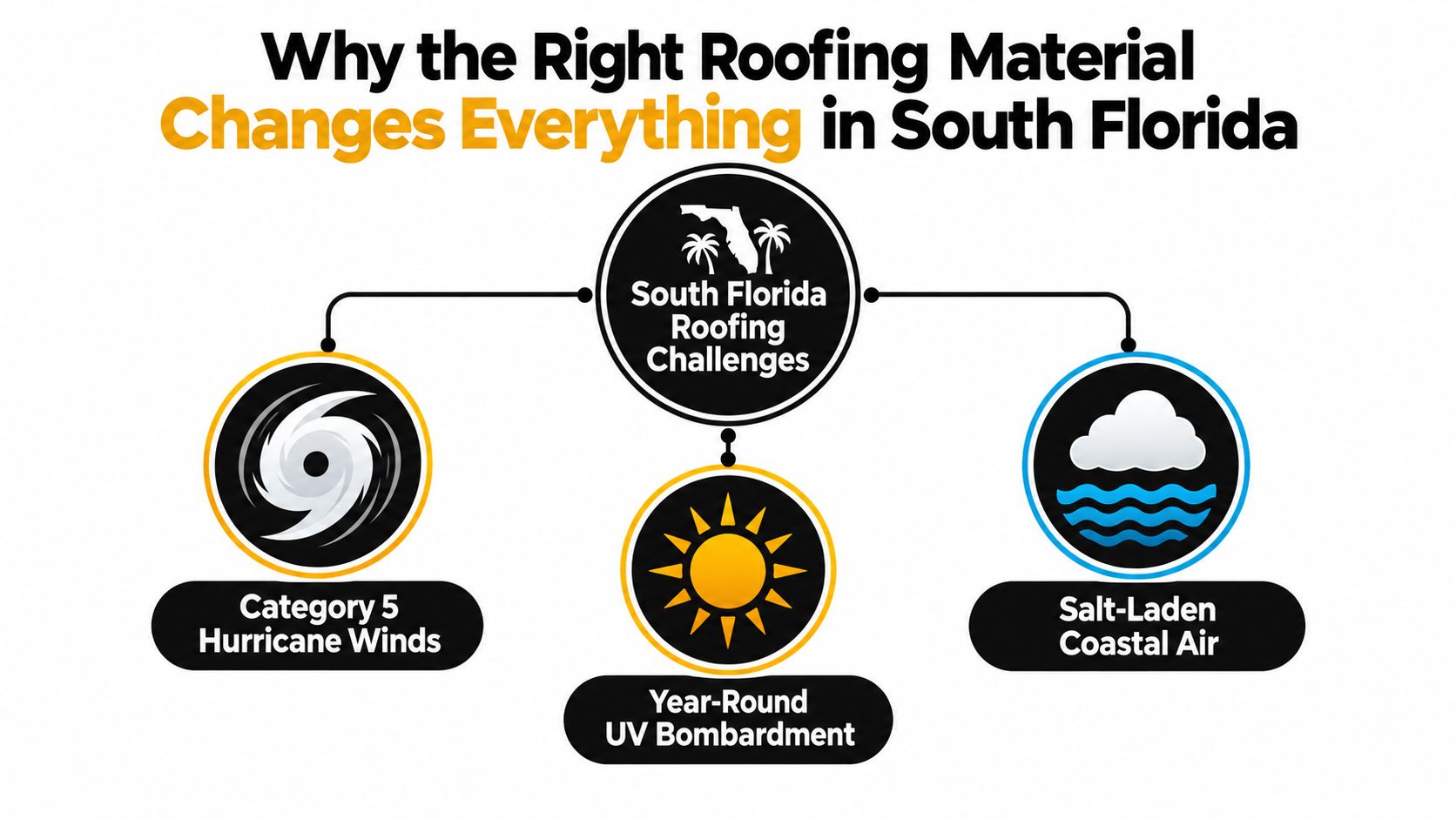
Material choice matters more in South Florida than most homeowners realize. Miami-Dade, Broward, and Palm Beach properties face hurricane winds, relentless ultraviolet exposure, heat, heavy rain, humidity, and salt-laden air. A roof that performs acceptably inland may deteriorate faster near the coast, especially when installers overlook fasteners, flashing, drainage, or underlayment.
The four material families deserve separate treatment:
- Asphalt shingles offer the lowest entry cost and broad style availability, but coastal exposure can shorten their useful life.
- Clay and concrete tile handle heat well and create the traditional South Florida appearance, although their weight affects structural requirements.
- Standing-seam metal combines long service life, low weight, strong wind performance, and useful solar-reflective options.
- Flat membrane systems, including TPO and modified bitumen, suit low-slope commercial and multifamily roofs, but drainage and seam workmanship determine the outcome.
The roof surface is only one part of the assembly. A high-quality material installed over weak decking, poorly sealed penetrations, inadequate edge metal, or deteriorated underlayment can still fail. Conversely, a modest material can deliver reasonable service when the design, attachment, flashing, and maintenance are correct.
South Florida rule: Buy the complete roof assembly, not a product label.
Coastal owners should also examine how the contractor plans to limit salt exposure around metal components, fasteners, vents, and flashing. This visual reference on salt-air corrosion protection is useful when reviewing those vulnerable details with an inspector.
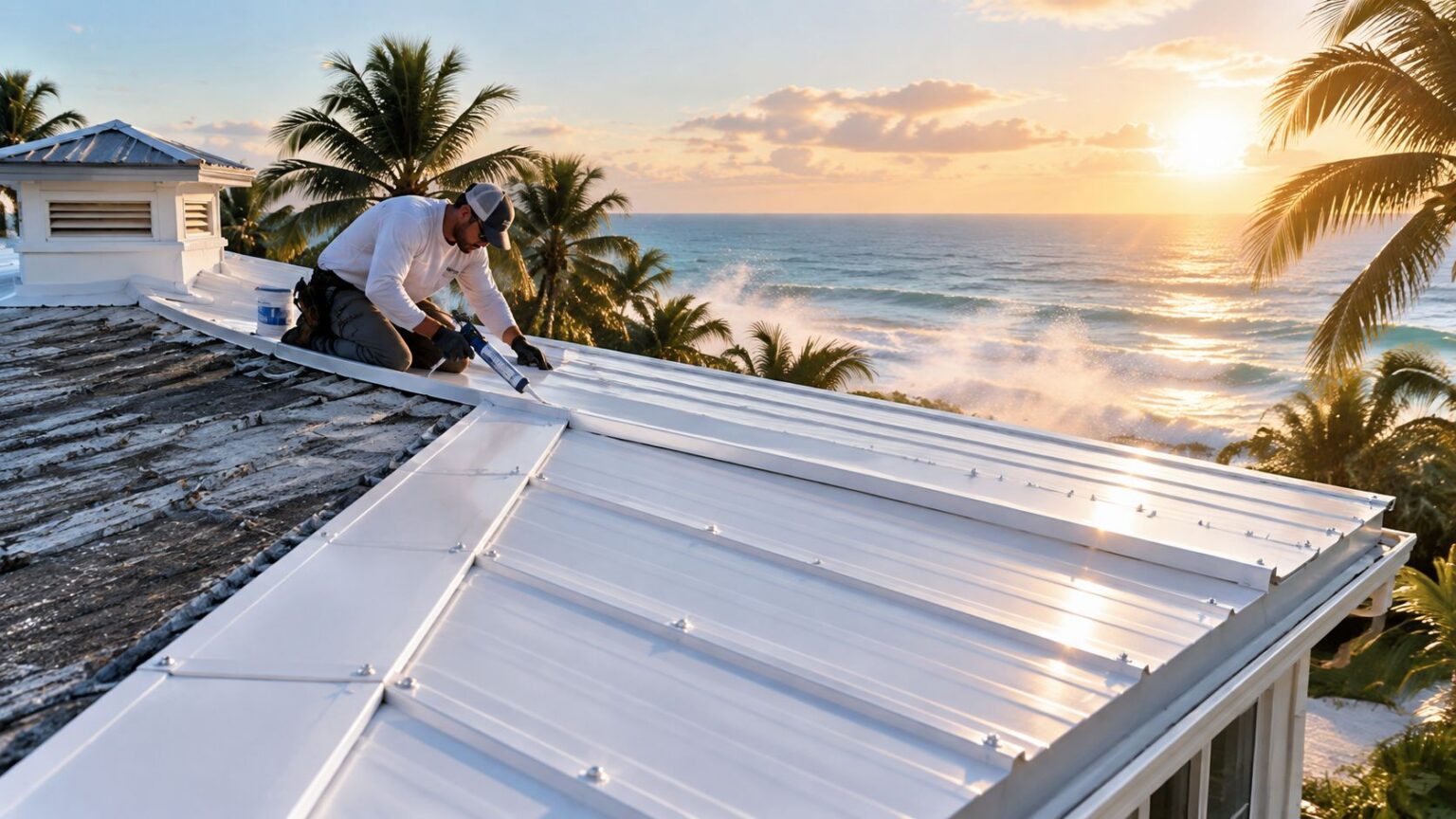
The right comparison therefore asks five practical questions: How long will the assembly realistically serve? What does it cost to install and replace? Can the structure support it? How will it handle wind and salt? Does the roof geometry favor that material? Manufacturer brochures rarely answer all five.
Lifespan Realities Versus Marketing Claims
A roofing warranty describes product performance under stated conditions. It does not promise the same result on a South Florida property. Published comparisons place asphalt shingles at roughly 15 to 30 years, standing-seam metal at 40 to 70 years, clay or concrete tile at 50 to 100 years, and natural slate at 75 years or more (roof lifespan comparison by material).
Those figures are useful for comparing materials, not for setting a replacement date. Tile can last roughly two to four times longer than basic asphalt, and slate can outlast asphalt by several decades. The assembly still decides when protection ends. Underlayment, fasteners, flashing, ventilation, drainage, and storm repairs frequently fail before the visible covering.
The marketing number is not the replacement date
A separate field report identifies a 10 to 20 year gap between marketing claims and realistic service life for many asphalt products. That matters most when a buyer sees “lifetime” architectural shingles. A product carrying a 50-year marketing claim may deliver realistic field life of only 22 to 28 years (2026 roofing material lifespan field report).
For coastal South Florida, treat every advertised lifespan as an upper-bound planning figure. The contractor must explain exposure, attachment, and maintenance requirements before you compare warranties. Salt air corrodes vulnerable components, thermal cycling stresses materials, algae holds moisture, hurricane winds damage edges and coverings, and repeated repairs shorten the useful life of the assembly.
| Material | Advertised Lifespan | Realistic South Florida Field Life | Primary Failure Driver |
|---|---|---|---|
| Asphalt shingles | About 15 to 30 years, depending on product | Shorter near severe coastal exposure | UV, wind damage, granule loss, moisture |
| Concrete tile | About 50 years or more | Long service life, with underlayment often needing attention first | Underlayment aging, cracked tiles, attachment issues |
| Clay tile | About 100 years or more in favorable conditions | Longest-lasting option when properly installed | Underlayment, broken tiles, flashing, structural movement |
| Standing-seam metal | About 40 to 70 years | Long service life when corrosion protection and fastening are correct | Corrosion, movement, failed penetrations, poor attachment |
| TPO | About 20 to 30 years | Strongly dependent on seams, drainage, and exposure | Ponding, seam failure, punctures |
| Modified bitumen | About 15 to 25 years | Dependent on membrane quality, seams, drainage, and maintenance | Surface aging, seam failure, ponding, punctures |
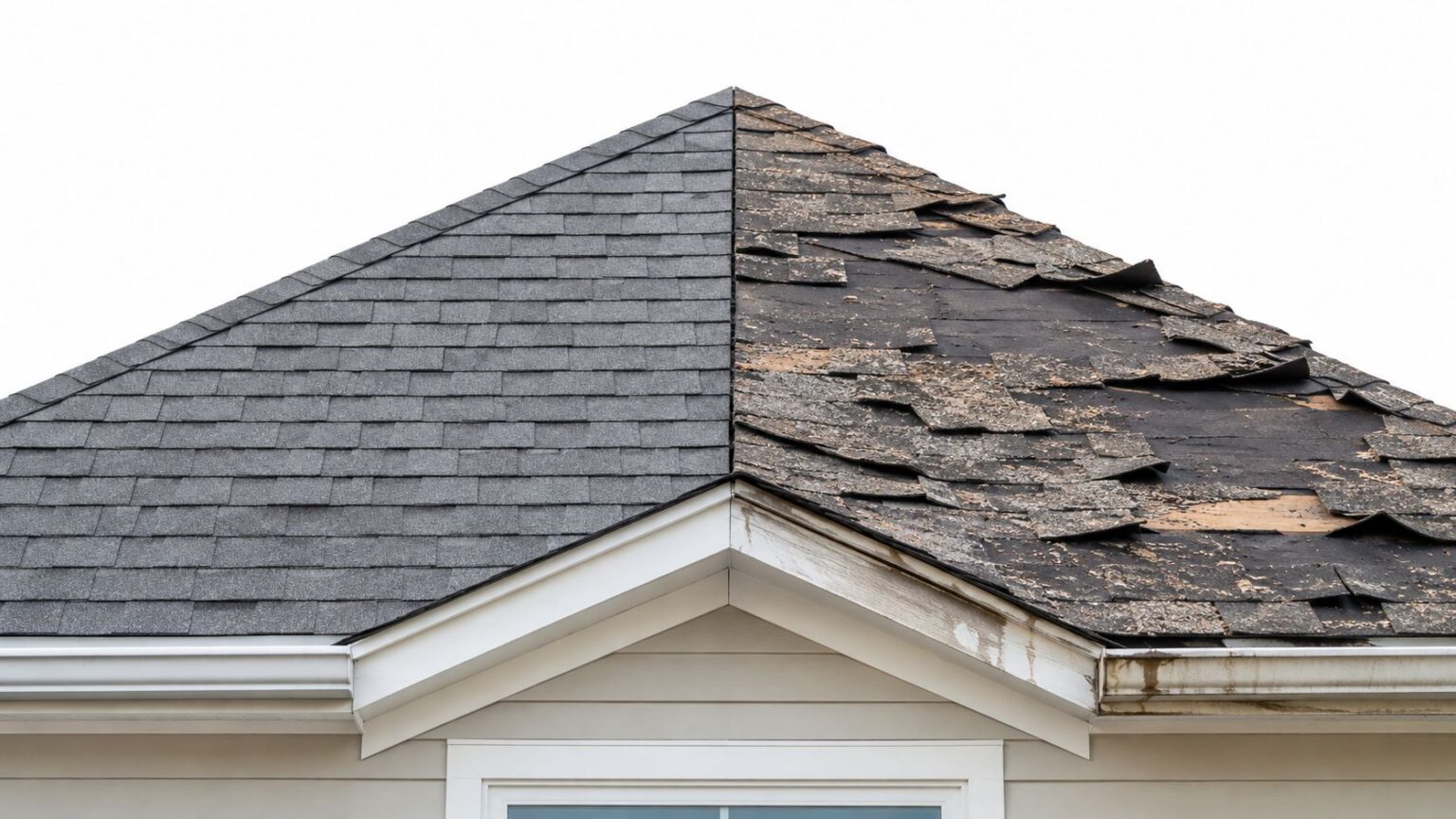
The roof-damage inspection reference shows why an inspection must cover the entire system. A tile field may still look serviceable while its underlayment needs replacement. For homeowners prioritizing predictable long-term protection, standing-seam metal or properly installed tile generally beats asphalt. Asphalt remains the practical choice for a constrained budget or shorter ownership horizon, provided the owner accepts an earlier replacement risk.
Installation and Lifecycle Costs Across Materials
The lowest installation price is rarely the lowest roof cost in South Florida. Roof geometry, tear-off, access, structural work, permits, attachment requirements, flashing, and product selection all change the final number. A verified comparison places standing-seam metal at roughly $14 to $22 per square foot, architectural shingles at $4.50 to $8.50, and flat or TPO systems at $5.50 to $10.00 (roofing materials comparison with installed costs).
Tile requires a larger installation budget than asphalt. Crews must handle heavier materials, detailed layout, underlayment, battens or attachment systems, and possible structural work. Clay tile sits in the premium tier, where its appearance, long service life, or fit with a historic property justifies the investment.
First cost versus ownership cost
A cheap roof becomes expensive after repeated tear-offs, disposal, permits, flashing replacement, underlayment repairs, and interior leak damage. Asphalt is the sensible choice for a short ownership horizon or a tightly limited budget. It can still require another major project sooner than metal or tile, especially under coastal exposure.
Standing-seam metal requires more money at installation, but its 40 to 70 year published service range can improve lifecycle value for an owner keeping the property beyond one replacement cycle. Tile can provide similar long-term economics when the structure, attachment system, and underlayment plan are suitable.
| Material | Installed Cost per Square | Expected Replacements in 30 Years | Estimated 30-Year Lifecycle Cost |
|---|---|---|---|
| Asphalt shingles | Lower entry tier, with architectural shingles commonly $4.50 to $8.50 per square foot | Potentially one replacement, depending on product and exposure | Lowest initial cost, but repeated labor, disposal, and underlayment work can raise ownership cost |
| Concrete tile | Higher than asphalt because of weight and installation complexity | Often limited surface replacement, with underlayment work potentially occurring first | Higher initial investment, lower replacement frequency |
| Clay tile | Premium installation tier | Usually limited surface replacement when the assembly is maintained | High upfront cost, strong long-term value for suitable properties |
| Standing-seam metal | Roughly $14 to $22 per square foot | Often no full replacement within 30 years when correctly installed | High first cost, competitive lifecycle value |
| TPO | Roughly $5.50 to $10.00 per square foot for flat or TPO comparisons | Depends heavily on drainage, seams, and maintenance | Moderate entry cost, variable long-term cost |
| Modified bitumen | Varies by assembly and attachment method | More frequent maintenance and renewal than long-lived metal or tile | Practical for low-slope roofs, but drainage failures can erase the savings |
The table shows cost direction, not a guaranteed bid. Before comparing proposals, confirm that each includes tear-off, disposal, deck replacement, underlayment, edge metal, penetrations, permits, and final inspection. A low bid with missing scope can become the most expensive roof after the first leak or storm repair.
How Each Material Handles Heat, Salt, and Hurricane Winds
South Florida roofs fail at their weak points, not because of the material on top. Weight, fastener patterns, perimeter attachment, seams, flashing, and penetrations determine whether the assembly holds during a hurricane. Comparative figures place standing-seam metal around 1.0 to 1.5 pounds per square foot with wind ratings near 140 to 180 mph. Concrete tile runs about 9 to 12 pounds per square foot with ratings around 130 to 150 mph. Architectural shingles weigh roughly 2.5 to 4.0 pounds per square foot and are listed around 110 to 150 mph, while 3-tab shingles are about 2.0 to 2.5 pounds per square foot with ratings near 60 to 70 mph (hurricane roof material comparison).
Those figures describe product ranges and complete systems, not a guarantee for one roof. In the High-Velocity Hurricane Zone, the entire assembly must satisfy applicable approval and attachment requirements. A strong product rating cannot compensate for a weak edge, incorrect fastener spacing, or an unsealed penetration. The roof should be judged as a system, especially around corners, eaves, vents, skylights, and wall transitions.
Material behavior under real exposure
Dark asphalt shingles absorb more solar energy and can lose granules, curl, crack, or lift as heat and wind age the roof. Architectural shingles are a reasonable budget choice for homeowners accepting a shorter realistic field life than premium metal or tile. 3-tab shingles offer the weakest hurricane position in this group, so I would use them only when initial budget pressure outweighs replacement risk.
Tile handles South Florida sun and heat better than asphalt, but it is not storm-proof. Pieces can crack or dislodge, and the underlayment remains the actual water barrier beneath the tile. Concrete tile also places a substantial load on the structure. Have the building evaluated before choosing it, particularly during a reroof or when changing from a lighter covering.
Metal is my choice for owners who want low weight, strong wind potential, and long-term ownership. Salt air changes the specification. Aluminum-coated or galvalume systems generally suit coastal exposure better than unprotected galvanized steel, provided the installer uses compatible accessories and prevents galvanic corrosion. Clay tile performs especially well in hot climates and resists salt exposure when properly installed, but broken pieces, attachment failures, and flashing leaks still require prompt repair (storm-performance comparison).
Flat roofs depend on drainage before anything else. TPO offers a reflective surface and heat-welded seams. Modified bitumen creates a layered low-slope assembly. Either one can fail after a storm when punctures, seam defects, clogged drains, or ponding water remain unattended.
| Material | Wind Rating | Salt Air Resistance | Heat Tolerance | Common Storm Failure |
|---|---|---|---|---|
| Standing-seam metal | About 140 to 180 mph in listed comparisons | Strong with suitable aluminum-coated or galvalume protection and compatible accessories | Strong, especially with reflective finishes | Edge uplift, failed penetrations, corrosion at incompatible components |
| Concrete tile | About 130 to 150 mph in listed comparisons | Strong surface resistance, but metal attachments and underlayment need attention | Strong, with substantial structural load | Cracked or displaced tiles, underlayment exposure |
| Clay tile | Can reach roughly 125 to 150 mph depending on system | Strong when properly installed and maintained | Excellent in hot climates | Broken tiles, attachment failure, flashing leaks |
| Architectural shingles | About 110 to 150 mph in listed comparisons | Fair to limited near direct salt exposure | Varies by color and formulation | Lifted tabs, blown-off shingles, granule loss |
| 3-tab shingles | About 60 to 70 mph in listed comparisons | Limited in severe coastal exposure | Fair, with faster aging under harsh exposure | Widespread blow-off and edge failure |
| TPO or modified bitumen | Depends on the complete assembly and attachment method | Membrane may resist exposure, while flashings and fasteners remain vulnerable | TPO handles solar exposure well; both require drainage | Punctures, seam failure, drain blockage, membrane uplift |
Choose the covering alongside the storm-readiness work. Review roof geometry, openings, connections, and documentation with guidance on how to prepare for a wind mitigation. For coastal homes, metal usually wins on weight and long ownership, tile wins on heat and appearance when the structure supports it, and asphalt wins only when the budget demands the lowest entry cost.
Matching Materials to Property Type and Roof Geometry
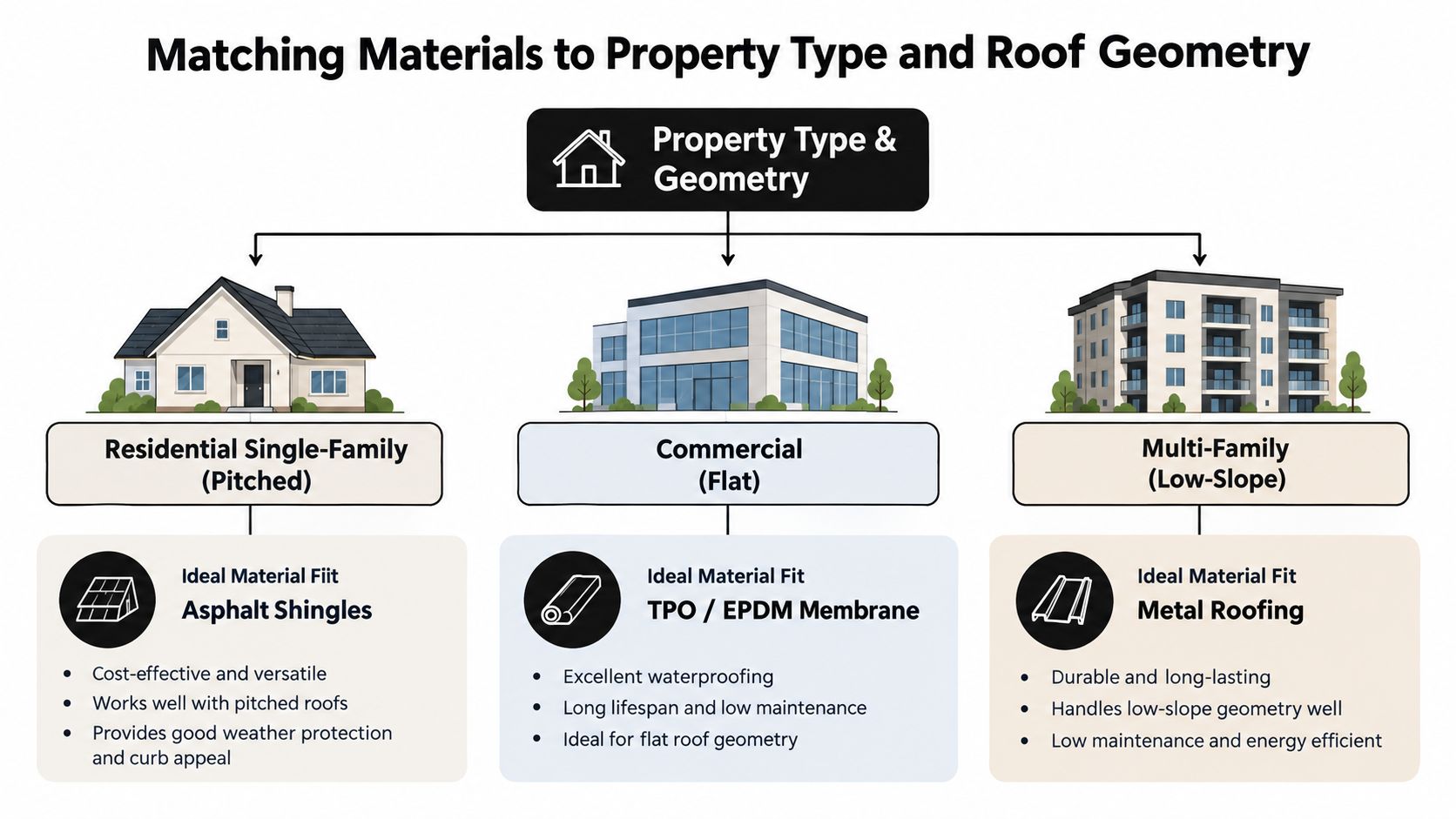
The best roofing material is the one that fits the building's structure and shape. A material that performs beautifully on a broad, simple roof can become poor value when a contractor has to cut around many valleys, skylights, vents, chimneys, and wall transitions.
Residential pitched roofs
For a single-family home with a conventional pitched roof, architectural shingles are the budget leader. They suit owners who need a clean replacement without the premium cost of tile or metal, but coastal exposure and future replacement timing should be part of the decision.
Concrete tile fits established South Florida neighborhoods where the structure can carry the load and the homeowner wants heat resistance, appearance, and long service. Clay tile is the premium architectural choice for Mediterranean, historic, or luxury properties. It can look outstanding, but paying for clay on a simple gable roof may not deliver enough practical value to justify the added cost.
Standing-seam metal earns my recommendation for owners prioritizing low weight, wind performance, and long-term ownership. It also handles porches, low-slope extensions, and transitions that can challenge traditional tile layouts. Confirm HOA rules before selecting any profile or color, because community covenants may limit visible materials and finishes.
Multifamily and commercial buildings
Condo associations need more than a material decision. They need a phased plan covering resident access, insurance requirements, common-area protection, drainage, and reserve planning. Tile can create logistical and structural demands across a large footprint, while metal or membrane systems may simplify certain replacement conditions.
Commercial warehouses, retail centers, and offices with low-slope geometry usually favor TPO or modified bitumen. TPO makes sense where reflectivity and heat management are priorities, while modified bitumen suits owners who prefer a layered membrane assembly. Standing-seam metal retrofits can work for selected low-slope or sloped commercial sections, especially where the owner wants to reduce replacement frequency.
Geometry decides value
Complex roofs create more seams, cuts, valleys, and penetrations. That raises the importance of flashing and installation precision. Simple gables make asphalt and tile straightforward, while standing-seam metal can shine on carefully detailed transitions and low-slope porch roofs.
Coastal estates should favor corrosion-aware metal assemblies or properly attached tile when the structure supports it. Inland tract homes have more flexibility. Historic district properties should prioritize approved appearance and compatible detailing before chasing the longest published lifespan.
Energy Performance and Reflectivity in a Hot Climate
A roof's color and finish can change how much solar heat reaches a South Florida building. Solar reflectance measures the portion of sunlight a surface reflects, on a scale from 0 to 1. Black is near 0, while white is near 1. The Solar Reflectance Index, or SRI, standardizes the comparison by assigning black a value of 0 and white a value of 100 (CRRC explanation of solar reflectance and SRI).
Material type gives only part of the answer. Reported reflectance ranges place asphalt shingles at 0.05 to 0.25, concrete or clay tile at 0.20 to 0.70, painted metal at 0.05 to 0.70, and single-ply membranes at 0.70 to 0.80 (roofing material solar-reflectance data). Finish selection can therefore change heat performance substantially within one roofing category.
Reflectance is only half the roof
Emissivity matters too. A roof that absorbs heat but releases it efficiently performs differently from one that stores heat. Attic ventilation, insulation, underlayment, and air sealing also affect the result. A reflective coating cannot correct poor attic design or hidden heat-transfer paths around a conditioned attic.
The U.S. Department of Energy explains that higher solar reflectance lowers roof temperature, reduces solar heat gain, and may reduce cooling electricity use and peak demand. Its cited Lawrence Berkeley result found that a reflective tile roof used 26% less annual cooling energy and 37% less peak-hour demand than dark asphalt shingles (Department of Energy cool-roofing guidance).
| Material | SRI Range | Energy Star Eligible | Emissivity | Estimated Cooling Impact |
|---|---|---|---|---|
| White TPO | Typically high because single-ply membranes can reflect 0.70 to 0.80 of solar energy | Product-specific | Product-specific | Strongest fit for reflective low-slope roof designs |
| Light-colored painted metal | Finish-dependent, with painted metal ranging from 0.05 to 0.70 reflectance | Product-specific | Finish-specific | Strong when a light finish and sound attic assembly work together |
| Architectural shingles | Often lower than reflective membranes, with asphalt ranging from 0.05 to 0.25 reflectance | Product-specific | Product-specific | Dark colors can increase heat gain; lighter options perform better |
| Reflective tile | Tile ranges from 0.20 to 0.70 reflectance, depending on material and finish | Product-specific | Finish-specific | Good opportunity for heat reduction when light or coated |
| Modified bitumen | Finish and cap-sheet dependent | Product-specific | Finish-specific | Variable, with drainage and assembly design controlling results |
My recommendation is straightforward. For a flat commercial roof with heavy cooling demand, begin with a reflective TPO evaluation. For a pitched home, choose a light metal or light tile finish when the budget and appearance fit. A dark roof can still work, but do not select it merely because a brochure calls it “cool.” In coastal South Florida, the roof assembly and installation quality still determine whether the advertised energy benefit survives real heat, humidity, and storm exposure.
Choosing the Right Material for Your Situation
There is no universal winner for South Florida roofing. The right choice depends on the property type, roof shape, budget, wind exposure, and how long you plan to own the building. Choose for realistic field performance in coastal conditions, not for color or the longest service-life figure printed on a warranty.
Coastal single-family home on a tight budget
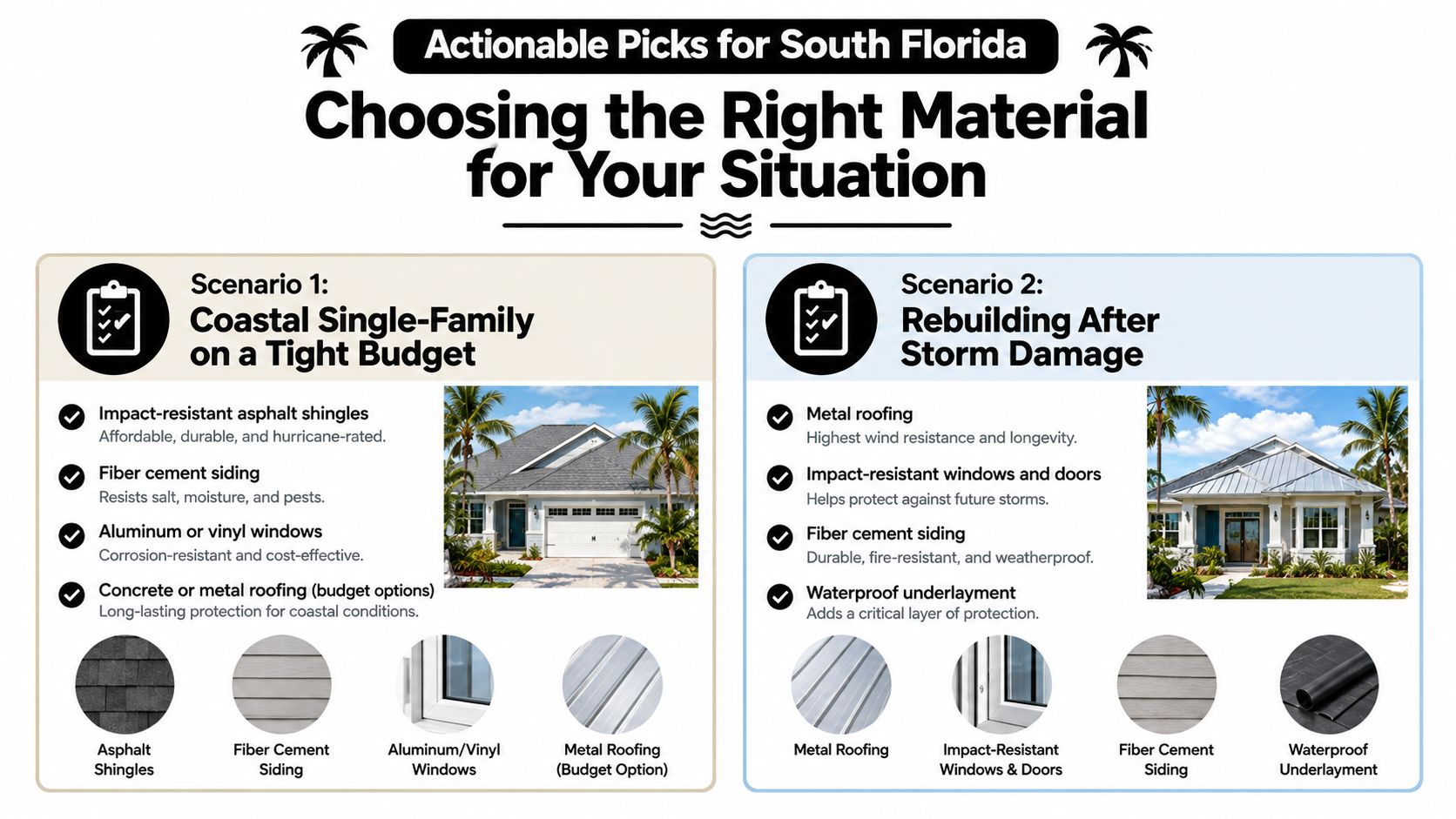
Choose architectural asphalt shingles when the roof has suitable slope and the installation meets local requirements. This is the practical budget choice, provided you accept a shorter realistic service life than tile or metal. Ask what the material can reasonably deliver in a salt-exposed neighborhood instead of paying for a broad marketing promise.
Save money through a clear scope, not weak construction. Require sound flashing, suitable underlayment, secure edge fastening, and specific storm-repair terms. A low bid that leaves out those details can become an expensive repair plan.
Rebuilding after storm damage
Choose standing-seam metal when low structural weight, strong wind performance, and long-term ownership matter most. Confirm the actual profile, attachment method, corrosion protection, and local approval documents for the proposed assembly. The product name alone does not prove the roof will perform on your building.
The tradeoff is higher installation cost. Metal makes better financial sense for an owner who plans to stay beyond one asphalt replacement cycle, especially when the existing structure and roof geometry suit the system.
HOA-controlled community
Choose the strongest assembly allowed by the covenant. If the community requires tile for its appearance, concrete tile usually provides a practical balance of durability, appearance, and cost. If metal is permitted, select a residential profile and finish that fit the neighborhood rather than treating metal as an industrial product.
Review HOA restrictions before ordering anything. Confirm permitted materials, visible colors, profiles, and approval procedures before signing a contract.
Commercial flat roof
Choose a properly designed TPO system when reflectivity, low-slope drainage, and cooling-load control lead the decision. Modified bitumen fits projects that need a layered membrane approach or have existing conditions better suited to that system. In either case, drainage controls the result. Ponding water can shorten the life of a well-installed membrane.
Maintenance determines whether the system reaches its realistic field life. Keep drains clear, inspect seams and flashings, and repair punctures before water reaches the insulation or deck.
A short decision checklist
- Budget ceiling: Separate installation from tear-off, disposal, structural work, and future replacement costs.
- Wind exposure: Confirm the complete assembly's tested or approved attachment system, not merely the material name.
- Roof slope: Match the covering to the geometry, with special attention to low-slope sections and complex transitions.
- HOA constraints: Verify permitted materials, profiles, and colors before signing.
- Ownership horizon: If you will stay beyond one replacement cycle, give lifecycle cost more weight than first cost.
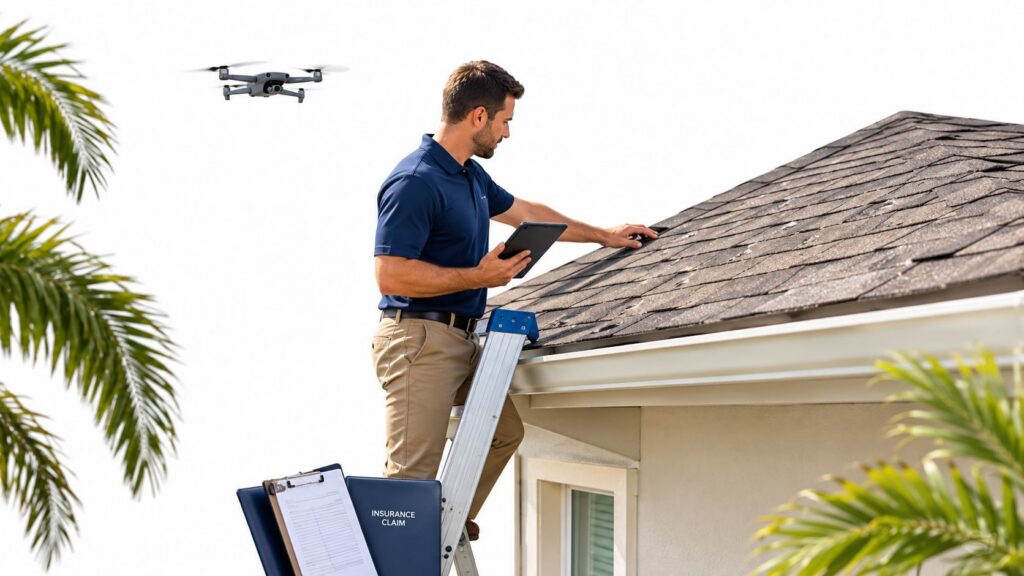
Get an inspection before choosing the material. It can document existing damage, underlayment condition, drainage, flashing, and storm-readiness. Review this roof inspection image for insurance documentation, then ask the contractor to explain every line item in the proposed scope.
Paletz Roofing and Inspections evaluates and installs shingle, tile, metal, and flat roofing systems across Broward, Miami-Dade, and Palm Beach counties. Its services include inspections, repairs, replacements, and damage assessments. Visit Paletz Roofing and Inspections to request an inspection or quote comparing material, installation details, and long-term ownership tradeoffs for your property.