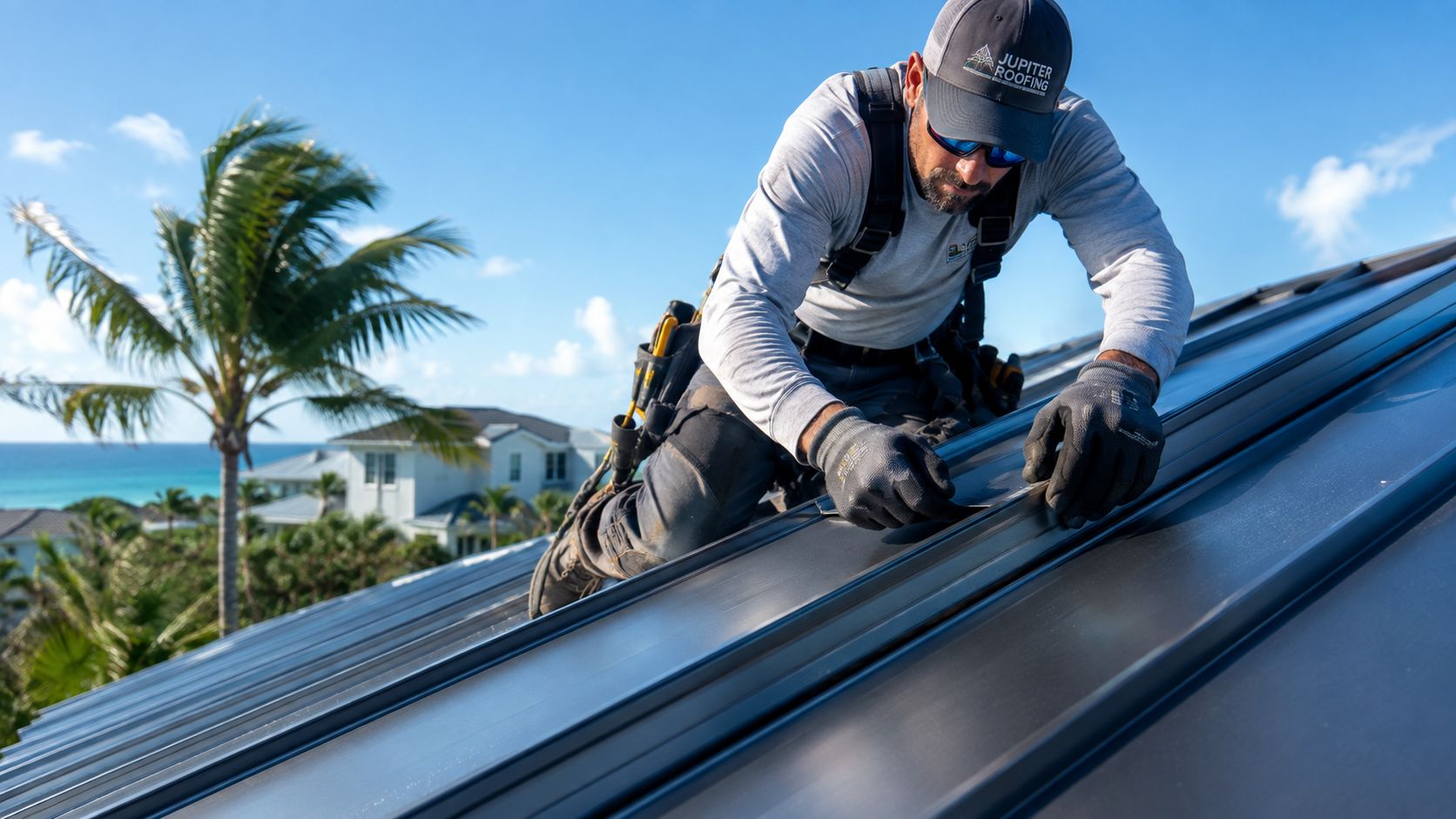
In Jupiter, a standing seam metal roof typically runs $12 to $20 per square foot installed, or about $18,000 to $45,000 for a typical home. That cost gap matters less than the installation details that decide whether the roof holds in a hurricane.
A homeowner usually feels that decision after a storm scare, after a shingle roof starts looking tired in the salt air, or when an inspector points out that the roof is getting close to the end of its life. In this market, you're not just buying a material. You're buying a hurricane-rated assembly that has to satisfy wind, water, corrosion, and paperwork at the same time.
Table of Contents
- Why Metal Roofing in Jupiter Is a Different Decision
- Choosing the Right Metal for Salt, Sun, and Storms
- Permits, Code, and the Paperwork Most Homeowners Skip
- What a Proper Metal Roof Installation Actually Looks Like
- Hurricane Details That Decide Whether the Roof Holds
- Cost, Timeline, and the Real ROI in Jupiter
- Hiring Checklist, FAQs, and Your Next Step
Why Metal Roofing in Jupiter Is a Different Decision
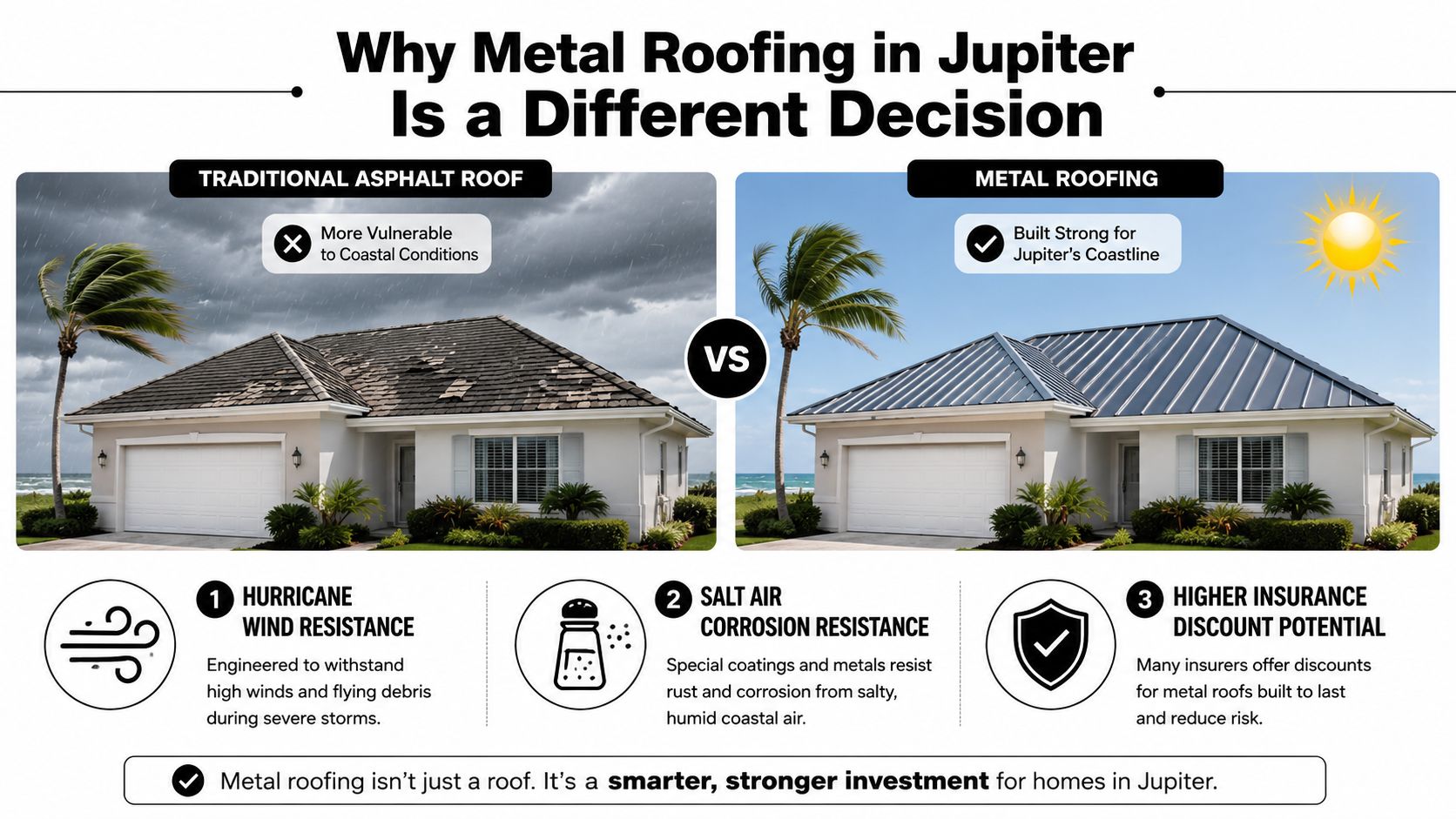
A Jupiter homeowner usually starts with the same question, should I replace the roof now, or squeeze one more season out of the shingles. In a coastal town, that question turns into a different calculation fast. Salt air, hurricane wind uplift, and brutal UV exposure punish weak details long before the roof's brochure claims do.
The coastal load is on the assembly, not just the panel
Metal roofs get sold as if the panel alone is the product. In Jupiter, that's incomplete. The roof has to resist salt exposure near the Atlantic, stand up to high wind, and stay stable under year-round heat that works on sealants, coatings, and fasteners every day.
That's why I tell homeowners to think in terms of an assembly, not a surface. A good system includes the panel profile, clips or fasteners, underlayment, flashing, closures, and the permit documents that prove the product is approved for the job. If one of those pieces is wrong, the roof can fail at the seams even if the metal itself is strong.
Practical rule: In Jupiter, the panel choice matters, but the install details matter more.
The local price data show that metal does cost more up front than asphalt shingles, yet that higher price buys more than appearance. It buys a roof that coastal buyers, inspectors, and insurance companies often view very differently from a basic shingle re-roof, especially when the work is documented properly and installed for wind performance.
Choosing the Right Metal for Salt, Sun, and Storms
Jupiter homeowners usually see four realistic metal choices on an estimate, standing seam steel, aluminum, exposed-fastener panels, and premium zinc or copper. Each one solves a different problem. The right answer depends on where the home sits, how exposed it is to salt, and how much maintenance tolerance the owner has.
Compare the trade-offs before you compare the price
| Metal Type | Installed Cost per Sq Ft | Coastal Suitability | Typical Profile |
|---|---|---|---|
| Standing seam steel | $12 to $20 | Strong, especially with the right coating and detailing | Concealed seam |
| Aluminum | $9 to $14 | Very good in coastal settings because it handles salt exposure well | Standing seam or similar concealed systems |
| Galvanized or Galvalume steel | $8 to $12 | Good, but the finish and installation details matter a lot near the coast | Exposed-fastener or concealed systems |
| Premium zinc or copper | $15 to $20+ | Excellent, but usually chosen for design and longevity rather than budget | Specialty seam systems |
That pricing comes from the Jupiter market guidance, where homeowners often compare metal against asphalt because the upfront cost is obviously higher. The smarter comparison is not just what costs less on day one. It's what gives you a roof that fits the home's exposure and the owner's plans.
What I'd steer a Jupiter homeowner toward
For most coastal homes, standing seam is the cleanest performance choice because concealed fastening reduces exposed hardware and keeps the assembly simpler to seal. Aluminum makes sense where salt exposure is a real concern and the homeowner wants better corrosion resistance in a more forgiving coastal package. Exposed-fastener panels can work on the right structure, but they need tighter maintenance discipline because the screw pattern and seal points do more of the waterproofing work.
Premium zinc or copper is a different conversation. Those systems are chosen for durability and appearance, but they're usually a specialty decision, not a default answer for a standard re-roof. If you're still sorting coatings and paint systems for solar heat and fade resistance, find the right roof coating for summer is a useful place to compare how finishes behave under strong sun.
If the home is close to the salt line, I'd lean toward the material and finish that give you the cleanest corrosion story, then make sure the installer details it correctly.
Permits, Code, and the Paperwork Most Homeowners Skip
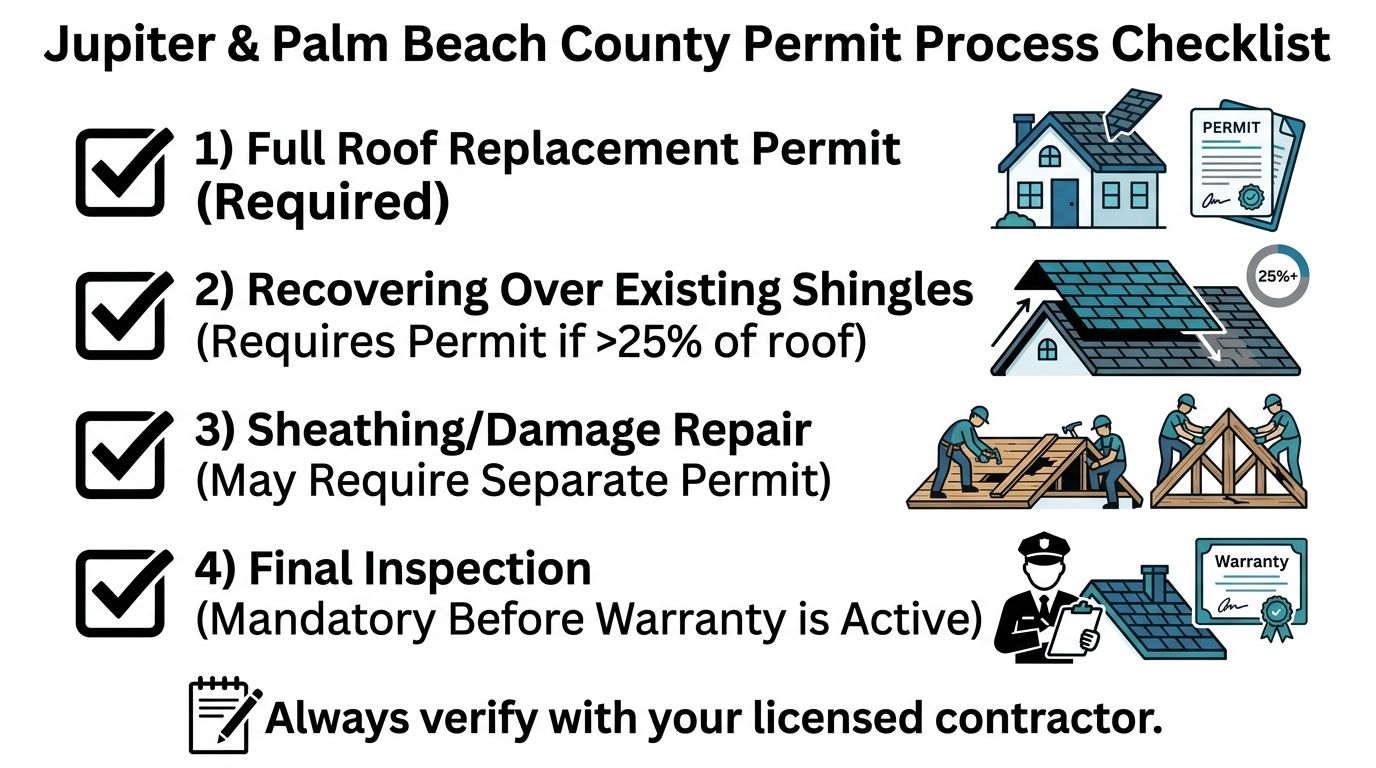
Most roof problems I see in coastal Florida start with paperwork that never got pulled, or product documents that never made it into the permit packet. In Jupiter, a permit is typically required for a complete roof replacement, a recover or overlay, or when more than 25% of the roof covering is replaced within any 12-month period. It's also generally required for structural repairs, underlayment or flashing replacement, ventilation changes, and new penetrations like skylights or solar tubes.
What inspectors actually want to see
Jupiter's roofing guidance requires the complete Florida Product Approval or Miami-Dade NOA for roofing materials and accessories. That's the verifier inspectors lean on, because it tells them the product is code-approved for the job. The town's guidance also says shingle and metal roofs do not require a specific form, which means the focus shifts to the product documentation rather than some special local checklist.
A licensed contractor can also use the Town of Jupiter Island's roofing affidavit process for certain work. That affidavit lets the contractor certify metal roof installation, roof underlayment, and re-nailing of roof sheathing by signing that the work complies with the Florida Building Code, the Existing Building Code, and the manufacturer's installation instructions. The affidavit then gets presented at the next scheduled on-site inspection, and if the final inspection is the only one scheduled, the inspector may pass the job as “CERTIFIED” when the signed affidavit is present.
A smaller like-for-like repair under 100 square feet may not need a permit, but homeowners shouldn't guess on that call. The permit threshold changes when flashing, structure, or penetrations are involved.
A clean permit packet usually saves more time than a rushed job ever will.
For a practical example of what a post-storm inspection and insurance support workflow can look like, this internal resource is relevant: roof insurance claim assistance and roof inspection.
What a Proper Metal Roof Installation Actually Looks Like
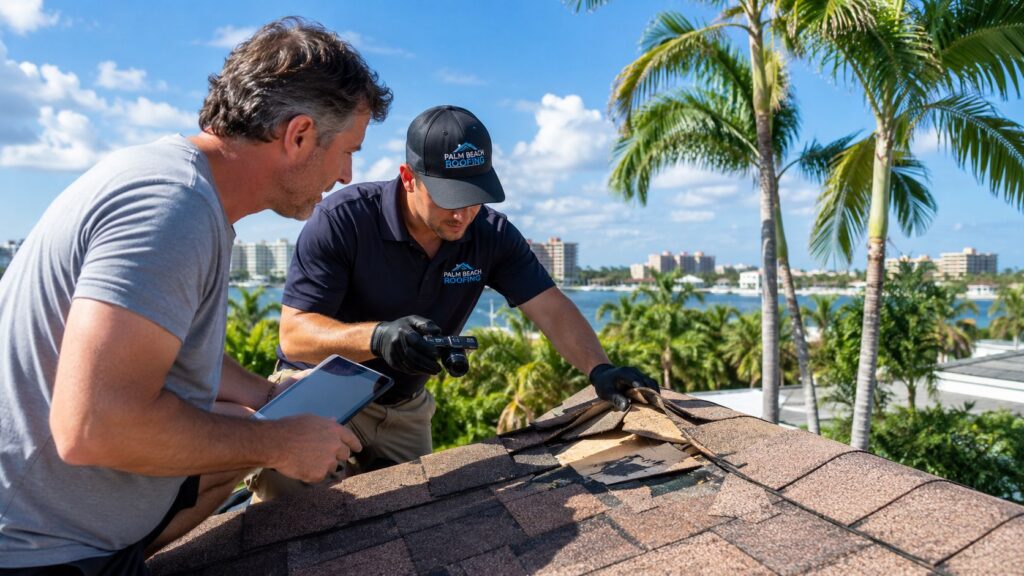
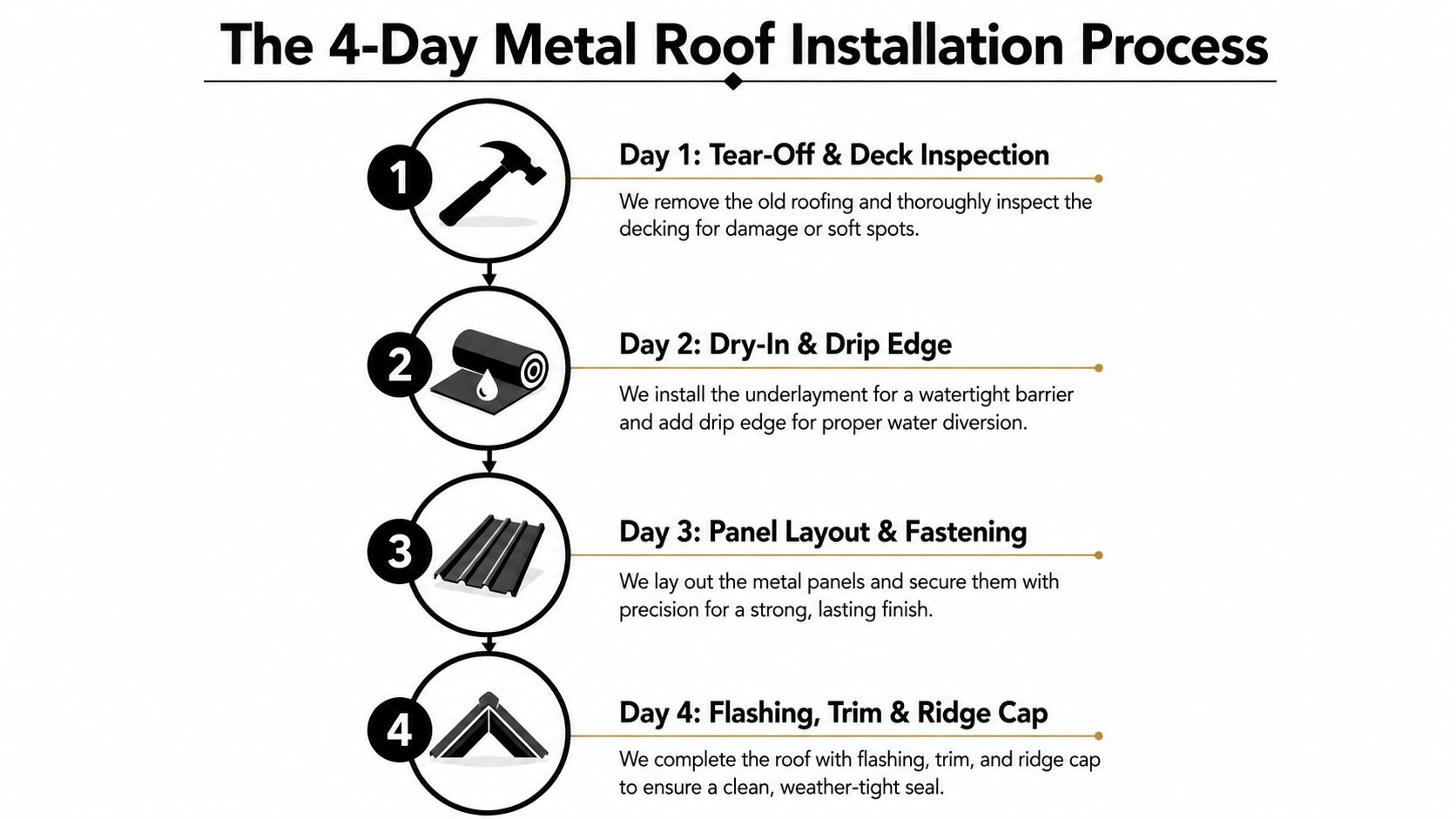
A good metal job starts before the first panel goes on. Tear-off exposes the deck, the crew checks for soft spots or bad sheathing, and the roof gets dried in before the new metal ever sees a fastener. If that prep is sloppy, the rest of the system inherits the mistake.
The sequence matters more than the sales sheet
A foreman should square the roof first using the 3-4-5 method. That keeps the panel layout from drifting and prevents the error from carrying across the entire plane. The first panel should then land with about 1 to 2 inches of overhang past the drip edge, because the drip line and edge detail are where many water issues start if the geometry is off.
After that, the crew should fasten panels from the center outward in the manufacturer's pattern. On exposed-fastener systems, screws belong in the flat areas, not the ribs, because the flat gives the fastener a more stable seat and reduces panel distortion. References for installation also call for fasteners roughly every 12 to 24 inches, depending on the product, and for overlapping panels by about 1 to 2 ribs or at least 1 inch.
Underlayment choice matters too. On sun-baked decking, I'd rather see high-temperature peel-and-stick in vulnerable areas than rely on a thin generic layer, especially where heat, valleys, or penetrations are going to stress the system. Synthetic underlayment has a place, but the roof's most vulnerable areas deserve the safer margin.
Several installation guides also recommend around 10% waste for cuts and layout losses. That sounds small until you're dealing with hips, valleys, and skylights, then the waste number stops being theoretical.
For a jobsite view of how a careful inspection ties into roofing work, this internal reference is useful: roof inspection and installation context.
Hurricane Details That Decide Whether the Roof Holds
The panel is rarely the weak point in a storm. The weak points are usually the seams, clips, screws, closures, and flashing transitions. That's where wind-driven rain finds a path, and that's where a roof either behaves like a system or starts working itself loose.
Four details that separate strong from sloppy
- Clip type and spacing: Concealed clips have to be matched to the product and wind zone. Too much spacing invites uplift and movement, especially on long runs.
- Fastener torque and pattern: Over-driven screws deform the panel, under-driven screws leave gaps, and both can create leak paths or noise.
- Z-closure and ridge closure sequencing: Closures have to be installed in the right order so wind can't force rain under the ridge or eave transitions.
- Flashing at valleys, walls, and penetrations: Bad detailing shows up first here, because intersecting planes concentrate water and wind.
Common failure modes are predictable. Poor seam control leads to wind-driven rain intrusion. Bad fastening leads to uplift. Sloppy panel alignment leads to oil-canning and movement noise. Weak flashing at the edges invites leaks that don't show up until a storm pushes rain laterally.
The roof's last line of defense is the underlayment and the attachment beneath the metal, not the finish color.
A serious Jupiter installer checks the layout before fastening, confirms the clip pattern against the product approvals, and verifies flashing transitions before calling the roof ready. That's the difference between a roof that looks finished and one that is storm-ready.
For another practical look at structural wind resistance in a Florida context, find hurricane-resistant metal buildings offers a useful comparison point for the way fasteners and connections matter more than marketing language.
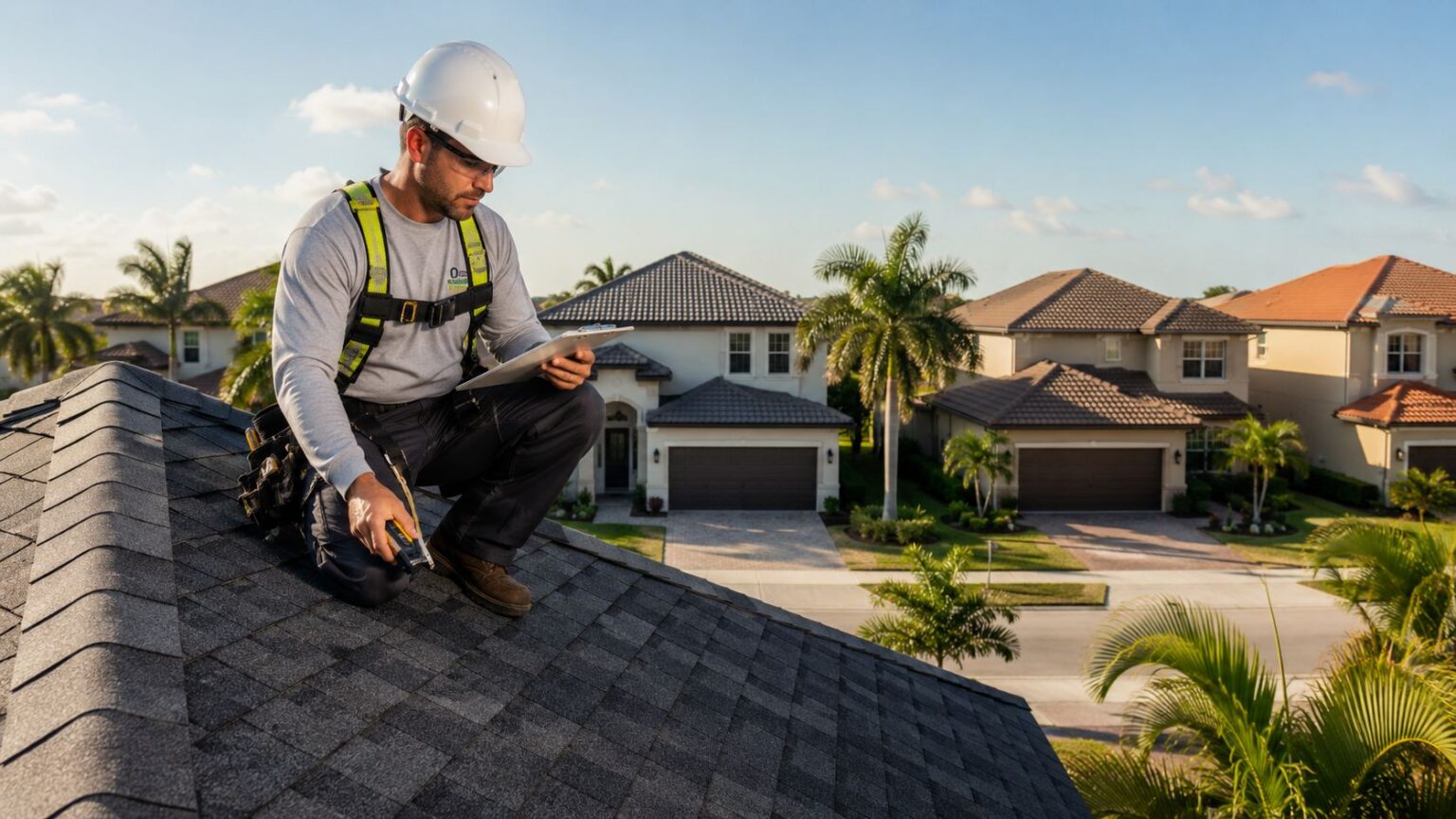
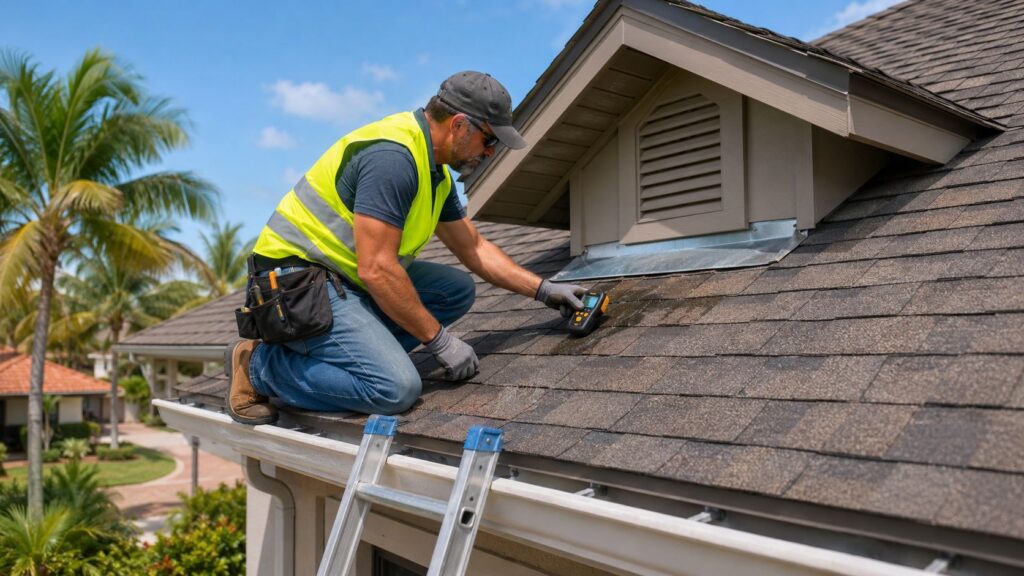
This is also where a technician's eye matters, especially on a leak-prone roof plane. For that kind of inspection perspective, roof leak detection and inspection is the kind of resource that matches how real failure points get found.
Cost, Timeline, and the Real ROI in Jupiter
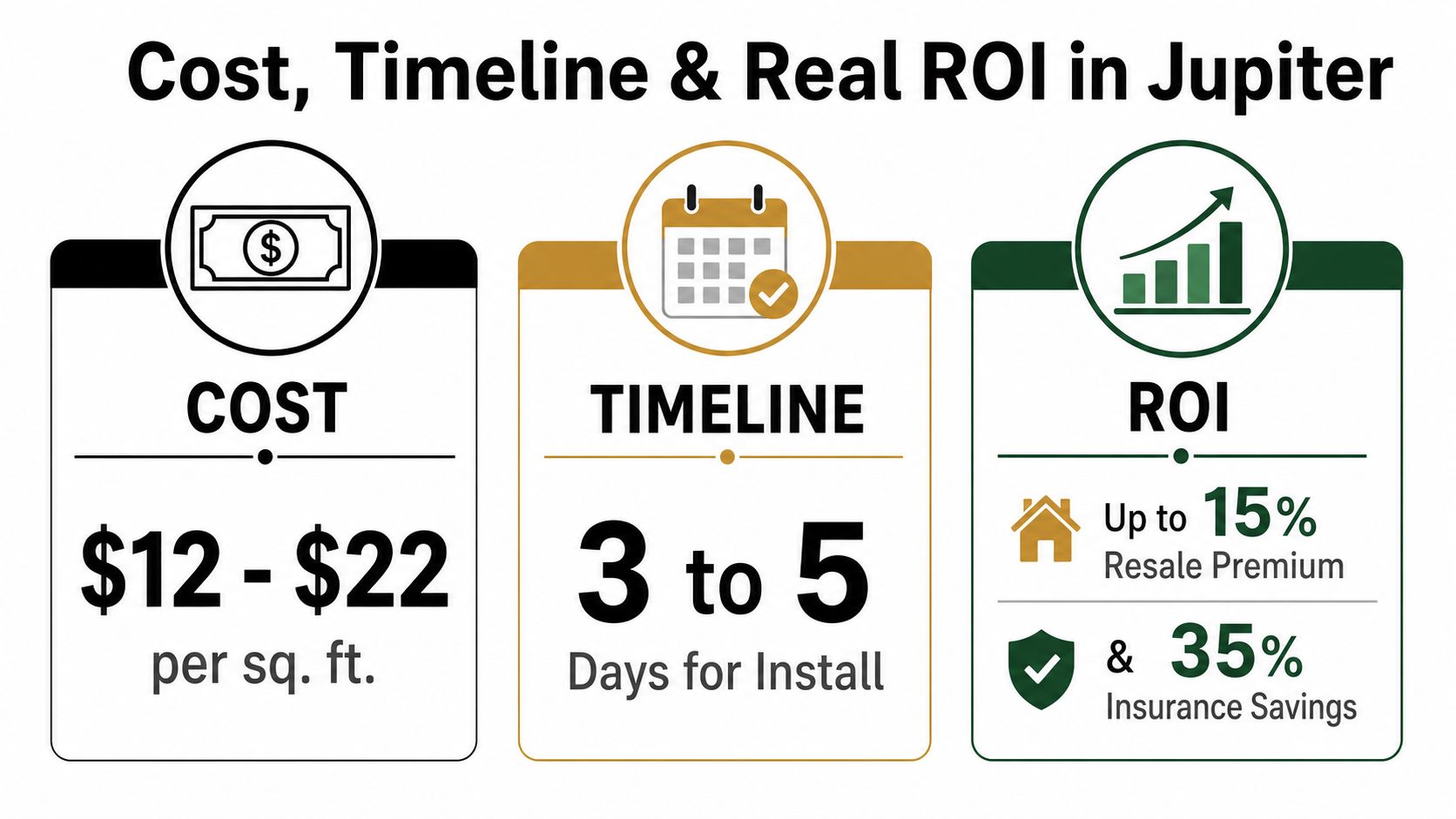
The Jupiter market puts a standing seam metal roof at $12 to $20 per square foot installed, which works out to about $18,000 to $45,000 for a typical home depending on size, labor, and roof complexity. That's a real investment, but the first number doesn't tell the whole story. The more useful question is what you get over time.
Upfront cost is only one line on the ledger
Florida industry data say metal roofs are the fastest-growing roofing material in Florida, with 22% annual growth since 2020, and they account for 25% of commercial roofs in Florida. The same source gives metal a roughly 50-year lifespan, compared with 15 to 20 years for asphalt shingles. That lifespan gap matters in a hurricane zone because every avoided replacement also avoids another round of tear-off, labor, disposal, and storm-season timing headaches.
A single-family metal install usually runs about one to two weeks of working days, plus lead time for panels and inspections. That schedule is normal for a proper tear-off and re-roof, especially when the home has hips, valleys, and multiple penetrations. It's not a one-day swap, and any estimate that sounds too fast usually is.
ROI in Jupiter is about durability, repair burden, and resale perception
The actual return is not just that metal lasts longer. It's that a metal system can reduce the cycle of storm-related repairs and repeated re-roofing in a coastal market where the roof is always under stress. Resale matters too, because buyers in premium Florida neighborhoods increasingly expect a roof that looks purpose-built for the environment rather than patched together for the lowest bid.
If you're trying to understand how a roof change affects a claim or replacement path, will insurance cover a new roof is a helpful place to sort through the policy side without guessing.
A metal roof only feels expensive if you price it like a one-time commodity instead of a long-life coastal system.
Hiring Checklist, FAQs, and Your Next Step
A strong contractor packet should include local Jupiter or Palm Beach references, proof of Florida Product Approval or Miami-Dade NOA, a licensed-and-insured certificate, and a written scope that names the clip type and fastener pattern. The warranty should also be clear about what the manufacturer finish warranty covers and what the workmanship warranty covers, because those are not the same thing.
Quick FAQs
How long does a Jupiter metal install usually take?
A typical single-family project usually takes about one to two weeks of working days, plus time for product lead time and inspections.
Can an existing shingle roof be overlaid with metal?
Sometimes, but only when the structure, code path, and permit strategy support it. Jupiter permit guidance still matters, and a recover or overlay can trigger permit requirements.
What maintenance does a metal roof need in salt air?
Keep it clean, inspect the fasteners and sealant points, and watch the coastal edges and penetrations more closely than you would inland. Salt exposure is manageable, but it's not something you ignore.
For a homeowner who wants a written, itemized scope tied to current Florida Building Code and local jurisdictional requirements, the next move is simple. Ask for the product approval documents, the fastening pattern, and the permit plan before anyone starts tearing off shingles.
Paletz Roofing and Inspections handles metal roof installations, inspections, repairs, and replacements across South Florida, including Jupiter, with a process built around code compliance and documented scope. If you want a written estimate that spells out the panel system, installation details, and permit path for your home, visit Paletz Roofing and Inspections and ask for a site review.