
In Florida, a professionally installed metal roof commonly runs $7 to $18 per square foot, with South Florida often higher because of stricter hurricane-code requirements, labor, and permitting. One 2026 Florida pricing guide puts Miami and Fort Lauderdale at $11 to $17 per square foot and North Florida at $8 to $13 per square foot, which is why two homes with similar sizes can get very different quotes.
That price range answers the basic question, but it doesn't answer the one that matters when you're writing the check. Homeowners usually search for metal roofing prices in Florida and get a neat number per square foot. Then the estimate shows up with tear-off, underlayment, trim, permit fees, fastening details, and code-related labor, and suddenly the “cheap” online number doesn't look real anymore.
Florida is hard on roofs. Sun, rain, salt air, and storm exposure don't forgive bad material choices or sloppy installation. A metal roof can be one of the smartest upgrades you make on a Florida home, but only if you understand the full installed cost and the trade-offs between systems.
That's where most online calculators fall short. They price the panel. They don't price the whole roof.
Table of Contents
- Investing in Your Florida Home's Future
- Metal Roofing Prices in Florida The 2026 Averages
- Key Factors That Influence Your Final Roof Cost
- Sample Metal Roof Estimates for Florida Homes
- Metal vs Other Roofing A Florida Cost Comparison
- Unlocking Savings with Insurance and Energy Incentives
- How to Get an Accurate Quote and Choose a Contractor
- Protect Your Home with a Lasting Investment
Investing in Your Florida Home's Future
A metal roof in Florida isn't a bargain purchase. It's a durability purchase.
Homeowners who focus only on the low end of a square-foot price usually miss the bigger financial picture. The roof isn't just a finish material. It's the system that has to stand up to heat, driven rain, uplift pressure, salt exposure near the coast, and the inspection standards that come with South Florida work. If the estimate looks simple, it's probably incomplete.
That's why I tell people to stop asking only, “What does metal cost?” and start asking, “What does the full job require on my house?” Those are different questions. The second one gets you closer to the actual number.
A clean-looking roofline on a brochure tells you almost nothing about installed cost. Roof pitch, penetrations, edge metal, valleys, underlayment transitions, and local permit handling all matter. Even two homes on the same street can price differently if one has more cut-up geometry or more storm-hardening requirements.
Practical rule: In Florida, the useful number isn't panel price. It's the all-in installed price after code, labor, trim, and jobsite conditions are accounted for.
Homeowners also need to think in terms of value, not just invoice total. The right system for a basic inland ranch home may not be the right system for a coastal property or a house with a complicated roof plan. Standing seam, metal shingles, and exposed-fastener panels each solve different problems, and they come with different price consequences.
If you want a visual reference for the kind of finished roof profile and curb appeal many owners are aiming for, this metal roof example image is useful. The appearance is straightforward. The construction behind it is where the money goes.
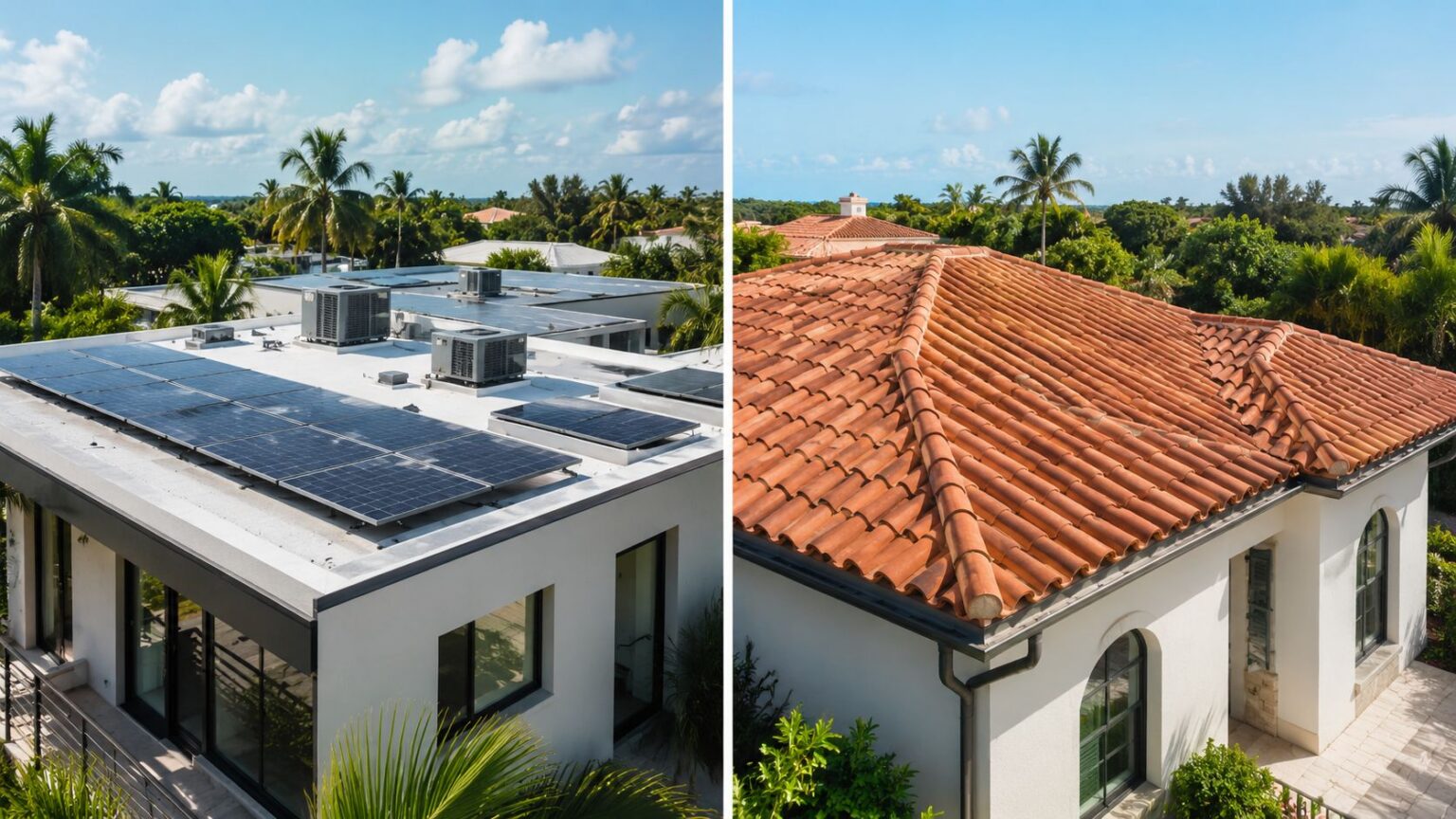
Metal Roofing Prices in Florida The 2026 Averages
The current baseline for metal roofing prices in Florida is straightforward if you're looking at installed work, not just raw materials. Professionally installed metal roofing in the state is commonly priced around $7 to $18 per square foot, with South Florida often running higher. A 2026 Florida pricing guide also notes Miami and Fort Lauderdale averaging $11 to $17 per square foot, while North Florida averages $8 to $13 per square foot. The same guide says labor costs rose 5% to 10% in 2026 and that permit and inspection fees often add $700 to $2,000 in many counties in Florida, all of which pushes final totals higher in the southern part of the state (2026 Florida metal roofing cost guide).
What homeowners are actually paying
Those statewide numbers are useful, but they only give you a range. In practice, most homeowners fall somewhere inside that range based on roof type, region, and complexity.
Here's a simple way to understand it:
| Installed price basis | Typical Florida range |
|---|---|
| Per square foot | $7 to $18 |
| South Florida example | $11 to $17 |
| North Florida example | $8 to $13 |
The mistake I see all the time is comparing a low online “from” number to a real contractor's installed estimate. Those aren't the same thing. A real estimate has to include labor, code work, accessories, and administrative costs that calculators skip.
Why South Florida costs more
Miami-Dade, Broward, and nearby markets usually come in higher for reasons homeowners can see on the paperwork and in the installation method.
- Stricter code environment: South Florida work often involves tighter hurricane-related requirements and more scrutiny on attachment methods and approvals.
- Higher labor burden: Skilled metal crews cost more where demand is strong and installation standards are less forgiving.
- Permitting and inspections: Local permitting isn't just paperwork. It affects schedule, coordination, and total price.
- More coastal exposure: Near-ocean homes often call for more careful material selection and detailing.
A cheap metal roof quote in South Florida usually means one of two things. Either the system is very basic, or the quote is missing parts of the job.
How to think about roofing squares
Roofers also price by the roofing square, which means 100 square feet. Homeowners don't always hear that term explained, and it can make estimates feel more confusing than they are.
If your installed price is quoted by square foot, you can translate that into roofing squares by multiplying by 100. That means:
- $7 per square foot equals $700 per roofing square
- $18 per square foot equals $1,800 per roofing square
- $11 to $17 per square foot in Miami or Fort Lauderdale translates to $1,100 to $1,700 per roofing square
That's useful when you compare bids from contractors who use different formatting.
For broader context on how system choices affect pricing structure, this detailed metal roofing cost analysis is a good companion read. It helps homeowners understand why two metal roofs can both be “metal” and still price far apart.
Key Factors That Influence Your Final Roof Cost
Average pricing gets you in the ballpark. The final estimate comes from the decisions hiding underneath the word “metal.”
The biggest pricing swings usually come from system type, roof shape, code requirements, and the accessories needed to make the roof watertight and compliant. That's why one homeowner hears a number that seems manageable while another gets a quote that feels far above the online averages.

Roof system choice changes everything
Florida pricing varies sharply by system. Standing seam metal roofs generally run about $10 to $25 per square foot, while corrugated or exposed-fastener systems are closer to $7 to $12 per square foot. That gap reflects the added fabrication, concealed-fastener hardware, and installation precision required for standing seam (Florida metal roof system pricing breakdown).
That difference isn't marketing fluff. It comes from how the roof is built.
Standing seam costs more because the panel design is more exacting. The fasteners are concealed, the seams are formed to lock panels together, and the trim details have less room for sloppy work. It's the cleaner, more refined system. It also tends to be the one homeowners choose when they want the strongest combination of appearance and weather resistance.
Corrugated or exposed-fastener metal usually costs less because the profile is simpler and the installation is less fabrication-heavy. That can make sense on certain homes, detached structures, workshops, or budget-driven projects. But it's not the same product in performance or appearance.
Here's the practical trade-off:
- Choose standing seam if you want a premium residential look, concealed fasteners, and a system built around tighter detailing.
- Choose corrugated metal if budget is the controlling factor and the structure is a good fit for a more utilitarian panel profile.
- Choose metal shingles when you want a more traditional appearance instead of long panel lines.
Roof complexity is where estimates separate
A simple gable roof is easy to price and efficient to install. A cut-up roof with hips, valleys, skylights, chimneys, dead valleys, and lots of penetrations is a different animal.
I explain this to homeowners like a flooring job. A big open room installs faster than a room chopped up with tight corners, built-ins, and multiple transitions. Roofing is the same, except every transition also has to shed water and resist wind.
More complexity affects cost in several ways:
- More labor time because the crew has more layout, cutting, fitting, and detail work.
- More waste because more panel cuts mean more offcuts.
- More trim pieces because every edge, valley, wall tie-in, and penetration needs proper flashing.
- More chances for failure if the installer isn't experienced with metal details.
A homeowner looking only at the house footprint often underestimates this. A house may look average from the street but still have a roof plan that takes much longer to execute.
The easiest way to overspend on metal is to put a premium system on a roof shape that fights it at every turn.
Florida code details add real cost
In South Florida especially, the roof isn't just being installed. It's being installed under a code environment that expects proper attachment, edge treatment, underlayment strategy, and approved components.
That affects cost in ways many homeowners never see until estimate day.
- Permit handling: Local jurisdictions can add time and direct fees.
- Inspection coordination: Scheduling, corrections, and documentation all have labor value.
- High-wind detailing: The edge and fastening details have to be right.
- Underlayment choice: The secondary water barrier matters on metal, especially in a storm-prone state.
- Penetration flashing: Vents, stacks, and mounted equipment can't be treated casually.
This is one reason low square-foot numbers often don't survive contact with real field conditions. Florida roofs need details that match Florida weather.
What usually gets left out of a casual quote
The panel itself gets the attention. The installed system is what makes the invoice.
When a homeowner tells me they got a very low number online, I usually ask whether that number includes the pieces below. Most of the time, it doesn't.
| Cost item | Why it matters |
|---|---|
| Tear-off and disposal | Existing roofing has to come off and leave the site legally and safely |
| Underlayment | Metal roofing still depends on a proper substrate and water-shedding layer |
| Trim and flashing | Ridges, valleys, walls, eaves, and penetrations all need formed metal details |
| Fasteners and clips | Hardware differs by system and affects both performance and labor |
| Permits and inspections | Required in most jurisdictions and often built into real estimates |
| Complexity labor | Steep slopes and intricate layouts cost more to install correctly |
A homeowner doesn't need to know every trade term. But you do need to know whether the quote is for a complete roofing system or just a panel package dressed up as a full job.
Sample Metal Roof Estimates for Florida Homes
Abstract pricing gets clearer when you attach it to real house sizes. A Florida homeowner guide states the average Florida roof is about 1,700 square feet and estimates a metal shingle roof at $15,300 to $34,000 installed. The same source set also says a 1,000-square-foot home typically runs $7,000 to $14,000 and a 3,000-square-foot home can reach $21,000 to $42,000 (Florida metal roof cost examples by home size).
Those numbers are useful because they show how quickly total budget changes as roof size increases. They also remind homeowners that size alone isn't the whole story. A compact house with a difficult roof can outprice a larger house with a simpler shape.
Small home example
For a 1,000-square-foot home, the cited Florida guide puts the installed metal roof cost around $7,000 to $14,000. That range usually fits smaller, simpler homes better than highly detailed ones.
On a straightforward single-story house, the lower end is more realistic when the roofline is simple and the system choice is basic. Once the roof gains more penetrations, tighter details, or a premium panel style, the total moves up fast.
Average Florida roof example
For the average Florida roof of about 1,700 square feet, the same source places a metal shingle roof at $15,300 to $34,000 installed.
That's a wide spread, but it reflects reality. Two average-sized homes can be priced far apart if one is inland and simple while the other is in a stricter South Florida market with more trim work, more tear-off, and a more demanding install. If you want a visual reference of the kind of residential roof size many owners picture in this range, this South Florida roof image helps frame the scale.

Large home example
For a 3,000-square-foot home, the same Florida cost guide says the project can reach $21,000 to $42,000. Large homes bring more roof area, but they also often bring design features that raise labor and accessory counts.
That matters in South Florida, where bigger homes frequently include more hips, valleys, elevations, and rooftop equipment.
Here's a simple reference table based on the cited Florida size examples.
| Home Size (sq. ft.) | Average Roof Size (sq. ft.) | Estimated Project Cost Range |
|---|---|---|
| 1,000 | About 1,000 | $7,000 to $14,000 |
| 1,700 | About 1,700 | $15,300 to $34,000 |
| 3,000 | About 3,000 | $21,000 to $42,000 |
Home size gives you a starting budget. Roof design decides where inside that range you actually land.
Metal vs Other Roofing A Florida Cost Comparison
Florida homeowners don't choose in a vacuum. The decision is usually between metal and another familiar option.
Upfront price matters, but so does how the roof handles sun exposure, heavy rain, salt air, and wind-driven storms over time. On Florida properties, that long-term performance often matters more than the first invoice.

Where metal wins
Metal's biggest advantage in Florida is that it matches the climate better than many homeowners realize. It sheds water efficiently, handles heat well when the right finish is selected, and gives installers system options that can be adapted for storm-heavy environments.
Compared with other materials, metal usually stands out in these areas:
- Storm-focused design: Properly selected metal systems are built around attachment and panel behavior that suit high-wind regions.
- Lower routine upkeep: Metal doesn't bring the same maintenance profile as materials that crack, break, or degrade differently under heat and moisture.
- Weight and versatility: It works on many structures without the structural demands that heavier roof systems can introduce.
- Clean detailing potential: On the right house, metal can deliver a sharper finished look than bulkier materials.
For homeowners staying in the home long term, those practical advantages often matter more than the sticker price comparison on day one.
Where other materials still make sense
That doesn't mean metal is the answer for every property.
Asphalt shingles still make sense when the budget is tight, the ownership horizon is shorter, or the home doesn't justify a premium roofing investment. They're familiar, widely available, and easier for some homeowners to fit into immediate financing plans.
Concrete tile can make sense when the architecture calls for it and the structure is designed to carry it. On certain South Florida homes, tile is part of the look and the neighborhood standard. But tile brings its own trade-offs in weight, fragility under foot traffic, and repair logistics.
A practical side-by-side view looks like this:
| Roofing type | Upfront cost position | Typical Florida fit | Main trade-off |
|---|---|---|---|
| Metal | Higher upfront | Homeowners prioritizing long-term durability and storm performance | Higher initial investment |
| Asphalt shingles | Lower upfront | Budget-driven replacements and shorter ownership plans | Shorter service life and more weather wear |
| Concrete tile | Mid to high upfront | Homes designed for a tile look and heavier roofing loads | Weight, breakage risk, and repair complexity |
What doesn't work is choosing strictly by material category name. “Metal” includes very different systems. “Tile” includes very different installation conditions. “Shingle” includes wide quality variation. The right comparison is always system to system, house to house.
A Florida roof should be chosen like storm equipment, not like paint color. Appearance matters, but performance is what you live under.
If a homeowner asks me which material is “worth it,” the honest answer is this: metal often makes the most sense when you care about long-term ownership, weather resistance, and fewer future headaches. But if your priorities are shorter-term or your house is a poor fit for a premium metal system, another material may be the more sensible move.
Unlocking Savings with Insurance and Energy Incentives
The purchase price is only one side of the equation. Florida homeowners should also ask what the new roof changes after installation.
The first place to look is your insurance policy. Before signing any contract, call your carrier and ask what documentation they require for a roof upgrade, what product approvals matter to them, and whether the specific system you're considering affects underwriting or premium treatment. Don't assume. Get the answer tied to your own property and policy.
Insurance conversations to have before you sign
A useful insurance call is short and direct. Ask:
- What roof documentation do you need? Some carriers want specific forms, inspection records, or product information.
- Does the exact roof system matter? The profile, approval path, and installation standard can affect how the roof is viewed.
- Will permit completion paperwork be needed? Some carriers want proof the work closed out properly.
- Does location change anything? Coastal exposure and county-specific conditions can influence how the carrier reviews improvements.
That call can save a homeowner from making assumptions that don't match the insurer's process.
Energy performance in the Florida heat
The second savings conversation is about cooling load. Florida homes fight sun for much of the year, and roof material choice affects how the house handles that heat.
Modern metal roofing can be a strong option for homeowners who want a roof that reflects sunlight effectively when paired with the right finish and color strategy. That doesn't mean every metal roof performs the same way. Finish quality, color selection, attic condition, insulation, and ventilation still matter.
What works well in practice is a whole-system mindset:
- Pick a roof system that fits the home and exposure.
- Choose a finish and color with heat performance in mind.
- Make sure attic ventilation and insulation aren't ignored.
- Confirm installation details are done cleanly so the roof performs the way it should.
Where homeowners go wrong is expecting the panel alone to solve every comfort or energy issue. The roof helps. The whole assembly matters.
How to Get an Accurate Quote and Choose a Contractor
A low quote isn't always a good quote. In Florida metal roofing, it's often just an incomplete one.
A frequently underexplained issue in this market is that many price-per-square-foot figures leave out the real installed cost drivers, including tear-off, underlayment, trim, fasteners, permit fees, and roof complexity. That's why a headline number can look attractive but still have little relationship to the invoice you end up approving (Florida installed metal roof cost factors).

What a real quote must include
If you're comparing bids, this is what needs to be spelled out clearly.
- Existing roof removal: The estimate should say whether tear-off and disposal are included.
- Underlayment specification: You should know what underlayment system is being installed, not just that one will be used.
- Panel or profile identification: “Metal roof” is not specific enough. The quote should identify the system.
- Trim and flashing scope: Valleys, ridges, pipe flashings, wall transitions, and edge metal should not be vague.
- Fastening method: The hardware and attachment approach matter on a metal roof.
- Permit responsibility: The estimate should state who is pulling permits and handling inspections.
- Warranty terms: Material and workmanship coverage should be listed in writing.
If those items aren't visible, the quote is hard to trust because too much is left for later interpretation.
Questions that protect you from change orders
Ask direct questions before you sign:
| Question | Why it matters |
|---|---|
| Is tear-off included? | Prevents a surprise line item later |
| What underlayment is specified? | Underlayment quality affects the whole assembly |
| How are penetrations and valleys handled? | These details are common leak points |
| Are permits and inspections included? | Homeowners often assume they are |
| What happens if decking issues are found? | You need a process for hidden conditions |
| What is excluded from this quote? | This is often the most revealing question of all |
A contractor who knows metal roofing well won't struggle with these questions. The answers should be plain, specific, and written down.
Choosing a contractor in South Florida
Metal roofing is less forgiving than many homeowners think. A crew that does mostly basic shingles may not be the right crew for a more technical standing seam install.
You want a contractor who can explain the system, the trim details, the code path, and the exclusions without dancing around the scope. The company should also be licensed and insured, and the quote should read like a construction document, not a napkin estimate.
For homeowners comparing local options, Paletz Roofing and Inspections is one South Florida roofing company that handles residential and commercial roof work across Broward, Miami-Dade, and Palm Beach counties. The practical point isn't the logo. It's whether the estimate you receive is complete enough to protect you from surprises after permit submission and tear-off begin.

If a contractor can't explain the quote line by line, don't expect the installation to get clearer once the crew is on your roof.
Protect Your Home with a Lasting Investment
A Florida metal roof usually costs more upfront, but the main issue isn't just price. It's whether the estimate covers the complete job and whether the system fits your home, location, and storm exposure. That's how you judge value.
Homeowners in Broward, Miami-Dade, and Palm Beach should treat roofing as a protection decision first and a finish decision second. If your roof has storm-related wear or you're trying to understand repair versus replacement, this guide from Eagle Restoration on storm damage is a useful supplemental read before you move forward with a project.
If you want a clear, all-in estimate for your property, contact Paletz Roofing and Inspections for a free, no-obligation inspection and quote. A detailed roof review is the fastest way to find out what your Florida metal roof should cost, what system fits your home, and which hidden line items need to be addressed before work starts.