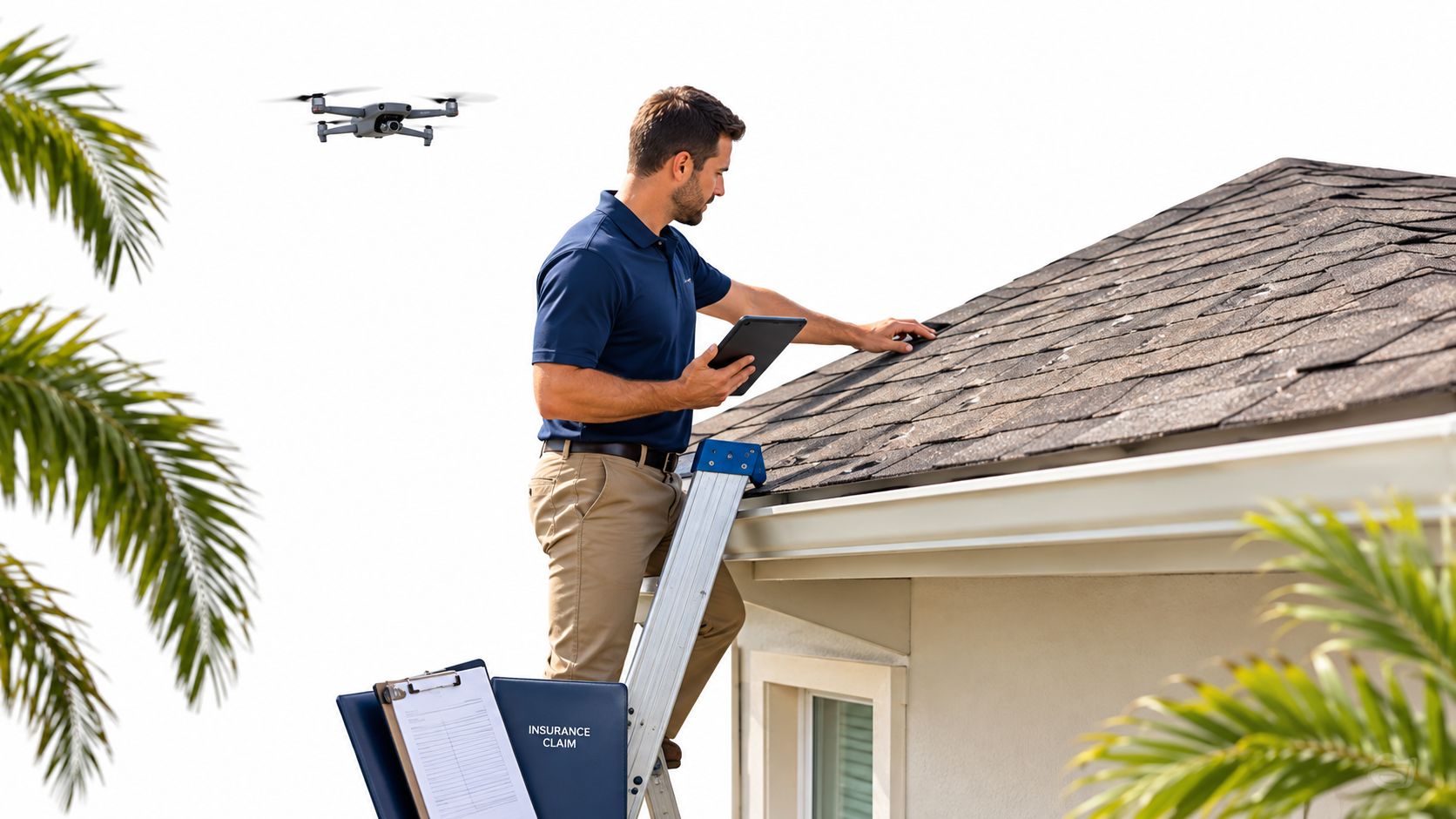
The morning after a hailstorm, a Broward County homeowner usually has three bad options in front of them: climb a wet ladder, call the insurance carrier before documenting anything, or let the first door-knocking roofer define the loss. None of those choices identifies the most important question, which is what kind of roof inspection for insurance do you need?
An underwriting inspection, a storm-claim inspection, and a wind-mitigation inspection can all examine the same roof, but they serve different purposes. They use different documentation, answer different carrier questions, and can produce very different outcomes at renewal or claim time. In South Florida, knowing which document you're triggering is often more important than ordering “a roof inspection.”
Table of Contents
- Why a Roof Inspection for Insurance Is More Than One Document
- The Three Inspection Types and When Each One Applies
- What an Insurance Roof Inspector Actually Looks For
- How to Document Damage So the Claim Holds Up
- Florida Rules That Change the Outcome
- How Drone, Satellite, and AI Screening Are Reshaping Roof Inspections
- Common Pitfalls With Florida Insurers and How to Avoid Them
Why a Roof Inspection for Insurance Is More Than One Document
One roof, three different insurance questions
Suppose the homeowner on that Broward lanai sees loose-looking shingles, dents in a metal vent, and a stain spreading across the ceiling. A claim inspection asks whether a covered storm caused functional damage and what it will cost to restore the property. An underwriting inspection asks whether the roof presents an acceptable future risk. A wind-mitigation inspection asks whether the home has documented wind-resistant features that may qualify for insurance credits.
Those questions overlap, but they aren't interchangeable. A report prepared to document storm damage may not contain the roof age, maintenance history, permit information, or remaining useful-life opinion required for underwriting. A wind-mitigation form may document roof-to-wall connections and opening protection without proving that hail bruised a shingle mat.
That distinction matters because roof exposure has become a major insurance concern. In 2024, U.S. roof repair and replacement cost value reached nearly $31 billion, up nearly 30% since 2022, according to Verisk's analysis of hail-damage roof insurance claims. Roof-related line items represented more than a quarter of residential claim value, while wind and hail remained the predominant loss drivers. The same source reported that non-catastrophic wind and hail roof claims rose from 17% of residential claims in 2022 to 25% in 2024.
Practical rule: Before calling anyone, identify whether you're documenting a loss, proving insurability, or documenting mitigation features.
Why carrier behavior matters
Carriers and adjusters don't read every report as a general statement about the roof. They look for evidence tied to a specific decision. For a claim, that means cause, timing, location, severity, and repair scope. For underwriting, it means age, deterioration, prior repairs, visible defects, and useful life. For mitigation, it means prescribed construction features recorded on the required state form.
A homeowner who treats those reports as one general inspection may discover the gap only after a renewal letter arrives or an adjuster challenges the claim scope. The roof may be sound enough for one purpose and insufficiently documented for another.
In the field, the strongest file is rarely the longest one. It's the file that matches the carrier's question, labels each roof area consistently, and separates storm damage from age, maintenance, and installation conditions. That's the standard to keep in mind before anyone steps onto the roof.
The Three Inspection Types and When Each One Applies
The easiest way to choose the right roof inspection for insurance is to start with the trigger.
| Inspection Type | Trigger | Ordered By | Key Deliverable | Florida-Specific Note |
|---|---|---|---|---|
| Underwriting inspection | New policy, renewal review, or carrier concern | Insurer, agent, or homeowner seeking documentation | Condition report with roof age, visible deterioration, repairs, and useful-life observations | Florida roof-age rules can make an inspection decisive for eligibility |
| Claim inspection | Wind, hail, falling-object, or other reported loss | Homeowner, insurer, or both | Cause-and-damage report with labeled photos, measurements, and repair scope | Evidence must distinguish covered storm damage from wear and maintenance |
| Wind mitigation inspection | Premium-credit review or policy documentation | Homeowner, agent, or insurer | Completed mitigation form with photographs of qualifying features | Florida guidance requires an authorized inspector and a form submitted for insurer review |
If a storm just caused damage
Start with a claim-focused inspection. Document the storm date, visible exterior damage, interior effects, and collateral evidence before permanent repairs alter the scene. A roofer can provide roofing expertise, but doesn't replace an attorney or public adjuster, and their presence at the adjuster appointment isn't mandatory.
The claim file should show what happened and where. That means slope labels, close-up damage photos, wide elevation views, and an estimate that uses the same labels. If you're comparing coverage considerations across different roof surfaces, the discussion of selling roof coverage in GA, AL, and MS also illustrates why material type and policy language can't be separated from the inspection record.
For a visual reference on how inspection documentation is commonly presented, see this roof inspection report example.

If a renewal or non-renewal letter arrived
You likely need an underwriting inspection, not a damage-only report. The carrier may want the roof's approximate age, visible wear, patching, ponding, corrosion, flashing condition, permit history, and remaining useful life. Ask the insurer or agent what form, report age, inspector credentials, and photo requirements they'll accept before ordering the inspection.
If the home is being insured for the first time
Ask whether the carrier wants an underwriting inspection, a wind-mitigation form, or both. A new policy review often focuses on condition and eligibility, while mitigation documentation addresses wind-resistant construction and possible credits. Keep separate copies because one report may not satisfy the other.
A single South Florida home can reasonably have all three documents in one year. Keep the reports, photographs, forms, estimates, permits, and carrier correspondence together. The inspection is only useful later if someone can understand what it documented and when.
What an Insurance Roof Inspector Actually Looks For
A credible storm inspection isn't a quick walk around the house followed by a replacement estimate. The inspector works slope by slope, records the orientation, photographs representative areas, and connects each observation to a roof plane.
On asphalt shingles, a common workflow uses 10 by 10 foot test squares, or 100 square feet, to count functional impacts. The frequently cited hail benchmark is approximately 8 to 10 qualifying impacts per 100 square feet on asphalt shingles when evaluating whether full-slope replacement may be supported. That benchmark comes from the InterNACHI hail-damage inspection workflow, but it isn't a universal automatic approval rule. The policy, material condition, damage pattern, and carrier guidelines still matter.
Functional damage versus surface marks
A dark spot isn't automatically a claimable hail impact. The inspector looks for changes such as granule loss, mat exposure, bruising, fractures, punctures, and loss of shingle integrity. Surface scarring without functional impairment may not support replacement, while a subtle depression that compromises the mat can matter even if it photographs poorly from the ground.
Wind leaves a different pattern. Inspectors look for creased tabs, lifted or displaced shingles, exposed fasteners, torn seals, and damage concentrated on windward slopes. Hail can affect multiple elevations and may leave matching evidence on vents, gutters, screens, ridge vents, and other soft metals.
Tile, metal, and shingle roofs also require different interpretation. Concrete or clay tile may crack, chip, or shift at edges and fasteners. Standing-seam metal can show dents, coating damage, distortion, or oil-canning, but not every visible impression affects weather performance. The inspector must connect the appearance to function rather than treating every mark as equivalent.
Why the report changes the estimate
An estimate can vary substantially based on what the inspector logged. Missing a damaged pipe boot, ridge vent, valley, flashing run, starter course, or soft-metal component can change the repair scope. Failing to identify the affected slope can make the estimate difficult to verify.
A proper report normally connects:
- Slope identity: North, south, east, west, or another consistent label.
- Test-square findings: The location and count of qualifying impacts.
- Material condition: Shingle, tile, metal, flat roofing, and relevant age observations.
- Collateral evidence: Gutters, vents, flashing, screens, fascia, and exterior surfaces.
- Functional conclusion: Repair, replacement, maintenance, or inconclusive condition.
That level of detail gives the adjuster something more useful than a stack of uncaptioned close-ups.
How to Document Damage So the Claim Holds Up
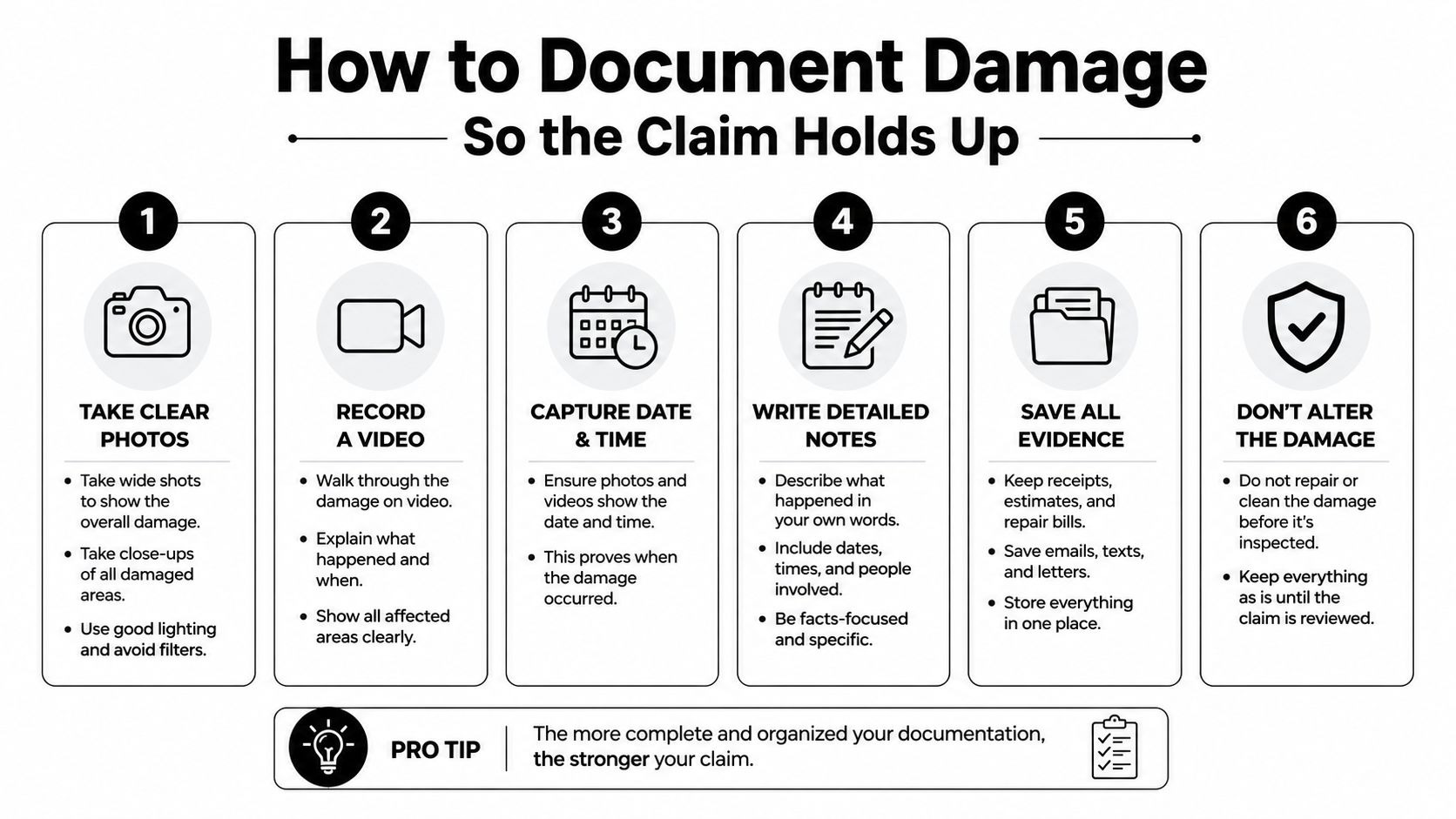
The first day matters because evidence changes quickly. Take photographs before anyone removes damaged material, scrapes surfaces, or completes permanent repairs. If the roof is unsafe, stay on the ground and use a qualified inspector or drone operator rather than creating a second accident.
Start with a simple naming system. Label each slope by compass orientation or a clearly defined site map, then use those labels in the photos, notes, estimate, and conversations with the carrier. A wide photo should show the roof plane and surrounding elevation. A close photo should show the suspected impact with a coin, tape measure, or other measurement reference.
A same-day evidence routine
- Record the event: Write down the storm date and type, then compare it with the relevant local weather documentation. Keep the report with the claim file rather than relying on memory.
- Photograph every elevation: Capture gutters, vents, screens, soffits, fascia, windows, and exterior walls. Collateral damage can help establish direction and timing.
- Photograph by slope: Use wide-to-close image sets, and keep the same slope labels throughout the file.
- Show scale: Place a coin or measuring tape beside each suspected impact. Avoid photos that show only an isolated dark mark.
- Capture interior effects: Photograph stained ceilings, wet attic insulation, displaced soffit, and active leaks. Include room context and close details.
- Preserve the file: Keep original images with their metadata, then create dated folders for the storm, inspection, estimates, and carrier communications.
Wind and hail evidence shouldn't be blended into one vague damage category. Creased tabs and lifted shingles on a windward slope may support a wind narrative. Bruised mats with intact surface granules, especially across exposed roof areas, may support hail-related analysis. The inspector should explain the conclusion instead of forcing every defect into the nearest storm label.
For a related visual example, review this wind-damage insurance claim inspection image. Homeowners should also understand why carriers scrutinize inconsistencies, altered images, and unsupported damage narratives. Background on detecting insurance claim fraud can help explain why original files and transparent documentation are safer than edited or selectively cropped images.

Don't authorize permanent repairs before the adjuster has had a reasonable opportunity to inspect, unless emergency mitigation is necessary to prevent additional damage. If a tarp or temporary repair is required, photograph the condition first, keep receipts, and preserve removed materials when practical. Tie every contractor estimate to the same slope labels used in the photo log.
Florida Rules That Change the Outcome
Florida roof insurance decisions often turn on age and documentation before anyone discusses storm damage. A common assumption is that an old roof is automatically uninsurable. The actual rules are more specific, and the paperwork can change the result.
Florida law says an insurer can't deny an application or refuse renewal solely because a roof is under 15 years old. For a roof 15 years old or older, the homeowner must be allowed to obtain an inspection. If that inspection shows at least five years of remaining useful life, the insurer can't refuse coverage based only on roof age, as described in this Florida roof-age rule explanation.
Citizens Property Insurance Corporation applies separate documentation requirements. Citizens says roofs older than 25 years for soft materials such as shingles, or older than 50 years for hard materials such as tile, slate, clay, concrete, or metal, require proof of at least five years of remaining useful life. Citizens also states that a Florida-licensed inspector must evaluate visible damage or deterioration, and that less than five years of useful life requires proof of full-roof replacement before a policy is written. The carrier's official inspection requirements should be checked before scheduling an inspection.
Florida rules at a glance
| Rule or Form | Threshold or Window | Who Signs | Effect on Claim or Renewal |
|---|---|---|---|
| Roof-age eligibility rule | 15-year age point, with five years of useful life required for the age-based protection | Qualified inspector prepares the report | Can affect underwriting eligibility and renewal decisions |
| Citizens roof documentation | 25 years for soft roofs, 50 years for hard roofs, with five years of useful life documentation | Florida-licensed inspector | May require useful-life proof or full replacement documentation |
| Wind-mitigation inspection | Valid for up to five years unless material changes occur | Authorized Florida professional | Documents wind-resistant features and may support premium credits |
| Uniform Mitigation Verification Inspection Form | Current form and supporting photographs | Qualified inspector, not the homeowner | Gives the insurer evidence to review mitigation features |
Wind mitigation is a different inspection
Florida's official mitigation guidance explains that a wind-mitigation inspection documents wind-resistant features so policyholders can qualify for premium discounts or credits. Eligible inspectors include licensed general, building, or residential contractors, licensed professional engineers, licensed professional architects, and certified building-code inspectors. The inspector must photograph and document qualifying features on the Uniform Mitigation Verification Inspection Form before submission to the insurer, as explained by the Florida Chief Financial Officer's mitigation guidance.
The form follows a five-year validity window, unless the roof, windows, or doors are materially changed, according to Florida Office of Insurance Regulation wind-mitigation resources. A missing form, an expired form, or a report signed by someone who isn't authorized can affect the policy before a storm ever arrives.
South Florida salt air creates another reason to document metal components, fasteners, and flashing carefully. A salt-air corrosion protection reference can help homeowners understand why corrosion is a maintenance and condition issue, not automatically storm damage.
How Drone, Satellite, and AI Screening Are Reshaping Roof Inspections
Automated screening changes the order in which carriers see a roof. A satellite image, drone capture, or machine-learning flag may reach an underwriting desk before a contractor or adjuster visits the property. Connecticut insurance guidance described in the available industry discussion treats aerial imagery primarily as a screening tool that can lead to a physical inspection when concerns arise, rather than as a complete substitute for every site visit.
That distinction matters in Florida. Tree shadows, glare, roof staining, missing imagery, and camera angle can create a flag that looks persuasive from above but doesn't establish functional damage at the roof surface. Tile cracks and metal distortion also require close inspection because visual irregularity doesn't always equal a weatherproofing failure.
What aerial screening does well
Aerial tools can give carriers broad visibility without putting an adjuster on a steep or compromised roof. They can preserve a visual baseline, identify apparent deterioration, and help route properties for manual review. Homeowners benefit when the imagery accurately captures the roof and prompts a timely inspection.
The weakness appears when a carrier treats a preliminary image as the final answer. A shadow can resemble a missing shingle. Tree cover can hide a roof plane. An old aerial image can misrepresent the current condition. An automated flag can also identify a genuine maintenance issue without proving that a recent storm caused it.
How to challenge a questionable flag
A contractor report should use the same discipline as a good claim file:
- Match the labels: Use the same slope names across the report, photos, and carrier correspondence.
- Show the field: Include wide images that establish the affected roof plane.
- Measure consistently: Use documented 10 by 10 foot test squares where appropriate for asphalt shingles.
- Explain function: Separate cosmetic marks, age-related wear, installation defects, and storm damage.
- Request human review: Ask the carrier what image or condition triggered the decision and submit the counter-documentation through the stated process.
The practical takeaway is uncomfortable but useful: more technology often means more scrutiny, not faster payment. A well-organized contractor file gives a human reviewer something concrete to compare against an automated flag.
Common Pitfalls With Florida Insurers and How to Avoid Them
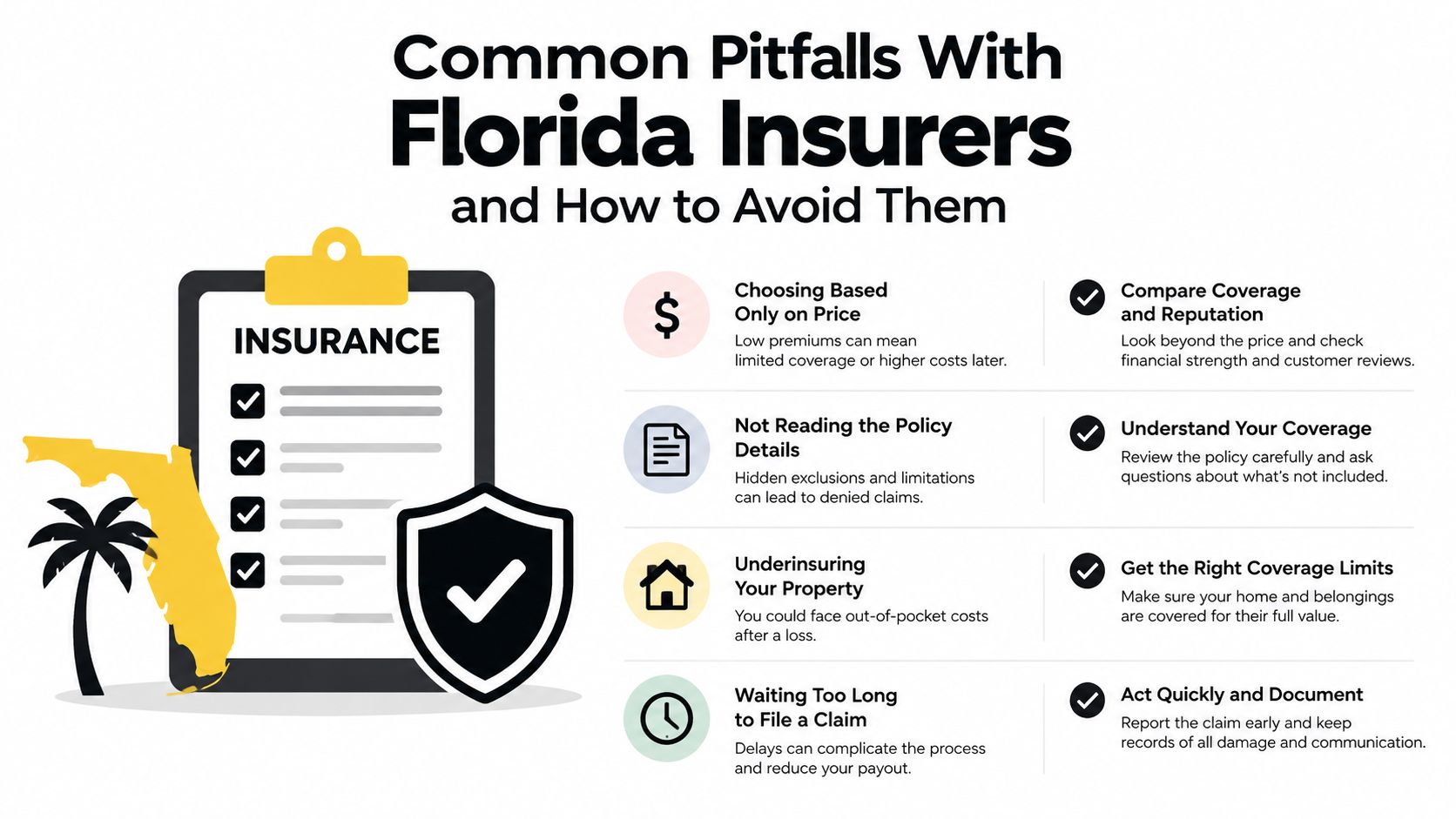
Florida claims are often weakened by timing and paperwork rather than by a single dramatic mistake. The safest approach is to preserve evidence first, make only necessary temporary repairs, and ask the carrier what documentation it needs before ordering a report.
Five mistakes that create avoidable trouble
- Delayed documentation: Waiting weeks to photograph ceiling stains, drips, or wet insulation can weaken the connection to the named storm, especially if the carrier already has a prior leak note. Photograph the condition immediately, even if the leak has stopped.
- Permanent repairs before inspection: Replacing damaged materials removes evidence and can create depreciation or scope disputes. Make emergency mitigation safe and temporary, then preserve receipts and removed materials where practical.
- Unclear contractor agreements: Don't sign an assignment of benefits or negotiation agreement because a salesperson says it's mandatory. Read the document, understand who controls communication, and don't let anyone promise coverage they can't determine.
- Expired mitigation paperwork: A wind-mitigation form can become unusable when its five-year window lapses or when material roof, window, or door changes occur. Check the form before renewal rather than after a carrier asks for it.
- Wrong inspection purpose: A claim report may not satisfy underwriting, and a mitigation form won't prove hail damage. Confirm the carrier's requested document, signer requirements, and acceptable report age first.
If an adjuster can't attend when your roofer is available, don't assume the claim is lost. A qualified roofing contractor can inspect before or after the carrier visit, document legitimate missing items, and review the estimate. The roofer's role is to explain roofing conditions and repair requirements, not to act as your lawyer or public adjuster.
A same-day checklist
- Photograph the roof and interior conditions without taking unsafe access risks.
- Record the storm date and keep original image files.
- Label each slope and use those labels everywhere.
- Report the loss promptly and ask what inspection documents the carrier requires.
- Make only temporary mitigation repairs until the roof condition is documented.
- Keep reports, estimates, permits, receipts, forms, and correspondence together.
Paletz Roofing and Inspections provides roof inspections for insurance documentation, storm-damage reports, repair estimates, and wind-mitigation support across South Florida. If you're in Broward, Miami-Dade, or Palm Beach County and need a roof file built around labeled photos, condition findings, and the right inspection purpose, visit Paletz Roofing and Inspections to schedule an evaluation.