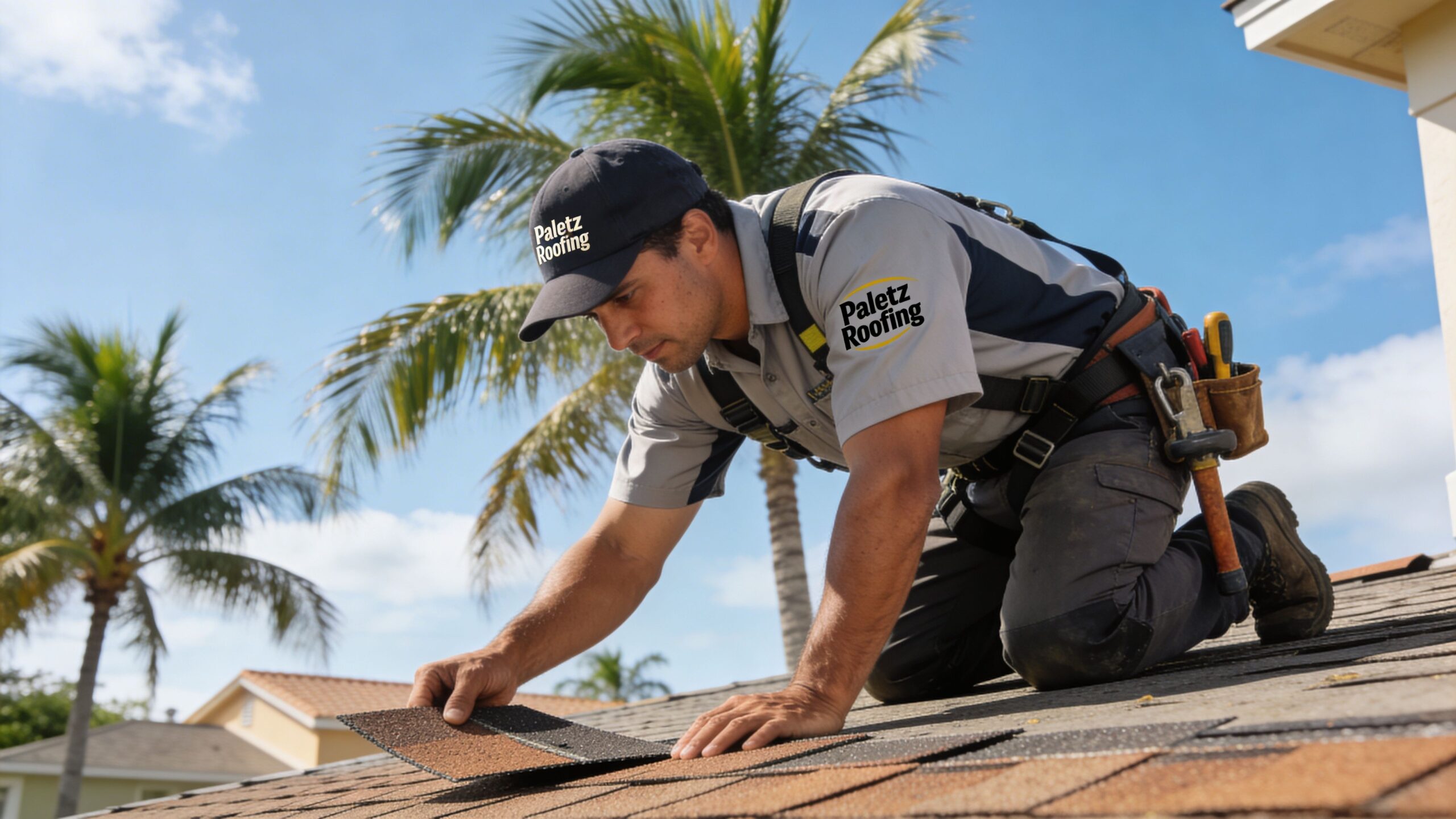
A lot of Boynton Beach homeowners call after the same moment. A hard rain moves in, water shows up on the ceiling, and what looked like a small roofing issue suddenly feels urgent. By then, significant damage usually started earlier.
That’s how roof repair boynton beach works in real life. The leak rarely begins the day you notice it. It starts with a lifted shingle, a cracked tile, worn flashing, a vent boot that dried out in the sun, or debris that kept water sitting where it shouldn’t. In this climate, heat, humidity, wind, and salt exposure don’t give roofs much forgiveness.
The other part people often miss is the insurance side. After a storm, the roof itself is only half the job. The other half is documenting damage correctly, understanding what repairs make sense under local code, and avoiding mistakes that can turn a valid claim into a delay or denial. In Boynton Beach, roof work isn’t just about patching a problem. It’s about making the right call early.
Recognizing Early Signs of Roof Damage in Boynton Beach
A Boynton Beach roof usually gives warning before it leaks into the house. The problem is that the early signs are easy to dismiss until a storm pushes water past the underlayment and into the attic.
I see the same pattern after summer squalls and tropical weather. A homeowner notices a stain near a light fixture or along a wall line, then assumes the leak started that day. In practice, the roof has often been failing for weeks or months. That timing matters for one reason many articles skip. If storm damage may lead to an insurance claim, the first photos, dates, and inspection notes can affect whether the carrier treats the problem as sudden wind damage or long-term wear.

What you can often spot from the ground
Start outside before you ever climb a ladder. Walk the property from a few angles and look when the sun is low enough to show shadows across the roof surface.
Watch for these signs:
- Dark streaks or algae staining: In South Florida humidity, staining often means moisture is lingering where it should dry out faster.
- Debris packed in valleys or gutters: Valleys have to shed water cleanly. When leaves, grit, or seed pods collect there, water can work backward under shingles or tile.
- Uneven roof lines: A dip, ripple, or sag can point to wet decking or framing movement below.
- Pieces on the ground: Shingle granules, broken tile, and dried sealant scraps are signs the roof surface is already breaking down.
- Visible lifted edges: Raised shingles, loose flashing, or disturbed drip edge usually mean wind has already opened a path for water.
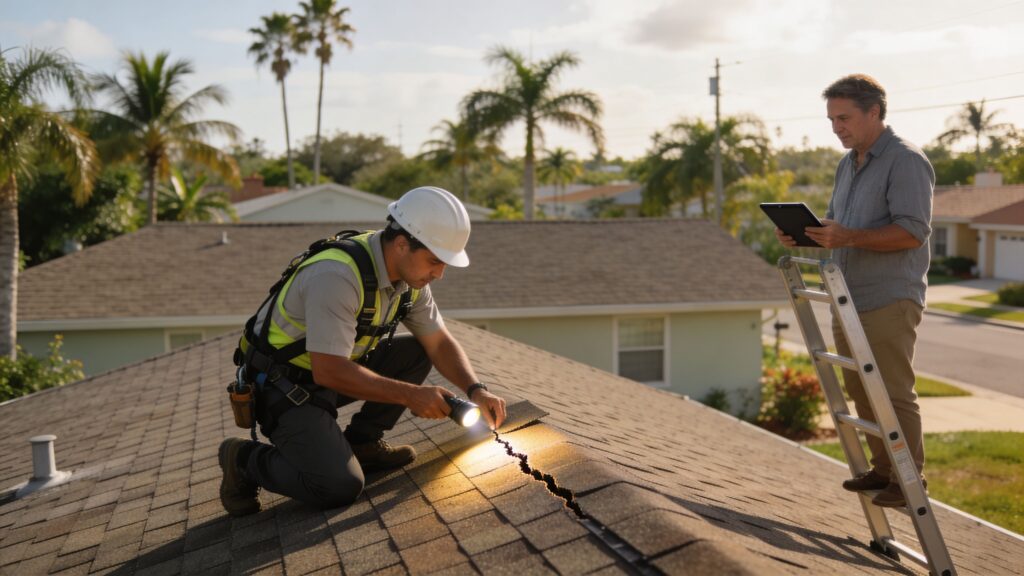
One photo can reveal a lot of neglect. This roof damage example shows the kind of surface wear many homeowners miss until the ceiling gets involved.
What usually requires a closer inspection
The bigger problems are often around transitions and penetrations, not in the wide open field of the roof.
On the roof or in the attic, a roofer checks for cracked vent boots, failed flashing at walls and chimneys, nail pops, soft decking, and blistering on low-slope sections. Those are the spots where Boynton Beach heat, rain, and wind exposure show up first. A small split in a pipe boot or a flashing separation at a wall can feed a leak long before it becomes visible indoors.
If you already see a ceiling stain, assume the entry point may be higher up the roof and older than it looks.
Photo records matter here. They help a contractor track the actual source of the leak, and they help the homeowner if storm damage has to be documented for an adjuster. Many crews now use aerial images and detailed jobsite photos for that reason. For a look at how contractors document conditions safely and consistently, this article on drone roofing inspection software is useful.
Boynton Beach conditions make small defects spread faster
Boynton Beach gets heavy seasonal rain, high humidity, salt exposure, and storm-driven wind. The National Weather Service office for Miami-South Florida tracks the region’s intense rainy season and tropical weather patterns, and the U.S. Census Bureau profile for Boynton Beach shows the size of the city these conditions affect every year. That detail is important because roofs here do not get much recovery time. Materials stay damp longer, sealants age hard in the sun, and one loose component can turn into interior damage fast.
That is also why early documentation matters on the insurance side. If a storm lifted shingles, cracked tile, or pulled flashing loose, get it inspected and photographed before the evidence gets softened by more rain, cleanup, or temporary patchwork. A clean record from the start makes it easier to show what was storm-related and what was age-related.
The Critical Decision To Repair or Replace Your Roof
Homeowners usually want the same answer at first. “Can you just repair it?” Sometimes that’s the right move. Sometimes it’s money thrown at a roof that’s already at the end of the line.
The decision has to be based on condition, repair history, and local code. In Boynton Beach, one rule can settle the issue quickly.

The 25 percent rule changes the conversation
In Boynton Beach, Palm Beach County building codes strictly limit cumulative roof repairs, replacements, or recoveries to 25% of the total roof area within any 12-month period. Once you go past that threshold, permitting and inspections are triggered, and the work must comply with the Florida Building Code and applicable hurricane standards, as outlined by MM Roof Repair’s Boynton Beach code summary.
That matters because many owners look at damage one spot at a time. The building department looks at the roof as a system.
If a home had one repair after a storm, another after a leak around a valley, and another after underlayment failure, those separate jobs can add up. At that point, trying to keep patching may not even be the legal path forward.
When repair still makes sense
A focused repair is usually reasonable when the roof is otherwise sound and the problem is limited.
Typical examples include:
- A localized leak around flashing
- A few wind-damaged shingles or tiles
- A small penetration issue at a vent or pipe boot
- Minor edge or valley work where surrounding materials remain solid
In those cases, a repair can buy real time if it’s done with matching materials, proper underlayment details, and clean tie-ins. Slapping mastic over a failure point is not repair work. It’s delay.
When replacement is the smarter call
Some roofs tell you they’re done, even if a few areas still look decent.
Watch for this pattern:
| Condition | What it usually means |
|---|---|
| Repeated leaks in different areas | The system is aging broadly, not failing in one isolated spot |
| Widespread surface wear | Protective layers have thinned out across the roof |
| Multiple prior repairs | New patches are being attached to old weak points |
| Deck or underlayment involvement | The problem goes below the visible roof covering |
| Repair totals nearing code limits | Replacement may be the cleaner legal and financial decision |
Think of granule loss on a shingle roof like worn skin on your hands. Once enough protection is gone, the material below takes the hit.
A good repair fixes a contained problem. A bad repair delays a system-wide failure and adds one more invoice before replacement.
The accurate trade-off homeowners face
Homeowners often compare the immediate price of a repair against the larger price of replacement. That’s understandable, but it’s incomplete.
The accurate comparison is this:
- Repair now and risk more repairs later
- Replace now and reset the roof under current code
- Keep patching and run into permit or insurance complications
- Invest once and stop chasing leaks room by room
A newer code-compliant system can also simplify future storm documentation because the materials, installation details, and permit history are clearer.
Ground signs versus hidden signs
From the ground, homeowners usually notice obvious issues first. Missing shingles, broken tiles, a stain on the soffit, or visible sagging. Those matter.
The subtler decision-makers show up during inspection:
- soft decking around penetrations
- aged underlayment beneath tiles
- repeated patching in valleys
- brittle sealants at transitions
- moisture patterns in attic framing
Those hidden conditions are why the repair-or-replace answer shouldn’t come from a quick glance in the driveway.
If your roof is still structurally healthy and the damage is confined, repair can absolutely be the right call. If the roof has crossed the code line, has failures in several areas, or keeps needing attention after every storm, replacement usually stops the cycle.
Repair Considerations for Different Boynton Beach Roof Types
Not all roof repair boynton beach jobs fail for the same reason. Material matters. The weak spots on a shingle roof are different from the weak spots on tile, metal, or flat systems. If the repair method doesn’t match the roof type, the fix won’t last.

Shingle roofs
Shingle systems are common because they’re practical and straightforward to service. But South Florida sun and storm cycles wear them down fast.
Common failure points include:
- Lifted or creased shingles after wind
- Granule loss from age and heat
- Pipe boot deterioration
- Exposed fasteners near transitions
- Improperly sealed repairs from previous work
A proper shingle repair means replacing damaged pieces, checking the fastening pattern, inspecting underlayment at the leak path, and tying the patch into the surrounding field cleanly. The mistake I see most is trying to “glue down” a wind problem without addressing the fastening and the substrate below.
Tile roofs
Tile roofs look tough, and they are, but they break in ways homeowners don’t expect. Sometimes the tile itself cracks. Other times the tile is fine and the underlayment below is what failed.
Local guidance notes that tile roofs in Boynton Beach can fail more quickly without regular checks, while flat roofs can develop leaks relatively soon if drainage isn’t maintained for the area’s heavy rainfall, according to EW MacDowell Roofing’s Boynton Beach page.
That tracks with what roofers see in the field. Foot traffic cracks tiles. Mortar details age. Underlayment dries out and starts letting water through long before the roof “looks bad” from the street.
Tile repairs often involve:
- replacing broken or slipped tiles
- checking battens or attachment points
- repairing valley metal and flashings
- isolating underlayment failures beneath the visible tile layer
One roof photo set can make these distinctions clearer, and this tile roof repair image shows the kind of access and detail work these systems often require.
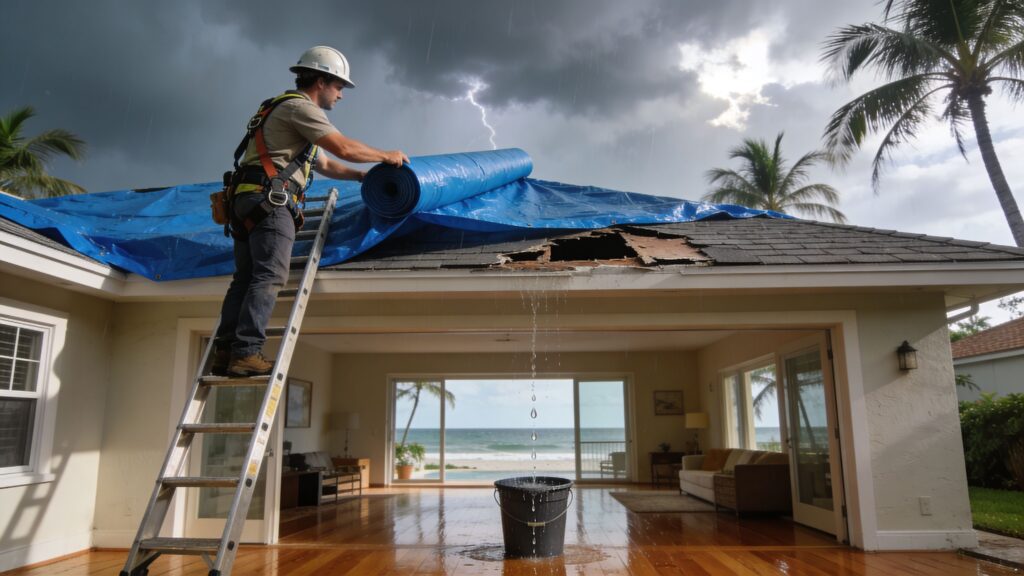
On tile roofs, the visible piece isn’t always the leak source. Many leaks start below the tile, not through it.
Metal roofs
Metal roofs hold up well, but they demand precise repairs. A rushed patch on metal often creates a bigger issue by trapping water or setting up corrosion at the seam.
The problems that show up most often are:
| Metal roof issue | Why it matters |
|---|---|
| Loose fasteners | Open paths for water intrusion |
| Failed sealant at laps | Lets driven rain move sideways |
| Corrosion near exposed cuts | Weakens protective coating |
| Flashing separation | Creates leaks at transitions and penetrations |
Good metal repair is detail work. The panel profile, fastener type, sealant compatibility, and expansion behavior all matter.
Flat roofs
Flat and low-slope roofs can be very durable in Boynton Beach, but only if drainage is taken seriously. Ponding water, clogged drains, split seams, and edge failures do more damage than owners realize.
For property owners comparing repair options, this guide to flat roof coating is useful background. Coatings can help in the right situation, but they’re not a cure for wet insulation, failed seams, or soft decking.
Flat roof repairs usually involve:
- Seam repairs: Heat-welded or manufacturer-compatible patching
- Drainage corrections: Clearing or adjusting paths so water exits properly
- Flashing work: Reinforcing parapet edges, curbs, and penetrations
- Surface restoration: Only after underlying moisture issues are ruled out
Maintenance is different for each system
A shingle roof needs a different maintenance eye than a tile or flat system. That’s why generic roof checklists don’t help much.
What works is material-specific maintenance:
- Shingle roofs: watch for surface wear, exposed nails, and seal strip failures
- Tile roofs: inspect cracked pieces, mortar condition, and underlayment warning signs
- Metal roofs: monitor fasteners, seam integrity, and corrosion points
- Flat roofs: keep drains clear and inspect seams, terminations, and ponding areas
The repair that lasts is the one matched to the roof in front of you, not the one copied from a different material.
Understanding the Roof Repair Process and Local Costs
A Boynton Beach homeowner sees a ceiling stain after a hard afternoon storm and wants one simple answer. How much will this cost, and how long will it take? The honest answer is that the process matters as much as the price. A rushed repair with poor documentation can create two problems instead of one. The leak comes back, and the paper trail is too weak if that storm damage later turns into an insurance issue.
How a proper roof repair usually unfolds
Good repair work follows a sequence, especially in South Florida where wind-driven rain, humidity, and code requirements can turn a small leak into a larger scope fast.
Leak and damage inspection
The first job is finding the actual entry point, not just the interior stain. On many roofs, water shows up several feet away from where it got in.Interior and exterior documentation
Photos, notes, moisture signs, and marked problem areas should be recorded before materials are disturbed. That protects the homeowner and gives the contractor a clear starting point.Scope review and permit check
Some repairs are straightforward. Others trigger permit requirements, especially if decking, structural components, or a larger section of the roof system is involved.Material matching and repair plan
This part is often underestimated. Matching shingle color, tile profile, metal components, and underlayment compatibility affects both appearance and performance.Repair work and dry-in details
Failed material gets removed, hidden damage is checked, and the assembly is rebuilt correctly. On storm jobs, temporary dry-in may come first if active water intrusion is still a risk.Cleanup and final review
The crew should leave the property clean and explain exactly what was repaired, what was found underneath, and whether any nearby areas need watching.
If a contractor cannot explain the leak path clearly, the diagnosis is not finished.
Why replacement pricing still matters
Even if you only need a repair today, replacement pricing gives useful context. It shows what is at stake if a leak is ignored and moisture gets into the decking, underlayment, insulation, soffit, or interior finishes.
Homeowners researching local pricing can compare broader market ranges through HomeBlue's Boynton Beach roofing cost guide. Use that kind of source as a benchmark, not a quote. Real pricing changes with roof height, access, material type, code requirements, and how much hidden damage is found after tear-off.
Estimated Roof Repair Costs in Boynton Beach (2026)
The exact cost depends on access, roof type, storm exposure, and whether the repair stays on the surface or reaches the substrate. These ranges are a practical field guide, not fixed pricing.
| Repair Task | Shingle Roof Cost | Tile Roof Cost | Flat Roof Cost |
|---|---|---|---|
| Minor leak repair at flashing or vent | Often the lowest-cost repair if damage is isolated | Usually higher because removal and reset take more time | Varies by membrane type and seam condition |
| Localized storm damage repair | Depends on shingle matching and underlayment condition | Can rise fast if tiles are brittle, slipped, or hard to match | Depends on punctures, wet insulation, and seam failure |
| Valley or transition repair | Moderate if limited to one section | Often labor-heavy because water control details are more complex | Moderate to high if tied to poor drainage |
| Substrate-related repair | Costs rise quickly once decking is involved | Costs rise further if underlayment below tile has failed | Higher if insulation or deck moisture extends beyond the visible leak |
What pushes repair costs up
The line items that surprise homeowners are usually below the finished surface.
The biggest drivers include:
- Access and setup: Steep slopes, second-story sections, pool enclosures, and tight lot lines all add labor time.
- Material fragility: Tile repairs take more care because breaking surrounding pieces during removal can widen the scope.
- Hidden damage: Soft decking, wet underlayment, damaged fascia, and compromised flashing change a small repair into a larger one.
- Code-related work: In Boynton Beach, repairs may need to meet current permit and attachment requirements depending on scope.
- Emergency response: Tarping, temporary dry-in, and after-hours storm calls usually cost more than scheduled repair work.
A solid estimate should break out what is being repaired, what assumptions were made, and what could change once the roof is opened. That level of detail matters for budgeting. It also matters if the repair later becomes part of a storm claim file.
Navigating Insurance Claims for Storm Damage Repairs
In this phase, many homeowners lose money. Not because the roof damage isn’t present, but because the claim file is weak, incomplete, or handled in the wrong order.
After a storm, people often call their carrier first, then start figuring out the roof. In practice, it usually works better to document the damage thoroughly before the claim conversation gets too far.

Why documentation matters so much
In Palm Beach County, over 30% of storm-related roof damage claims are initially denied due to improper or insufficient documentation, and claim activity surged 45% after Hurricane Milton in 2025, according to Boynton Beach Roofing Experts.
That’s the part homeowners need to understand. Insurance companies don’t approve claims because damage feels obvious. They approve claims based on documented evidence, policy language, and whether the file supports the cause and scope of loss.
What to do after a storm
The right first steps are practical:
- Protect the interior first: Move valuables, contain water, and reduce further damage.
- Take clear photos: Ceiling stains, wet insulation, exterior damage, fallen debris, and anything displaced by wind.
- Write down timing: Note when the storm hit and when you first noticed the problem.
- Avoid permanent repairs before documentation: Emergency tarp or temporary dry-in is fine. Full repairs should wait until the condition is recorded properly.
- Keep every receipt: Temporary protection costs may matter later.
Don’t tell your carrier what the roof “probably needs” before the roof is documented. Report what happened and what you observed.
What adjusters usually need to see
A strong roof claim file usually includes more than pictures of a ceiling stain.
It should support:
| Claim element | Why it matters |
|---|---|
| Exterior damage photos | Shows storm-related impact or wind movement |
| Interior water evidence | Connects roof failure to resulting damage |
| Material-specific notes | Helps distinguish storm damage from old wear |
| Repairability concerns | Important when matching or code issues affect scope |
| Temporary mitigation records | Shows the owner acted responsibly to limit damage |
A certified roofer can help here. A pre-claim inspection can identify whether the damage is isolated, storm-related, old deterioration, or a combination. That matters because mixing those categories in one conversation with the carrier can muddy the file fast.
What hurts claims
The biggest mistakes are avoidable.
Common problems include:
- waiting too long to document the damage
- throwing away damaged materials immediately
- making broad statements to the carrier before inspection
- using vague photos with no close-ups or context
- hiring someone who can patch the leak but can’t document the cause
Paletz Roofing and Inspections is one option for owners who need a damage assessment, repair scope documentation, and code-aware roof review before or during the claims process.
What a practical insurance conversation sounds like
Keep it factual. Report the storm event, the date damage was noticed, the visible symptoms, and the steps taken to prevent further interior damage. Don’t guess at coverage. Don’t minimize the issue either.
If the roof needs temporary protection, get that done. Then build the file correctly. In storm work, the paper trail matters almost as much as the repair itself.
Why Paletz Roofing Is Boynton Beachs Trusted Choice
Roofing in South Florida isn’t just labor. It’s judgment. The contractor has to know when a leak is surface-level, when it points to deeper failure, when code changes the scope, and when an insurance file needs tighter documentation before the homeowner says another word to the carrier.
Paletz has been licensed and insured since 1990, serving South Florida with residential and commercial roofing across Palm Beach, Broward, and Miami-Dade. That kind of longevity matters in roof repair boynton beach because local work means local code familiarity, material experience, and real storm-response discipline.
What homeowners need from a roofer
The job isn’t just to stop water for today. It’s to repair the roof in a way that holds up under humidity, wind exposure, and the next inspection.
That means:
- Clear diagnosis: not a guess from the driveway
- Material-specific repairs: shingle, tile, metal, and flat roofs each need different methods
- Code awareness: especially when the scope starts pushing beyond minor repair
- Insurance-ready documentation: when storm damage is part of the picture
A roofing company should also be easy to verify. The Paletz Roofing and Inspections logo file is a simple reference point, but what matters more is consistent field work, proper licensing, and repair details that don’t fail the next time the weather turns.

The right roofer doesn’t just patch the hole. They identify why it opened, what else was affected, and whether the repair path still makes sense under code.
Frequently Asked Questions About Roof Repairs
How fast should I call after I notice a leak
Right away. In Boynton Beach, roof leaks don’t stay small for long. Even if the water stain looks minor, moisture can already be moving through insulation, decking, fascia, or drywall.
Is a small repair worth doing on an older roof
Sometimes, yes. If the problem is isolated and the rest of the roof is still serviceable, a repair can buy useful time. If the roof has multiple failure points or a history of repeated patching, the repair may only delay a bigger decision.
Can a leak start far from the spot where I see water inside
Yes. Water often enters at one point and travels before it shows up indoors. That’s why roofers inspect the full leak path instead of only the stain on the ceiling.
What should I save for an insurance claim after storm damage
Save photos, temporary mitigation receipts, notes about when the damage appeared, and any inspection records. Good documentation helps support the claim and reduces confusion later.
Are tile roof repairs more complicated than shingle repairs
Usually, yes. Tile repairs often involve both the visible tile and the system below it, especially underlayment and flashing details. Matching existing tile can also be a challenge.
How do I know if a repair was done correctly
You should get a clear explanation of what failed, what was removed, what was replaced, and whether any hidden damage was found. A vague “we sealed it” answer usually isn’t enough.
If you need practical help with roof repair, storm damage documentation, or a straight answer on whether your Boynton Beach roof should be repaired or replaced, contact Paletz Roofing and Inspections. They handle residential and commercial roofing across South Florida and can help you sort out the roof condition, the code side, and the next steps before the problem gets more expensive.