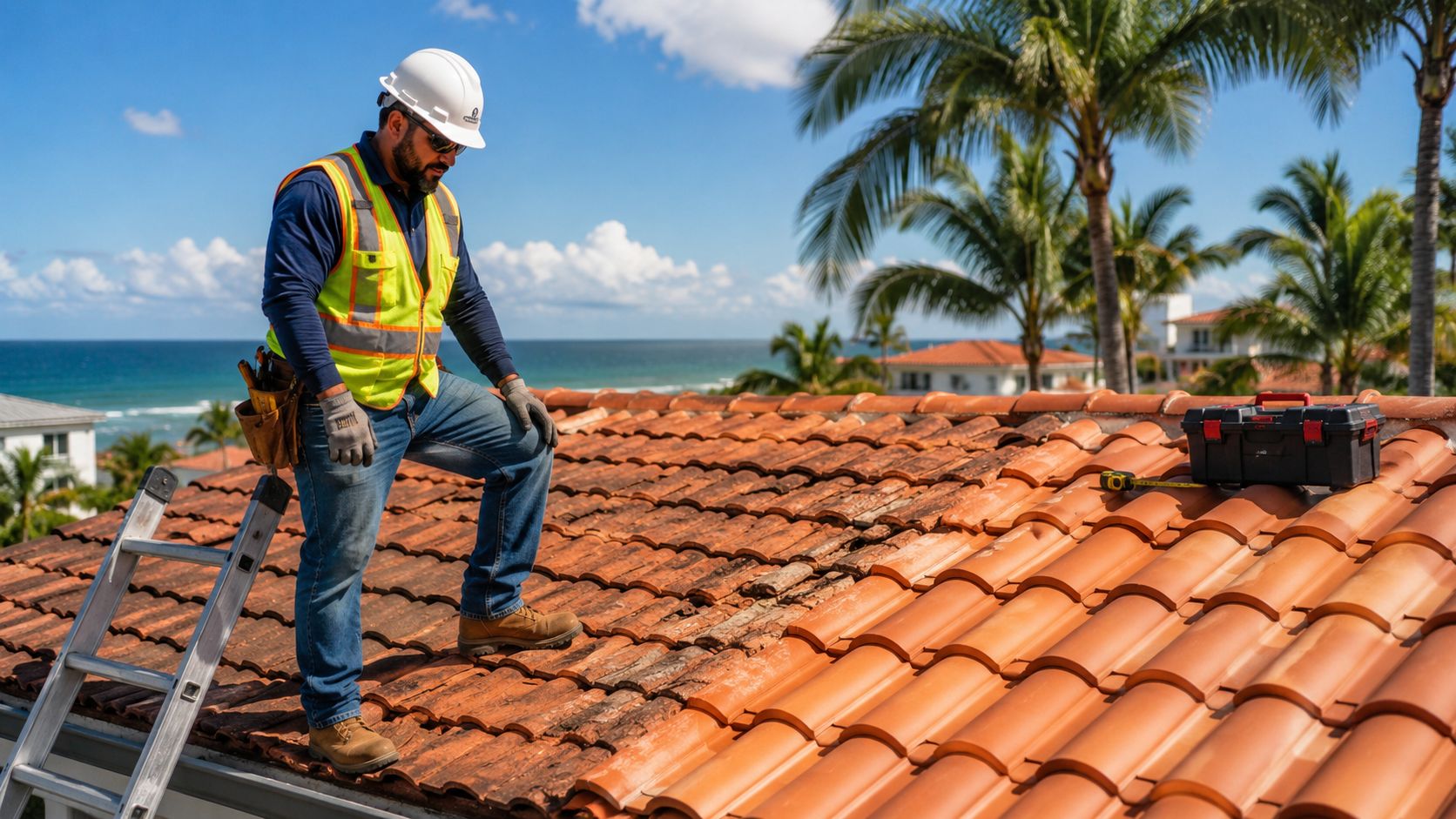
A ceiling stain after a summer squall in Boca Raton usually starts as a small, ugly surprise. A homeowner notices a brown spot near a vent, hears dripping in the attic, or sees a tile out of place after a windy afternoon, then has to decide fast whether this is a simple roof repair or the start of a much bigger project. In this market, that decision matters because the roof isn't just weatherproofing, it's a code-sensitive system that has to stand up to coastal exposure, permit rules, and insurance scrutiny.
Table of Contents
- Why Roof Repair in Boca Raton Is Different From Other Markets
- What to Do in the First 24 Hours After a Leak or Storm
- How Much Roof Repair Costs in Boca Raton
- Repairing Shingle, Tile, Metal, and Flat Roofs
- Boca Raton Permits and Building Code Essentials
- How to Choose the Right Boca Raton Roofing Contractor
- Repair Timelines and Year-Round Maintenance
- Repair or Replace, How to Decide
Why Roof Repair in Boca Raton Is Different From Other Markets
A Boca Raton roof can look fine from the driveway and still be failing in the hidden layers. After a summer storm, the visible clue might be a cracked tile or a rusted flashing edge, but the expensive damage often sits underneath in the underlayment, decking, valley metal, or membrane seams. That's why roof repair boca raton is never just a patch job. It's a diagnosis.
The Boca Raton challenge
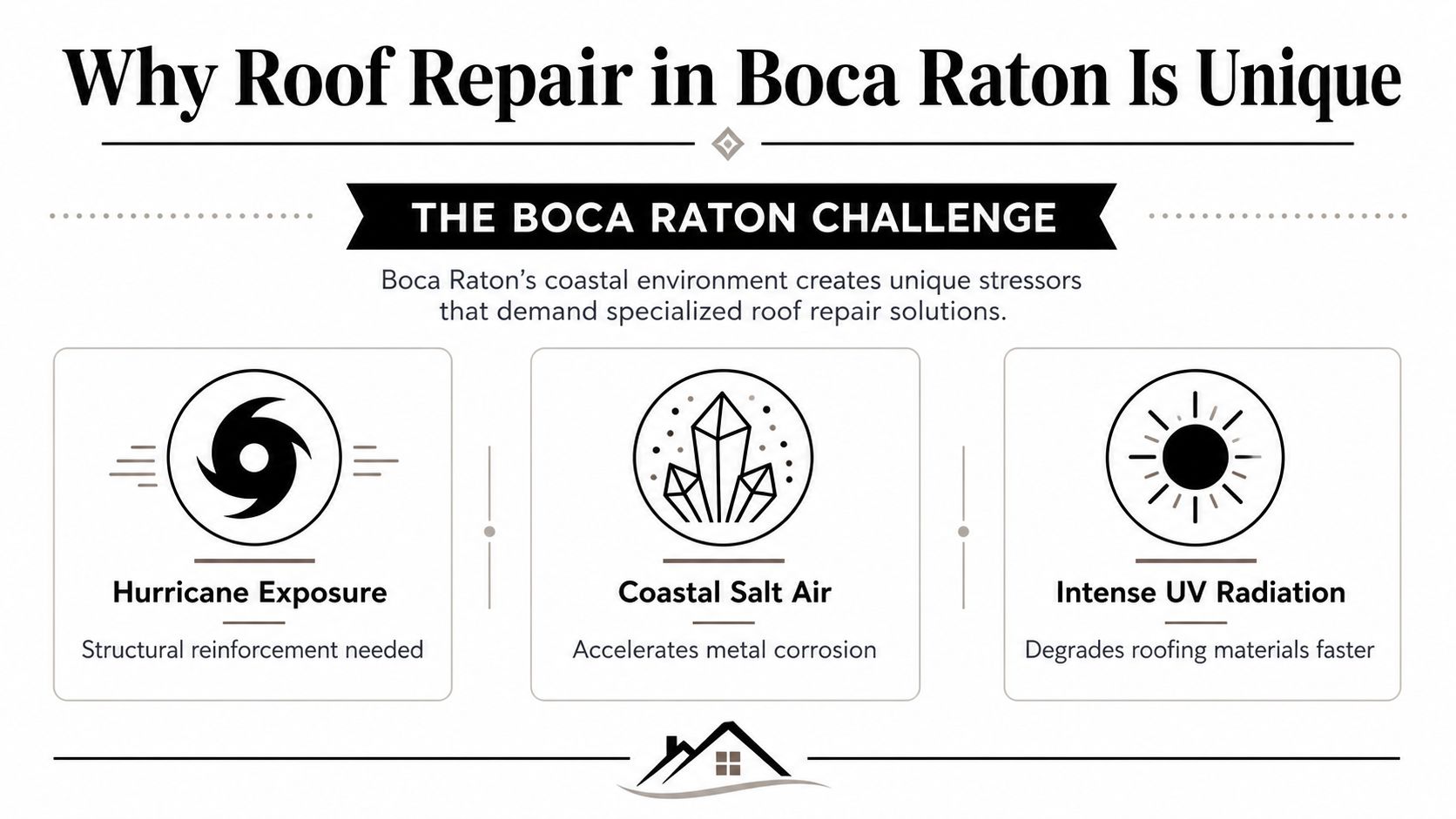
The local environment pushes roofs hard from three directions at once. Hurricane exposure drives uplift and edge failure, coastal salt air attacks metal parts, and intense UV radiation dries out boots, sealants, and surface materials faster than homeowners expect. The city's permit package also reflects that reality, because Boca Raton wants wind-design details tied to ASCE 7-22 and Florida code, including uplift pressures, attachment schedules, product approvals, and roof-sketch identification of pressure zones, parapets, expansion joints, and skylight pressures, all of which matter most at edges, corners, and penetrations (Boca Raton roof supplemental package).
Here's the part many homeowners miss. A leak in the ceiling doesn't always mean the surface material failed first. In South Florida, water often finds its way in through flashings, pipe boots, valleys, and membrane seams, and older roofs can hide damage for months before the stain shows up indoors.
A homeowner can usually do a first-pass check from the ground, then in the attic, before calling for help. Missing or cracked shingles, displaced tiles, rusted flashing, granules in gutters, soft spots on a flat roof, ceiling stains, peeling paint near soffits, and a musty attic smell all point to different failure modes. A few broken tiles can be a repair. Rot, repeated leaks, or signs that the waterproof layer is failing can push the work into a much deeper scope.
Practical rule: if the problem is visible only on the surface, the repair may stay localized. If the stain, odor, or soft spot suggests hidden moisture, the scope is probably bigger than the roof covering you can see.
A roof older than 15 years deserves a professional inspection after a named storm, even if nothing obvious is missing. That's especially true when you're trying to decide whether to call soon or call today. Active dripping, a new ceiling stain, or obvious wind damage means call today. A loose tile, rust streak, or small flashing gap means call soon, because waiting lets water reach the layers that cost more to open up and dry out.
What to Do in the First 24 Hours After a Leak or Storm
The first mistake is panic. The second is climbing onto a wet tile roof with a bucket and a tube of sealant. That usually makes the damage worse, and it can turn a repair into a safety problem. Shut off electricity to affected rooms if water is near fixtures, move valuables, and catch the drip before it reaches flooring or insulation.
Document first, clean up second
Take timestamped photos before you move too much. Get wide shots of the room, close-ups of the stain or drip, and a few pictures of the exterior if the damage is safely visible from the ground. Write down when you noticed the leak, which room it affected, and whether the rain was driven by wind.
A proper emergency visit should do more than slap on tarps. A roofer should provide temporary dry-in, moisture assessment, and a written scope that says what was damaged and what needs follow-up work. Household sealants are a bad idea because they can interfere with later repairs and may complicate warranty discussions.
The simplest rule is this.
Keep the receipts and the photos.
For storm response, a temporary tarp setup is often the right bridge until permanent work can begin, especially if the roof needs a permit-backed repair. If you're also evaluating financing on a property that needs broader renovation work, financing a fixer-upper property can be useful context for understanding how repair scope and lending sometimes interact. That's not a roofing fix, but it does matter when the roof is part of a larger purchase or rehab plan.
How Much Roof Repair Costs in Boca Raton
Boca Raton pricing usually tracks the amount of hidden work, not just the obvious surface damage. A minor leak diagnosis and repair often runs about $500-$1,000. Individual tile replacement can run $75-$150 per tile installed, while major section work such as multiple roof-plane repairs can reach $6,000-$15,000. A 2025 Boca Raton cost report also estimated an average roof repair of $1,376.75 for a 217-square-foot example, or $6.89 per square foot, which shows how fast costs rise when the job reaches underlayment, decking, or flashing instead of a simple surface patch (Boca Raton roof repair cost guide).
What pushes a repair higher
The bill jumps when the roofer opens the assembly and finds wet sheathing, rotten decking, or damaged metal work. That's because the labor becomes a remove, dry, replace, and reassemble job, not a quick fix. On South Florida tile homes, a targeted repair may land in the $2,500-$8,000 range, while a complete roof replacement on a typical 2,400-square-foot concrete-tile home can run $38,000-$65,000. Broader Boca Raton roofing market data also places average replacement costs at $18,810, with labor alone around $7,524 (Modernize Boca Raton roofing market data).
That gap is why repair-first decisions are common, but not always smart. One contractor marketplace notes that repairs become less economical when damage affects more than 25% of the roof or when the roof is older than 20 years (Modernize Boca Raton roofing market data).
If you're weighing the cost against a broader home project, a roof repair can be easier to absorb than a full replacement, especially when the leak is localized and the rest of the system is sound. A homeowner who's trying to stabilize a property before resale or refinancing should think in terms of scope control, not just the cheapest invoice.
If damage is spreading across planes, valleys, or multiple penetrations, the repair is no longer a patch decision. It's a replacement decision in stages.
Repairing Shingle, Tile, Metal, and Flat Roofs
The right repair depends on the roof system, because each one fails differently. A shingle roof tends to show wind-creased tabs, nail pops, and vulnerable valley flashing. A tile roof can fool the eye, because the tile itself may be intact while the underlayment beneath it has already failed. Metal roofs usually fail at fasteners, seams, and edge details. Flat roofs are all about drainage, membrane continuity, and ponding water.
What actually gets fixed on each system
On an asphalt shingle roof, a good repair usually means re-securing lifted tabs, replacing compromised flashing, and checking the valley line where water moves fast. On concrete or clay tile, a few cracked tiles may only be the visible symptom. The repair often has to address the underlayment beneath those tiles, which is why a “simple tile swap” can be misleading.
Metal roofs need a different eye. Fastener gaskets dry out, seams loosen, and salt air accelerates corrosion on exposed metal. Standing seam and 5V crimp systems can also show oil-canning, which isn't always a leak by itself, but it can signal stress, movement, or installation issues that need attention before fasteners back out further.
Flat and low-slope roofs, including modified bitumen, TPO, and PVC, reward any water that stays too long. Ponding water is the enemy, because it stresses seams and magnifies small defects. A membrane patch may solve the leak, but drainage still has to be checked, or the same area may fail again.
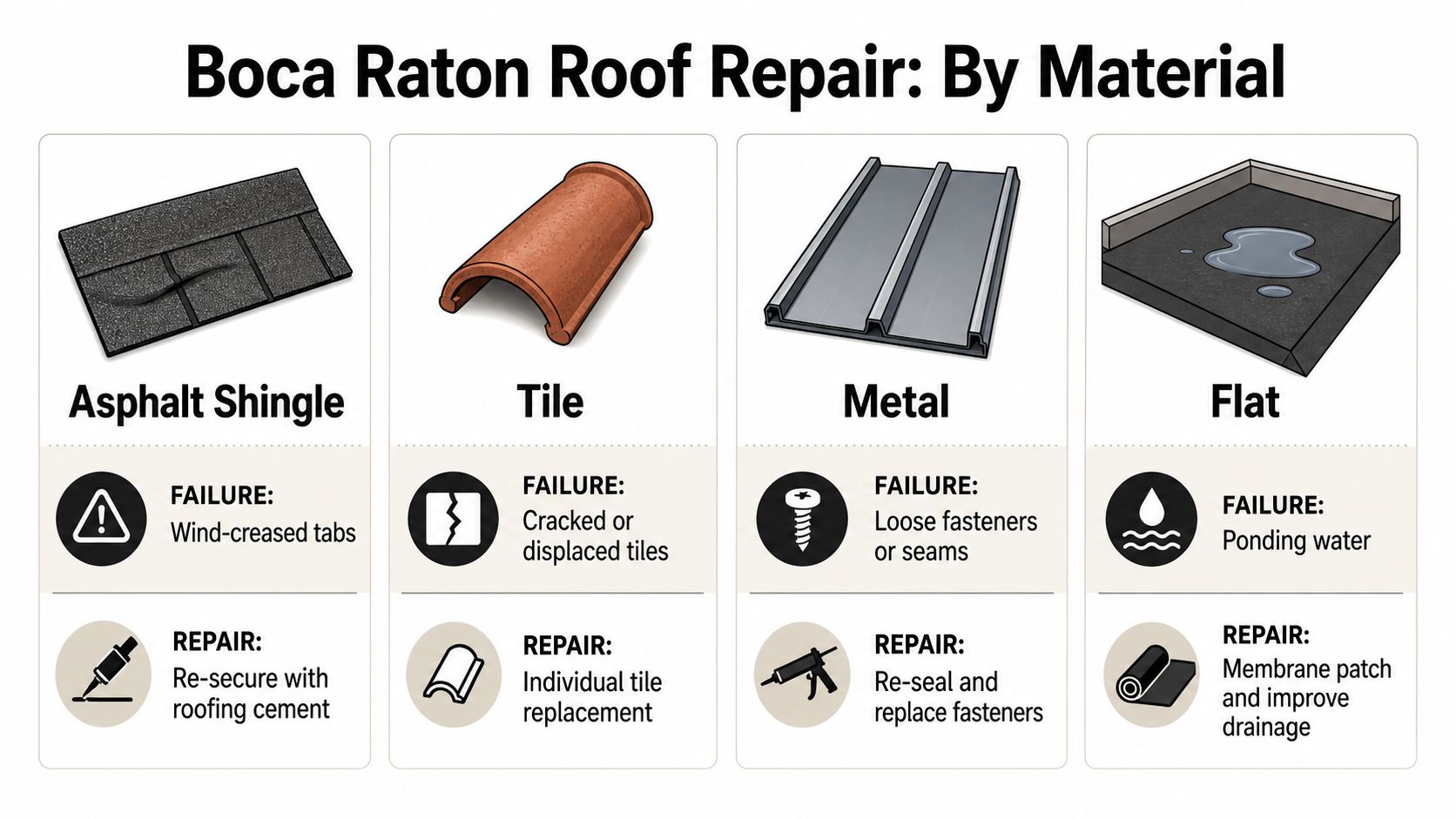
Repair logic: match the fix to the system. On tile, don't stop at the tile. On metal, don't ignore the fasteners. On flat roofs, don't patch the membrane without checking the slope.
Boca Raton code matters here too, because a repair that crosses into re-roofing territory can trigger secondary-water-barrier requirements. That's why the material choice is only half the conversation. The repair has to work in the actual assembly, not just on the visible surface.
Boca Raton Permits and Building Code Essentials
The city's permit rules set the boundary between a small repair and a regulated job. Boca Raton exempts alteration, replacement, or repair work to a 1- and 2-family dwelling only if the value is less than $1,000 within any 12-month period, the work is done by a qualified owner-builder or properly licensed contractor, and it does not adversely affect wind-load protection, structural components, fire protection, egress, electrical systems, solar systems, accessibility, energy efficiency, sound transmission, or zoning setbacks (Boca Raton work-exempt code). In real life, many roof repairs cross that line quickly.
When the paperwork starts
Boca Raton also requires contractors to be registered and up to date to pull permits, and a certified Notice of Commencement is required on building permits with a value greater than $5,000. For single-family re-roof OTC permits, the city's checklist says the total balance is due at submittal (Boca Raton re-roof OTC checklist). That means the job doesn't move forward as a handshake deal. It moves forward as a permit-and-payment workflow.
The code side gets more technical when roof covering is removed and replaced. Boca's mitigation package specifies a secondary-water-barrier approach using either a full self-adhered ASTM D1970 membrane, a 3 3/4-inch self-adhering flashing strip at joints, or two layers of specified felt underlayment (Boca Raton re-roof mitigation package). If the scope reaches re-roofing, the moisture-defense layer has to be upgraded. You're not just replacing visible shingles or tile. You're rebuilding the weather barrier under them.
If a contractor is acting like a permit is optional when the scope clearly needs one, that's a red flag.
Insurance is the other side of the paperwork. Citizens insurance can require a Roof Condition Certification or proof of replacement for homes over certain ages. The age thresholds noted in local inspection guidance are over 25 years for shingle roofs, over 50 years for any other roof type, and mobile homes over 25 years old (Boca Raton roof inspection and certification guidance). Acceptable proof can include a completed roofing contract or an inspection by a licensed roofing contractor using the cited Citizens form.
Before an adjuster visits, gather the photos, repair invoices, the contractor's report, the roof age if you know it, and any previous inspection paperwork. A clean packet helps the conversation stay focused on damage and compliance instead of missing documents.
How to Choose the Right Boca Raton Roofing Contractor
A solid contractor in Boca Raton should do more than quote a price. Start with license verification, insurance, and local references, then ask whether the company is registered with the city to pull permits. That one detail separates a roofer who understands local workflow from one who hopes the job never gets examined too closely.
What a real estimate should include
A proper roof estimate should name the roof system, the damaged areas, and the repair scope in plain English. It should also itemize decking, flashing, underlayment, ventilation, and any code-related upgrades instead of hiding everything in one line. If the contractor doesn't want to inspect the attic, check for moisture, or photograph the problem areas, the estimate is too thin for a Boca Raton roof.
Look for someone who can explain how the secondary-water-barrier rules and wind-design requirements affect the work. If the repair is small, they should tell you why it stays a repair. If the scope has tipped into re-roof territory, they should say so before the ladder goes up and the bill expands.
A local crew with long South Florida experience usually handles that transition more cleanly. Paletz Roofing and Inspections is one example of a contractor that works across Broward, Miami-Dade, and Palm Beach counties and provides roof repair, inspections, and re-roofing on shingle, tile, metal, and flat systems. That kind of regional familiarity matters when permits, weather, and insurance documentation all intersect.
For homeowners who need someone to answer the phone quickly during a leak or storm event, 24/7 roofing lead capture is relevant as an operational tool, especially when emergency calls come in after hours. The point isn't marketing. It's making sure a real person can collect the right information before water spreads.
Repair Timelines and Year-Round Maintenance
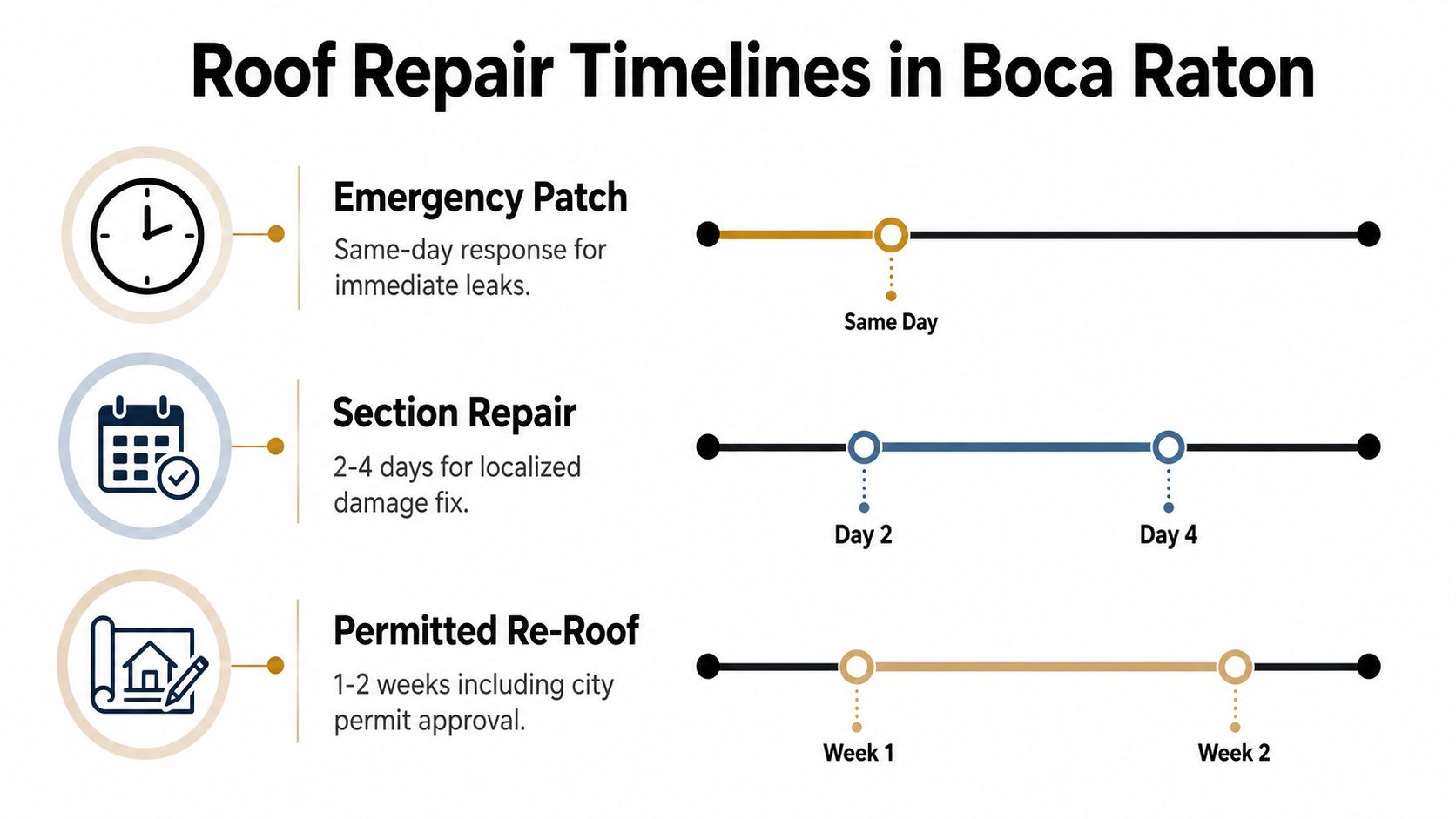
A same-day patch and a permitted roof segment don't move on the same clock. Emergency dry-in work can often happen the day you call, while a localized section repair may take a few days once materials and scheduling line up. A permit-driven re-roof segment can stretch longer because the paperwork has to clear before the final work can begin.
Maintenance that prevents emergency calls
A Boca Raton roof lasts longer when it gets small checks before the weather tests it. A late-spring inspection before hurricane season catches weak flashing, loosened tiles, and drying sealant. A post-storm walk-around after any named system catches new damage early. A fall check after the wettest months shows whether the roof held up under repeated rain. A light winter inspection helps before cold fronts drive wind-driven rain sideways.
The homeowner side stays simple.
- Clear the gutters: standing water around the edge line can turn a minor issue into a bigger one.
- Trim overhanging limbs: branches scrape materials and drop debris into valleys.
- Check pipe boots: UV exposure dries them out faster than expected.
- Watch for interior stains: a fresh stain is a warning, not a decoration.
For insurance follow-up, keep roof age records, repair photos, and any Citizens Roof Condition Certification paperwork together. That file becomes useful if a claim, inspection, or refinance question comes later. Good records don't just help after damage. They help prove the roof was being maintained.
Repair or Replace, How to Decide
The decision comes down to three things, roof age, how much of the roof is affected, and whether code issues are part of the problem. A younger roof with a localized flashing or valley failure is usually a repair. A roof older than 20 years with damage affecting more than 25% of the surface usually leans toward replacement, even if the visible damage looks minor (Modernize Boca Raton roofing market data).
A simple decision frame
Start with age. If the roof is relatively young and the leak is isolated, repair-first usually makes sense. If the roof is older and the leaks are showing up in more than one area, you're probably looking at a broader system problem.
Then look at spread. One valley, one pipe boot, one flashing line. That's a repair conversation. Multiple planes, repeated stains, or damage that crosses into underlayment replacement starts to sound like re-roof work. The code question matters too, because once the scope reaches replacement territory, the secondary-water-barrier requirements in Boca Raton come into play (Boca Raton re-roof mitigation package).
The insurance side should stay in the same conversation. Citizens age thresholds, Roof Condition Certification forms, and roof documentation can affect whether a roof is repaired, inspected, or flagged for additional proof (Boca Raton roof inspection and certification guidance). That's why homeowners should think about the roof as both a building component and a documentation file.
If you're still deciding how to fund a bigger scope, roof replacement financing options can help frame the difference between a short repair cycle and a planned replacement budget.

The habits that prevent most emergencies are plain enough. Inspect yearly, walk the roofline after storms, and check the attic during heavy rain. If you're seeing an active leak, visible storm damage, or a roof that's past the age where repairs stop making sense, stop monitoring and call a contractor this week. Use a licensed, insured, code-fluent local roofer, insist on a written scope, and make sure permits are pulled whenever the work requires them.
Paletz Roofing and Inspections handles roof repair, inspections, and replacements across South Florida, including the kind of Boca Raton leak diagnosis and code-aware repair work described here. If your roof has a stain, a storm hit, or you need a written scope before the next step, visit Paletz Roofing and Inspections and schedule a local inspection with a team that works these roofs every day.