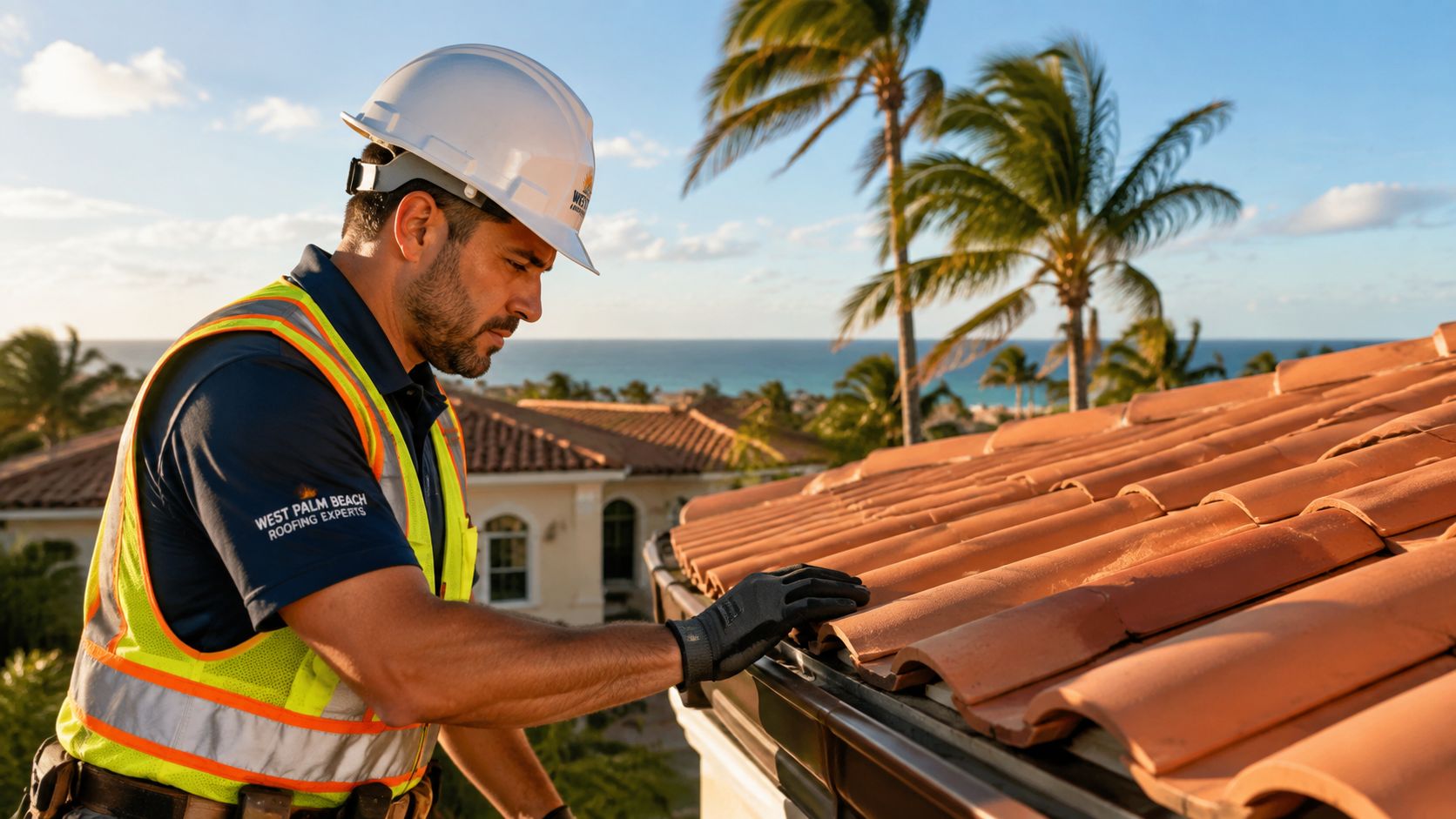
A roof leak in West Palm Beach usually shows up at the worst possible time, after a hard rain, a windy afternoon, or when the attic suddenly smells damp. In this market, a small stain on the ceiling can turn into a real problem fast, because the roof is doing more than keeping water out. It's protecting the structure, the interior finishes, and everything you've invested in the property.
That's why choosing a roofing company West Palm Beach homeowners can verify matters so much. South Florida has a deep roofing labor pool, with the Miami–Fort Lauderdale–West Palm Beach metro reporting 4,990 roofers in May 2023 and a location quotient of 2.06, which means roofing is more concentrated here than in the U.S. overall, according to the Bureau of Labor Statistics roofers data. For a homeowner, that says two things at once, there's real local expertise available, and there's also plenty of noise from companies trying to look local without proving it.
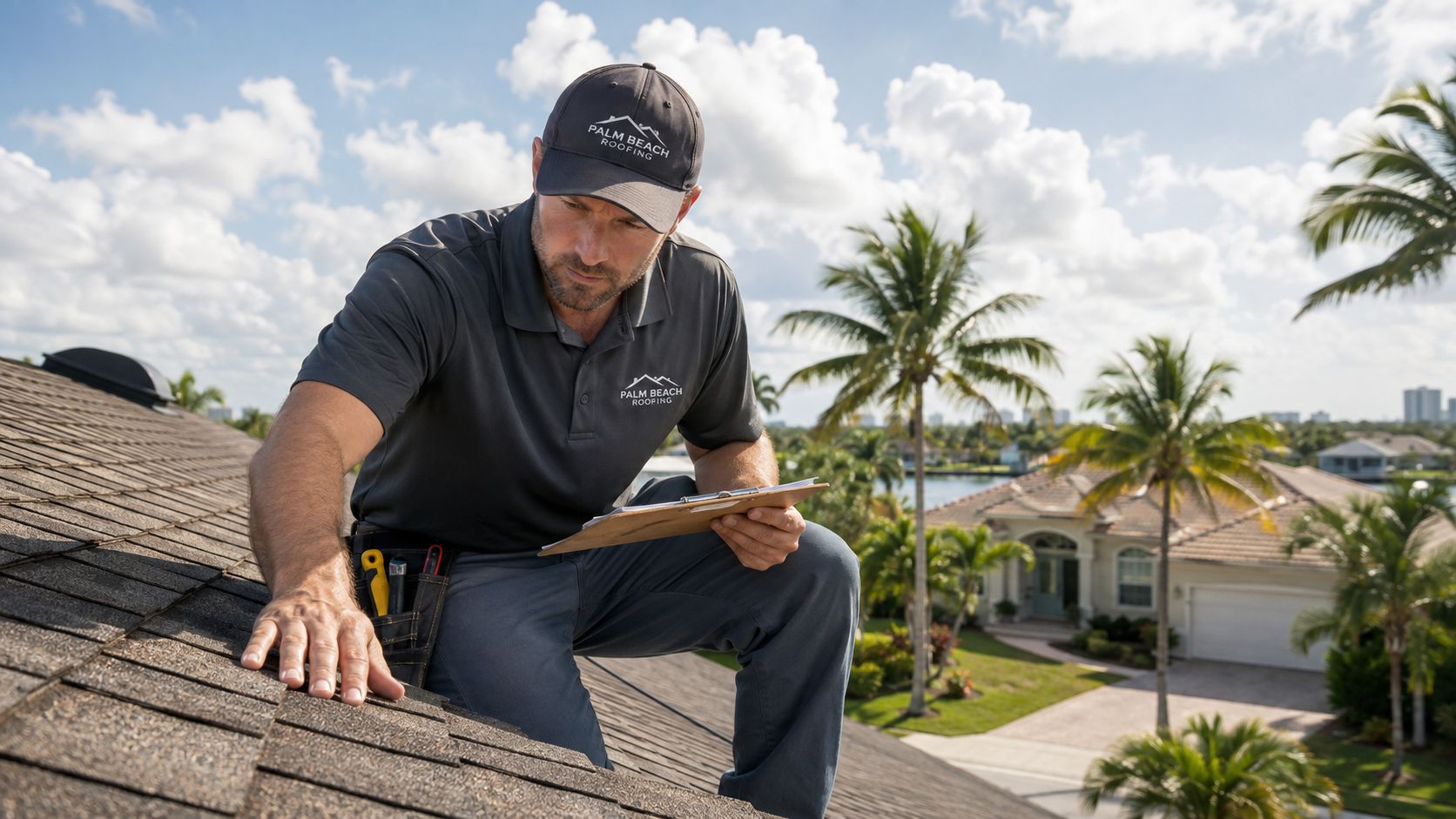
A solid contractor doesn't just sell shingles or tile, it understands how West Palm Beach roofs are built to handle weather, code requirements, and long-term maintenance. If you want a useful local marketing lens for your own search, the AI Tools for Local SEO construction guide is a practical reference for spotting the difference between polished visibility and genuine local presence.
Table of Contents
- Your Trusted Roofing Company in West Palm Beach
- Our Full Range of Roofing Services in Palm Beach County
- Selecting the Best Roof for West Palm Beach Weather
- Our Proven Process from Inspection to Installation
- Understanding Local Permits and Insurance Claims
- Verifying Your West Palm Beach Roofing Contractor
- Common Questions About Roofing in Our Area
Your Trusted Roofing Company in West Palm Beach
A homeowner in West Palm Beach usually makes the call after one of two moments. A storm pushes water into a place it should never reach, or the roof has taken so much sun that cracked sealant, lifted edges, or loose flashing finally show up. Either way, the right response is not panic. It is finding someone who understands how South Florida roofs fail and what to do next.
A true local roofing company in West Palm Beach that residents can rely on needs more than a truck and a logo. It should understand coastal weather, permit expectations, and how the whole roof assembly performs, not just the visible parts. Contractors like Paletz Roofing and Inspections fit naturally into that standard when they bring local familiarity, steady workmanship, and a process that treats the roof as the building's first line of defense.
Verification matters just as much as appearance. A homeowner should check Florida contractor records, confirm the company is licensed for the work being proposed, and look for proof that the roofer handles permits the right way. For roofers in this trade, the work is active and competitive, as shown in the BLS roofers profile, so documentation matters because it separates a real contractor from someone advertising the service.
Practical rule: in this area, judge a roof by how well it handles wind, water, and code compliance together, not by a brochure photo or a short promise.
The right contractor should be able to explain where the leak started, what failed first, and whether repair or replacement makes more sense. A homeowner who gets that kind of clear answer is in a better position before signing anything, especially near the coast where wind exposure and salt air punish weak systems.
Our Full Range of Roofing Services in Palm Beach County
Roofing needs in Palm Beach County don't all look the same. Some homes need a targeted leak repair, some are due for a full reroof, and others need a fresh inspection after a storm, sale, or insurance request. The service has to match the problem, or the homeowner ends up paying for work that doesn't solve the root issue.
New installations and replacements
A new installation makes sense on additions, new construction, or complete tear-offs where the existing system has reached the end of its useful life. A replacement is the better fit when recurring leaks, brittle materials, or widespread wear make patching inefficient. In South Florida, the roof should also be planned around the building's wind exposure and code requirements, not just style.
Repairs that target the actual failure point
Repair work is the right answer when damage is isolated. That might include a lifted shingle section, flashing failure around a penetration, a puncture from debris, or localized storm damage that doesn't justify a full replacement. Good repair work solves the entry point, then checks the surrounding area so the same leak doesn't come back through a neighboring seam.
Inspections that support smart decisions
A detailed roof inspection helps before a purchase, after a storm, or when a homeowner wants to know whether to repair or replace. It should identify visible wear, likely moisture paths, and any installation issues that could become larger failures later. In a market like West Palm Beach, inspection isn't just preventive care, it's a decision tool.
Residential and commercial needs
Residential roofs and commercial roofs fail in different ways, but both need documented attention. Homes usually need more help with leak tracing, material aging, and storm impact. Commercial properties often need careful evaluation of flat or low-slope conditions, drainage, and maintenance planning.
If you're comparing service options, a single contractor should be able to move between all of these without changing the conversation every time the roof type changes. That's a sign they understand the building, not just the sale.
Selecting the Best Roof for West Palm Beach Weather
West Palm Beach punishes roofs in ways that look simple from the street and complicated up close. Sun, humidity, salt air, and high winds all attack different parts of the assembly, which is why the material choice matters, but the installation details matter just as much. A roof here should be selected for real performance, not just appearance.
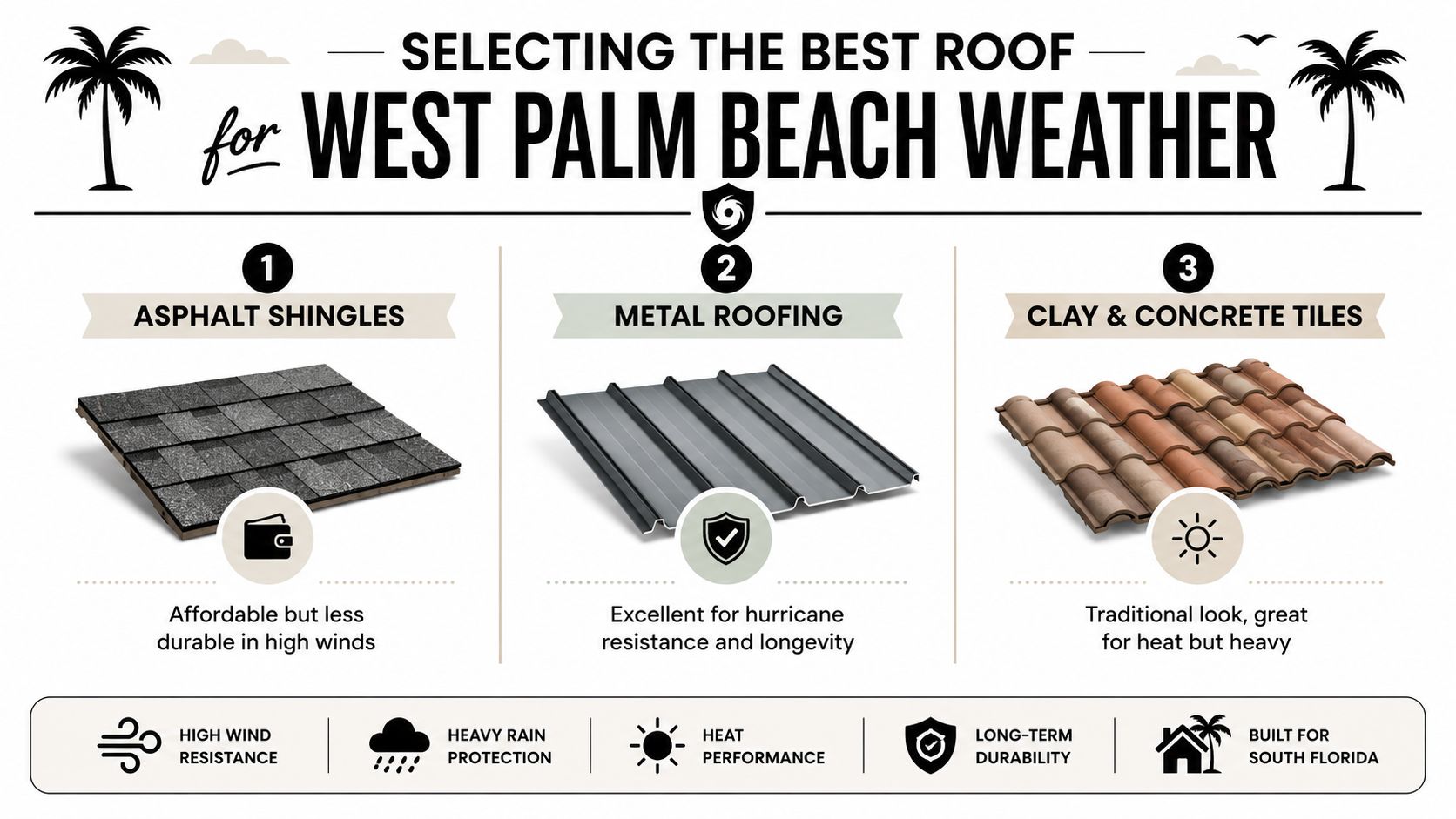
How the main systems compare
Asphalt shingles are common because they're familiar and often easier to budget for up front. They can work well when installed correctly, but they're generally less forgiving under repeated wind stress and heat exposure. In a storm-prone coastal zone, that makes installation quality and fastening pattern especially important.
Metal roofing is often favored for hurricane resistance and long service life. It can also shed water efficiently and handle strong weather well when the fastening schedule and edge details are engineered properly. The trade-off is that upfront cost and detailing quality matter more, because a poorly installed metal system can still fail at vulnerable points.
Clay and concrete tile bring a traditional South Florida look and handle heat well, but they're heavy and system-dependent. Underlayment, flashing, and fastening all need careful execution, because the tile itself is only one part of the defense. When a tile roof fails in a storm, the weak link is often the assembly beneath it.
Flat roofing systems are common on certain architectural styles and commercial buildings. They demand excellent drainage, seam integrity, and frequent inspection because standing water and hidden membrane issues can cause trouble before the damage becomes visible indoors.
| West Palm Beach Roofing Material Comparison | Average Lifespan | Storm Resistance | Initial Cost | Maintenance Needs |
|---|---|---|---|---|
| Asphalt Shingles | Varies by product and installation | Moderate, installation-sensitive | Typically lower upfront | Regular checks, more vulnerable to edge damage |
| Metal Roofing | Long-service system when installed well | Strong in wind-focused applications | Higher upfront | Lower routine maintenance, detail-sensitive |
| Clay and Concrete Tiles | Long-service system when assembled correctly | Strong when the full assembly is engineered | Higher upfront | Periodic inspection of underlayment and flashing |
| Flat Roofing Systems | Varies by membrane type | Depends heavily on drainage and seam quality | Project-specific | Frequent inspection and upkeep |
For technically demanding work, a common benchmark is Florida Product Approvals with wind-load engineering aligned to ASCE 7-22, and Miami-Dade NOA-approved components in higher-exposure zones, as noted in the West Palm Beach roofing guidance from Luxe Builder Group. That standard exists for a reason, because the roof has to work as one system, not a pile of separate parts.
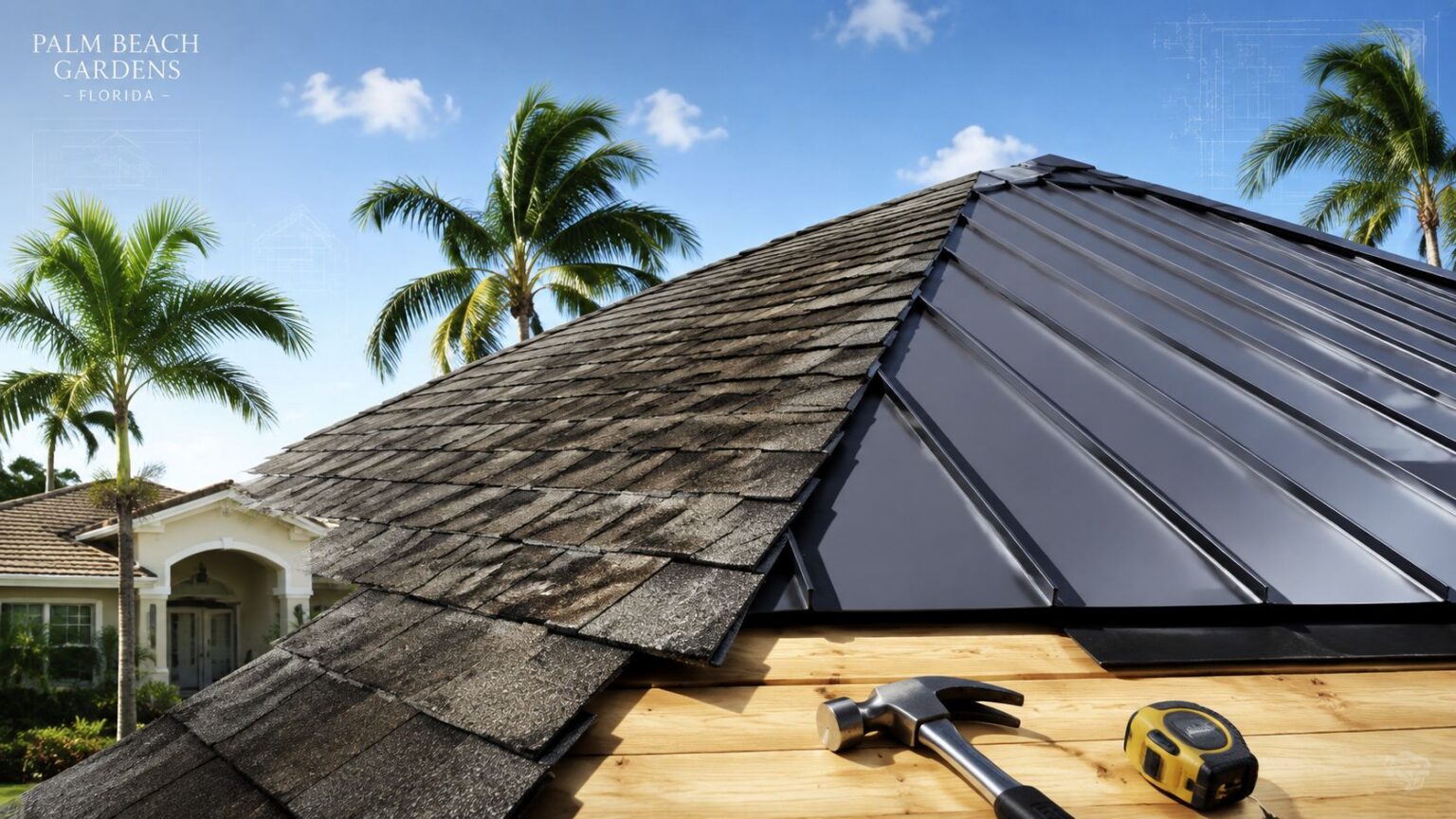
A useful image reference for that kind of project planning is this Palm Beach Gardens roof replacement example, which shows how material, slope, and installation details affect the final result.
Our Proven Process from Inspection to Installation
A homeowner should never have to guess what happens after they call a roofer. The process should feel organized, documented, and calm, because roofing work already brings enough stress on its own. Good contractors reduce uncertainty by making each step visible.
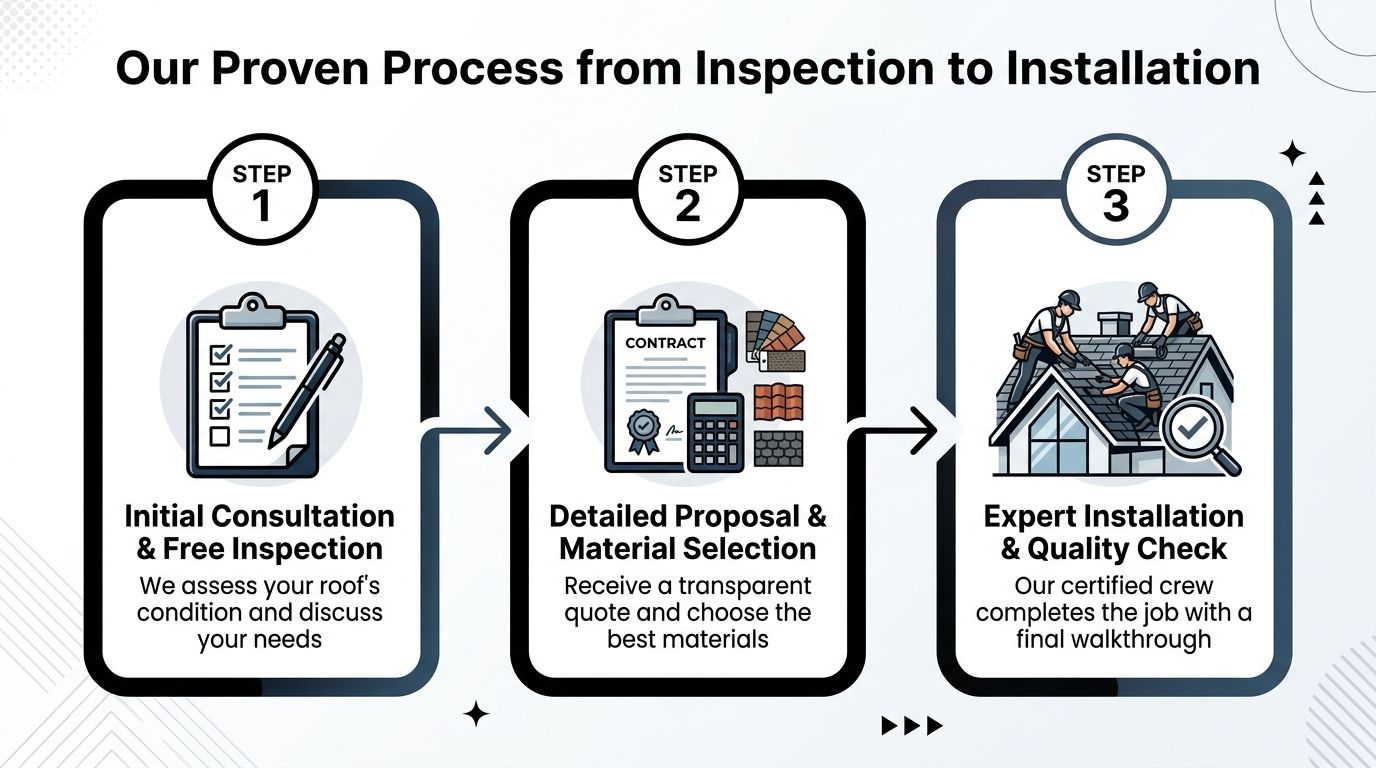
First contact and roof inspection
The first call should lead to a clear appointment, not a vague promise. During the inspection, a roofer should look at the visible roof surface, the flashing, edge conditions, penetrations, and signs of water entry inside the home where access is possible. If you want a smart way to evaluate that visit, the 8 key inspection questions resource is a helpful reminder to ask about access, scope, documentation, and what was checked.
Proposal and material selection
A good proposal doesn't just name a price. It explains what work is included, what materials are being used, and where the job could change if hidden damage appears after opening the roof. That's the point where the homeowner should compare repair versus replacement carefully, not emotionally.
Installation and final walkthrough
Once the job starts, site protection and cleanup should be part of the job, not an extra favor. Crews should keep the work area organized, control debris, and verify the finished roof before the last nail is driven and the truck leaves. If you want one example of a roof repair inspection point in a visual format, this roof inspector image shows the kind of attention detail-oriented work requires.
A roofing project should end with a homeowner who understands what was done, why it was done, and what to watch next.
That level of communication is what separates a managed project from a rushed one.
Understanding Local Permits and Insurance Claims
Roofing in West Palm Beach isn't just a construction job, it's a compliance job. Local submittal packages commonly require documentation of the roof type, roof slope, deck fastener spacing, and secondary water barrier, according to the West Palm Beach roof spec sheet. That tells you something important, the roof is evaluated as a system, and the paperwork has to match the way the system was built.
Why permits matter before the first shingle comes off
Permits aren't paperwork for the contractor's benefit. They help confirm that the roof design, fastening, and installation match local expectations for wind and water resistance. If those details aren't documented correctly, the homeowner can end up with a roof that looks finished but doesn't satisfy the underlying code path.
How claims and compliance fit together
Insurance carriers want evidence, not guesses. Clear photos, documented scope, and a roof that was installed or repaired to code make the claim conversation easier to support. That's especially important after storm damage, because a clean record helps distinguish wear from sudden loss.
A strong contractor should be able to translate roof findings into the language carriers and permit reviewers expect. That means noting what failed, what was repaired, what remains at risk, and whether the visible condition supports a larger claim review.
Why this matters to the homeowner
The practical result is simple. Better documentation can reduce confusion, speed up decisions, and prevent arguments over what was done versus what was needed. In a coastal market, that's not admin work, it's part of protecting the property value.
When the roof, permit file, and claim file all tell the same story, the homeowner is in a much stronger position.
Verifying Your West Palm Beach Roofing Contractor
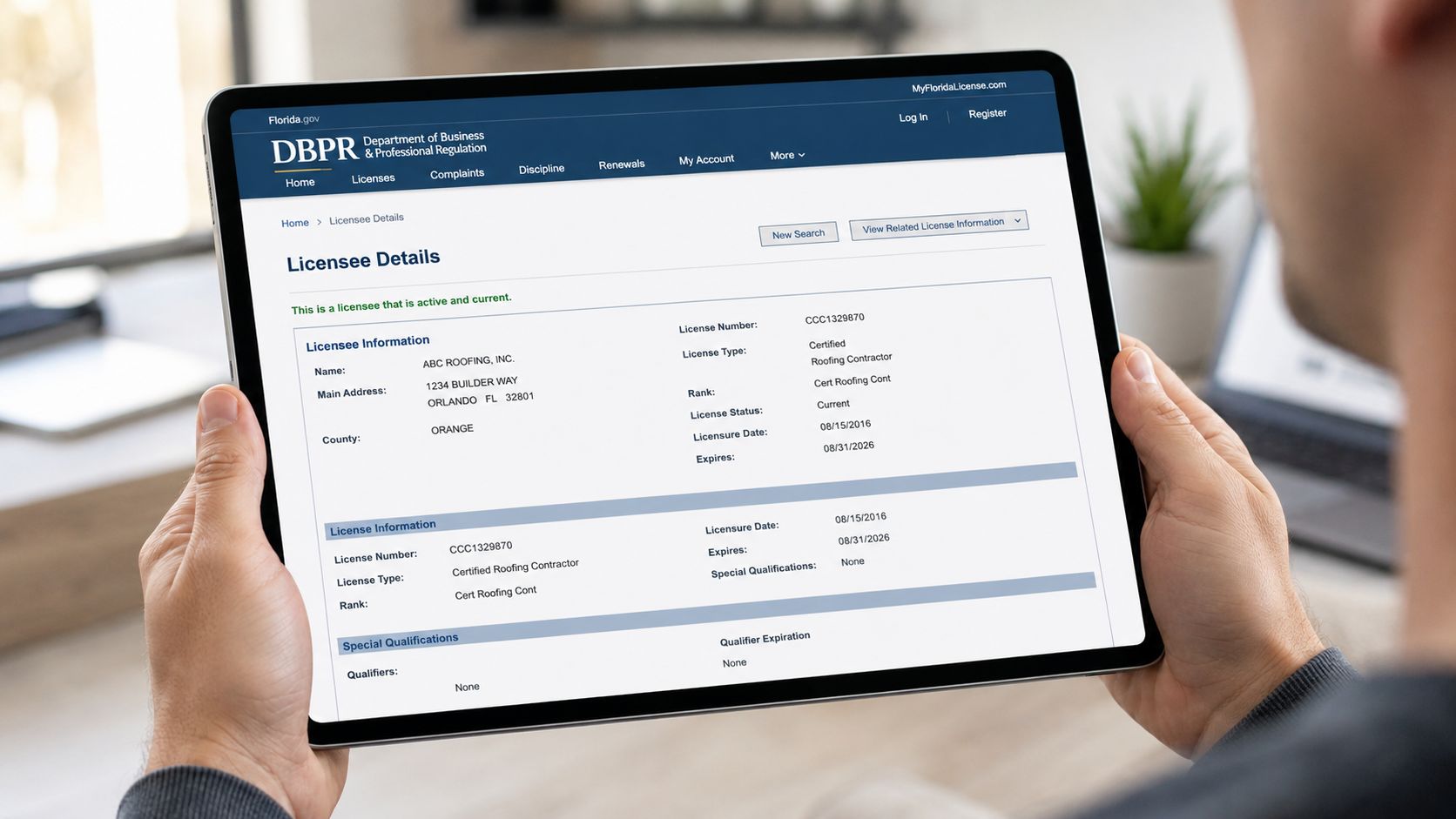
A polished website doesn't prove a company is established in your area. It only proves they know how to market themselves. The ultimate test is whether they can document a Florida license, project-specific insurance, and a permit history that matches the work they claim to do, which is exactly the gap highlighted in the Florida contractor question guide from Pitch Roofing.
What to check first
Start with the Florida DBPR record, then ask for proof of general liability and workers' compensation insurance tied to the actual project. Don't settle for a vague statement that they're covered. Ask for documents that name the business and cover the scope of work at your address.
Why local permit history matters
A company can say it serves West Palm Beach without having much verifiable work in the city. Permit history shows whether they've pulled permits and completed jobs in the area, which is a much better signal than a service-area claim on a website. It also helps separate an established local contractor from a storm-chaser who only appears after bad weather.
What homeowners should look for in practice
- License status: confirm the active Florida roofing license before you schedule a job.
- Insurance proof: request current certificates, not a verbal assurance.
- Permit activity: ask what jobs they've pulled in your municipality and how recent they are.
- Project match: make sure the company name on the proposal matches the name on the insurance and license documents.
Local presence is easier to claim than to prove. Public records tell you the difference.
That's the most reliable way to protect yourself before a deposit changes hands.
Common Questions About Roofing in Our Area
How do I know if I need repair or replacement
If the problem is isolated, a repair can make sense. If leaks keep returning, materials are brittle, or the system has broad wear, replacement is usually the more practical path. The right answer comes from an inspection, not a guess.
What should I ask about warranties
Ask what the material warranty covers, what the workmanship warranty covers, and what actions could void either one. Get the answer in writing before work starts, because warranty language matters most after there's a problem.
How often should a roof be inspected in Florida
More often than in milder climates, especially after severe weather or when the roof is aging. In South Florida, inspections are useful before hurricane season planning, after a storm, and before buying or selling a property.
Can financing help with a roof project
It can, if the payment structure fits your budget and the roof scope is clearly defined. For homeowners comparing payment options, this roof replacement financing overview is a helpful visual reminder to look at the full cost picture, not just the monthly number.

A roofing project should feel controlled, documented, and aligned with the way West Palm Beach homes age. If your roof is leaking, worn, or due for a checkup, schedule a professional inspection and ask for a clear scope before the next storm season puts more pressure on it.
Paletz Roofing and Inspections helps West Palm Beach homeowners with roof inspections, repairs, replacements, and system-specific guidance for coastal conditions. If you want a contractor who can review your roof, explain the permit and insurance side, and recommend a practical path forward, visit Paletz Roofing and Inspections to request an inspection and start the conversation.