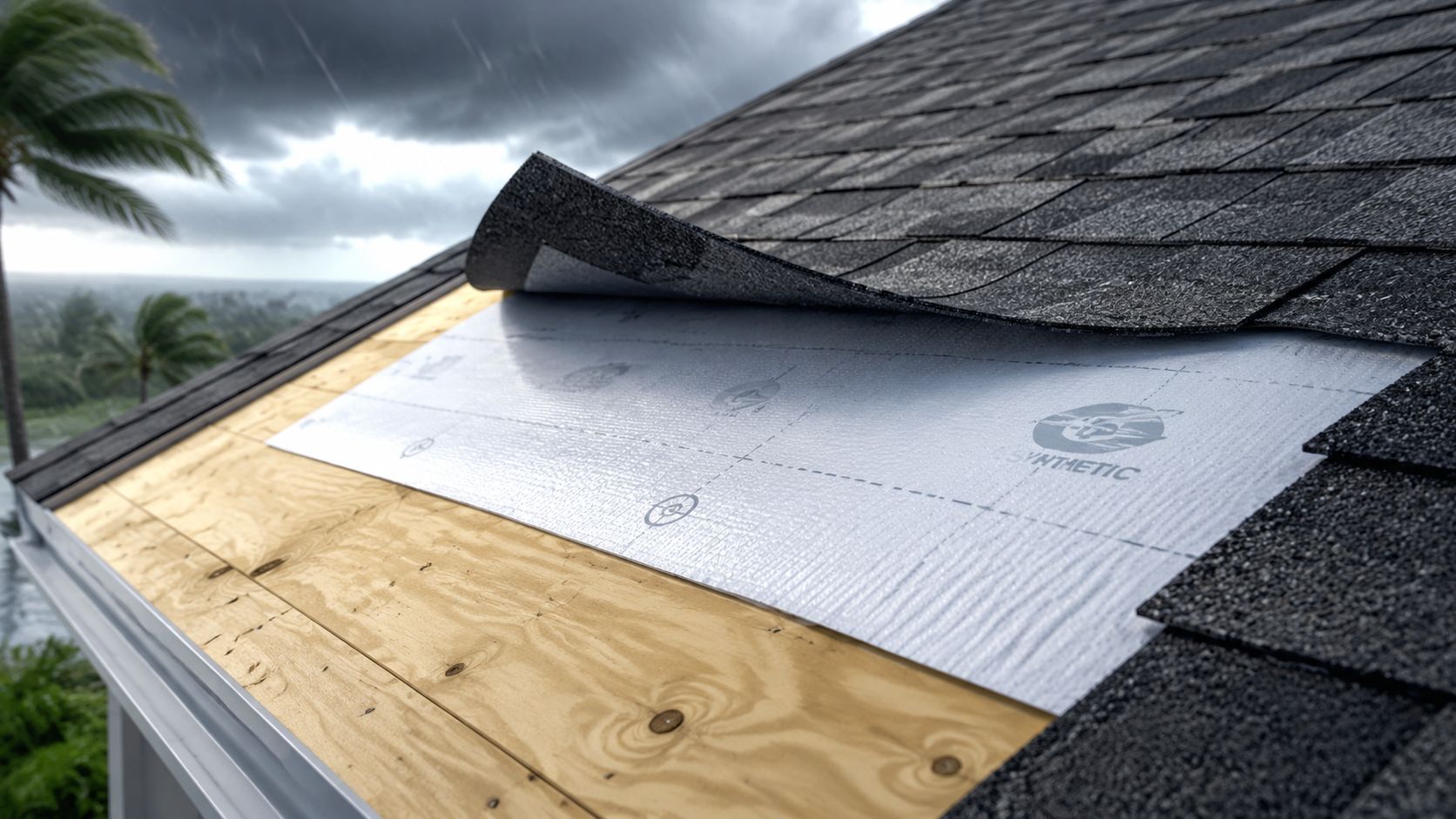
Roof underlayment is a secondary water-shedding layer installed between the roof deck and the shingles or tiles. On asphalt shingle roofs, the common code baseline is one layer at slopes of 4:12 and above, while slopes between 2:12 and 4:12 commonly require two layers, with the second lapped 19 inches over the first.
You may never see this material after a roof is finished, but it becomes important the moment a South Florida storm drives rain beneath a lifted shingle or around a loose tile. The outer covering takes the direct punishment from wind, sun, and rain. Underlayment catches water that gets past it and helps keep that water away from the wood deck, insulation, and rooms below.
That distinction matters because shingles and tiles are generally water-resistant roofing components, not a single, continuous waterproof sheet. The underlayment choice determines whether a small breach becomes controlled drainage or an interior leak. In Broward, Miami-Dade, and Palm Beach counties, intense heat, ultraviolet exposure, tropical rain, and high winds make that decision more consequential than a generic product comparison suggests.
Table of Contents
- The Hidden Layer That Protects Your Roof
- How Roof Underlayment Actually Works
- Comparing Felt Synthetic and Self-Adhered Underlayment
- Code Requirements and Installation Rules by Roof Slope
- Signs of Failure and When to Inspect
- Cost Ranges and Next Steps for South Florida Homeowners
The Hidden Layer That Protects Your Roof
A storm can expose the weakness in a roof within minutes. Wind lifts the edge of a shingle, rain travels sideways beneath it, and water reaches the fasteners, seams, or flashing around a vent. From the ground, the roof may still look mostly intact. Inside the attic, however, a damp patch can begin spreading across the deck.
The material beneath the visible roof covering is the roof underlayment, a secondary water-shedding layer installed directly over the roof deck and beneath shingles, tiles, or another primary covering. The International Residential Code framework treats it as part of the roof assembly, not as decorative padding. IRC underlayment provisions describe common requirements for felt, synthetic underlayment, and ice-barrier membranes.
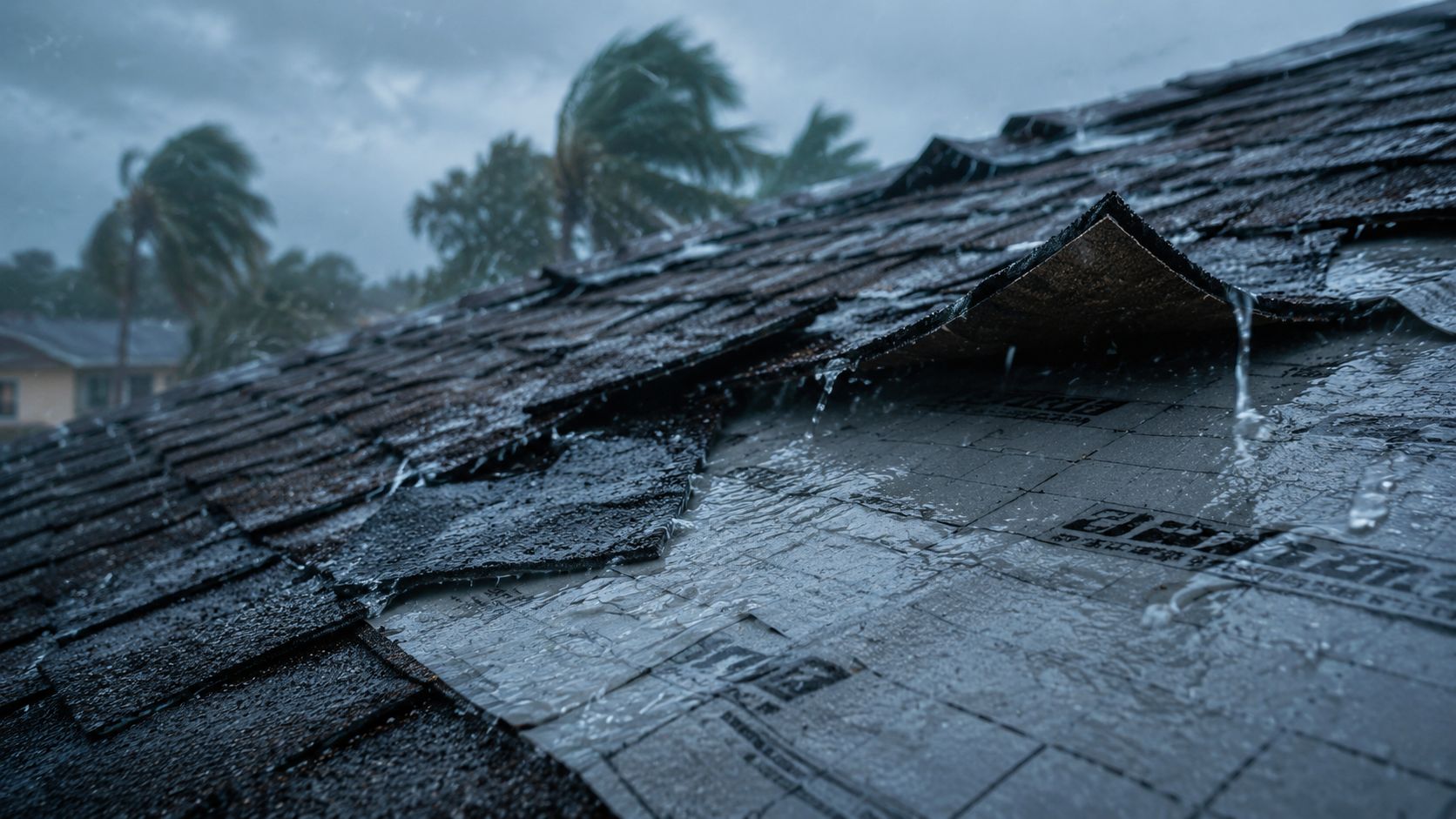
What the layer does
Underlayment gives a roof a backup drainage plane. If the outer material is compromised by wind uplift, aging, impact, or an installation defect, water should encounter the membrane and move down the roof instead of soaking the deck.
That protection has limits. Underlayment isn't a substitute for sound shingles, properly secured tiles, flashing, ventilation, or correct roof geometry. It also isn't automatically waterproof in every form. Traditional felt and many synthetic products are designed primarily to shed water, while self-adhered polymer-modified bitumen membranes provide a bonded, sealed interface in selected high-risk areas.
Practical rule: A roof covering keeps most weather out. Underlayment manages what gets through.
South Florida raises the stakes because wind-driven rain can approach from directions ordinary gravity drainage doesn't anticipate. Heat can also soften, wrinkle, or accelerate the deterioration of some materials when crews leave them exposed before installing the final covering. A roof that performs well in a mild climate may need different detailing at coastal eaves, valleys, penetrations, and low-slope sections.
The useful question isn't only, “Is there underlayment?” Ask what material was installed, where it was used, how it was fastened, and whether the product matches the slope and roof covering. Those details determine the roof's likely failure mode during the next hard rain.
How Roof Underlayment Actually Works
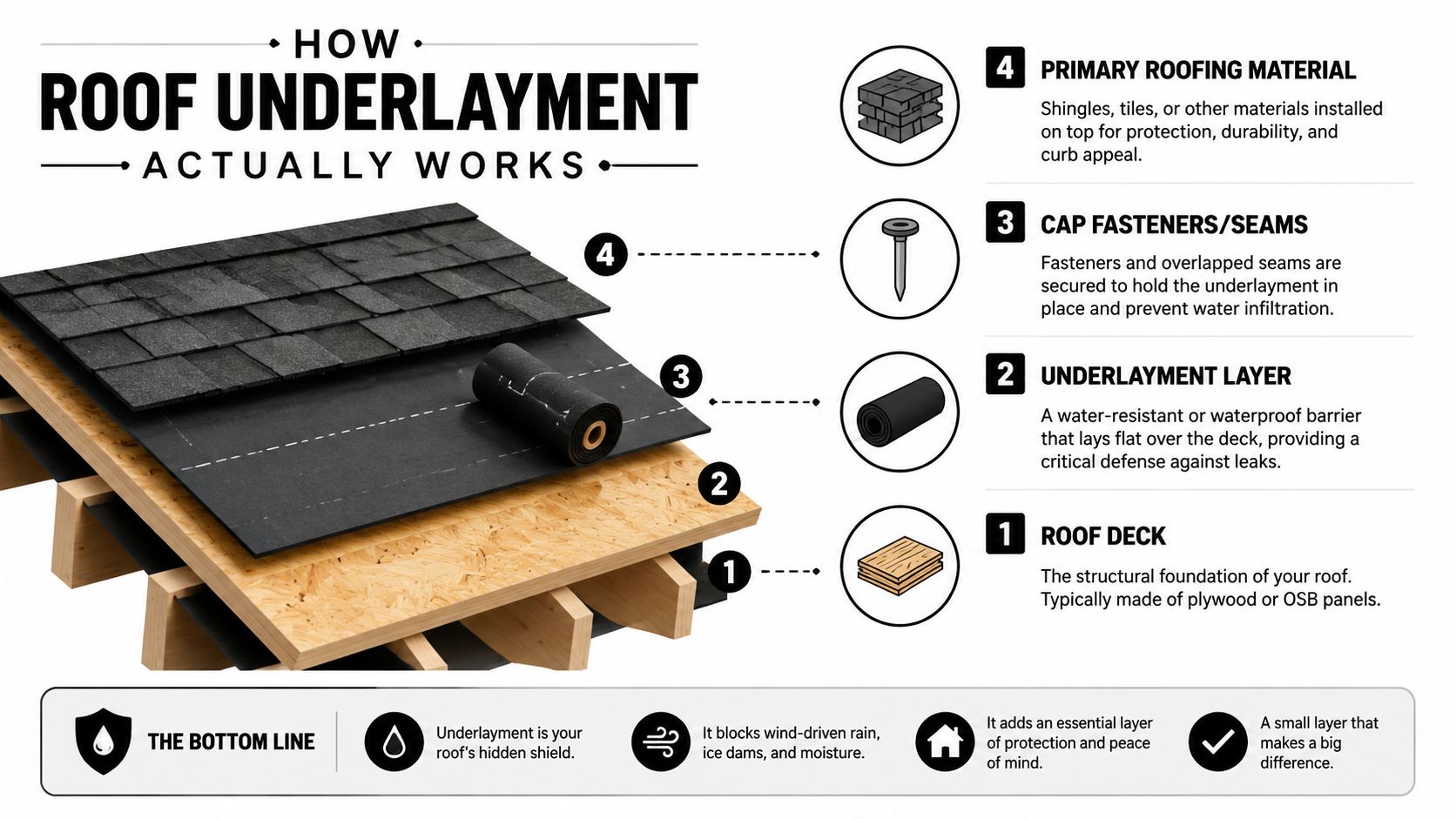
A finished roof works as a layered assembly. The roof deck, usually plywood or OSB, provides the structural base. Underlayment goes over that deck, and shingles, tiles, or another primary roof covering go above it. When water slips past the outer layer, the underlayment provides a surface that guides the water toward the eave rather than allowing it to enter the deck immediately.
The layer also helps manage pressure and moisture behind the cladding. Research on roof assemblies describes underlays as limiting water entry and functioning as an air-impermeable barrier behind tile or shingle coverings, which can reduce the pressure difference that drives rain through joints during wind events. Research and technical discussion of roof underlayment supports specifying the membrane as part of the complete assembly, not as an afterthought.
Three material families
Asphalt-saturated felt is the traditional option. ASTM D226 covers asphalt-saturated organic felt used in roofing and waterproofing, while ASTM D4869 addresses asphalt-saturated organic felt underlayment for steep-slope roofing. Industry references commonly identify ASTM D226 Type I as 15-pound felt and Type II as 30-pound felt. Asphalt Roofing Manufacturers Association guidance explains the standards and categories.
Felt is water-shedding and relatively breathable, but it can wrinkle in heat and tear during handling. In a South Florida reroof, a wrinkled sheet can create uneven support beneath shingles, while exposed felt can deteriorate before the covering is installed.
Synthetic underlayment uses polymer-based sheets that are generally lighter and more resistant to tearing than felt. It can be a practical choice when a crew needs a durable temporary surface over the deck during a reroofing job. Its performance still depends on the product's exposure limits, fasteners, laps, and compatibility with the roof covering.
Self-adhered membrane, often called ice and water shield, uses rubberized or polymer-modified bitumen that bonds to the deck. It can seal around fasteners and protect concentrated risk areas such as eaves, valleys, wall intersections, and penetrations. ASTM D1970 products intended for ice-dam protection have a noted minimum machine-direction tensile strength of 200 pounds per square inch in industry summaries. Technical ice-barrier guidance describes the material's role and performance requirements.
The membrane doesn't make poor installation acceptable. Crews still need a clean, dry deck, correct overlaps, compatible primers or sealants where required, and careful treatment around vents and transitions. Underlayment sheds water only when the installer preserves a continuous path downhill.
Comparing Felt Synthetic and Self-Adhered Underlayment
South Florida homeowners often hear that one underlayment is “better” than another. That answer is incomplete. The right choice depends on roof slope, exposure, installation timing, roof covering, and budget. A basic felt layer may satisfy a code minimum on one roof, while a self-adhered membrane is the sensible protection at a vulnerable valley or low-slope transition.
Felt remains useful for straightforward assemblies where the crew can install the covering promptly and protect the material from prolonged heat and ultraviolet exposure. Type I is commonly called 15-pound felt, and Type II is the heavier 30-pound felt, as summarized by roofing underlayment material guidance. The heavier designation doesn't eliminate the installation risks. Felt can wrinkle, tear around fasteners, and lose reliability when exposed longer than the roof plan allows.
Synthetic products typically offer a stronger balance for many reroofing projects. They handle job-site traffic better, resist tearing, and provide a more stable temporary covering than ordinary felt. They aren't impervious to wind or water, though. Poorly secured edges, open seams, and incompatible fasteners can still create pathways for rain.
Self-adhered membrane belongs in the high-risk conversation. At eaves, valleys, penetrations, and low-slope transitions, the bonded surface can reduce the chance that wind-driven rain will travel beneath the covering. In ice-dam-prone regions, code-based ice-barrier guidance calls for a self-adhering polymer-modified bitumen sheet or two cemented layers where the barrier is required. South Florida doesn't have the same ice-dam trigger, but the sealing principle remains relevant at concentrated leak zones.
| Factor | Felt (#15/#30) | Synthetic | Self-Adhered (Ice & Water Shield) |
|---|---|---|---|
| Main strength | Familiar, economical water shedding | Tear resistance and job-site durability | Bonded protection around vulnerable details |
| Heat and exposure concern | Can wrinkle or degrade when left exposed | Generally handles exposure better, subject to product limits | Can be sensitive to installation conditions and product requirements |
| South Florida fit | Simple, prompt-covering installations | Many shingle, tile, and reroofing assemblies | Eaves, valleys, penetrations, and low-slope transitions |
| Main limitation | More vulnerable to tearing and wrinkling | Still depends on mechanical fastening and seam treatment | Higher material cost and more demanding deck preparation |
| Selection question | Is the roof simple and will covering follow promptly? | Does the project need a tougher, lighter sheet? | Is this a concentrated water-entry risk? |
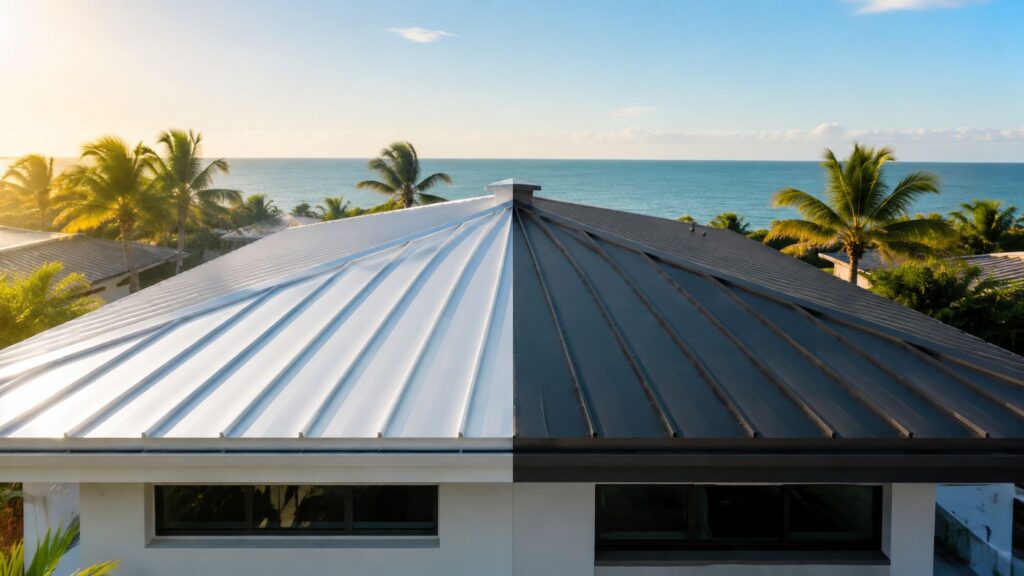
Florida Building Code requirements and Miami-Dade County product approvals can affect what a contractor is allowed to install, especially in the High Velocity Hurricane Zone. A product's label, approval documentation, and installation instructions matter more than a salesperson's shorthand description. If the roof includes metal, tile, or unusual transitions, confirm that the membrane is compatible with the covering and attachment system. A reference image such as this metal-roofing comparison may help explain why the underlayment conversation changes with the outer material.
Code Requirements and Installation Rules by Roof Slope
Roof slope changes how quickly water leaves the assembly, so it changes the underlayment requirement. The commonly cited IRC baseline for asphalt shingles is one layer of ASTM D226 Type I felt or ASTM D4869 Type I or II synthetic underlayment at slopes of 4:12 and above. For slopes from 2:12 up to 4:12, the baseline is two layers, with the second layer lapped 19 inches over the first. The 2024 IRC slope requirements provide the cited framework.
Start with the slope
A contractor should verify the slope before choosing the roll material. A low-slope section drains more slowly, so the laps and transitions face greater exposure to backed-up water. That doesn't mean every low-slope roof can use ordinary shingle underlayment. The primary covering must also be approved for the slope, and the entire assembly has to work together.
At steeper slopes, a single layer may satisfy the baseline, but wind uplift becomes a major installation concern in South Florida. The crew must follow the product's fastening pattern, keep sheets aligned, protect laps, and secure edges before the shingles or tiles go down.
Detail the vulnerable zones
Eaves, valleys, wall intersections, vents, skylights, and other penetrations deserve deliberate detailing. In cold regions where an ice barrier is required, the membrane must extend at least 24 inches inside the exterior wall line. Some provisions add a 36-inch along-slope extension at slopes of 8:12 and above. Those dimensions come from the cited ice-barrier update.
South Florida projects require attention to approved products and wind resistance rather than assuming a generic membrane will pass review. Inspectors may look for the specified material, proper laps, secure attachment, sealed penetrations, and installation that matches the approved roof system. A contractor who substitutes a cheaper roll without documenting compliance can create inspection, warranty, and leak problems.
Before signing: Ask for the exact underlayment product, approval information where applicable, roof-slope treatment, fastening method, and locations receiving self-adhered membrane.
Signs of Failure and When to Inspect
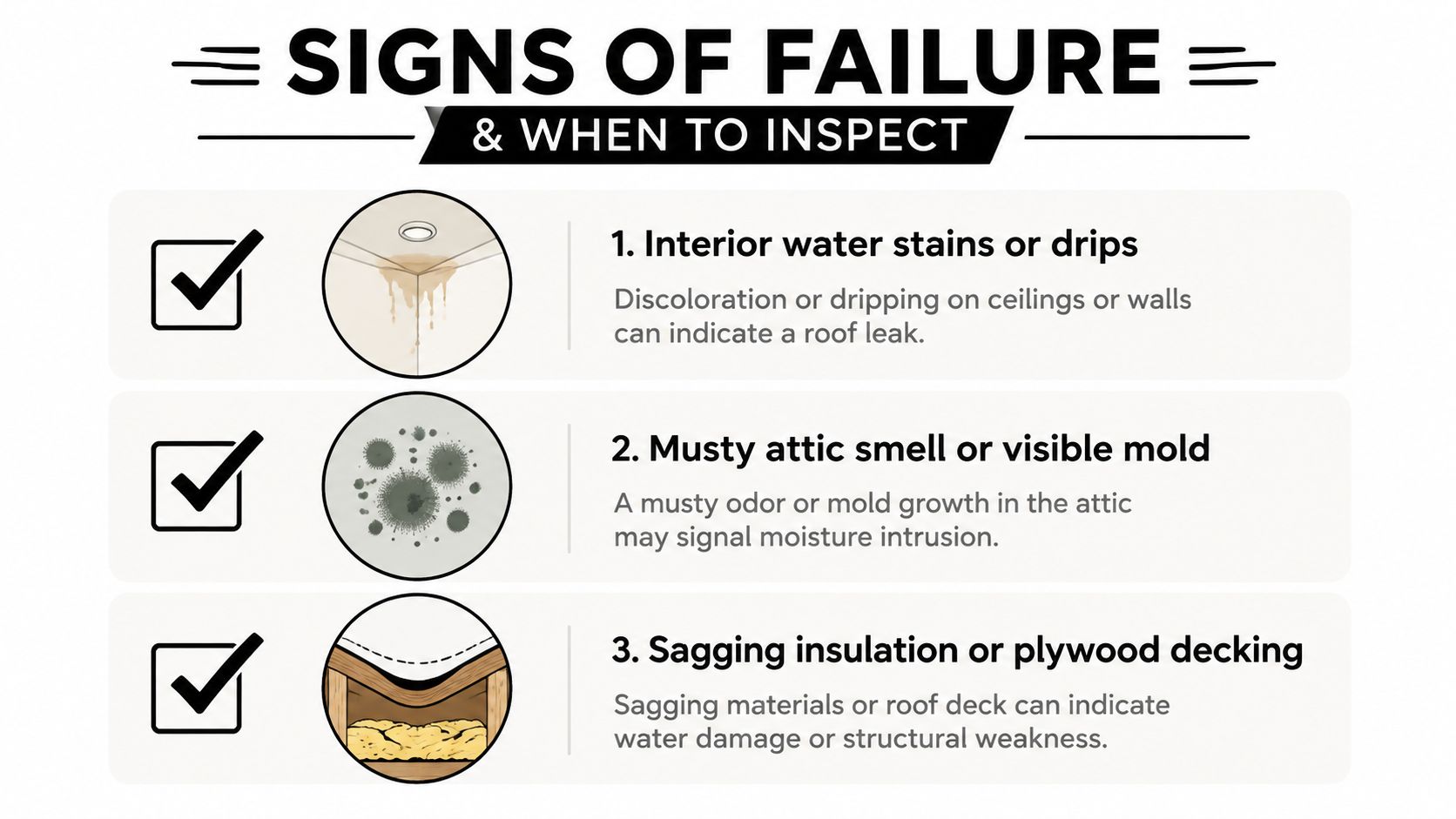
Underlayment failure often stays hidden until water reaches a visible part of the house. A ceiling stain after wind-driven rain may indicate a problem above it, but the entry point can be several feet away because water travels along decking, rafters, or fasteners before dripping.
Interior clues deserve prompt attention:
- Ceiling stains or drips: Record whether they appear after wind from a particular direction or after heavy rain.
- Musty attic odor: A persistent smell can point to trapped moisture even when the ceiling looks clean.
- Mold or damp wood: Darkened decking, wet rafters, or soft plywood require professional evaluation.
- Sagging insulation or deck areas: Deflection suggests moisture damage or a structural concern that shouldn't wait for another storm.
Exterior clues can be less obvious. Wavy or lifted shingles, concentrated granule loss, open seams, and sagging between rafters may signal water entry or movement in the roof assembly. A damaged outer covering doesn't prove that the underlayment has failed, but it tells you the backup layer may have been exposed to conditions it wasn't meant to manage indefinitely.
Use a sensible inspection routine
Schedule an inspection after a major storm, before hurricane season, or when planning a reroof. A professional can use moisture-meter readings, deck-softness testing, and thermal imaging to identify wet areas that a ground-level visual check won't reveal. A roof-inspection reference image illustrates the kind of assessment homeowners often need after weather damage.
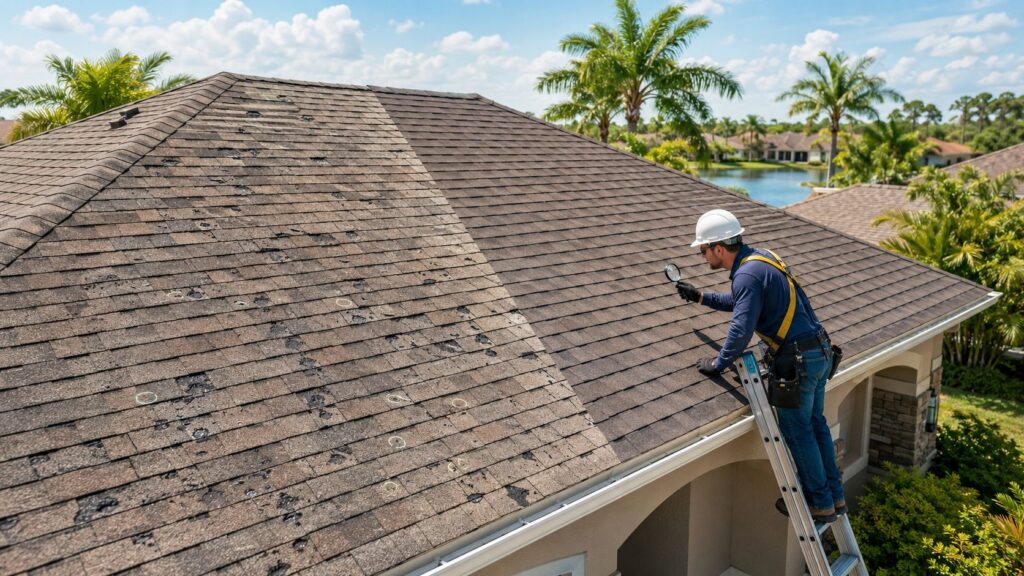
You generally can't inspect the membrane directly without removing sections of the roof covering. Don't lift shingles or disturb tiles yourself, especially on a roof with suspected moisture damage. A licensed contractor can open a controlled test area, inspect the deck and fasteners, and determine whether the issue is localized or part of a broader replacement need.
Cost Ranges and Next Steps for South Florida Homeowners
Material pricing varies with roof complexity, access, slope, covering, and whether the work is new construction or reroofing. The supplied South Florida planning ranges are $0.50 to $0.75 per square foot for felt, $0.75 to $1.25 for synthetic, and $1.50 to $3.00 installed for self-adhered ice and water shield. Those figures should be treated as planning ranges, not a quote, because labor, tear-off, deck repairs, permits, and detail work can change the final proposal.
| Underlayment Type | Material Cost per Sq Ft | Installed Cost per Sq Ft | Best Application |
|---|---|---|---|
| Felt | $0.50 to $0.75 | Varies by project | Straightforward, promptly covered roof sections |
| Synthetic | $0.75 to $1.25 | Varies by project | Durable general coverage and reroofing conditions |
| Self-adhered ice and water shield | Varies by product | $1.50 to $3.00 | Eaves, valleys, penetrations, and low-slope transitions |
Labor can represent 60% to 70% of underlayment expenses, according to the provided project guidance, so the cheapest roll won't necessarily produce the lowest installed cost. Preparation, careful layout, approved fastening, and flashing details determine whether the material performs. For contractors and property managers comparing scopes, Exayard roofing estimating software can help organize measurements and proposal details before bids are reviewed.
A practical decision starts with four questions:
- What is the slope? Low-slope sections need closer attention to drainage and laps.
- Where does rain concentrate? Eaves, valleys, penetrations, and complex transitions deserve stronger detailing.
- How exposed is the property? Coastal and open sites face more wind-driven rain.
- How long will you own the home? A more durable assembly can make sense when you plan to stay for years.
When a proposal only says “roof underlayment” without naming the product and installation method, ask for clarification. If you see stains, odor, soft decking, or storm-related damage, arrange an inspection before authorizing repairs. A roof-maintenance visual reference reinforces why routine observation matters, but it doesn't replace an on-roof evaluation.

Paletz Roofing and Inspections provides roof inspections, repairs, replacements, and underlayment installation for homes and commercial properties across Broward, Miami-Dade, and Palm Beach counties. Visit Paletz Roofing and Inspections to request an assessment and discuss an underlayment system suited to your roof slope, covering, and South Florida exposure.