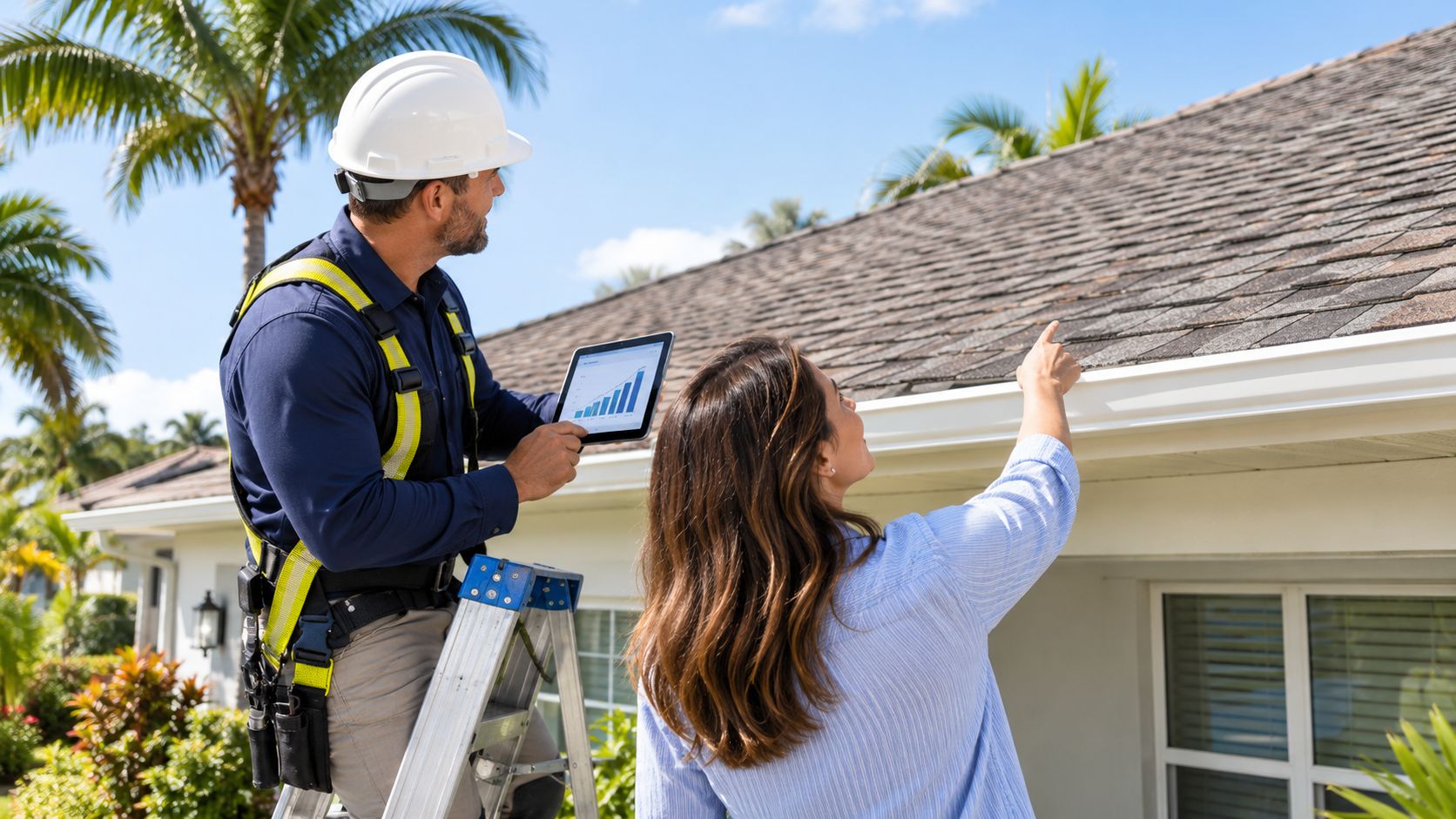
A roof inspection in South Florida typically costs $150 to $600, while the 2026 national average is about $247. The final price depends on roof size, pitch, material, access, documentation, and whether you need a physical, drone, infrared, or certification inspection.
That fee is easier to understand as hurricane-prevention math, not as another maintenance bill. A roof can look acceptable from the street while hiding lifted tile, failed flashing, wet decking, or fastener problems that become far more expensive after the next storm. In Broward, Miami-Dade, and Palm Beach, the useful question isn't only, “What does an inspection cost?” It's, “What risk does this inspection help me identify before wind and rain turn it into a claim, a closing delay, or a major repair?”
Table of Contents
- What Roof Inspection Cost Looks Like in South Florida Today
- The Factors That Move Roof Inspection Cost Up or Down
- Inspection Types and How Each One Changes the Price
- Residential vs Commercial Roof Inspection Cost
- Free Estimates vs Paid Independent Inspections
- What a Real South Florida Inspection Uncovers
- Smart Ways to Save on Roof Inspection Cost
- Making the Right Inspection Decision for Your Property
What Roof Inspection Cost Looks Like in South Florida Today
The 2026 national average roof inspection cost is $247, with a broad U.S. range of $75 to $1,000, according to Angi's 2026 roof inspection pricing guide. That same benchmark places standard physical inspections around $75 to $200, while attic inspections average $200 to $500.
South Florida pricing usually reflects more than the size of the house. Coastal exposure, high-wind requirements in the High-Velocity Hurricane Zone, difficult tile profiles, rooftop equipment, and post-storm demand can push a professional inspection toward the upper end of the local range. A straightforward single-family inspection may sit near the lower end, while a detailed inspection with photographs, moisture investigation, or insurance documentation costs more.
A second market benchmark places average roof inspection costs between $100 and $400, with a stated national average of $280. It places commercial inspections at $200 to $600, usually around $0.05 to $0.10 per square foot, and notes that complex jobs can reach $1,200. Those figures appear in HomeGuide's roof inspection cost data, and they reinforce a practical point: there isn't one universal inspection price.
Practical rule: Compare the inspection scope before comparing the fee. A low quote for a quick visual check isn't equivalent to a documented storm assessment with attic access and moisture testing.
| Region / Property | Typical Cost Range | Common Add-Ons |
|---|---|---|
| Broward or Palm Beach single-family home | $150 to $325 | Attic review, photographs, written findings |
| Miami-Dade tile or two-story home | $400 to $600 | Drone documentation, safety equipment, certification |
| South Florida commercial property | $200 to $600 | Per-square-foot pricing, parapet and equipment review |
| Complex or specialized inspection | Up to $1,000 or more | Infrared scanning, structural review, claim documentation |
A few hundred dollars spent before hurricane season can expose conditions that would otherwise remain invisible until water enters the building. The inspection doesn't prevent a storm, but it can identify the weak points that make storm damage harder to document and more expensive to address.
The Factors That Move Roof Inspection Cost Up or Down
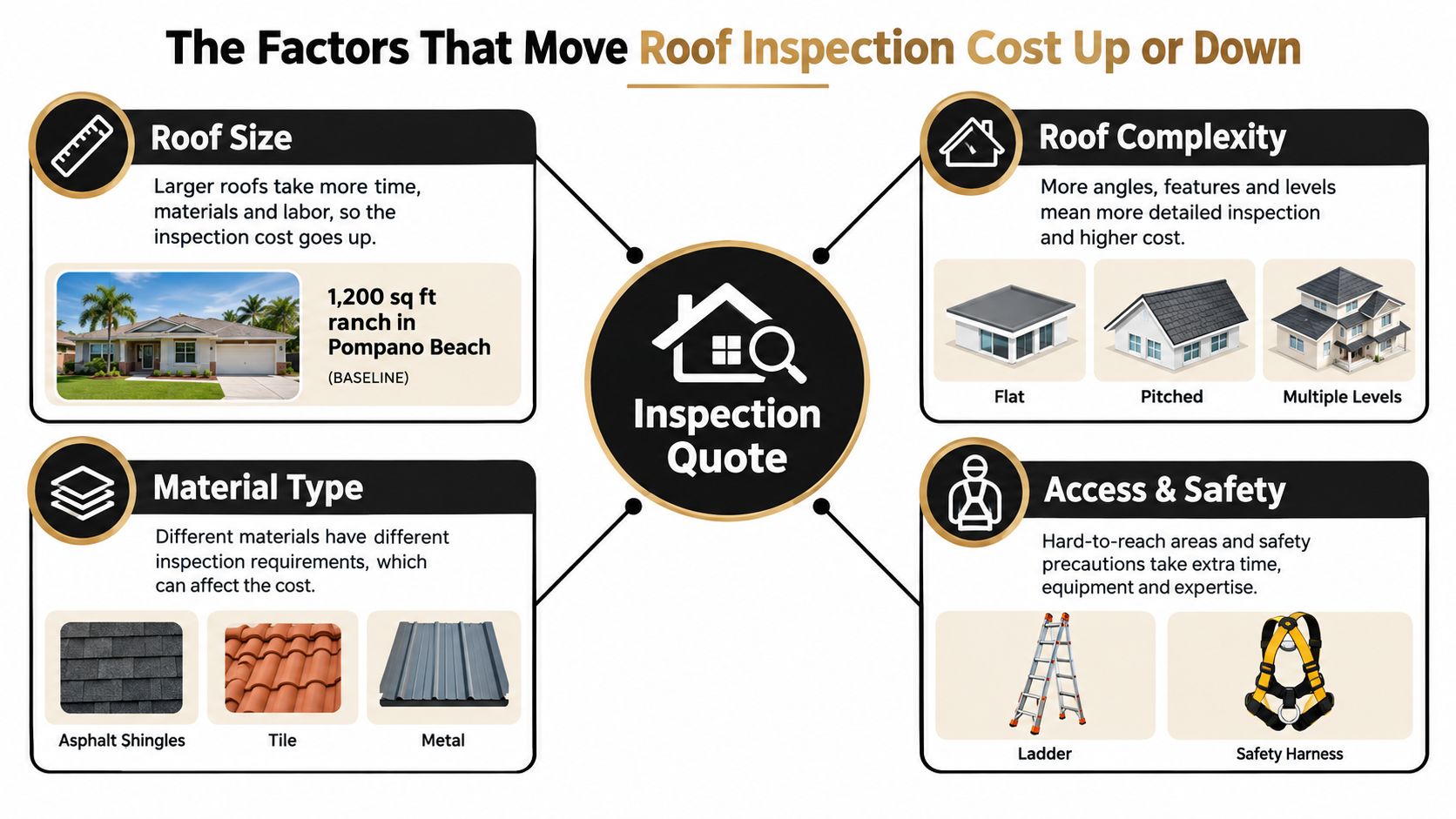
Roof complexity matters more than square footage alone. A 1,200-square-foot ranch in Pompano Beach may require similar ladder setup, travel, and safety preparation as a larger but simpler roof. A 2,500-square-foot Weston estate may take longer because of multiple slopes, valleys, elevations, tile transitions, and limited staging areas.
Pitch changes the work as well. A steep Mediterranean-style roof in Coral Gables may require additional safety preparation, while a low-slope commercial membrane allows a different inspection method. The more carefully an inspector must access each surface, the more labor the quote usually includes.
Size and roof design
A 1,700-square-foot roof is estimated at $125 to $357, while a 3,500-square-foot roof is estimated at $265 to $735, based on Angi's roof inspection cost benchmarks. The difference isn't just the number of roofing squares. Larger roofs often contain more penetrations, drainage paths, parapets, ridges, valleys, and repair history to document.
Material affects technique. Barrel tile requires careful foot placement because a careless step can crack a tile. Standing-seam metal calls for attention to seams, fasteners, penetrations, and corrosion. Modified bitumen and other flat-roof systems require close review of membrane laps, drains, ponding areas, and edge conditions.
Access, safety, and reporting
Two-story construction, dense landscaping, gates, limited driveway access, and rooftop equipment can add setup time. A roof that looks easy from the curb may be difficult to stage safely.
The inspection type also changes the price. A routine visual inspection needs less documentation than a storm-damage report prepared for an insurer. A roof certification, sale-related report, or detailed moisture assessment carries a different responsibility because another party will rely on the written findings.
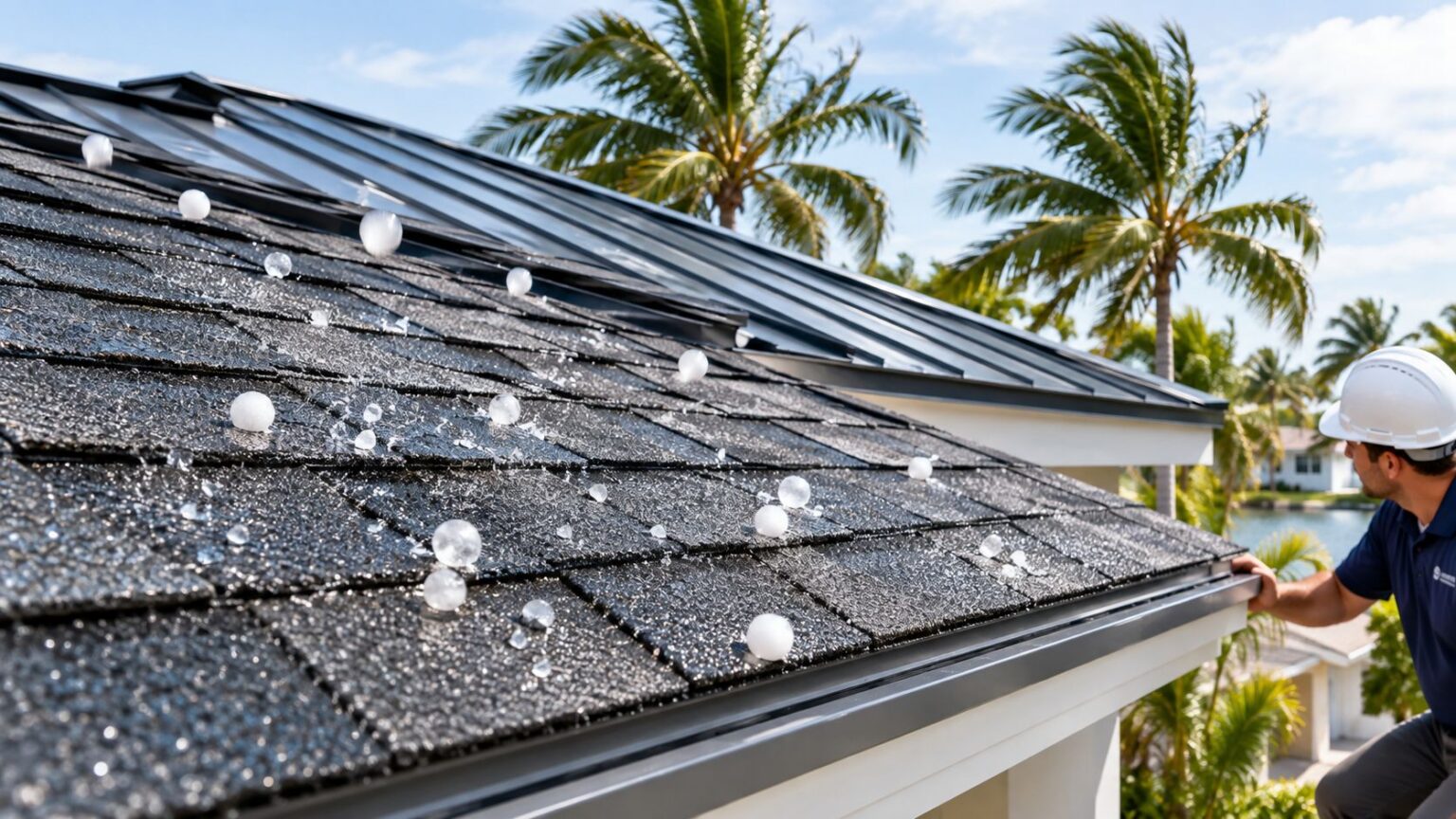
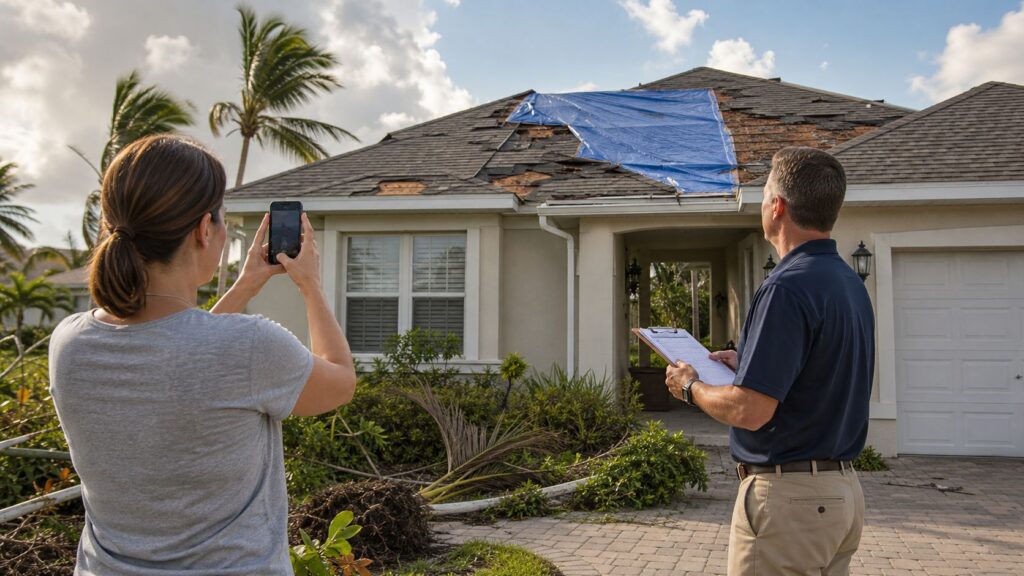
A photo showing a storm-related roof condition can be useful when a report needs visual support, such as this wind damage inspection reference. Ask whether your quote includes labeled photos, attic access, moisture readings, measurements, and a written repair priority list.
Inspection Types and How Each One Changes the Price
The right inspection isn't necessarily the most expensive one. It should match the decision you need to make.
A basic physical walk-through is usually the starting point for annual maintenance, a post-storm spot check, or a concern about visible wear. The inspector examines accessible roofing surfaces, flashing, drainage details, penetrations, and conditions visible from the attic when access is available.
Drone-assisted work makes sense when fragile barrel tile, steep geometry, height, or unsafe access limits walking. A drone can document broad roof areas and difficult slopes, but it doesn't replace hands-on evaluation of soft decking, loose materials, or subtle movement underfoot.
Infrared scanning serves a narrower purpose. It helps investigate suspected moisture trapped beneath a roof surface, especially on flat commercial membranes or in a home where the ceiling stain doesn't line up with the actual entry point. Thermal imaging isn't necessary for every routine inspection, and the report should explain what the scan did and didn't establish.
A certification inspection is documentation-heavy. Insurance renewals, property sales, lender requirements, and HVHZ-related records may require a signed statement about roof condition or remaining serviceability. Confirm exactly what document you'll receive before booking.
| Inspection Type | Typical Cost | Best Use Case |
|---|---|---|
| Basic physical walk-through | $125 to $225 | Maintenance and routine post-storm checks |
| Drone-assisted inspection | $200 to $400 | Fragile tile, steep areas, or difficult access |
| Infrared or thermal scan | $300 to $550 | Suspected hidden moisture or flat membranes |
| Formal certification inspection | $350 to $600 | Insurance, sale, renewal, or documentation needs |
These ranges should be treated as planning figures, not promises. HomeGuide's pricing benchmark also shows that method, property type, and report depth create wide differences between quotes.
Residential vs Commercial Roof Inspection Cost
Residential and commercial inspections use different pricing logic. A single-family roof is often quoted as a project, while a commercial inspection may be connected to roof area, access conditions, drainage layout, parapets, penetrations, and rooftop equipment.
For a 2,000-square-foot Coral Springs home, the inspection invoice usually reflects the roof's design and documentation requirement more than a strict per-square-foot calculation. A visual inspection may fall within the residential market range, while drone photographs, attic review, thermal work, or certification increase the scope.
A 20,000-square-foot Pompano warehouse is different. The inspector may need to review a large membrane field, seams, drains, edge metal, rooftop units, penetrations, and parapets. Commercial pricing commonly runs around $0.05 to $0.10 per square foot, with commercial inspections often ranging from $200 to $600, as documented by HomeGuide's commercial roof inspection pricing.
| Property Type | Square Footage | Standard Inspection | With Drone / Thermal | Notable Add-Ons |
|---|---|---|---|---|
| Single-family home | 2,000 square feet | $150 to $450 | $300 to $600 | Tile access, attic review, certification |
| Large residential property | Varies | Higher with complexity | $400 to $600 or more | Multiple levels, fragile tile, detailed report |
| Commercial warehouse | 20,000 square feet | Custom quote | Custom quote | Membrane mapping, drains, equipment, parapets |
| Multi-building portfolio | Varies | Portfolio pricing possible | Scope-dependent | Repeated documentation and annual scheduling |
Property managers often plan around a broader internal benchmark of about $0.10 to $0.30 per square foot, but that figure should be treated as a budgeting guideline rather than a market guarantee. The lower end may suit repeated routine reviews, while detailed reports across multiple buildings require more labor.
Bundled pricing can work when several buildings share one visit, consistent access, and the same reporting format. Commercial owners should also ask whether wind-uplift documentation, roof plans, photographs, and defect mapping are included, because those requirements can move the quote beyond a basic visual review.
Free Estimates vs Paid Independent Inspections
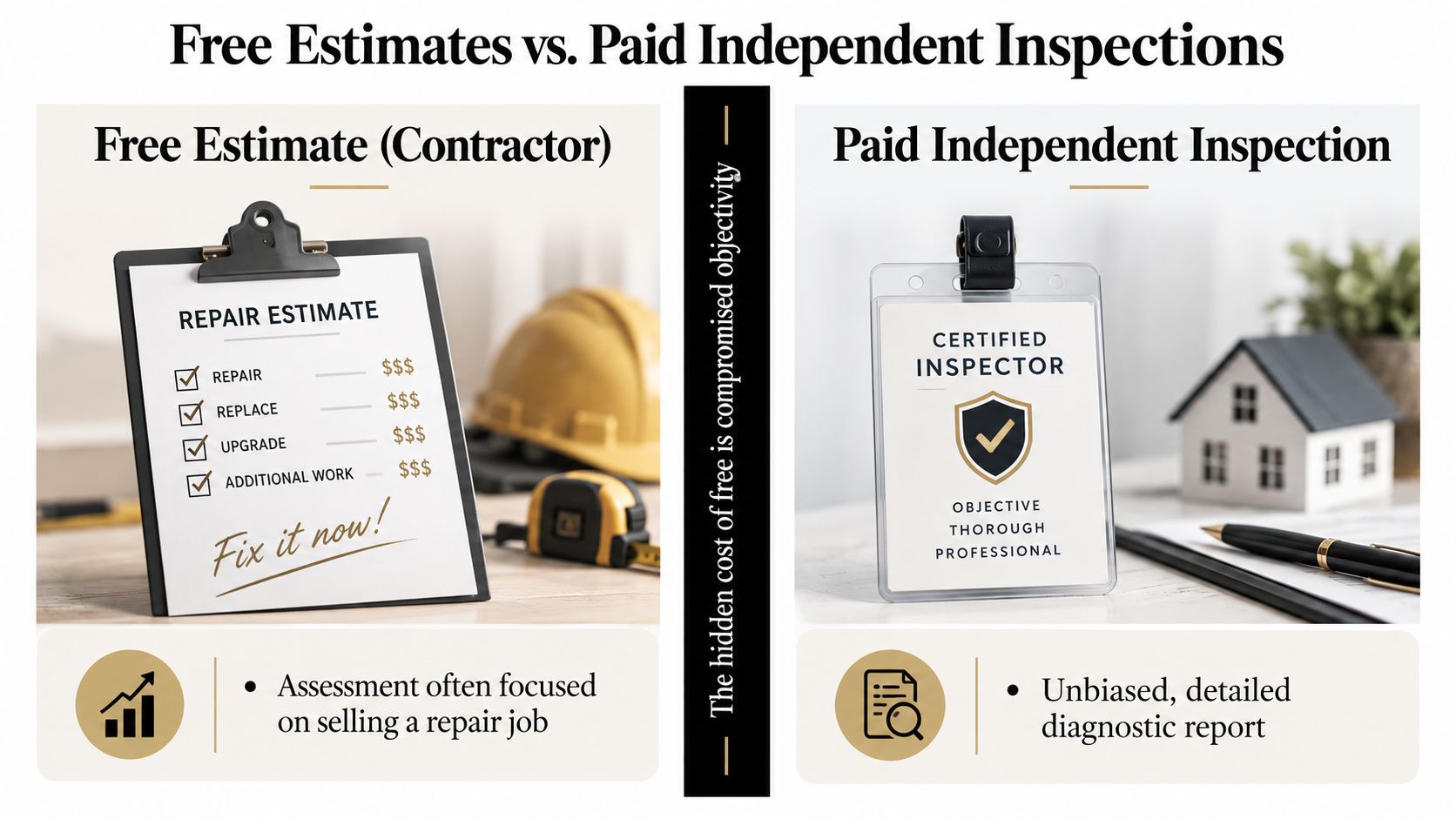
A free roof estimate can be useful, but it answers a different question from a paid independent inspection. The free visit is usually connected to potential repair or replacement work. The paid inspection is designed to give the property owner a documented condition assessment, even when the right recommendation is to repair, monitor, or do nothing immediately.
That distinction creates a conflict of interest many homeowners overlook. A contractor who expects to sell a roof may naturally focus on replacement eligibility, scope, and installation cost. An independent inspector has less reason to turn a small flashing gap, nail pop, or isolated wind issue into a replacement conversation.
Match the inspection to the decision
Use a free contractor assessment when you're already shopping for installation work and need a repair or replacement estimate. Use a paid third-party inspection before filing an insurance claim, listing a home, buying property, or resolving a disagreement about roof condition.
A paid inspection commonly falls between $150 and $600, depending on scope and documentation, according to Rooflio's insurance inspection guidance. Claim-focused inspections often require photographs, written defect descriptions, and evidence that connects the observed condition to the requested decision.
Homebuyers and sellers can also benefit from broader context in BatchData home inspection insights, especially when deciding whether a general home inspection is enough or whether a roofing specialist should review the roof separately.
A free visit isn't automatically unreliable, and a paid inspection isn't automatically thorough. Check licensing, insurance, roof-specific experience, sample reports, and whether the inspector will identify conditions that don't lead to a sale. The strongest approach is often hybrid: use a free roofer estimate for installation pricing, then obtain an independent report when objectivity and documentation matter.
What a Real South Florida Inspection Uncovers
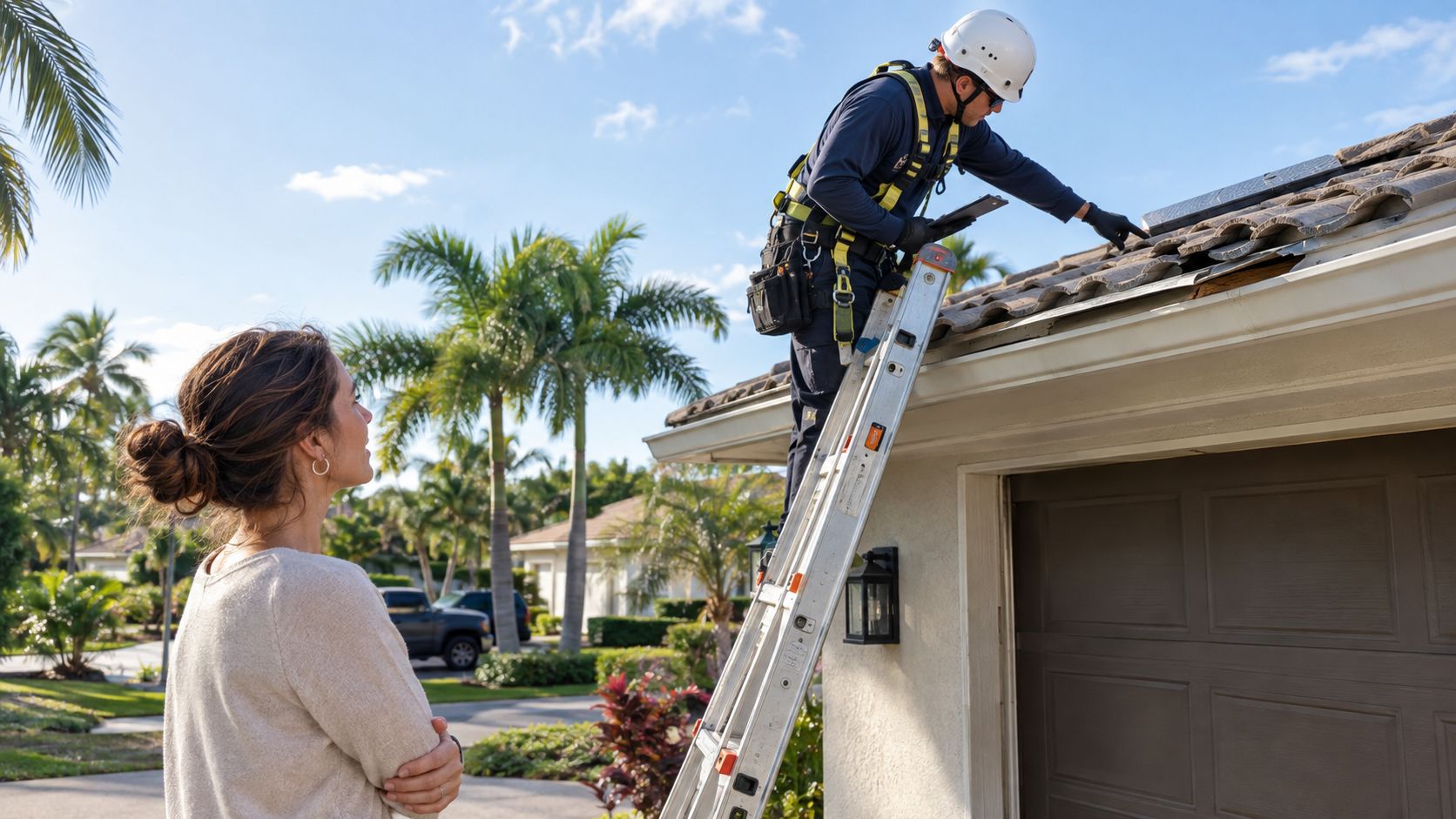
Maya, a fictional homeowner in Plantation, schedules a post-hurricane inspection two weeks after a storm. From the driveway, her roof looks intact. The inspector's perimeter review finds displaced edging and a lifted ridge on the west slope, where wind moved tiles at speeds exceeding 130 miles per hour in the scenario. Those conditions aren't reliably visible from ground level.
The attic changes the assessment. Daylight appears at decking seams, nail shanks show rust, and a truss plate is sagging. None of those findings would be captured by a quick glance at the roof from the street, and each one needs a different recommendation.
The report creates the value
A drone pass photographs the rear valley and shows membrane wear along the water channel. The inspector marks the location on a scaled diagram rather than leaving Maya with a vague note that “the back slope needs attention.”
An infrared scan then identifies a soaked section beneath the kitchen. The visible ceiling condition doesn't reveal that moisture has been affecting the substrate for months. Thermal imaging doesn't prove the cause by itself, but it tells the inspector where to investigate and what evidence to document.
Maya receives a written report containing photographs, measurements, and a prioritized action list. Each defect is assigned to a practical category, an insurance claim, a small maintenance repair, or a future replacement discussion. A report like the storm damage documentation example gives an adjuster, buyer, or roofer a common reference point.
The product isn't the visit. It's the documented narrative that explains what was found, where it was found, how urgent it is, and what decision should follow. Maya can give that report to a public adjuster without relying on memory, and a roofer has less room to misinterpret the requested work.
Smart Ways to Save on Roof Inspection Cost
Cutting the inspection price only helps if the report still answers the question you hired someone to answer. Use this checklist before requesting quotes.
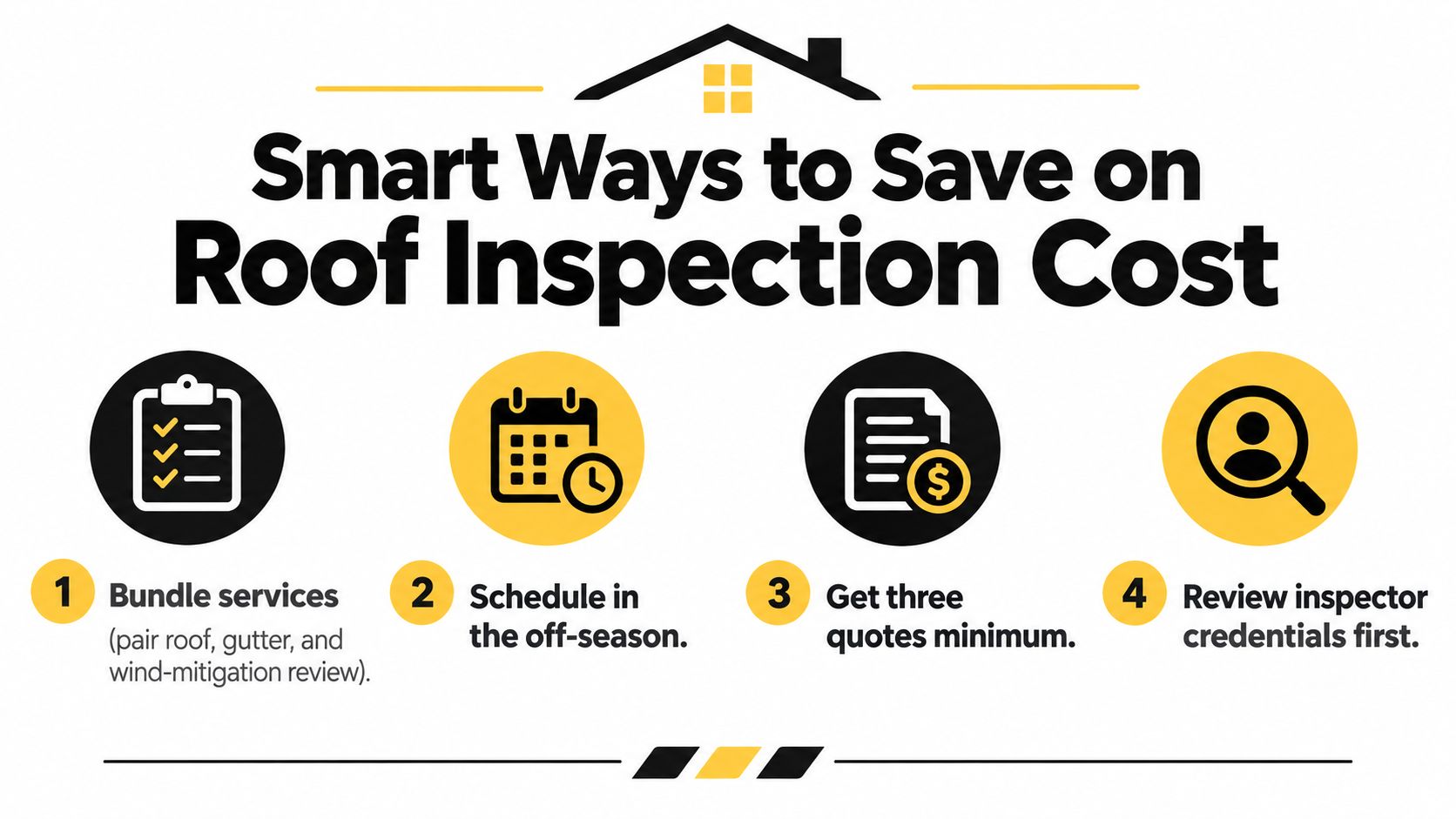
Bundle related reviews. Pair the roof inspection with an attic, gutter, or wind-mitigation review when the same visit can cover the setup and access. Ask for the combined scope in writing rather than assuming every added service is included.
Schedule before claim season peaks. December through April can offer more scheduling flexibility than the period when contractors are handling a heavy volume of storm-related work. Availability doesn't guarantee a discount, but it can make it easier to compare inspectors and request a complete report.
Request the deliverables first. Confirm whether the quote includes photographs, moisture readings, attic access, measurements, and a repair estimate. A vague “diagnostic charge” doesn't tell you what you'll receive.
Compare qualified scopes, not just fees. Get multiple written quotes and ask each inspector to state the inspection method, report format, certifications offered, and any safety or access charges. The cheapest quote may omit the very documentation you need.
HOAs in Broward and Palm Beach may be able to coordinate access and negotiate group pricing for multiple homes, although the final rate depends on the inspector and scope. Prompt payment may also produce a courtesy discount, but ask about the policy before scheduling rather than treating it as an entitlement.
Be cautious with door-knocking storm chasers offering free inspections immediately after a storm. A free visit can become an inflated repair recommendation, rushed claim paperwork, or work by a company that won't remain available when problems surface. Use a roof repair versus replacement comparison to keep the inspection findings separate from the sales decision.
Making the Right Inspection Decision for Your Property
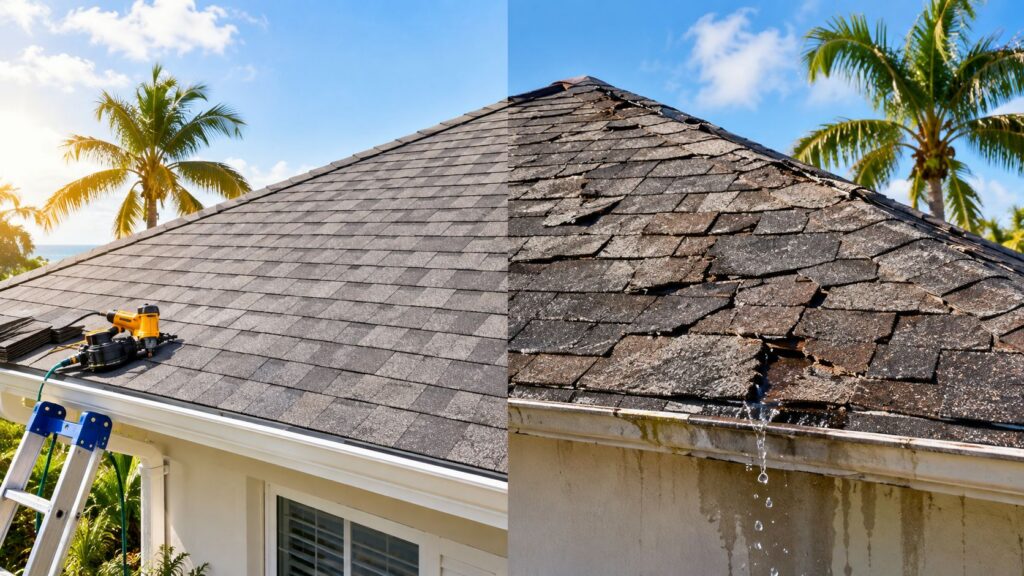
The inspection fee should connect to two outcomes, storm readiness and resale value. A good report gives a homeowner time to correct weak details before a hurricane, while giving a seller or buyer evidence that can support a realistic negotiation.
The decision changes with the property. A Miami-Dade homeowner may need a focused review of tile attachment, flashing, roof edges, and attic moisture. A Fort Lauderdale condo board may need repeatable documentation across shared buildings, clear defect priorities, and records that support maintenance planning. A warehouse owner near Port Everglades needs a commercial membrane assessment that addresses drainage, penetrations, rooftop equipment, parapets, and the reporting standard required by the ownership group or insurer.
Use the report to separate risk from urgency
Not every defect deserves immediate replacement. A cracked pipe boot, failed seal, or isolated flashing issue may call for a targeted repair. Wet decking, structural movement, widespread membrane failure, or storm-related displacement may require a broader conversation. The inspector's job is to document the condition so the owner can choose the appropriate next step.
Specialized inspections can also prevent a costly mismatch between evidence and purpose. Rooflio's insurance inspection guidance explains why claim-related assessments often require more documentation than a routine walk-through, including written reports and photo evidence. That extra detail matters when an insurer, buyer, lender, or permit reviewer will examine the file.
A practical decision rule is simple: schedule a paid independent inspection when the roof is older, has endured a named storm, or the property will be sold soon. If none of those conditions applies and you're only seeking installation pricing, a free contractor estimate may be sufficient, provided you understand its sales relationship and report limitations.
Paletz Roofing and Inspections provides residential and commercial roof inspections, documented damage assessments, repairs, replacements, and free roofing estimates across South Florida. Visit Paletz Roofing and Inspections to request an inspection scope that matches your roof, storm exposure, and documentation needs.