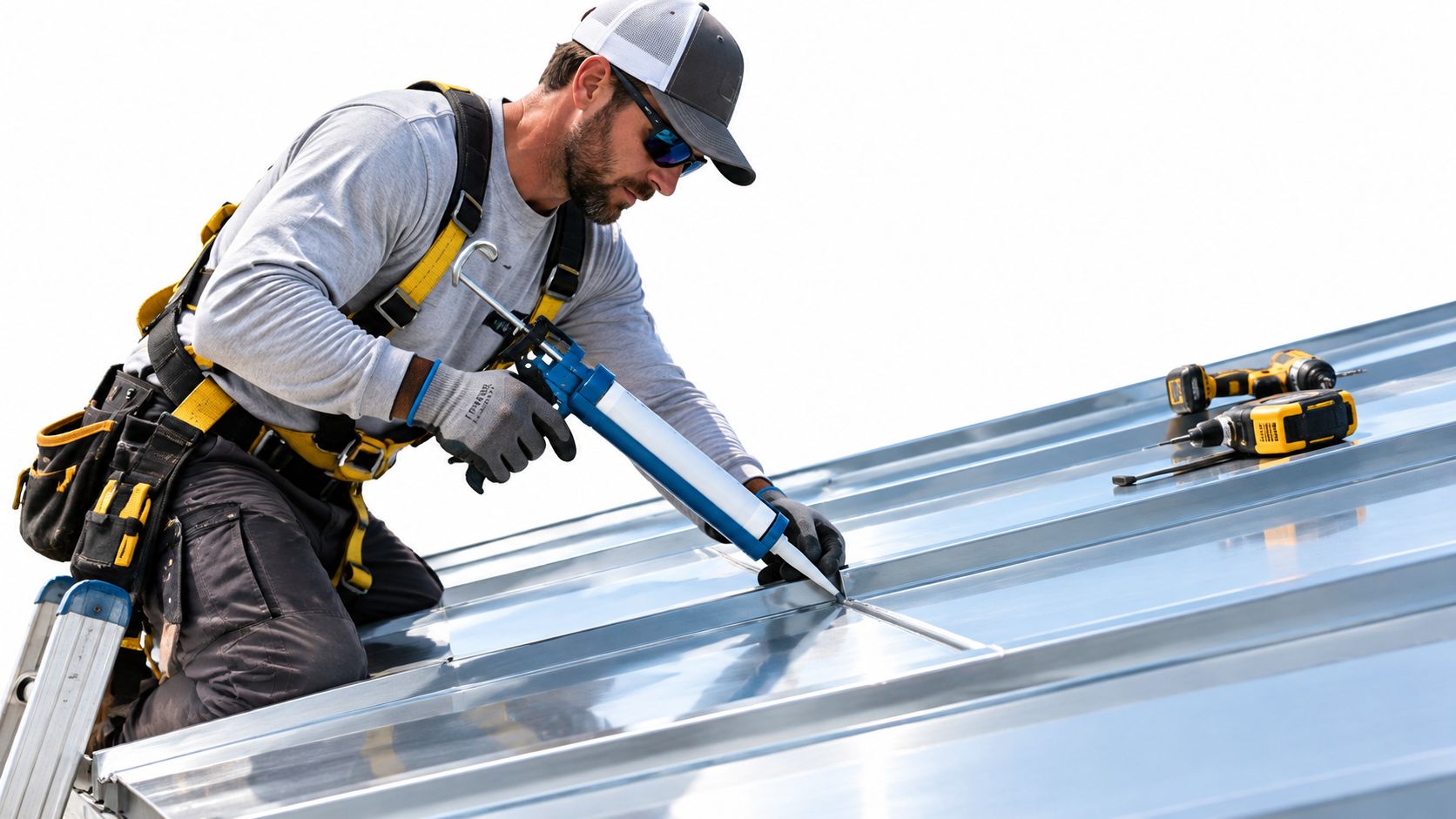
A brown ceiling stain appears after an August downpour in Broward County. The roof may look intact from the driveway, yet water can be entering at a fastener, seam, flashing transition, or corroded cut edge and traveling before it reaches the ceiling. That's why a successful metal roof repair starts with finding the entry point, not covering the first wet spot you see.
South Florida adds pressure that generic repair guides often miss. Salt air, intense sunlight, hurricane winds, humidity, and repeated thermal movement can turn an otherwise localized defect into a recurring leak. The practical question isn't “Can this hole be patched?” It's whether the roof substrate, panel system, and repair materials can work together for years in this climate.
Table of Contents
- Why South Florida Is Hard on Metal Roofs
- How to Inspect a Metal Roof Before You Repair Anything
- Common DIY Metal Roof Repairs That Hold Up
- Standing Seam and Panel Repairs Done Right
- When Metal Roof Repair Stops Making Sense
- Metal Roof Repair Costs in South Florida
- Maintenance Rhythm and When to Call a Pro
Why South Florida Is Hard on Metal Roofs
A homeowner near the coast may blame a ceiling stain on the latest storm. Sometimes that's correct. Often, the storm only exposes a weakness that developed gradually under salt, heat, movement, and aging sealants.
Standing-seam metal roofs are commonly associated with service lives of 40 to 80 years, while premium copper and zinc systems may reach 70 to 100 or more years, according to documented metal-roof service-life guidance. That long expected life makes repair worthwhile when the damage is isolated. It also creates a trap: a durable panel doesn't make every fastener, seam, coating, or flashing detail durable for the same length of time.
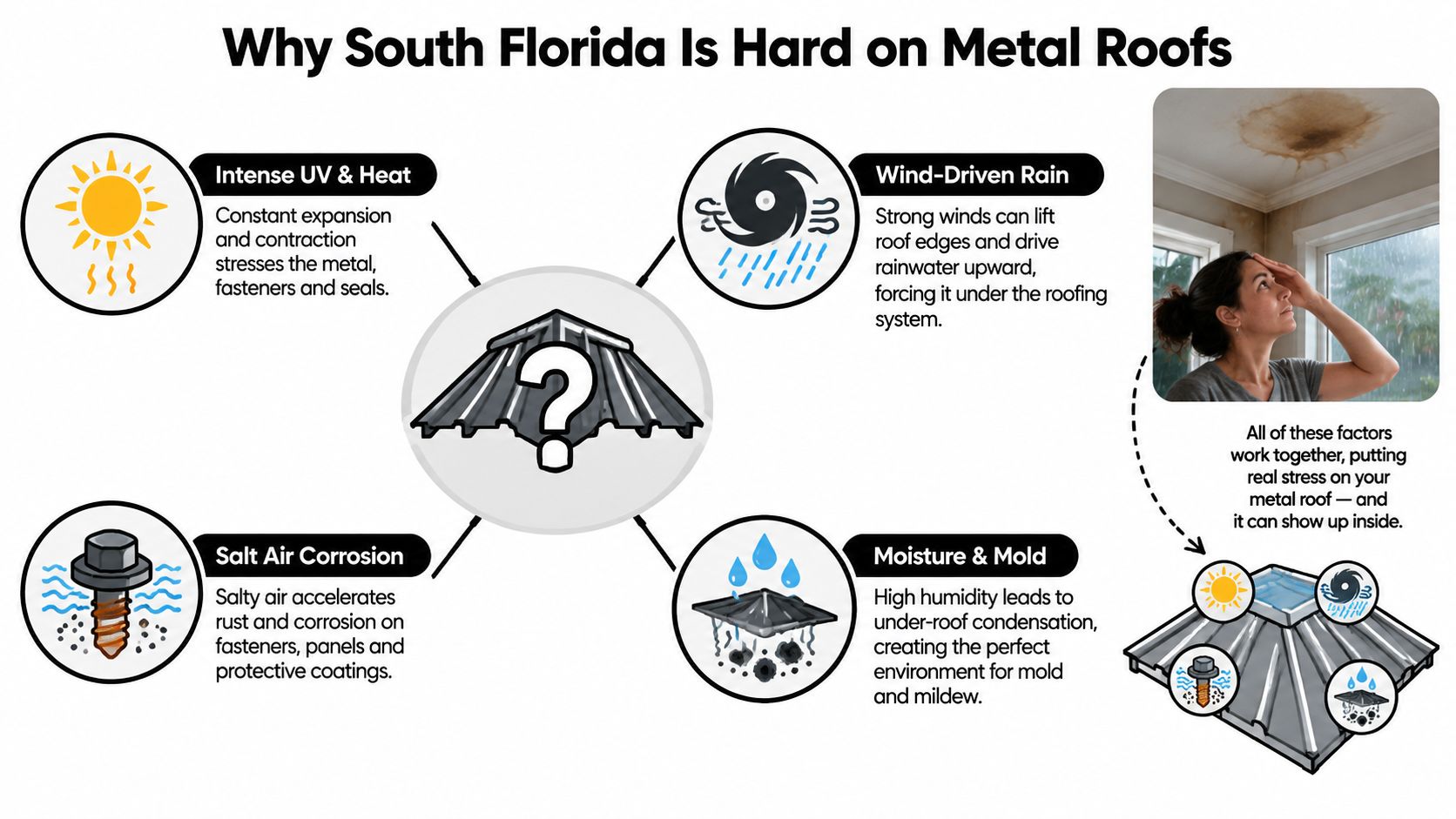
Four stressors I look for first
- Salt-laden air: Coastal moisture attacks exposed steel, fasteners, dissimilar-metal contacts, and especially panel cut edges. Galvalume and aluminum resist corrosion differently from steel, but no system should be treated as immune to salt exposure.
- UV and heat: South Florida sunlight bakes coatings and exposed sealant lines. A bead can look intact at the surface while losing flexibility underneath, especially around penetrations and flashing.
- Hurricane wind: Wind uplift repeatedly loads panel edges, seams, closures, and exposed screws. A fastener that has backed out may not leak during a calm rain, but wind-driven rain can exploit the opening.
- Thermal cycling: Hot afternoons and cooler nights make panels expand and contract. If a flashing cleat, seam, or fastener detail can't accommodate movement, the roof stresses the surrounding sealant and metal.
The roof's history matters, too. Corrugated iron was patented in London in 1829, galvanization followed in France in 1837, and a major early metal roof in the southern United States was installed on the U.S. Mint in New Orleans in 1857, milestones summarized in this history of metal roofing and corrosion protection. Modern repair work still revolves around the same fundamentals, seams, fasteners, coatings, and flashings.
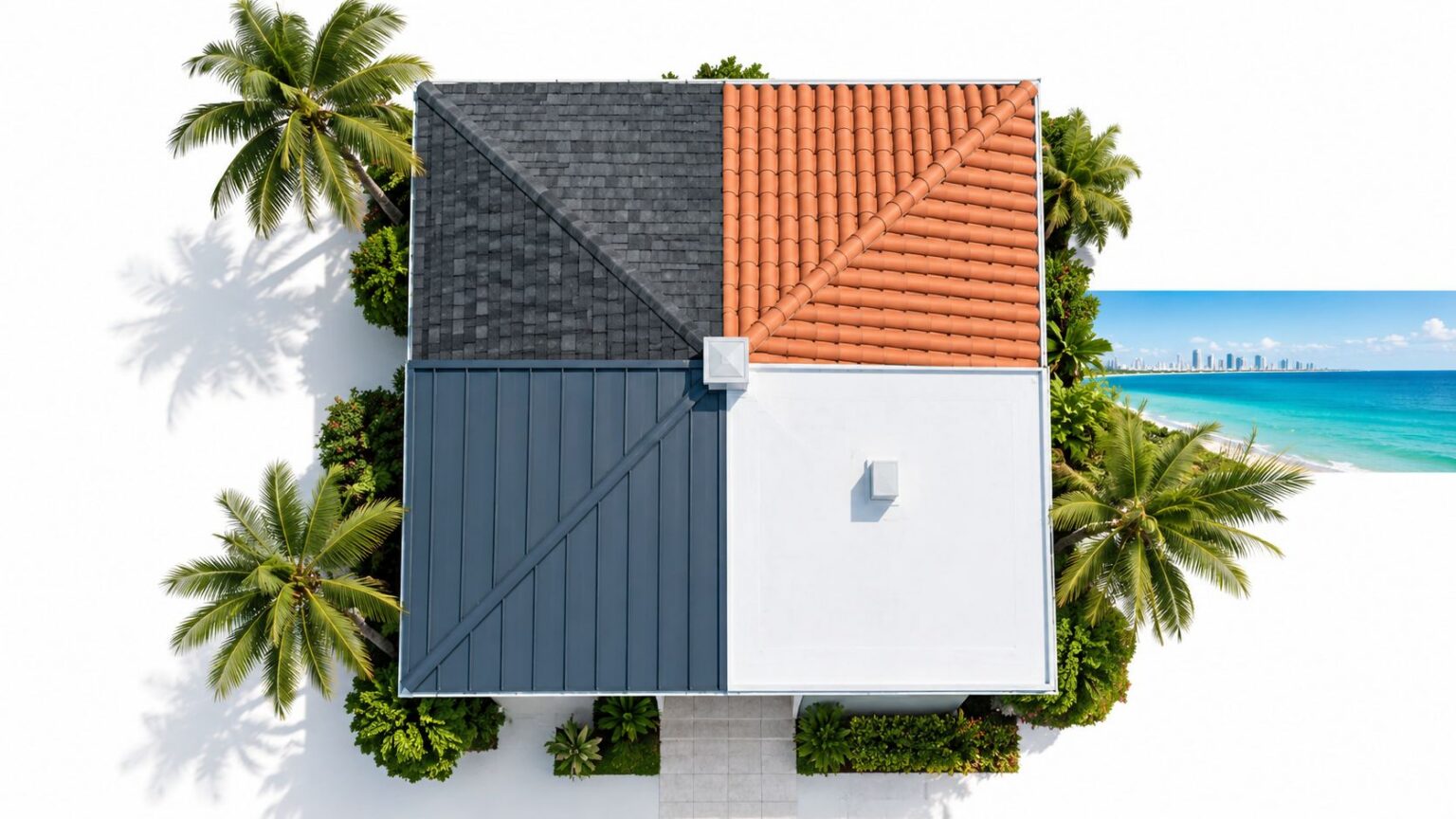
For a quick visual reference when comparing systems, this roofing-material comparison image can help homeowners identify the broad differences between roof types. The repair decision, however, depends on the actual profile and condition above the building.
How to Inspect a Metal Roof Before You Repair Anything
Don't start by buying sealant. Start by tracing the leak.
Begin inside the building
Inspect the attic around midday with the lights off, when sunlight can reveal openings around panels, fasteners, and penetrations. Follow the stain upward to the highest wet point, not merely the lowest point where water dripped onto the ceiling. Water can travel along rafters, insulation, panel ribs, and the underside of the roof before it appears indoors.
Look for damp insulation, darkened decking, rust marks, and fresh water trails. Photograph each finding with a recognizable object nearby for scale, such as a tape measure or ruler. Add the date and location to your notes so you can compare the condition after rain.
Scan from the ground
Use binoculars from several angles. Check for lifted panel edges, missing or crooked exposed fasteners, rust streaks, damaged ridge caps, open flashing, and debris holding moisture against the roof. Ground-level inspection is safer than climbing and can reveal patterns that are hard to see from directly above.
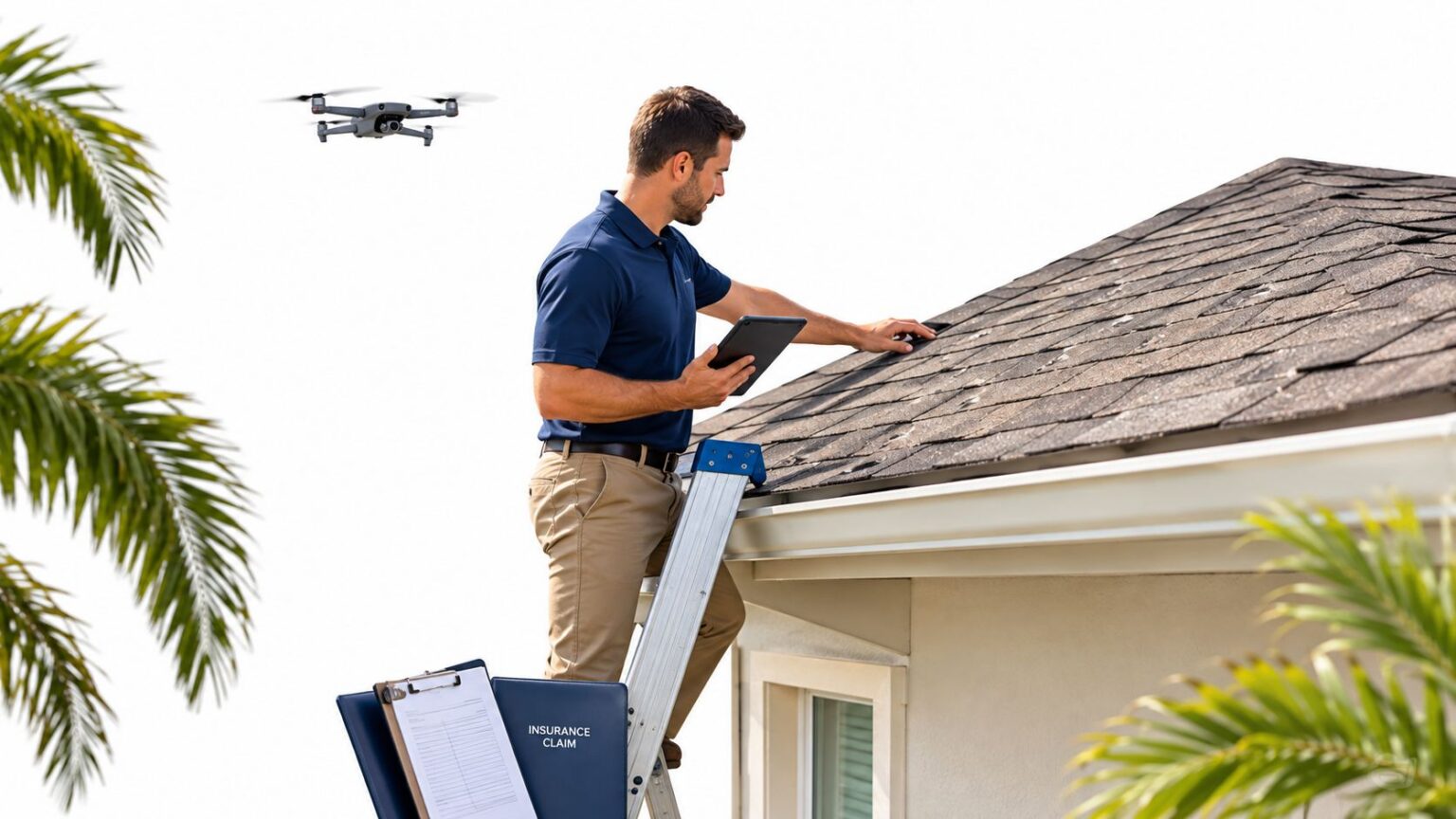
This roof inspection reference image is useful when organizing photos for a contractor, property manager, or insurance file.
Only climb when conditions are safe
Wet metal is slippery, and some profiles are easy to deform under foot pressure. If access is safe and you understand the roof system, inspect fasteners for movement, probe failed sealant at penetrations, and examine transitions at walls, chimneys, vents, and skylights. Don't step on seams, ridge caps, closures, or unsupported panel areas.
A professional assessment may include visual review, probing, water-intrusion tracing, corrosion-depth evaluation, fastener pull-out resistance, and panel-deformation checks. The visible drip point isn't reliable evidence of the leak source, so a repairer who skips tracing may seal the wrong location.
Practical rule: Photograph the defect, the surrounding roof area, and the interior stain. A close-up alone rarely shows whether the problem is isolated or part of a larger failure pattern.
Common DIY Metal Roof Repairs That Hold Up
Some repairs are reasonable for a capable homeowner. The boundary is simple: work only where you can reach the area safely, identify the panel and coating, and avoid altering a concealed-seam system without knowing its construction.
Replace failed exposed fasteners
Backed-out screws are common on exposed-fastener roofs because movement places stress on the connection. Remove the damaged screw, clean the hole and surrounding metal, and use a replacement with the same metal type and compatible washer. An oversized screw can help when the original hole no longer holds, but the washer should compress slightly, not split or cut.
Drive the screw straight and stop when the gasket seats. Over-driving crushes the neoprene washer and creates a new leak path. The fastener and separated-seam repair guidance from Lowe's also emphasizes matching replacement fasteners rather than mixing incompatible types.
Patch a genuinely small puncture
For punctures up to about 2 inches, technical repair guidance supports a composite patch made with mesh embedded in polyurethane mastic, after the surface is cleaned and prepared. Larger damage generally calls for a cut-out patch with about a 3-inch overlap and a sealed perimeter, rather than a blob of sealant over the opening. See this metal-roof sealant and patching analysis for the preparation and patching sequence.
A profile-matched metal patch is preferable to flat stock when the panel ribs or corrugations must continue shedding water. Remove loose rust and failed sealant, clean away contaminants, allow the area to dry, and use a material compatible with the panel coating.
Reseal flashing at penetrations
Flashing around pipes, vents, walls, and masonry transitions moves differently from the roof panel. Remove failed material completely, clean the joint, prime where the product requires it, and re-bed the flashing with a polyurethane or butyl product rated for the specific metal-to-masonry connection.
Avoid generic silicone over PVDF or Kynar-coated panels unless the coating manufacturer expressly approves it. Asphalt-based products can also create compatibility problems on galvanized panels. A repair that sticks briefly but prevents proper movement or attacks the coating isn't a durable repair.
Material choice matters: The original roof may still have decades of useful life, while a generic patch can fail in about 3 to 7 years, according to the cited repair analysis. Match the sealant, washer, primer, patch metal, and coating system to the roof.
Standing Seam and Panel Repairs Done Right
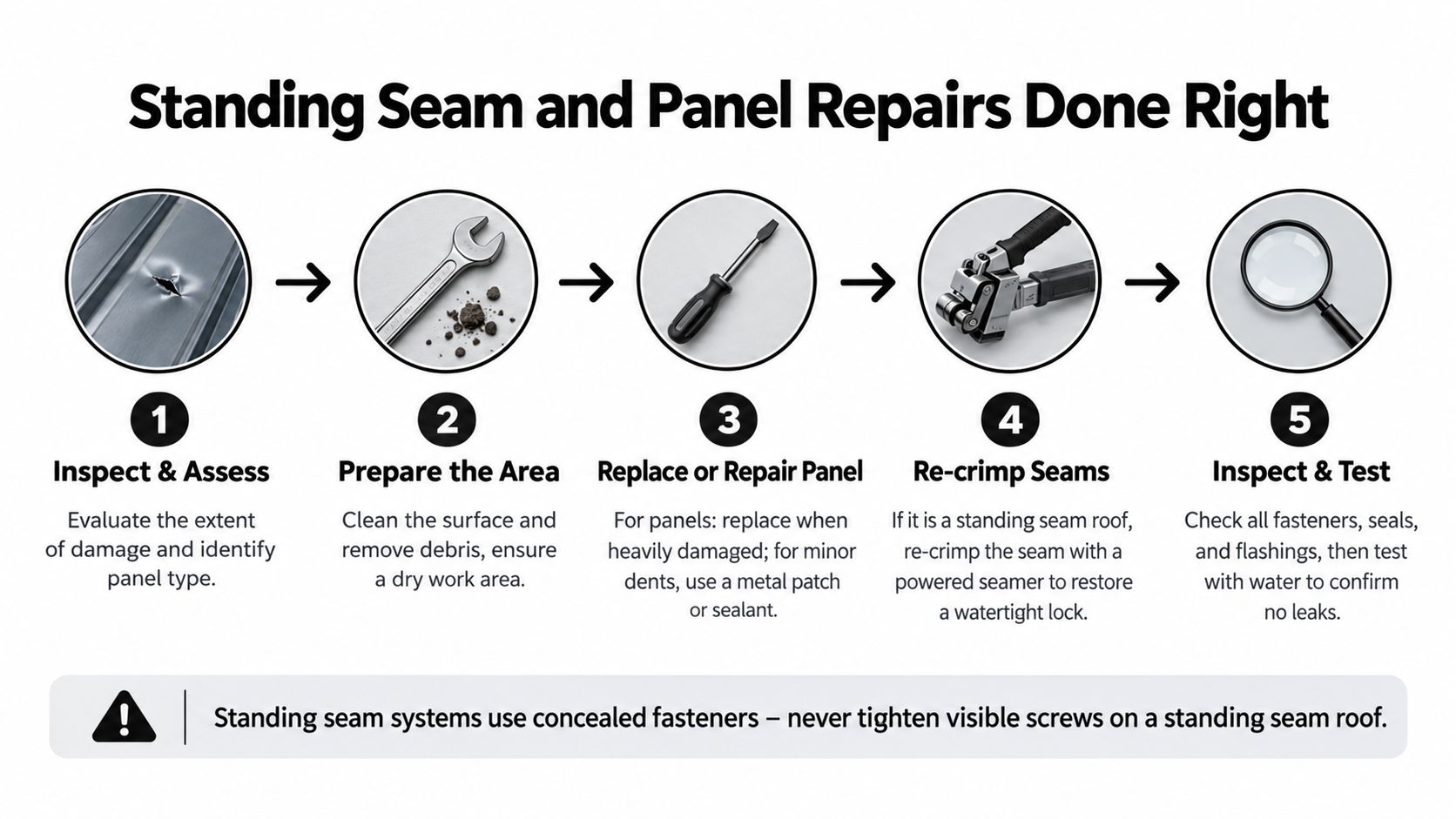
Standing-seam roofs hide their fasteners beneath interlocking seams, so the repair logic differs from an exposed-fastener roof. Never start tightening visible screws on a standing-seam roof because you see a screw nearby. That may belong to a clip, trim detail, or unrelated flashing, and the seam itself may need mechanical correction.
Thermal movement is the usual reason a seam begins to separate. Panels lengthen in heat and contract as temperatures fall. When clips, seams, or flashing details restrict that movement, the lock can loosen, sealant can shear, and water can enter above the location where the interior stain appears.
Match the method to the seam
A snap-lock profile and a mechanically seamed profile aren't interchangeable. A snap-lock seam may need careful realignment and compatible sealant tape between locking surfaces. A mechanically seamed roof may require a powered seamer or profile-specific crimping tool to restore the lock. Walking on the wrong portion of either system can flatten ribs, distort the seam, and create more damage than the original leak.
Clean the seam before applying any product. Remove dirt, rust, old sealant, and coating debris. If the metal remains sound, a roofer may re-crimp the seam with the correct tool, use compatible butyl tape or sealant where the design allows it, and verify that the panel can still move.
Know when the panel must come out
A seam repair won't solve metal that has corroded through, a panel with severe deformation, or damage extending beyond a small isolated area. The proper repair may require removing trim, releasing clips, extracting the damaged panel, installing a matching replacement, and restoring the seam without trapping water.
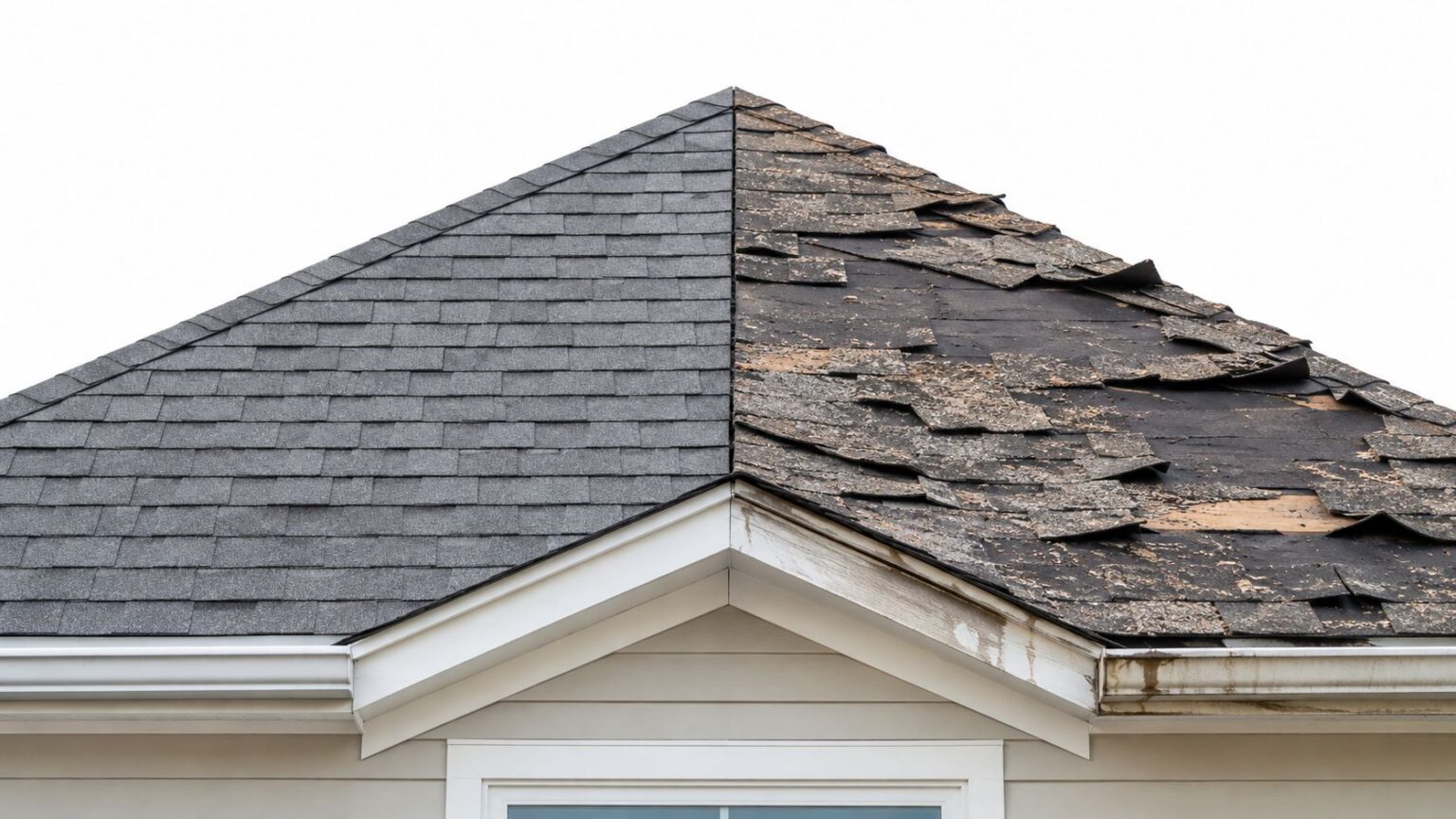
The damaged-roof visual reference can help distinguish a surface blemish from a condition that deserves a broader inspection. The final step should include water testing and photographs of the completed work, particularly when a warranty or permit close-out is involved.
When Metal Roof Repair Stops Making Sense
A patch is the right answer when the roof has a localized defect and a sound surrounding system. Replacement becomes more sensible when corrosion, movement, and recurring leaks show that the defect isn't isolated.
| Factor | Still Repairable | Time to Replace |
|---|---|---|
| Corrosion | A small, stable area with solid metal around it | Rust spread across multiple panels, perforation, or deep substrate loss |
| Leak history | One localized leak with a traceable source | Repeated leaks after several patch cycles |
| Panel condition | Minor denting or isolated puncture | Widespread distortion, separated seams, or failing ribs |
| Fasteners | A limited number of loose or damaged fasteners | Many failed connections in the same roof area |
| Underlying layers | Sound decking and underlayment | Wet, deteriorated, or structurally compromised substrate |
| Storm damage | Repairable localized wind or impact damage | Broad uplift, displaced panels, or damage affecting the roof assembly |
Roof age is only one input. Standing-seam systems are commonly referenced at 40 to 80 years, but coastal exposure can make the remaining useful life much shorter than the original design expectation if coatings, cut edges, fasteners, and flashings have deteriorated. A low-slope 55% aluminum-zinc alloy-coated steel assessment projected sealant service life at 60 years, with coating life of 79 years or more in all but the worst case, while projected flat-panel service lives varied from 60 to 375 years depending on precipitation pH. Those figures describe specific technical conditions, not a promise for every South Florida roof. The relevant question is how much sound system remains on your building.
Florida storm claims also need organized documentation and permit review. For owners dealing with storm-related damage outside the coast, this Marion County roof damage guide offers useful context on documenting roof conditions and evaluating repairs.
Decision point: If the repair scope approaches roughly 30 percent of replacement value, the life-cycle math may favor replacement, especially when leaks recur or corrosion is distributed. That threshold should be treated as a practical screening point, not a substitute for a written inspection.
Metal Roof Repair Costs in South Florida
There isn't a reliable universal price for metal roof repair in Broward, Miami-Dade, or Palm Beach. A loose screw near a reachable eave is a different project from a corroded standing-seam panel over a two-story interior space. Cost guides describe small repairs as potentially costing a few hundred dollars and larger damage as reaching several thousand dollars, depending on scope, access, and materials, as outlined in this repair-versus-replacement cost discussion.
Because the verified cost information is qualitative rather than a local price schedule, a contractor should provide the actual range for your roof after inspection. Ask for labor, materials, access, testing, disposal, permits, and any allowance for concealed damage to appear separately.
What changes the quote
- Corroded substrate: A repair can expand once the roofer removes a panel or failed flashing and finds weakened metal or wet decking beneath.
- Panel matching: Older profiles may be difficult to source if the original manufacturer no longer produces them. A visually similar panel may not lock correctly.
- Access: Steep slopes, two-story elevations, limited staging areas, and fragile landscaping increase labor and protection requirements.
- System type: Exposed-fastener repairs are not priced or performed like concealed-fastener standing-seam work.
- Testing and documentation: Water testing, photographs, and permit close-out add work, but they help confirm that the source was corrected.
South Florida metal roof repair cost ranges
| Repair Type | Typical Cost Range | Notes |
|---|---|---|
| Loose or damaged fastener repair | A few hundred dollars for small fixes | Depends on roof access, fastener count, and corrosion around holes |
| Small puncture or composite patch | A few hundred dollars for isolated damage | Profile, coating compatibility, and preparation affect the final quote |
| Flashing or penetration repair | A few hundred dollars to several thousand dollars | Larger transitions may require removal and reconstruction |
| Panel or seam repair | Several hundred dollars to several thousand dollars | Profile matching, seaming tools, and concealed damage can change scope |
| Broad corrosion or storm repair | Several thousand dollars or more | May be better evaluated as partial replacement or reroofing |
Treat any “small repair” quote without a defined inspection scope cautiously. Request the roof area, repair materials, warranty terms, water-testing method, permit responsibility, and conditions that would trigger a change order.
Maintenance Rhythm and When to Call a Pro
South Florida metal roofs need a maintenance rhythm built around storms and exposure, not just calendar convenience. Schedule a visual inspection after every named storm and at the start of hurricane season. A focused fastener and sealant audit every 18 months, plus a full professional inspection every 3 to 4 years depending on roof age and coastal exposure, creates a practical baseline. The annual fastener, rivet, and screw checks recommended in metal-roof maintenance guidance remain sensible for exposed-fastener systems.
Homeowners can usually handle ground-level photos, gutter clearing, and light debris removal without climbing onto the roof. Keep tools and pressure washers away from coatings, seams, and flashings. Roof access becomes a professional task when the surface is wet, steep, corroded, or built with a concealed seam that you can't identify confidently.
Call a licensed roofer when:
- Leaks return within one season: Recurrence suggests the source wasn't found or the system has a broader failure.
- Several fasteners fail in one area: That pattern may indicate substrate movement, wind stress, or widespread connection problems.
- Panels visibly move: Loose edges and separated seams need evaluation before the next storm.
- Rust spreads beyond a small spot: Broad corrosion may require panel replacement or a coating system rather than a patch.
- Damage reaches penetrations or wall flashings: These transitions are difficult to seal correctly without allowing movement.
Before signing: Document the current condition, obtain two quotes for work beyond basic fastener swaps, and confirm licensing, insurance, material compatibility, testing, and warranty terms in writing.
Paletz Roofing and Inspections provides metal roof inspections, repairs, replacements, and storm-damage assessments across Broward, Miami-Dade, and Palm Beach counties. If your leak source is unclear or corrosion keeps returning, visit Paletz Roofing and Inspections to arrange an inspection and request a repair or replacement evaluation.