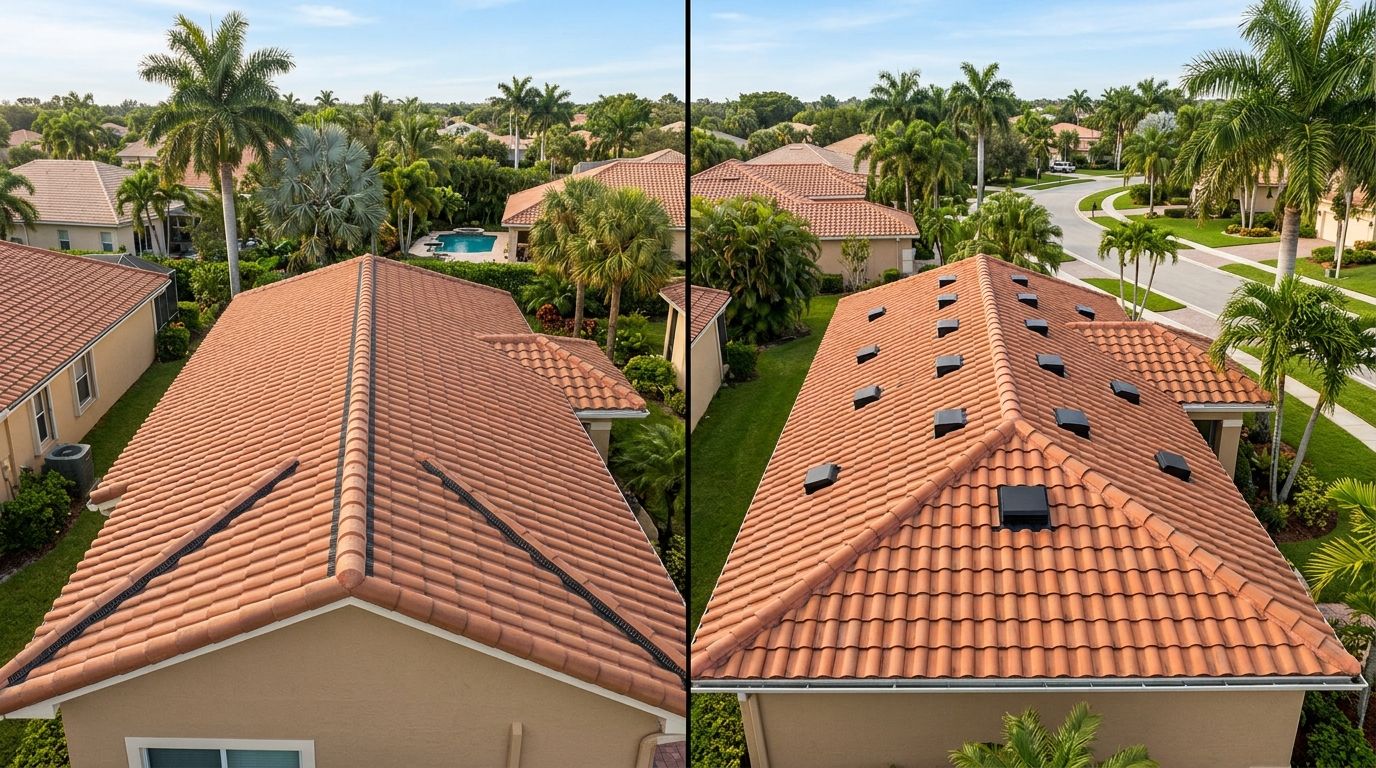
For a typical 1,500-square-foot attic, the ventilation target is not guesswork. The required minimum is 5 square feet of total open vent space, split evenly into 2.5 square feet of intake and 2.5 square feet of exhaust under the 1:300 rule outlined in this ridge vent ventilation reference. That single requirement changes the whole ridge vent vs roof vent conversation.
In South Florida, I see homeowners focus on the vent they can spot from the ground. The underlying issue is whether the roof system moves air correctly in brutal heat, heavy humidity, and storm-driven rain. A ridge vent can be the best answer on one house and the wrong answer on the next. Box vents can solve a layout problem that a ridge vent can't. And if you mix the wrong vent types, you can turn a good attic into a wet one.
The right comparison isn't about what's popular. It's about airflow path, roof shape, intake balance, and whether your home already has gable vents or an unvented spray foam assembly.
| Feature | Ridge Vents | Roof Vents (Box Type) |
|---|---|---|
| Exhaust style | Continuous exhaust along the roof peak | Exhaust at isolated roof openings |
| Airflow pattern | More uniform across the attic | More localized, can leave hot spots |
| Best fit | Straightforward roofs with proper soffit intake | Complex roof designs or segmented attic areas |
| Appearance | Low-profile under ridge caps | Visible units on the roof surface |
| Ventilation ratio | 1 square foot per 300 square feet of attic space | 1 square foot per 150 square feet to meet standard manufacturer warranty requirements |
| Common failure point | Poor intake balance or conflict with gable vents | Too few units or uneven placement |
| South Florida concern | Must be matched to existing vent system and storm conditions | More penetrations in the roof plane |
Table of Contents
- Why Proper Attic Ventilation Is Crucial for Your Roof
- Understanding the Mechanics of Roof Ventilation
- Head-to-Head Comparison Ridge Vents and Roof Vents
- Analyzing the Costs and ROI of Each Vent System
- Critical Installation Factors for South Florida Homes
- Which Ventilation System Is Right for Your Roof
- How to Ensure Your Roof Ventilation Is Done Right
Why Proper Attic Ventilation Is Crucial for Your Roof
South Florida attics don't just get hot. They collect heat and moisture at the same time. That combination is what damages roof systems from the inside out.
Attic ventilation works on the stack effect. Hot, moisture-laden air rises to the highest point of the attic, and replacement air should enter from lower intake vents, usually at the soffits. If that path is blocked or poorly designed, the attic holds heat, the roof deck stays stressed, and moisture lingers where it shouldn't.
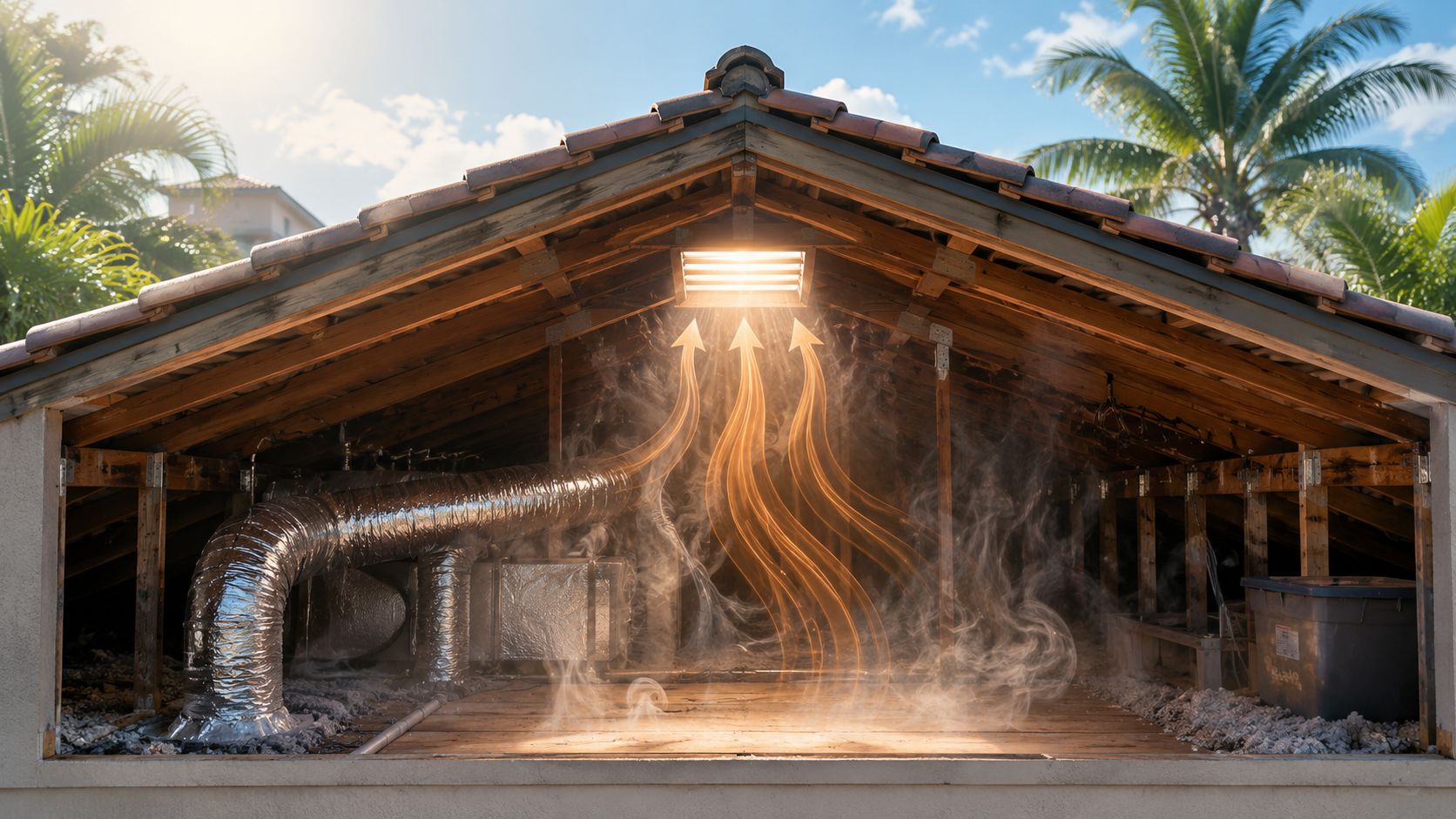
In a humid climate, ventilation has several jobs at once:
- Reduce trapped attic heat so the rooms below don't stay hotter than they need to.
- Move moisture out before it contributes to mold, damp insulation, or wood deterioration.
- Protect the roof structure by limiting long-term heat and humidity stress at the decking and framing.
- Help the AC system by reducing the heat load above the ceiling.
One reason ridge vent vs roof vent matters so much here is airflow efficiency. In hot climates like South Florida, ridge vents generally deliver superior airflow efficiency compared to box vents, helping reduce attic heat buildup and keeping second-floor temperatures lower, while box vents often need far more units to move comparable air, according to this South Florida-focused ventilation comparison.
Practical rule: Ventilation is a system, not a product. Intake, exhaust, roof shape, and existing vents all have to work together.
That's why the best vent on paper can still perform badly on a real house. The attic has to breathe in a controlled path. If the path is wrong, the vent choice won't save it.
Understanding the Mechanics of Roof Ventilation
Ridge vents and roof vents solve the same problem in different ways. The difference is not cosmetic. It changes how air travels through the attic, how evenly heat is removed, and whether the system works with or against the rest of the house.
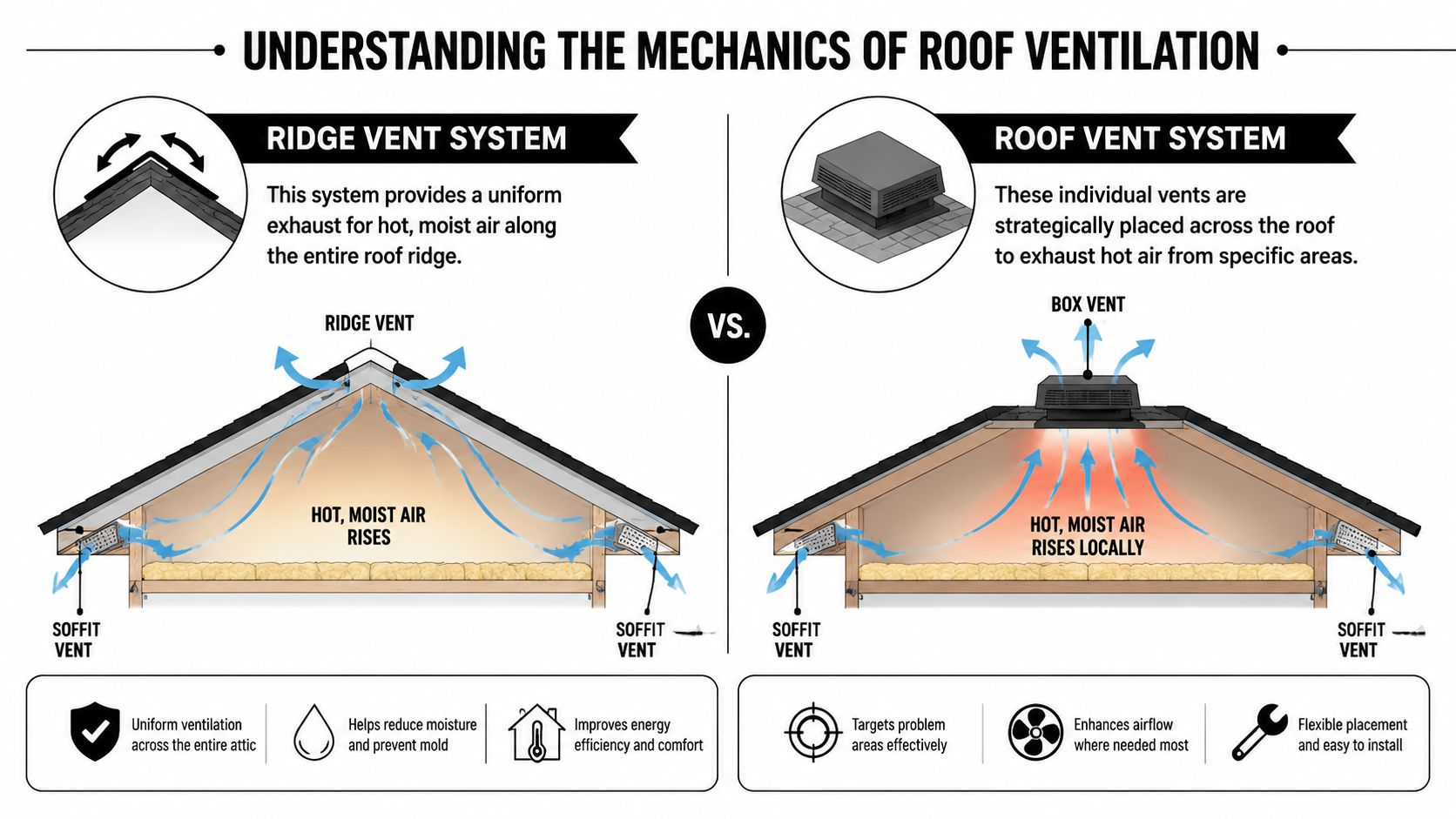
How a Ridge Vent Moves Air
A ridge vent runs along the roof peak, which is the highest exhaust point available on a standard attic. The installer cuts a slot near the ridge and covers it with a vented product and ridge cap shingles. Air that enters low at the soffits rises and leaves high across the full ridgeline. GAF explains that ridge vents are designed to exhaust attic air at the peak as part of a balanced intake and exhaust system in its attic ventilation overview.
That continuous opening is the main advantage. Instead of relying on a few holes in specific spots, the attic gets a uniform exhaust path at the top. On a simple gable roof with clear soffit intake, that usually produces more even air movement than isolated static vents.
The catch is system compatibility. A ridge vent works best when the attic is one connected space and lower intake is open. If soffits are blocked by insulation, or if the house still has open gable vents, the airflow can short-circuit. Air takes the easiest path, not the path the roofer intended.
How Box and Other Roof Vents Work
Box vents, also called static roof vents, exhaust through individual openings cut into the roof surface. Each one serves the area around it. That can work well on roofs with broken ridgelines, hips, valleys, separated attic sections, or layouts where one continuous ridge vent would not draw evenly across the whole attic.
Placement matters more with box vents. A bad layout leaves dead zones. A good layout can solve roof shapes that a ridge vent alone does not handle well.
Other roof vents follow the same basic split. Static vents rely on natural air movement. Mechanical vents use fans or turbines to force air out. In South Florida, I treat powered attic fans carefully. They can help in some houses, but if intake is weak or the ceiling plane is leaky, they can pull conditioned air from the house instead of fixing the attic.
Why airflow pattern matters
Airflow pattern is where many attic ventilation jobs go wrong.
A vent is only one part of the assembly. The bigger question is whether the house has a vented attic at all. If the attic is part of an unvented spray foam system, adding ridge vents or box vents is usually the wrong move because the thermal and air boundary has been moved to the roof deck. Mixing vented and unvented strategies can create moisture problems and waste money.
Existing vents can also conflict with a new system. Open gable vents often interfere with ridge-and-soffit airflow by pulling air across the upper attic instead of drawing it from the eaves. That leaves lower sections of the attic hotter and less effectively flushed.
For South Florida homes, that matters. High outdoor humidity, long cooling seasons, and wind-driven rain expose weak ventilation designs fast. The best setup is not the vent type that sounds best in a sales pitch. It is the one that matches the roof shape, the insulation strategy, the code requirements, and the vents already in place.
Head-to-Head Comparison Ridge Vents and Roof Vents
Florida Solar Energy Center testing found that attic ventilation changes heat flow, but the vent label alone does not decide the result. On a South Florida home, ridge vents and box vents perform very differently once roof shape, existing vent conflicts, and insulation type are factored in.
Airflow and Coverage
Ridge vents exhaust along the highest continuous point of the roof. On a simple gable roof with full soffit intake, that usually gives the most even exhaust path across the attic. Box vents, also called static roof vents, exhaust only where each unit is installed, so coverage depends on layout, vent count, and whether each attic section can reach those openings.
That difference matters most on larger attics and cut-up roof designs. A long ridge can ventilate evenly. A broken ridge or separated attic compartments often cannot. In those cases, box vents can solve a real design problem that a ridge vent cannot solve cleanly.
Manufacturers and code tables size these systems differently because they do not move air the same way. Air Vent notes in its attic ventilation guide that proper vent selection depends on net free area, balanced intake and exhaust, and roof configuration, not just vent style.
Practical takeaway: Ridge vents exhaust continuously. Box vents exhaust in targeted locations. The better option depends on whether your roof gives air a clean path from soffit to exhaust.
Weather Exposure and Roof Penetrations
Every penetration in a South Florida roof has to survive heat, UV, wind, and wind-driven rain.
Ridge vents require a continuous slot at the ridge, then ridge vent material and cap shingles over the top. Box vents require several individual cut-ins across the field of the roof. More field penetrations usually mean more flashing points, more sealant details, and more places to inspect as the roof ages.
That said, fewer penetrations do not automatically mean fewer problems. A badly installed ridge vent on a low-quality shingle roof can leak. A properly flashed box vent can last for years without trouble. The deciding factor is workmanship, product quality, and whether the vent type fits the roof system.
This is also where incompatibility shows up fast. If a house still has open gable vents, a new ridge vent may short-circuit airflow near the top of the attic instead of pulling consistently from the soffits. If the attic has been converted to an unvented spray foam assembly, adding either ridge vents or box vents is usually the wrong move because that roof deck was designed to be inside the conditioned envelope.
Appearance and Roof Design Fit
Ridge vents are less visible from the ground. Homeowners usually prefer that look, especially on newer architectural shingle roofs.
Box vents are visible, but appearance should not outweigh function. On hip roofs, chopped-up rooflines, and homes with multiple isolated attic pockets, box vents often fit the structure better. I have seen plenty of South Florida homes where a ridge vent looked cleaner on paper but left dead zones because the ridge length was too short or the attic sections were disconnected.
A modern roofing system can also limit your options. Some high-performance assemblies, especially spray-foam roof decks, should not be mixed with conventional venting at all. On those homes, the right comparison is not ridge vent versus box vent. It is whether the house should have a vented attic in the first place.
| Feature | Ridge Vents | Roof Vents (Box Type) |
|---|---|---|
| Air distribution | Continuous along usable ridge length | Concentrated at each vent location |
| Best fit | Simple gable roofs with strong soffit intake | Complex roofs, short ridges, separated attic sections |
| Roof penetrations | One continuous ridge opening | Multiple field penetrations |
| Visibility | Low profile under ridge caps | Visible from ground level |
| Common failure point | Weak performance if soffit intake is blocked or gable vents remain open | Uneven ventilation if vent count or placement is wrong |
| Compatibility concern | Poor choice for many spray foam, unvented attic assemblies | Also a poor choice for unvented attic assemblies |
Thermal performance homeowners often miss
Marketing often gives too much credit to the exhaust vent itself.
A 1995 study by Beal and Chandra found that sealing an attic versus ventilating it to standard 1:300 levels with soffit and ridge venting produced a 32% reduction in attic heat flux, while adding a ridge vent alone improved ceiling heat flux reduction by only about 4% compared to standard ventilation. The researchers also found attics with balanced soffit and ridge vents averaged 22°F higher than ambient temperatures, based on the published Florida Solar Energy Center research paper.
For homeowners, the lesson is straightforward. Ridge vents can work very well. Box vents can also work well. Neither one fixes a bad attic design, blocked soffits, conflicting gable vents, or a roof that was supposed to remain unvented.
Analyzing the Costs and ROI of Each Vent System
Florida roofs are expensive to replace. That is why vent pricing should be judged against roof life, attic moisture control, and whether the system fits the house.
A ridge vent usually costs more as a full system because it often requires a continuous ridge cut, matching ridge cap work, and enough soffit intake to make it function correctly. Individual roof vents, often called box vents or static vents, usually cost less per unit and can be a practical retrofit on roofs with short ridges, multiple attic sections, or layouts where a continuous exhaust path is not realistic. Owens Corning notes that attic ventilation costs vary with roof design, vent type, and labor scope, not just the vent product itself, in its attic ventilation guide.
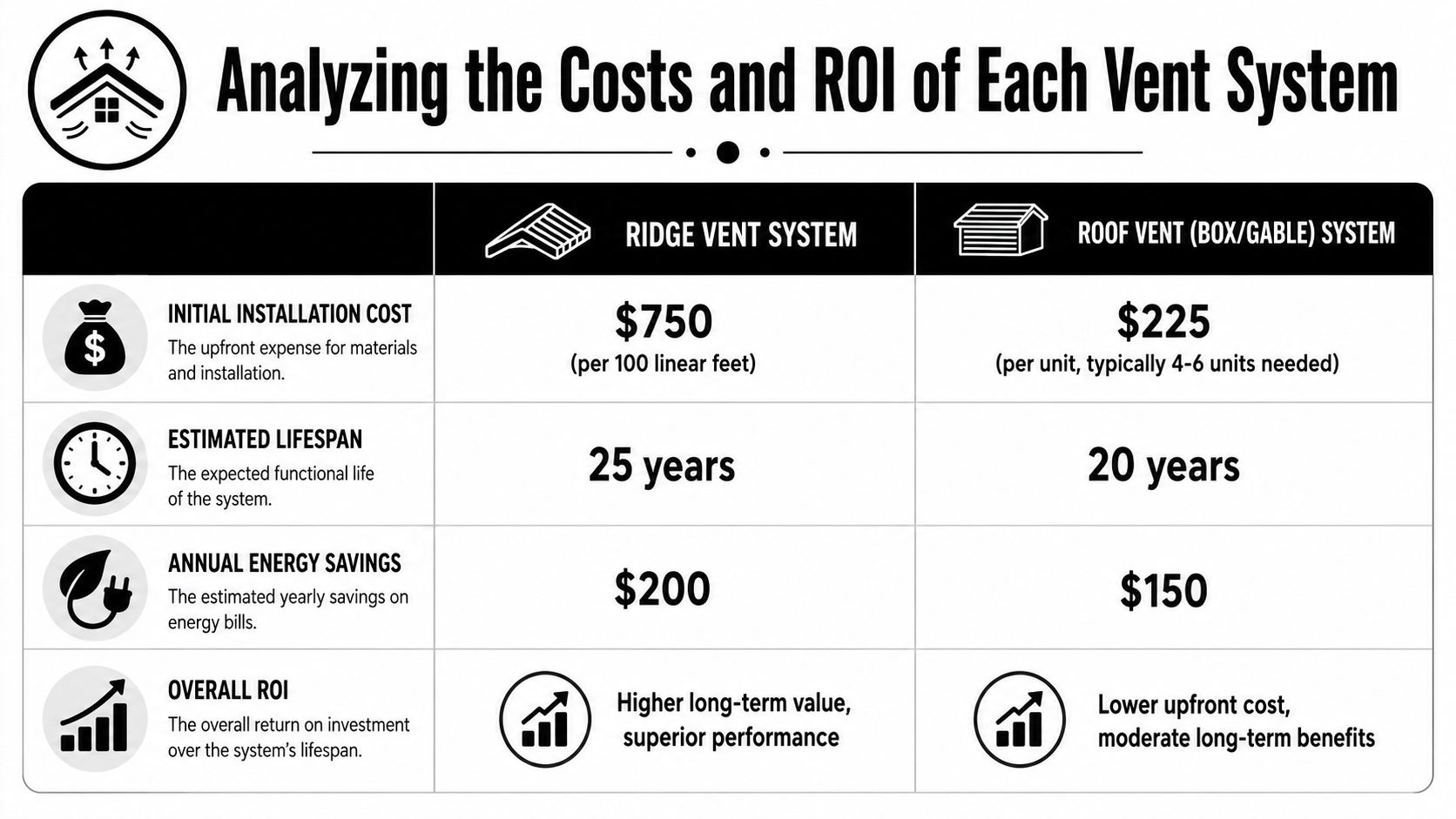
That cost spread gets wider in South Florida.
On a straightforward gable roof with clean soffit intake, ridge vent pricing can make sense because one continuous exhaust line can ventilate the attic without adding several field penetrations. On a chopped-up roof, the math changes. A few properly placed static vents may solve the exhaust problem with less tear-in and less ridge modification. The lower install price can produce better value if the roof shape does not support ridge ventilation well in the first place.
ROI also depends on what the attic assembly is supposed to be. If the home has spray foam under the roof deck and the attic was designed to be unvented, adding ridge vents or box vents is not an upgrade. It is a correction in the wrong direction. The U.S. Department of Energy attic ventilation guidance makes that distinction clearly. Venting strategy has to match the insulation and air-sealing strategy.
Maintenance matters too. Ridge vents have no motor and keep the roof profile cleaner, but they still depend on proper installation, intact baffles, and open intake below. Static roof vents are simple and serviceable, but every extra unit is another flashing and another potential leak point over time. In our climate, salt air, wind-driven rain, and storm repairs make those details more important than brochure-level energy claims.
The best return usually comes from avoiding a mismatch.
- Ridge vents often deliver better value on longer ridge lines with balanced soffit intake and one connected attic space.
- Roof vents often deliver better value on complex roofs, older homes with existing gable vent conflicts, or houses where separating attic sections requires targeted exhaust.
- Powered attic fans rarely produce strong payback once electricity use, maintenance, and pressure problems are factored in. The Florida Solar Energy Center has published research showing attic ventilation changes do not automatically produce large cooling-energy savings, especially when the rest of the attic system is poorly designed, in this Florida Solar Energy Center research paper.
The cheapest option on bid day can turn into the expensive option if it leaves the attic humid, pulls from the wrong openings, or conflicts with a modern unvented assembly.
For South Florida homeowners, the strongest ROI usually comes from a vent system that matches the roof geometry, the existing vent layout, and the attic design. If those three do not line up, neither ridge vents nor roof vents will earn their keep.
Critical Installation Factors for South Florida Homes
Standard ridge vent vs roof vent advice often falls apart. Two houses can have the same shingles and need completely different exhaust strategies because of what's already inside the attic.
Why Gable Vents Can Defeat a Ridge Vent
A ridge vent should not be treated like a universal upgrade. If a house already has gable vents, adding a ridge vent without reworking the whole ventilation plan can create a bad airflow path.
Roofing professionals discussing this issue have stated plainly that ridge vents are not recommended when existing gable vents are in place because the combination can lead to wind-driven rain intrusion or reversed airflow, as discussed in this roofing community thread about ridge vents and gable vents.
What does that mean in real terms?
- Air may enter and exit too close to the top of the attic instead of pulling from the soffits.
- The attic can short-circuit its own airflow pattern.
- Storm conditions can drive rain where the pressure pattern is working against the intended design.
This issue is especially relevant in South Florida because older homes often already have gable vents. If those vents stay in service, a box vent or other roof exhaust strategy may be the cleaner answer.
If the house already has gable vents, don't assume a ridge vent is an upgrade. It may be a conflict.
What changes with spray foam roof assemblies
Another problem most homeowner guides ignore is the unvented roof assembly, especially with spray foam. These systems don't behave like traditional vented attics.
GreenBuildingAdvisor notes that in an unvented roof, the answer is not a standard ridge vent but a vapour-diffusion vent at the ridge with specific requirements of 1:600 port area, vapor permeance greater than 20 perms, and roof slope greater than 3:12, based on this discussion of ridge treatment in unvented roofs.
That matters in South Florida because open-cell spray foam is common, and humidity is relentless. On these homes, copying a traditional ridge vent setup without checking the roof assembly can trap moisture where the system was never supposed to vent conventionally.
A few field rules help:
- Traditional vented attic: Ridge vents or box vents may work, depending on layout and intake.
- Existing gable vent house: Treat ridge vent installation with caution unless the gable vents are addressed.
- Spray foam unvented assembly: Verify whether the roof should use a vapor-diffusion detail rather than conventional attic venting.
- No soffit intake: Stop and fix intake first. Exhaust alone won't solve the problem.
That's the part many homeowners never hear. Ridge vents are often the best option. They are not the best option in every assembly.
Which Ventilation System Is Right for Your Roof
The right answer comes down to roof shape, intake availability, and what's already in place.
Choose a Ridge Vent When
A ridge vent is usually the better option if your home has a straightforward roof design, a usable ridge line, and balanced passive intake at the soffits. Professional roofing standards require a strict 50% intake and 50% exhaust balance for ridge vent installations, and without that balance the system can short-circuit and fail to circulate air through the attic, according to this roofing standards explanation on balanced ventilation.
Choose a ridge vent when:
- Your soffit intake is present and open
- Your roof has a clear ridge line
- You want a lower-profile appearance
- You are not trying to combine it with conflicting vent types
Choose a Roof Vent When
Box-type roof vents are often the smarter choice when the roof is cut up by hips, valleys, multiple levels, or separated attic spaces. They also make more sense when an existing vent layout can't be converted cleanly to a balanced ridge-and-soffit system.
Use roof vents when:
- The roof geometry is complex
- The attic is divided into sections
- Existing gable vent conditions make ridge venting a poor fit
- A continuous ridge exhaust path doesn't exist
The biggest mistake is trying to force one favorite product onto every roof. In ridge vent vs roof vent decisions, the better system is the one that completes a proper airflow circuit on your actual house.
How to Ensure Your Roof Ventilation Is Done Right
Poor vent design usually fails in one of two places. The vent area was never calculated correctly, or the roof system was never checked for compatibility before anyone started cutting holes.
Start with the net free vent area your attic needs, then split that capacity between intake and exhaust. The common rule of thumb is the 1:300 ratio for balanced systems, with roughly half at the soffits and half at the exhaust. The Federal Housing Administration attic ventilation guidance is a solid reference for that baseline. In the field, the calculation is only the first step. South Florida homes often have blocked soffits, leftover gable vents, or insulation upgrades that change the whole strategy.
What a Roofer Should Verify Before Installation
A proper inspection should confirm these points before any vent is added, replaced, or removed:
- Intake is usable, not covered by insulation, paint, debris, or aftermarket soffit panels with too little open area
- Exhaust types are compatible, so ridge vents are not competing with box vents, powered fans, or open gable vents
- The attic is one connected space, or whether fire walls, additions, or separated roof sections require independent ventilation zones
- The roof assembly is vented by design, because spray foam under the roof deck can turn the attic into an unvented assembly where ridge and box vents are the wrong answer
- Local code and product approvals line up with the roof covering, especially in high-wind South Florida installations
That last point matters more than many homeowners realize.
I see the same mistake over and over. A house gets a new ridge vent, but the old gable vents stay open. That creates a shorter air path between the gable and ridge, so the system can pull air sideways instead of drawing it from the soffits through the full attic. The vent is not defective. The layout is.

Why the inspection matters more than the vent style
Ridge vent versus roof vent is only part of the job. A key question is whether the whole assembly works together. If the attic has open-cell or closed-cell spray foam at the roofline, the correct move may be to seal off old vents, not add more. If the roof has multiple isolated sections, one continuous ridge vent may leave dead pockets untouched. If soffit intake is weak, adding more exhaust can make performance worse instead of better.
Homeowners in Broward, Miami-Dade, and Palm Beach should ask the roofer to show the airflow plan, identify vents that must be closed off, and explain how the attic type affects the recommendation. If you are reviewing a contractor's inspection-related materials, Paletz Roofing and Inspections branding is one example of a local company presence tied to roof inspections and ventilation work in South Florida.

If you want a clear answer on whether your home needs a ridge vent, box vents, or a full ventilation redesign, contact Paletz Roofing and Inspections. Their team serves South Florida with roof inspections, repairs, replacements, and ventilation assessments that account for intake balance, vent conflicts, spray foam assemblies, and the heat, humidity, and wind exposure this region deals with every year.