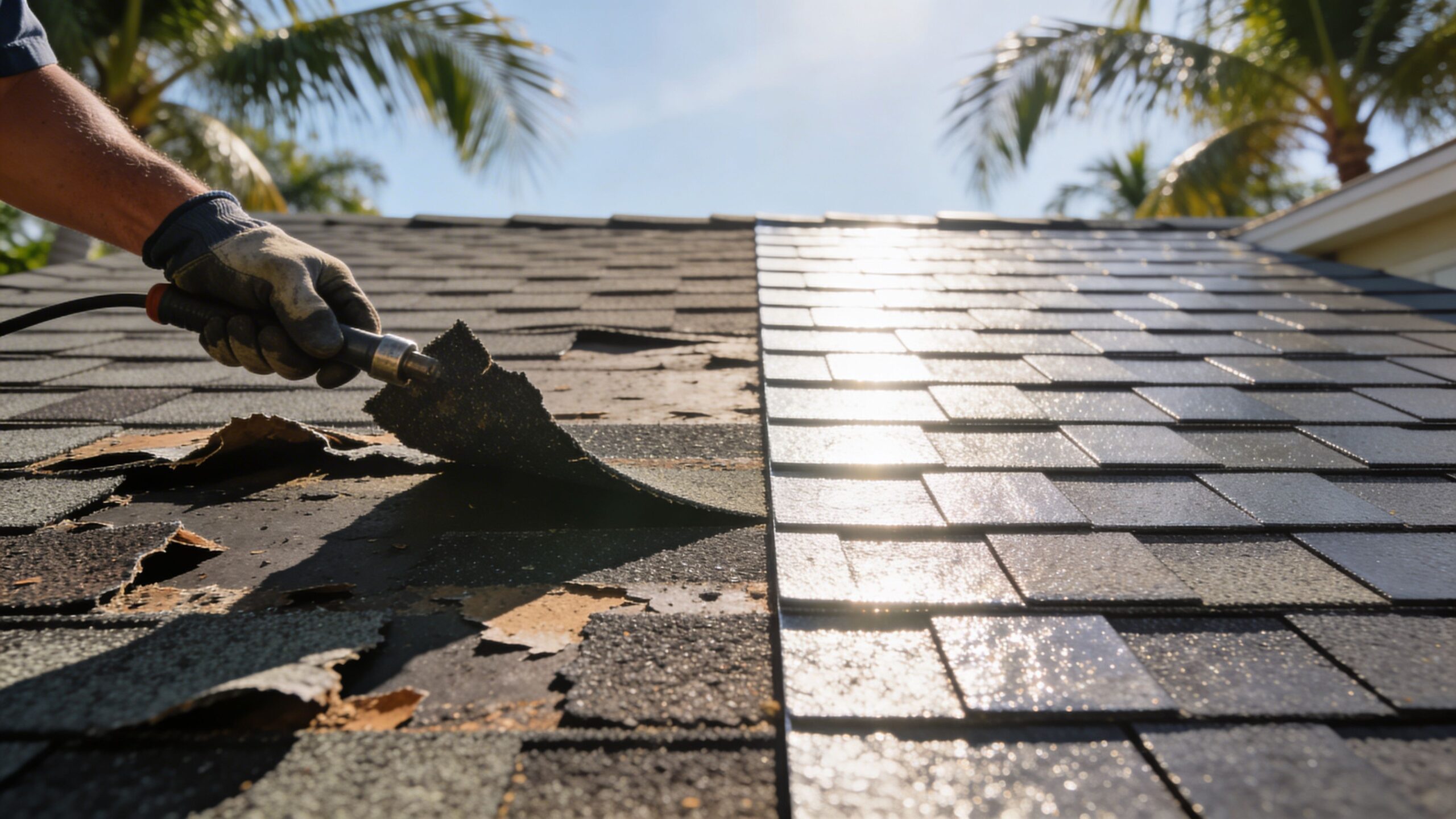
When a roof starts leaking in South Florida, most homeowners jump straight to the same expensive fear: “I guess I need a new roof.” Sometimes that’s true. A lot of the time, it isn’t.
The bigger issue is making the wrong move for the wrong reason. In the United States, roof repair and replacement costs reached nearly $31 billion in 2024, and roof-related claims made up more than a quarter of all residential claim values, according to Insurance Journal’s report on rising roofing losses. That number matters because it changes how you should think about the problem. This isn’t only a maintenance decision. It’s an asset protection and insurance decision.
In Broward, Miami-Dade, and Palm Beach, a roof has to do more than keep water out on a calm afternoon. It has to survive heat, UV, wind uplift, and the next named storm. A repair that makes sense in a mild climate can be a bad decision here. On the other hand, a full replacement can be a waste of money if the damage is isolated and the rest of the system is still sound.
If you’re asking can you repair a roof instead of replacing it, the honest answer is yes, often. But only under the right conditions, and only if you look past the upfront invoice and consider lifespan, insurability, code requirements, and what happens when the next hurricane warning goes up.
Repair or Replace Your Roof? The Billion-Dollar Question
The repair-versus-replace question is oversimplified. People treat it like a choice between a cheap option and an expensive option. In practice, it’s a choice between short-term spending and long-term exposure.
A repair makes sense when the roof still has useful life left, the damage is limited, and the fix restores performance. A replacement makes sense when repairs only delay a larger failure, or when insurance and code realities make patching a bad investment.
Here’s the fast comparison homeowners usually need first:
| Factor | Repair often makes sense when | Replacement often makes sense when |
|---|---|---|
| Damage area | Limited and localized | Widespread or across multiple sections |
| Roof age | Still in the earlier part of service life | Nearing the end of service life |
| Leak source | Clearly identified | Repeated leaks in different areas |
| Cost decision | Repair stays well below replacement threshold | Repair cost climbs too close to replacement |
| Storm readiness | Existing system remains structurally sound | Wind resistance or deck condition is questionable |
| Insurance outlook | Carrier still accepts repair path | Carrier may challenge coverage on older patched roofs |
| Appearance | You can accept a visible patch or close match | You want uniform appearance and reset warranties |
Practical rule: A roof problem is rarely just a roof problem in South Florida. It affects drywall, insulation, interior finishes, mold risk, claim handling, and future policy renewals.
The right decision starts with a physical assessment, not guesswork. You need to know four things first:
- How old the roof is
- How much of the roof is damaged
- Whether the decking and structure are still sound
- Whether a repair preserves or weakens your insurance position
Once those are clear, the decision gets much easier.
Reading the Signs When Your Roof is a Candidate for Repair
A lot of roofs can be repaired successfully. The key is that the problem has to be specific, not systemic.
For asphalt shingle roofs in hurricane-prone areas like South Florida, repairs are generally viable when damage is localized to less than 25% of the roof surface and the roof is under 15 to 20 years old, and those targeted repairs can cost 60% to 75% less than full replacement, based on this roof repair threshold review.

Localized storm damage
This is the most common repair situation.
If a wind event lifted a few shingles, broke a limited section of tile, or pulled flashing loose around one penetration, that’s often a repair job. The rest of the roof may still be doing its job.
Look for damage that is:
- Confined to one area instead of spread across multiple slopes
- Tied to one event such as a recent storm
- Visible at edges or penetrations like vents, pipe boots, skylights, or chimneys
- Not accompanied by sagging or widespread staining inside
A roof with one problem area is very different from a roof failing in several places at once.
Small leaks around roof details
Many leaks don’t start in the field of the roof. They start at transitions.
Pipe jacks crack. Counterflashing loosens. Sealants fail. Fasteners back out. Valleys collect debris and hold water. On tile and shingle systems, these are common repair points.
That matters because a leak over a bedroom ceiling doesn’t automatically mean the whole roof is bad. It may mean one detail failed.
A leak location inside the house is not always the leak origin on the roof. Water travels. Good roofers trace the path before they price the fix.
The roof still has useful life left
Age matters, but condition matters more.
A younger roof with isolated damage is usually worth repairing. A roof that still has solid decking, acceptable material condition, and no broad pattern of breakdown should not be torn off just because one section was hit.
That’s especially true if the roof was installed correctly and the issue is limited to replaceable components.
What you can often repair successfully
These are the situations that commonly justify repair work:
- Missing shingles or tiles: Wind damage that affects a limited area can often be corrected without disturbing the entire system.
- Flashing failures: Metal flashing around walls, vents, and chimneys often causes leaks and can often be replaced or reset.
- Minor punctures or isolated surface damage: Fallen branches or service foot traffic sometimes create repairable damage.
- One leak with one source: If the moisture path is clearly identified and the surrounding roof is sound, a focused repair is often the smart move.
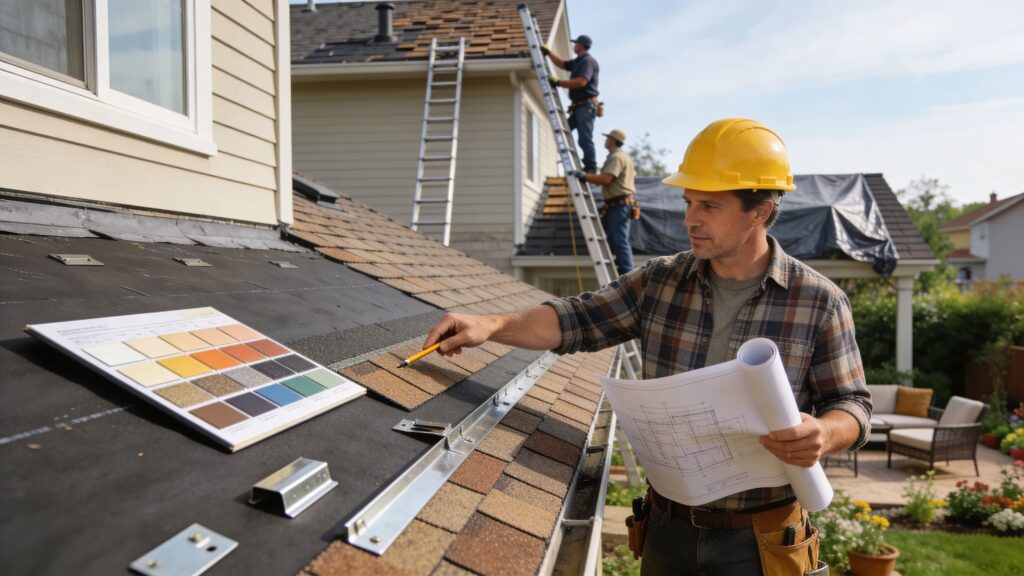
If you want to see the kind of damage pattern roofers evaluate closely, this roof image example is the type of situation where the spread and concentration of damage matter more than panic.
Signs you are past the repair stage
Homeowners lose money in this situation. They pay for a repair on a roof that’s already telling them it’s done.
Repair is usually the wrong call when you see:
- Widespread granule loss or surface wear
- Repeated leaks in unrelated areas
- Soft decking underfoot
- Sagging lines
- Large sections of cracked, curled, or brittle shingles
- Water intrusion that has already moved below the roof covering into substrate or structure
If the roof is failing as a system, a patch won’t change that. It just moves the invoice.
Comparing Your Options Across Cost Lifespan and Long-Term Value
The cheapest invoice is not always the lowest cost decision.
A repair can save serious money today. A replacement can prevent years of repeat calls, interior damage, coverage headaches, and ugly section-by-section patchwork. The right choice depends on whether the repair is solving a limited problem or financing a roof that’s already on its way out.
Here’s the side-by-side view most property owners need.
| Decision point | Repair | Replacement |
|---|---|---|
| Upfront spending | Lower immediate cost | Higher immediate cost |
| Best fit | Localized damage on a roof with remaining life | Aging roof or broad system failure |
| Disruption | Usually less invasive | More invasive and longer process |
| Visual match | May be noticeable on older roofs | Uniform appearance |
| Warranty effect | Often limited to repaired area | Typically resets system coverage |
| Storm confidence | Depends on overall roof condition | Stronger if full system is updated |
| Insurance posture | Can be harder on older roofs with patch history | Often cleaner for underwriting and claims |
| Long-term planning | Good when buying time is reasonable | Better when repeated repairs are likely |

The 30 percent rule of thumb
There’s one guideline I tell people to keep in mind because it cuts through a lot of indecision. If the repair cost exceeds 30% of the full replacement price, replacement is often the better economic move. That same source notes that an asphalt shingle roof replacement averages $30,680 and returns 56.9% at resale, according to this roofing cost and ROI reference.
That doesn’t mean every repair under that threshold is a good idea. It means once you get close to that line, you need to ask a harder question: what exactly are you preserving?
If the answer is “a roof with real life left,” repair may still win. If the answer is “an old roof with mounting risk,” replacement usually wins.
When repair gives real value
Repair has a strong place in South Florida. It’s often the right financial move when:
- Damage is isolated: One slope, one leak source, one storm-hit section.
- The roof is still structurally sound: Decking, attachment, and surrounding materials are holding up.
- You need immediate protection without a full capital project: A good repair can stabilize the property and stop interior damage.
- You are not triggering larger code or insurance problems: This point matters more here than it does in many other states.
Good repairs also create less disruption. That matters for occupied homes, businesses, associations, and buildings where a full tear-off affects operations.
When replacement creates better long-term value
Replacement starts to make more sense when the roof has become a series of problems instead of one problem.
That usually shows up as recurring leaks, visible aging across large sections, poor prior repairs, or a mix of old and new materials that no longer act like one roof system. In those cases, each repair buys less certainty.
Decision lens: Don’t compare repair cost to replacement cost alone. Compare repair cost to the value of the remaining reliable service life.
A replacement can also clean up issues that a patch cannot:
- Uniform weather barrier performance
- Consistent attachment and wind resistance
- Reset material condition across the whole roof
- Cleaner underwriting conversation with insurers
- Better appearance for resale or leasing
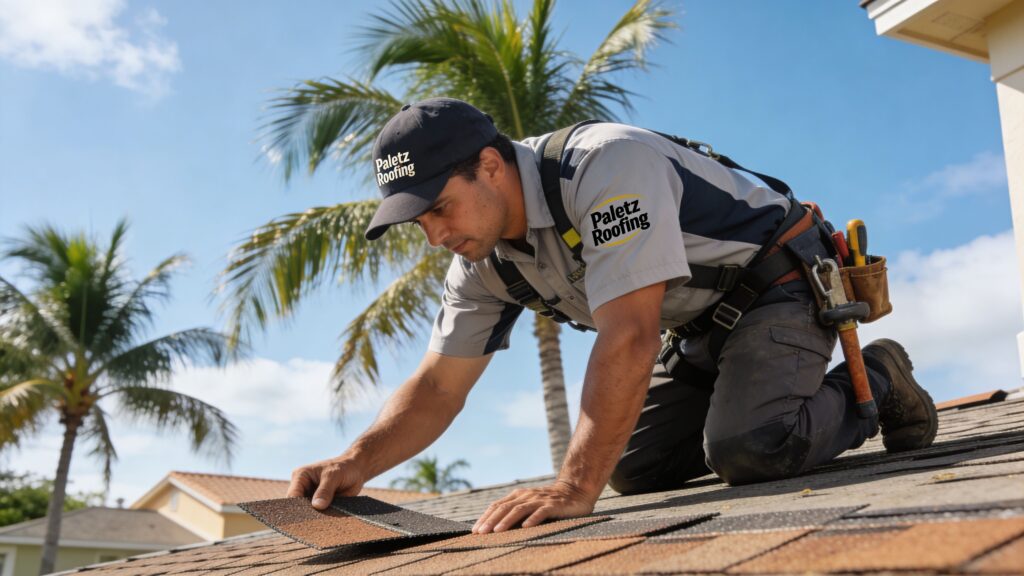
If you’re evaluating visible wear and trying to judge whether the roof still behaves like one system, this roof comparison visual is the kind of side-by-side context that helps frame the conversation.
Lifespan and timing matter more than people think
The same repair can be smart on one roof and wasteful on another.
A flashing repair on a younger roof can add useful years. The same flashing repair on a heavily aged roof may only postpone broader failure. That’s why roof age, weather exposure, and overall condition matter more than the leak itself.
Aesthetic matching is a real trade-off
Homeowners often underestimate this one until the job is done.
On older shingle roofs and weathered tile roofs, a repair may stand out. Sun exposure changes color over time. Even when the replacement material is correct, the surrounding field may have faded enough that the patched area is visible from the street.
That doesn’t mean repair is wrong. It means you need to decide whether appearance matters more than preserving cash.
The honest bottom line on cost
If your roof is healthy, a repair protects your money.
If your roof is old, brittle, repeatedly leaking, or difficult to insure, a cheap repair can be the most expensive decision you make all year.
How Hurricanes and Heat in South Florida Impact Your Decision
South Florida changes the repair-versus-replace equation.
A roof in this market doesn’t age gently. Heat, UV exposure, wind-driven rain, and storm cycles put more stress on every seam, fastener, flashing line, and exposed surface. That’s why a repair that looks fine on paper can perform very differently after one hurricane season.

Time matters after a storm
After a hurricane or major wind event, waiting is where small damage turns into expensive interior work.
In storm-vulnerable markets like South Florida, post-hurricane repairs completed within 72 hours can reduce interior damage claims by 60%, according to Owens Corning’s reroof versus repair guidance. That same guidance also notes that when more than 25% of shingles show curling or cracking from thermal cycling, repair performance drops enough that replacement becomes the stronger option.
The point isn’t only speed. It’s containment.
A small breach after a storm rarely stays small here. Wind-driven rain finds underlayment laps, wall intersections, and fastener penetrations quickly.
Heat changes how materials fail
South Florida roofs take a daily beating from sun and heat. Then afternoon rain cools surfaces fast. That expansion-and-contraction cycle stresses roofing materials over and over.
On asphalt systems, you often see:
- Curling and brittleness
- Loss of flexibility
- Cracking at exposed edges
- Progressive weakening around repaired areas
On tile systems, the visible tile may look acceptable while underlayment and flashings tell a different story. On metal roofs, the panel may be fine while screws, seals, and transitions become the weak point.
This is why a visual check from the ground doesn’t tell you enough.
Wind resistance is not just about the damaged spot
A lot of owners focus on the obvious missing shingle, broken tile, or open seam. The bigger concern is whether that isolated damage points to a wider attachment problem.
If the surrounding system still has good integrity, repair can work well. If the damage shows the roof has lost its ability to resist uplift as a system, replacement becomes the safer path.
A roof doesn’t fail one piece at a time during a hurricane. Once wind gets under the system, failure can spread fast.
Material-by-material reality
Different roofs handle repair differently in this climate.
Asphalt shingles
These are common, practical, and often repairable when damage is limited. But they are also vulnerable to heat aging and wind damage. Once a shingle roof becomes brittle, repair crews can create more breakage by moving across it.
Tile roofs
Tile can sometimes be repaired selectively, especially when the breakage is limited. The caution is underneath. If the visible tile damage is minor but the underlayment is aging broadly, replacing a few tiles doesn’t solve the underlying problem.
Metal roofs
Metal often gives you more repair flexibility when the panel system remains sound and the issue is tied to fasteners, flashing, penetrations, or localized corrosion. The repair has to be done carefully so you don’t create future leak points.
Flat and low-slope systems
These can often be repaired effectively if seams, penetrations, drains, or ponding areas are treated correctly. But standing water, open seams, and repeated patching are warning signs that the system needs a larger reset.
What works in South Florida
The best repair decisions here share a few traits:
- The damage is identified quickly
- The repair is done before moisture spreads
- The surrounding roof still has storm value
- The owner is making a weather decision, not just a budget decision
A repair should leave the roof ready for the next storm, not just closed up for the next rain.
Navigating Insurance Claims Permits and Warranty Rules
A roof repair can save money upfront and still cost you more later if it creates claim trouble, coverage gaps, or code issues.
Many generic articles fail homeowners in this regard. They talk about shingles and leaks, but they skip the paperwork side. In South Florida, that paperwork side can decide whether a repair was smart or shortsighted.

Insurance can punish the wrong repair choice
On older roofs, partial repair can become an argument point for the carrier later.
In hurricane-prone regions like South Florida, repairing an older roof can nullify remaining manufacturer coverage on undamaged sections. The same source states that 35% of claims were disputed due to partial repair attempts on roofs over 20 years old, as insurers increasingly push toward full replacement in these cases, according to this discussion of repair-related warranty and claim issues.
That doesn’t mean every repair creates a dispute. It means you need to think beyond whether the leak stops today.
If the insurer sees an aged roof with a patch history, they may argue the system was already at the end of its life. Once that happens, your repair receipt doesn’t always help the way you think it will.
Warranties don’t always survive patchwork
Manufacturers care about system continuity. They also care about approved methods, compatible materials, and scope.
That’s why a homeowner can spend money on a repair and still weaken their warranty position. The repair itself may be fine, but the remaining undamaged sections may no longer have the same coverage standing they once had.
This is especially important when:
- The roof is already older
- The repair is broad enough to change system behavior
- The work mixes products or methods
- The original installation paperwork is incomplete
Permits and disputes matter more than people expect
A roof decision can turn into a dispute when owners, insurers, contractors, or associations disagree about scope. That usually happens after storm damage, during claim negotiation, or when one party thinks a patch is enough and another believes code or building condition requires more.
When that happens, outside guidance on documenting defects, scope disagreement, and resolving a roofing building dispute can be useful because the issue often stops being technical and starts becoming evidentiary.
If there’s disagreement about whether the roof can be repaired, documentation matters as much as the repair proposal itself.
Questions to ask before you approve a repair
Don’t sign off on a patch until these points are clear:
- Will this repair affect any existing manufacturer coverage?
- Could the carrier argue the roof is already beyond repairable condition?
- Does the planned work trigger permit or code review?
- Will repaired materials match enough to avoid future inspection questions?
- If another storm hits, will the insurer view this as a maintained roof or an aging roof with temporary fixes?
The common assumption that gets people in trouble
A lot of homeowners think repair is automatically safer because it costs less and seems less invasive.
That assumption fails when the repair leaves you with:
- an older roof that’s harder to insure
- unclear warranty coverage
- a future claim dispute over prior condition
- a patched appearance that signals age and inconsistency during inspections
The roof doesn’t exist in a vacuum. It sits inside a code, permit, warranty, and insurance system. In South Florida, ignoring that system is expensive.
A Step-by-Step Framework for Making the Right Choice
When homeowners ask can you repair a roof instead of replacing it, the cleanest answer comes from following a sequence instead of reacting to the leak.
Step one looks at age and material
Start with the basics.
If the roof is relatively young and the material is still in stable condition, repair deserves real consideration. If it’s an older shingle roof with visible wear in multiple areas, your standard for approving a repair should be much higher.
Material matters too. Tile, metal, shingle, and flat systems age differently and fail differently.
Step two checks scope, not panic
Walk the problem in terms of spread.
Is the damage isolated to one area, or are you finding signs in several places? One broken section after a storm points one way. Recurring leaks in unrelated rooms point another.
Use this quick screen:
- One area affected: Repair may be sensible.
- Multiple slopes or multiple leak paths: Replacement moves higher on the list.
- Visible structural concerns: Stop thinking cosmetic. Get a full professional assessment.
Step three tests whether the repair is preserving a good roof
This is the question many owners skip.
You are not buying a repair. You are buying the remaining performance of the roof after the repair is done. If that remaining performance is strong, the money is well spent. If it is weak, the repair is just a delay.
Field advice: Ask, “What will this roof be after the repair?” not just “What will the invoice be?”
Step four weighs your financial horizon
A homeowner planning to stay put usually benefits from a longer view. A property owner preparing for sale or trying to stabilize a building before a larger project may reasonably choose a sound repair if the roof qualifies.
Think in terms of timing:
Immediate cash flow
Can you handle replacement now, or do you need to stop active water entry first?Next storm season
Will this roof leave you confident during the next major weather event?Future repair cycle
Are you likely to be spending again soon if you choose the repair route?
Step five reviews insurance and warranty exposure
Before work starts, review your policy documents and any warranty paperwork you still have.
Look for language around roof age, storm damage, repair scope, exclusions, and prior condition. If the roof is older, this step is not optional. What looks like a savings decision can turn into a claim problem later.
Step six gets a real inspection
Practical judgment matters more than theory in this situation.
A proper inspection should identify the source of failure, the spread of damage, whether moisture has gone below the roof covering, and whether the system still has enough integrity to justify repair. One option among others in South Florida is to have a contractor such as Paletz Roofing and Inspections evaluate shingle, tile, metal, or flat roof damage and separate repairable conditions from replacement conditions based on what is on the roof.
Step seven chooses the option that lowers risk, not just price
At the end, the better decision is the one that gives you the strongest mix of:
- weather protection
- financial sense
- insurance stability
- reasonable service life
Sometimes that’s a focused repair. Sometimes it’s a full replacement. What matters is that the decision fits the roof you have, not the roof you wish you had.
Secure Your Home with Paletz Roofing and Inspections
South Florida roofs don’t get judged on a sunny day. They get judged when the wind picks up, rain starts driving sideways, and weak spots show themselves fast.
That’s why the repair-versus-replace decision should never be based on guesswork, a quick ladder look, or the hope that one more patch will carry the roof for a few more years. Sometimes a repair is the right financial choice. Sometimes it puts you deeper into an aging system that’s harder to insure and more vulnerable in the next storm.
Paletz Roofing and Inspections has served Broward, Miami-Dade, and Palm Beach counties for over 30 years and has been licensed and insured since 1990. That local experience matters because roofing decisions here are shaped by hurricane exposure, building requirements, and the challenge of keeping a property protected without overspending.
Homeowners and commercial property owners need clear answers to practical questions:
- Is the damage localized or widespread?
- Does the roof still have enough life to justify repair?
- Will a repair create insurance or warranty problems?
- Would replacement save money over the longer term?
Those answers come from a real inspection, not assumptions.
If you want to verify the company identity tied to those services, you can view the Paletz Roofing and Inspections logo file. You need a roof assessment that matches the condition of your actual system, whether that’s shingle, tile, metal, or flat roofing.

The right roofing decision is the one that protects your home, keeps you compliant, and makes financial sense in a hurricane market. If a repair will do that, it should be done properly. If replacement is the safer path, it’s better to know now than after another storm opens the roof up further.
If your roof has storm damage, active leaks, or visible wear and you need a straight answer on whether repair or replacement makes more sense, contact Paletz Roofing and Inspections to schedule an inspection and get a clear, property-specific recommendation.