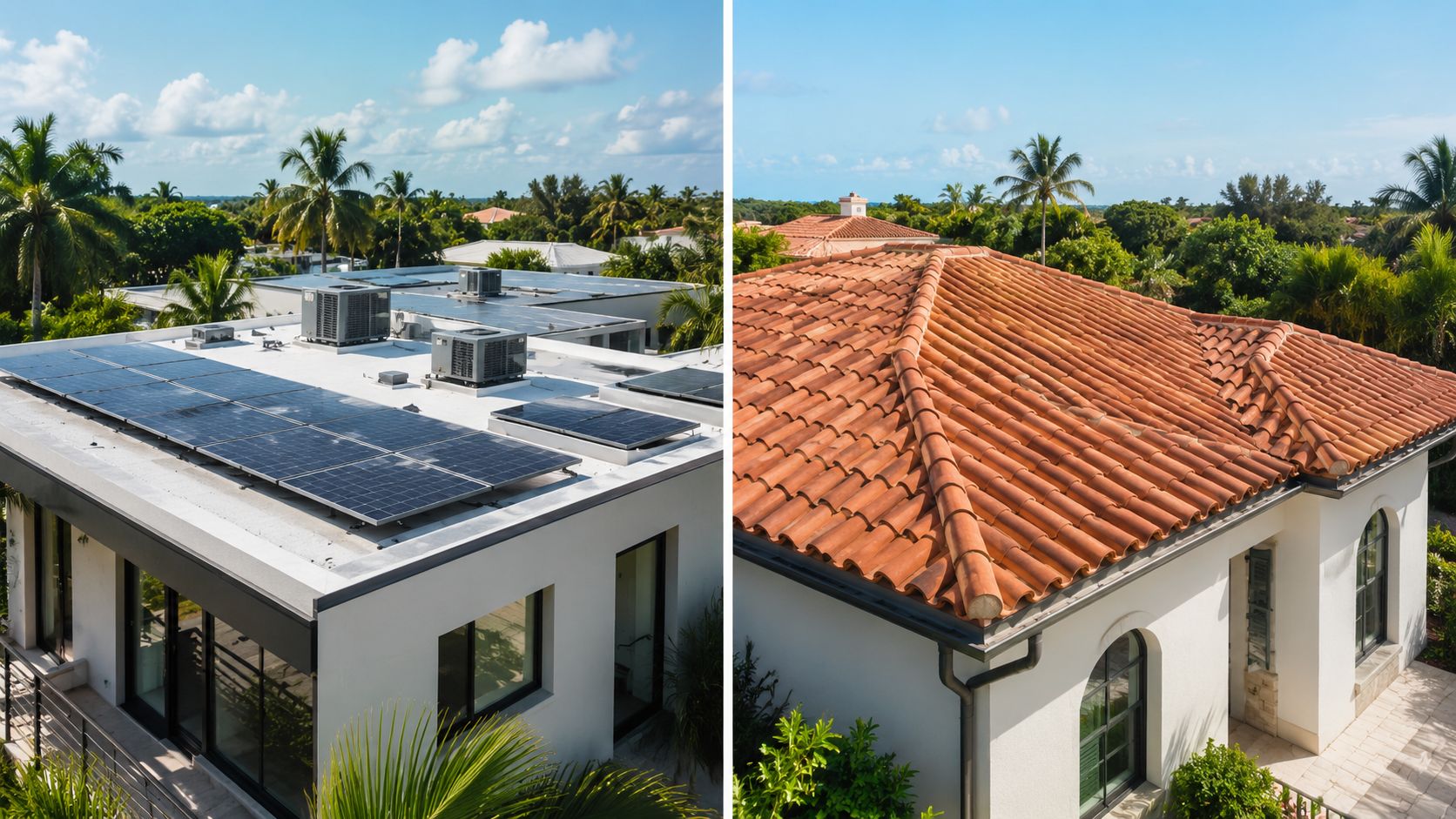
Most roof articles give the same generic advice. Pick pitched if you want drainage. Pick flat if you want modern style. That advice misses what decides the job in South Florida.
Here, roof choice is a storm-performance decision first. A roof has to deal with wind uplift, wind-driven rain, brutal UV exposure, humidity that never really leaves, and code requirements that are stricter than what many national articles assume. The usual “flat roofs always leak” line is also too simplistic. A flat roof in practice is a low-slope roof, and the outcome depends on drainage design, membrane selection, detailing, maintenance discipline, and how the building will use the roof surface.
One of the most useful ways to frame this comes from a comparison that points out the tradeoff isn't flat versus pitched. It's how small-slope drainage, membrane choice, and maintenance frequency change leak risk, service intervals, and lifecycle cost in places with heavy rain and hurricane exposure (analysis of flat roof versus pitched roof tradeoffs). That's exactly the South Florida issue.
A modern low-slope roof can be a rational choice on the right building. A pitched roof can still be the smarter long-term move for many homes. The answer depends on the property, the neighborhood, the use of the structure, and how much upkeep you're realistically willing to stay on top of. For a quick visual reference tied to local roof styles, this South Florida roof design image gives a useful starting point before getting into the technical side.
| Factor | Flat Roof | Pitched Roof |
|---|---|---|
| Drainage approach | Uses low slope plus drains, scuppers, or gutters | Sheds water by gravity |
| Best fit | Commercial buildings, modern homes, rooftop equipment or solar layouts | Traditional homes, many HOA communities, owners prioritizing drainage and longevity |
| Upfront cost trend | Usually lower | Usually higher |
| Maintenance pattern | More frequent attention to seams, edges, drains, ponding areas | Less drainage-related maintenance, but repairs can be harder to access |
| South Florida concern | Drainage design and membrane durability under sun and storms | Wind detailing, attachment, and edge security in hurricane conditions |
| Usable roof space | Strong advantage | Limited practical roof-surface use |
Table of Contents
- Introduction Choosing Your Roof in a Storm Prone Climate
- The Fundamental Difference Flat Slope vs Pitched Slope
- Detailed Comparison for South Florida Properties
- A Guide to Roofing Materials for Each System
- Cost Analysis Flat vs Pitched in 2026
- Real World Scenarios When to Choose Each Roof Type
- Your Decision Making Checklist and Next Steps
- Frequently Asked Questions
Introduction Choosing Your Roof in a Storm Prone Climate
South Florida flips a lot of standard roofing advice on its head. In cooler regions, people often default to pitched roofs because snow and long-term moisture sit at the center of the conversation. Here, hurricanes, UV damage, salt-heavy air near the coast, and code compliance carry much more weight.
That's why the flat roof vs pitched roof decision needs a local lens. A low-slope roof on a commercial building in Miami with multiple HVAC units is a completely different decision from a tile reroof on a single-family home in Boca Raton under HOA restrictions. The roof isn't just covering the structure. It's part of the drainage plan, storm envelope, insurance file, maintenance budget, and in many cases the building's usable mechanical platform.
What property owners usually get wrong
The most common mistake is treating “flat” as if it means level and failure-prone by default. That's not how a properly built low-slope roof works. If the drainage layout is right, the membrane is right for the building, and maintenance is consistent, a flat roof can perform very well in this climate.
The second mistake is assuming a pitched roof solves everything automatically. It does move water off the surface faster, but poor attachment, weak edge metal, bad flashing work, and aging underlayment can still create major storm failures. Slope helps. Slope doesn't excuse bad workmanship.
Practical rule: In South Florida, the better roof is the one that matches the building's use, meets local code cleanly, and can be maintained without shortcuts.
Why local conditions matter more than generic pros and cons
Heavy rain comes in sideways here. Sun bakes exposed materials year-round. On coastal properties, salt exposure pushes metal components harder. After a tropical event, drains, valleys, flashings, and perimeter details tell you much more about future leak risk than broad labels like “flat” or “pitched.”
For homeowners, architecture and neighborhood rules often narrow the choice fast. For commercial owners, rooftop access and equipment loads usually do the same. If you need solar, large mechanical units, or future deck use, flat and low-slope systems stay in the conversation for good reason. If you want the most forgiving water-shedding profile for a traditional residence, pitched roofing still earns its reputation.
The Fundamental Difference Flat Slope vs Pitched Slope
Before talking cost, lifespan, or curb appeal, it helps to get one thing clear. A flat roof is rarely perfectly flat.
A foundational roofing distinction is that a flat roof is usually a low-slope roof, often described as having up to a 3:12 rise, while anything steeper is treated as pitched. That difference matters because low-slope roofs depend on engineered drainage through internal drains, scuppers, and gutters, while pitched roofs shed water by gravity (roof slope and drainage comparison).

How low-slope roofs actually move water
On a flat or low-slope roof, water should never be left to “find its own way.” The installer has to build the path. That can mean tapered insulation, structural slope, crickets, sumps around drains, and carefully located scuppers. If those details are off, water lingers longer than it should.
That's why these roofs are detail-sensitive. The membrane might be excellent, but if water repeatedly sits at a seam, a penetration, or a transition point, the weak spot shows up sooner. In South Florida, that can mean faster trouble after clogged drains, wind-driven debris, or neglected service work by other trades.
How pitched roofs use gravity as their main advantage
Pitched roofs are simpler in concept. The surface angle does more of the work. Water leaves the field of the roof faster, and debris usually doesn't stay put as easily.
Another comparison describes flat roofs as very low pitch, around 1° to 10°, while pitched roofs are often around 20° to 45°. It also notes that the geometric difference is the core performance driver because pitched roofs shed water faster (roof angle comparison). That basic geometry is why pitched roofs remain such a strong fit for residential properties where owners want a more forgiving drainage profile.
A pitched roof gives you more drainage margin. A flat roof gives you more design control over how the roof surface gets used.
What this means in South Florida
In a dry climate, low-slope drainage mistakes may take longer to show up. In South Florida, they usually show up sooner. Afternoon downpours expose weak flow paths quickly. Hurricanes test edge securement, flashing continuity, and drainage capacity under stress.
For pitched roofs, the challenge shifts. The slope helps with water, but high winds can push and pull at ridges, eaves, hips, and perimeter edges. That's why the best pitched roofs in this region aren't just steep. They're well-fastened, properly flashed, and built with materials and attachment methods that suit local code requirements.
The practical takeaway
If you strip away style, the flat roof vs pitched roof decision starts with one question. Do you want the roof itself to be a usable platform, or do you want the roof shape to do more of the drainage work for you?
That one difference drives almost everything else. It affects maintenance. It affects material choice. It affects how much tolerance the system has for neglect. And in South Florida, tolerance for neglect matters.
Detailed Comparison for South Florida Properties
The biggest mistake in roof selection is comparing systems in the abstract. South Florida doesn't allow that. The same roof that makes sense in a dry inland market can become a maintenance headache here if it wasn't chosen for local conditions.
This side-by-side view keeps the focus where it belongs. Storms, heat, moisture, service access, and practical ownership.

A local roof style reference like this South Florida roofing comparison visual is useful because many owners need to balance performance with neighborhood fit.

Hurricane resilience
South Florida owners usually start here, and they should.
A pitched roof can perform very well in hurricanes, but only when the full assembly is right. The visible covering is only part of it. Underlayment, fastening patterns, edge metal, flashing at penetrations, valley construction, and the connection from roof structure into the rest of the building all matter. A beautiful tile or shingle roof with weak perimeter detailing is still vulnerable.
Flat and low-slope roofs have a different storm profile. They don't present the same steep planes to the wind, which can be an advantage in some designs, but they're highly dependent on secure membrane attachment and perimeter integrity. Corners and edges still take abuse. So do penetrations and transitions.
In the field, the roof that usually performs best in a storm is the one with fewer compromised details before the storm starts. Deferred maintenance is what turns a heavy-rain event into interior damage.
Long-term durability in sun salt and moisture
South Florida is hard on every roofing system. UV exposure dries, bakes, and ages materials. Salt air pushes corrosion risk on exposed metals and fasteners. Constant humidity tests sealants, flashing joints, and neglected repairs.
Pitched roofs often get an edge on long-term weathering because they move water off the surface faster. Less time wet usually means fewer opportunities for moisture to work into vulnerable points. But material choice changes the conversation. Some pitched systems hold up much better than others under strong sun and coastal exposure.
Low-slope roofs live or die on membrane quality and drainage consistency. If the roof keeps water moving and the field seams, penetrations, and edge details stay in shape, the system can be dependable. If ponding becomes routine, wear accelerates.
Field advice: The sun in South Florida exposes weak roofing details long before many owners notice them from the ground.
Maintenance reality
Here, owners need honesty, not brochure language.
Flat roofs are easier to access. That's a genuine advantage. Technicians can inspect them, service rooftop equipment, and spot emerging issues without working on steep slopes. But easier access also means more foot traffic from HVAC crews, electricians, solar contractors, and other trades. A lot of low-slope roof damage starts with someone else's service visit.
Pitched roofs usually need less drainage-related upkeep, but access is harder and repairs can become more involved. A minor flashing problem on a steep roof may require more setup, more safety equipment, and more careful staging than the same issue on a low-slope roof.
For many South Florida commercial buildings, flat roofs are manageable because maintenance is already part of operations. For many homeowners, a pitched roof works better because it asks less from them year to year.
Energy performance
Both roof types can work in a hot climate. The better question is how the assembly is built.
A low-slope roof can be excellent for reflective membrane systems and can provide a practical platform for solar layout if the structure and code path support it. On commercial properties, that's a major reason flat roofs remain common. The roof becomes part of the building's mechanical and energy strategy.
A pitched roof can also perform well, especially when the material, ventilation design, insulation approach, and attic conditions are handled correctly. On homes, that often gives owners more flexibility in balancing heat control with appearance.
No owner should assume shape alone determines cooling performance. In South Florida, reflectivity, ventilation, insulation, and installation quality matter more than a simplistic flat-versus-pitched label.
Aesthetics code pressure and resale fit
A roof has to fit the building and the neighborhood.
In many single-family communities across Broward, Miami-Dade, and Palm Beach, a pitched roof aligns more naturally with the local streetscape, HOA expectations, and buyer expectations. Tile and shingle profiles are often part of the area's visual identity, especially in traditional subdivisions and established residential neighborhoods.
Flat roofs are strongest where the architecture is modern, the structure is mixed-use or commercial, or the roof needs to support a visible functional agenda like solar arrays or rooftop equipment. On the right design, a low-slope roof looks intentional and clean. On the wrong house, it can look like an afterthought.
Usable rooftop space
Flat roofs clearly distinguish themselves.
If a property needs room for HVAC units, a cleaner solar layout, future deck potential, or easier service access, a low-slope system solves problems a pitched roof doesn't solve nearly as well. That's one reason flat roofs are common on commercial buildings and modern homes where owners value roof access and roof utility.
A pitched roof can support solar too, but it doesn't give the same flexibility for equipment placement or future rooftop use. It usually gives up that surface utility in exchange for stronger natural drainage and a more traditional form.
Quick side-by-side summary
- Choose flat or low-slope when the building needs rooftop utility, a modern profile, easier equipment access, or a commercial-style roof plan.
- Choose pitched when the priority is faster gravity drainage, traditional residential fit, and a lower-maintenance ownership pattern.
- Be careful with either one when the installer ignores edge details, penetrations, flashing transitions, or post-storm inspection planning.
A Guide to Roofing Materials for Each System
The roof shape matters, but the material package often decides whether the system stays dependable in South Florida. A good roof type paired with the wrong material or weak detailing still creates expensive problems.
Materials that usually make sense on pitched roofs
Asphalt shingles are common because they're familiar and broadly available, but in South Florida they need to be viewed as an economy-driven choice, not an all-conditions premium solution. They can work well when properly installed and code-compliant, but they don't give the same visual permanence as tile or the same crisp storm-oriented profile as standing seam metal.
Concrete and clay tile stay popular for a reason. They fit local architecture well, especially in neighborhoods where Mediterranean and coastal styles dominate. They also create a strong curb-appeal result. The tradeoff is weight, more involved installation, and the need for proper underlayment and flashing work beneath the visible tile layer.
Standing seam metal is one of the strongest pitched-roof options for owners who want a cleaner modern look with serious durability potential. It's often a smart fit on coastal properties and contemporary homes when the installer understands attachment, expansion, perimeter details, and code requirements. Metal isn't forgiving of poor workmanship, but when it's done right, it's a serious roof.
The best pitched-roof material in South Florida is usually the one that matches the house, the exposure, and the owner's maintenance habits. Not just the one with the best showroom look.
Materials that usually make sense on flat roofs
TPO is widely used on low-slope roofs because it can deliver a clean, reflective surface that suits hot climates and commercial properties. It's often a practical choice where owners want a bright membrane and straightforward rooftop service access.
PVC is another strong low-slope option, especially where puncture resistance and durability at seams matter. On buildings with more rooftop traffic or mechanical activity, PVC often stays in the conversation because of how those roofs get used in real life.
Modified bitumen remains relevant because it has a long track record and can be a tough system when installed correctly. It's not the flashy option, but many owners and contractors still respect it because it has seen real-world service for years.
Material selection in South Florida usually comes down to use
For homes, the material decision is often tied to neighborhood style, slope, and how long the owner plans to keep the property. For commercial buildings, the decision is more operational. Can the roof handle regular service traffic? Can it support equipment needs cleanly? Can it be inspected and repaired without turning every small issue into a major event?
A visual reference like this roof material style guide can help owners compare form and function before narrowing down products.

Practical material filter
- Match the material to the building type. A warehouse and a waterfront home don't need the same roof strategy.
- Think about who will walk on the roof. Service traffic changes what makes sense.
- Check code and approval requirements early. South Florida isn't the place to pick a system first and ask compliance questions later.
- Look at the whole assembly. Underlayment, flashing, drains, insulation, edge metal, and attachment matter as much as the top layer.
Cost Analysis Flat vs Pitched in 2026
A roof that looks cheaper on day one can cost more in South Florida long before it reaches the end of its rated life.
One published comparison puts flat roofs at about 22% less to install on average, with example installed costs near $7,400 versus $9,400 for pitched roofs. The same source cites a common service-life range of 10 to 30 years for flat roofs and about 20 to 50 years for pitched roofs (flat roof and pitched roof cost comparison).
That gap is real, but local conditions change how useful those numbers are. South Florida roofs deal with hurricane exposure, hard UV, salt air near the coast, and heavy summer rain. Insurance carriers and inspectors also care about roof age, attachment details, product approvals, and replacement timing. Those factors can erase a lower upfront price if the system is a poor fit for the building.

What you pay upfront
Flat roofs usually start lower because the framing is simpler and the roof surface is easier to access during installation. On many commercial buildings and modern low-slope homes, that matters.
Pitched roofs usually cost more because the structure is more involved, the install takes longer, and the finish material can raise the price quickly. Shingles, tile, and metal do not carry the same labor burden. In South Florida, code-compliant attachment and edge details also add cost, especially once wind resistance becomes a priority instead of a line item owners try to trim.
Upfront vs Lifetime Cost Comparison
| Metric | Flat Roof | Pitched Roof |
|---|---|---|
| Typical installation cost per square foot | Lower in many cases | Higher in many cases |
| Average installed cost example | $7,400 | $9,400 |
| Upfront cost trend | Lower | Higher |
| Service life commonly cited | 10 to 30 years | 20 to 50 years |
What ownership costs later
This is the part owners in South Florida need to price accurately.
A flat roof can still be the right financial choice. That is especially true on buildings with rooftop equipment, limited design options, or a layout that makes low-slope construction practical. But the owner has to budget for regular inspections, drain cleaning, flashing repairs, and follow-up after every trade that cuts or penetrates the roof. In our climate, neglected drainage and small membrane problems do not stay small for long.
A pitched roof often spreads the cost over a longer period, but that does not automatically make it cheaper. Tile can crack. Underlayment ages out under intense heat. Metal systems cost more upfront. Steep-slope repairs can also be slower and more expensive once access, height, and matching materials enter the picture.
Insurance is part of the equation too. In South Florida, premium pressure often has less to do with whether the roof is flat or pitched and more to do with age, permit history, code compliance, and how the assembly performs in wind. A newer roof with proper approvals can help the file. An older roof, even if it still looks serviceable from the ground, can become a problem during renewal or sale.
Compare replacement cost, maintenance frequency, insurance impact, and how long you plan to keep the property. That is the cost analysis that matters here.
For owners preparing to sell instead of holding the property long term, roof math changes again. In some cases, putting money into a full replacement does not produce the best return if the sale timeline is short. If that is your situation, this guide for fast home sales can help you think through timing, condition, and disposition strategy in Florida.
Real World Scenarios When to Choose Each Roof Type
Theory is fine. Actual property decisions are easier when you look at common South Florida situations.

The commercial building in Doral
A warehouse, office-flex space, or retail strip with multiple HVAC units usually leans low-slope for practical reasons. The roof needs to carry equipment, give technicians access, and keep service work manageable. In that setting, a flat roof often isn't a compromise. It's the correct tool for the building.
The owner still has to accept the maintenance discipline that comes with it. Rooftop traffic has to be monitored. Drains can't be ignored. Penetrations need attention after service work.
The HOA-driven home in Boca Raton or Coral Gables
Some residential choices are decided before the estimate is even written. If the neighborhood expects a traditional profile, a pitched roof is usually the path. Tile and other steep-slope systems fit the architecture and avoid visual conflict with the surrounding homes.
That roof type also tends to match what many homeowners want anyway. Better natural drainage, familiar appearance, and a less hands-on maintenance pattern.
The modern custom home in Fort Lauderdale
Low-slope roofing often presents a highly practical solution. If the design includes clean lines, rooftop entertaining space, solar planning, or concealed mechanical equipment, a flat roof may support the architecture better than a conventional pitched profile.
But the owner has to respect the system. A modern roof isn't forgiving just because it looks simple. Clean detailing, precise drainage, and scheduled inspections matter more on these homes than many people realize.
The long-hold investor or facility manager
For a shopping plaza, multifamily building, or mixed-use property, roof choice often comes down to operational control. If the building team is already set up for scheduled inspections and service coordination, a flat roof can be efficient and practical. If the property is less hands-on and the goal is a longer, more passive ownership pattern, a pitched system may reduce day-to-day roof attention where the architecture allows it.
Your Decision Making Checklist and Next Steps
Florida insurers and building departments do not judge roofs by appearance alone. They look at age, attachment, product approvals, drainage, and how the system is likely to perform after years of sun, salt air, and wind-driven rain. That changes the decision fast.
A roof choice in South Florida should hold up in three places at once. On the building. On the insurance application. In the maintenance budget ten years from now.
A practical checklist
- Start with the building's job. If the property needs rooftop equipment access, solar layout flexibility, or a usable roof area, low-slope roofing may fit better. If the goal is simple water shedding with fewer service visits on the roof surface, a pitched system often has the edge.
- Check what the neighborhood and municipality will allow. In many South Florida communities, HOA rules and architectural review boards narrow the options before pricing even starts. Local code requirements and approved assemblies can do the same.
- Review cost in phases, not just at contract signing. Flat roofs often start lower, but they usually demand more attention to drains, seams, and inspection schedules. Pitched roofs often cost more to build, yet they may age more predictably if the design and materials fit the house.
- Match the roof to your maintenance habits. Low-slope systems punish neglect faster in our climate. A clogged drain before a summer storm can create a problem that would never show up on a steeper roof.
- Ask how the roof affects insurance. In South Florida, carriers may care less about roof shape than about age, fastening, secondary water resistance, and documentation. Still, roof type can influence how underwriters view risk on certain properties, especially if drainage or storm vulnerability looks questionable.
- Look hard at edge details and penetrations. Hurricanes do not test the broad field of the roof first. They test perimeters, flashings, curbs, and transitions.
- Think about exit strategy. If you may sell in a few years, choose the roof that will be easiest to explain to a buyer, inspector, and insurer with clean paperwork and a clear maintenance record.
When to call for an inspection
Call for an inspection before you commit to a roof type, not after a contractor has already priced one direction. That visit should answer practical questions that affect the critical decision.
Can the structure carry the system you want? Will the drainage layout support a low-slope assembly without ponding issues? Do the existing edges, parapets, or overhangs create wind-uplift concerns? Is there past moisture intrusion that changes the recommendation? Those are the questions that matter on a South Florida property.
I also tell owners to ask for a code and documentation review. A roof that looks fine from the ground can still create trouble if the attachment pattern, product approval, or permit history does not line up with current expectations from local officials or insurers.
For owners weighing style along with performance, our latest architectural posts can help frame how roof form changes the overall design of a building.
Choose the roof you can afford to build correctly, inspect regularly, and insure without surprises. That is usually the right answer.
Frequently Asked Questions
Is a flat roof always a bad idea in South Florida
No. A flat roof is often the right choice for commercial buildings, modern homes, and properties that need rooftop equipment, solar planning, or service access. The key is proper slope, drainage, membrane selection, and regular upkeep.
Is a pitched roof better for hurricanes
Not automatically. A pitched roof has a drainage advantage, but storm performance still depends on the full assembly. Attachment, flashing, edge details, and condition before the storm matter as much as roof shape.
Which one usually costs less to install
Flat roofs usually come in lower upfront. Pitched roofs usually cost more at installation because the framing and roof assembly are more complex. The longer-term value question depends on maintenance, lifespan, and how the building uses the roof.
Which roof is better for solar
Both can work. A flat roof often gives more flexibility for panel layout and orientation because the roof surface functions like a platform. A pitched roof can also support solar, but the roof angle and orientation affect layout choices.
Do flat roofs leak more
They can be less forgiving if drainage is poor or maintenance is skipped. That doesn't mean they are leak-prone by default. A professionally designed low-slope roof with proper drainage and regular inspections can stay watertight for years.
Do pitched roofs need less maintenance
In many cases, yes. They usually move water off faster and don't depend on drains the way low-slope roofs do. But they still need inspections, especially after major wind events, and repairs can be more difficult to access.
Does roof type affect insurance
It can, but there isn't a one-size-fits-all answer. Insurers often look at age, material, condition, documented upgrades, wind-mitigation features, and compliance with local requirements. Owners should discuss the specific property with their agent and roofing professional rather than assuming one roof type always gets better treatment.
If you need a straight answer based on your actual building, Paletz Roofing and Inspections can inspect the roof, review the structure, and help you decide whether a flat or pitched system makes more sense for your South Florida property. That's the safest way to match the roof to your budget, your code requirements, and the weather it has to survive.