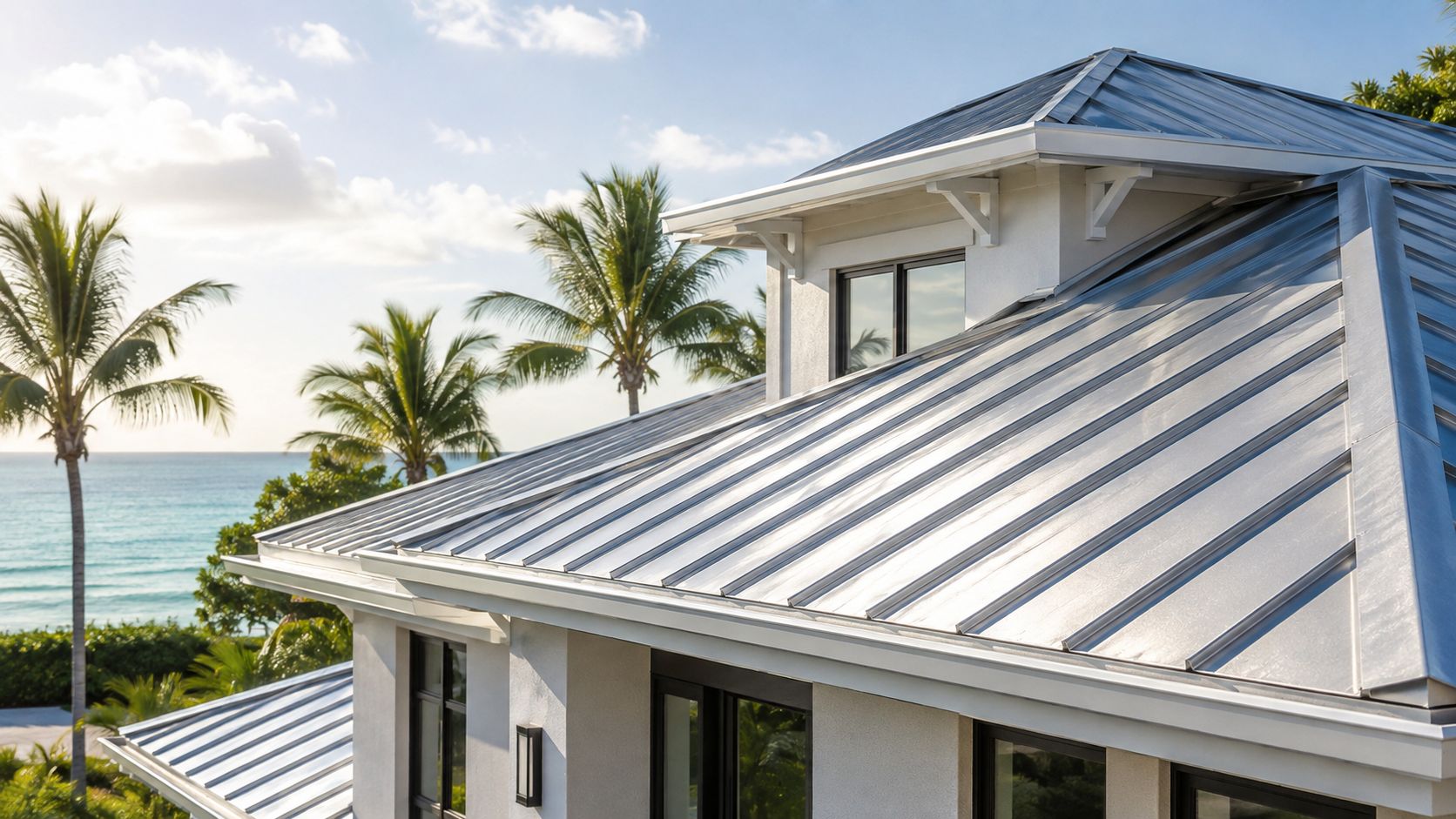
A galvalume standing seam metal roof isn't just a tougher shell for a house. In coastal Florida, it's a roofing system that can be engineered to last minimum 60 years in a service-life projection for 55% aluminum-zinc alloy-coated standing seam roofs, which matters when the home itself is designed for the same 60-year horizon under LEED version 4 (MBCI service-life study summary). This is why homeowners in Broward, Miami-Dade, and Palm Beach keep looking at this material, not because it sounds premium, but because it can line up with the structure's life instead of forcing a mid-life reroof.
Table of Contents
- Why Galvalume Standing Seam Roofs Last 60 Years in Coastal Climates
- Understanding the Galvalume Alloy and Standing Seam Mechanics
- Comparing Galvalume to Galvanized Steel and Other Metal Options
- Hidden Installation Risks and Geometry Challenges in South Florida
- Performance Standards for Wind Uplift and Water Penetration
- Maintenance and Inspection Tips for Coastal Homeowners
- Long-Term Value and Professional Installation with Paletz Roofing
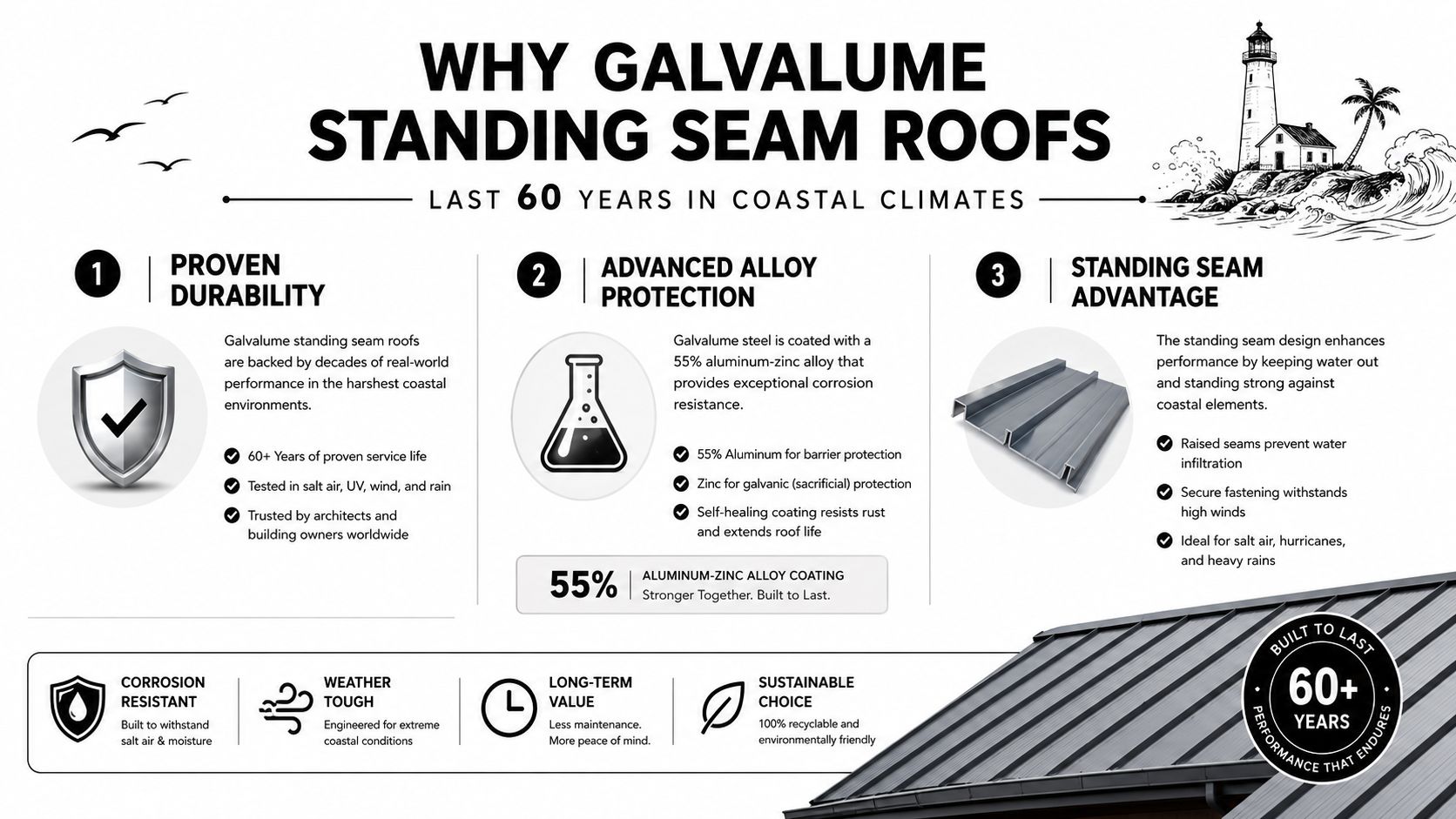
Why Galvalume Standing Seam Roofs Last 60 Years in Coastal Climates
A 60-year service-life projection changes the roof conversation in South Florida. Salt air still attacks metal, but the combination of coating chemistry and concealed-fastener design is built for the problems that shorten roof life here, constant humidity, UV exposure, and storm-driven moisture. A study of low-slope unpainted 55% aluminum-zinc alloy-coated standing seam roofs projected a minimum 60-year service life, and roofs already 35 years old still had sealant described as “entirely adequate and without issue” (service-life study summary).
Why the coastal environment rewards the right coating
Galvalume's strength comes from the alloy itself, not from “metal roof” branding. Industry sources describe Galvalume as a 55% aluminum, 43.5% zinc, and 1.5% silicon coating, and that mix helps explain why this roof type keeps showing up in places where corrosion resistance matters (Galvalume roofing background). In coastal Florida, roof failure usually does not begin with one dramatic event. It starts where water sits too long, salt stays on the surface, or a seam detail was finished poorly.
Value lies in long-term service, not a short-term cosmetic upgrade. A roof with a 60-year projection can be specified to carry the house for the long haul rather than being treated like a temporary cover. If storm damage has already entered the picture and insurance questions are part of the decision, how to navigate insurance for roof damage is a useful place to start, because the repair scope and the claim process often happen at the same time.
Practical rule: In South Florida, the roof that lasts longest is usually the one that handles seams, edges, and drainage correctly first, not the one with the loudest marketing claim.
Understanding the Galvalume Alloy and Standing Seam Mechanics
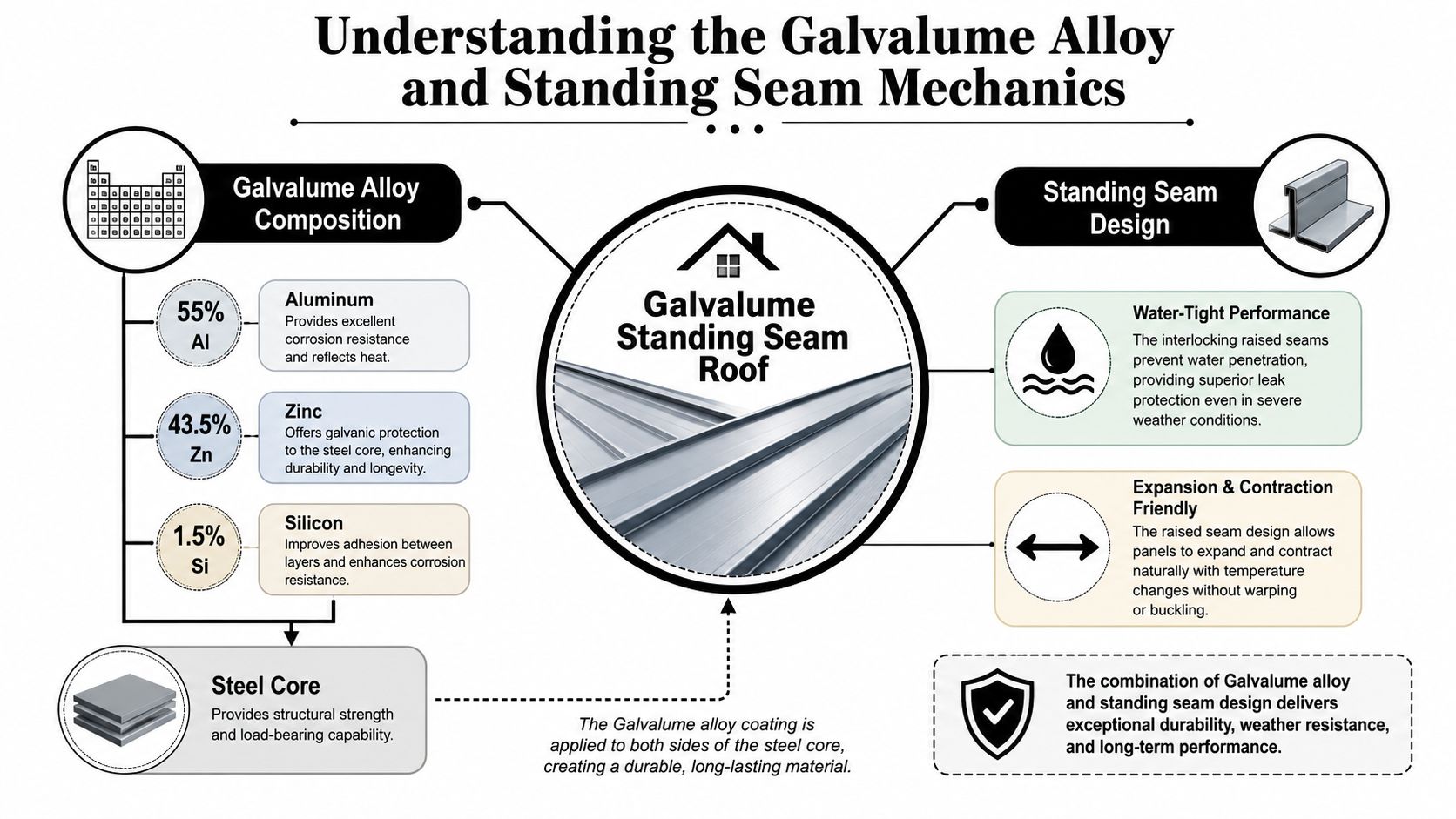
A Galvalume roof starts with a steel panel that carries a specific coating system, and that base metal matters just as much as the finish on top. Industry sources describe the coating as roughly 55% aluminum, 43.4% to 43.5% zinc, and 1.5% to 1.6% silicon, and note that Galvalume was introduced in 1972 as an improvement over traditional galvanization (Galvalume background).
What each part of the alloy is doing
The coating works as two layers of protection in one. The aluminum portion acts as a barrier, slowing corrosion by keeping the steel away from the environment. The zinc portion gives sacrificial protection at cut edges, scratches, and trimmed areas, which is exactly where a roof becomes vulnerable once panels are field-formed, notched, or cut to fit. That balance is why Galvalume behaves differently from standard galvanized steel, and why the coating detail matters so much on a roof that lives in salt, rain, and heat day after day.
The panel profile matters just as much as the coating. Standing seam metal roofing uses concealed fasteners and raised vertical seams, so the weather side of the panel is not covered with exposed penetrations (standing seam profile overview). In South Florida, that matters because roof problems usually start at fasteners, flashings, laps, and other details, not in the middle of the panel field.
Why concealed fasteners change the game
Two metal roofs can look similar from the curb and still perform very differently. A concealed-fastener standing seam roof keeps the attachment points protected from direct weather exposure, which helps in high-wind, high-rainfall conditions. It also gives the panels room to move as they expand and contract, and that movement has to be handled correctly on long metal runs in South Florida heat.
That movement is one of the places where bad installation shows up first. If clips, seam spacing, panel length, or slope are handled poorly, the roof can bind, oil-can, or stress the seams, and those problems shorten the life of the system long before corrosion becomes the main concern.
| Roof element | What it does | Why it matters in Florida |
|---|---|---|
| Galvalume coating | Resists corrosion | Helps the steel stand up to salt air |
| Steel core | Adds stiffness | Supports panel spans and clip attachment |
| Raised seam | Hides attachment points | Reduces weather exposure at fasteners |
Comparing Galvalume to Galvanized Steel and Other Metal Options
Galvalume keeps winning specifications for a practical reason. It usually delivers a longer service life than standard galvanized steel while still giving you the structural benefits of a steel roof system. One industry source says Galvalume-coated metal roofing can prevent rust 3 to 4 times as long as regular galvanized metal roofing, while another says its outdoor corrosion resistance can be about nine times longer than galvanized steel at equivalent coating thickness (galvalume quick facts). Those comparisons point in the same direction, Galvalume buys time.
Material comparison for South Florida roofs
| Material | Expected Lifespan | Corrosion Resistance |
|---|---|---|
| Galvalume standing seam steel | 40 to 60+ years | Strong resistance, especially in concealed-fastener systems |
| Galvanized standing seam steel | Roughly 40+ years or less | Good, but generally lower than Galvalume |
| Aluminum | Long-lasting in coastal settings | Excellent corrosion resistance, softer than steel |
| Copper | Very long-lived | Excellent durability, usually a premium choice |
The primary trade-off involves cost, strength, and detailing. Aluminum handles corrosion very well, but steel standing seam systems are often preferred where stiffness, panel flatness, and structural performance matter. Copper lasts a long time, but it sits in a different pricing category and is not the default answer for most South Florida homes. Galvalume ends up in the middle of the decision tree, strong enough for demanding roof geometry, durable enough for the climate, and familiar enough for experienced installers to detail correctly.
Bottom line: A cheaper roof that needs replacement sooner can cost more over time than the roof you specify correctly once.
For homeowners, the question is not which material looks the most impressive on paper. It is which one fits the house, the exposure, and the maintenance reality. In our market, that usually means the roof has to survive not just rain, but recurring salt exposure, intense sun, and storm season without turning into a recurring repair file.
Hidden Installation Risks and Geometry Challenges in South Florida
Most roof failures I see in coastal Florida don't begin with the coating. They begin with the details around it. Dead valleys, intersecting planes, awkward transitions, and shortcut flashing work create the conditions for leaks long before corrosion becomes a problem. Industry guidance also points to recurring issues like higher cost, more difficult installation, oil canning, limited availability, and design problems at roof intersections, all of which can shorten real-world performance even when the base material is strong (standing seam problems overview).
Where geometry becomes the weak link
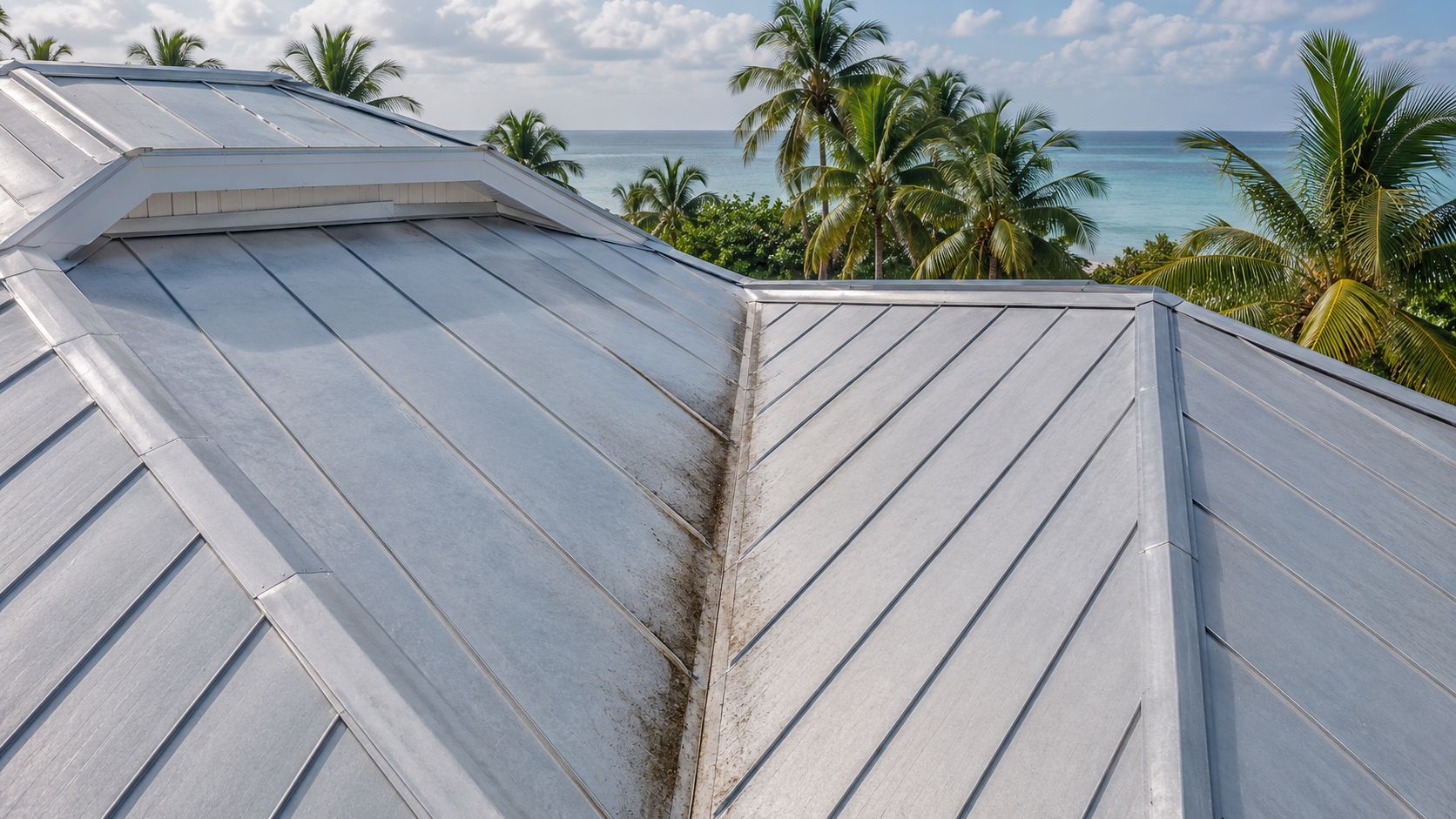
On complex roofs, water doesn't always travel where the designer expects it to go. A dead valley can trap runoff, and intersecting planes can concentrate flow at a detail that needs precise flashing, not guesswork. That's why a standing seam roof on a simple gable often behaves better than the same material installed on a complicated roof with multiple hips, tie-ins, and low-slope transitions.
Field cuts matter too. Raw edges can become weak points if they're left unprotected, and exposed fasteners are a problem when the wrong fastener type is used or when the system relies on hardware that doesn't have the service life to match the panels. In humid, coastal Florida, that gap matters because the panel coating alone does not determine lifespan.
Questions worth asking before you sign a contract
- How are cut edges protected? A good crew explains what happens at field cuts, penetrations, and transitions.
- What fasteners are specified? Long-life fasteners matter more than most homeowners think.
- How is the roof geometry handled? Dead valleys and intersecting planes should have a clear flashing plan.
- What substrate is being used? The roof surface and support structure need to match the tested assembly.
A roof can be made from a durable alloy and still fail early if the layout is sloppy. That's the part many homeowners don't see until after the first serious storm. A 60-year roof is only realistic when the installation details are treated like the system, not like afterthoughts.
Performance Standards for Wind Uplift and Water Penetration
In South Florida, a roof that resists corrosion but leaks under pressure is still a bad roof. Performance has to include air control, water control, and impact resistance, because hurricane season punishes weak assemblies from multiple directions. Independent spec data for some galvalume standing seam assemblies show ASTM E283 air leakage of 0.035 cfm/ft² at 1.57 psf, ASTM E331 water penetration of none at 12 psf, and UL 2218 Class 4 impact resistance (standing seam specification data).
What those numbers mean in real life
Those benchmarks only matter if the roof is built as the tested assembly. Panel coverage, seam height, clip spacing, slope, and substrate type all work together. Commercial systems commonly use 16- to 18-inch coverage, about 2-inch seam height, and concealed clips, with minimum slopes ranging from 0.5:12 over open framing to 3:12 over solid substrates depending on the profile (standing seam specification data). If one of those variables is changed without checking the tested system, the roof may no longer perform the way the spec sheet suggests.
A standing seam roof is a tested system, not a pile of interchangeable parts.
That point matters for local inspections too. A proper install needs the right gauge, the right coating designation, and the right attachment method. The technical guidance calls for ASTM A792 aluminum-zinc coated steel, with AZ50 or AZ55 designations corresponding to 0.50 and 0.55 oz/ft² total coating mass on both sides, and 24-gauge is common in standing seam applications (specification data). Thicker gauges such as 22 ga are often used when wind uplift, panel flatness, or clip spacing need tighter control (specification data).
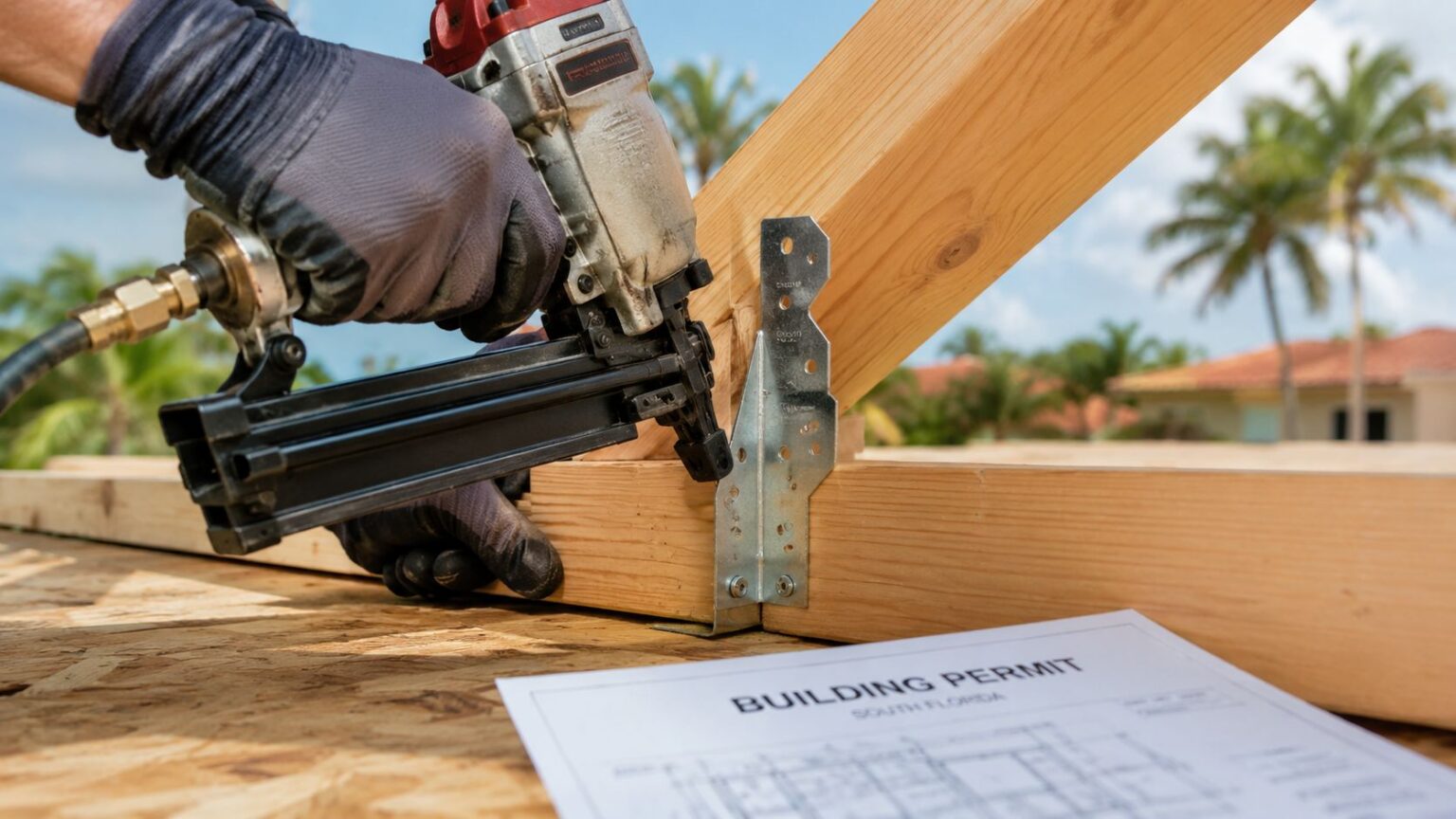
For hurricane-prone homes, the installation photo in this guide is worth studying alongside the assembly details: hurricane clip installation in a construction setting. The clip system is part of the roof's actual performance, not an optional accessory.
Maintenance and Inspection Tips for Coastal Homeowners
A Galvalume standing seam roof is low-maintenance, but it's not no-maintenance. In coastal Florida, the inspection routine should focus on the weak spots that weather still finds, especially sealants, scuffing, debris, and drainage. Independent and manufacturer-facing technical sources note that Galvalume's coating itself is strong, but exposed fasteners and field cuts can become weak points if they aren't protected properly (galvalume vs. galvanized standing seam guide).
What to check after storms and during routine visits
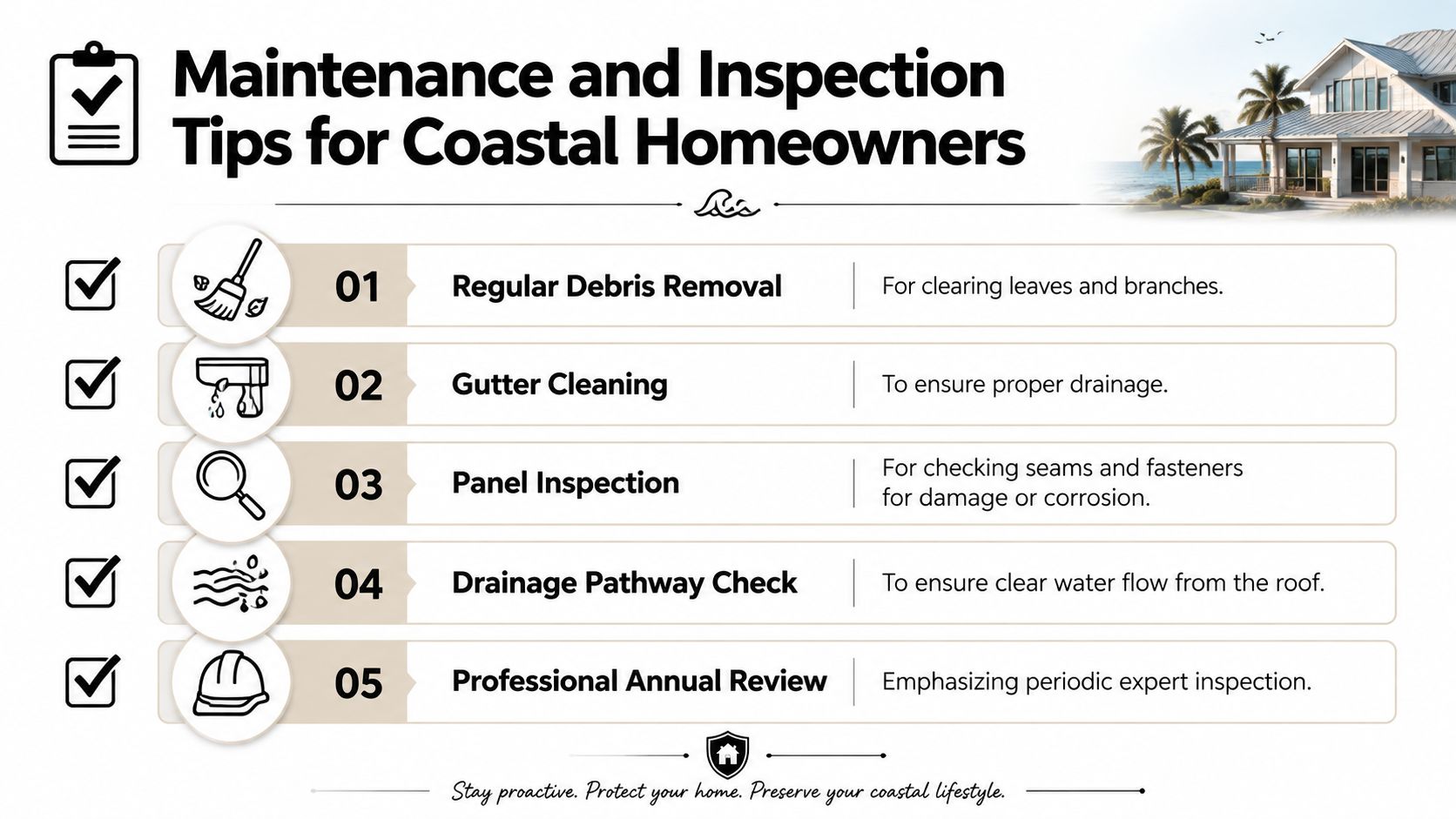
- Regular debris removal: Leaves, branches, and trapped grit can hold moisture against the roof surface.
- Gutter cleaning: Water needs a clear path off the roof, especially during heavy rain.
- Panel inspection: Look for scuffing, seam damage, or corrosion around exposed areas.
- Drainage pathway check: Standing water and backed-up runoff usually point to a detail problem, not a material problem.
- Professional annual review: A trained roofer can confirm clip condition, seam integrity, and the state of field cuts.
Those checks are straightforward, but they're important. A storm doesn't have to rip panels off to cause trouble. Minor seam movement, a clogged drainage path, or a damaged edge can turn into a bigger repair if nobody catches it early.
After a major storm, inspect the roof before assuming it's fine. Most hidden damage shows up as a detail problem first.
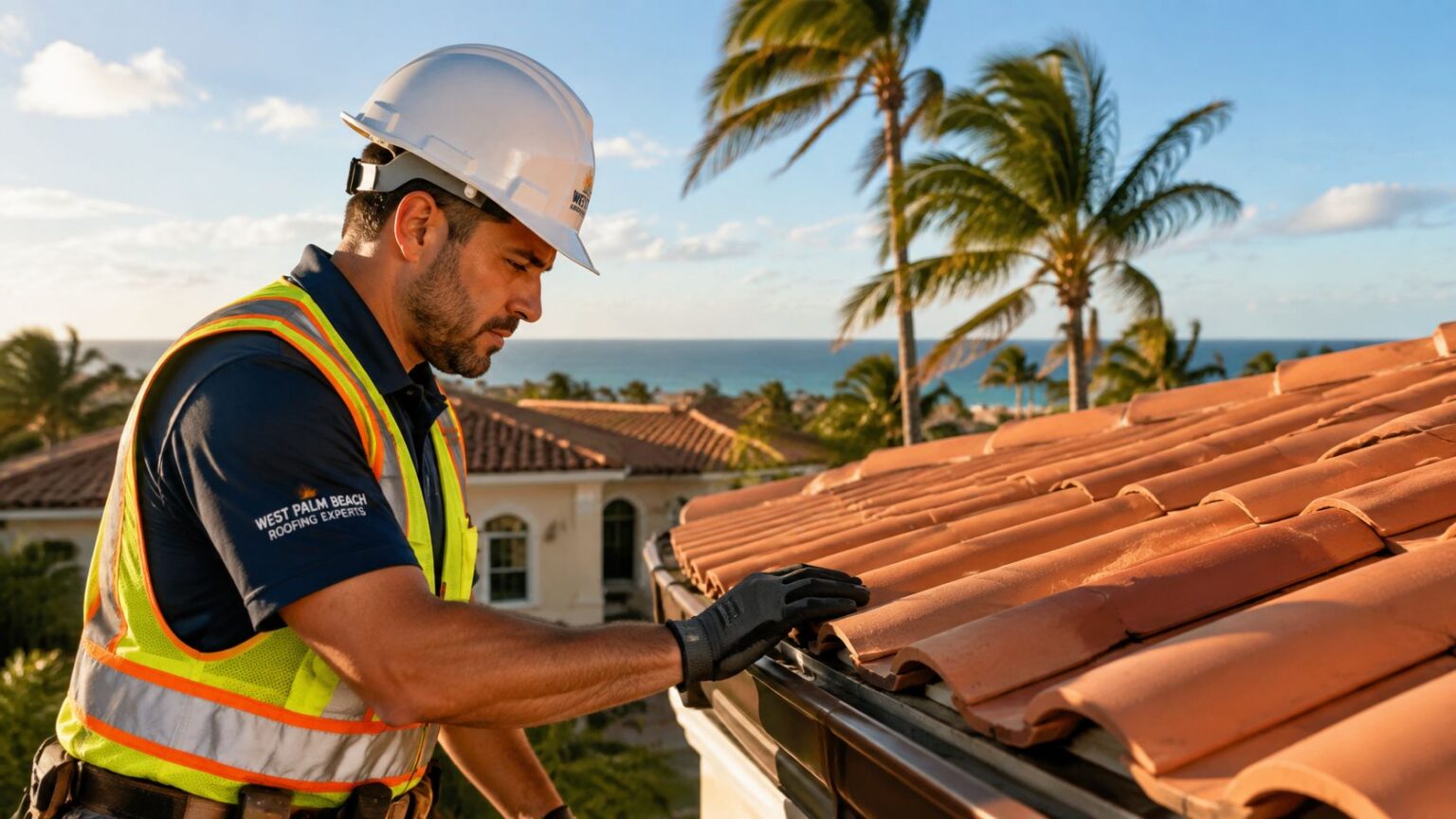
Homeowners sometimes assume the coating alone determines lifespan, especially in humid, coastal Florida. It doesn't. The coating helps, but the inspection process protects the system. For a visual reference on the kind of professional review that makes sense in this market, see roof inspection work in West Palm Beach.
Long-Term Value and Professional Installation with Paletz Roofing
The long-term value of a Galvalume standing seam roof starts with avoiding repeat replacements. If the roof system is built to stay in place through the life of the structure instead of being torn off halfway through, the ownership math changes in a real way. It also helps curb appeal and can support better energy performance, but only when the assembly is designed and installed the right way.
Why the installer matters as much as the material
A durable roof still depends on the crew that puts it on. Misaligned seams, the wrong clips, or improvised transitions can shorten the service life fast, even if the panel coating itself is sound. In South Florida, that usually means the difference between a roof that stays tight in salt air and one that starts giving up at the details.
The hidden problems are geometry problems. Valleys, hips, penetrations, edge metal, and low-slope tie-ins all need to be planned for the actual roof shape, not guessed at on the fly. If those areas are handled poorly, the warranty can be affected and the roof can begin to fail where water and wind pressure are hardest on it.
Paletz Roofing and Inspections is one local option for homeowners who want metal roofing installed or evaluated with coastal conditions in mind. Their experience across Broward, Miami-Dade, and Palm Beach counties, along with metal roof repair and installation work, makes them relevant when the question is whether a standing seam system fits the structure and the exposure. Their logo is here for reference: Paletz Roofing and Inspections.

For a closer look at the kind of company identity tied to that work, see this Paletz Roofing and Inspections logo.
The decision usually comes down to whether the roof needs a quick patch, a full replacement, or a properly designed standing seam system that can handle salt air, storm demand, and long-term ownership. On a coastal property, the roof evaluation should focus on geometry, fasteners, edge protection, and the tested assembly, not just the panel finish. That is where a good installer protects the value of the material.
If you're weighing a Galvalume standing seam metal roof for a home in South Florida, schedule a roof evaluation with Paletz Roofing and Inspections. They can look at your roof geometry, explain the installation details that affect warranty and lifespan, and help you decide whether this system fits your property and your long-term plan.