
Knowing how to clean roof gutters really boils down to three main phases: safely scooping out all the gunk, flushing the whole system to spot any clogs, and making absolutely sure the downspouts are clear. It sounds simple, but this bit of maintenance is what stands between you and serious headaches like foundation damage, roof rot, and a flooded basement. It's easily one of the most critical chores for any South Florida homeowner.
Why Gutter Cleaning Is Essential For Your Home

It’s tempting to overlook your gutters—they're just a small part of your home’s exterior, right? But they have a massive job to do. Their only purpose is to safely guide thousands of gallons of rainwater away from your house. When they get clogged with leaves, twigs, and all the other debris our Florida storms kick up, that system breaks down completely.
That water has to go somewhere, and it usually ends up pouring over the edge and pooling right up against your foundation. It doesn't take long for that to cause cracks, leaks, and even a flooded basement—repairs that can easily climb into the thousands of dollars.
The True Cost of Neglect
Beyond the obvious foundation issues, overflowing gutters trigger a whole chain reaction of other problems. Water cascading down your siding leads to ugly stains, peeling paint, and can even cause the wood to rot. It can also seep behind the fascia boards—those boards your gutters are mounted on—causing them to decay and creating a pathway for water to damage your roof structure.
And let's not forget the pests. Those damp, debris-filled troughs become a five-star resort for mosquitoes, rodents, and even birds. Before you know it, you’ve got a whole new set of unwanted guests setting up shop right on your doorstep.
The biggest problems I see homeowners face almost always start with small, neglected maintenance tasks. A clogged gutter is the perfect example—a minor annoyance that, if you ignore it, can snowball into major structural and water damage.
To help you get a clear picture of the job ahead, here's a quick breakdown of what the process looks like from start to finish.
Quick Guide to Gutter Cleaning Essentials
This table gives you a high-level overview of the key phases involved in cleaning your gutters, helping you quickly grasp the entire process.
| Phase | Key Objective | Primary Tools Needed |
|---|---|---|
| Preparation | Gather tools and set up your ladder for safe, easy access. | Ladder, bucket, gloves, trowel |
| Debris Removal | Scoop out all leaves, twigs, and muck from the gutters. | Trowel, gloves, bucket |
| Flushing | Use a hose to rinse the gutters and check for hidden clogs. | Garden hose with nozzle |
| Downspout Check | Ensure water flows freely from top to bottom. | Hose, plumber's snake |
Each of these steps is crucial for a complete and effective cleaning that truly protects your home.
A Growing Industry For a Critical Task
Preventing these disasters is exactly why the professional gutter service industry is booming. When you combine gutter cleaning and installation, you're looking at a huge chunk of the home maintenance market. Globally, it was valued at around USD 0.17 billion in 2024 and is projected to hit USD 0.45 billion by 2033. This surge shows that more and more homeowners are realizing that regular cleaning is a non-negotiable part of protecting their property.
To really drive the point home, it's worth reading up on why gutter cleaning is crucial to prevent costly damage. At the end of the day, learning how to clean your roof gutters isn't just about ticking a box on your chore list; it’s a powerful act of preventive maintenance that safeguards your most valuable asset.
Equipping Yourself for a Safe and Effective Clean

Jumping into a gutter cleaning project without the right gear is more than just inefficient—it’s flat-out dangerous. Having the correct tools ready to go before you even think about stepping on that first ladder rung is what turns a frustrating chore into a manageable weekend task. This isn’t about buying every gizmo on the shelf; it's about making smart choices for your home.
The single most critical piece of equipment is your ladder. Your choice here has a direct impact on your stability and, most importantly, your safety.
- A-frame Ladders: These are your go-to for single-story homes. Because they're self-supporting, they’re ideal for working on flat, solid ground like a driveway or patio, providing a stable base.
- Extension Ladders: If you have a two-story home or tricky-to-reach roof sections, an extension ladder is a must. Just remember, they need a solid surface to lean against—like your home's siding—and must be set at the correct angle to be safe.
Essential Hand Tools and Protective Gear
Once the ladder is sorted, it’s time to gather the gear for the actual hands-on work. Think protection and practicality.
First up, a pair of heavy-duty, waterproof gloves are absolutely non-negotiable. Gutter muck is a nasty cocktail of rotting leaves, stagnant water, and sometimes sharp twigs or even animal droppings. Good gloves are your first line of defense against cuts, bacteria, and just plain filth.
You don't need to get fancy with debris removal. A simple garden trowel or even a repurposed plastic scoop from an old laundry detergent bottle works great. If you have a lot of gutters, though, you might appreciate a specialized gutter scoop with an ergonomic handle for a bit more comfort.
A simple bucket with a handle hook is a game-changer. It hangs right on your ladder, giving you a convenient spot to dump debris. This one small tool saves you from tossing gunk onto your lawn and creating a whole second cleanup job for yourself later.
Advanced Tools for Power and Efficiency
For homeowners who like to work smarter, not harder, a few high-tech tools can make the job much faster, though they do come with a higher price tag.
Gutter vacuum systems, for example, have become increasingly popular. These tools often come with long extension wands, letting you suck out all the debris while keeping your feet safely on the ground. Similarly, you can find pressure washer attachments designed to blast away grime and stubborn clogs with a high-pressure stream of water.
The market for these advanced tools is booming. The global demand for gutter and roof vacuum cleaners hit around USD 1.15 billion in 2023 and is projected to more than double by 2033. This surge shows a real shift toward safer, more efficient methods for tasks like learning how to clean roof gutters.
Whether you should invest in these tools really comes down to your budget, the size of your home, and how much you value the convenience and added safety. If you have a large, two-story house surrounded by trees, the upfront cost might be well worth it in the long run.
The Complete Gutter Cleaning Walkthrough
Alright, you've got your tools lined up and the ladder is waiting. Now it’s time to get this done. We’re going to go through the whole process, step-by-step, with a big focus on doing it safely, efficiently, and leaving nothing behind. The entire point is to get your gutters spotless and ready for the next torrential Florida downpour.
First thing’s first, and this is non-negotiable: ladder safety. Never, ever set up your ladder on soft or uneven ground. Find a firm, level spot and make sure the ladder's feet are planted solid. You want to position it so you can work comfortably without leaning or overreaching. A great rule of thumb I always follow is to keep my hips squarely between the ladder rails.
Getting the Debris Out
Once you’re safely up there, the real work begins. I've found the most efficient way to work is to start at a downspout and move away from it. This simple trick keeps you from accidentally shoving all that gunk right back into the opening you’re trying to clear. Use your gutter scoop or trowel to pull out the big stuff—the leaves, twigs, and that compacted muck that builds up.
Toss all that debris onto a tarp you've spread out below. This makes cleanup so much easier later on. Trust me, you don't want to be picking soggy, decomposing leaves out of your lawn or garden beds. Just slide the tarp along as you move the ladder down the line.
A small bucket can be your best friend up on the ladder. Just bend a wire handle into an "S" shape and hook it onto the gutter or your ladder. Now you have a hands-free spot to drop debris, which means less mess and more stability for you.
This image gives a great overview of the basic flow, from scooping out the gunk to rinsing it clean.
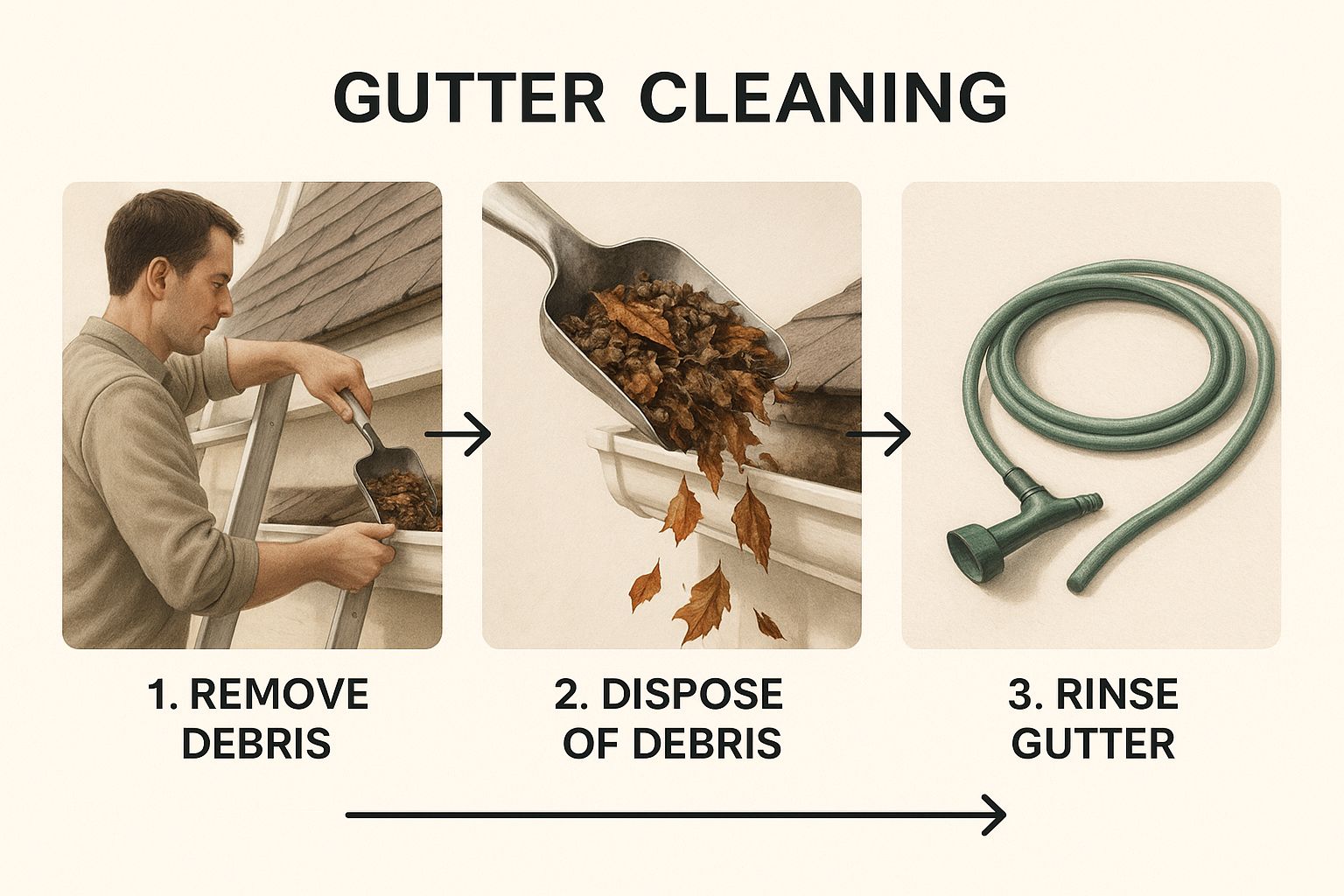
As you can see, it’s a pretty straightforward process: get the big stuff out, then flush the small stuff away.
Flushing the System and Checking Flow
After you’ve scooped out all the solid material, it's time for the water test. Grab your garden hose—a high-pressure nozzle makes this part much more effective—and start rinsing the gutters. Just like with scooping, always work toward the downspout.
This final rinse does two very important things:
- It clears out the fine sediment. This is what gets rid of all the residual grit and slime that your scoop couldn’t grab.
- It acts as a final inspection. You get to see with your own eyes that the water is flowing freely and your downspouts are completely clear.
As you spray, keep a close eye on the water. It should flow quickly and smoothly right into the downspout opening and disappear without any pooling or overflowing.
Clearing Stubborn Downspout Clogs
So, what happens if the water starts backing up? That means you’ve got a clog somewhere in the downspout. Don't worry, it's a very common problem.
Your first move should be to run water from the top and give the side of the downspout a few firm taps with the handle of your trowel. More often than not, the vibrations are enough to break the clog loose.
If that doesn't do the trick, turn off the water. Now, try feeding the hose up from the bottom opening of the downspout. Push it in as far as it can go, then have someone turn the water on full blast for just a few seconds. The upward pressure can often dislodge the blockage and push it out the top. For really stubborn clogs, you might need to use a plumber's snake to break it apart.
You'll know the job is truly done when you see a strong, steady stream of water pouring out the bottom of every single downspout. That visual confirmation is the final, most satisfying step.
Mastering Ladder Safety and Gutter Cleaning Best Practices
Let's get straight to the point: no clean gutter is worth a trip to the emergency room. Before you even think about climbing up there, your first and most important job is committing to safety. It's surprisingly easy to get complacent on a ladder, and just one moment of carelessness can have life-altering consequences.
The absolute foundation of using a ladder safely is what we call the "4-to-1 rule." It’s simple: for every four feet of height you need to climb, the base of the ladder should be one foot away from the wall. This specific angle gives you the most stable setup, preventing the ladder from sliding out from under you or, just as bad, tipping backward.
Safe Practices While You're on the Ladder
Once your ladder is set up correctly, how you act on it is just as critical. The golden rule here is to maintain three points of contact at all times. This means you should always have either two feet and one hand, or two hands and one foot, firmly on the ladder. It’s a simple principle that naturally forces you to move slowly and with intention.
I can't stress this enough: overreaching is one of the most common ways people fall from ladders. It’s so tempting to stretch just a little bit further to get that last clump of leaves, but doing so shifts your center of gravity in a dangerous way. Always take the extra minute to climb down and move the ladder. It’s a small hassle that makes a world of difference.
Sticking to these core principles dramatically lowers your risk, turning what could be a dangerous chore into a routine, manageable task.
Essential Safety Checks Before You Climb
Before your feet even leave the ground, a few final checks can make all the difference. What you do on the ground is just as vital as your actions up in the air.
- Look Up for Power Lines: This is a big one. Always, always do a visual sweep of the area for overhead power lines before you even place the ladder. Electricity can arc, which means you don’t have to touch the wire to get electrocuted. Keep your ladder and yourself at least 10 feet away from any power lines.
- Wear Non-Slip Footwear: Sturdy, closed-toe shoes with a good, deep tread are non-negotiable. They give you the grip you need on the ladder rungs and protect your feet from any sharp debris or a dropped tool.
- Use a Ladder Stabilizer: For extra security, especially if you're using an extension ladder that will rest against your siding, a ladder stabilizer is a fantastic investment. These accessories attach to the top of your ladder, creating a much wider and more stable point of contact against your roof or wall.
- Ask for a Spotter: Honestly, the simplest safety measure is just having another person there. A spotter can hold the base of the ladder steady for you, hand you tools so you don't have to carry them, and be there to call for help if anything goes wrong. It's an invaluable layer of protection.
Keep Your Gutters Clear with Proactive Maintenance
A one-time gutter cleaning is a good start, but it's really just a single battle in the ongoing war against debris here in South Florida. If you want to truly protect your home, you need to think proactively. This means checking your gutters regularly, not just waiting until you see water spilling over the sides.
For most homes in our area, a twice-a-year cleaning schedule is a solid baseline. I always recommend one cleaning in late spring after the oaks and jacarandas drop their last bits, and another in late fall to clear out everything before our drier winter season.
Of course, your property is unique. If your home is blessed with the shade of large oak or pine trees, you'll want to inspect your gutters quarterly. A quick peek after a heavy downpour is also a smart move. The key is to establish a consistent preventive maintenance schedule, much like we do in the professional trades, to catch clogs before they can cause real trouble.
The Great Gutter Guard Debate
Gutter guards are often sold as a "set it and forget it" magic bullet, but from my experience, the reality is a bit more complicated. While they do a fantastic job blocking large leaves and twigs, they are not an impenetrable forcefield. Small debris, pesky pine needles, and shingle grit can still find their way through, eventually creating a dense, sludge-like blockage that’s a real pain to clear.
Think of them not as a replacement for cleaning, but as a way to reduce the frequency of it.
- Mesh Guards: These are great for stopping most debris, but fine sediment can clog the screen itself. You'll still need to rinse them off occasionally.
- Brush Guards: Imagine giant pipe cleaners sitting in your gutters. They do a decent job of stopping big leaves but have a tendency to trap smaller particles.
- Foam Inserts: These porous foam blocks fill the gutter, letting water pass through while blocking debris. They work well, but they can get clogged themselves and need to be pulled out and cleaned every so often.
The bottom line is that gutter guards can be a worthwhile investment, especially if your yard has a lot of trees. Just go into it knowing they still require maintenance—you’re just trading a full-on muck-out for a less intensive inspection and rinse.
Knowing When to Call a Professional
There are definitely times when the risks of a DIY gutter cleaning just aren't worth the savings. Your safety has to be the top priority, period. It's time to put the ladder away and call in a pro if any of these situations sound familiar:
- Multi-Story Homes: The minute you step onto a ladder to reach a second or third story, the risk of a serious fall skyrockets. It's just not worth it.
- Very Steep Roof Pitches: Walking around on a steep roof is a job for someone with the right safety harnesses, training, and experience.
- Extensive Damage: If you spot gutters pulling away from the fascia, significant rust, or broken sections, a professional can diagnose the problem and perform the necessary repairs while they clean.
- Major Pest Infestations: Finding a wasp nest, hornets, or signs of rodents in your gutters is a job best left to those equipped to handle them safely.
More and more homeowners are choosing to leave this job to the experts. In fact, the global market for gutter cleaning services is expected to hit USD 125.4 million by 2033, a trend driven by people who understand the value of getting the job done right and, most importantly, safely. Handing the job over to a licensed and insured company like Paletz Roofing gives you peace of mind, knowing your home is in expert hands.
Common Gutter Cleaning Questions Answered
Even with the best game plan, questions always come up. It’s especially true when you’re teetering on a ladder trying to figure out if you’re doing this right. Knowing how to properly clean your roof gutters often comes down to handling those little “what ifs” that pop up mid-job. Let’s walk through some of the most common questions we hear from South Florida homeowners.
One of the biggest is about timing. While the old rule of thumb is to clean your gutters in late spring and late fall, South Florida's year-round foliage and intense rainy season change everything. If your yard is full of large oaks, shedding jacarandas, or those notorious pine trees, you really need to be checking your gutters quarterly. A quick peek after a heavy storm can also save you a world of hurt later.
Answering Your Top Gutter Concerns
Many homeowners ask if they can just fire up a leaf blower and blast the gunk out. The short answer? Yes, but it’s a messy, often ineffective shortcut. A blower with a special gutter attachment might work for some light, dry leaves, but it’s no match for the damp, compacted sludge that causes the worst clogs.
Frankly, you’ll probably just blast leaves, twigs, and grime all over your siding, windows, and lawn—creating a whole new cleanup job for yourself.
Another frequent question is about gutter guards. Are they actually worth the money? They certainly can be, but they are not a "set it and forget it" magic bullet.
Think of gutter guards as a way to reduce the frequency of major cleanouts, not get rid of them completely. They do a fantastic job blocking big leaves, but smaller debris and shingle grit will always find a way in, meaning you’ll still need to do occasional inspections and rinsing.
Finally, what are the dead giveaways that your gutters are already clogged? The most obvious sign is water gushing over the sides like a waterfall during a rainstorm. It’s dramatic, but it’s not the only clue.
Keep an eye out for these other red flags:
- Gutters that are visibly sagging or pulling away from the fascia board under the weight.
- Ugly water stains streaking down your siding, especially right below the roofline.
- Paint that’s starting to peel on the fascia or near the roof.
- Actual plants—weeds, grass, or even small saplings—sprouting from the debris in your gutters.
If you spot any of these signs, your gutters are screaming for help. Getting these common questions sorted out helps you tackle the job with more confidence and keeps your home protected from water damage.
Don't let clogged gutters threaten the integrity of your South Florida home. For a professional, safe, and thorough cleaning, trust the experts at Paletz Roofing and Inspections. Contact us today for a free quote and enjoy the peace of mind that comes with knowing your home is in expert hands.