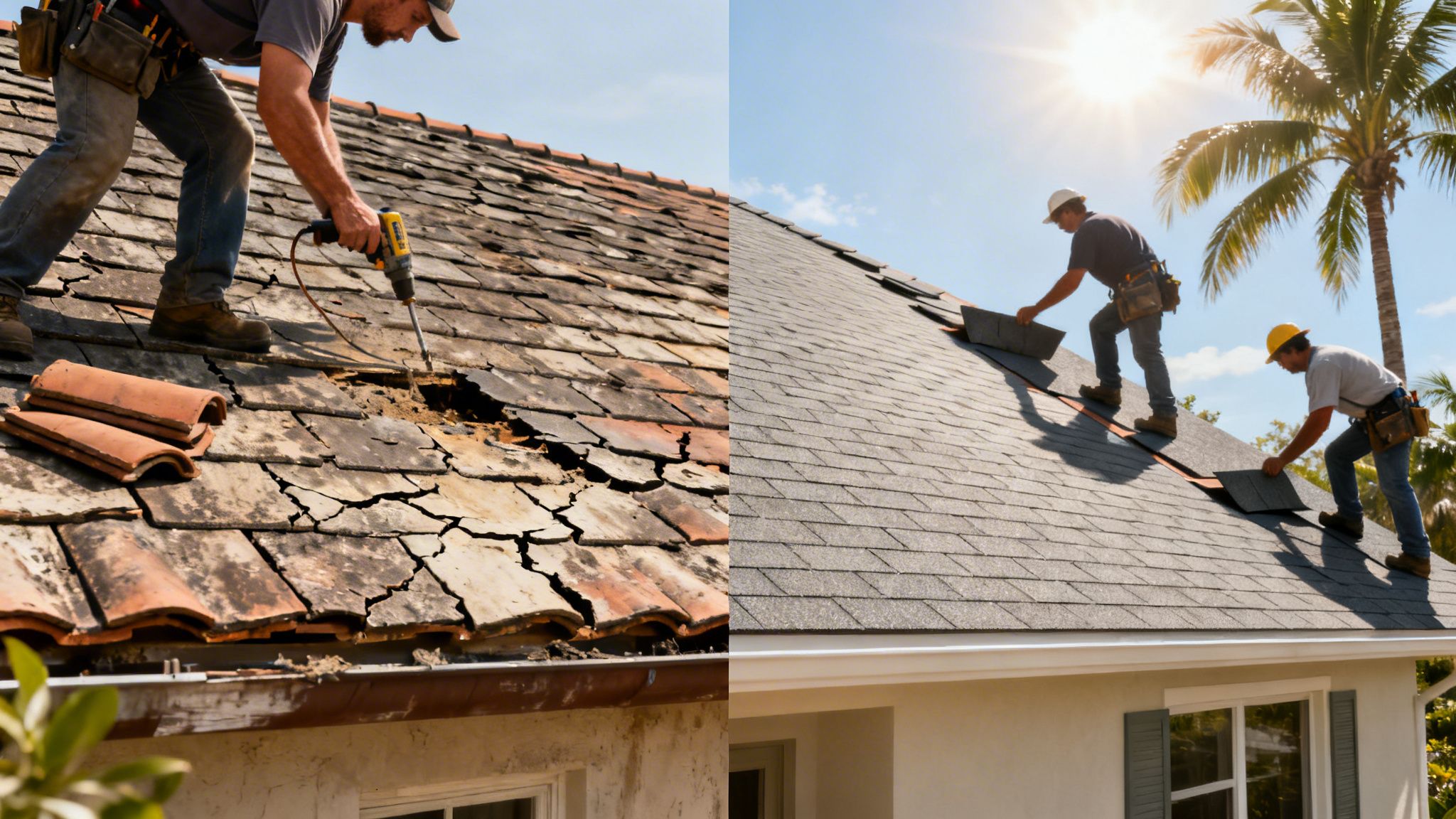
Deciding between a roof repair and a full roof replacement is one of the most critical choices a property owner can make. The core difference is simple: a repair targets isolated damage on a roof with years of life left, while a replacement is a necessary investment for widespread issues, an aging system, or systemic failure.
Patching a few trouble spots is one thing, but a full replacement is about securing your entire home against South Florida’s relentless climate for the long haul.
Understanding The Critical Choice

For homeowners across Broward, Miami-Dade, and Palm Beach counties, this isn't just a financial calculation—it's a high-stakes decision against hurricanes, punishing sun, and year-round humidity. Getting it wrong can lead to a cycle of endless repairs, devastating interior water damage, and a whole lot of stress when a storm is on the horizon.
Making the right call, on the other hand, buys you priceless peace of mind and protects your most valuable asset. The trick is to step back and assess the situation with a clear head, using real criteria instead of just the immediate price tag.
The 25 Percent Rule Of Thumb
A practical guideline we use in the field is the 25% Rule. If the damage is localized and impacts less than a quarter of your roof's total surface area, a professional, high-quality repair is usually the most sensible and cost-effective path forward. This is perfect for issues like a handful of shingles blown off in a storm or one specific, contained leak.
But once the damage creeps past that 25% threshold—or you start seeing problems pop up in multiple, unrelated areas—the scales tip heavily toward replacement. At that stage, you’re not just patching a leak anymore. You're fighting a losing battle against a system that’s failing.
The decision isn't just about fixing a current problem. It’s about investing in future protection. A new roof resets the clock on its lifespan, enhances property value, and often improves your home's insurability in Florida's tough market.
When To Repair Vs When To Replace
Understanding the "why" behind your roof's issues is everything. To give you a clearer picture, we've put together a quick decision guide to help you see where your situation likely falls. You can also dig deeper by exploring our guide on assessing different types of roof damage to learn more.
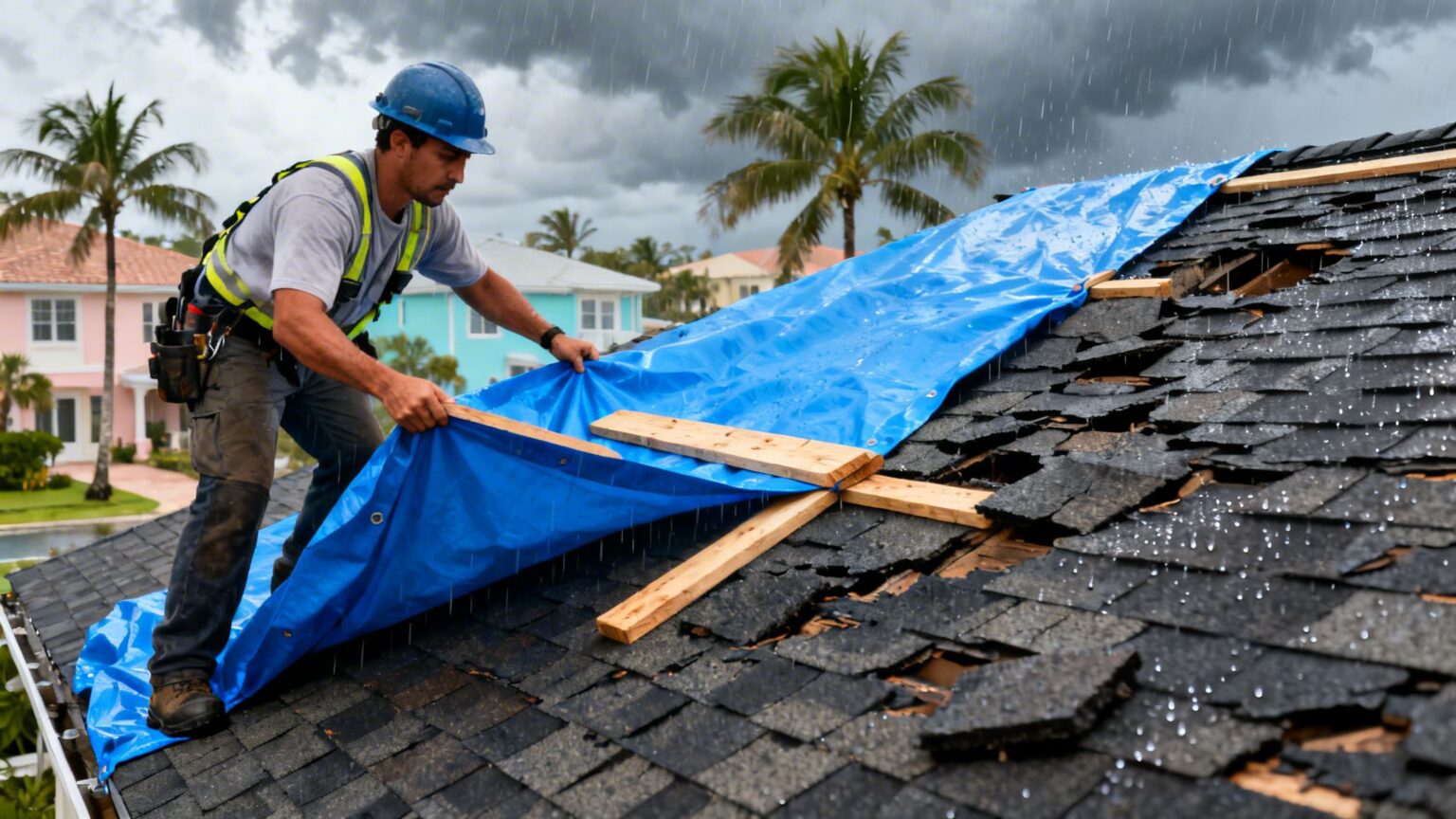
Quick Decision Guide: Repair vs. Replacement Scenarios
This table helps you quickly assess whether your roof issue points toward a simple repair or a full replacement.
| Roof Issue | Most Likely Solution | Key Consideration |
|---|---|---|
| A few missing shingles or cracked tiles | Repair | The damage is isolated and the rest of the roof is in good shape. |
| Widespread granule loss ("balding") | Replacement | This is a clear sign that the shingles are at the end of their life. |
| A single, easily sourced leak | Repair | The source can be identified and contained (e.g., around flashing). |
| Multiple leaks in different rooms | Replacement | This points to a systemic failure of the underlayment or material. |
| The roof is less than 10-12 years old | Repair | A younger roof should still have plenty of life left in it. |
| The roof is nearing its expected lifespan | Replacement | Investing more money in repairs offers very poor long-term value. |
Ultimately, if you're looking at an older roof with multiple problem areas, putting more money into repairs is often throwing good money after bad. A replacement provides a clean slate and a secure future.
Decoding the Warning Signs of Roof Failure

Your roof gives you hints about its condition all the time—some are subtle, others are impossible to ignore. Learning to read these signals is the first real step in the roof repair vs roof replacement decision. It’s what helps you see a few missing shingles as an isolated fix, or as the first sign of a much bigger, system-wide problem brewing overhead.
A professional eye can spot the difference between a simple patch job and a critical warning. For instance, a single, small water stain on your ceiling probably points to a bad seal around a vent pipe—a classic repair job. But when you start seeing multiple stains in different rooms, or the same stain keeps coming back after being patched, the problem isn't isolated anymore. That’s a sign of widespread underlayment failure, and a full replacement is the only real long-term answer.
From The Outside Looking In
The most direct evidence of your roof’s health is right there on the outside. A quick look from the ground can tell you a lot, but you have to know what you’re looking for. It’s about more than just obvious storm damage; the real clues to your roof's age and integrity are often hiding in plain sight.
For example, a couple of cracked or missing tiles after a hurricane is a common sight in South Florida and usually an easy repair. But if you also see that the tiles around them look faded, chalky, or have slipped out of alignment, you’re looking at long-term UV damage and heat stress. This means the whole roof is getting brittle and old. A simple patch is just a band-aid on a system that’s failing, pushing the roof repair vs roof replacement decision toward the latter.
A critical mistake is focusing only on the obvious point of failure. You have to look at the condition of the surrounding area. Widespread granule loss, curling, or blistering shingles around a missing one means the entire system is at the end of its life, not just one spot.
Signs That Demand A Closer Look
Some warning signs aren't about one specific damaged spot but about the overall health of your entire roofing system. These symptoms usually point to deeper problems that a simple repair just can't fix, making replacement the smarter choice.
- Granule Loss in Gutters: Finding a pile of asphalt granules in your gutters is a major red flag. Those granules are the protective shield for your shingles against sun and rain. Losing them is like a severe sunburn for your roof, and it speeds up its decline fast.
- A Spongy or Sagging Deck: If your roof feels soft or bouncy when walked on, or if you can see it sagging between the trusses, that’s a serious structural problem. It’s almost always caused by trapped moisture leading to rot. This is a clear sign that you need a replacement that includes repairing the underlying deck.
- Widespread Algae or Moss: While some dark streaks (caused by an algae called Gloeocapsa magma) are just cosmetic, thick patches of algae or moss mean your roof is holding onto moisture. This constant dampness breaks down roofing materials and shows your roof isn't shedding water like it should.
When Interior Damage Tells The Story
Sometimes, the most convincing argument for a roof replacement comes from inside your house. By the time water has worked its way through your roof deck, insulation, and drywall, the problem is often far more advanced than you realize.
A single leak is one thing. But a history of leaks that keep coming back is a clear sign you’re chasing a systemic failure. If you're calling a roofer for repairs every year, the money and stress you’re spending almost certainly justify a full replacement. Constant patching isn't a strategy—it’s a symptom of a roof that has hit the end of its useful life. Recognizing this pattern is the key to solving the roof repair vs roof replacement dilemma for good.
A Detailed Cost and ROI Analysis for Homeowners
When you're staring down the choice between a roof repair vs roof replacement, money is usually the first thing on your mind. The numbers tell a clear story, pitting a short-term fix against a long-term investment. While a repair looks great on paper with its lower upfront cost, it's essential to look at the total cost of ownership over time.
A simple repair is meant to solve one specific, isolated problem, which naturally makes it the more affordable choice right now. But in South Florida's tough climate, what starts as a single patch can quickly turn into a line item on your annual budget. Multiple repair calls over just a few years can easily add up, sometimes costing you more than a full replacement would have from the beginning.
Breaking Down the Immediate Costs
At first glance, the price difference between a repair and a replacement is huge. Industry data shows that the average repair lands around $1,158, though small fixes like sealing a leak or swapping out a few shingles can range from $393 to $1,939. That feels like a drop in the bucket compared to a full replacement, which averages $11,500 nationally but can easily run from $9,500 to $46,000 depending on your roof’s material and complexity.
Keep in mind, these numbers are climbing. We're seeing projections for price hikes of 15-25% by 2026, thanks to ongoing labor shortages and material tariffs. This reality makes putting off a necessary replacement a gamble that could cost you a lot more down the road.
The Long-Term Return on Investment
A repair saves you money today, but a replacement delivers a powerful long-term Return on Investment (ROI). This is where the financial debate of roof repair vs roof replacement really gets interesting. A new roof isn't just an expense; it’s a capital improvement that completely resets the clock on your home's most critical shield.
A full replacement brings several key financial perks that a patch job just can't match:
- Enhanced Property Value: A new roof is a massive selling point. It seriously boosts curb appeal and tells potential buyers that a major, costly project is already taken care of.
- Improved Insurability: In Florida's notoriously difficult insurance market, having a new, code-compliant roof can make it much easier and cheaper to get or keep your homeowner's insurance.
- Elimination of Recurring Costs: A full replacement, backed by a solid warranty, puts an end to the expensive cycle of yearly repair calls and the stress that comes with them.
For any homeowner weighing the financial side, it’s important to know which home improvements that increase value. A new roof consistently lands near the top of that list, often returning a huge chunk of its cost when you sell.
The hidden cost of repeated repairs isn't just about the money you spend on the roof. It's the risk of a patch failing catastrophically, leading to thousands in interior damage. Think drywall, insulation, and mold remediation—expenses that can easily dwarf the price of a replacement.
Calculating the True Cost of Delay
Let's look at a real-world scenario. A homeowner with a 19-year-old shingle roof spends $1,200 to fix a leak. A year later, another leak pops up in a different spot, costing them $950. The next year, after a storm, they're hit with another $1,500 repair bill for widespread damage.
In just three years, they've poured $3,650 into fixing an old roof that's clearly failing. That money could have been a solid down payment on a brand-new replacement, which would have given them decades of protection, a new warranty, and total peace of mind. This cycle of reactive spending is a financial trap that a proactive replacement helps you completely avoid.
How Your Roofing Material Impacts the Decision

When it comes to the roof repair vs roof replacement debate, the single most important factor is often what’s sitting on top of your house. What makes sense for a shingle roof is completely different for a tile or metal system, especially here in South Florida. Making a smart, cost-effective decision really boils down to knowing your material’s limits.
Every roof has a tipping point—a moment when patching things up just doesn't cut it anymore. Knowing where that line is for your specific roof type helps you put your money where it will do the most good, whether that’s a targeted fix or a full-scale replacement.
Asphalt Shingle Roofs
Asphalt shingles are everywhere in residential neighborhoods, but they take a serious beating from our sun and storms. For these roofs, the decision almost always comes down to the condition of those sandy granules you see on the surface.
When to Repair: If a storm blows through and rips off a handful of shingles in one spot, a repair is usually the perfect fix. We can easily weave in new shingles to patch the damage, as long as the surrounding shingles are still in good shape and have plenty of life left in them.
When to Replace: The minute you start seeing widespread "balding"—those large, smooth patches where the granules have worn away—your roof is on life support. Those granules are the shingle's sunscreen. Without them, the asphalt underneath gets brittle, starts to curl at the edges, and cracks. At that point, you're past the point of no return; a replacement is the only real solution.
Tile Roofs
Tile roofs are a South Florida classic, prized for their longevity and style. But here’s the thing many homeowners don't realize: the tiles are just the armor. The real waterproofing hero is the underlayment underneath, and its condition is what truly dictates whether you repair or replace.
When to Repair: A few cracked or smashed tiles from a flying palm frond or a clumsy walker can be individually swapped out. As long as the underlayment wasn't torn in the process, a simple tile replacement is a quick and effective repair.
When to Replace: If you’ve got leaks but your tiles look perfectly fine, that’s a giant red flag. It almost always means the underlayment has failed. After decades of baking in the Florida heat, it becomes brittle and tears, letting water right in. This requires a full "lift and relay"—we remove all the tiles, install a brand-new waterproof membrane, and then reinstall the tiles.
The underlayment is the real workhorse of a tile roof system. Once it fails, no amount of tile repair can stop water intrusion. A full lift and relay is a replacement project that addresses the root cause of the failure.
The roofing industry is seeing a major shift. In North America, which is on track to become a $41 billion market by 2031, re-roofing projects make up about 80% of demand due to aging infrastructure and severe weather. For Florida homeowners, this means while a repair might save money upfront, a necessary replacement can prevent thousands in future water damage claims. Explore more roofing industry statistics to understand these trends.
Metal Roofs
Known for their incredible lifespan, metal roofs rarely need a full replacement unless something catastrophic happens. Most of the time, the problems are small and localized, making repairs a straightforward process.
Here’s how the decision usually breaks down:
| Scenario | Recommended Action | Rationale |
|---|---|---|
| Loose Fasteners or Screws | Repair | Constant expansion and contraction can loosen screws over time. A roofer can simply replace them with new, oversized screws and fresh sealant to make it watertight again. |
| Small Punctures or Scratches | Repair | Minor surface damage from debris can be cleaned, sealed, and painted over. This prevents rust and keeps the panel protected. |
| Widespread Corrosion or Rust | Replacement | If you're seeing significant rust across multiple panels, especially at the seams, the protective coating has failed. At this stage, replacement is the only way to stop the decay. |
| Severe Denting or Panel Damage | Replacement | If a large section gets crushed by a fallen tree or deformed in a hurricane, the panel's structural integrity is gone. A full panel or section replacement is needed. |
Flat Roofs
Common on commercial buildings and many modern South Florida homes, flat roofs have their own set of rules, largely centered around preventing ponding water. A quick look at a flat roof system's complexity shows why getting a proper diagnosis is so important.
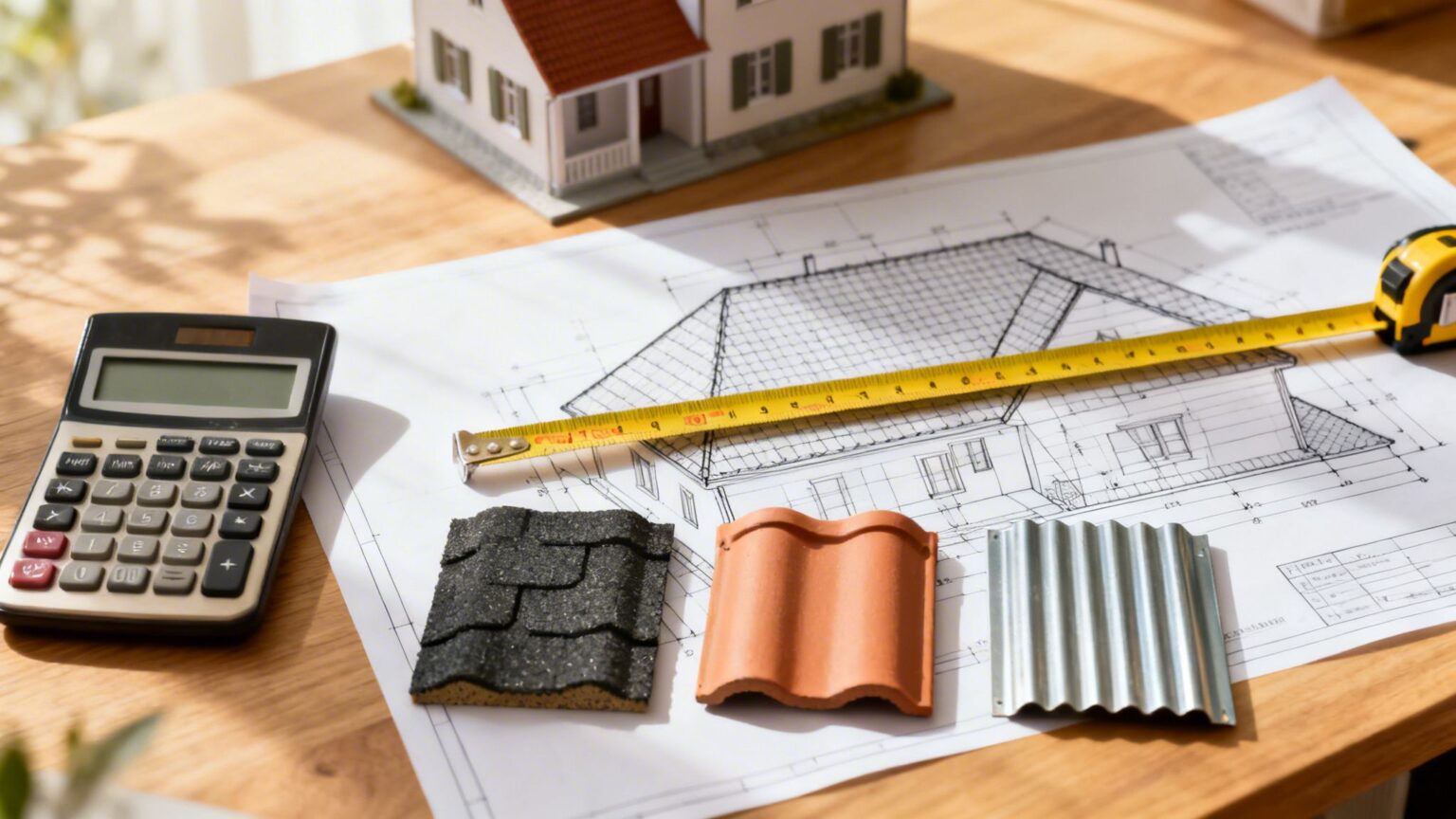
The key is telling the difference between a minor surface issue and a complete system failure. A small puncture in the membrane can be patched. But if you see widespread "alligatoring"—cracking that looks like dry, scaly skin—or chronic blistering, the entire membrane has lost its flexibility and is failing. This isn't a repair job; it’s time for a full replacement.
Navigating Florida Insurance Claims and Building Codes
Here in South Florida, the decision between a roof repair vs roof replacement isn't always up to you. More often than not, it's a choice dictated by state laws and your insurance policy. If you’re a property owner facing roof damage, understanding how these rules work is essential—they can quickly take a simple repair off the table and make a full replacement mandatory.
This is particularly true after a named storm rolls through. Your insurance carrier isn’t just looking at the handful of shingles you lost; they’re assessing their future risk. A patched-up old roof is a major liability for them, so they are far more likely to approve a full replacement that meets today's standards and prevents them from having to pay out another claim anytime soon.
The Florida Building Code and The 25% Rule
The biggest player in this decision is a state regulation known as the Florida Building Code's "25% Rule." This law was specifically designed to make older homes more resilient against hurricanes, and it has a massive impact on roofing claims.
Simply put, the rule says that if more than 25% of a single section of your roof is damaged and needs to be repaired or replaced within a 12-month window, the entire section has to be brought up to the current, much stricter building code. For many older homes, that's just not possible without tearing everything off and starting fresh. This makes a full roof replacement the only legal option, ensuring that major repairs don't just put a band-aid on the problem but actually upgrade the home's structural integrity.
A critical question on every homeowner's mind is whether their policy will cover this, which can completely change the financial picture. To get a better handle on this, you need to know if and how does an insurance company pay for a new roof.
The Role of Your Insurance Carrier
When your insurance adjuster shows up after a hurricane, their job is to evaluate the damage based on your policy and state law. They know the 25% Rule backward and forward. If their inspection reveals damage that crosses that threshold, they will almost always steer the claim toward a full replacement because the law demands it.
This reality has been amplified by two major forces: our aging housing stock and increasingly severe weather. A huge number of roofs installed during the housing boom of the early 2000s are now hitting middle age, fueling a replacement boom. In fact, re-roofing now makes up about 80% of the $29.5 billion U.S. roofing services market, with a huge chunk of that driven by storm damage claims.
Why Permitting Is Not Optional
Whether your new roof is funded by an insurance claim or you're paying out-of-pocket, a full replacement always requires a permit from your local city or county. This isn't just bureaucratic red tape; it’s a non-negotiable step that protects you as the property owner.
- Code Compliance: The permit process includes inspections that verify the new roof meets all current building and hurricane codes.
- Investment Protection: A properly permitted and professionally installed roof is essential for protecting your property value and is a must-have for any future real estate sale.
- Contractor Accountability: A reputable contractor like Paletz Roofing and Inspections will always handle the entire permitting process for you. It's a standard, non-negotiable part of a professional job.
While it might seem like a complicated process, it often points to a clear and logical path forward. When significant damage happens, a full replacement—often covered by insurance and required by code—is almost always the smartest and safest financial move for your property.
Making Your Final Call: A Homeowner's Decision Checklist
Deciding between a roof repair and a full replacement can feel like a high-stakes choice, but you don't have to make it in the dark. By now, you've learned what the key warning signs look like, how costs break down, and the specific issues for different materials here in South Florida. It's time to put that knowledge to work with a straightforward checklist.
Think of this as your personal game plan. Walking through these points will help you organize your thoughts and move from a place of uncertainty to one of clarity. Answering these questions for yourself will give you a solid idea of whether a targeted repair will do the job or if a replacement is the smarter long-term investment.
Your Personal Decision Checklist
Before you pick up the phone to call a pro, take a few minutes to honestly assess your roof’s situation. The answers you come up with will be incredibly helpful when you have that professional consultation.
- Age vs. Lifespan: How old is your roof, really? A 19-year-old shingle roof is telling a very different story than one that's only 10 years old and is well within its expected lifespan.
- Extent of Damage: Is the problem contained to one small spot? Or are you seeing issues all over? Widespread granule loss, multiple leaks, or shingles curling on different slopes point to a bigger problem than just a single point of failure. Damage covering more than 25% of your roof is a major red flag.
- Repair History: Are you on a first-name basis with your roofer? If you’ve had to schedule repairs for the same roof more than once in the last couple of years, it’s a strong sign the underlying system is starting to fail. You're just patching a sinking ship.
- Your Long-Term Plans: How long do you see yourself in this home? If you’re planning to stay for the long haul, a new roof provides decades of peace of mind. If you're thinking of selling soon, a new roof is one of the most powerful selling points you can have, often boosting resale value significantly.
This decision-making process is often a matter of scale. A little damage can be fixed, but widespread problems usually demand a bigger solution.

As the flowchart shows, if the damage is limited to less than a quarter of your roof, a repair is often the most practical route. Once the problems become more extensive, replacement becomes the only logical choice to ensure your home is truly protected.
Keep in mind, this checklist is your starting point—not the final word. The definitive step is always a professional, on-site inspection. Only a certified roofer can spot hidden issues, properly assess the condition of your underlayment, and give you a precise, code-compliant recommendation you can trust.
When you're ready for that expert opinion, the team at Paletz Roofing and Inspections is here to give you a clear, honest assessment. A professional inspection will confirm what you're seeing and lay out a clear path forward, giving you the confidence to make the best choice for your home’s safety and value.
Frequently Asked Questions
Even after you’ve weighed the costs, materials, and warning signs, it’s natural to have a few more questions. When it comes to the roof repair vs. replacement decision, we hear the same critical queries from property owners all over South Florida. Here are the straightforward answers you need.
How Long Should A Roof In South Florida Last?
A roof’s lifespan comes down to the material used and how well it was installed. Here in our unique climate, these are the timelines you can generally expect:
- Asphalt Shingle Roofs: Typically last 15-25 years.
- Concrete Tile Roofs: Can last 30-50 years with proper maintenance.
- Metal Roofs: Often last 50 years or even longer.
Keep in mind, these are just averages. South Florida’s relentless sun, high humidity, and the constant threat of hurricanes can take a serious toll, shortening these lifespans. This is especially true if a roof isn’t professionally maintained to catch small issues before they spiral out of control.
Will My Insurance Cover A Full Roof Replacement?
This is the big question, and the answer really hinges on your policy, your roof's age, and what caused the damage. Insurance often covers a replacement if a significant portion of the roof (usually over 25%) is damaged by a single, covered event like a hurricane. That’s because Florida’s building code often requires a full replacement in these cases to bring the entire structure up to current safety standards.
On the other hand, insurance will almost never pay for a roof that has simply gotten old or failed due to a lack of maintenance. Insurers consider that normal wear and tear, which is the homeowner's responsibility to manage.
Think of it this way: insurance is for sudden, accidental damage—not for the predictable end of your roof’s service life.
Can I Repair My Roof Myself?
While tackling a single missing shingle might seem like an easy weekend project, we strongly advise against it. Roofing is not only dangerous work but also surprisingly technical.
An amateur repair can easily make the leak worse, create new problems you can't see, and could even void your roof's warranty. A professional roofer has the right safety gear, specialized training, and years of experience to correctly diagnose the problem's source and fix it to code for a solution that actually lasts.
What Is The 25% Rule In Florida Roofing?
The Florida Building Code's "25% Rule" is a game-changer in the repair vs. replacement debate. In simple terms, it says that if you repair or replace more than 25% of a roofing section within a 12-month period, you must bring the entire roofing section up to the current building code.
For older roofs that don't meet modern standards, this rule often makes a large repair financially impractical. It usually makes more sense to move forward with a full replacement.
Still have questions about your roof? The most reliable way to get answers is with a professional inspection. Contact Paletz Roofing and Inspections today for a free, no-obligation assessment of your roof's condition. https://paletzroofing.com