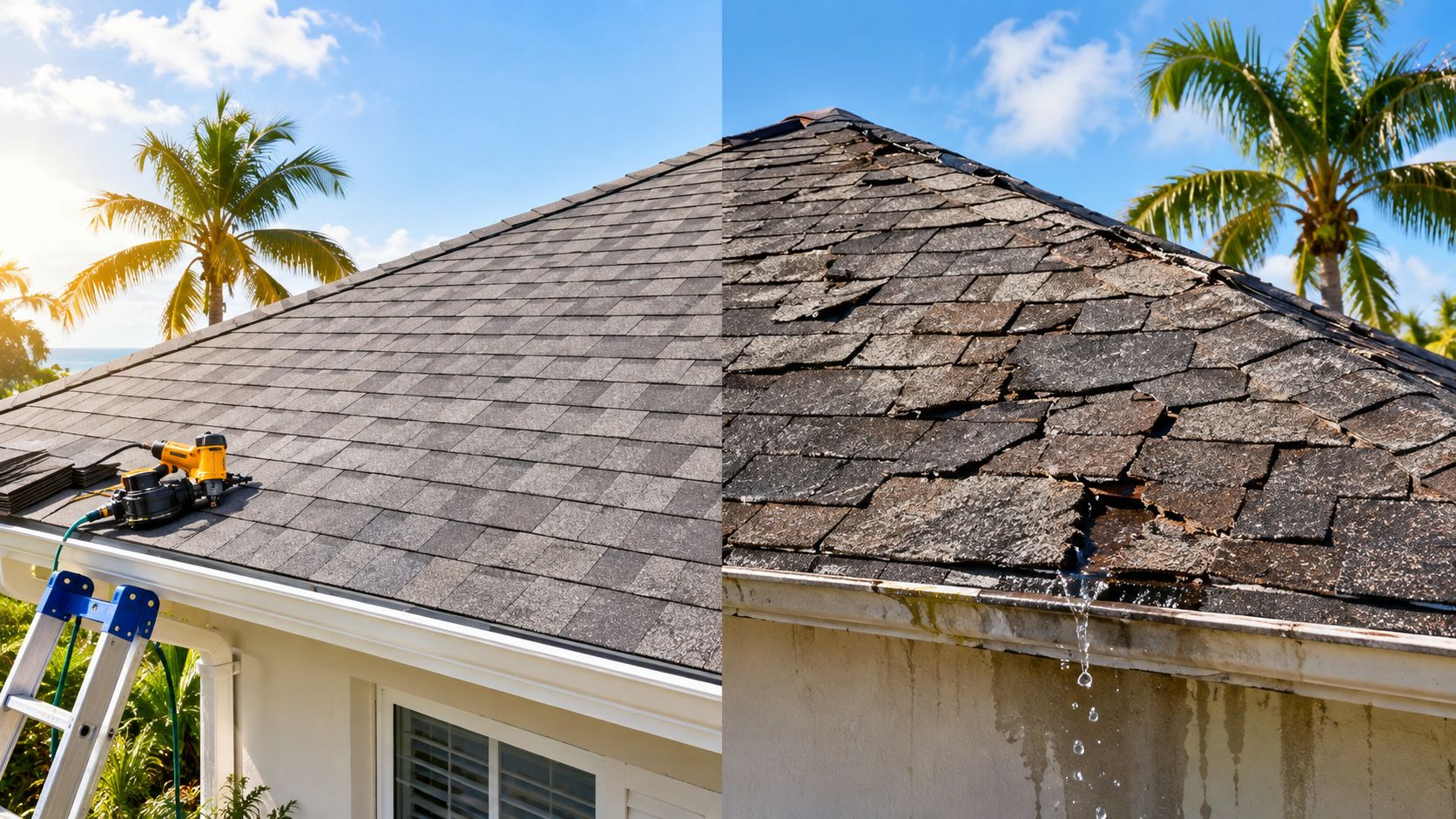
You've got a leak after a tropical squall, an insurance renewal letter on the counter, and a roofer's estimate that makes you wonder whether one more patch is the smart move. In South Florida, that decision can't be made from the leak alone. Roof age, damage extent, repair cost, insurance rules, and the next hurricane cycle all matter.
The direct answer is simple. Repair a relatively young roof when the damage is localized and the surrounding system remains sound. Replace an aging roof when deterioration is widespread, repairs keep recurring, or the repair bill reaches a meaningful share of replacement cost. The sections below give you practical thresholds for Broward, Miami-Dade, and Palm Beach homeowners, along with the life-cycle math that many roof estimates leave out.
Table of Contents
- The Decision South Florida Homeowners Face Every Storm Season
- Repair and Replacement Costs in 2025
- Roof Lifespan by Material and the Last-Quarter-of-Life Rule
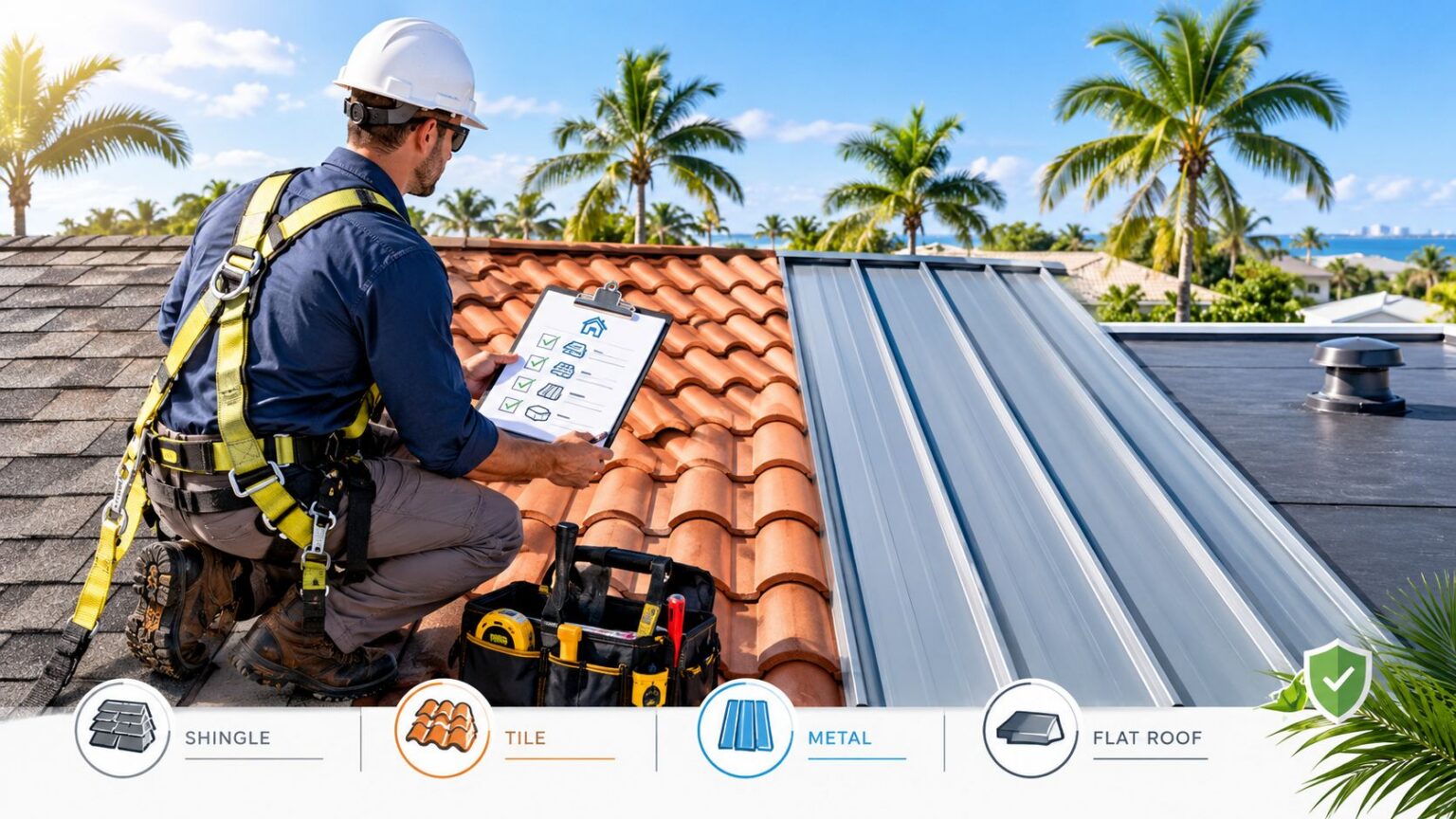
- Material-Specific Scenarios for Shingle, Tile, Metal, and Flat Roofs
- The 25% Damage Rule, the 30% Cost Rule, and Florida Age Thresholds
- The True Cost of Delay and the Life-Cycle Math
- Decision Flowchart and When to Choose Each Option
- Questions Homeowners Ask After the Comparison
The Decision South Florida Homeowners Face Every Storm Season
South Florida roofs take a hard beating from hurricane winds, salt air, intense ultraviolet exposure, heavy rain, and repeated thermal cycling. A roof can look acceptable from the driveway while flashing, underlayment, fasteners, or deck areas deteriorate underneath. Storm damage also tends to arrive in cycles. One squall lifts a few shingles, the next rain finds a weak flashing point, and the next season exposes a larger failure.
Start with three questions.
- How old is the roof compared with its material lifespan? A repair on a younger system can preserve many useful years. A repair on a roof near the end of its life often postpones replacement without changing the final outcome.
- What percentage of replacement cost is the repair? A small, isolated repair is reasonable. A repair that consumes a substantial portion of a new-roof budget deserves a replacement comparison.
- How much of the roof is damaged? Once damage affects more than roughly one-quarter of a slope or roof area, patching becomes difficult to defend, especially when the rest of the system is already weathered. This commonly used threshold is summarized in Florida roof-age and repair guidance.
Inspector's rule: Don't ask only, “Can this leak be repaired?” Ask, “Will repairing this leak leave me with a dependable roof?”
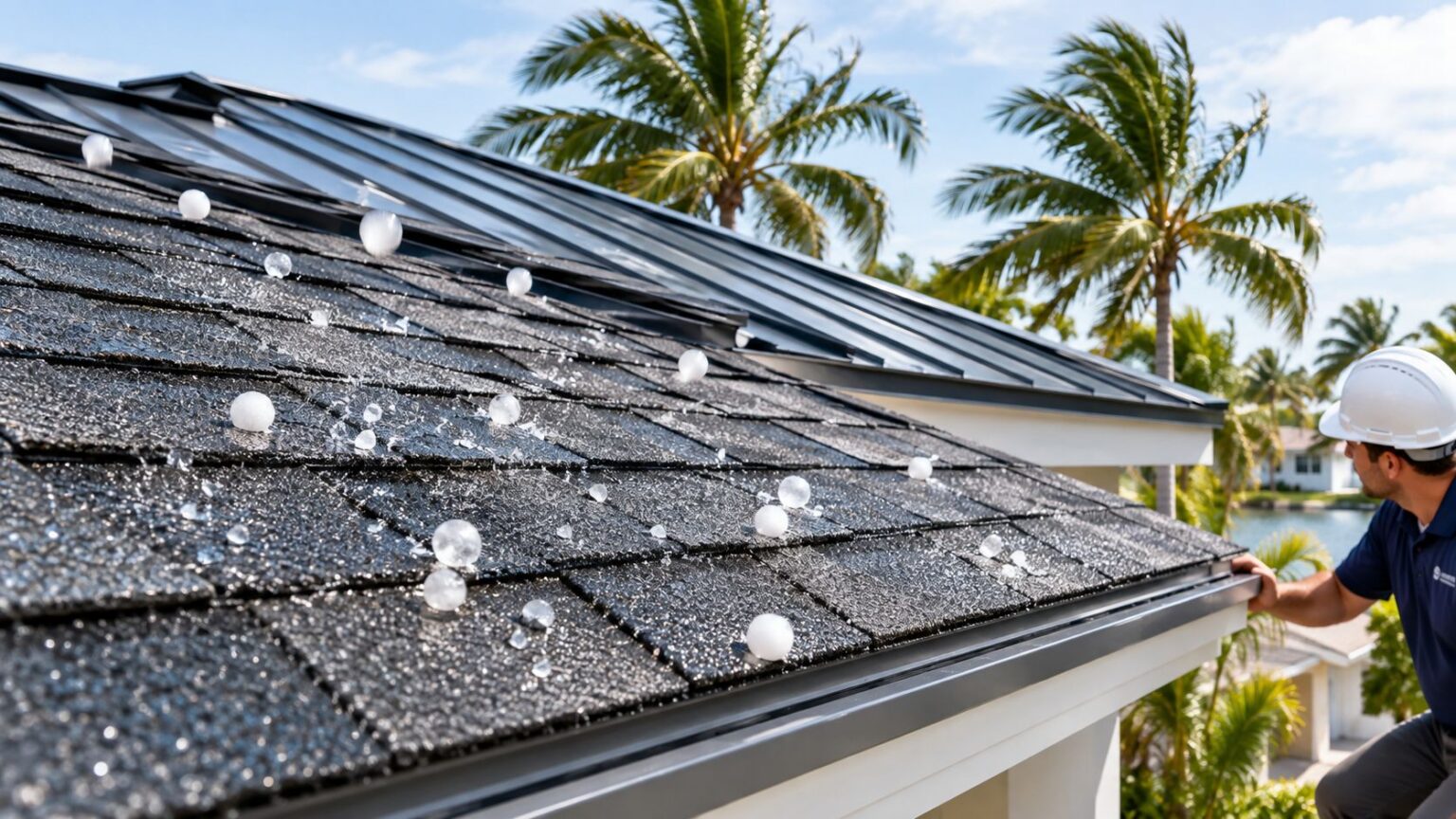
For a second technical perspective on inspection documentation and storm-related roof condition, homeowners can review this hail-proof roof inspection visual. If you're comparing inspection providers outside South Florida, a resource such as SuperiorPRO Marietta roofing can also help illustrate what a written roofing assessment should include. Your own decision should rest on a licensed local inspection, clear photographs, and a scope that separates localized damage from system-wide deterioration.
Repair and Replacement Costs in 2025
Verisk reported that the average U.S. residential roof replacement cost reached $17,631 in 2025, while the average repair cost was $4,699. Those figures were about 33% and 25% higher, respectively, than the 2021 to 2024 average, according to its 2025 roofing cost and risk report. The national averages don't replace a South Florida estimate, but they show why an old rule based on inexpensive patching no longer works automatically.
The table below uses the South Florida planning ranges specified for common residential systems. Treat them as budgeting bands, not promises. Roof size, pitch, access, tear-off requirements, decking, underlayment, permits, material selection, and code compliance can move the final proposal substantially.
2025 South Florida Roof Repair vs Replacement Cost Ranges
| Roof System | Typical Repair Range | Full Replacement Range |
|---|---|---|
| Shingle | $450 to $1,500 | Architectural shingles, $12,000 to $20,000 |
| Tile | $900 to $3,500 | Concrete or clay tile, $20,000 to $40,000 |
| Standing seam metal | $900 to $3,500 | $25,000 to $55,000 |
| Flat roof systems | Scope-dependent within the common repair category | $9,000 to $22,000 |
The gap widens when a replacement must satisfy Florida Building Code requirements, high-wind detailing, insurance documentation, and HVHZ material standards. In Broward and Miami-Dade, the product approval and installation details matter as much as the visible roof covering. A cheap patch may solve water entry today but leave unresolved questions about the roof assembly, attachment, drainage, or future insurability.
The practical cost test is straightforward. If the repair approaches about 30% of full replacement cost, replacement deserves the stronger position. That benchmark is discussed in roof repair versus replacement cost guidance. A repair quote should also be evaluated against the roof's remaining useful life, not just against this month's cash flow.
Roof Lifespan by Material and the Last-Quarter-of-Life Rule
Material labels create false confidence. A roof may carry a long manufacturer rating, but South Florida heat, UV exposure, salt air, wind events, and installation quality determine how much of that rating remains available in practice.
Common historical benchmarks place 3-tab asphalt shingles at about 20 years, architectural asphalt shingles at about 30 years, metal roofs at 40 to 80 years, and clay or concrete tile at 100 or more years. These broad benchmarks are summarized in roof repair versus replacement life-expectancy guidance. They're useful for orientation, but the roof's observed condition still controls the inspection decision.
Practical South Florida lifespan guide
- 3-tab shingles: Usually the shortest-lived common shingle option in harsh coastal exposure.
- Architectural shingles: More durable than basic 3-tab products, but still vulnerable to widespread granule loss, brittleness, curling, and wind damage.
- Concrete and clay tile: The tile can remain serviceable while the underlayment, flashings, or fasteners deteriorate.
- Metal roofing: Often supports targeted repairs because individual seams, fasteners, coatings, and panels can be evaluated separately.
- Flat systems: Modified bitumen and TPO roofs depend heavily on seam condition, drainage, flashing, and maintenance history.
The last-quarter-of-life rule is the key judgment point. Once the roof enters the final quarter of its expected service life, every repair must justify itself against the short remaining runway. A patch can be technically possible and still be financially wrong because another failure may occur nearby before the repair has delivered meaningful value.
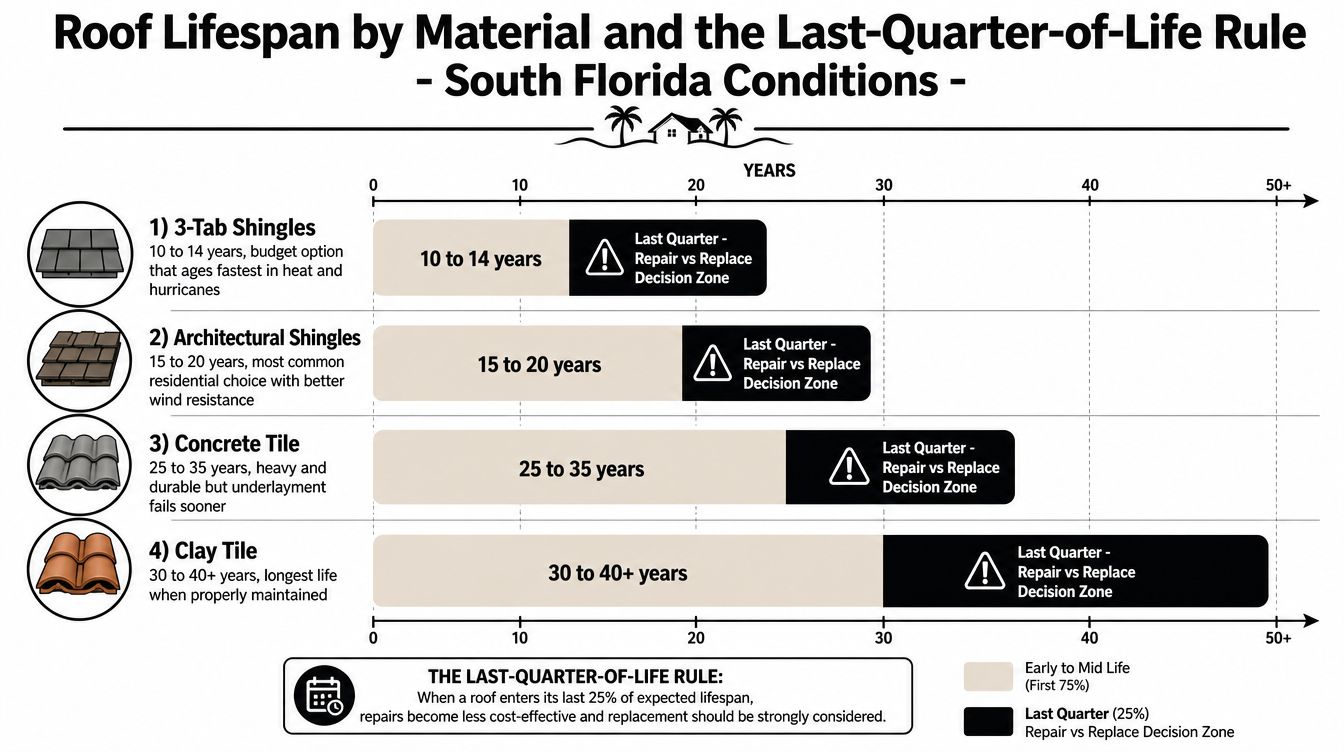
My verdict is direct. If your roof is in its final quarter and the damage is more than a small, isolated defect, plan replacement instead of buying another temporary repair. A younger roof with intact surrounding materials earns a repair evaluation. An old roof with widespread deterioration earns a replacement proposal.
Material-Specific Scenarios for Shingle, Tile, Metal, and Flat Roofs
Different roof systems fail differently, so a single roof replacement vs repair rule is too crude. The same leak may call for a flashing repair on one roof and a complete replacement on another.
Repair vs Replacement Triggers by Roof Material
| Material | Typical Lifespan in S. FL | Repair-Trigger Symptoms | Replace-Trigger Symptoms | 2025 Repair Cost Range |
|---|---|---|---|---|
| 3-tab shingles | Shorter asphalt-shingle service life in coastal exposure | Isolated lifted tabs, a few missing shingles, one defined leak area | Widespread curling, granule loss, brittle shingles, repeated leaks | $450 to $1,500 |
| Architectural shingles | Longer than 3-tab shingles, but shortened by heat and storm exposure | Localized wind loss, one penetration, limited flashing failure | Granular wear across slopes, widespread curling, repeated nail pops | $450 to $1,500 |
| Concrete tile | Tile may outlast its underlayment | Cracked tiles over sound underlayment, isolated broken pieces | Spongy walking surface, exposed battens, multiple leak zones, failed underlayment | $900 to $3,500 |
| Clay tile | Long material life when maintained | Individual cracked or displaced tiles with sound supporting layers | Broad underlayment failure, movement, multiple active leak points | $900 to $3,500 |
| Standing seam or 5V crimp metal | Long service life with maintainable components | Isolated seam separation, failed fastener gasket, individual panel damage | Widespread corrosion, systemic attachment problems, failed substrate or drainage | $900 to $3,500 |
| Modified bitumen or TPO flat roof | Moderate service life, highly dependent on drainage | One seam failure, small puncture, isolated flashing issue | Persistent ponding, alligatoring, multiple seam failures, widespread membrane deterioration | Scope-dependent |
Tile deserves special attention. Homeowners often assume cracked tile means a new tile roof, but the inspector must determine whether the tile is the problem or whether water is traveling through a failed underlayment system. Replacing a few cracked tiles over sound underlayment is sensible. A spongy walking surface or exposed battens indicates a deeper assembly problem.
Metal roofing usually offers the clearest repair case. A separated seam or degraded gasket can be localized, and replacing the entire roof to address one component is wasteful when the panels and substrate remain sound.
Flat roofs demand a drainage inspection before any patch is approved. Ponding, seam failure, and membrane aging across multiple zones are replacement signals. A small puncture or one failed flashing detail can remain repair territory, but only when the surrounding membrane is still performing.
The 25% Damage Rule, the 30% Cost Rule, and Florida Age Thresholds
Three tests turn a subjective roofing conversation into a defensible decision.
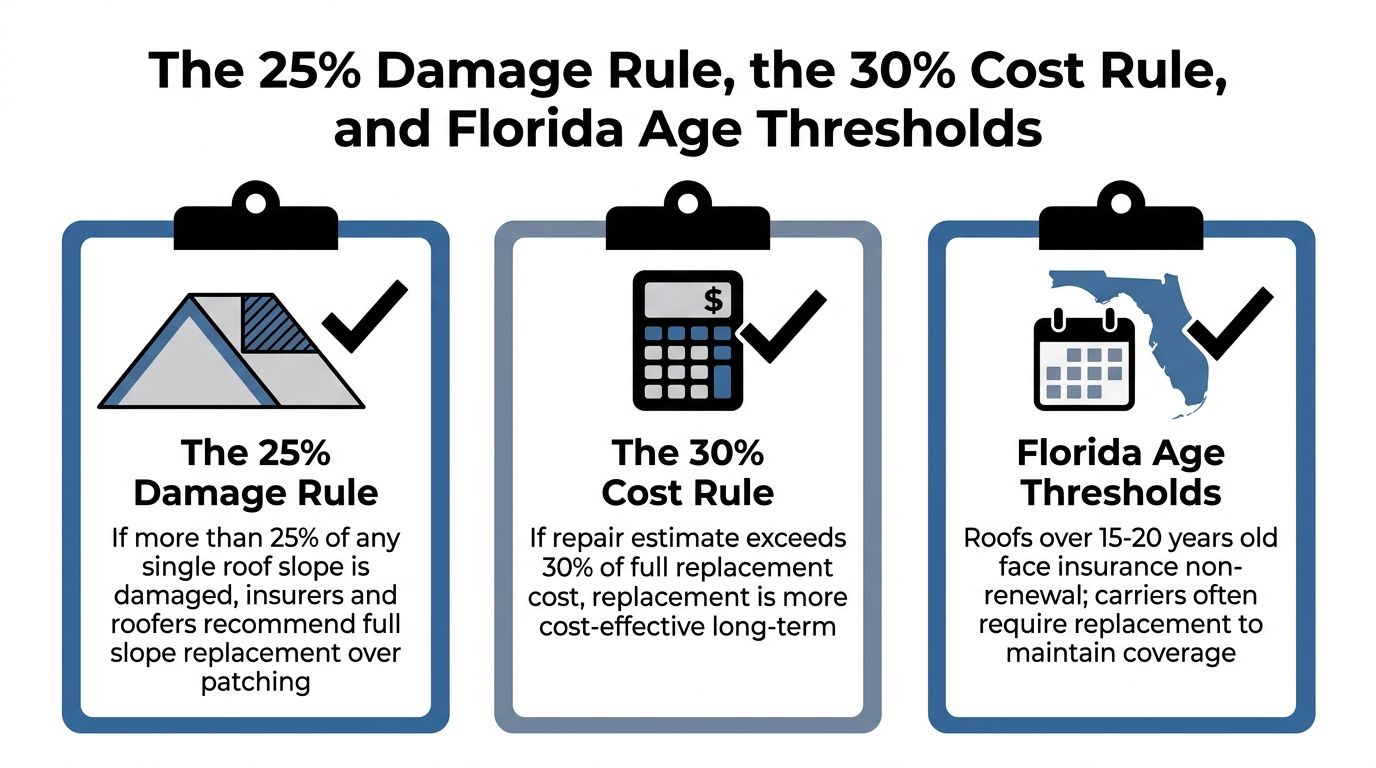
The 25% damage rule asks how much of a roof slope is affected. When damage exceeds roughly one-quarter of a slope, a full-slope replacement or broader reroofing scope often makes more sense than scattered patches. The concern isn't only appearance. New material must integrate with older material, and widespread damage may indicate that the roof has lost its ability to resist the next storm.
The 30% cost rule compares the repair estimate with the full replacement estimate. If the repair exceeds about 30% of replacement cost, you're spending a large share of a new roof's price on an older system. The result is especially poor when the roof is already in its last quarter of life or has a history of recurring leaks.
Florida insurance rules add a separate layer. Citizens' published benchmark requires proof of full replacement or an inspection showing at least 5 years of remaining useful life when a shingle roof is more than 25 years old, or when tile, slate, clay, concrete, or metal roofing is more than 50 years old, as described in Florida roof material and insurance guidance. Florida's statutory process also says that when a roof is 15 years or older, an insurer can't require replacement as a coverage condition without first allowing an authorized inspection. A finding of at least 5 years of remaining useful life can defeat a denial based solely on age.
HVHZ properties in Miami-Dade and Broward also require careful documentation of approved products, attachment methods, flashing, and wind-mitigation features. A 4-point inspection or wind-mitigation inspection may affect underwriting, but the exact insurance result depends on the policy and carrier. Don't assume a patch preserves coverage. Ask for written confirmation.
The True Cost of Delay and the Life-Cycle Math
A roof rarely announces its financial failure in one dramatic moment. More often, the homeowner pays for a leak, then another leak, then interior damage that was hidden behind insulation or ceiling finishes. The repair bills may look manageable individually while the roof's total cost keeps rising.
Verisk's 2025 averages show the pressure clearly. Replacement averaged $17,631, compared with $4,699 for repairs, and replacement costs had risen faster than repair costs against the earlier baseline, as reported in its roofing cost analysis. That doesn't mean every homeowner should replace immediately. It means repeated repairs deserve a cumulative calculation.
Cumulative Repair Spend vs Single Replacement Over 5 Years
| Scenario | Year 1 | Year 2 | Year 3 | Year 4 | Year 5 | 5-Year Total | Single Replacement |
|---|---|---|---|---|---|---|---|
| Localized repair on a sound roof | One repair | None if stable | None if stable | None if stable | None if stable | One repair invoice | Not justified by the repair alone |
| Recurring repair cycle | Repair invoice | Additional repair | Additional repair | Interior or roof repair | Further repair | Add every invoice and related damage | Compare against the cumulative total |
| Aging system with widespread deterioration | Patch only if temporarily necessary | Another failure is possible | Additional scope may appear | Interior damage risk continues | Replacement pressure increases | Often approaches replacement economics | Single replacement resolves the aging system |
Life-cycle analysis uses more than first-year capital cost. A recognized roof life-cycle model defines total lifecycle cost as initial cost plus the present value of future maintenance and the present value of eventual removal or replacement costs, explained in roof life-cycle analysis guidance. That framework changes the question from “What's cheapest today?” to “Which option produces the lowest total cost over the ownership period?”
A commercial roof study found that least-cost service lives were roughly 30 years on average, with substantial variation by roof and condition. Government and industry guidance also notes that management may extend modeled service life by only 3 to 5 years, while annual maintenance costs increase, according to commercial roof life-cycle research1076-0431(2010)16:1(29)). For a residential owner, the lesson is practical: maintenance can buy time, but it doesn't reverse systemic aging.
Use a written repair history. If the same roof has required multiple interventions, add those invoices, interior repairs, temporary protection, and inspection costs before approving another patch. A preventive roof maintenance visual can help organize the records you should bring to an inspection.
Decision Flowchart and When to Choose Each Option
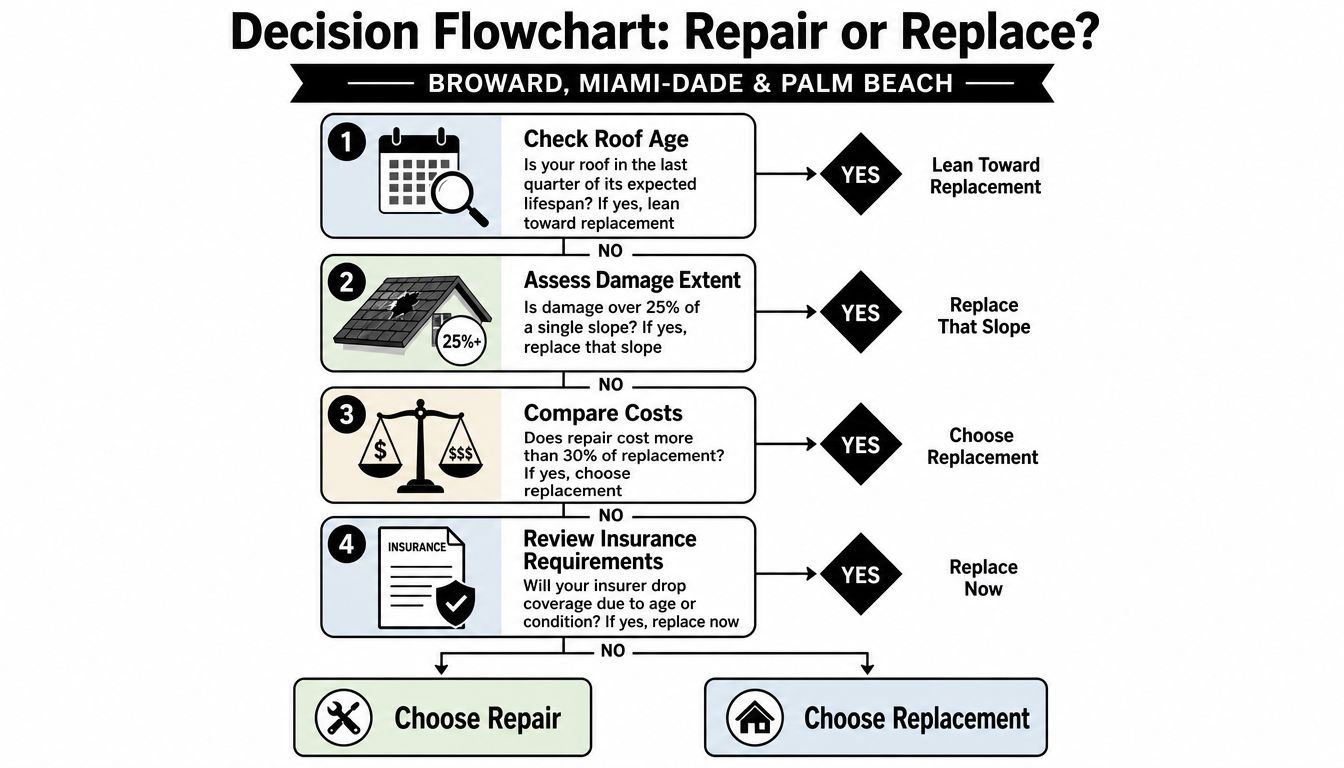
Use this sequence for a property in Broward, Miami-Dade, or Palm Beach. Don't skip directly to the contractor's preferred scope.
Five checkpoints for a defensible decision
- Confirm roof age. Identify the installation year and material. If the roof is in the final quarter of its expected life, replacement becomes the default unless the defect is isolated.
- Map the damage. Mark every active leak, damaged slope, missing covering, cracked tile, failed seam, and soft deck area. If more than 25% of a slope is affected, treat full-slope work as the serious option.
- Compare the money. Obtain a repair scope and a replacement scope. If repair exceeds roughly 30% of replacement cost, the repair must offer a compelling reason to proceed.
- Review insurance status. Check Citizens requirements, carrier age rules, inspection demands, wind-mitigation documentation, and any policy conditions before authorizing major work.
- Add the recent repair history. Total what you've spent over the prior 36 months. Repeated repairs on a late-life roof usually indicate that replacement has become the more responsible financial choice.
Text flowchart
Roof age: In the final quarter of expected life?
- No: Continue to damage assessment.
- Yes: Replace now if damage is widespread. Otherwise, plan replacement within 12 months and repair only urgent leaks.
Damage area: More than 25% of a single slope?
- No: Continue to cost comparison.
- Yes: Replace the affected slope or proceed with broader replacement if the remaining roof is also aged.
Repair cost: More than 30% of replacement cost?
- No: Repair when the surrounding system is sound.
- Yes: Choose replacement, especially with recurring leaks or limited remaining life.
Insurance: Will age or condition threaten coverage?
- No: Use the roof condition and life-cycle math.
- Yes: Replace now or obtain the required authorized inspection before coverage is jeopardized.
Repair history: Have repeated repairs consumed meaningful money?
- No: A targeted repair may be appropriate.
- Yes: Plan replacement within 12 months or replace now if active leaks, widespread damage, or underwriting pressure exists.
After a hurricane, authorize emergency tarping and water-control work first, then document the roof before permanent repairs. A property under contract may need a repair that satisfies the buyer's inspection, but an old roof that threatens insurance eligibility should be addressed before closing. For contractors and property managers reviewing risk transfer alongside project scope, insurance for roofing contractors 2026 provides additional context, but homeowners should rely on their own policy and carrier for coverage decisions.
Questions Homeowners Ask After the Comparison
Does insurance favor repair or replacement?
Insurance generally evaluates the covered cause, the extent of damage, the policy terms, and the cost to restore the property. Age-related wear isn't the same as sudden storm damage. Citizens' age and remaining-useful-life requirements can change whether a repair leaves the home insurable, so obtain the carrier's requirements in writing before choosing a limited scope.
When should I replace before hurricane season?
Don't wait until contractors are overloaded after a storm. If your roof is in its last quarter, has active leaks, or is approaching an insurance age review, schedule the inspection and permitting process early enough to address documentation and material availability. The cheapest month depends on contractor scheduling, weather, permits, and the specific roof, so a fixed calendar answer is less useful than replacing before the roof becomes an emergency.
Should I repair before a hurricane or wait for a storm assessment?
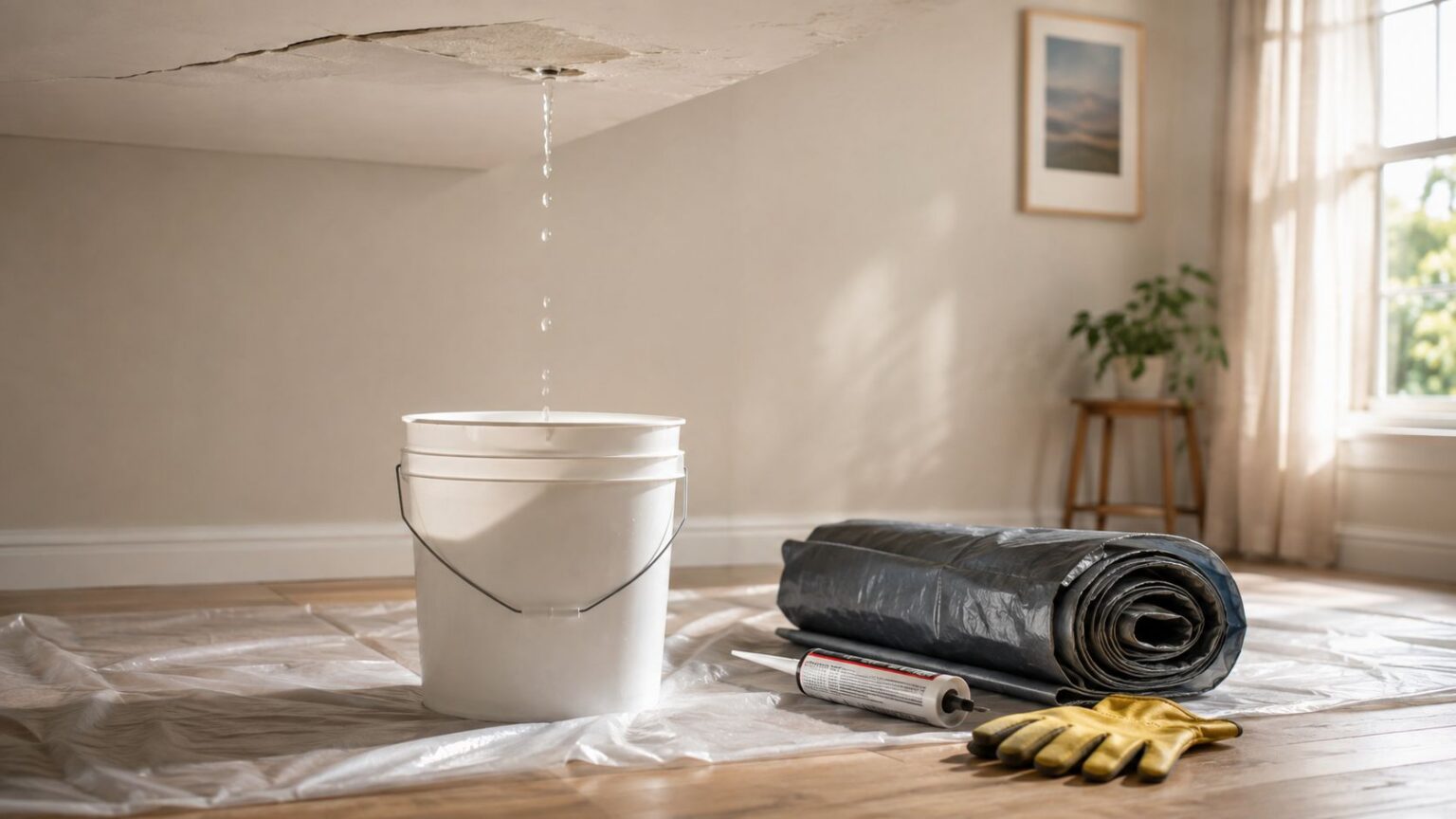
Repair known defects before a storm. Waiting allows a small opening, loose tile, or failed flashing point to become interior damage. Photograph the roof and existing conditions, keep invoices, and report sudden storm damage to your insurer before authorizing non-emergency permanent work. For immediate water entry, use emergency leak repair guidance while preserving evidence.
Which warranties matter?
Separate the manufacturer material warranty, the contractor's workmanship warranty, and any transferable warranty terms. A material warranty may not cover installation defects, while workmanship coverage depends on the contractor's written scope and exclusions. For replacement, ask who performs warranty work, what maintenance voids coverage, how wind and ponding are treated, and whether the warranty transfers when you sell. For a repair, confirm whether the patch carries its own workmanship coverage and whether it affects the original roof warranty.
The right choice is the one that matches the roof's condition, remaining life, insurance position, and total cost. Get a written inspection before you sign a replacement contract or authorize another repair.
Paletz Roofing and Inspections provides roof repairs, replacements, inspections, storm-damage assessments, and maintenance guidance for shingle, tile, metal, and flat roofing across Broward, Miami-Dade, and Palm Beach. Visit Paletz Roofing and Inspections to request an inspection and get a documented repair-versus-replacement recommendation for your property.