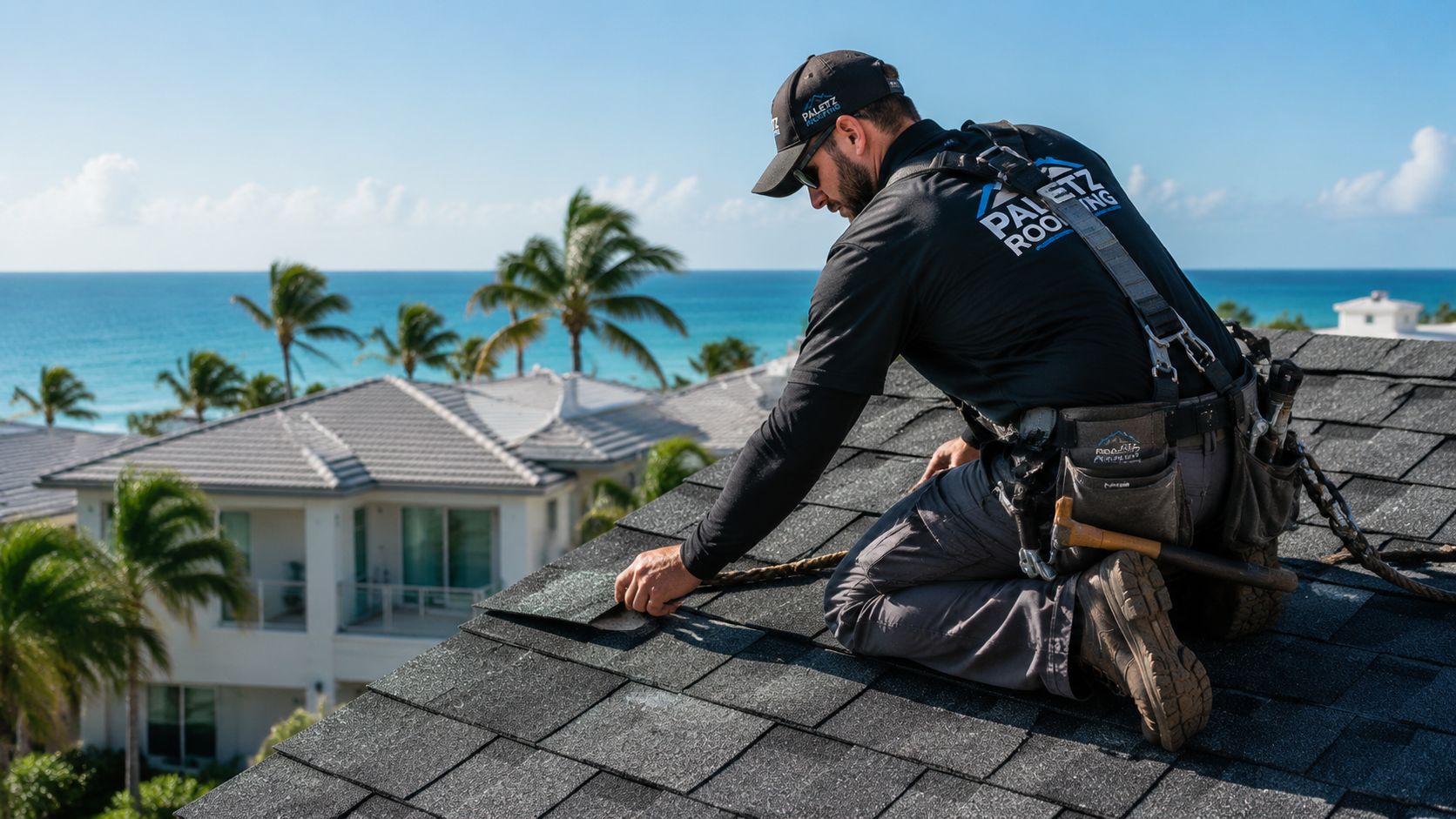
If you're looking for a roofing company in Delray Beach, you're probably not doing it for fun. Most homeowners start searching after a leak stains the ceiling, a storm tears off material, or an insurance notice lands in the mailbox and suddenly the roof needs official documentation. In South Florida, that decision has real consequences. The wrong contractor can leave you with code problems, denied claims, and a roof that looks fine from the street but fails where it matters.
A solid roof in Delray Beach has to do more than keep water out. It has to stand up to heat, wind, salt air, inspection scrutiny, and the paperwork side of ownership that too many roofing articles ignore. That's why the smart question isn't just who can show up fast. It's who can inspect correctly, document clearly, install to code, and tell you when a repair makes sense versus when it doesn't.
Table of Contents
- How to Choose a Qualified Roofing Company in Delray Beach
- Our Full Range of Delray Beach Roofing Services
- Your Roof Replacement and Inspection Process Explained
- Navigating Roofing Costs and Florida Insurance Mandates
- Choosing The Best Roofing Material For Your Florida Home
- Why Paletz Is Delray Beachs Trusted Roofing Partner
- Frequently Asked Questions About Delray Beach Roofing
How to Choose a Qualified Roofing Company in Delray Beach
The highest-risk time to hire a roofer is right after a storm. That's when homeowners are under pressure, leaks are active, and bad actors know people want a fast answer. If you remember one thing, remember this. A roofing company in Delray Beach should be verified before anyone gets on your roof or asks for money.
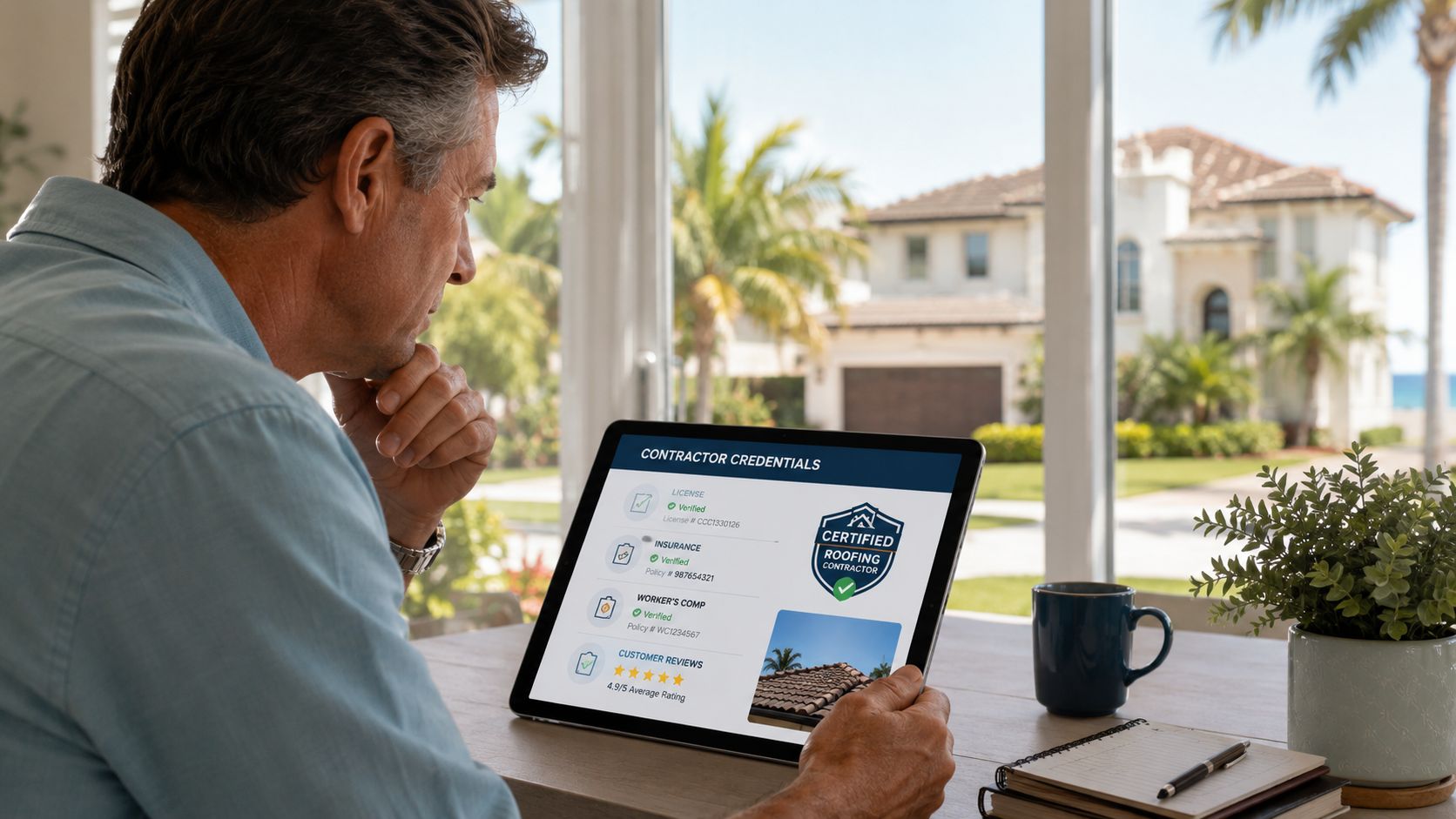
Start with the license, not the sales pitch
In Florida, the first filter is the contractor license. A real roofing contractor should be able to provide a CCC license number immediately. If they dodge that question, give you a vague answer, or tell you a permit can be handled later, move on.
A proper verification checklist should include:
- State roofing license: Ask for the exact CCC or CGC number and verify it before signing anything.
- Proof of insurance: Don't settle for verbal assurance. Ask for current documentation.
- Physical business presence: A contractor with an established office is easier to reach if warranty or inspection issues come up later.
- Written scope of work: You need material details, not a one-line estimate scribbled on a flyer.
- Local review trail: Look for a pattern of real customer feedback, not just dramatic before-and-after photos.
Practical rule: If a contractor wants a commitment before giving you traceable business credentials, you're not talking to a serious professional.
Know the scam pattern before it reaches your door
Delray Beach homeowners also need to watch for post-storm scams. Current online coverage overlooks the rising prevalence of post-storm contractor scams in Delray Beach, where unlicensed entities use fake names to demand upfront payments for non-existent repairs. BocaNewsNow documented this trend in mid-2025 after receiving 12+ scam reports in 48 hours in a local community discussion about the issue, which is why checking CCC or CGC credentials matters before hiring anyone (community report on Delray Beach storm scam activity).
That scam pattern is usually easy to recognize once you know it:
- Urgency pressure: They tell you the whole neighborhood is booking and you must sign today.
- Large upfront payment demand: They ask for substantial money before materials arrive or permits are discussed.
- Fake or shifting company identity: The name on the truck, estimate, and payment request doesn't match.
- No inspection depth: They talk a lot about damage but don't document flashing, decking, slope transitions, or penetrations.
What a real contractor should show you
A qualified roofer should inspect the roof system, not just the visible surface. That means looking at drainage, edge details, underlayment condition where visible, signs of movement, repair history, and whether the existing roof is still a good repair candidate.
For homeowners trying to judge whether a contractor operates like a local business, online visibility can tell you a lot. A well-managed profile usually includes service categories, verified contact details, photos of real work, and a review history that aligns with how the company presents itself. For a useful breakdown of what those local trust signals look like, Wispra's insights for local merchants are worth reading.
A good contractor doesn't rush you past the boring parts. License verification, insurance documentation, permit readiness, and a clear written scope are what protect your house.
Our Full Range of Delray Beach Roofing Services
Most homeowners don't need every roofing service. They need the right one for the condition they're dealing with now. In practice, roofing work in Delray Beach usually falls into three buckets. Immediate leak response, planned replacement, or maintenance and inspection before a problem gets expensive.
For urgent leaks and visible storm damage
When water is already getting inside, the first job isn't cosmetic. It's containment, diagnosis, and stabilization. The contractor should identify where water is entering, because the interior stain and the entry point often aren't in the same place.
Urgent service typically includes:
- Leak tracing: Finding the source around valleys, penetrations, flashing lines, wall connections, and transitions.
- Targeted roof repair: Replacing damaged sections without disturbing sound areas.
- Storm damage assessment: Documenting what failed and whether the system can be repaired reliably.
- Temporary protection when needed: Keeping the home dry until permanent work can be completed.
A rushed patch can stop water for a few days and still fail in the next hard rain. Good repair work solves the assembly problem, not just the symptom.
For planned replacement and long-term upgrades
Some roofs are past the point where repairs make financial sense. If multiple areas are failing, the underlayment is compromised, or the roof has a history of repeated leak calls, replacement is often the cleaner path.
A full-service roofing company in Delray Beach should handle replacement for the main systems used in South Florida:
- Shingle roofing: Common on many homes and practical when the roof design fits it well.
- Tile roofing: Popular for curb appeal and often chosen for South Florida architectural styles.
- Metal roofing: A strong option when owners want durability and a cleaner modern look.
- Flat or low-slope roofing: Used on commercial buildings and some residential sections like additions or porches.
One option homeowners can evaluate is Paletz Roofing and Inspections, which provides repairs, replacements, new installations, and inspections for shingle, tile, metal, and flat roofing systems across South Florida.
For maintenance and inspections
The least expensive roof problem is the one found early. Regular inspections help catch slipped materials, sealant failure, drainage trouble, and small edge issues before they become interior damage.
A well-timed inspection often gives a homeowner choices. Waiting too long usually turns the same issue into an emergency.
Maintenance matters most after storms, before listing a property for sale, and when an insurer asks for documentation. Even if no leak is visible inside, the roof may still have exposed weak points that should be corrected before the next weather event.
Your Roof Replacement and Inspection Process Explained
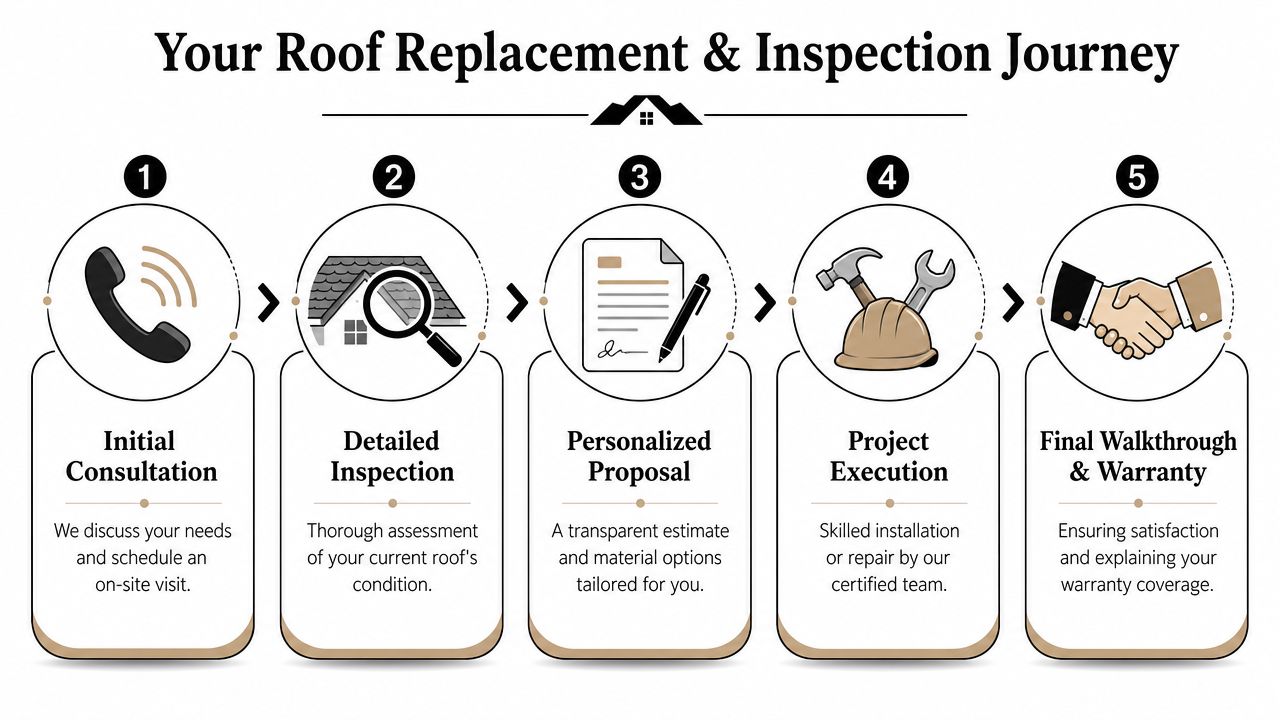
Homeowners feel better about a roofing project when they know what they're going to see, what decisions they'll need to make, and what details separate careful work from rushed work. A proper process is orderly. It starts with inspection, moves into scope and materials, then into dry-in, installation, cleanup, and final review.
What happens before work starts
The first site visit should determine whether you're dealing with a repairable problem or a full replacement condition. That visit should include a close look at the roof covering, vulnerable transitions, visible decking issues if accessible, and any signs of moisture intrusion.
After that, the proposal should spell out the essentials:
- Scope of work: Repair versus replacement, plus what areas are included.
- Material selection: Shingle, tile, metal, or flat roofing system, based on the structure and your priorities.
- Permitting and code readiness: Especially important in coastal South Florida.
- Scheduling expectations: Access, staging, debris handling, and homeowner preparation.
A company logo on a document doesn't prove much by itself, but consistent branding and documentation usually signal a contractor that operates with process and accountability. You can see the company's brand asset here: Paletz Roofing visual identity.

What happens during installation
Tear-off is where the truth comes out. Once old materials are removed, the crew can inspect the deck and identify any substrate issues that weren't fully visible before. If the deck isn't sound, the roof system above it won't be either.
Then comes dry-in and fastening. At this point, code knowledge is paramount, particularly in South Florida's wind zone. In the high-velocity hurricane zone, roof deck fastening for 4/12-slope tile roofs must use 10d galvanized common nails spaced no more than 6 inches on center to prevent uplift failure during 140+ mph winds, as required by Florida Building Code 8.3.4.1. The benchmark is discussed in this HVHZ roof replacement overview.
That kind of requirement isn't trivia. It affects whether the assembly holds together when the weather gets violent.
The clean-looking roof isn't always the good roof. The good roof is the one fastened, flashed, and detailed correctly where you can't see it from the driveway.
What the final review should include
At the end of the project, the homeowner should get more than a handshake. Final review should include a walkthrough, cleanup confirmation, discussion of what was installed, and a clear explanation of warranty coverage and maintenance expectations.
Look for these closeout basics:
- Visible condition check: Ridge, hips, valleys, edges, penetrations, and transitions should all be reviewed.
- Debris and magnet cleanup: Nails in the driveway and lawn are a sign of careless site control.
- Documentation: Keep permits, invoices, inspection paperwork, and warranty records together.
- Next-step guidance: Know what to monitor after major weather and when to schedule follow-up inspection.
A project feels smooth when the homeowner never has to guess what's happening next.
Navigating Roofing Costs and Florida Insurance Mandates
Roofing cost worries are real, but in Delray Beach the insurance side can be even more stressful than the construction itself. Plenty of homeowners can budget for repairs or replacement once they understand the scope. What catches people off guard is when an insurer requires inspection documents, certification language, or proof that the roof meets current expectations.
Why insurance paperwork now matters more
A roof isn't just a building component anymore. For many owners, it's also an underwriting issue. Florida's 2025 to 2026 insurer-driven roof certification mandates require licensed, wind-code-compliant roof inspections with signed 5-year certifications for insurance renewal, and one source says 68% of South Florida homeowners faced policy non-renewals in 2025 due to uncertified roofs (Florida roof certification mandate overview).
That changes the homeowner's job. You can't wait for a leak and assume paperwork will sort itself out later. If renewal is on the line, inspection quality matters as much as repair quality.
What actually drives roofing cost
Roof pricing changes from house to house because the scope changes. Two homes with similar square footage can produce very different proposals if one has complex valleys, steep sections, tile details, low-slope tie-ins, or hidden substrate trouble.
The biggest cost drivers are usually:
- Material type: Shingle, tile, metal, and flat systems all install differently and carry different labor demands.
- Roof design complexity: Intersections, penetrations, height, and access all affect production time.
- Condition below the surface: Deck repairs and waterproofing details change the job.
- Code-related requirements: Permits, fastening details, and compliant assemblies matter in this region.
Cheap bids often leave out the exact places where roofs fail first. Flashing, edge details, underlayment choices, and cleanup logistics rarely look dramatic on an estimate, but they shape the result.
How to protect yourself financially
The right question isn't 'What's the lowest price?' It's 'What am I buying?' A detailed estimate should identify the system, the affected areas, and the responsibilities on both sides.
It also helps to understand how contractor overhead connects to lawful operation. Insurance and labor compliance aren't glamorous topics, but they affect whether a company is operating responsibly. If you want context on that side of the business, understanding Florida workers comp is useful background for homeowners reviewing contractor paperwork.
Insurance inspections, repair scopes, and replacement bids should line up. If those three things contradict each other, stop and ask why before signing.
The roof is expensive. Losing coverage because the roof wasn't properly documented can be worse.
Choosing The Best Roofing Material For Your Florida Home
Material choice should match the house, your maintenance tolerance, and how long you plan to keep the property. In Delray Beach, homeowners usually narrow the field to shingles, tile, metal, or a flat or low-slope system for specific sections. Each one can work. Each one also asks something different from the structure, the budget, and the installer.
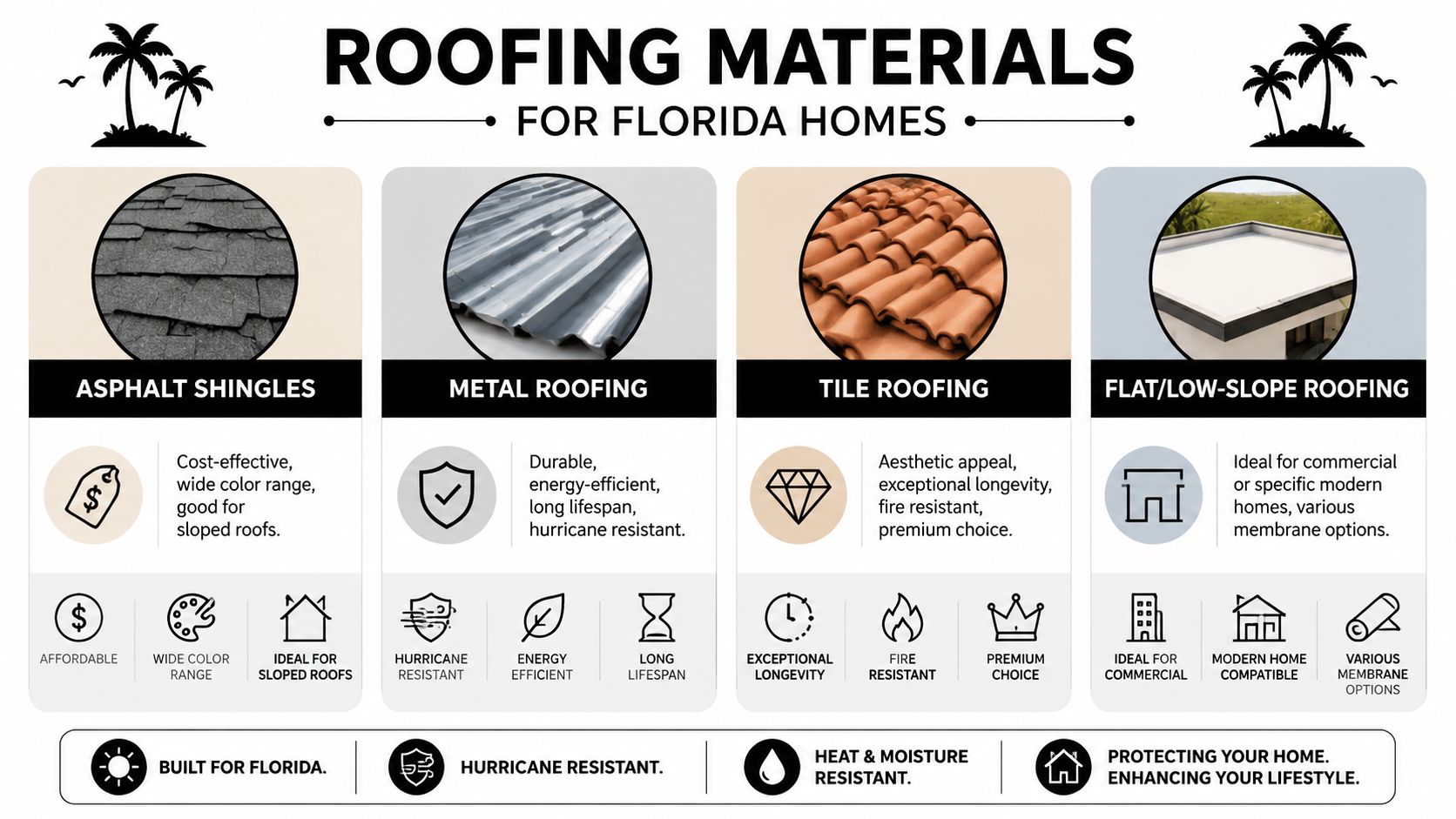
How shingles, tile, metal, and flat systems compare
The table below is meant to help you compare categories, not give a universal price sheet. Actual cost and lifespan vary by product line, installation quality, roof design, and maintenance.
| Material | Est. Lifespan | Hurricane Resistance | Energy Efficiency | Avg. Cost |
|---|---|---|---|---|
| Asphalt Shingles | Varies by product and installation | Good when properly specified and installed | Moderate | Generally lower upfront cost |
| Metal Roofing | Often longer-term than basic systems | Strong choice for storm-prone areas when detailed correctly | Often strong due to reflective performance | Generally higher upfront cost |
| Tile Roofing | Known for long service life when the assembly is maintained | Strong, but attachment details are critical | Good in hot climates | Premium cost range |
| Flat or Low-Slope Roofing | Varies by membrane and maintenance | Depends heavily on system design and drainage | Can perform well with the right membrane and reflectivity | Varies widely by system |
Match the material to the house, not the trend
Asphalt shingles work well when a homeowner wants a familiar look, broad color choice, and a practical price point. They're common for sloped residential roofs and can be a sensible choice if the roof design is straightforward and the attic ventilation is handled correctly.
Metal roofing appeals to owners who want durability and a cleaner profile. It can be a smart fit for homes where long-term performance and lower maintenance are more important than the lowest initial number on the estimate.
Tile roofing is often chosen for appearance as much as function. It suits many South Florida homes well, but the underlayment and attachment details matter just as much as the tile itself. Heavy material on the wrong structure, or beautiful tile with poor fastening, is not a premium roof.
Flat or low-slope systems belong on the right roof geometry. They aren't interchangeable with steep-slope materials, and drainage detail is everything.
One credential that matters across all these choices is proper state licensing. Paletz Roofing and Inspections Inc. holds Florida Certified Roofing Contractor license number CCC1325656, officially registered since 1990, which is listed in its GAF contractor profile.
The material doesn't save the project by itself. The right assembly, installed by a qualified contractor, does.
Why Paletz Is Delray Beachs Trusted Roofing Partner
By the time most homeowners finish sorting through quotes, code questions, and insurance demands, they're not looking for clever marketing. They want a company with a track record, real credentials, and the ability to handle both the roof work and the practical realities around it.
That combination is part of why Paletz has earned attention across South Florida. Paletz Roofing & Inspections Inc was founded in 2003 and reflects over 30 years of industry experience in South Florida. The company also has an estimated annual revenue of $6.5 million, a 5.0-star Yelp rating, and a 78% recommendation rate across 15 Facebook reviews according to its business listing and review profile.
Those numbers matter less as bragging points than as trust signals. They suggest the company isn't a pop-up operation and that customers have responded well to the work and service experience.
For a Delray Beach homeowner, the practical takeaway is simple:
- Experience matters: Roof problems in South Florida rarely stay simple.
- Documentation matters: Inspection and insurance issues don't fix themselves.
- Range matters: The right company should be able to handle repair, replacement, and inspection work without forcing the wrong solution.
- Responsiveness matters: Leaks and certification problems both come with deadlines.
If your roof needs repair, replacement, or an inspection tied to insurance renewal, the next move should be straightforward. Request a quote, ask for the license information up front, and get the roof looked at before the problem gets more expensive.
Frequently Asked Questions About Delray Beach Roofing
How long does a roofing project usually take
It depends on the size of the roof, the material, weather interruptions, permit timing, and whether hidden deck repairs show up after tear-off. A straightforward repair can move quickly. A replacement with complex details or material-specific installation steps will take longer. The useful question to ask isn't just how long the crew will be there. Ask what could extend the schedule and how you'll be updated if conditions change.
What signs of roof damage can I spot from the ground
Look for missing or shifted materials, sagging lines, dark streaks that suggest persistent moisture paths, debris buildup in valleys, bent flashing edges where visible, and stains on soffits or exterior walls below roof transitions. Inside the house, ceiling discoloration and attic moisture smell also matter. None of those signs confirm the full extent of damage, but they tell you the roof deserves a closer look.
Is regular roof maintenance worth it in Florida
Yes, especially in a climate with heat, heavy rain, storm exposure, and salt air. Maintenance gives you a chance to catch small failures in sealants, edges, flashing, and drainage before they become interior repairs. It also helps when you're preparing for a sale, recovering after a storm, or trying to stay ahead of insurance documentation requests.
What should I ask about warranties
Ask what covers materials, what covers workmanship, what actions could affect coverage, and what records you need to keep. Also ask who handles warranty follow-up if a problem appears later. A warranty is only useful when the scope is clear and the contractor can explain it in plain language.
If you need help sorting out repairs, replacement options, or an insurance-related roof inspection, Paletz Roofing and Inspections is a practical place to start. Ask for a written scope, verify the license details, and get clear answers before work begins.