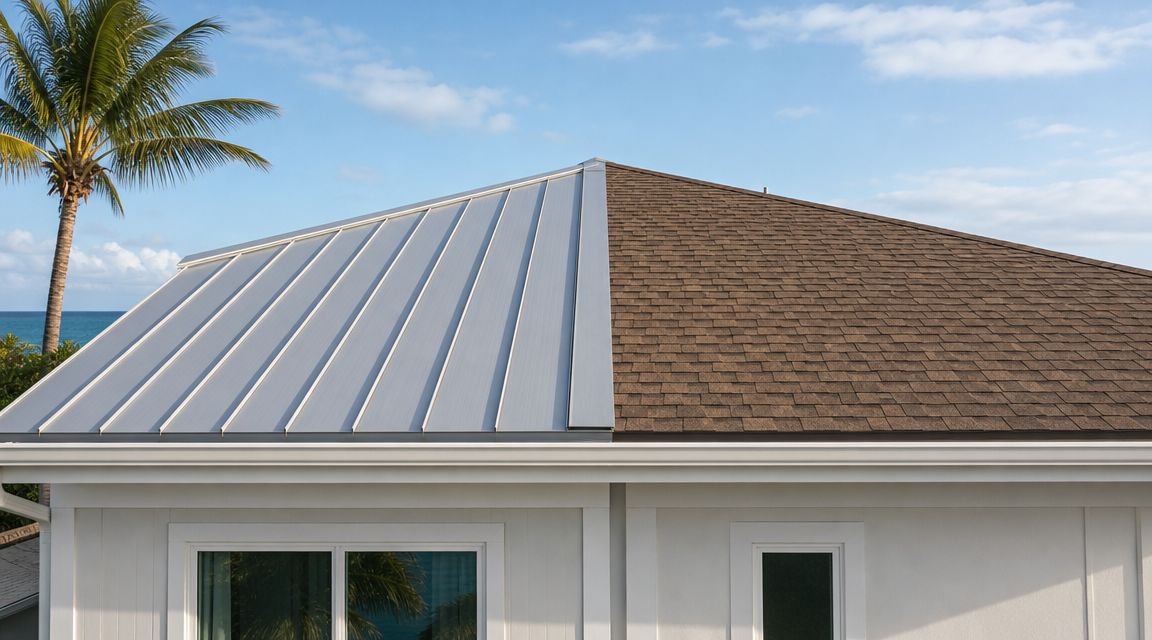
When it comes to choosing between metal and asphalt shingle roofing in South Florida, the decision often boils down to upfront cost versus long-term performance and storm defense. While architectural shingles offer a reliable and more budget-friendly solution for the short term, a modern metal roof is the superior investment for lifetime durability and maximum hurricane protection.
Table of Contents
- What is the best roofing choice for South Florida?
- Analyzing the True Lifetime Cost of Your Roof
- Hurricane Durability and Extreme Weather Performance
- Calculating Energy Efficiency and Environmental Impact
- Making the Right Choice for Your Property
- Frequently Asked Questions About Metal and Shingle Roofing
What is the best roofing choice for South Florida?
For homeowners and commercial property owners in our region, selecting a new roof is one of the most critical decisions you'll make. This guide moves beyond simple price tags to give you a detailed, side-by-side comparison of metal and asphalt shingle roofing. We’ll dive into the factors that matter most in South Florida’s unique coastal environment, so you can make a strategic choice for your property.
When are shingles the right choice?
Architectural shingles present a compelling case for property owners who prioritize a lower initial investment. They are a great choice for a quick, reliable installation, particularly if you're thinking about selling your home within the next 10 to 15 years. Their classic appearance is familiar and trusted, making them a common sight all across South Florida.
When is a metal roof the better long-term investment?
For those of us planning for the long haul, however, a modern metal roof is the clear winner. It’s the best option for maximizing long-term value, getting superior hurricane protection, and achieving significant energy savings. The upfront cost is certainly higher, but the return on investment comes from a lifespan that can be two to three times longer than shingles, not to mention lower energy bills and potential insurance discounts.
A new roof isn't just a purchase; it's a strategic investment in your property's safety and financial future. The right choice depends on your specific goals, budget, and how long you plan to own the property.
This infographic breaks down the core differences at a glance, highlighting the primary benefits of each material for local property owners.

As you can see, shingles are the go-to for budget-conscious projects and a traditional look. Metal, on the other hand, excels in durability and delivering long-term financial performance. To get a better sense of how these materials look on actual homes, you can explore some of our recently completed roofing projects in our gallery.
Metal vs. Shingles: A Quick Comparison for South Florida
When you’re weighing your options, it helps to see a direct comparison. Here’s an at-a-glance summary of the key performance and cost factors to help you make an informed roofing decision for your South Florida property.
| Factor | Metal Roofing | Asphalt Shingles |
|---|---|---|
| Lifespan | 40-70+ years | 15-25 years |
| Hurricane Performance | Excellent, high wind uplift resistance | Good, but susceptible to damage over time |
| Upfront Cost | Higher initial investment | Lower initial investment |
| Energy Efficiency | High, reflects solar heat to lower cooling costs | Low, tends to absorb and retain heat |
| Maintenance | Minimal, occasional inspections and cleaning | Requires regular checks for loose or damaged shingles |
| Insurance Impact | Often qualifies for significant premium discounts | Fewer discounts available |
Ultimately, this table shows a clear trade-off. Metal roofing requires a larger upfront investment but delivers unmatched performance and longevity, often paying for itself over time. Asphalt shingles offer a more affordable path to a secure, reliable roof, making them an excellent choice for many homeowners.
Analyzing the True Lifetime Cost of Your Roof
When you’re weighing metal roofing against shingles, the conversation almost always kicks off with the upfront price. But the real cost of a roof isn’t just the number on the first invoice; it’s the total you'll spend over its entire lifespan. For any property owner in South Florida, looking beyond that initial estimate is key to making a smart investment.
Architectural shingles definitely have a lower initial price tag, which is a major draw for many. On the other hand, a high-quality standing seam metal roof requires a bigger investment from the get-go. This price gap is a huge factor, but it only tells half the story, especially here in our demanding coastal climate.
How much does it cost to install a metal roof vs. a shingle roof?
Let's get practical and look at the numbers. Asphalt shingles are, without a doubt, the more budget-friendly option at the start. You'll typically see installed asphalt shingle prices around $4.50 to $6 per square foot.
In contrast, standing seam metal panels often run between $9 and $14 per square foot, with some premium metal systems going well over $30 per square foot. On a standard 2,000-square-foot roof, that difference can mean paying roughly $9,000 to $12,000 for shingles versus $18,000 to $30,000+ for metal.
The logic behind these prices is simple. Shingles are a mass-market product designed to be replaced every couple of decades. Metal is engineered as a long-term system that you install once and forget about. For homeowners in a hurricane-prone area like South Florida, the real question isn't just about the first bill, but how many times you’ll have to replace that roof over a 40- or 50-year period. You can learn more about how industry experts break down these costs.
While that initial cost difference is significant, the financial picture changes completely when you factor in the realities of owning property in South Florida over the long haul.
What is the total cost of ownership over 30 years?
The real economic gap between metal and shingles appears over time. Let's map out the total cost for a typical 2,000-square-foot home in Broward County over 30 years.
Scenario 1: Architectural Shingles
- Year 1: Initial installation costs you approximately $12,000.
- Years 5-15: You’ll likely face repair costs from tropical storm damage, relentless sun exposure, and granule loss.
- Year 20: A full roof replacement becomes almost a certainty. This will cost another $12,000 or more, once you account for inflation.
Over 30 years, a shingle roof owner will have paid for their roof nearly twice. The total expense could easily top $25,000, and that’s not even including the smaller, intermittent repair bills.
Scenario 2: Standing Seam Metal Roof
- Year 1: Your initial installation costs around $24,000.
- Years 5-25: Maintenance is minimal, usually just inspections and maybe some cleaning.
- Year 30: The original metal roof is still performing perfectly, well within its expected 40 to 50+ year lifespan. No replacement is needed.
In this scenario, your total cost after 30 years is still just the initial $24,000.
Over a 30-year horizon, the "more expensive" metal roof often proves to be the more economical choice by completely eliminating the cost, stress, and disruption of a mid-life roof replacement.
This long-term view completely changes the decision. That higher upfront cost for a metal roof is essentially buying you financial predictability and peace of mind. It insulates you from the inevitable replacement cycle that a shingle roof demands in our harsh climate. For anyone planning to stay in their property long-term, this makes a metal roof a powerful financial tool, not just a covering.
Hurricane Durability and Extreme Weather Performance
In South Florida, a roof is more than just a cover—it's your first and last line of defense when a hurricane is on the horizon. The debate between metal roofing and asphalt shingles isn't just about curb appeal; it’s a crucial question of safety and resilience. When severe weather hits, the performance differences between these two materials are stark and directly impact your property's security.
A metal roof’s incredible strength comes from its design. Individual panels are mechanically fastened to the roof deck and interlock, creating a single, unified shell over your home. This system is exceptionally good at resisting wind uplift, which is the primary cause of catastrophic roof failure during a hurricane. Wind speeds reaching 140 mph or higher struggle to find a weak point on a properly installed standing seam metal roof.
Asphalt shingles, on the other hand, rely on an adhesive strip that is activated by the sun's heat to seal them together. While this works fine under normal conditions, the intense South Florida sun eventually makes these seals brittle. During a storm, powerful winds can easily exploit this weakness, lifting a single shingle and setting off a chain reaction of failures across the entire roof.
How well does each roof type resist impact and debris?
During a hurricane, high winds are only half the battle; flying debris is the other major threat. A roof's ability to withstand impacts from tree branches, airborne objects, and even hail can mean the difference between a minor dent and a major breach.
- Metal Roofing: Metal panels provide superior impact resistance. A significant impact might leave a dent, but it's far less likely to puncture the material. This is critical for maintaining the roof's protective barrier and preventing immediate water intrusion.
- Asphalt Shingles: Shingles are much more vulnerable to punctures and tears from sharp or heavy debris. Just one breach can expose the underlayment, leading to immediate and severe water damage inside your property.

This image says it all. You can see how shingles degrade and become compromised over time, while metal maintains its structural integrity for a much longer period. For anyone weighing their options, this visual tells a powerful story about long-term performance.
How do metal and shingles handle the corrosive coastal environment?
For communities in Miami-Dade and along the coast, salty air is a constant, corrosive force. This salt spray attacks and accelerates the deterioration of many building materials, and your roof is exposed to it 24/7.
Modern metal roofing is specifically engineered to win this fight. Most systems feature a Galvalume coating—a patented blend of zinc, aluminum, and silicon. This coating creates a powerful barrier against rust and corrosion, holding up even in the harshest salt-air environments.
Asphalt shingles handle this threat very differently. Their protective top layer is made of ceramic-coated mineral granules. Over the years, constant exposure to salt and UV rays causes these granules to break loose and wash away. This not only makes the roof look worn but also exposes the underlying asphalt to the elements, speeding up its decay.
In a storm, a metal roof acts like a helmet, designed to deflect wind and impacts. An aging shingle roof, however, can behave more like a jacket with a faulty zipper, where one small failure can lead to a complete unzipping of your home's protection.
These distinct failure patterns have shaped roofing decisions in coastal regions like ours for years. Studies comparing metal and shingles consistently find that metal roofs are far better at withstanding high winds and hail. With a typical lifespan of 40 to 80 years, a property owner who installs a metal roof today might not have to think about a replacement for decades. That’s a stark contrast to the 20-year replacement cycle often seen with asphalt shingles.
When a storm warning is issued for South Florida, there's a significant peace of mind that comes with having a well-maintained metal roof. The robust, interlocking nature of metal offers a level of security that adhesive-sealed shingles simply cannot match after years under the Florida sun. This durability is a key reason why, for long-term storm readiness, the choice is clear. For a closer look at how various options perform on homes in our area, you can review some real-world project examples here.

Calculating Energy Efficiency and Environmental Impact
In South Florida's relentless heat, your roof's ability to manage the sun isn't just a bonus—it's a critical factor for your comfort and your wallet. When we look at metal roofing versus shingles, their performance in the sun and their environmental footprints are worlds apart, directly impacting your utility bills and your home's green credentials.
The whole conversation revolves around the idea of a "cool roof." Put simply, a cool roof reflects more sunlight and absorbs less heat than a standard one. We measure this with the Solar Reflectance Index (SRI), a scale from 0 to 100 that tells us how well a roof can reject solar heat. A higher SRI number means a cooler roof.
How does each roof type handle the Florida sun?
This is where metal roofing truly shines. Many modern metal systems, especially those with light-colored, factory-applied coatings, are born to be "cool roofs." They can bounce a huge amount of solar energy right back into the atmosphere, keeping the attic space beneath them dramatically cooler than a typical roof ever could.
Asphalt shingles, on the other hand, struggle badly here, particularly the standard dark-colored ones. They have very low SRI values, which means they soak up and hold onto a massive amount of solar heat. That heat radiates straight down into your attic, forcing your HVAC system to work overtime just to keep your home comfortable.
For any South Florida property owner, this heat absorption is a direct financial drain. An attic that becomes an oven forces your air conditioner to run longer and harder, leading to sky-high energy bills all year long.
The temperature difference can be absolutely staggering. On a sunny day, an attic under a dark shingle roof can easily hit 150°F or higher. In contrast, an attic under a reflective metal roof can stay 50-60°F cooler. That reduction in heat gain is a complete game-changer for your energy consumption.
How much money can you save on energy with a metal roof?
The incredible efficiency of a metal roof translates directly into real, tangible savings. By reflecting so much solar heat, metal roofs slash the cooling load on your home. The performance data gathered over the past few decades consistently shows why metal roofing has become the go-to choice for hot climates.
While shingles are still common because they're familiar and cheap upfront, metal offers superior performance where it counts. Homeowners with metal roofs often report that they can cut their cooling-related energy costs by up to 40%. That kind of savings can completely change the long-term cost of owning a property, helping the roof essentially pay for itself over time. You can discover more insights on the pros and cons of these materials to see the data for yourself.

What is the environmental impact of metal vs. shingle roofing?
Beyond your monthly energy bill, the environmental impact of your roofing choice is another vital piece of the puzzle. This is where we need to look at the entire lifecycle of the materials involved.
Metal Roofing: Metal is a true leader in sustainability. It’s often made from a high percentage of recycled materials—sometimes up to 95%. At the end of its incredibly long life, a metal roof is 100% recyclable and can be turned into something new instead of being dumped in a landfill.
Asphalt Shingles: Shingles leave behind a much larger environmental footprint. As petroleum-based products, their manufacturing process is resource-heavy. Once their shorter lifespan is over, they contribute millions of tons of waste to U.S. landfills every year because recycling them is both difficult and rare.
For the property owner who is both eco-conscious and financially smart, the choice becomes pretty clear. A metal roof not only lowers your personal energy use and carbon footprint month after month, but it also represents a responsible choice that avoids piling waste into a landfill for generations to come.
Once you look past the big-ticket items like cost and storm performance, you get to the realities of living with your new roof day in and day out. This is where aesthetics, maintenance, and even your insurance policy start to matter—a lot. For South Florida property owners, these practical details are often what tip the scales in the metal vs. shingle debate, impacting both your wallet and your peace of mind for years to come.
Let's clear up an old myth right away: a metal roof does not have to make your house look like a commercial warehouse. That idea is decades out of date. Modern metal roofing has come a long way, offering incredible design versatility that perfectly suits South Florida’s diverse architectural styles.
You can go for the clean, contemporary look of standing seam panels or choose profiles that convincingly mimic traditional slate, shingles, or even classic clay tiles. With a huge selection of colors and finishes, a metal roof today is a genuine architectural upgrade, not just a functional covering. While asphalt shingles have a timeless appeal, their stylistic options are frankly more limited.
What is the maintenance difference between metal and shingle roofs?
Every roof needs some attention, but the kind of care required by metal and shingles couldn't be more different. The time and money you’ll spend on upkeep should be a major factor in your decision.
An asphalt shingle roof, for instance, requires constant vigilance. Here in our climate, you have to be on the lookout for:
- Loose or missing shingles, a common problem after any significant storm.
- Curling or cracked shingles, an inevitable result of relentless sun exposure.
- Granule loss in your gutters, which is a sure sign your roof is aging and losing its protective layer.
A metal roof, on the other hand, is a genuinely low-maintenance choice. Upkeep mostly consists of simple visual checks and an occasional wash-down to get rid of dirt and debris. Because the panels are interlocked and securely fastened to the roof deck, you don't have shingles that can blow away or granules that wash off in the rain.
With a shingle roof, maintenance is a continuous cycle of finding and plugging weak spots. With a metal roof, maintenance is simply about preserving the look of a system that is already structurally sound by design.
Can a metal roof save you money on homeowners insurance?
Here is where a metal roof delivers a powerful, and often completely missed, financial advantage for anyone owning property in South Florida. Our homes are in a high-risk hurricane zone, and insurance companies give major discounts for upgrades that improve wind resistance. A new metal roof is one of the single most effective upgrades you can make.
A properly installed metal roof can qualify you for substantial reductions in your annual insurance premium because of its proven high wind uplift resistance. Insurers see it as a much lower risk; it’s far less likely to fail during a storm and cause the catastrophic water damage that follows. Shingle roofs, being much more vulnerable to wind, almost never qualify for these top-tier credits. When you’re investing in a new roof, it’s also crucial to vet your installer’s qualifications, including making sure you work with a company that has Liberty Insurance Associates' contractor insurance.
This insurance benefit alone can dramatically speed up the return on your investment, shrinking the initial cost gap between metal and shingles much faster than most people realize. When you add up these savings, the supposedly "more expensive" metal roof often proves to be the smarter financial decision over its lifetime. To see how these different materials look on real South Florida homes, you can browse the visuals of completed projects.

Making the Right Choice for Your Property
So, how do you decide between a metal roof and asphalt shingles? After weighing the costs, performance, and aesthetics, the final choice really comes down to your property, your budget, and your plans for the future.
To cut through the noise, it helps to ask a few straightforward questions. This simple checklist will give you clarity on what matters most, pointing you toward the roofing material that truly aligns with your long-term goals.
A Practical Decision Checklist
Think about where you land on these four critical points:
- Your Budget: Are you focused on the absolute lowest upfront cost to get the job done, or are you more interested in long-term value and a better return on investment over the life of the property?
- Your Timeline: How long do you realistically see yourself owning this home or building? Is this your "forever" property, or is a sale on the horizon within the next 10 to 15 years?
- Your Style: What look truly complements your property’s architecture? Are you drawn to the classic, familiar texture of shingles, or do you prefer the clean, modern lines and versatile styles that metal roofing offers?
- Your Tolerance for Maintenance: Honestly, how much time and energy are you willing to put into roof upkeep? Do you want a solution you can basically set and forget, or are you comfortable with the idea of periodic inspections and potential repairs?
Answering these questions will quickly reveal which material is the right fit for your specific needs.
Real-World Scenarios in South Florida
To see how these choices work in the real world, let’s look at two common scenarios we see every day with local property owners. These examples show how different priorities lead to different—but equally smart—roofing decisions.
Scenario 1: The Fort Lauderdale Family
A family in Fort Lauderdale needs a new roof to satisfy their insurance company but also plans to sell their home in the next five years. Their top priorities are a fast, budget-friendly reroof that will boost curb appeal for potential buyers.
They choose high-quality architectural shingles. This move gives them a beautiful, reliable new roof with a much lower upfront cost, making perfect financial sense for their short-term ownership.
Scenario 2: The Boca Raton Business Owner
A commercial property owner in Boca Raton intends to hold onto their building as a long-term rental asset. For them, the primary goals are maximum durability, lower operating costs, and ironclad storm protection.
They invest in a standing seam metal roof. While the initial cost is higher, it's easily justified by the roof's 50+ year lifespan, the significant energy savings from its cool-roof surface, and the substantial insurance premium discounts it brings.
Your ideal roof is the one that best aligns with your financial plan, ownership timeline, and peace of mind. There is no single "best" answer, only the best answer for you.
Making the right choice is critical for your property's protection and your financial future. With over 30 years of local experience, we've helped thousands of South Florida property owners navigate this exact decision. Let our expertise work for you.
Schedule a free, no-obligation consultation with our team. We'll help you assess your needs and find the perfect roofing solution that protects your investment for decades to come.
Frequently Asked Questions About Metal and Shingle Roofing
Even after weighing all the details, South Florida property owners often have a few final questions when choosing between a metal and shingle roof. With decades of local experience, we've heard them all. Here are the straight-up answers to the questions we get asked the most.
Are metal roofs louder than shingles in the rain?
No, modern metal roofs are not louder than shingles. That stereotype of a noisy "tin roof" comes from old-school barns where a thin piece of metal was installed with no underlying structure.
Modern residential metal roofs are installed as a complete system over a solid roof deck, high-performance underlayment, and your home’s existing insulation. This entire assembly works together to muffle sound. During a classic Florida downpour, the noise level inside your home is virtually identical to that of an asphalt shingle roof.
A professionally installed metal roof will not be any louder than a shingle roof. The system is engineered with multiple layers specifically designed to manage sound, weather, and temperature effectively.
Can a metal roof be installed over existing shingles?
No, you cannot install a metal roof over existing shingles in South Florida. Local building codes in counties like Broward, Miami-Dade, and Palm Beach almost always require a full tear-off of the old roof before a new one can be installed.
There’s a critical safety reason for this rule. Tearing off the old shingles is the only way for a professional to properly inspect the underlying roof deck for rot, water damage, or structural issues. This step is non-negotiable for ensuring the long-term integrity and code compliance of your new roof.
Will a metal roof attract lightning?
No, a metal roof will not increase the risk of your home being struck by lightning. Lightning is drawn to the highest object in an area, regardless of what material it's made of.
In the unlikely event of a strike, a metal roof is actually safer. Because metal is conductive but not flammable, it disperses the electrical charge safely across its entire surface. A properly grounded metal roofing system provides superior fire protection compared to combustible materials like asphalt.
How do roofing warranties for metal and shingles compare?
Warranties for metal versus shingle roofing are significantly different. Asphalt shingle warranties are almost always pro-rated, meaning the coverage value decreases each year over their typical 20 to 30-year term. This leaves you with very little financial protection as the roof ages.
Metal roofing warranties, on the other hand, are built for longevity. It is common to see 40 to 50 years of non-prorated coverage that protects the finish against defects like chalking, fading, and peeling. This is a separate warranty from the workmanship guarantee provided by a certified installer, offering a much stronger and more valuable layer of long-term security.
Ready to find the perfect roofing solution for your South Florida property? The experts at Paletz Roofing and Inspections have over 30 years of experience helping homeowners and businesses make the right choice. Contact us today for a free, no-obligation consultation at https://paletzroofing.com.