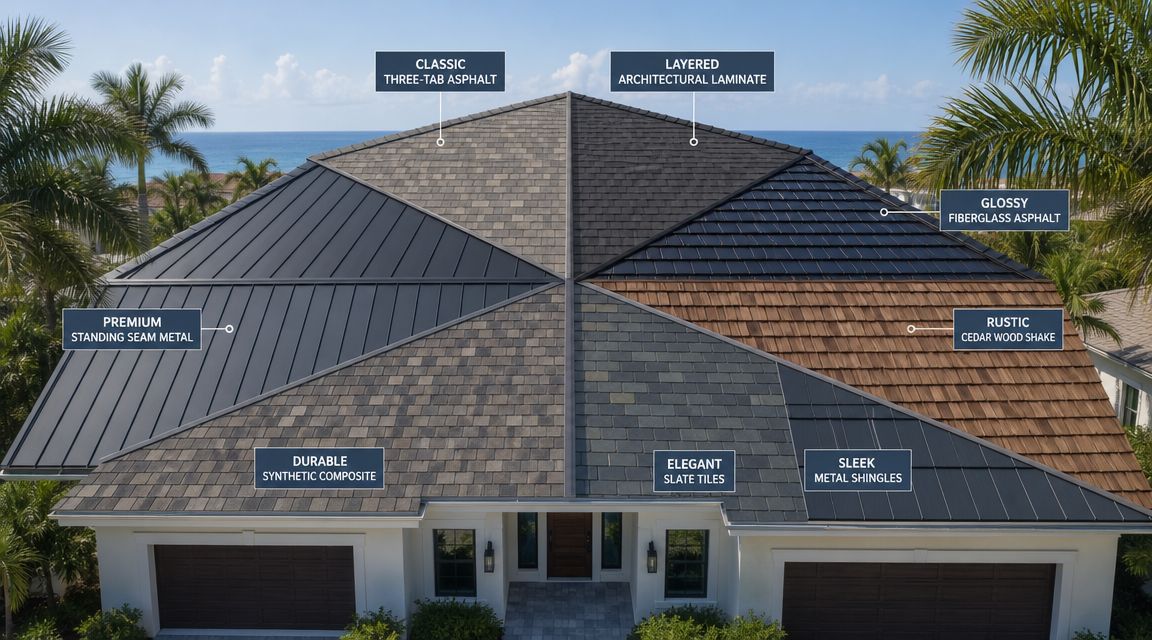
Your roof has to do more than look good. In South Florida, it has to handle punishing sun, salt-heavy air near the coast, wind-driven rain, and the kind of storm season that exposes every shortcut in materials and installation. That's why talking about types of shingles as if they're just style choices misses the point.
Asphalt shingles are still the baseline in residential roofing, and the standard product framework most homeowners hear first is strip or 3-tab, dimensional or architectural, and luxury shingles, as outlined in this overview of roof shingle categories. In real projects, though, South Florida buyers usually need a second layer of decision-making. They need to know which products hold up better in high wind, which finishes resist algae in humid conditions, and which upgrades matter more for insurance conversations than decorative profile alone.
That practical lens matters here. A premium-looking roof that isn't the right fit for a salt-exposed home near the Intracoastal can become a maintenance headache. A simpler shingle with the right wind, impact, and reflective features can be the smarter long-term choice. If you're trying to explore roofing shingle options, start with the material category, then narrow it by climate performance, installation quality, and how long you plan to keep the property.
Table of Contents
- 1. Asphalt Shingles (Three-Tab)
- 2. Architectural (Laminate) Shingles
- 3. Impact-Resistant Shingles
- 4. Metal Roofing Shingles
- 5. Slate Shingles
- 6. Wood Shake Shingles
- 7. Composite/Synthetic Shingles
- 8. Rubber/Asphalt Shingles with Advanced Coatings
- 8-Point Comparison of Shingle Types
- Making Your Final Choice Partnering with a South Florida Expert
1. Asphalt Shingles (Three-Tab)

Three-tab shingles are still the lowest-cost way to put an asphalt roof on a house. That price keeps them in the conversation, especially on rentals, older homes, and replacement jobs where the owner needs to control upfront cost.
In South Florida, price alone is a risky way to choose a roof. Three-tab shingles have a flat, lighter profile, and that matters in a region where wind uplift, salt exposure, and year-round UV wear on the system. On inland homes with tight budgets, they can still be serviceable. On coastal properties or long-term ownership plans, they are usually the first option I rule out.
Why some homeowners still choose them
The case for three-tab is simple. Lower material cost, familiar appearance, and a basic roof system that many owners understand right away.
That can make sense on a short-hold property or a house being prepared for sale without a full premium upgrade. A plain shingle pattern also fits some neighborhoods better than a thicker, shadow-line look. If you are already researching higher-tier asphalt options, this guide on choosing architectural shingles helps show where the extra cost often goes.
Practical rule: Choose three-tab because the budget requires it. Do not choose it expecting the same wind margin, lifespan, or insurance appeal you may get from heavier shingle systems.
The South Florida trade-offs
Three-tab shingles usually give up performance margin first. In this climate, that shows up in a few predictable ways.
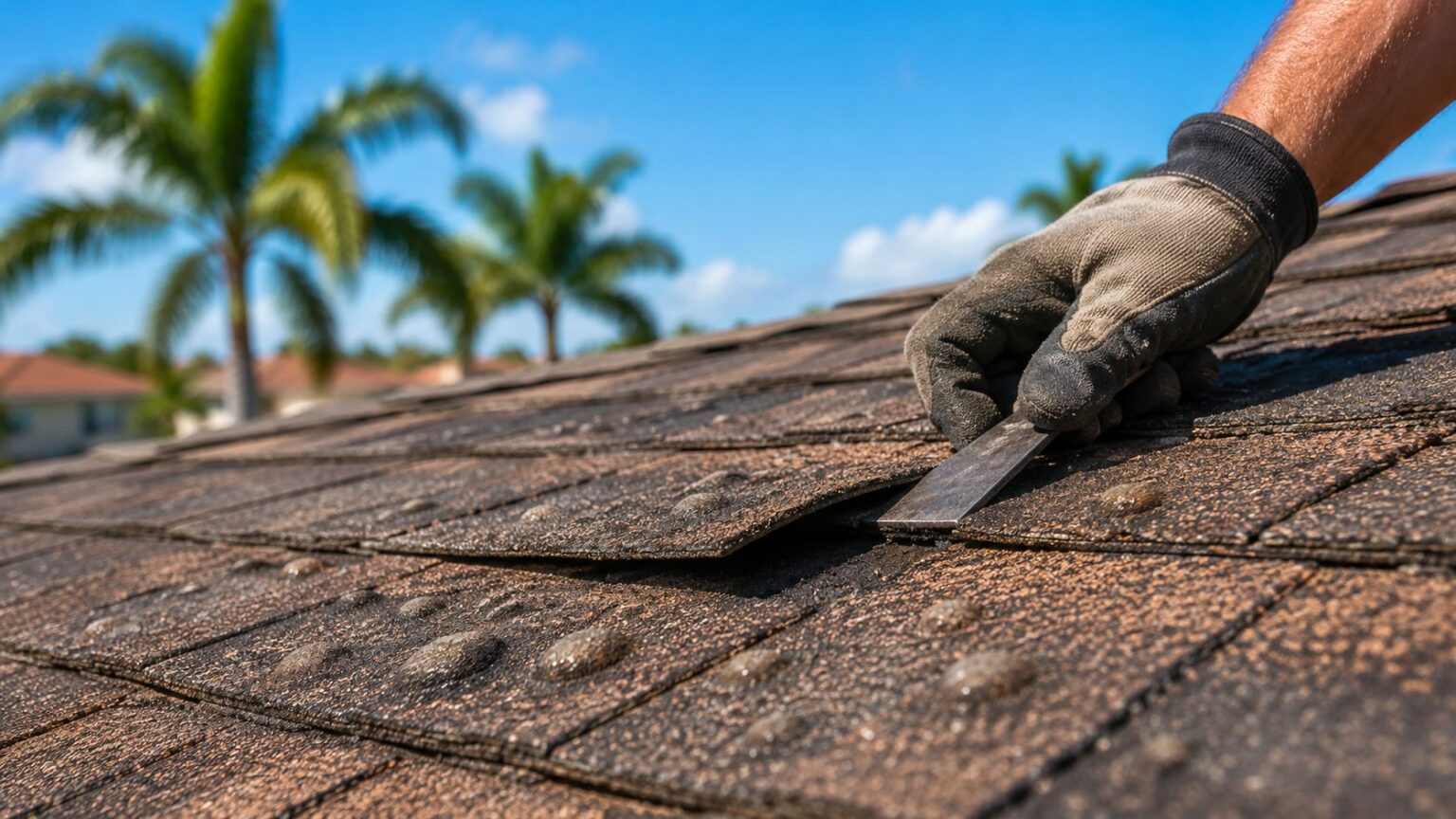
Wind is the obvious concern, but it is not the only one. South Florida sun dries and ages asphalt. Salt air is hard on exposed roofing components near the coast. Afternoon heat pushes attic temperatures up, and poor ventilation speeds up wear from below. On shaded slopes, humidity and algae staining become part of the maintenance picture fast.
Insurance also matters here. Some carriers and buyers view basic strip shingles as a lower-tier roofing choice, especially when the roof is older or the home sits in a higher-wind area. That does not mean three-tab roofs are automatically uninsurable. It does mean owners should verify current underwriting standards before treating the cheapest bid as the best value.
Where they fit best
Three-tab shingles fit best on homes where keeping initial cost down matters more than maximizing service life or storm performance. That often includes older rentals, smaller inland homes, or short-term ownership situations where the roof only needs to meet present needs and code requirements.
They are a weaker fit for coastal homes, exposed neighborhoods, and owners planning to stay put for years. In those cases, the lower purchase price can disappear if earlier replacement, storm repairs, or insurance friction show up sooner than expected.
Maintenance points that matter
Three-tab roofs need closer observation in this market. I tell owners to stay disciplined about the basics:
- Check for lifted tabs after storms: Early wind damage is easier to repair before it spreads across a slope.
- Watch granule loss and brittle edges: South Florida sun can age lower-end asphalt faster than many owners expect.
- Keep attic ventilation in good shape: Excess heat under the deck shortens shingle life.
- Monitor shaded areas for algae and moisture retention: Cosmetic staining can turn into maintenance neglect if nobody is watching it.
- Document inspections and repairs: Keeping photos organized, even with a simple roof inspection file reference, makes warranty, insurance, and resale conversations easier.

For homeowners evaluating different shingle options, three-tab still has a place. In South Florida, that place is usually the budget end of the market, not the performance end.
2. Architectural (Laminate) Shingles

If a homeowner asks me which asphalt option usually makes the most sense in South Florida, architectural shingles are the first place I'd look. They sit in the middle of the market in the best way. Better profile, better durability, and usually a better long-term fit than basic strip shingles.
The category is also the market leader. One market report estimates that architectural shingles held 48% of the asphalt shingles market in 2024, largely because they balance durability, wind resistance, and curb appeal better than 3-tab products. That lines up with what many contractors see on reroof jobs. This is often the default upgrade path.
Why they're the default upgrade
Architectural shingles use multiple laminated layers to create a thicker, more dimensional look. That extra body does two things homeowners notice quickly. It improves appearance from the street, and it usually feels like a more substantial roof system when compared with a flat 3-tab layout.
For homes in Palm Beach or Broward where resale matters, that visual difference carries weight. A Mediterranean-style home, coastal transitional design, or even a modest suburban property often looks more complete with laminate shingles than with a thin strip product.
Another practical advantage is flexibility. This category includes many of the colors and profiles people want without forcing them into a luxury shingle price tier.
What to watch in South Florida
Architectural doesn't mean every product performs the same. In South Florida, the details matter more than the brochure. Lighter colors can help with heat absorption. Salt exposure near the coast can punish metal accessories and fastening details even when the shingles themselves look fine. And if attic ventilation is poor, even a good shingle can age unevenly.
Many “types of shingles” guides stop at naming categories. In this market, the bigger question is whether the shingle line also offers wind-resistant, algae-resistant, impact-resistant, or solar-reflective versions.
That's where architectural shingles become more than a style choice. They're often the platform homeowners use to add performance features without jumping all the way to metal or specialty systems. If you're comparing brands and profiles, this guide on choosing architectural shingles is useful as a broad starting point, but local code, installation quality, and coastal exposure should drive the final decision.
3. Impact-Resistant Shingles
Impact-resistant shingles aren't a separate style in the same way 3-tab or architectural shingles are. They're a performance-focused version of a shingle system, built for owners who care less about decorative profile and more about how the roof responds when debris, hail, or storm-thrown objects hit it.
That distinction matters in South Florida. A lot of homeowners shop by appearance first, then ask about storm protection later. In practice, severe-weather performance often deserves to be the first filter, especially on exposed homes near open water or in neighborhoods with mature trees.
What this category really means
Industry guidance on asphalt roofing doesn't stop at basic classes. It also separates out performance shingles such as impact-resistant, wind-resistant, algae-resistant, fire-resistant, and solar-reflective products, with those features appearing across multiple shingle classes, as described in this breakdown of asphalt roofing shingle types. That's a better way to shop in a hurricane-prone market.
For example, a premium designer shingle may look impressive on paper, but if the home regularly faces windborne debris and salt-heavy storms, a performance-oriented architectural shingle can be the more practical choice. The “best” roof on a coastal Florida home is often the one that matches the hazard profile, not the one with the fanciest silhouette.
Best fit for local storm exposure
Impact-resistant shingles make the most sense for homes where storm damage history is already part of the ownership experience. Waterfront neighborhoods, open-lot communities, and properties with tall surrounding landscaping all fit that description.
A few decision points usually help:
- Ask for performance documentation: Don't assume the word “premium” means impact resistance.
- Talk to your insurance agent early: Some carriers care more about documented protective features than about upgraded appearance.
- Use the full system approach: Underlayment, flashing, fastening pattern, and ventilation still matter.
- Plan for inspections after major weather: These roofs can hide damage better than homeowners expect.
A stronger shingle won't fix weak installation. In South Florida, the attachment method and the entire roof assembly matter as much as the product label.
The image many owners have in mind is a rugged roof that shrugs off the next storm. That's the goal, but it only happens when the performance product is paired with disciplined installation and post-storm follow-up.

4. Metal Roofing Shingles
Metal roofing shingles sit in an interesting spot. They appeal to homeowners who want the look of shingles instead of standing seam panels, but they also want the lighter feel and weather durability that make metal attractive in the first place.
In South Florida, that combination can make a lot of sense. Heat, salt, and storm exposure are relentless here. Metal shingles aren't right for every house, but on the right home, with the right installer, they solve several long-term headaches at once.
Where metal shingles make sense
These systems fit well on homes where the owner plans to stay put and wants to reduce the cycle of repeated asphalt replacements. They're also useful on projects where weight matters. A property with structural limits may not be a candidate for very heavy natural materials, but it may still support a metal shingle system that delivers a refined look.
Coastal location also changes the recommendation. Near the ocean, aluminum is often the smarter call than standard steel because corrosion resistance becomes part of the day-to-day durability equation, not a side issue.
The South Florida installation details that matter
Metal is less forgiving of poor craftsmanship than many homeowners realize. Expansion and contraction have to be accounted for. Fastener placement has to be precise. Accessories and trim details have to match the exposure level of the site.
That's why I'd focus on contractor experience before obsessing over profile samples. Ask to see projects completed in Broward, Miami-Dade, or Palm Beach under similar coastal conditions. Ask how they handle dissimilar metals, flashing transitions, and attic ventilation.
A few practical checks help:
- Choose the right substrate and underlayment: Metal performs best as part of a complete system.
- Match the finish to the climate: Reflective finishes can help in intense sun.
- Review the accessory package: Trim, clips, fasteners, and seal details matter.
- Confirm storm-zone experience: South Florida isn't the place for a crew learning metal installation on your house.
For homeowners comparing types of shingles beyond asphalt, metal is one of the clearest long-term alternatives. If you want a visual reference for the style category, this metal shingle roof example shows the look many owners are after, and this broader article on Dallas-Fort Worth metal shingle roofs helps explain why the format appeals in severe-weather markets generally.
5. Slate Shingles
Natural slate is the material people choose when they want permanence, architectural weight, and a roof that feels tied to the identity of the house. On the right property, it can look exceptional. It also asks more from the structure, the installer, and the budget than almost any other option on this list.
That's why slate tends to be a specialty decision rather than a default one. In South Florida, I usually see it considered on estate homes, historic properties, or projects where authenticity matters more than cost control.
Why some owners still choose natural slate
Slate brings something manufactured products rarely match. It has natural variation, visual depth, and a sense of permanence that works especially well on classical, Mediterranean, and older luxury homes. If the property is meant to stay in the family or hold a distinctive architectural character, slate can be the right material even when it's not the easiest one.
It also avoids the “imitation” issue some owners dislike. Composite products may mimic slate well, but some buyers still want the original and won't be satisfied with a substitute.
Why slate isn't automatic in coastal Florida
The two practical barriers are structure and specialist labor. Slate is heavy, and not every home was designed for it. Before anything else, the roof structure has to be evaluated for load. Then you need an installer who works with slate, not just a general roofing crew willing to take the job.
On a South Florida waterfront property, salt, wind, and complex flashing details can make a beautiful roof fail at the edges long before the field material wears out.
That's the part homeowners miss. Slate itself is durable, but every penetration, valley, flashing edge, and fastening decision still has to perform in a demanding climate. For many homes in this region, a high-end synthetic or metal alternative gives the owner the look they want with fewer structural and maintenance complications.
If you're set on slate, go in with clear eyes. It's a material for owners who are willing to pay for design integrity, engineering review, and specialized workmanship, not just surface beauty.
6. Wood Shake Shingles
Wood shake still has visual appeal. On the right house, nothing else creates the same texture, shadow lines, and natural character. That's why some owners keep coming back to it even when easier-maintenance materials are available.
South Florida, though, is a demanding place for wood. Heat, humidity, algae, and salt-laden moisture can turn a charming material into a maintenance commitment quickly. That doesn't make wood shake impossible. It means the owner has to want the look enough to live with the upkeep.
The appeal and the trade-offs
Wood shake works best when architecture is driving the decision. A coastal cottage, a custom estate with rustic detailing, or a home designed around natural materials can benefit from the authentic uneven texture that machine-made products try to imitate.
The trade-off is constant environmental pressure. Organic roofing materials don't get a break in this climate. Shaded roof planes can stay damp longer. Sun-baked slopes weather differently from protected areas. Even when the roof still looks attractive from the street, small maintenance issues can develop unnoticed.
What usually changes the decision
Most practical owners back away from wood shake once they understand the long-term attention it demands. They don't just need installation. They need regular inspection, debris control, algae management, and realistic expectations about weathering patterns.
A few conditions make wood shake more workable:
- The home has a fitting design language: The roof should support the architecture, not fight it.
- The owner accepts maintenance: This isn't a set-it-and-forget-it roof.
- Drainage details are excellent: Gutters, valleys, and transitions need close attention.
- The installer knows local exposure patterns: South-facing and shaded sections won't age the same way.
For some South Florida homeowners, a synthetic shake-look product ends up being the better answer. It preserves much of the visual effect without asking the owner to manage natural wood in one of the harshest roofing climates in the country. If you want to compare that rustic profile visually, this wood-shake-style roofing image captures the character people are usually trying to achieve.
7. Composite/Synthetic Shingles
Composite and synthetic shingles have moved from niche option to serious contender. That shift is happening because homeowners aren't only asking what types of shingles exist anymore. They're asking which materials are worth paying more for once you factor in maintenance, storm performance, and long-term ownership.
That's especially relevant in Florida. A roof that mimics wood or slate but avoids some of the traditional weaknesses gets attention fast.
Why this category is getting more attention
Updated roofing guides now list composite or synthetic shingles and solar shingles alongside traditional asphalt categories, reflecting a broader move toward multi-function and alternative roof systems, as noted in this roofing guide to shingle types. That doesn't mean asphalt has disappeared. It means more owners are seriously comparing alternatives before they commit.
Synthetic products are attractive because they can deliver a high-end look without all the baggage of natural materials. A homeowner who likes slate aesthetics but doesn't want to reinforce the structure may consider synthetic slate. Someone who wants shake style without organic maintenance may look at molded composite options.
What to verify before you buy
This category rewards careful product review. “Synthetic” covers a wide range of formulas and build quality. Some products look convincing only from the curb. Others hold their appearance better under intense sun and close inspection.
Here's what I'd review before signing:
- Sample the product outdoors: South Florida sunlight reveals sheen, color shift, and texture quickly.
- Check thermal movement guidance: Some systems require very specific installation allowances.
- Read the warranty language carefully: Coverage terms vary and usually depend on proper installation.
- Ask how the product has performed locally: Regional track record matters more than showroom appeal.
Composite shingles are often strongest when they solve a specific problem. They can give a homeowner the appearance of luxury materials without the same structural burden or upkeep. For many South Florida homes, that's a compelling middle path.
8. Rubber/Asphalt Shingles with Advanced Coatings
A lot of South Florida roof failures start at the surface. Sun dries out the shingle, salt hangs in the air near the coast, algae stains take hold in humidity, and wind tests every seal line during storm season. That is why coated asphalt and rubber-modified asphalt shingles deserve more attention than they usually get.
This category fits homeowners who want a practical step up from standard asphalt without moving into the cost and installation demands of metal, slate, or specialty synthetic systems. The base material is familiar. The upgrade is in the formula and surface treatment. Depending on the product, that can mean better UV resistance, stronger granule adhesion, algae resistance, or improved flexibility under heat.
In South Florida, those details matter more than the brochure styling.
A practical choice for real-world conditions
I usually look at this category as a performance upgrade, not a design purchase. For many homes, especially mid-range residences and rentals, the goal is straightforward: get better weathering and cleaner long-term appearance while staying within an asphalt reroof budget.
Rubber-modified blends can help shingles resist cracking and wear as roofs cycle through intense heat and sudden rain. Advanced coatings can also slow down the streaking and discoloration that show up fast in humid neighborhoods. That does not turn an asphalt roof into a coastal indestructible system. It does give the homeowner a better chance of getting stable performance from a material family local crews know well.
That installation familiarity has value. It usually means fewer surprises during replacement, easier accessory matching, and simpler future repairs if storm damage affects only part of the roof.
Where these shingles make the most sense
These systems are often a strong fit for owner-occupied homes, investment properties, and light commercial buildings where appearance matters, but the bigger priority is controlling maintenance and replacement cost. They are also worth a close look on homes exposed to constant sun, regular algae staining, or moderate coastal conditions where salt and UV wear down lower-grade shingles faster.
As noted earlier, modern asphalt products can vary widely in wind performance and overall build quality. That gap is especially important in South Florida, where insurance carriers and inspectors pay attention to roof age, attachment method, and product rating. A coated or rubber-modified shingle may make sense if it comes with documented wind resistance and is installed to the manufacturer's high-wind requirements.
The decision still comes down to trade-offs. These products usually cost more than basic asphalt shingles, but they do not deliver the lifespan of good metal. Near the water, they still need realistic expectations because salt air is hard on almost every roofing material over time. For inland homeowners who want a balanced option, though, they often hit the sweet spot.
In South Florida, the best-value roof is usually the one that addresses the local failure points first: wind uplift, UV exposure, algae growth, and installation quality.
If you're evaluating shingle options for a practical residence rather than a showpiece, this category deserves serious consideration. In the right product line, it can improve durability, appearance, and day-to-day ownership cost without pushing the project into a premium roof budget.
8-Point Comparison of Shingle Types
| 🔄 Implementation Complexity | 💡 Resource Requirements & Notes | ⭐ Expected Outcomes (Quality & Lifespan) | ⚡ Installation Speed / Efficiency | 📊 Ideal Use Cases | Key Advantages |
|---|---|---|---|---|---|
| Low, simple nailing, minimal skill | Very low cost; lightweight materials; annual inspections in South Florida recommended | Basic protection; 20–25 years; lower storm durability | Very fast, quickest to install | Budget homes, rentals, short-term ownership | Most affordable; widely available; easy to replace |
| Moderate, heavier shingles, verify structure | Medium cost; heavier weight; choose light colors and ensure ventilation | Improved durability; 30–50 years; better wind resistance | Moderate, slightly longer than three-tab | Upscale residences wanting balance of cost and quality | Dimensional appearance; longer life; enhanced curb appeal |
| High, specialized installation, manufacturer certification advised | High material and labor cost; heavier; contractor certification recommended | Excellent protection; 40–50+ years; UL 2218 Class 4 impact rating | Lower, careful handling and fastening required | Coastal/hurricane-exposed and high-value properties | Superior hail/impact protection; potential insurance discounts |
| High, specialized flashing, expansion considerations | Very high cost; select aluminum for salt-air; skilled metal roofers required | Outstanding longevity; 50–70+ years; top wind resistance and energy savings | Moderate, panels can be rapid but detailing is time-consuming | Luxury homes, long-term owners, energy-conscious properties | Longest durable performance; recyclable; energy-efficient |
| Very high, master craftsmen and structural reinforcement needed | Extremely high material and installation cost; heavy; limited specialists | Unmatched longevity; 100+ years; minimal maintenance after install | Low, slow, meticulous installation | Historic mansions, legacy estates, architectural restorations | Prestigious aesthetics; unmatched permanence and value |
| High, skilled layout and ongoing care required | High upfront cost; regular treatments for rot/mold; ventilation critical | Good with care; 40–60 years if maintained; vulnerable in humid climates | Moderate, installation slower; frequent maintenance | Craftsman/Colonial-style homes and owners committed to upkeep | Natural beauty and insulation; replaceable individual shakes |
| Moderate, similar to asphalt but product-specific handling | Medium–high cost; lighter than slate/wood; verify warranties and installer experience | Long life; 40–60 years; excellent impact and wind resistance; low maintenance | Moderate–High, generally easier than natural materials | Homes wanting premium look with low upkeep; rentals seeking durability | Realistic premium appearance, low maintenance, eco-options |
| Moderate, standard shingle install with coating care | Medium cost premium; coating quality varies; periodic recoats may be advised | Improved performance; 30–40 years; enhanced algae/UV resistance and reflectivity | High, similar to standard asphalt; self-sealing features speed install | Typical South Florida homes seeking value/upgrade vs basic asphalt | Cost-effective upgrade; algae/UV resistance; energy-saving reflective options |
Making Your Final Choice Partnering with a South Florida Expert
The hard part of choosing between types of shingles isn't finding a list. It's matching the roof to the house, the location, and the way you own the property. A waterfront home in Palm Beach doesn't face the same conditions as an inland rental in Broward. A primary residence you plan to keep for years should be evaluated differently from a property you may sell after a shorter hold.
That's why the material decision has to start with exposure and goals. If budget is the main constraint, three-tab may still be the answer, but only if you accept its limits in a storm-focused market. If you want the most balanced asphalt option, architectural shingles are usually the strongest starting point. If your roof takes regular weather punishment, impact-resistant or coated performance shingles may matter more than decorative upgrades. If you're planning for the long haul and want a premium alternative, metal or select synthetic products often deserve serious consideration.
Insurance and code concerns are part of that equation too. In South Florida, roofing decisions don't happen in a vacuum. Attachment methods, product approvals, documentation, and the full roof system can affect how smoothly a project moves through permitting and how clearly the property's protective features are presented to insurers. Even the best shingle won't help much if the installation details are weak or the paperwork is incomplete.
The local climate also punishes bad assumptions. Salt exposure can shorten the life of the wrong accessories. Sun can accelerate visible aging on darker or lower-grade products. Humidity can turn a minor maintenance issue into a bigger one if shaded slopes stay damp and neglected. Homeowners who focus only on the face value of the shingle often miss the parts of the roof that determine whether the system performs under stress.
That's why installation quality has to carry equal weight with material selection. A well-chosen roof system installed badly can fail early. A sensible product installed with care, code awareness, and proper ventilation often performs better than a more expensive roof put on carelessly. In this region, the crew's familiarity with local wind exposure, flashing details, and permit expectations isn't a bonus. It's central to the outcome.
A good roofing conversation should sound practical. Which slopes take the worst sun. How close the home is to salt air. Whether nearby trees increase debris and algae pressure. Whether you're optimizing for resale, long-term durability, or a lower-maintenance ownership experience. Those are the questions that narrow the field quickly.
For homeowners and property managers in Broward, Miami-Dade, and Palm Beach, working with a local contractor who understands those trade-offs can save time and expensive mistakes. Paletz Roofing and Inspections is one South Florida-based option that works across residential and commercial roofing and inspections in those counties, with more than 30 years of experience according to the company background provided for this article. That kind of local familiarity can help when you're weighing material choice, permit realities, and how a roof should be built for this climate rather than for a generic national guide.
The right roof isn't the one with the most marketing behind it. It's the one that fits your home, your exposure, and your plan for the property, then gets installed the right way.
If you're comparing types of shingles for a home or building in Broward, Miami-Dade, or Palm Beach, Paletz Roofing and Inspections can help you review material options, inspect the current roof, and make a choice that fits South Florida conditions.