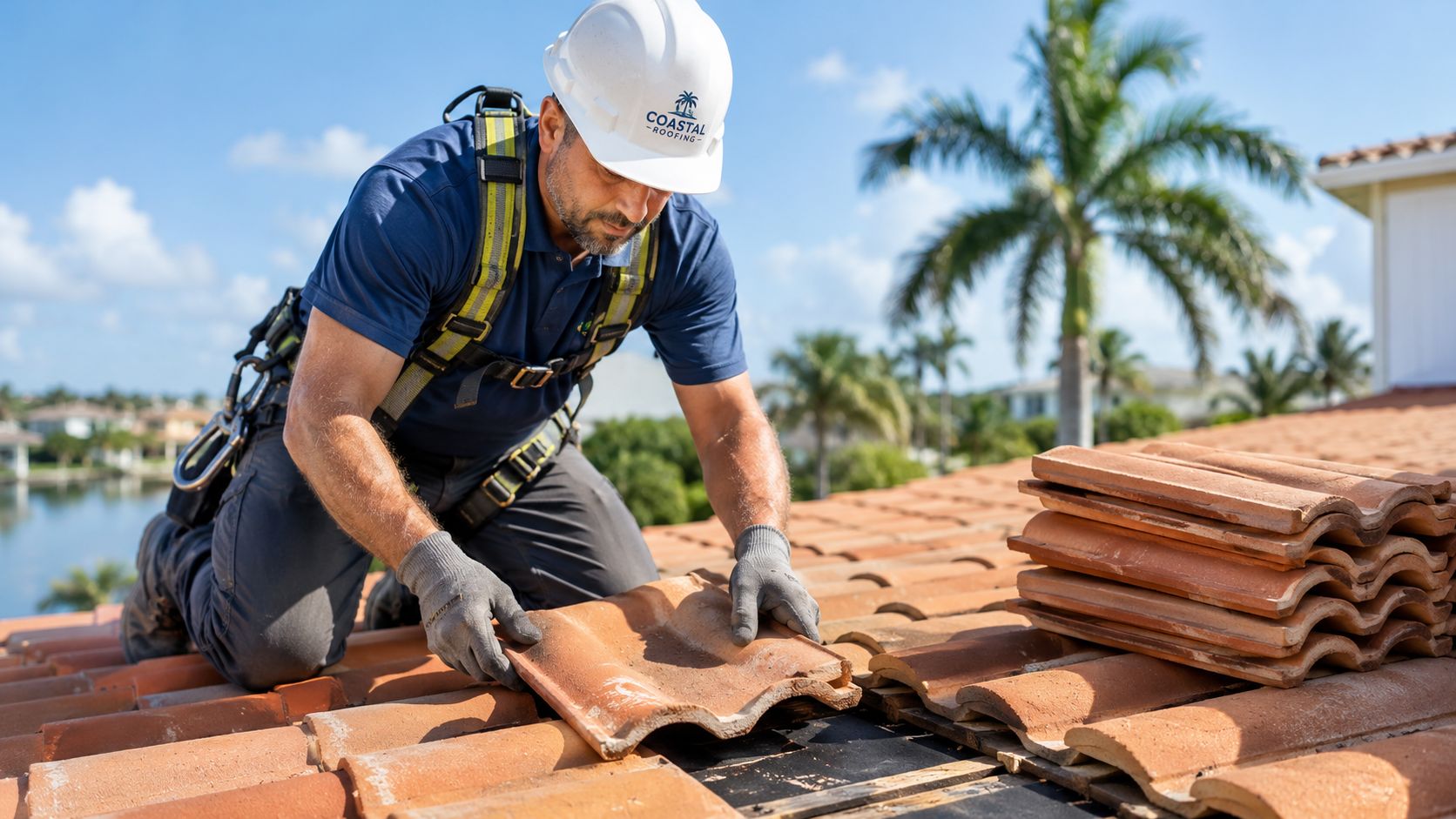
Most advice about tile roof replacement Boca Raton gets the biggest thing wrong. Cracked tiles are visible, so homeowners are told to focus on the surface, but the core failure often sits underneath in the underlayment and decking. That's why one roof can need a small repair, while another with the same look from the driveway needs a full tear-off and rebuild.
The right decision starts with the hidden layers, the permit path, and the actual supply situation for the tile you want. A tile roof can look sturdy from the street and still be leaking at the seams below, which is why a careful scope matters more than a quick visual fix.
Table of Contents
- When Tile Damage Means Repair Versus Full Replacement
- Navigating Permits and HOA Requirements in Boca Raton
- Choosing Tile Types and Underlayment for Florida Conditions
- Understanding Tile Roof Replacement Costs in Boca Raton
- Proper Installation Sequence and Florida Code Compliance
- Realistic Timelines and Supply Chain Considerations
- Your Estimate and Contractor Selection Checklist
When Tile Damage Means Repair Versus Full Replacement
A cracked tile does not automatically mean the roof has failed. In Boca Raton, the better question is whether the problem is isolated to a valley, a penetration, or a small section, or whether the waterproofing system has started to break down across the roof field. One guide for the area notes that only 5% to 10% broken tiles can justify a partial repair when the rest of the roof still has useful life left, while widespread underlayment deterioration or decking damage points toward full replacement. (Boca Raton rebuild or replace guide)
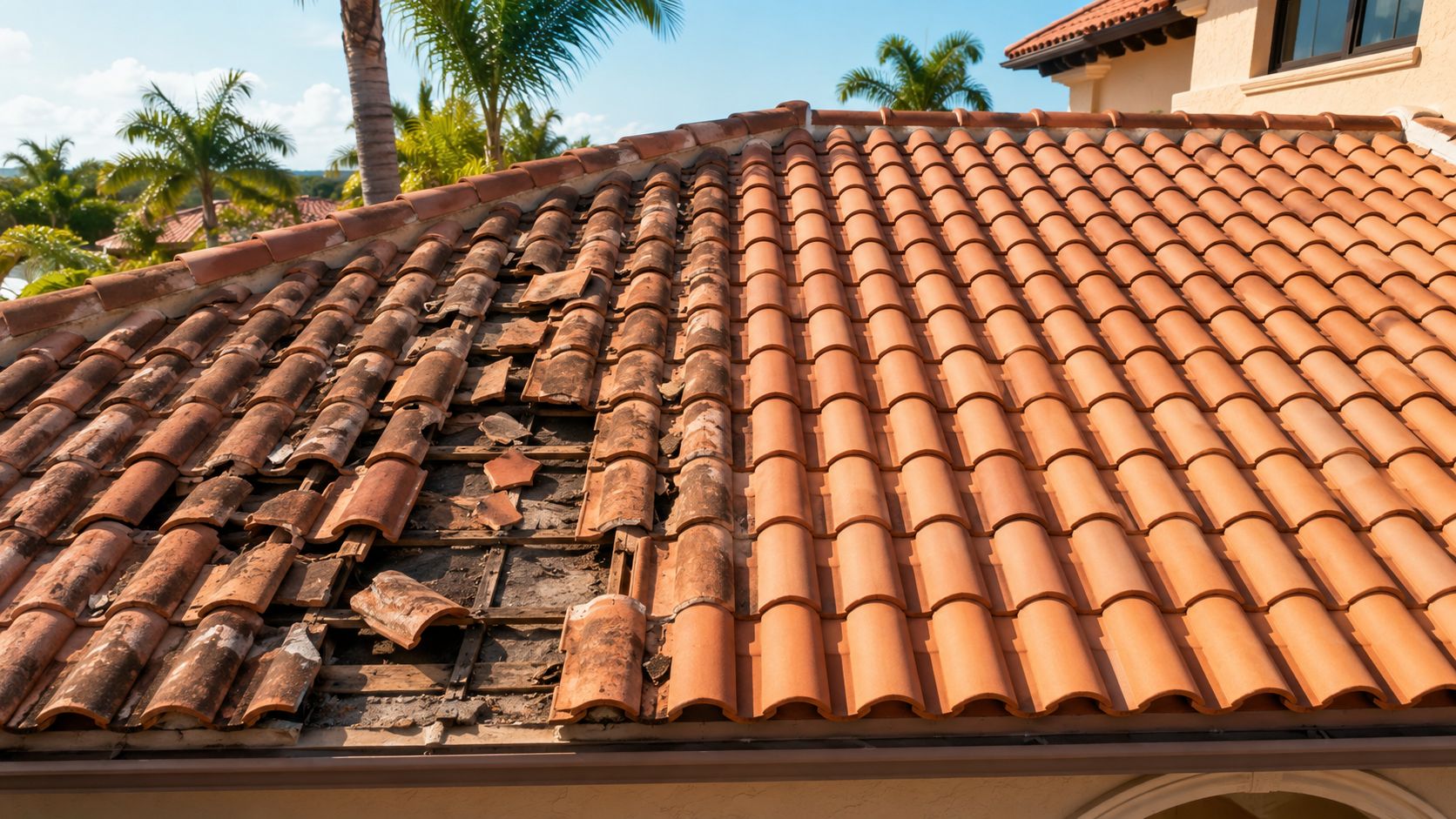
What usually points to a repair
A targeted repair makes sense when the leak source is narrow and the rest of the roof field is healthy. Think isolated flashing leaks, storm damage in one section, or tiles that broke from impact but didn't open up the roof system below. In those cases, preserving the existing tile field can avoid a much larger project and keep a matching profile for HOA review.
That's where a disciplined inspection matters. A ground-level view only tells you whether tiles are missing or visibly cracked, not whether the valley metal has failed, the counterflashing has opened, or the membrane under a small section has reached the end of its life. If the roof deck stays sound and dry, a partial rebuild can be the smart move.
A useful outside reference on surface defects and hidden movement is the Awesim Building Consultants tiling guide, which is a good reminder that visible damage and system failure aren't the same thing.
Practical rule: if the damage is localized and the roof assembly beneath it still performs, replacement is usually too much roof for the problem.
What pushes the job toward replacement
Full replacement becomes the rational option when the underlayment is breaking down, decking shows rot or delamination, or the damage pattern is spread across multiple slopes. Once water has reached the layers below the tile, the job stops being about a few broken pieces and starts becoming a roof system reconstruction. That is also the point where the cost jumps sharply, because the hidden work is what drives the scope.
Homeowners often want the cheapest visible fix, but that can be the most expensive choice over time if the leak source keeps moving. If the roof is older, if repairs keep getting repeated, or if different sections are failing at once, a full replacement usually gives a cleaner result and a longer runway.
For Boca Raton properties with HOA color rules, a partial repair can still be attractive when matching the existing tile profile is feasible. But once the tile field and the waterproofing layer no longer align in age or condition, the roof is no longer a good candidate for patchwork.
A useful visual reference for the broader roof assembly is this roof installation detail image, especially when discussing how surface material and support layers interact.
Navigating Permits and HOA Requirements in Boca Raton
Tile roof replacement in Boca Raton is not just a construction job, it's a paperwork job first. The city requires a roofing permit for re-roofing, and its guidance also distinguishes minor repairs from full re-roof work, which helps separate simple maintenance from a formal permit path. Estimated permit fees generally run about $100 to $400, with approval often taking about one week to three weeks depending on the source and review stage. (Boca Raton roofing permit guidance)
City paperwork and timing
The city's re-roof OTC checklist says the total permit balance is due at submittal for single-family re-roof permits, with exceptions for tile re-roofs, projects over $300,000 in improvement value, and shingle-to-tile or metal conversions. It also requires a certified Notice of Commencement when the building permit value is greater than $5,000. (Boca Raton Re-Roof OTC PDF)
That changes scheduling. If the paperwork is incomplete, the job waits before the first tile ever comes off. A clean submittal matters because tile replacement usually touches multiple review points, including permit review, inspection scheduling, and any HOA sign-off needed before material can be ordered.
The city's supplemental roofing package adds another layer. It calls for product approvals, roof uplift pressures and attachment details under the relevant Florida Building Code sections, and roofing accessory approvals. For partial reroofs, tie-in details are required when applicable, and flat roofs can need enhanced nailing details. (Boca Raton Roofing Supplemental Package)
HOA and insurance coordination
HOAs usually care about the things the city does not, especially color, profile, and visible consistency. That means the contractor has to know whether a matching tile is available and whether the proposed profile fits the community standard before anyone starts tear-off. A homeowner who waits until after permit approval to ask those questions can lose weeks to a redesign or a resubmittal.
Keep the city, HOA, and insurance file aligned before scheduling demolition. A roof that can't clear all three gates on paper can't start in the field.
A stronger file includes product approvals, the proposed roof assembly, and proof that the replacement scope matches the community rules. When the roofing company understands Boca Raton's permit flow, the job moves faster and with fewer surprises.
Choosing Tile Types and Underlayment for Florida Conditions
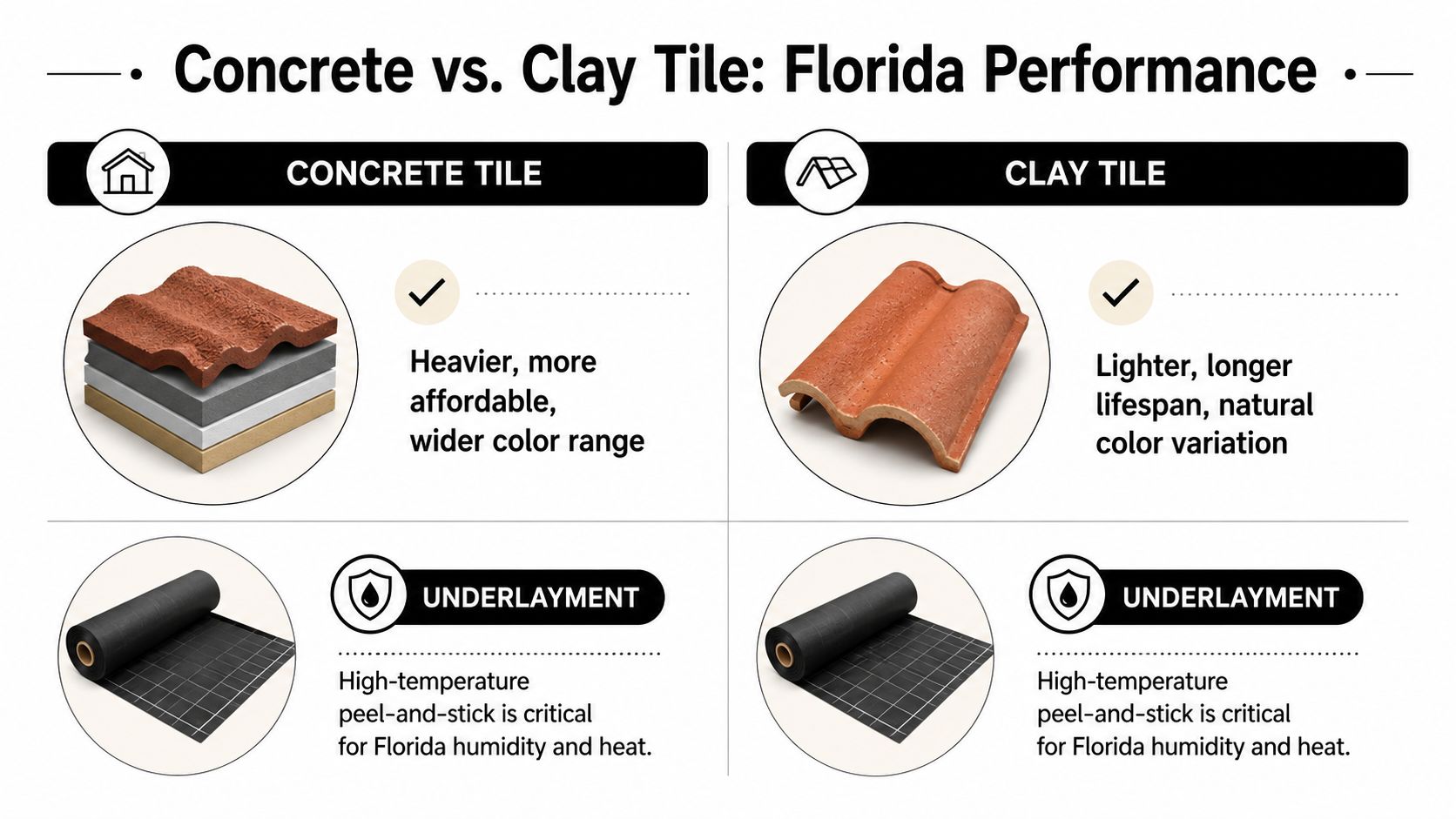
Tile gets the attention, but the underlayment is what decides how long the roof protects the home. In Florida, concrete tile roofs typically last 35 to 50 years, while clay tile roofs are commonly estimated at 40 to 60 years. Boca Raton guidance also says tile surfaces can last 30+ years, but the underlayment usually reaches the end of effective life at about 20 to 25 years, which is why the 20-year mark matters so much. (Florida roofing statistics)
Concrete, clay, and the layer beneath them
Concrete tile is common because it balances price, weight, and color options. Clay tile tends to hold a different visual character and is often chosen where the look matters as much as the weather performance. In both cases, the roof system's real defense comes from the waterproofing layer under the tile, not the decorative surface above it.
That's why an aging tile roof can fool people. The tiles may still look acceptable from the driveway, but the membrane below may be brittle, dried out, or no longer sealing around penetrations. Once that happens, the roof stops being a tile roof in practical terms and becomes a failing assembly hidden under a pretty shell.
For homeowners comparing aesthetics and moisture resistance in other tile applications, the 2026 wet room tile guide is a useful reminder that material selection always has to match the environment, not just the appearance.
Why the underlayment matters more than the tile
The underlayment choice should match South Florida heat, humidity, and wind exposure. In practical terms, the best option is the one that keeps water out after the tile field is lifted, reset, and exposed to hurricane-driven conditions. If the contractor ignores deck prep or treats the membrane as an afterthought, the roof may look new and still fail early.
If a roof is nearing 20 years, the conversation should shift from tile color to waterproofing condition.
Partial tile preservation can still make sense when the profile matches and the underlayment is serviceable in the remaining area. That is especially true in HOA neighborhoods where tile color matching affects approval. But once the waterproofing layer is done, matching the old look is less important than building a roof that performs.
Understanding Tile Roof Replacement Costs in Boca Raton
Tile roof pricing in Boca Raton has a wider spread than most homeowners expect because the visible tile is only part of the job. Independent cost guidance for the area puts individual tile replacement at about $75 to $150 per tile installed, while a complete concrete tile roof replacement on a typical 2,400-square-foot home can reach about $38,000 to $65,000. Broader Boca Raton replacement estimates also commonly fall in the $20,000 to $40,000 range for a full tile roof. (Boca Raton roof repair costs guide)
What drives the price spread
The biggest driver is whether the job stays on the surface or moves into the hidden layers. A small localized repair can stay under $1,000 when it's only a narrow issue, but once underlayment or structural sections are involved, the project jumps by an order of magnitude. That's because tear-off, decking repair, membrane replacement, flashing, and reinstallation all add labor and material in layers.
| Project Type | Typical Cost Range | Key Cost Drivers |
|---|---|---|
| Single tile replacement | $75 to $150 per tile installed | Tile sourcing, access, matching profile |
| Small localized repair | Under $1,000 | Narrow leak area, limited tear-off |
| Full tile roof replacement | $20,000 to $40,000 commonly | Tear-off, underlayment, permit, inspections |
| Concrete tile replacement on a 2,400-square-foot home | $38,000 to $65,000 | Deck repair, system rebuild, hidden damage |
The reason quotes can look wildly different is simple. One contractor may be pricing only the visible fix, while another is including deck replacement, secondary barrier work, and full cleanup. A homeowner who compares those bids as if they were the same is comparing different scopes, not different prices.
The estimate must get specific. Ask what happens if rotten decking is found, whether underlayment is included across the full roof, and whether the quote includes permit fees and inspections. If those items are not listed clearly, the price on paper can turn into a much larger number after tear-off.
Proper Installation Sequence and Florida Code Compliance
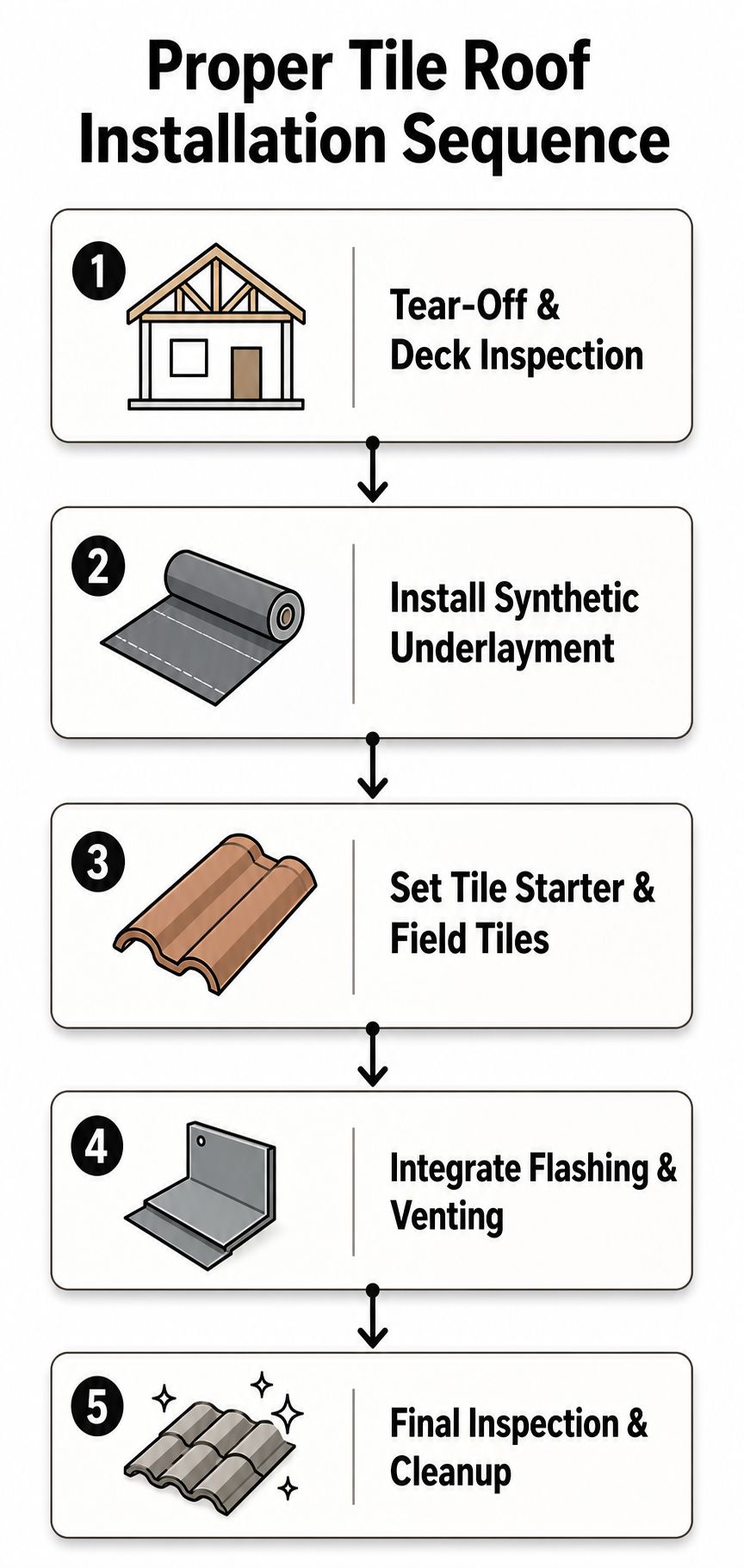
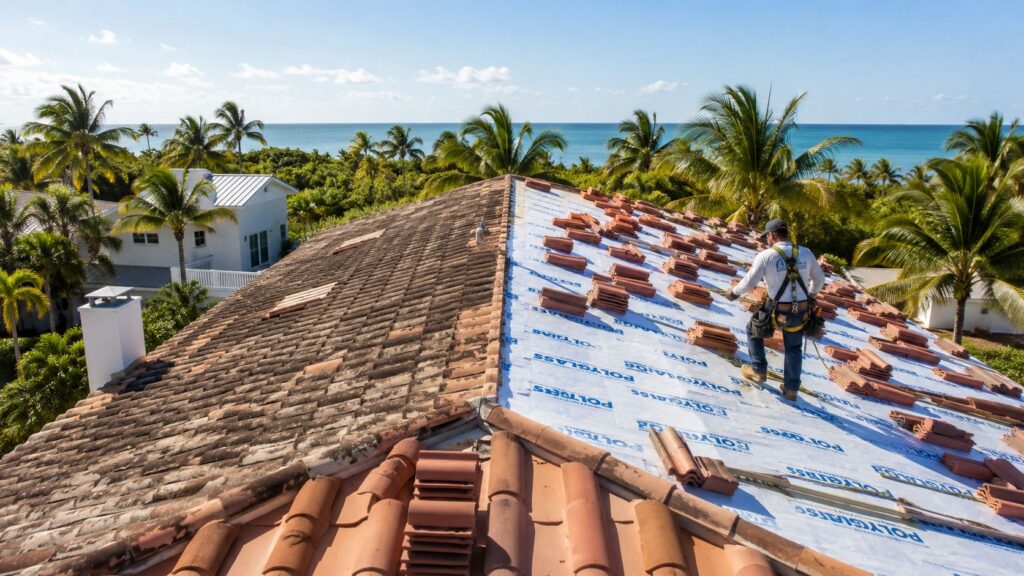
A tile roof replacement only works when the crew follows the correct order and does not skip the hidden layers that control whether the roof lasts. The deck has to be clean, dry, level, and free of rot or delamination before anything gets covered again. From there, underlayment goes on from the eaves upward with at least 6-inch overlaps, then flashing is installed at penetrations, and starter tiles and field tiles go on from the bottom edge upward. (South Florida tile roof replacement guide)
The sequence that prevents premature failure
Deck repair has to happen before the new roof goes back on. Soft spots, corrosion, or loose decking do not disappear under tile, and they keep moving after the surface looks finished. That is one of the hidden costs homeowners miss when they only compare tile prices.
Tile is not the waterproofing layer. The waterproofing work sits in the underlayment, flashing, and the way every penetration is handled. Pipes, vents, valleys, and wall transitions are common leak points, especially when old flashing gets covered instead of replaced. A proper installation handles those areas before the field tile goes back on.
A useful field reference is this tile roof installation detail image, because the details in the build sequence matter more than the name stamped on the tile.
Wind hold-down and secondary barrier details
For wind performance, local installers secure tiles with nails, clips, or adhesive depending on tile type and code. One Boca Raton repair source notes using a Miami-Dade-approved tile adhesive that meets uplift requirements instead of relying on nails when resetting tiles. Installation guidance also notes that nails should penetrate battens by at least 15 mm where battens are used. (South Florida tile roof replacement guide)
Boca Raton's mitigation package says that when a roof covering is removed and replaced, a secondary water barrier must be installed under Florida Building Code Section 1507.1.1 or R905.1.1. It also states that clay and concrete tile roof systems installed as required by the Florida Building Code are deemed compliant with the secondary water barrier requirement under Section 706.7.2. (Boca Raton Re-roof Mitigation Package)
That code requirement matters because compliance is not just about passing inspection. It is about building a roof system that can stand up when weather turns rough and the underlayment gets tested.
Realistic Timelines and Supply Chain Considerations
Tile roof replacement is often treated like a labor schedule, but in Boca Raton it's also a supply problem. One Florida roofing source says tile roof projects typically take 4 to 8 weeks after contract signing, yet tile availability can stretch the timeline because manufacturers may be 3 to 6+ months behind. (Residential roof replacement timeline)
The difference shows up fast once a homeowner picks a tile profile that isn't sitting in local inventory. A contractor can be ready, a permit can be moving, and the job can still stall because matching material is backordered. In storm seasons, that delay gets worse because insurance claims, HOA approvals, and weather-related demand all compete for the same crews and materials.
A typical scheduling problem looks like this. The homeowner signs a contract, the roofer starts permit paperwork, the HOA requests a sample, and then the chosen tile is confirmed unavailable in the needed color or profile. At that point, the replacement date moves not because of labor, but because the material chain broke.
The practical questions to ask are simple. Is the tile in stock, or is it a special order? Can the contractor match the existing profile without changing the look of the house? What happens if the exact tile is unavailable after the permit is already filed?
Material availability is part of the roof plan now. If it is not checked before signing, the start date can drift for months.
Homeowners should also verify local permit and inspection timing before committing, because a delay in either one can sit on top of the material delay. In a coastal market like Boca Raton, early planning beats last-minute urgency every time.
Your Estimate and Contractor Selection Checklist
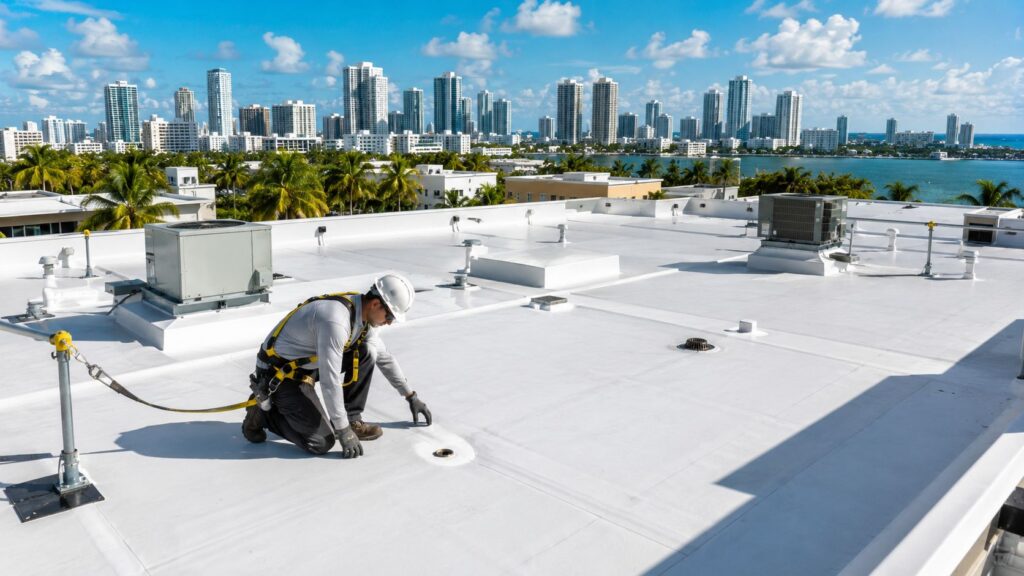
A tile roof estimate should read like a scope of work, not a guess. Ask for proof of licensing and insurance, recent tile roof references, and a written breakdown that separates tile, underlayment, deck repair, permits, and cleanup. If the quote does not say how hidden damage will be handled, the final bill can change the moment the old roof comes off. That is where hidden underlayment failure and soft decking turn a straightforward job into a larger replacement. For a broader example of documenting roof conditions before a project starts, this inspection reference image shows the kind of visual record a careful contractor should be able to explain.
A strong estimator should also know Boca Raton's permit thresholds, supplemental roofing package, and secondary barrier requirements. If the contractor cannot discuss product approvals, uplift pressures, attachment details, or the city's re-roof paperwork, that is a warning sign. The same goes for any bid that ignores deck inspection or treats underlayment as optional. Hidden costs usually start there, not in the visible tile itself.
For homeowners comparing bids, the cleanest way to judge them is to ask these questions:
- What is included in tear-off? Make sure disposal, protection, and cleanup are part of the scope.
- How is deck damage priced? You need to know whether rotten sheathing is covered by unit pricing or change order.
- Which underlayment system is being used? The membrane should be named, not just described vaguely.
- How are tile matches handled? That matters for appearance, HOA approval, and schedule.
- What warranty covers labor and materials? Separate the two so there is no confusion later.
- Who is responsible if the roof opens up and the match tile or replacement parts are delayed? Supply problems are common, and the contract should say how the project stays moving.
- Is the contractor willing to protect your home from restoration risks? Bonding and insurance should be verified before any tear-off starts.
One practical option in the market is Paletz Roofing and Inspections, which offers roof inspections, repairs, and full reroofing work for tile systems across South Florida. That kind of contractor is useful when the decision hinges on whether a roof needs preservation or a full rebuild, because the estimate has to be based on what is under the tile, not just what is visible from the street.
The best estimate is the one that tells you where the money goes before tear-off, not after the surprises appear.
If you're weighing repair versus full tile replacement, get a roof assessment that looks beyond surface damage and into the underlayment, decking, and permit path. Visit Paletz Roofing and Inspections to request a quote, compare material options, and get a Boca Raton reroof plan that is built around the roof you have.