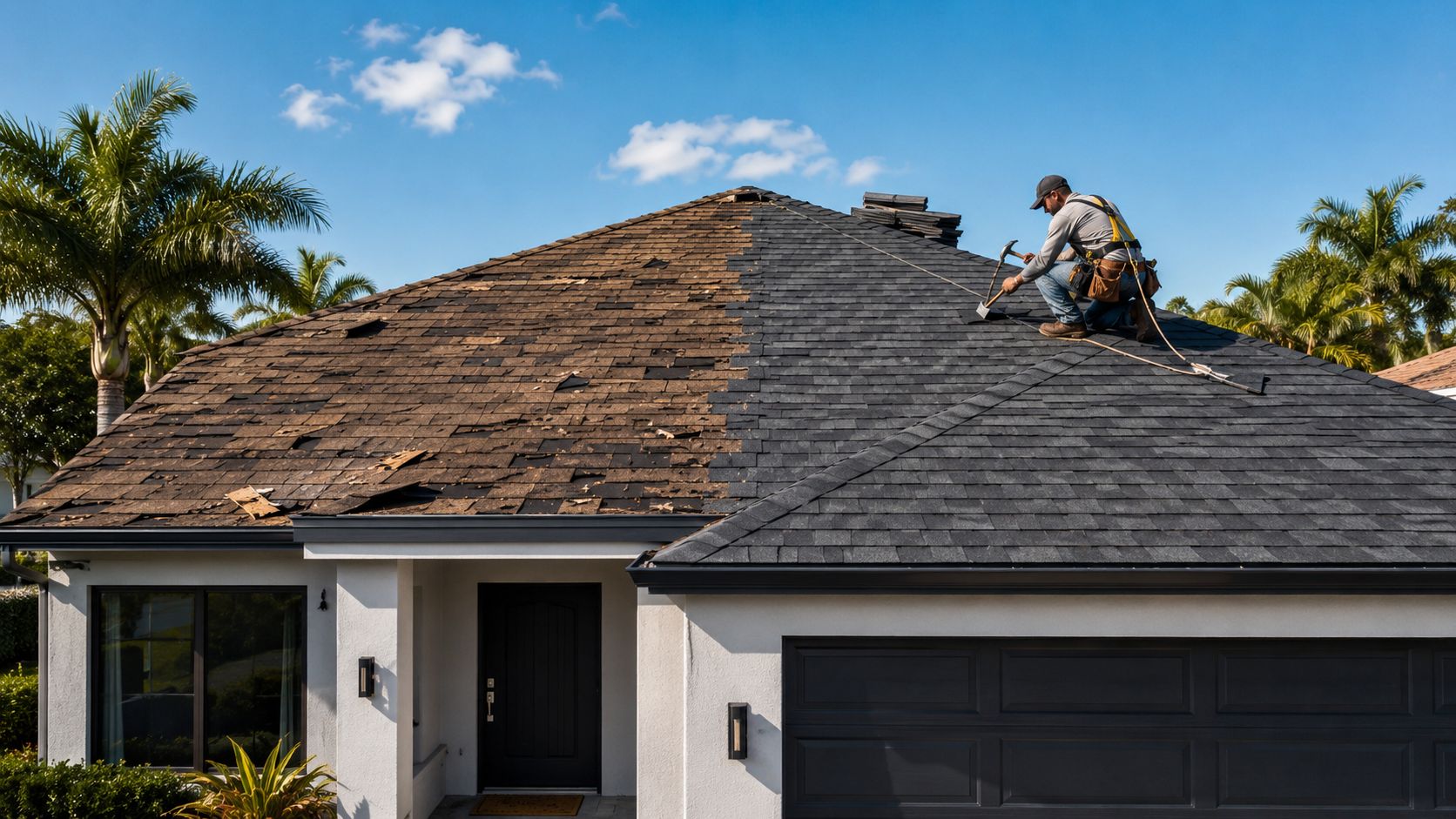
You're back from a storm-season trip and notice three missing shingle tabs, a ridge cap that's lifted, and a gritty layer of granules collecting in the gutters. The ceiling stain near a vent is small, but the roof is old enough that another patch may only delay a larger decision. In South Florida, replacing a shingle roof involves more than matching a color and covering the old surface. Wind exposure, permitting, deck condition, salt air, and the Florida Building Code all shape the scope.
This guide walks through the practical decisions homeowners face in Broward, Miami-Dade, and Palm Beach counties, from deciding between repair and replacement to choosing tear-off methods, confirming product approvals, preparing for inspections, and evaluating contractor proposals. A useful visual reminder of broader roof maintenance is available in this roof maintenance reference image, but a shingle replacement must be planned around the actual conditions on your property.
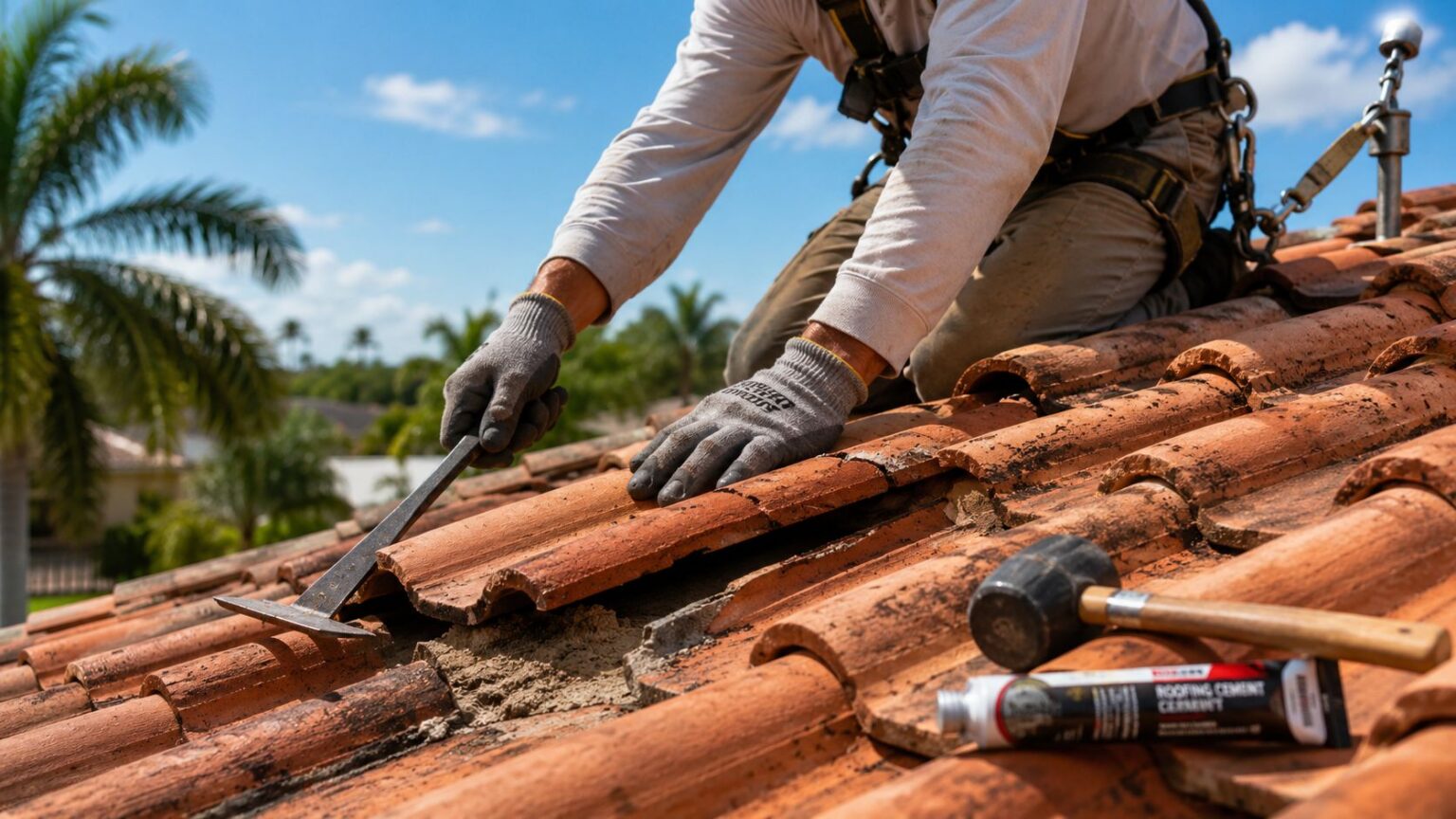
Table of Contents
- Why Replacing a Shingle Roof in South Florida Feels Different
- How to Tell Your Shingle Roof Is Ready for Replacement
- Tear-Off vs Recover and What Florida Actually Allows
- Permits, Codes, and Inspections in Broward, Miami-Dade, and Palm Beach
- How a Shingle Roof Replacement Is Built From the Deck Up
- Costs, Timelines, and Choosing the Right Contractor
- Your Pre-Project Checklist and Final Takeaways
Why Replacing a Shingle Roof in South Florida Feels Different
A Coconut Park homeowner might first treat storm damage as an insurance question. Missing tabs and a lifted ridge cap can result from a covered wind event, but widespread granule loss, brittle shingles, and long-term deterioration generally point toward maintenance rather than a single claim. The right first move is to document the roof from the ground, arrange a professional inspection, and avoid authorizing substantial work before understanding whether the damage is storm-related.
South Florida changes the normal roofing playbook in several ways. Much of Broward and Miami-Dade falls within the High-Velocity Hurricane Zone, where approved assemblies, fastening patterns, and installation details receive closer scrutiny. Palm Beach projects still face serious tropical-weather exposure, even where a particular address isn't in the same HVHZ category. The Florida Building Code, including the 8th Edition, affects how contractors approach permits, products, underlayment, and inspections.
Local conditions affect material choices
Salt air can corrode flashings and fasteners, particularly near the coast. Intense ultraviolet exposure can age asphalt shingles faster than homeowners expect, while high roof temperatures make underlayment selection important. Heat, humidity, algae, wind-driven rain, and repeated storm loading all work together, so a roof that looks acceptable from the driveway may have compromised fastener retention or deteriorated deck areas underneath.
The replacement decision also depends on whether the existing roof can legally and technically receive another layer. Florida guidance limits asphalt shingle systems to two layers total, meaning one new layer over one existing layer. A roof with two existing layers requires a complete tear-off before the next system is installed, as outlined in Florida roofing building-code guidance.
Local planning rule: A storm doesn't create every roofing problem. It often reveals weaknesses that heat, age, moisture, and earlier installation shortcuts have already created.
Storm-driven demand creates another challenge. After a hurricane or major tropical storm, inspection appointments, materials, permits, and qualified crews become harder to schedule. Planning before peak hurricane demand gives you more time to compare written scopes and resolve code questions instead of accepting the first available proposal.
How to Tell Your Shingle Roof Is Ready for Replacement
A roof doesn't become a replacement candidate because one shingle blew away. A younger roof with a localized failure may need a targeted repair, while an older roof with several apparently small defects may have a system-wide problem. The decision depends on age, distribution of damage, deck condition, ventilation, flashing, and the likelihood that another repair will hold.
In coastal Florida, 3-tab and architectural shingles commonly reach roughly 15 to 20 years in demanding conditions, while roofs farther inland may perform closer to 25 to 30 years, depending on installation, exposure, and maintenance. Those ranges are practical field expectations, not guarantees. Asphalt shingle products are often described by nominal service-life labels, but real-world roofing lifespan guidance explains why actual performance can fall short of the marketing number.
Look for patterns, not isolated defects
From the ground, homeowners can spot cupped or clawed tabs, exposed fiberglass mat, broad areas of granule loss, and shingle fragments scattered around the yard after wind. A rusted drip edge or sagging roofline deserves prompt attention. Inside the house, ceiling stains near vents, damp insulation, musty attic air, or daylight around penetrations suggest that the roof assembly needs more than a cosmetic review.
Storm damage has recognizable forms. Wind creases can break the shingle seal and weaken the tab even when the piece remains in place. A lifted ridge cap after a tropical storm can allow wind-driven rain into the ridge area. Rusted nail tips visible on the roof surface, repeated patches, and attic moisture often indicate that several layers of the system are deteriorating together.
A leak alone doesn't prove that full replacement is necessary. The question is whether a roofer can isolate and correct the source without leaving an aged field, damaged underlayment, wet deck, or failing flashing system behind.
Repair or replace indicators
| Indicator | Typical Age Range | Likely Action |
|---|---|---|
| One missing shingle in an otherwise sound field | Younger roof | Targeted repair after checking surrounding tabs and seal strips |
| Several cupped or clawed areas across multiple slopes | Later service life | Replacement evaluation |
| Widespread granule loss and exposed mat | Older or heavily weathered roof | Replacement usually deserves serious consideration |
| Soft decking or recurring attic moisture | Any age | Open the system, inspect the deck, and repair structural damage |
| Lifted ridge cap after a storm | Any age | Prompt wind and water-intrusion inspection |
| Rusted drip edge, fasteners, and repeated patches | Mature roof | Assess the complete assembly rather than adding another patch |
| Damage covered by a documented storm event | Any age | Photograph conditions and consult the insurer before major work |
Insurance can change the financial decision, but it doesn't remove the need for a technical inspection. A covered loss may justify replacement of damaged areas, while normal aging, algae, and deferred maintenance usually require a different conversation with the homeowner and carrier.
Tear-Off vs Recover and What Florida Actually Allows
A tear-off removes the existing shingles and exposes the roof deck. A recover installs a new shingle layer over an existing layer. Recovering can reduce immediate labor, disposal, and exposure time, but it also preserves whatever problems remain below the old shingles.
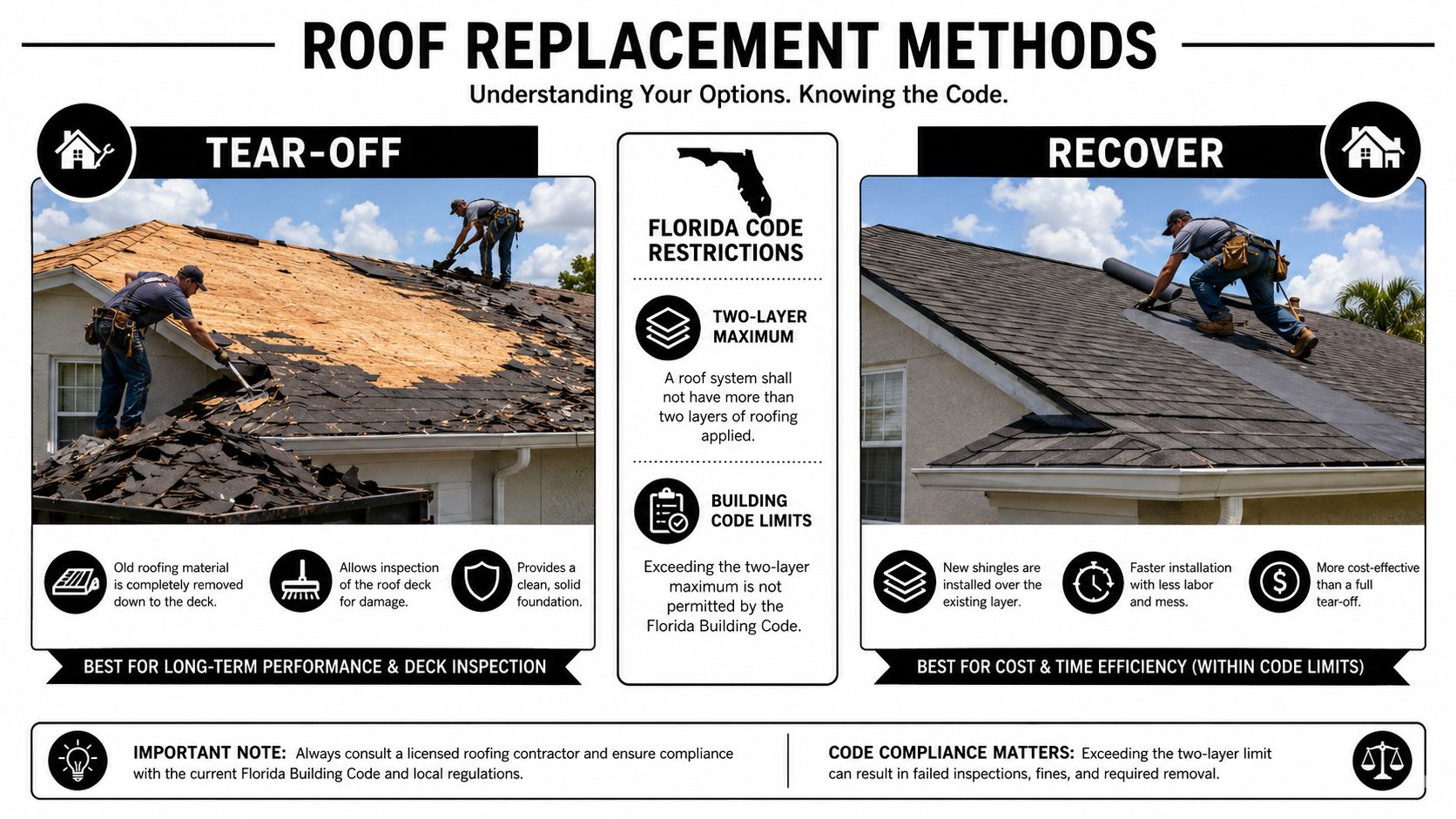
Florida's practical limit is clear. Asphalt shingle systems can have no more than two layers total, so a new recover is possible only where one existing layer is present and the deck and system otherwise qualify. If two layers are already installed, the contractor must tear down to the deck. ARMA's replacement and recover guidance also identifies rotten, warped, or structurally sagging decks as reasons to reject a recover.
What a recover saves, and what it hides
A recover is faster in suitable conditions, but the apparent savings can disappear when the underlying deck is wet or deteriorated. The crew can't properly inspect every deck area, replace old wall and chimney flashing, or correct poor fastening beneath the existing layer. Added thickness can also complicate edge details, vents, valleys, and transitions.
Manufacturer warranty requirements matter too. A recover that doesn't follow approved installation conditions may restrict warranty protection, and an assembly that hasn't been tested for the site's wind demands may not provide the expected uplift resistance. In South Florida, hiding the substrate is a particularly poor trade when wind-driven rain and salt exposure have already affected nails, flashings, and deck edges.
A tear-off creates a cleaner starting point. The contractor can replace damaged sheathing, install new drip edge and flashing, use code-compliant underlayment, improve ventilation, and fasten the shingles to the exposed deck according to the approved assembly. It also creates a defensible record for inspections and future insurance or resale questions.
On a coastal home, the lowest upfront scope isn't always the lowest-risk scope. If the deck can't be inspected, the contractor can't honestly confirm what the new roof is attached to.
The practical local rule is simple. If there's uncertainty about moisture, deck condition, existing layers, or wind performance, a tear-off is usually the sounder choice.
Permits, Codes, and Inspections in Broward, Miami-Dade, and Palm Beach
A shingle roof replacement requires a construction permit and must follow the Florida Building Code. Work covering more than 25% of the existing roof area within a 12-month period triggers the applicable reroofing threshold under the Florida Existing Building Code, as summarized in Florida reroofing rule guidance.
The licensed contractor typically prepares and pulls the permit. The application should state the work scope, product approvals, contractor license and insurance details, and proposed installation method. In Broward and Miami-Dade, verify whether the property falls within the High-Velocity Hurricane Zone, or HVHZ. Palm Beach requirements depend on the specific city or county authority, even though the project remains subject to Florida code.
County comparison
| County | HVHZ? | Permit Threshold | Typical Inspections |
|---|---|---|---|
| Broward | Much of the county is within HVHZ | More than 25% of roof area within 12 months generally triggers reroof compliance | Plan review, dry-in, final, with local requirements varying |
| Miami-Dade | Much of the county is within HVHZ | More than 25% of roof area within 12 months generally triggers reroof compliance | Plan review, dry-in, final, with high-wind product and fastening review |
| Palm Beach | Varies by location and jurisdiction | More than 25% of roof area within 12 months generally triggers reroof compliance | Plan review, dry-in, final, and any locally required inspections |
The dry-in inspection takes place after underlayment is installed and before shingles cover the roof. The final inspection follows shingle installation and completion of the roof system. Florida permit guidance notes that projects valued over $2,500 generally require a Notice of Commencement, creating another filing obligation.
Why applications get delayed
Permit applications often come back because product approval documents are incomplete, the address does not match, insurance proof is missing, the scope is vague, or the plans omit the required wind-zone fastening pattern. Ask the contractor for the permit number, approved product documents, inspection status, and final approval copies.
Before work begins, confirm who pulled the permit, which roof areas it covers, and who will schedule each inspection. Municipal review times and reinspection needs vary, so the schedule should allow for those contingencies rather than promise a fixed completion date before approval. A permit number alone does not confirm that the approved scope matches the work planned.
How a Shingle Roof Replacement Is Built From the Deck Up
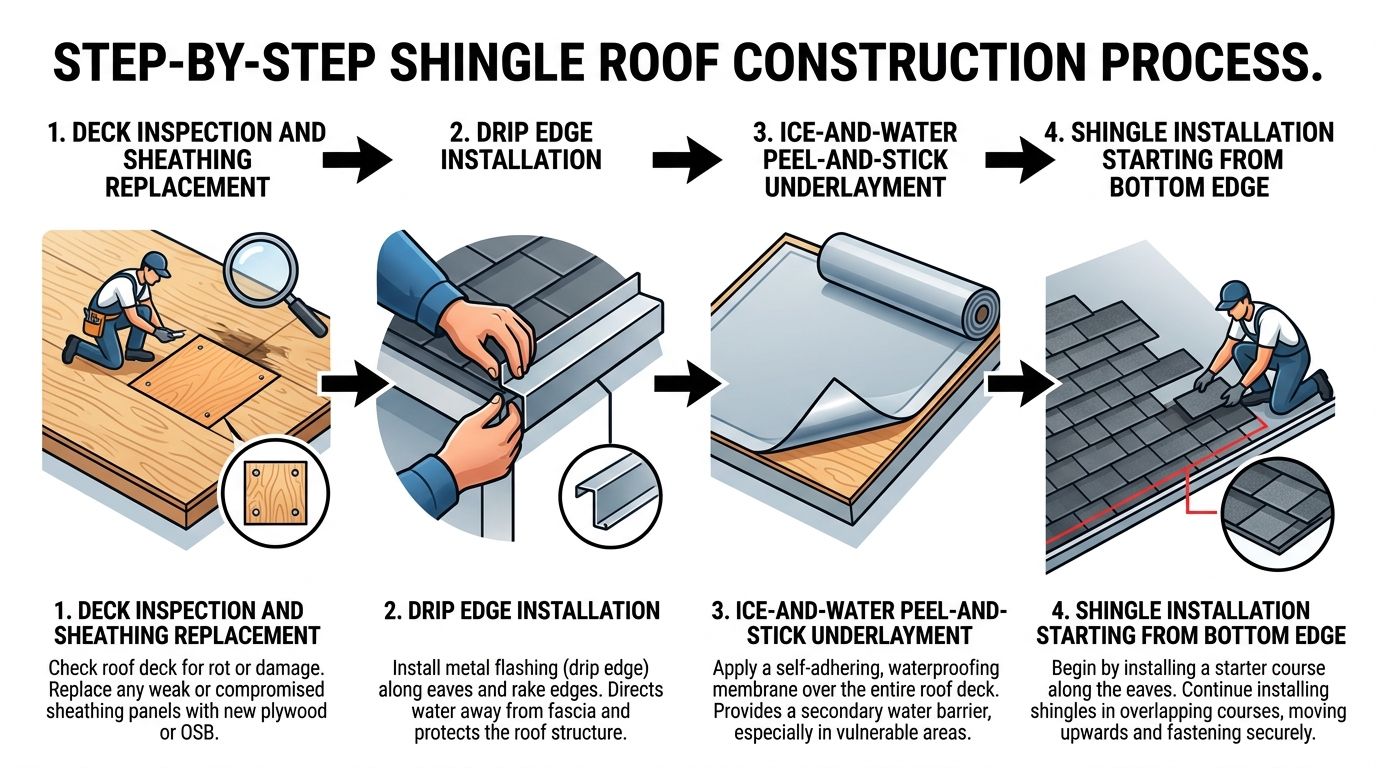
A durable replacement begins with what the crew finds below the shingles. After tear-off, the contractor should inspect the sheathing for soft areas, water staining, delamination, improper edges, and inadequate fastening. Damaged plywood or other approved decking must be replaced before the new roof system covers it.
The layers have distinct jobs
The drip edge establishes a clean water-shedding edge at the eaves and rakes. Underlayment follows, with HVHZ work requiring an approved assembly suited to the site. Many South Florida specifications use a peel-and-stick, ice-and-water-style membrane across the deck, but the exact product and installation must match the approved system and code requirements.
Valleys and penetrations receive focused attention. The crew should install appropriate valley protection, replace deteriorated flashing around vents and walls, and seal pipe boots and other penetrations with compatible materials. Corrosion-resistant fasteners are essential where salt air can attack ordinary metal.
Shingle installation starts at the lower edge with the approved starter strip. The field shingles need the correct nail location, nail count, exposure, offset, and alignment for the selected product. In high-wind areas, small deviations matter because the assembly's performance depends on the complete system, not the shingle's appearance alone.
Ventilation and wind performance
Balanced intake and exhaust ventilation protects the roof deck and helps the shingles operate within their warranty conditions. Depending on the design, exhaust may use a ridge vent or off-ridge vents, while intake must provide a real air path rather than a decorative opening blocked by insulation or framing.
For wind performance, FEMA guidance identifies UL 2390 shingle classifications of Class D at 90 mph, Class G at 120 mph, and Class H at 150 mph. The selected rating should meet or exceed the building-code basic wind speed for the property, as reflected in FEMA wind-resistance guidance. ASTM D3161 F-rated products or Miami-Dade-approved shingles may be appropriate, but the contractor must verify the product approval and complete assembly.
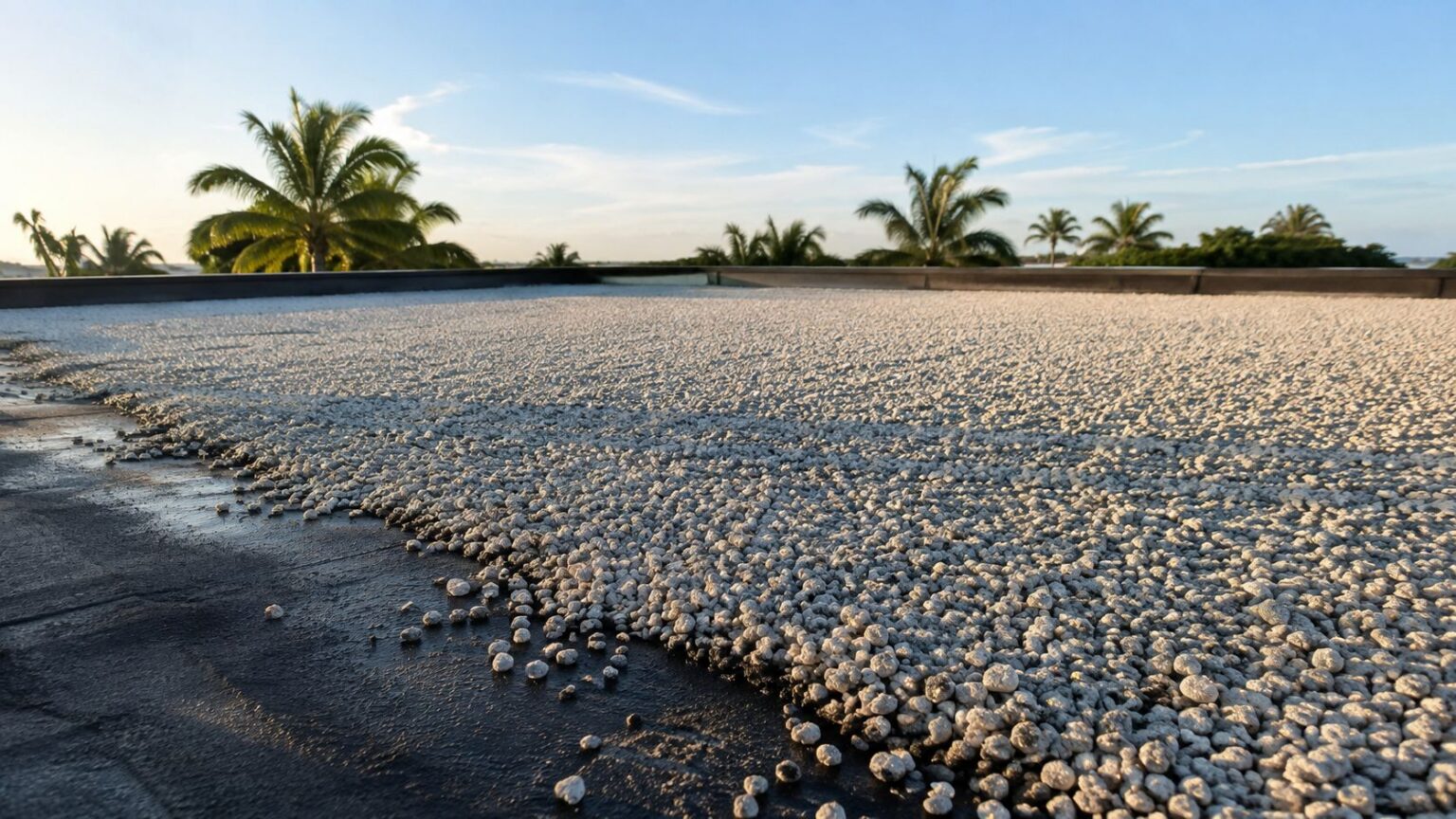
The ridge cap finishes the system. Poorly sealed hips and ridges, exposed nails, excessive overhang, and inadequate starter treatment are common failure points. A separate roofing-system reference can help explain how different assemblies are built, but the commercial roofing installation visual shouldn't be treated as a substitute for the approved shingle details on your permit.
Costs, Timelines, and Choosing the Right Contractor
A replacement estimate should separate the roof covering from the work that makes the covering perform. Ask the contractor to identify tear-off and disposal, deck repairs, underlayment, flashings, ventilation, permit costs, inspections, tax, and any allowances. A low number that excludes those items isn't comparable to a complete proposal.
Published market data placed the average U.S. roof replacement cost at $17,631 in 2025, with average repairs at $4,699, according to the cited 2025 roofing cost discussion. Those figures aren't a quote for a particular South Florida property. Access, roof geometry, deck damage, HVHZ materials, municipality, disposal logistics, and storm demand can move a local proposal substantially.
Cost and scheduling comparison
| County | Cost Per Square | Typical Total Range | Avg. Timeline |
|---|---|---|---|
| Broward | Obtain a written local proposal | Varies by roof size, scope, and HVHZ requirements | Commonly two to four weeks from contract to final inspection |
| Miami-Dade | Obtain a written local proposal | Varies by roof size, scope, and HVHZ requirements | Commonly two to four weeks from contract to final inspection |
| Palm Beach | Obtain a written local proposal | Varies by roof size, scope, and jurisdiction | Commonly two to four weeks from contract to final inspection |
The two-to-four-week planning window includes contract processing, material coordination, permitting, installation, and inspections. It can expand after a major storm, when contractor availability and municipal review demand rise. Weather can also interrupt tear-off and dry-in work.
Vet the company, not just the price
Verify the state license, local registration, liability insurance, workers' compensation coverage, manufacturer certifications, references, and written warranty terms. Separate the workmanship warranty from the manufacturer's material warranty. The contract should state who handles permit fees, deck-replacement pricing, change orders, cleanup, inspections, and warranty claims.
Storm-chasing crews often use urgency, vague insurance promises, and large deposits to close work quickly. Don't sign an assignment or authorize claim-related work without understanding the contract. For roofing businesses that need a dependable way to never miss a roofing lead, an answering service can help capture inquiries, but homeowners should still judge the contractor by licensing, documentation, and installation scope.
Your Pre-Project Checklist and Final Takeaways
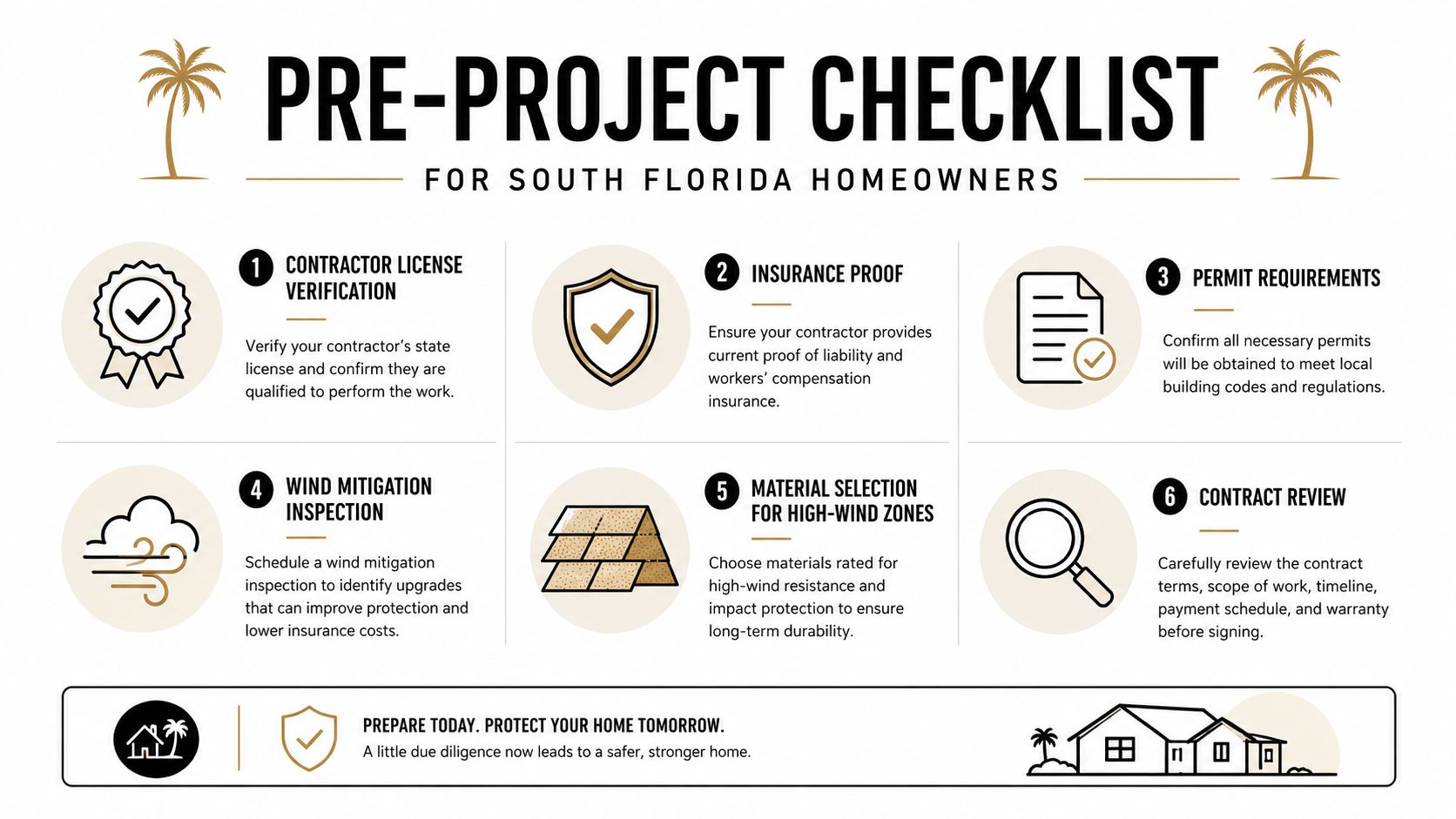
Before signing, make the decision traceable. You should be able to explain why the roof needs replacement, what the contractor will remove, which approved products will be installed, and how the permit and inspection process will be handled.
Confirm these items in writing
- Roof condition: Get dated photographs showing damaged shingles, deck concerns, flashing defects, attic moisture, and storm-related evidence.
- Tear-off scope: Confirm the number of existing layers and what happens if the crew finds wet or deteriorated decking.
- Code compliance: Ask for the applicable product approval, wind rating, fastening schedule, underlayment specification, and HVHZ requirements where applicable.
- Permit responsibility: Confirm that the licensed contractor will pull the permit and schedule the dry-in and final inspections.
- Contract details: Require written pricing for disposal, permit fees, deck repairs, ventilation, flashings, cleanup, and change orders.
- Insurance documentation: If a storm may have caused the damage, document conditions and contact the carrier before major work begins.
- Post-project records: Keep the permit closure, product information, photographs, invoices, and warranty documents together.
Schedule a wind-mitigation inspection after completion when appropriate. It can document the roof's storm-resistant features for insurance review, although any premium effect depends on the carrier and policy. Timing outside the busiest hurricane-response period can make it easier to obtain qualified inspections, materials, and permitting attention.
Broward, Miami-Dade, and Palm Beach replacements require more discipline than a generic national roofing checklist suggests. Tropical storms test weak details, salt air attacks exposed metal, ultraviolet exposure accelerates aging, and product approval requirements limit improvisation. A well-defined scope turns those risks into manageable tasks.
With the right contractor, approved materials, complete documentation, and realistic expectations, replacing a shingle roof in South Florida becomes a controlled project rather than a leap of faith.
Paletz Roofing and Inspections provides roof inspections, shingle repairs, and complete shingle roof replacements across Broward, Miami-Dade, and Palm Beach counties. Visit Paletz Roofing and Inspections to request an assessment and discuss the tear-off, code, permit, and material decisions specific to your property.