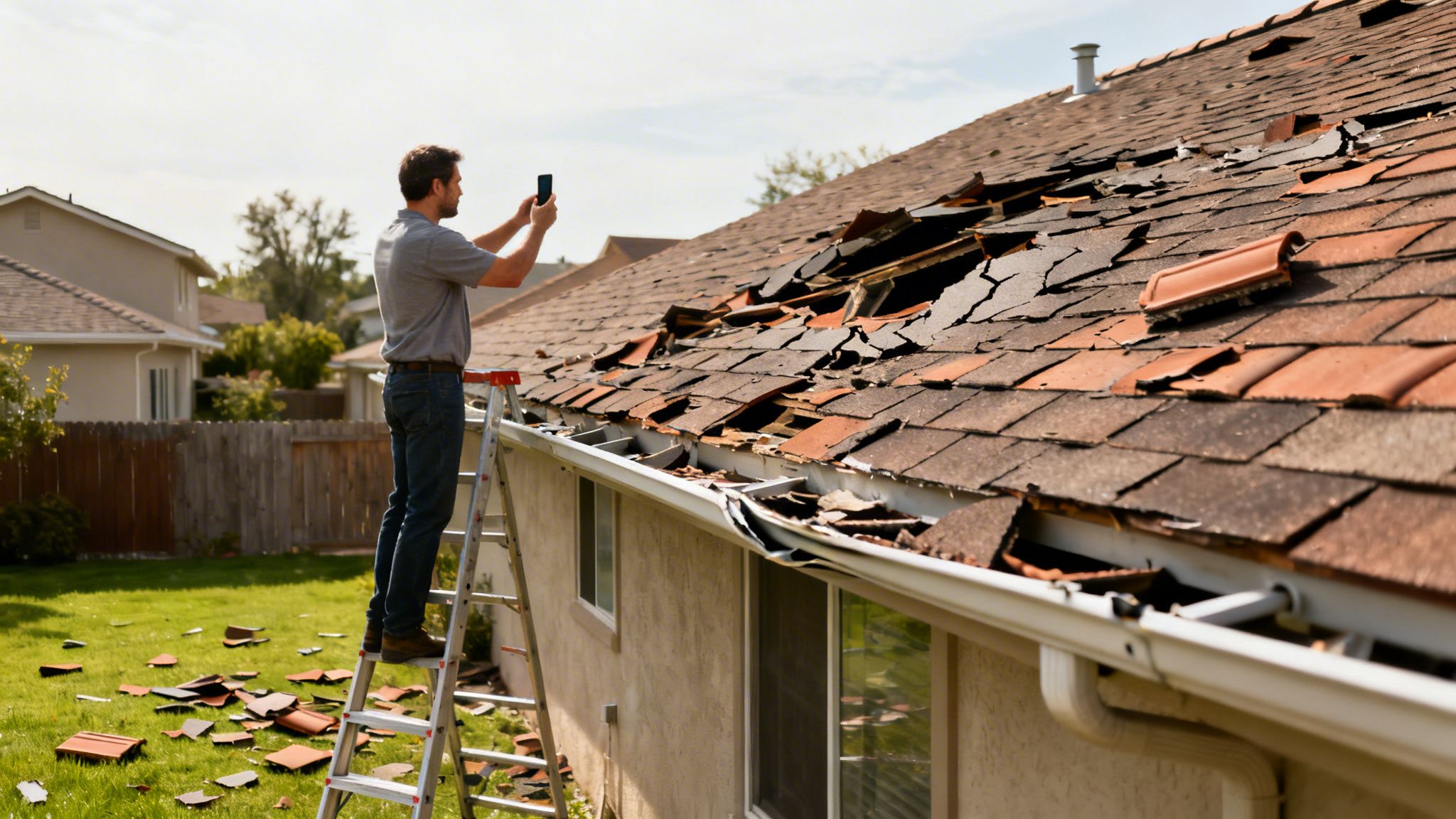
After a big storm blows through, your first thought is probably about the roof. But hold on—don't even think about grabbing a ladder yet. The safest and most revealing first step happens with your feet planted firmly on the ground.
A quick walk around your property can tell you almost everything you need to know about whether you need to call in a professional.
Your Post-Storm Walkaround: What to Spot From the Ground
It's natural to want to check the roof immediately, but a smart, safe assessment starts on the ground. This initial sweep gives you instant clues about the storm's intensity and helps you spot the obvious red flags that mean it's time for a closer look.
Start by doing a full lap around your house. You're looking for anything that seems out of place. Are there tree limbs scattered around? More importantly, is a big branch resting on your roof? Even a medium-sized limb can puncture roofing materials or cause structural damage, creating an immediate leak.
Look at the Ground First, Then Gutters
What you find in your yard can be a dead giveaway. If you see pieces of shingles or other roofing materials on the lawn or in your driveway, that's a direct sign that high winds did some damage.
Pay close attention to what's gathered near your downspouts. Finding a pile of small, sand-like granules is a major red flag. Those granules are the protective top layer of your asphalt shingles. When hail or wind-driven rain strips them away, it dramatically accelerates your roof's aging process and leaves it vulnerable.

This simple flow chart really drives the point home: your inspection should follow a logical path, starting with the big picture (debris in the yard) and narrowing in on the details at your roof's edge.
Next, check your gutters and downspouts. Are they dented, dinged, or pulling away from the house? That’s a classic sign of hail or powerful wind gusts. If they're clogged up, it could be from all those granules we just talked about. And even if you have guards, it’s important to know how to clean gutters with gutter guards to make sure they’re actually working.
Check Siding, Windows, and A/C Units
While you're outside, take a look at your siding, window screens, and even your outdoor air conditioning unit. If you see damage in these places, it’s a strong indicator that the storm was powerful enough to hurt your roof, too.
After all, if hail was strong enough to dent the metal fins on your A/C unit, it definitely had enough force to damage your shingles.
To help you keep track, here's a quick summary of what to look for on your initial ground-level inspection.
Quick Ground-Level Storm Damage Checklist
| Area to Inspect | What to Look For | Why It Matters |
|---|---|---|
| Lawn & Driveway | Shingle pieces, roofing felt, granules near downspouts, fallen branches. | This is direct physical evidence that high winds or impacts have torn material from your roof. |
| Gutters & Downspouts | Dents, dings, detachment, sagging, or blockages. | Shows the force of hail and wind; clogged gutters can cause water to back up under your roof. |
| Siding & Windows | Cracks, holes, or chips in siding; torn or damaged window screens. | Damage here indicates the storm's intensity and suggests the roof likely sustained similar impacts. |
| Exterior Fixtures | Dents on A/C units, vent caps, or metal flashing. | Metal fixtures are a great "witness panel" for hail, proving its size and force. |
This checklist isn't a substitute for a professional inspection, but it gives you a solid starting point to determine if you have a potential insurance claim on your hands.
Pro Tip: Take a slow walk down your street. If you see other homes with visible damage, tarps on their roofs, or roofing trucks parked out front, there's a very good chance your home was hit by the same storm cell.
This "neighborhood check" is one of the most reliable indicators we use. Storms, especially hail and high-wind events, rarely damage just one house in isolation. They carve a distinct path, and seeing that pattern is a huge signal that you need to get your own roof checked right away.
Alright, you've done your first walk-around. Now it’s time to get a bit more forensic. This is where you grab your binoculars and really start to look at the roofing materials themselves for the specific calling cards a storm leaves behind.
Let me be clear: do this from the ground or a securely placed ladder. Never, ever walk on a roof you suspect is damaged. Different materials—shingles, tile, metal—each have their own unique tells, and knowing what you're looking for is the key to catching problems before they turn into catastrophic leaks.

This step moves past the obvious stuff like branches in your yard and gets into the subtle clues that tell the real story of what your roof just went through.
Spotting Damage on Asphalt Shingles
Asphalt shingles are on the majority of homes in America, and they have some very specific weak spots when it comes to wind and hail. Finding shingle granules in your gutters was a good first sign, but now we need to look for more concrete evidence.
Granule Loss: Those little sand-like bits are the shingle's sunscreen, protecting it from UV rays. A bad storm can literally blast them off, leaving behind "bald" spots. Scan your roof for areas that look darker, almost wet, as this is a classic sign of heavy granule loss.
Wind Damage: People think wind damage means shingles ripped clean off the roof. More often, the wind lifts the shingle, breaks the sealant strip underneath, and then lays it right back down. From the ground, you might spot shingles that are flapping a bit, have curled-up edges, or show a distinct horizontal crease where the wind bent them backward over the shingle below. This is a serious breach.
Hail "Bruising": Hail damage can be sneaky. It often creates a "bruise" rather than a clean crack. The impact crushes the shingle's fiberglass matting, leaving a spot that feels soft and spongy to the touch—like a bruised apple. You can't feel this from the ground, but you can often see telltale circular patterns where the granules have been knocked off.
It’s hard to overstate how vulnerable these roofs are. Nearly 75% of single-family homes use asphalt shingles. And by the time a shingle roof is just eight years old, it has a one-in-four chance of sustaining damage from severe weather. After 15 years, that risk jumps dramatically—more than 90% of older asphalt roofs show visible storm damage. You can dig into the data in this report on severe storms and their insurance impact.
Identifying Issues on Tile Roofs
Tile roofs, a common sight here in South Florida, are incredibly tough but can be brittle. A direct hit from flying debris or the stress from extreme wind can cause problems. Because of how they interlock, even one broken tile can compromise a whole section of your roof.
Here’s what you’re looking for on a tile roof:
- Cracked or Chipped Tiles: Binoculars are your best friend here. Look for sharp, fresh-looking breaks or missing corners. Small cracks are almost impossible to spot otherwise.
- Dislodged or Slipped Tiles: Strong winds can get underneath and shift tiles out of alignment. Look for any that are sitting crooked or have slid down, exposing the dark underlayment beneath.
- "Chatter" Marks: Sometimes hail isn't strong enough to break a tile but will scuff the surface, leaving behind impact marks or tiny craters.
A key tip for inspecting any roof, especially tile, is to view it from different angles and at different times of day. The changing sunlight can cast shadows that reveal subtle cracks, chips, and lifted edges that are invisible in direct overhead light.
Detecting Damage on Metal Roofs
Metal roofing is prized for its resilience, but it's not bulletproof. Hail is its number one enemy, and while the damage is often just cosmetic, a severe hailstorm can cause real problems.
Dents and Dings: This is the most obvious sign. You’ll see small, circular indentations scattered across the metal panels. Even minor denting is definitive proof that hail hit your property, which is crucial information for any insurance claim.
Scratches and Punctures: Debris tossed around by the wind can easily scratch the protective coating on metal panels. If a scratch is deep enough to expose bare metal, it’s a ticking time bomb for rust and corrosion. In rare cases, a sharp object can even puncture the panel completely.
No matter what kind of roof you have, doing this detailed visual check gives you the specific evidence you need. It helps you understand exactly how to tell if your roof has storm damage by taking the guesswork out of the equation. Once you've pinpointed these issues, you’re in a much better position to talk to a professional and start the process of getting things put right.
After you’ve done a thorough walk-around of your property, your next move is to head inside. While the mess outside tells part of the story, some of the most telling signs of storm damage are hiding right inside your home.
Water is a sneaky adversary. A leak on your roof rarely drips straight down. Instead, it can travel along rafters, soak into insulation, and run down the inside of walls before it ever makes an appearance. That’s why a careful interior check is non-negotiable.
Your first stop? The attic. After any significant storm—especially one with wind-driven rain—the attic is your best early-warning system for finding leaks before they cause catastrophic damage to your ceilings and walls.
How to Safely Inspect Your Attic
Grab a powerful flashlight and head on up, but be extremely careful where you put your feet. Only walk on the solid wood joists or any designated plywood flooring. Never, ever step on the insulation or the drywall ceiling below it. It absolutely cannot support your weight.
Once you're situated, switch off your flashlight for a moment. Let your eyes adjust to the darkness and look up. Do you see any tiny pinpricks of daylight shining through the roof deck? Even the smallest sliver of light is a direct path for water to get in.
Next, flip your flashlight back on and methodically scan the entire space. You’re on the hunt for:
- Damp or Discolored Insulation: Insulation that looks wet, feels compressed, or is noticeably darker than the surrounding fluff is a dead giveaway. If you touch a suspicious spot and it feels damp or cold, you’ve got an active leak.
- Dark Stains on the Wood: Look at the underside of the roof deck—that’s the plywood or OSB sheathing. You're searching for dark, round stains, long streaks, or watermarks that show where moisture has been.
- Rust and Corrosion: Check out the nails and metal fasteners poking through from the roof above. If you spot rust forming around them, it’s a clear sign that moisture has been present for a while.
Finding any of these clues is confirmation that water has breached your roofing system. A single damp patch in the attic can easily correspond to a much larger section of compromised shingles or flashing on the outside.
Spotting Clues in Your Living Areas
You don't always need to climb into the attic to find evidence of a leak. Often, the signs will pop up right in your living room, bedroom, or kitchen. These clues might not even show up for hours or days after the storm has passed.
Keep a close eye out for any new or changing marks on your ceilings and walls. Pay extra attention to the upper corners of rooms and the areas around light fixtures or ceiling fans.
A small, faint water spot on a ceiling is often just the tip of the iceberg. By the time moisture has saturated drywall enough to become visible, a significant amount of water may have already pooled above, soaking the underlying structure.
Look specifically for these common indicators:
- New Water Spots: Small, yellowish or brownish circles appearing on your ceiling are the classic calling card of a slow leak.
- Bubbling or Peeling Paint: When water seeps behind paint, it breaks the bond and causes it to blister, bubble up, or flake off. This is especially common on walls where a leak is running down from the ceiling.
- Sagging or Bowing Drywall: If you notice any part of your ceiling starting to dip or look swollen, it’s a sign that water is accumulating and weighing it down. This is a serious red flag that demands immediate attention, as a ceiling collapse could be imminent.
Discovering any of these interior issues after a storm is a clear signal that your roof's defenses have failed. This is no longer a "wait and see" situation. It's time to call in a professional to find the source of the leak and stop the damage from getting any worse.
Documenting Damage for an Insurance Claim

Once you’ve spotted what looks like storm damage, your focus needs to shift immediately to documentation. From our experience, this is the single most important step in the entire insurance process. Clear, methodical proof is what separates a quickly approved claim from a long, drawn-out dispute.
Think of yourself as building a case for your home. Every photo and note you take serves as undeniable evidence. Without it, you're leaving the outcome up to an adjuster's brief visit and interpretation, which may not capture the full extent of what your roof just went through.
Create a Photographic Record
Your smartphone is the best tool for the job, but how you use it makes all the difference. Random snapshots won't cut it. You need to create a visual narrative that tells a clear story of the damage, making it easy for an adjuster to understand and approve your claim.
Start from the ground with wide shots of each roof slope. These are your "establishing shots" that provide context. Then, it's time to get into the details.
Here’s what to focus on:
- Capture the specifics: Get close-up shots of any bruised shingles, cracked tiles, or dented metal panels. If you found pieces of your roof in the yard, photograph them right where they landed before picking them up for a closer picture.
- Show scale and location: This is a pro tip that adjusters appreciate. Place a ruler, a coin, or even your car keys next to hail marks or cracks. It gives undeniable context for size. Then, pull back and take a medium shot to show where that specific damage is located on the roof.
- Document "witness" damage: Don't just focus on the roof. Photograph dents on your gutters, window screens, mailbox, and A/C unit. This collateral damage proves the storm was severe enough to damage metal, strengthening your case for roof damage.
A dated log is just as important as the photos. Jot down the date of the storm and the date you documented the damage. For each photo, add a simple description like, “West slope, dime-sized hail impact near top ridge,” or “Five cracked tiles on the front slope.” This turns a collection of pictures into a powerful report.
Photo Documentation Checklist for Insurance Claims
Taking the right photos can make or break your insurance claim. A detailed photographic record provides undeniable proof of the storm's impact. Use this checklist to ensure you capture every critical detail an adjuster needs to see.
| Photo Type | What to Capture | Pro Tip |
|---|---|---|
| Establishing Shots | Each side of your house, showing the entire roof slope from the ground. | Take photos from multiple angles (e.g., from the street and the backyard) to provide full context. |
| Medium Shots | A specific section of the roof where damage is concentrated. | This helps the adjuster pinpoint the exact location of the problems you're highlighting in close-ups. |
| Close-Up Shots | Individual damaged shingles, tiles, or dents in metal. | Capture cracked, bruised, creased, or missing roofing materials in sharp detail. |
| Scale Photos | Place a ruler, coin, or tape measure next to hail impacts or cracks. | This provides an objective measurement of the damage size, which is crucial for claim validation. |
| "Witness" Damage | Dents on gutters, window screens, A/C units, and fences. | This collateral damage proves the storm's intensity and supports your claim for roof damage. |
| Interior Damage | Water stains on ceilings, wet insulation in the attic, or peeling paint. | If the damage has caused interior leaks, document it immediately. This indicates a serious breach. |
By following this checklist, you create a comprehensive visual story that is difficult for an insurer to dispute, streamlining your path to a fair settlement.
Why Professional Documentation Is a Game-Changer
While your photos are a vital first step, a formal inspection report from a certified roofer like Paletz Roofing and Inspections carries immense weight with insurance carriers. We work with adjusters daily and know precisely what evidence they need to see to process and approve a claim efficiently.
Our reports go far beyond what a homeowner can capture. We often use chalk to outline subtle hail impacts or wind-lifted shingles, making them impossible to miss. Our documentation includes precise measurements, an evaluation of the underlayment, and a professional assessment of whether your roof needs a simple repair or a full replacement based on the damage and South Florida’s strict building codes.
This expert assessment is more critical than ever. Storm-related roofing claims have shot up by 40% since 2015. In 2022 alone, severe storms caused over $60 billion in damages—a staggering figure that has made insurers scrutinize claims more closely.
A professional report from Paletz Roofing gives your claim the expert evidence it needs for a fair and timely settlement. And if you run into problems, a detailed roofer's report is often the strongest tool you have to avoid or resolve insurance disputes.
Why a Professional Inspection Is Essential in Florida
So you’ve done a walk around your property and checked for leaks inside after a big storm. That's a great start, but what you can see from the ground is just the tip of the iceberg. When it comes to knowing what a storm really did to your roof, a DIY assessment barely scratches the surface. Here in South Florida, where intense wind and hail are a regular threat, you need a level of scrutiny that only a trained professional can deliver.
Think of a professional inspection not as an expense, but as a crucial investment. It’s about protecting your home's value and, just as importantly, giving your insurance claim the best possible chance of success. An experienced roofer knows exactly how to tell if a roof has storm damage by finding problems that are practically invisible to an untrained eye.
Seeing Beyond the Obvious Damage
A homeowner might notice a shingle that’s completely missing, but a professional from Paletz Roofing and Inspections sees the full story. We’re trained to spot the subtle but destructive hail "bruises" on asphalt shingles. These might just look like small, soft spots, but we know they're a sign of a crushed fiberglass mat beneath—a critical failure that compromises the shingle's ability to keep water out.
We also know to look for the faint, horizontal crease that a shingle gets when high winds lift it just enough to break its watertight seal, even if it settles back down perfectly flat. An insurance adjuster juggling a packed schedule can easily miss these subtle clues. That can lead to a denied claim for what is, in reality, a seriously compromised roof.
An adjuster's job is to evaluate a claim based on the evidence they're given. Our job as your professional roofer is to find and document all of that evidence, making sure nothing gets missed. We become your expert advocate, ensuring the complete story of the storm's impact is told.
This level of detail is more important than ever. Wind and hail now account for 34.3% of all property damage claims across the country, making them the top cause of insured losses. While "Tornado Alley" used to be a Midwestern concern, these severe storms have pushed into the Southeast. This puts Florida directly in the path of more frequent and intense hail. You can read more about how hail and wind damage impacts insurance claims at Policygenius.com.
A Complete System Assessment
Your roof is so much more than the shingles or tiles you see from the street. It’s a complex, interconnected system, and a real inspection has to evaluate every single component. A professional doesn’t just glance at the surface; we assess the entire protective envelope of your home.
Our thorough check includes:
- Underlayment: This is the water-resistant barrier under your primary roofing material. We search for any tears or exposure that are just waiting to become a leak.
- Decking: The wooden foundation of your roof structure. We'll check for soft spots from above and water stains from inside the attic, which are tell-tale signs of rot.
- Flashing: These are the metal strips that seal joints around chimneys, vents, and valleys. Damaged or lifted flashing is one of the most common culprits behind major roof leaks.
- Ventilation: In Florida's heat, proper attic ventilation is non-negotiable. If vents are damaged, they can trap moisture and super-heated air, which dramatically speeds up the aging of your roof.
A professional from Paletz Roofing and Inspections understands how all these pieces work together. We know that a small dent in a vent cap could be a red flag for widespread hail damage, or how one lifted shingle might point to a systemic wind failure across an entire section of your roof.
Local Knowledge of Codes and Weather
Finally, hiring a local professional gives you an invaluable home-field advantage. Here in South Florida, we work under some of the toughest building codes in the nation, specifically written to stand up to hurricane-force winds. We know these codes inside and out.
This local expertise is critical. It allows us to identify if storm damage now requires your roof to be brought up to today’s much higher standards—a key detail for calculating the true restoration cost for your insurance claim. We understand the unique weather patterns across Broward, Miami-Dade, and Palm Beach counties and recognize the signature damage our local storms inflict. This blend of technical skill and local insight guarantees that no detail is overlooked, giving you the accurate, comprehensive assessment your home deserves.
Frequently Asked Questions About Roof Storm Damage
After a major storm rolls through, it’s completely normal to have a ton of questions, even after you’ve done a quick walk-around of your property. Trying to figure out what to do next in the chaotic aftermath of severe weather can be overwhelming for any homeowner.
We get it. We've heard just about every question you can imagine from homeowners across Broward, Miami-Dade, and Palm Beach counties. Here are some direct, no-nonsense answers to the most common concerns we hear, helping you understand how to tell if your roof has storm damage when the signs aren't always obvious.
My Roof Looks Fine From the Ground. Could It Still Be Damaged?
Absolutely, and thinking otherwise is one of the most dangerous assumptions a homeowner can make. A huge amount of storm damage is completely invisible unless you get on the roof for a hands-on inspection.
For instance, hurricane-force winds can easily lift a shingle, breaking the critical watertight seal underneath, and then lay it right back down. From your yard, everything looks perfect. But that shingle is now just a loose flap, and the next wind-driven rain will send water pouring directly into your attic.
Hail damage is just as tricky. It often creates subtle "bruises" on asphalt shingles that you can only find by touch—they’ll feel soft or spongy. These impacts crush the shingle’s internal mat, creating a weak point that will fail over time, but you'd never spot them from the ground.
Key Takeaway: A quick glance from your lawn is a good start, but it's not a real inspection. Just because you don’t see missing shingles doesn’t mean your roof is okay. Only a professional can safely get up there to perform the tactile, up-close look needed to know for sure.
How Long Do I Have to File a Storm Damage Claim in Florida?
The clock starts ticking the second a storm hits. While every insurance policy is a little different, Florida law gives homeowners a specific, limited window to file a claim for damage from a windstorm or hurricane.
Frankly, you can't afford to wait. The sooner you get the damage professionally inspected and documented, the stronger your claim will be. If you delay, the insurance company has an opening to argue the damage is from something else entirely—maybe a different storm, pre-existing issues, or just a lack of maintenance on your part.
Your best move is to call a professional roofer for an inspection immediately after a major storm passes. This ensures you hit all your deadlines and have the expert documentation you need to support your claim from day one.
Will a Small Roof Leak Fix Itself?
Never. A roof leak will never, ever fix itself. In fact, it’s 100% guaranteed to get worse over time. Water intrusion is a progressive problem—once it finds a way in, it will continue to cause more extensive and more expensive damage.
That tiny drip or small water spot on your ceiling is a massive red flag. Even a slow, seemingly insignificant leak can:
- Soak and rot the wooden roof deck and structural supports in your attic.
- Destroy your insulation, making it worthless and spiking your energy bills.
- Spark the growth of dangerous black mold inside your attic, ceilings, and walls.
What looks like a tiny issue on the surface is often the tip of the iceberg, signaling a much larger area of saturated material hidden from view. Getting any leak professionally repaired right away, no matter how small, is the only way to prevent thousands of dollars in secondary damage.
My Neighbors Are Getting New Roofs. Should I Be Concerned?
Yes, you should be very concerned. Storms—especially hail and high-wind events—almost never damage just one house in a neighborhood. They typically carve a clear path of destruction.
If you see roofing trucks up and down your street and your neighbors are getting their roofs replaced, that’s an extremely strong sign your home was hit by the same weather. Insurance carriers know this and often process claims in geographic clusters after a major storm.
Don't just assume your house was the lucky one. The damage to your roof might be less obvious, but it could be just as severe. The smartest thing you can do is schedule a free, no-obligation inspection to get a professional set of eyes on it. It’s always better to know for sure than to find a major problem months later when it’s too late to file a claim.
When you need a clear, honest assessment of your roof's condition after a storm, trust the local experts who know South Florida's weather and building codes inside and out. For a thorough and professional inspection, contact Paletz Roofing and Inspections today. Schedule your free quote and protect your home by visiting https://paletzroofing.com.