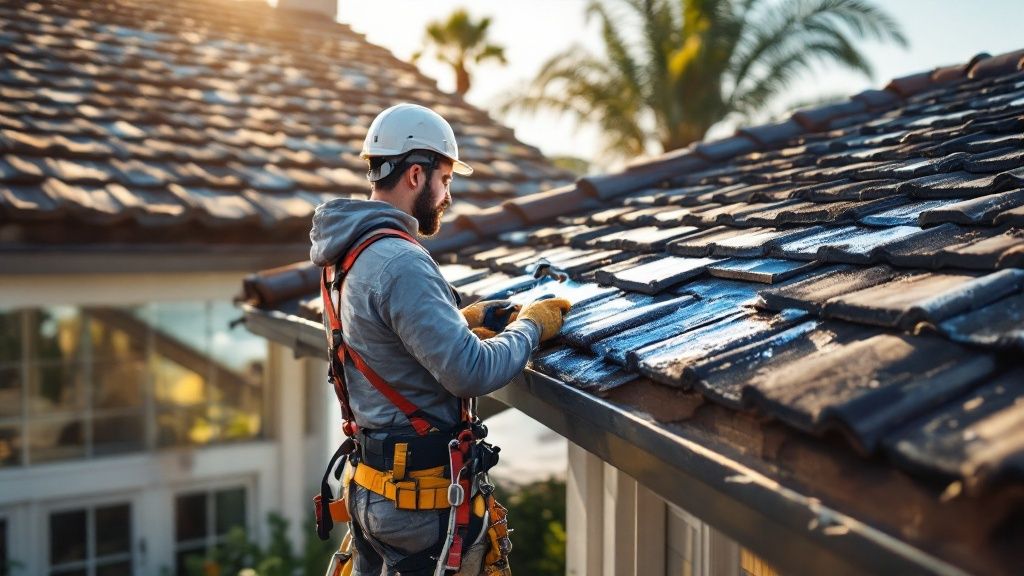
Taking a proactive approach to roof leak detection in Sea Ranch Lakes isn't just a good idea—it's essential. For homeowners along this stretch of coast, the unique climate can turn a tiny, unnoticed issue into a major structural threat much faster than you'd think. This is about more than just stopping a drip; it's about protecting your home's value by catching hidden water damage before it leads to rotted wood, spreading mold, and repairs that cost a fortune.
Why Your Sea Ranch Lakes Home Is Uniquely at Risk

Owning a home in Sea Ranch Lakes means you're living in a beautiful but incredibly harsh environment. The combination of constant salt air, high humidity, and intense sun is a punishing trio for any roofing system. These aren't just minor annoyances; they are active agents of decay, relentlessly working to break down your home's first line of defense.
Unlike homes further inland, roofs here face a very specific set of threats:
- Salt Air Corrosion: That salty mist coming off the Atlantic is highly corrosive. It eats away at metal components like flashing, fasteners, and gutters, creating tiny openings that are perfect entry points for water.
- High Humidity and Moisture: The air here is so persistently humid that roofing materials sometimes never fully dry out. This encourages algae growth and can seriously compromise the integrity of your roof's underlayment.
- Intense UV Exposure: Florida’s sun is brutal. It beats down on roofs year-round, causing materials like asphalt shingles to turn brittle and tile roofs to develop micro-fractures from the constant cycle of heating and cooling.
The Amplified Threat of Coastal Weather
The very location of Sea Ranch Lakes makes its homes especially vulnerable. Positioned right on the southeast coast of Florida, the village gets the full force of tropical storms and hurricanes. And wind-driven rain is an expert at finding the smallest flaw in a roof's armor.
A report from Broward County clearly lays out the area's climate vulnerabilities, noting that rising sea levels and bigger storm surges are only making things worse. Projections show sea levels could rise by as much as 2 feet by 2060, which means our roofing structures will face even more extreme weather. This constant environmental stress just fast-forwards common roofing problems, from cracks in flat roof membranes to corroded fasteners on tile systems.
For homeowners in this exclusive community, a "wait-and-see" approach is a financial gamble. A small, undetected leak can quickly escalate, leading to saturated insulation, rotted wood framing, and dangerous mold growth hidden within walls.
Ultimately, proactive roof leak detection isn't just another maintenance task; it’s a non-negotiable part of owning a coastal home. Regular inspections are the only real way to get ahead of the domino effect of damage, protecting your home’s structure and preserving its significant value.
Finding Hidden Leaks Before They Cause Damage
A discolored spot on the ceiling is often the first time a homeowner in Sea Ranch Lakes realizes they have a problem. By that point, though, the leak has been active for a while.
The real skill is learning to spot the subtle clues that appear long before a single drop of water hits your living room floor. You have to become a bit of a detective in your own home.
Instead of waiting for an obvious stain, start paying attention to the less dramatic warning signs. After a heavy rain, walk through your home and look for faint, yellowish rings along ceiling corners or where the ceiling meets the wall. These are often the first hints of moisture seeping through.
Also, trust your other senses. A persistent, musty smell in a closet or attic that you can’t quite place is a huge red flag. That earthy odor is a classic indicator of hidden moisture, likely from a slow leak that hasn't yet soaked the drywall enough to become visible.
Tracing the Source From the Inside Out
Once you spot a potential issue, the next step is connecting it to its likely origin. An interior clue is just one half of the puzzle; understanding what it means for your roof's exterior is the key to a fast, effective repair.
The following graphic outlines a simple, logical process for a preliminary leak investigation, starting inside and working your way out.
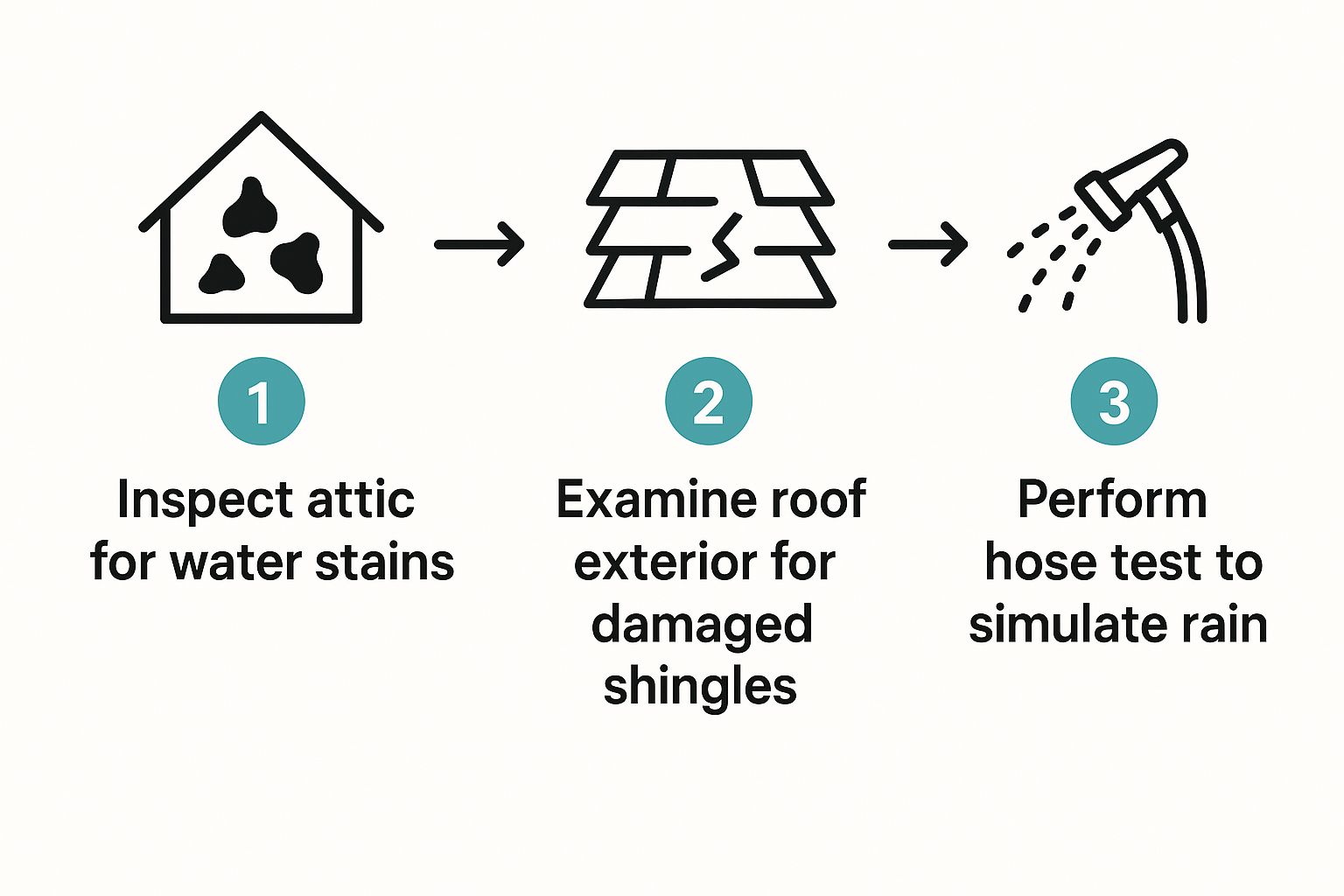
This visual guide shows why an attic inspection is your best first move. It can often reveal the direct path of water entry before you even think about getting up on the roof.
Remember, the location of an interior water stain is rarely directly below the actual roof breach. Water can travel along rafters and insulation before it finds a spot to drip through, making a thorough attic check essential.
One of the most common challenges is figuring out if you're dealing with a true roof leak or something else entirely. Sometimes, what looks like a roof leak is actually attic condensation. Learning how to distinguish between a roof leak and attic condensation can save you time and point you toward the right solution.
To help you connect the dots between what you see inside and what's happening outside, I've put together this quick reference table.
Connecting Interior Signs to Potential Exterior Leak Sources
This table is a handy guide for making an educated guess about where your leak is coming from based on the signs you're seeing indoors.
| Interior Sign | Most Common Location | Likely Exterior Cause |
|---|---|---|
| Peeling or Bubbling Paint | High on walls near the ceiling, around window frames | Clogged gutters or damaged flashing causing water backup |
| Dark Stains on Rafters | Attic, crawlspaces | Compromised underlayment or cracked/slipped roof tiles |
| Damp Spots Around Vents | Bathrooms, kitchen, utility rooms | Damaged seals or "boots" around pipes and vents |
| Musty Odors with No Visible Stain | Closets, rooms with poor ventilation | Slow, seeping leak absorbed by insulation or wood framing |
By using this table, you can start to form a clearer picture of the problem. For instance, if you see subtle signs of peeling paint in an upstairs bedroom, clogged gutters become a highly probable cause.
This kind of informed observation is invaluable when you eventually call a professional. It allows for a more efficient and targeted inspection, which saves everyone time and money.
How to Safely Inspect Your Roof Exterior

Once you've hunted for clues inside your home, the next logical step is to take the investigation outside. Now, this doesn't mean you should grab a ladder and start climbing. In fact, for your own safety, you absolutely shouldn't. You can learn a surprising amount about your roof's condition with a thorough visual check from the ground.
Think of yourself as a detective gathering intelligence, not a DIY repair person. Spotting potential issues from a safe distance gives you specific, valuable information to share with a professional, which makes their job of diagnosing the problem much faster and more accurate. A pair of binoculars will be your best friend here. Start with a slow walk around your property.
This first pass is all about the big picture. Keep an eye out for anything that just doesn't look right. Do you see any sagging in the roofline? That could point to a serious structural problem. Are there large patches of discoloration? That's often a dead giveaway for hidden moisture issues.
Common Issues on Sea Ranch Lakes Roofs
Homes in our Sea Ranch Lakes community often have tile or flat roof systems, and each comes with its own set of potential weak spots. Knowing what to look for based on your specific roof type is the key to an effective ground-level inspection.
For Tile Roofs:
- Cracked or Broken Tiles: Even a single cracked tile is an open invitation for water to get in. Look for obvious breaks or even tiny hairline fractures, especially right after a storm.
- Slipped Tiles: When a tile slides out of its proper place, it exposes the underlayment to the elements. This creates a direct pathway for water to sneak underneath.
- Missing Tiles: This one is a no-brainer and an urgent issue. Any visible gap in your tile pattern is a massive red flag that you likely have an active leak.
For Flat or Low-Slope Roofs:
- Ponding Water: If you see water still standing on your roof more than 48 hours after it rains, that's a serious problem. It signals poor drainage and puts a tremendous amount of stress on the roofing membrane.
- Blisters or Bubbles: These look exactly like they sound—raised bumps on the roof's surface. They're caused by trapped air or moisture and mean the roof membrane is starting to fail.
Universal Weak Points to Check
No matter what kind of roof you have, some areas are just naturally more prone to leaks. These are the critical joints and transitions on your roof that take the brunt of the weather day in and day out.
Pay special attention to the flashing. This is the metal stripping that seals the joints around chimneys, vents, skylights, and where walls meet the roof. Check for any rust, corrosion, or sections that look like they're pulling away from the structure. Flashing is one of the most common failure points on any roof, period.
A critical but often overlooked area is your gutter system. Clogged gutters and downspouts cause water to back up and seep under the eaves, leading to wood rot and hidden leaks that can damage your walls and foundation.
Finally, take a look at what’s washing out of your downspouts. If you have an asphalt shingle roof and you see a lot of shingle granules—that sandy, gravel-like material—it’s a sign that your roof is getting old and losing its protective outer layer. A good checklist can keep you organized. To get a better idea of what a professional looks for, you can learn more about the complete roof inspection process.

The Technology Professionals Use to Find Leaks
When a stubborn leak is playing hide-and-seek, a simple visual inspection just won't cut it. That water spot on your ceiling? It could be yards away from the actual breach in your roof. This is where we bring in specialized technology to get an accurate diagnosis without any destructive guesswork—a level of precision that’s essential for effective roof leak detection in Sea Ranch Lakes.
Instead of just relying on what the eye can see, we use advanced tools that reveal hidden moisture and subtle structural problems. This lets us pinpoint the exact source of the water, making sure we fix the root cause, not just the symptom. It's a much smarter approach than just chasing stains around your ceiling.
Seeing Through Your Roof with Infrared Thermography
One of the most powerful tools in our arsenal is infrared (IR) thermography. An infrared camera doesn't actually see moisture. What it does see are tiny temperature differences across your roof's surface. Wet insulation and roofing materials hold onto heat differently than dry materials, creating a thermal signature that’s impossible to miss.
After the sun goes down, a roofer can scan the entire roof. Any areas holding onto the day's heat—a dead giveaway for trapped moisture—will show up as warmer spots on the camera. This technology lets us "see" the exact size and shape of a saturated area under the roof membrane, all without drilling a single hole. It’s like giving an inspector x-ray vision for water.
The real value of infrared scanning is its non-invasive nature. It finds the hidden problem area with incredible accuracy, preventing the need for exploratory cutting or removal of roofing materials, which saves both time and money.
Mapping Moisture with Non-Invasive Surveys
Beyond thermal imaging, professionals often run comprehensive roof moisture surveys. This is especially critical in our coastal climate where moisture can be everywhere. A study highlighted in "The Military Engineer" way back in 1982 noted that these surveys dramatically improve roofing performance and cut down on long-term costs.
Experienced local companies have known this for a long time, emphasizing these surveys to find damage before it gets out of hand. These non-invasive meters map out dampness across the entire roof system, often creating color-coded graphs that clearly show property managers which spots need immediate attention.
This systematic approach gives us a complete picture of your roof's health. For incredibly precise topographical data that can reveal subtle roof deformations or areas where water is pooling, professionals often deploy advanced LiDAR UAV drone technology.

This is exactly why hiring a professional gives you such a massive advantage. A trained expert knows how to interpret the data from these tools to uncover the true origin of a leak, which might be nowhere near where the symptoms are showing up inside your home. It’s the difference between a temporary patch and a lasting solution—a crucial distinction for any homeowner.
Understanding the True Cost of a Hidden Roof Leak

Putting off professional roof leak detection in Sea Ranch Lakes is more than just a gamble—it’s a surefire way to watch a small, manageable problem spiral into a financial nightmare. What starts as a tiny drip can silently kick off a destructive chain reaction inside your home, with the repair bill growing exponentially every single day you wait.
That seemingly insignificant leak doesn't just disappear. The water it lets in soaks your attic insulation, turning it into a soggy, compacted mess that can no longer do its job. The immediate result? Your HVAC system starts working overtime to keep your home comfortable, and your energy bills start to climb.
From there, things only get worse. Persistent moisture saturates the wooden rafters and structural beams, creating the perfect, damp environment for wood rot and toxic mold to take hold.
The Financial Domino Effect of Water Damage
The cost of a simple patch is a tiny fraction of what you'll be up against once secondary damage sets in. The financial fallout multiplies fast, spreading far beyond the roof itself.
Here’s a glimpse at how quickly those costs can get out of control:
- Insulation Replacement: Once attic insulation is waterlogged, it's useless. Tearing it all out and replacing it can run into thousands of dollars, depending on the size of your attic.
- Mold Remediation: Black mold isn't just a serious health hazard; it's also incredibly expensive to remove. This is a specialized service that can easily tack on another huge bill.
- Structural Repairs: This is where the numbers get truly scary. Replacing rotted wood trusses, decking, and ceiling joists is a major construction project that can easily leave you with a five-figure invoice.
A proactive professional inspection is a small, strategic investment. It’s the difference between paying for a targeted repair now versus funding a massive restoration project later. Catching a leak early protects not just your home's structure but also its overall market value.
From Minor Fix to Major Overhaul
The financial argument for catching a leak early is impossible to ignore. A basic professional roof inspection might start around $100, but letting that same leak fester can lead to catastrophic expenses.
Repairs for structural damage can average between $5,000 to $15,000, and a complete roof replacement here in South Florida can easily blow past $20,000. Beyond the direct repair costs, hidden water damage and mold can tank your property's value by as much as 10%.
When you consider that water damage accounts for about 20% of all home insurance claims in Florida, proactive maintenance just makes sense. You can discover more about how water damage impacts local properties to see why jumping on these issues early is so critical. The financial reality makes a powerful case for dealing with potential leaks immediately, protecting both your home and your savings.
Answering Your Questions About Sea Ranch Lakes Roof Leaks
Even after you know what to look for, it's natural to have a few more practical questions about handling roof issues. We get calls all the time from Sea Ranch Lakes homeowners trying to navigate the specifics of roof care in our unique coastal community.
Let's clear up some of the most common concerns we hear. Getting straightforward answers is the best way to move from worrying about a leak to having a clear plan of action.
How Often Should I Get My Roof Inspected Here?
Living right on the coast means our roofs take a beating. For that reason, we strongly recommend a professional inspection at least once a year. The ideal time is right before hurricane season kicks off in June.
This proactive check gives a certified roofer the chance to spot and fix small vulnerabilities before they face the test of a major storm.
More importantly, it is absolutely critical to get an inspection right after a major storm rolls through. High winds and driving rain can lift tiles, crack flashing, or create tiny stress points you can't see from the ground. Catching that fresh damage immediately is the key to preventing a future disaster.
Key Takeaway: Think of it this way: an annual inspection is your proactive maintenance baseline. A post-storm inspection is non-negotiable for catching storm-related damage before it has a chance to turn into a full-blown leak.
Is It Safe to Fix a Small Roof Leak Myself?
It’s tempting, I know. You see a small drip, run to the hardware store, and grab a bucket of sealant, thinking you'll save a few bucks. But for a coastal home in Sea Ranch Lakes, this is rarely a good idea.
Those DIY patch kits are usually just a temporary band-aid. The bigger risk is that an improper patch can actually trap moisture underneath it, creating a perfect environment for hidden rot and mold to thrive. You might stop the drip, but you could be starting a much bigger, more expensive problem.
Here’s why calling a pro is always the smarter move:
- The Right Materials: Professionals use commercial-grade materials specifically designed to hold up against our intense sun and salt air.
- Warranty Protection: A DIY fix can easily void your existing roof warranty. If the problem gets worse, you could be left footing the entire bill for a major repair.
- Finding the Real Cause: A pro won't just patch the symptom; they'll diagnose the underlying reason for the leak. This ensures you get a long-term solution, not just a quick fix that will fail again next season.
My Leak Only Happens in Heavy, Wind-Driven Rain. Should I Worry?
Yes, absolutely. A leak that only shows up under specific conditions is a classic sign of a significant weak point in your roof's armor. It’s a textbook symptom of compromised flashing, cracked tiles, or failing seals around vents and pipes.
Don't be fooled by its intermittent nature. Every single time that leak happens, water is getting into your home's structure. It might not be enough to stain the ceiling right away, but it’s more than enough to kickstart the slow, silent destruction of wood rot, insulation damage, and mold growth inside your attic or walls.
Addressing it now is the only way to stop that hidden, cumulative damage before it gets serious.
Don't wait for a small drip to become a major disaster. For expert roof leak detection in Sea Ranch Lakes and professional repairs you can trust, contact the team at Paletz Roofing and Inspections. Schedule your comprehensive roof inspection today.