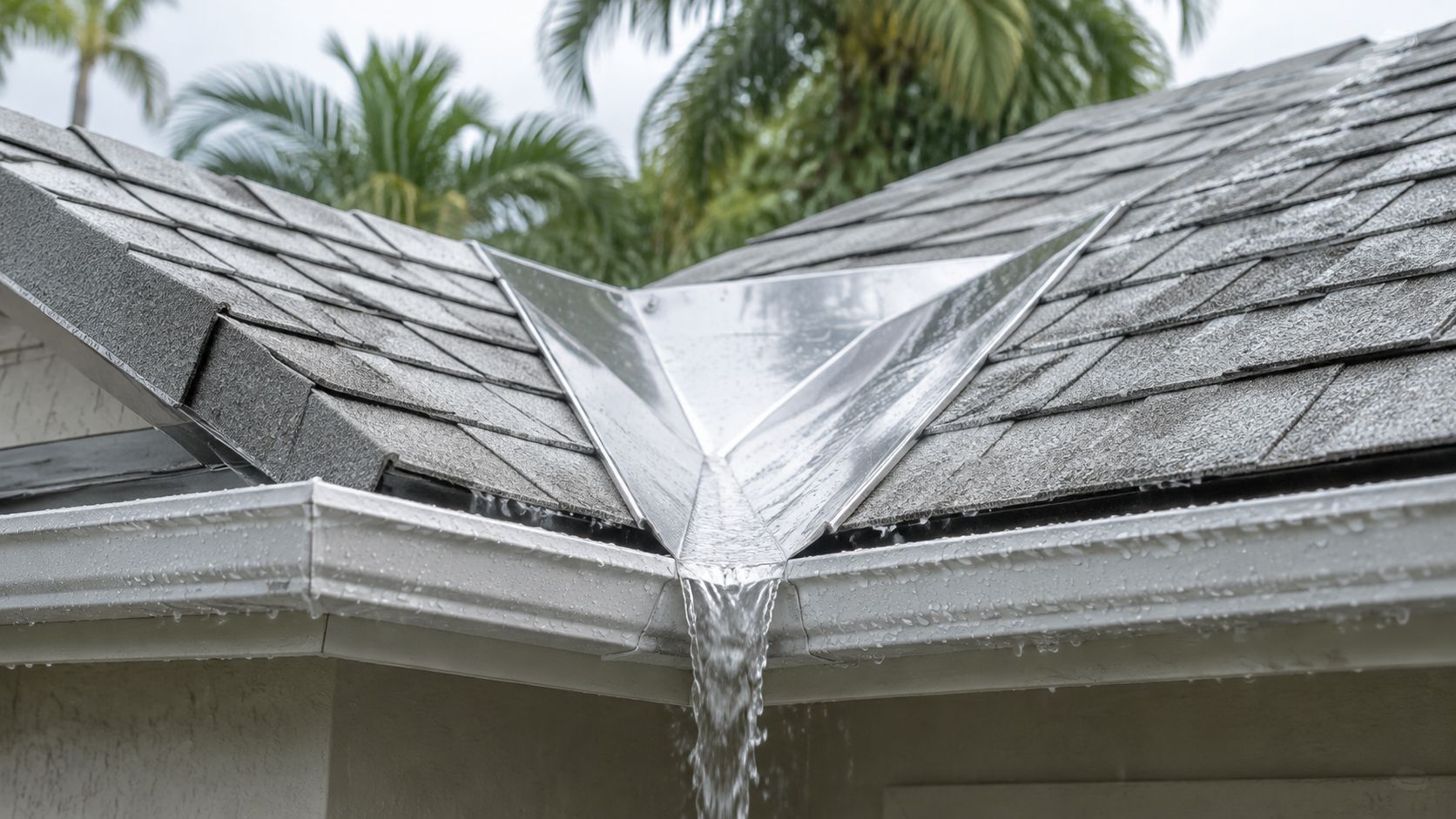
A roof valley rain water diverter is a ribbed or angled piece installed in the valley trough that keeps high-velocity runoff centered so it enters the gutter instead of sheeting under the shingles. For a dependable fix, start with the valley's flashing, gutter capacity, debris load, and discharge path, then choose and install the diverter that addresses the actual bottleneck.
A South Florida homeowner usually notices the problem during a fast afternoon storm. Water pours off two roof slopes, hits the valley outlet, leaps over the gutter, and splashes onto the fascia or ground below. The metal accessory may be small, but the decision behind it isn't. A diverter can control a concentrated stream, yet it can also push water behind the gutter when the geometry, height, or discharge path is wrong.
This guide walks through what happens inside the valley, how the hardware works, which materials make sense, how to diagnose the failure, and when a gutter upgrade or professional re-flashing is more appropriate.
Table of Contents
- What Happens When Rain Piles Up in a Roof Valley
- How a Roof Valley Rain Water Diverter Works
- Common Diverter Types and How They Compare
- Diagnosing Whether You Really Need a Diverter
- Installation Considerations for South Florida Roofs
- Maintenance and Lifespan in a High-Volume Climate
- Warning Signs, Ballpark Costs, and When to Call Paletz
- Putting It All Together for Your Roof
What Happens When Rain Piles Up in a Roof Valley
A homeowner standing under the eave during a South Florida summer squall can usually see the failure before finding its cause. At one point along the roof edge, a sheet of water blasts past the gutter while the rest of the gutter appears to be handling runoff normally. The valley is the reason that one location behaves differently.
Two roof planes meet in a V, so runoff from both surfaces converges into one channel. During a hard storm, that concentrated stream reaches the eave with speed and direction that a standard gutter section may not capture cleanly. If the gutter is too narrow, poorly pitched, blocked, or set too far below the roof edge, water can overshoot the front lip or roll behind the backplate.

Where the overflow goes
The visible splash is only the first symptom. Repeated runoff can stain or soften the fascia, wet the soffit framing, wash mulch away from the drip edge, and send water toward the foundation. On tile and metal roofs, the smooth surface can deliver water with even less resistance, making the valley outlet especially sensitive to the gutter opening and the angle of the receiving edge.
A diverter supplies a controlled transition between the valley trough and the gutter. Instead of allowing the stream to spread sideways beneath the adjacent roofing material or shoot beyond the gutter, a raised rib or angled metal piece keeps the flow aimed at the collection point.
Practical rule: Fix the direction and capacity of the water path together. A diverter that redirects runoff into a blocked or undersized gutter only moves the failure downstream.
The right question isn't whether a diverter can stop the splash. It's whether the valley is producing a geometry problem, a drainage-capacity problem, or an end-of-valley discharge problem. That distinction determines whether a small piece of metal will help or whether the gutter and flashing system needs more substantial work.
How a Roof Valley Rain Water Diverter Works
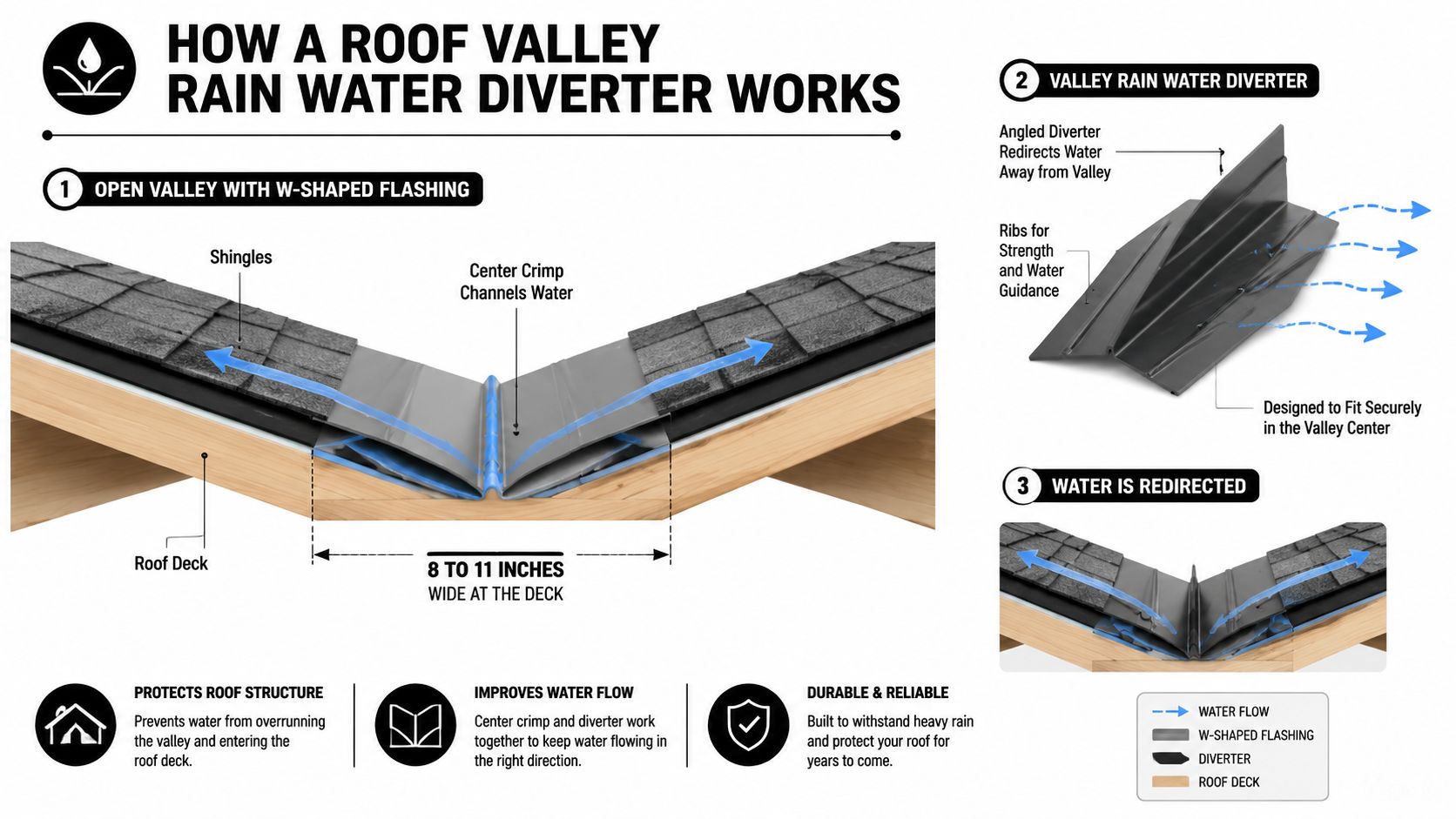
During a South Florida downpour, two roof planes can send a concentrated stream into the valley faster than the gutter can accept it. An open valley provides the route, while visible flashing commonly forms a W-shaped channel. Its center crimp or raised fold keeps water from spreading beneath the roofing edges. New York City building code guidance for valley flashing describes valley flashing extending 8 to 11 inches from the centerline on each side, with 4-inch end laps and a splash-diverter rib at the flow line measuring at least 3/4 inch to 1 inch high.
Those dimensions protect the roof deck along the concentrated flow path. The rib serves as the hydraulic control point. It does not need to stop the water. Its job is to interrupt sideways sheeting and keep the fast-moving stream centered as it approaches the gutter opening.
The flow path in plain terms
- Runoff enters the valley. Water from both roof planes moves toward the W-shaped flashing.
- The center fold holds the stream. The crimp helps keep water from wandering under shingle or tile edges.
- The diverter controls the approach. A rib or angled piece guides the concentrated flow forward instead of letting it fan sideways.
- The gutter receives the stream. The outlet angle must send water into the gutter, not behind its rear wall or over its front edge.
South Florida weather exposes poor geometry quickly. Wind can push rain across the roof, while palm fronds, seed pods, and other debris can partly block the valley or gutter. A diverter that handles a light shower may fail when debris narrows the path and the valley carries a fast, heavy stream.
That makes the diverter a symptom check before it becomes a hardware choice. Confirm whether the failure comes from the valley shape, a blocked or undersized gutter, or the end-of-valley discharge. A diverter cannot correct inadequate downstream capacity.
For high-volume runoff areas, including a wide garage door or roof valley, a 36- to 48-inch diverter, or multiple overlapping units, is a practical sizing approach identified in guidance on roof rain diverter sizing. The length must follow the flow path. Installed without a clear outlet, a long diverter can create another overflow edge instead of correcting the original problem.
Common Diverter Types and How They Compare
The common choices fall into three groups: formed metal flashing, improvised PVC splash guards, and commercial valley guard inserts. Each can work in the right location, but they don't offer the same resistance to heat, salt air, movement, or debris.
Stamped metal is usually the most natural match for a roof valley because it can follow the existing flashing profile. Aluminum resists rust and is easy to form, galvanized steel provides stiffness, and copper offers a durable custom-metal option when the roof system and budget support it. Salt air still demands inspection, especially at fasteners, cut edges, and dissimilar-metal contacts.
PVC piping can serve as a quick splash-control piece in limited situations, but exposed plastic has a harder time with South Florida heat and ultraviolet light. It may warp, crack, or lose its shape, particularly when it isn't supported correctly. Commercial valley guard inserts can offer a cleaner manufactured fit and may help with debris management, but they still depend on an open downstream gutter and correct placement.
Roof Valley Diverter Types Compared
| Diverter Type | Material Options | Cost per Linear Foot | Best Roof Match | South Florida Suitability |
|---|---|---|---|---|
| Stamped metal flashing diverter | Aluminum, galvanized steel, copper | Varies by material and fabrication | Shingle, tile, and metal when properly formed | Strong fit when matched to the existing flashing and inspected for corrosion |
| PVC piping splash guard | PVC or similar plastic | Varies by product and fabrication | Limited, low-slope shingle transitions | Conditional. Heat, UV exposure, and brittleness can shorten service life |
| Commercial valley guard insert | Formed metal or manufactured insert materials | Varies by product and installation | Roof systems with a compatible valley profile | Useful where debris control and a defined outlet are both present |
Copper can outlast lighter metals, but it isn't automatically the right choice. A copper insert touching incompatible metals can create corrosion concerns, and a custom piece needs a roofer who understands the existing flashing, underlayment, tile, or standing-seam details.
The practical choice is the one that preserves the roof system and gives water a clean route. A thin, mismatched accessory may cost less initially but can lift, deform, trap debris, or send water behind the gutter.
Diagnosing Whether You Really Need a Diverter
Before buying a roof valley rain water diverter, identify where the failure starts. From the ground, a homeowner can use binoculars and a tape measure to gather useful clues, although roof access and close flashing inspection belong to a qualified professional.
Start with four observations:
- Valley length: A longer valley carries runoff over a greater travel path and may produce a stronger, more difficult-to-control outlet stream.
- Roof pitch: A steeper surface generally sends water toward the valley more directly, while a shallow slope can allow water to spread and arrive as a broad sheet.
- Gutter size and outlets: A diverter can't compensate for a gutter or downspout arrangement that lacks capacity.
- Debris load: Palm fronds, leaves, seed pods, and roof grit can slow drainage or form a temporary dam above the outlet.
Match the symptom to the bottleneck
A long valley with a shallow pitch may point toward a geometry issue. If the flow is visibly sheeting sideways or arriving at the gutter at the wrong angle, a properly positioned rib can help center it.
A short valley that overshoots an undersized gutter points to capacity instead. Increasing the diverter's height may only force more water toward the back of the gutter. In that situation, gutter modification, additional drainage, or a better outlet is more logical than adding metal to the trough.
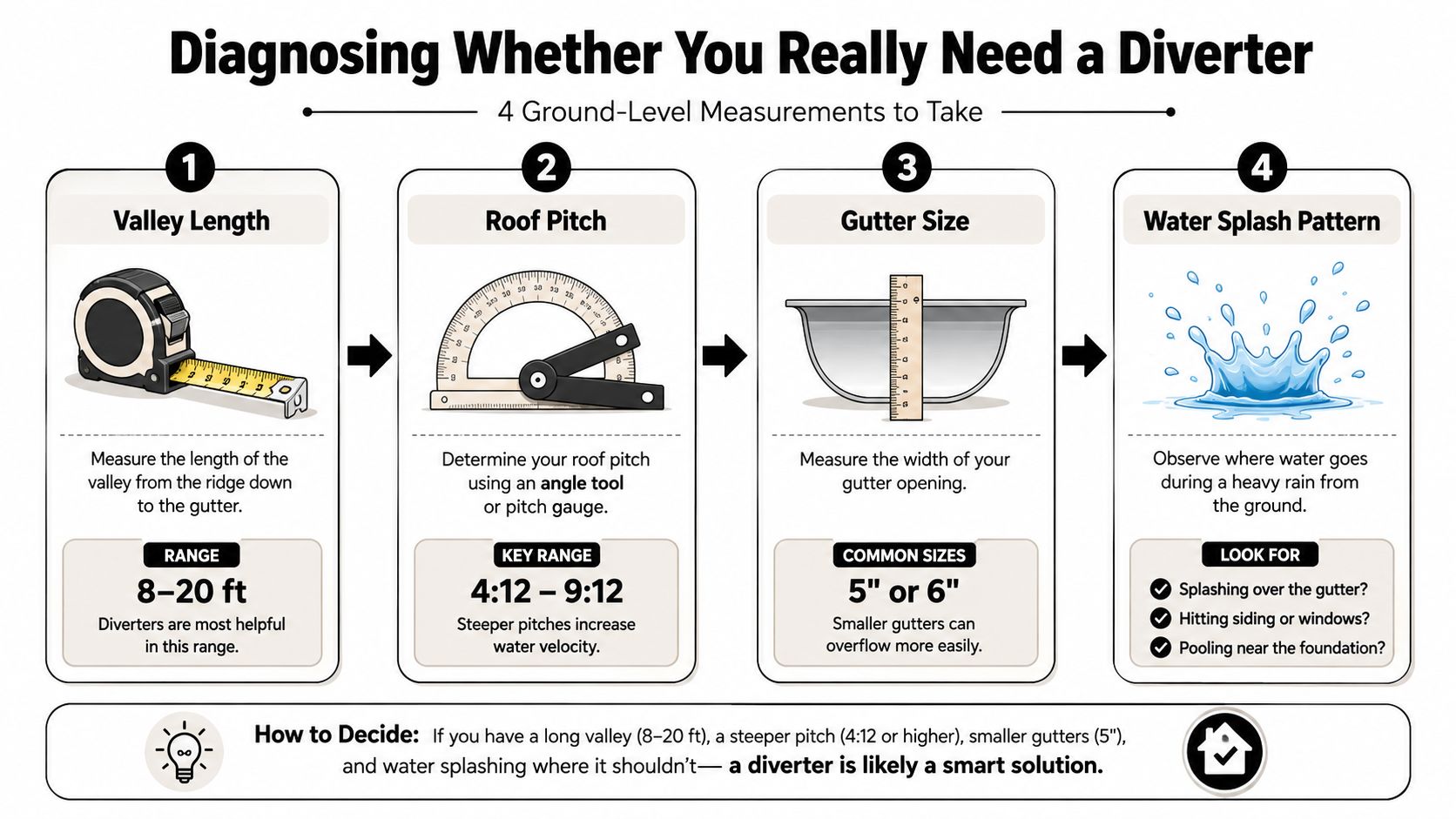
A valley that dumps onto a walkway, driveway, or wall line has a discharge-location problem. A kick-out detail, extended downspout, or redirected outlet may be more effective than a diverter installed higher on the roof.
Before choosing hardware: Watch where the water goes after it leaves the valley. The correct fix must end at a functioning gutter, downspout, or safe discharge area.
Debris-packed valleys need cleaning and possibly a valley guard before any diverter can perform consistently. Independent guidance also emphasizes that performance depends on valley length, pitch, gutter sizing, and debris load, and warns that a diverter can fail when the gutter below is undersized or packed with debris. That diagnosis is especially important in wet, tree-lined South Florida neighborhoods.
Installation Considerations for South Florida Roofs
A proper installation begins with the water path, not the fasteners. The diverter must integrate with the valley flashing and underlayment so water stays above the roof's drainage layers from the upper valley down to the gutter.
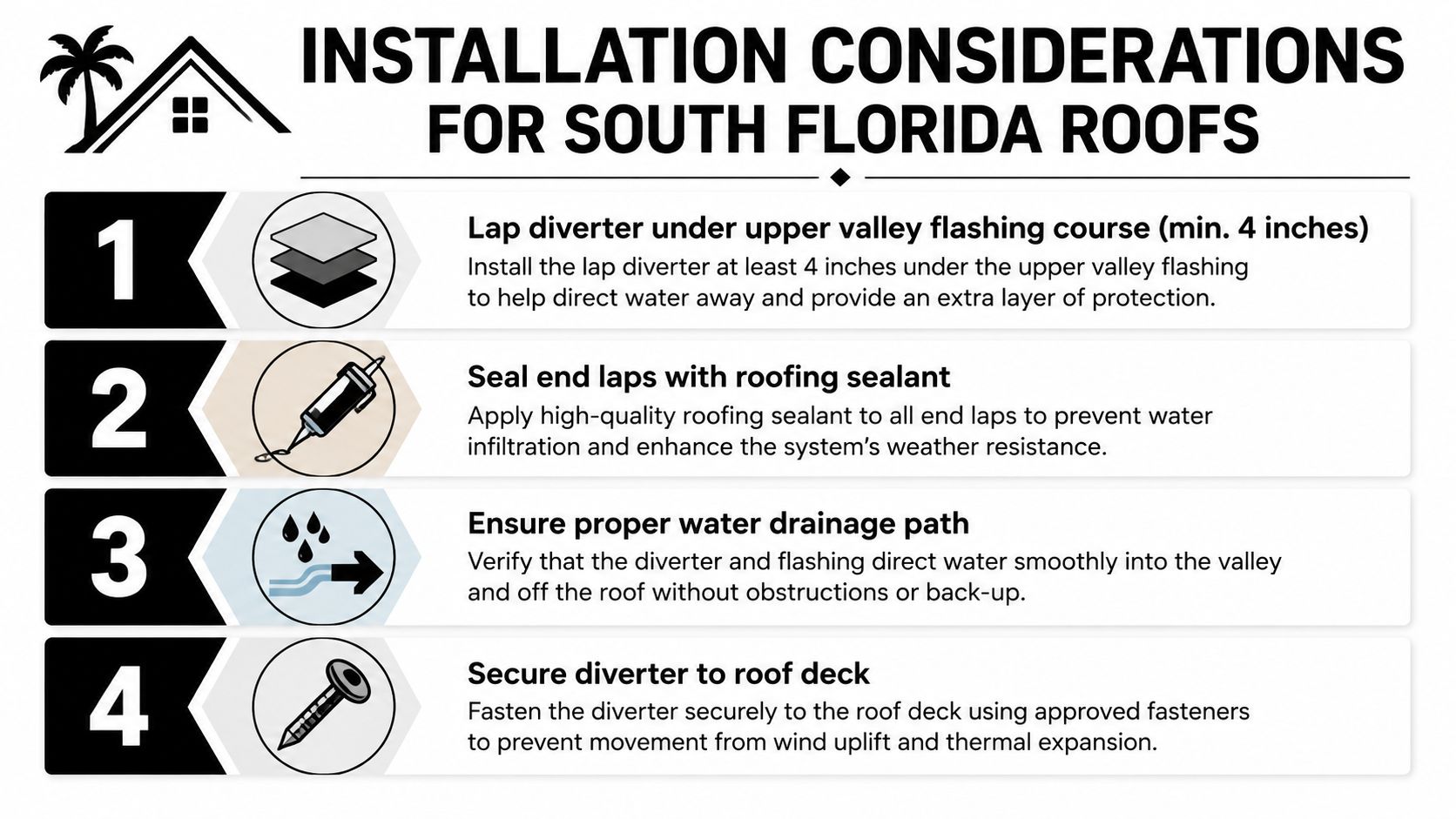
The upper course should overlap the lower component by at least 4 inches, and the end lap should be sealed with roofing cement compatible with the underlayment and flashing materials. The roof underlayment reference image helps illustrate why a diverter can't be laid over exposed edges without considering the layers beneath it.

Installation details that prevent callbacks
- Hide the fasteners: Place nails or screws where the next shingle, tile, or flashing course covers them. Exposed fasteners in the water path become leak points.
- Match the roof material: Galvanized steel or aluminum commonly suits asphalt-shingle valleys. Tile and standing-seam systems may require pre-finished metal or copper shaped to the existing profile.
- Keep the flow forward: The rib should direct water into the gutter. If it rises too high or leans toward the roof, the stream can travel behind the gutter backplate.
- Tie into edge details: The diverter must work with the drip edge, gutter apron, and any kick-out where the valley ends at a wall.
Older South Florida homes can complicate the work. Tile battens, hurricane straps, aged underlayment, brittle shingles, and previous repairs may limit where a roofer can lift, cut, or fasten. A diverter that looks secure from the ground may still interrupt the flashing sequence underneath.
Test the completed installation with controlled water before the next major storm, then inspect the outlet during rainfall. The goal isn't merely to keep water on the metal. The goal is to deliver it into the gutter without wetting the fascia or creating a reverse path behind the backplate.
Maintenance and Lifespan in a High-Volume Climate
A diverter in South Florida isn't a set-and-forget accessory. Heavy rain, salt air, heat, wind-driven debris, and repeated flow can expose weak seams or poor placement long before the homeowner notices an interior leak.
Inspect each valley at the start of June, again in September, and after any named storm. Those checks should include the metal surface, laps, fasteners, surrounding shingles or tiles, the gutter opening, and the downspout connection.
What deterioration looks like
Galvanized metal may show red rust or white oxidation. Aluminum can develop pitting, especially where debris stays wet against the surface. Copper may show green verdigris, but thinning, pinholes, or failed seams matter more than color alone. PVC deserves close attention for brittleness, cracks, and deformation caused by prolonged outdoor exposure.
Palm fronds, seed pods, and oak tassels can mat inside the valley and above the diverter rib. The resulting buildup acts like a small dam. Cleaning the trough above and below the rib often matters more than polishing or replacing sound metal.
| Material | Expected Lifespan | Primary Failure Mode |
|---|---|---|
| Galvanized steel | 8 to 12 years | Rust, coating loss, and corrosion at exposed edges or fasteners |
| Aluminum | 15 to 25 years | Pitting, bending, and corrosion where debris or incompatible metals remain in contact |
| Copper | 30-plus years | Thinning, failed seams, and installation-related movement or compatibility issues |
| PVC | 5 to 10 years | UV-related brittleness, cracking, and warping |
These lifespan bands are planning guides, not guarantees. Recent metal-roofing guidance places aluminum and galvanized diverters in a broader 10 to 20-year range, with copper lasting longer, while also identifying corrosion, debris buildup, and improper placement as recurring failure points in high-volume locations. The actual service life depends on exposure, fabrication, roof movement, cleaning, and whether the outlet remains clear.
An annual maintenance routine should include clearing debris, checking laps, looking for rust or pitting, confirming that the rib hasn't shifted, and observing the first heavy storm after inspection. A simple roof maintenance visual reference reinforces the value of keeping debris away from drainage details.

Warning Signs, Ballpark Costs, and When to Call Paletz
A clean shingle valley with a visible overshoot and no evidence of concealed damage may need only a straightforward service visit or a carefully selected metal splash rib. The decision changes when water has already reached the building envelope.
Look for soffit stains, peeling paint behind the gutter, mulch washout at the drip edge, and rust tracks on the valley flashing. These signs indicate that the water problem may involve fascia, underlayment, flashing laps, or the gutter attachment, not just the final direction of runoff.
Cost ranges by roof type
| Roof Type | DIY Material Cost | Professional Install Cost |
|---|---|---|
| Asphalt shingle | Roughly $20 to $60 for a metal splash rib | Roughly $150 to $350 for a roofer-installed diverter |
| Tile | Varies with formed metal and access | Roughly $400 to $900 for a custom copper or galvanized insert |
| Metal | Varies with compatible fabricated material | Roughly $400 to $900 for custom copper or galvanized work |
These are ballpark ranges for the specific diverter work described, not a promise for a complete roof repair. Access, existing damage, tile removal, flashing replacement, and gutter modifications can change the scope. A commercial roofing cost and repair reference also illustrates why the visible accessory isn't always the largest part of a roofing project.
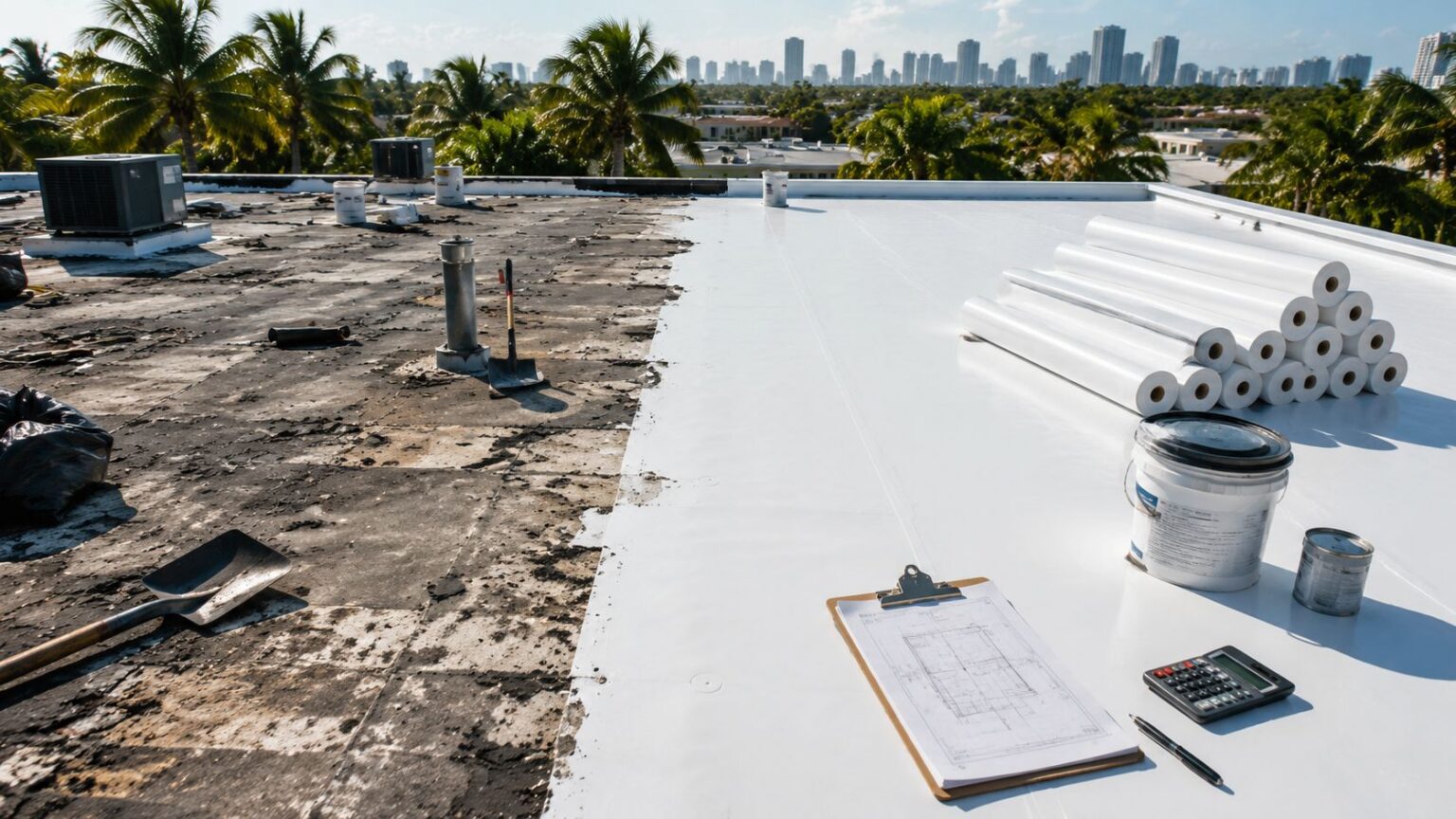
A homeowner may handle a simple, accessible metal splash rib when the roof is safe, the valley is sound, and the flow path is obvious. Roof work becomes a professional job when the repair requires lifting tile, opening an active flashing assembly, fabricating copper or galvanized metal, or tying into a wall and gutter system.
Interior ceiling stains after a valley-driven storm aren't a DIY moment. Paletz Roofing and Inspections can assess roof-to-wall flashing, gutter flow, downspout capacity, and recurring splash patterns before recommending a rain diverter or a broader repair.
Putting It All Together for Your Roof
Use this sequence before ordering hardware:
- Confirm the source. Watch the valley during rain and make sure the splash isn't coming from a gutter seam, loose end cap, or blocked downspout.
- Record the geometry. Measure the valley length, observe the pitch, and note whether the stream spreads sideways or leaves the roof with excessive speed.
- Check capacity. Look for undersized gutters, limited outlets, packed debris, and water backing up below the valley.
- Choose a compatible material. Match the diverter to the shingle, tile, or metal roof instead of forcing a generic piece into the flashing.
- Verify the outlet. The final flow must enter the gutter or reach a safe discharge point without going behind the gutter.
- Plan inspections. Check the valley at the start of June, again in September, after named storms, and whenever overflow returns.
A roof valley rain water diverter is a targeted South Florida upgrade. It works when the failure comes from concentrated flow direction, but it isn't a universal cure for blocked drainage, undersized gutters, damaged flashing, or a poor discharge location. If you see rust tracks, soffit damage, interior stains, or water behind the gutter, stop adding accessories and have the complete path inspected.
Paletz Roofing and Inspections can inspect the valley, flashing, gutter flow, downspout capacity, and recurring overflow before recommending a diverter or related repair. Visit Paletz Roofing and Inspections to request an inspection or discuss the right water-control solution for your South Florida roof.