
Seeing your roofline sagging after a hurricane hits North Miami Beach is more than just alarming—it's a structural emergency. The first thing you need to do, without a doubt, is get everyone safely out of the house. Once you're a safe distance away, start documenting the damage with your phone. Take pictures, and lots of them. Whatever you do, don't even think about going back inside or climbing on the roof until a professional gives the all-clear.
Your Immediate Game Plan for a Sagging Roof
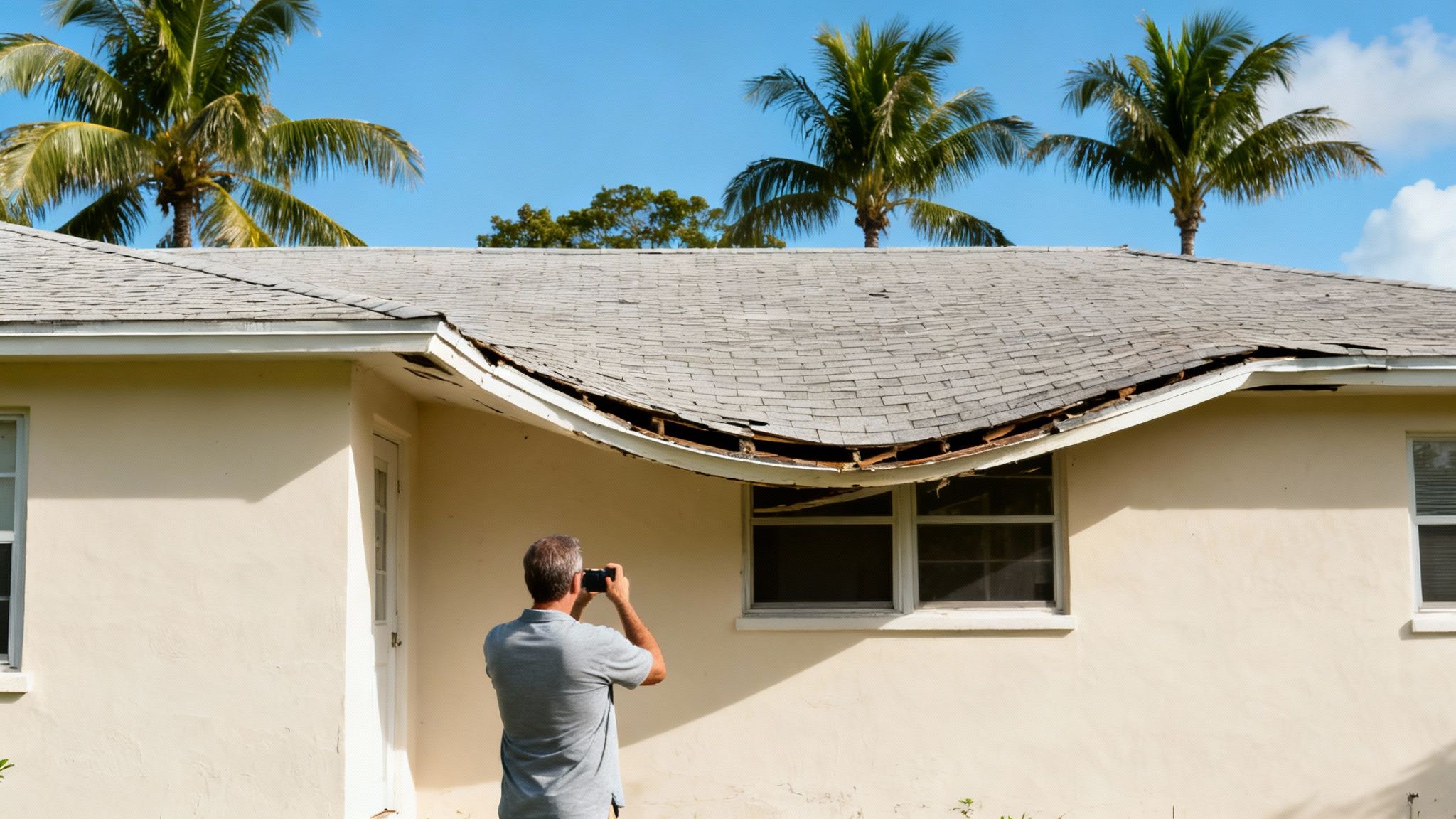
The aftermath of a storm is pure chaos, but having a clear plan helps you cut through the panic and take control. A sagging roof is one of the most serious signs of damage you can see. It screams that the very bones of your home are compromised. This isn't about a simple leak; it's about the real and present danger of a total collapse.
What you do in these first few moments is crucial for your safety and for getting your insurance claim approved down the line.
After a major storm, time is not on your side. Knowing the importance of a quick emergency response for storm damage helps you make the right moves to secure the situation without putting anyone else in harm's way.
Prioritize Safety Above All Else
Before you start snapping photos or making calls, your number one job is to get everyone—people and pets—out of that house. Seriously, don't go back in for anything. A sagging roof is already failing, and it can give way completely with no warning. The immense weight of waterlogged materials on a broken frame is a recipe for disaster.
Once you're all outside, create a safe zone well away from the house itself. Keep an eye out for other post-hurricane hazards like downed power lines, shattered glass, or unstable debris.
A sagging roof is a clear signal that the underlying framework—the trusses and rafters—has been compromised. This isn't a cosmetic issue; it's a structural failure in progress.
Document Damage from a Safe Distance
With everyone safely away from the structure, it's time to start building your case for the insurance company. This evidence is absolutely vital. Use your phone to take as many photos and videos as you can, capturing the scene from every possible angle around the property.
Make sure you get these shots:
- The Big Picture: Get wide shots of the whole house. You want to clearly show the sagging roof in context with the rest of the building.
- The Details: Zoom in on the lowest point of the sag. Capture any visible cracks you see in the exterior walls or eaves, plus any areas with missing or busted shingles.
- The Cause: If a huge tree limb or other large debris is lying on or near the roof, get plenty of pictures of that, too. It helps tell the story of what happened.
Living here, we know the history. Our area has been hit by 79 hurricanes since 1930, so this isn't our first rodeo. During Hurricane Irma, for example, more than 1,585 homes in the county had roof damage from those vicious winds. That kind of force can easily compromise a roof's structure, leading directly to the kind of sagging you’re seeing now. Taking detailed notes and photos right away creates an undeniable record of the immediate aftermath.
For homeowners, navigating this situation can feel overwhelming. Here’s a quick-reference checklist to guide your immediate actions.
Immediate Action Checklist for a Sagging Roof
| Action Item | Why It's Critical | Pro Tip |
|---|---|---|
| Evacuate Immediately | Personal safety is non-negotiable. A collapsing roof can happen in an instant. | Designate a safe meeting spot for your family away from the home and any downed power lines. |
| Call 911 (If Necessary) | If there are immediate dangers like fire, gas leaks, or trapped individuals, call for help first. | Describe the sagging roof to the dispatcher; they may send specialized response units. |
| Document from a Distance | Photographic evidence is crucial for your insurance claim to show the extent of the damage. | Take a video walking around the perimeter of your property, narrating what you see. |
| Notify Your Insurer | The sooner you start the claims process, the sooner you can begin recovery. | Have your policy number ready. Ask them for approved emergency service providers. |
| Contact a Pro Roofer | You need a structural assessment from an expert before anyone can safely re-enter the property. | Look for a licensed and insured local roofer with specific experience in storm damage. |
Following this checklist helps bring order to a chaotic situation, ensuring you take the right steps to protect both your family and your property investment.
How to Safely Inspect Hurricane Roof Damage
After a hurricane blows through, the urge to get outside and see what happened to your North Miami Beach home is strong. But when you see a sagging roofline, your first priority has to be safety. That dip is a tell-tale sign of structural failure, and getting up on a compromised roof is a risk you just can't take.
The good news? You can gather almost everything you need from the safety of the ground and, if possible, from inside your home. This initial check isn't about fixing anything yourself. It's all about documentation—getting the proof you need for your roofer and your insurance adjuster. A smooth recovery process starts with solid evidence.
This graphic breaks down the first critical actions: stay safe, document everything, then call in the pros.
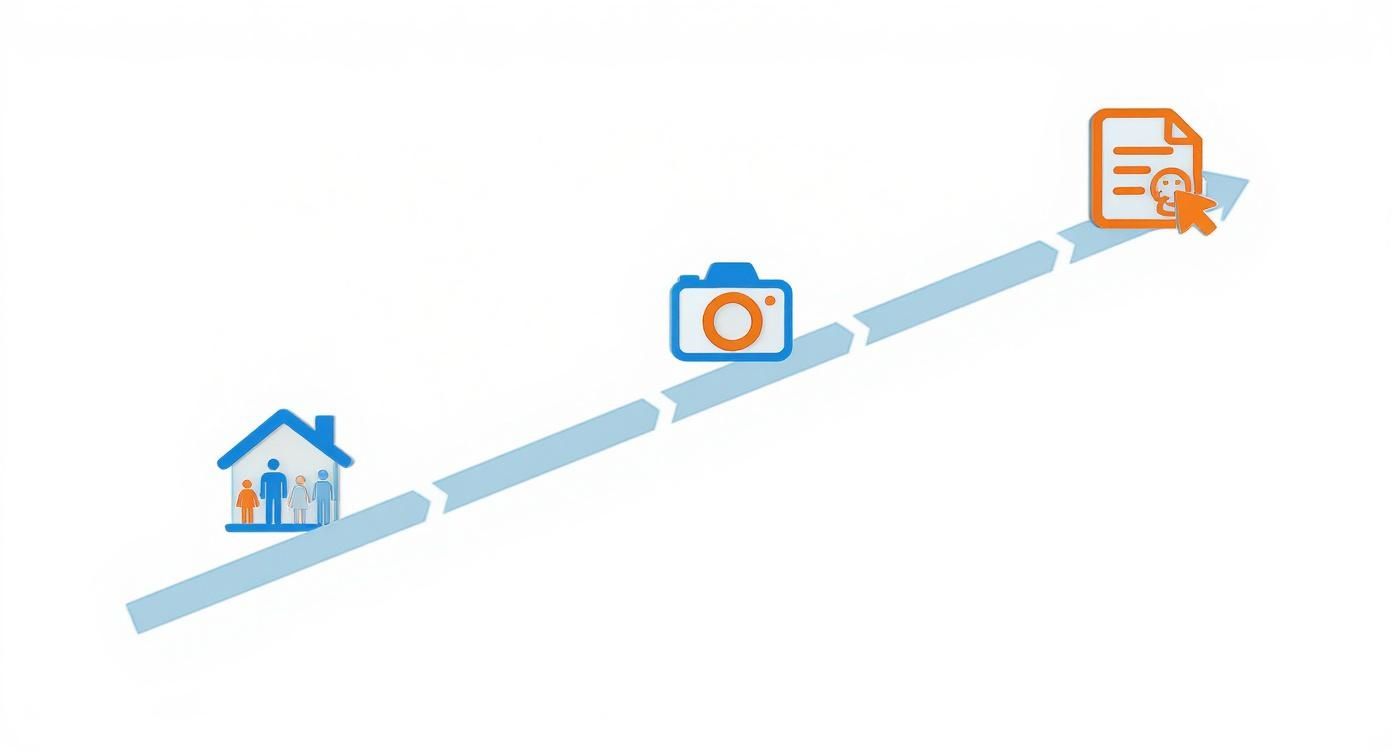
Following this order is non-negotiable. It keeps you out of harm's way while ensuring you have a clear record of the damage.
Your Ground-Level Walkaround
Start your inspection outside, but keep a safe distance from the house. A failing roof can easily make walls or even the chimney unstable. Grab a pair of binoculars; they're your best friend for getting a close-up look without taking any chances.
From the ground, you're looking for a few specific things that scream "sagging roofline" after a hurricane here in North Miami Beach:
- A visible dip or curve: The main ridgeline of your roof should be perfectly straight. Any kind of bow, sway, or dip is a massive red flag.
- Odd shadows and lines: Look at the surface of the roof. If you see new or unusual shadows, it could be a depression where the underlying trusses or rafters have given way.
- Cracks in the exterior walls: Pay close attention to the walls directly below the sagging section. New cracks in the stucco or siding are a bad sign, showing that structural stress is traveling down the frame of your home.
While you're safely checking out the roof and your property, make sure you take a detailed photo inventory for insurance claims. Get pictures of all the damage you can see, both to the structure and any personal property.
The Attic Inspection: What to Look For
If you're confident it's safe to go inside, your attic is where you'll find the smoking gun. But if you hear any cracking or popping sounds, do not go in. If it's quiet, take a powerful flashlight and be extremely careful where you put your feet—step only on the solid joists.
A cracked rafter often looks like a splintered two-by-four that's about to snap under intense pressure. You might even hear a low creak as the structure continues to settle. If you see or hear that, get out immediately.
Once you're in the attic, scan the area for these undeniable signs of failure:
- Cracked or broken rafters: Shine your light along all the wooden framing. Look for any beams that are split, cracked, or completely broken in two.
- Daylight peeking through: Any sliver of sunlight you can see coming through the roof deck is a hole. That's where water is pouring in.
- Wet or compressed insulation: Check for dark, damp patches in the insulation. If it looks matted-down and compressed, it means it's soaked and has lost all its insulating power, pointing to a serious leak. We have a visual guide that shows more about what a damaged roof from the inside can look like.

Why North Miami Beach Roofs Sag After Storms
A sagging roofline is more than just an ugly dip in your home's profile; it's a huge red flag signaling a serious structural failure. After a hurricane blasts through North Miami Beach, the forces acting on your home are incredible. Knowing why your roof is starting to bow helps you have a much smarter, more confident conversation with roofing pros about what needs to be done.
The damage really comes from two directions: the brute force of the wind and the crushing weight of the rain. They work together, creating a perfect storm of destruction that goes straight for your roof's weakest points.
The Double Threat of Wind and Water
Hurricane winds don't just shove your roof around. They create an aerodynamic lift, almost like an airplane wing, that tries to suck the shingles right off. More importantly, this upward pressure works to pull the entire roof deck away from the rafters and trusses holding it up. Every single gust weakens those vital connections.
At the same time, all that torrential rain is looking for any tiny opening the wind has created. Water pours in, soaking the wooden skeleton of your roof and adding thousands of pounds of weight it was never designed to hold. It's this one-two punch of upward pulling and downward pressure that often causes a key structural support to crack or give way, leading to that tell-tale sag.
When we see a sagging roof, it's almost always one of these culprits:
- Broken Rafters or Trusses: Think of these as the bones of your roof. When one of them snaps under the immense strain, that section loses all its support and starts to dip.
- Saturated Roof Sheathing: The plywood or OSB decking under the shingles gets completely waterlogged. It loses all its stiffness and begins to bow down between the rafters.
- Failed Connection Points: The metal plates and connectors that hold the trusses together can rust out or get physically ripped apart by the wind's lifting forces.
North Miami Beach's Unique Challenge: Floodwater
For homeowners here, the danger isn't just coming from the sky. A sagging roofline after a hurricane in North Miami Beach is frequently made worse by our area's high flood risk. Storm surge and massive rainfall can saturate the ground, which can compromise the very foundation of your house.
This ground-level moisture then gets wicked up into your home’s structure. It's a huge problem, especially when you consider that climate data shows about 99% of buildings in North Miami Beach are at risk of flooding.
When that steady moisture from below meets the water coming in from the damaged roof above, it puts the decay of wooden supports into overdrive. This leads to rot and corrosion that weakens the entire frame of the house over time. You can explore more about local climate risks to see just how this affects properties in our community.
A roof is only as strong as its support system. When that system is getting attacked by wind-driven rain from above and flood-related moisture from below, the risk of a sag—or a complete collapse—goes up exponentially.
By understanding how these forces team up against your home, you can see why this is such an urgent problem. The sag you're seeing is proof that your home has lost a major structural battle. The next move is to get an expert in to figure out the extent of the damage and build a plan to make it safe again.
Securing Your Home with Temporary Fixes
After the storm passes, a sagging roofline is a clear sign the danger isn't over yet. While you're waiting for professional roofers to arrive, your top priority needs to be damage control. These temporary fixes aren't about actually repairing the structure—that’s a job strictly for the experts—but about preventing a bad situation from turning into a catastrophic interior disaster.
The goal here is simple: buy yourself some valuable time and protect your home from further harm, like pervasive water damage and the rapid onset of mold.
Protecting Your Home's Interior
First things first, focus on what you can control inside your home. Get any furniture, electronics, and irreplaceable items like family photos out from under the compromised area. Water is relentless and will always find a path, and the ceiling directly below that sag is ground zero for leaks.
Next, you'll want to set up a containment system for any active drips. Strategically place buckets, bins, or even large trash cans to catch incoming water. If the dripping is widespread, you can get a little creative and use plastic sheeting to create a channel, directing the water into a single, larger container.
Remember, a five-gallon bucket can fill up surprisingly fast during a classic South Florida downpour. Keep a close eye on your collection points, especially if more rain is in the forecast, to avoid overflow and the headache of secondary water damage.
The Right Way to Tarp a Damaged Roof
An emergency roof tarp is your best temporary shield against the elements. But be warned, applying one incorrectly can do more harm than good by trapping moisture or getting ripped away by the next gust of wind, causing even more damage. Safety is everything; if you have any doubt at all about getting on your roof safely—don’t. Just wait for a professional.
If you feel confident you can proceed safely, stick to these guidelines:
- Choose the Right Material: You need a heavy-duty, waterproof tarp that's at least 10 mil thick. Those thin blue tarps you see at hardware stores will shred almost instantly in the wind.
- Secure It Properly: Use 2×4 wooden planks or furring strips to anchor the edges. Nailing the tarp directly to the roof is a rookie mistake; it creates holes and gives the wind a perfect place to start ripping it loose. Instead, wrap the edge of the tarp around the wood, and then nail the wood through the tarp into the roof decking.
- Extend Past the Damage: Your tarp needs to cover the damaged area completely. Make sure it extends at least four feet past the sag on all sides. This overlap is critical for creating a proper seal against wind-driven rain.
Getting this temporary measure right is crucial. A properly secured tarp can easily prevent thousands of dollars in interior repairs. You can see some examples of how professionals handle securing damaged roofs in our area to get a better sense of the proper technique.

Finding a Trustworthy Roofer in South Florida
After a hurricane blows through, the demand for roof repairs goes through the roof—and unfortunately, so do the scams. Opportunists, often called "storm chasers," will flood areas like North Miami Beach, going door-to-door with high-pressure tactics and promises of a quick fix. Choosing the right contractor is the single most important decision you'll make, and rushing it can lead to shoddy work, voided warranties, and a whole lot of headaches.
Your mission is to find a licensed, insured, and reputable local roofer with a permanent address right here in South Florida. These are the pros who will still be around to stand by their work long after the storm cleanup crews have packed up and moved on.
Vetting Potential Roofing Contractors
First things first, create a shortlist of at least three local roofing companies. The best place to start is by asking neighbors or friends for recommendations—nothing beats a firsthand positive experience. A quick online search for roofers specializing in hurricane damage in Miami-Dade County will also give you a solid starting point.
Once you have your list, it's time to do some homework. A thorough, systematic vetting process is your best defense.
- Verify Licensing and Insurance: This is non-negotiable. Ask for a copy of their Florida state contractor's license and proof of both general liability and workers' compensation insurance. You can easily verify a license directly with the Florida Department of Business and Professional Regulation.
- Check Their Local Experience: How long have they actually been in business in South Florida? A company with deep roots in the community has a reputation to protect. More importantly, they understand our specific building codes and the unique challenges of our hurricane-prone climate.
- Ask for References: Any confident, reputable roofer will be happy to provide contact information for recent clients who had similar repairs done. Make the calls. Ask about their experience.
Be wary of anyone demanding a large upfront payment or the entire insurance check before work even begins. This is a classic storm chaser move. A legitimate local contractor will typically require a reasonable deposit, with the final balance due only when the job is completed to your satisfaction.
Spotting Red Flags and Scams
Knowing the warning signs can save you from predatory practices. The chaos after a storm is fertile ground for scammers who exploit the confusion. Be skeptical of anyone who uses aggressive sales tactics or offers a deal that seems too good to be true—because it almost always is.
To put it in perspective, the sheer volume of damage can be overwhelming. After one recent hailstorm, a staggering 48,387 homes across the greater Miami region suffered major roof damage. This ranged from granule loss on shingles to shifted tiles that can easily lead to a sagging roofline after a hurricane in North Miami Beach. This incredible demand strains local roofers and creates the perfect opening for unqualified opportunists to swoop in. You can read more about the impact of severe local storms on reimagineroofing.com.
To help you tell the good guys from the bad, here’s a quick comparison of what to look for versus what to run from.
Reputable Roofer vs. Storm Chaser
| Characteristic | Reputable Local Roofer | Potential Storm Chaser |
|---|---|---|
| Physical Address | Has a permanent, verifiable local office and showroom. | Uses a P.O. Box or has no local address. |
| Licensing & Insurance | Readily provides proof of Florida license and full insurance. | Vague about credentials; may have out-of-state license. |
| Vehicle | Drives a company-branded truck with a local license plate. | Often has an unmarked vehicle or out-of-state plates. |
| Sales Approach | Offers a detailed inspection and a written, itemized estimate. | Uses high-pressure sales tactics; demands an on-the-spot decision. |
| Payment Terms | Asks for a reasonable deposit with the balance due on completion. | Demands a large cash deposit or your entire insurance check upfront. |
| Contract | Provides a detailed contract outlining scope, materials, and timeline. | Offers a vague, confusing, or incomplete agreement. |
| Community Ties | Has a long-standing reputation and positive local reviews. | Shows up only after a storm and has no local history. |
Ultimately, a detailed, written estimate is your best defense. It should clearly break down all costs for labor, materials, and permits, and include a realistic timeline for completion. Compare the estimates you get, but don't just jump at the lowest price. Focus on the overall value, the quality of materials proposed, and the contractor's reputation.
At Paletz Roofing, we believe in complete transparency. That’s why our professional inspection process is designed to give you a clear, honest assessment from the very beginning. Taking these careful steps ensures you partner with a true professional who will restore your home’s safety and integrity.

Got Questions About Your Sagging Roof? We've Got Answers.
When you're looking up at a sagging roof after a hurricane has torn through North Miami Beach, your mind starts racing. It’s an incredibly stressful situation, and the uncertainty can feel just as overwhelming as the storm itself. Let’s cut through the noise and get you some clear, straightforward answers to the most pressing questions homeowners like you are asking.
Will My Insurance Actually Cover a Sagging Roof?
More often than not, yes. Standard homeowner's insurance policies are designed to cover damage from wind and storms—exactly what causes a roof to sag after a hurricane. The critical part is proving that the damage is a direct result of that specific storm.
This is precisely why you need to document everything, immediately. Grab your phone and take photos and videos from the ground. Get shots of the sag itself, any broken rafters you can see, and related damage. This becomes undeniable evidence for your claim. Your coverage should handle the costs for both the structural repairs and any water damage that has seeped into your home as a result.
How Long is This Going to Take to Fix?
Honestly, the timeline can vary quite a bit. Several factors come into play here, and it's rarely a quick fix.
- The Roofer Rush: After a major storm, every reputable local roofer is slammed. Just getting on their schedule can take time.
- Permitting Purgatory: Structural work always requires permits from the city of North Miami Beach. Depending on how backed up they are, this alone can add a few weeks to the process.
- Material Scarcity: Widespread damage means everyone is trying to buy the same materials, like trusses and shingles. This can lead to supply chain delays.
- The Damage Itself: Repairing a couple of cracked rafters is a much quicker job than a full-scale rebuild of your roof's underlying structure.
Realistically, you could be looking at anywhere from a few weeks to several months for complex structural repairs, from the first inspection to the final sign-off.
Don't let any contractor talk you into skipping the permitting process to "speed things up." An unpermitted structural repair will create a massive headache when you eventually sell your home and could even void your insurance coverage for any future problems.
Is It Safe to Stay in My House?
Absolutely not. A sagging roof isn't just a cosmetic issue; it's a sign of a critical structural failure. That roof is incredibly heavy, especially when it's waterlogged from storm rain. Staying inside puts you and your family at severe risk of a sudden, catastrophic collapse.
You need to evacuate immediately. Do not go back inside until a certified structural engineer or a qualified roofing contractor has thoroughly inspected the property and given the official all-clear.
Check your insurance policy for a clause called Additional Living Expenses (ALE). This coverage is designed for exactly this kind of emergency, helping to pay for temporary housing like a hotel or a rental while your home is unsafe. Call your insurance agent right away and ask about it.
When you're dealing with a sagging roofline after a hurricane in North Miami Beach, you need a team you can trust to restore your home's safety and integrity. Contact Paletz Roofing and Inspections for an urgent, professional assessment. Visit us at https://paletzroofing.com to schedule your inspection today.