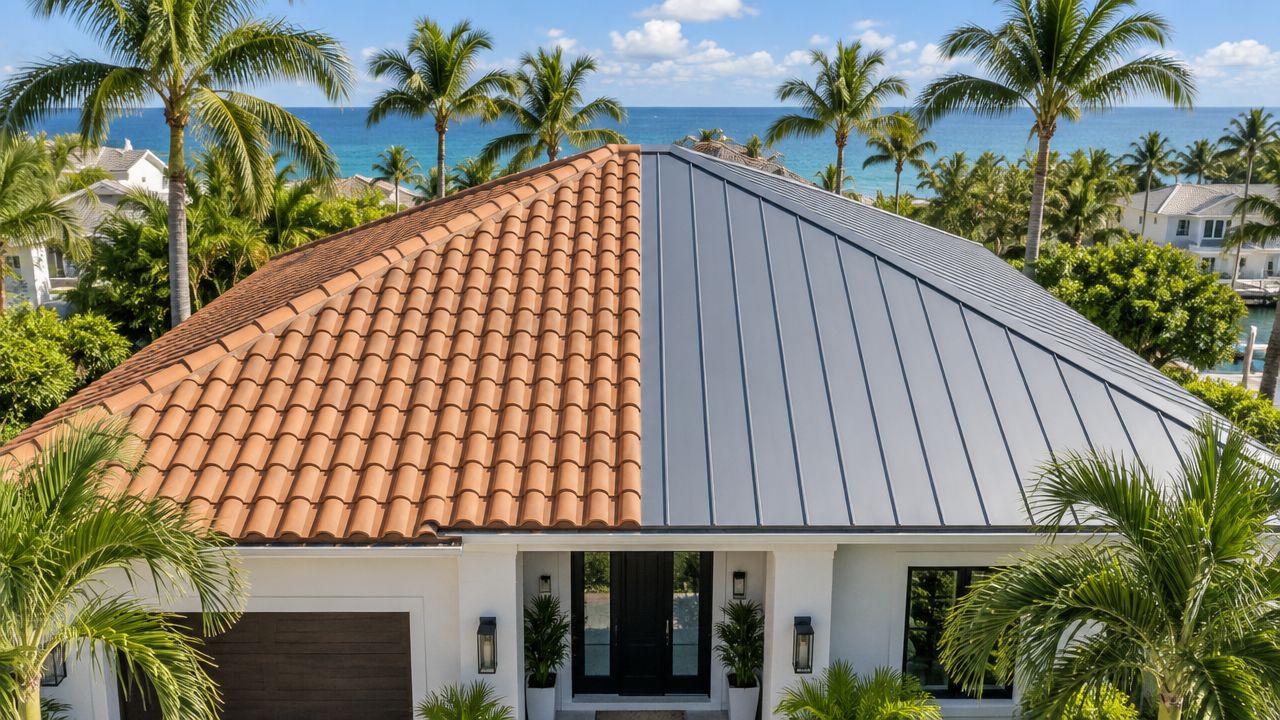
You're looking at a roof that has done its job for years, but the next decision isn't as simple as replacing tile with tile or choosing the metal roof your neighbor just installed. In Miami-Dade, Broward, and Palm Beach County, the roof has to handle salt air, intense ultraviolet exposure, humidity, heavy rain, and hurricane-force uplift. The covering you see is only one part of that assembly.
A useful tile roof vs metal roof comparison starts underneath the surface. Underlayment, fasteners, flashing, roof-deck attachment, framing, and approved installation details often determine whether a roof performs well. The right choice depends on the house, the location, and the exact Florida Product Approval or Miami-Dade Notice of Acceptance assembly, not on a generic national chart.
Table of Contents
- Understanding the Choice in South Florida
- Lifespan and the Underlayment Factor
- Weight, Framing, and Installation Realities
- Hurricane and Wind Performance
- Cost Comparison and Long-Term Value
- Best Matches for Different South Florida Properties
- Making the Final Call for Your Roof
Understanding the Choice in South Florida
A homeowner in Broward faces a different roofing conversation from someone replacing a roof in an inland market. Miami-Dade and Broward fall within Florida's High-Velocity Hurricane Zone, while Palm Beach properties can also face severe coastal exposure, salt, and demanding wind conditions. A roof that performs acceptably in a dry inland climate may not be the right system beside the Atlantic.
Start with the property, not the color brochure. Identify the distance from the coast, the roof shape, the existing deck, the framing type, and whether the address falls under HVHZ requirements. Then ask the contractor to identify the exact approved assembly, including the product approval or Miami-Dade NOA, the fastening schedule, the underlayment, and the edge details.
The surface is only one layer
Tile protects the weather-exposed surface, but the waterproofing beneath it carries much of the roof's water-management responsibility. Metal panels also rely on underlayment, flashings, clips, seams, and perimeter attachment. A strong panel or durable tile can't compensate for weak ridge, valley, eave, or penetration details.
South Florida humidity encourages algae and mildew on areas that stay damp. Heat causes repeated expansion and contraction, which places stress on fasteners, seams, sealants, and flashing transitions. Salt air adds another concern for exposed metal components, especially when the wrong coating, incompatible fastener, or poor detailing is used.
Practical rule: A quote that names only “tile” or “metal” doesn't describe a complete roof system.
Insurance carriers also examine roof age, maintenance, wind-mitigation features, and documentation. The material can influence the conversation, but the carrier usually needs evidence of the installed system and its condition. That's why a current inspection and clear approval documentation matter when you're buying, selling, insuring, or replacing a roof.
The most reliable comparison asks five questions:
- Can the structure support the system? Tile adds a substantial permanent load.
- Which approved assembly fits the address? HVHZ requirements can narrow the available options.
- How will the roof handle coastal exposure? Coatings, fasteners, and maintenance all matter.
- What happens when the underlayment needs service? The visible covering may still look usable.
- What is the ownership horizon? A short holding period creates different priorities from a long-term home.
Lifespan and the Underlayment Factor
Tile often wins the headline lifespan comparison. Clay and concrete tile roofs typically last 50 to 100 years, while standing-seam metal roofs commonly last 40 to 70 years, according to this roof lifespan comparison by material. That difference is real, but it describes the exposed covering more clearly than it describes the complete waterproofing system.
The hidden issue is the underlayment. Industry sources commonly place tile underlayment life at about 20 to 40 years, and the underlayment can fail long before the tile itself. South Florida heat, humidity, storm exposure, and persistent moisture can make the timing less predictable than a national lifespan figure suggests.
Compare the whole assembly
| System Component | Tile Roof | Metal Roof |
|---|---|---|
| Visible covering | Clay and concrete tile typically last 50 to 100 years | Standing-seam metal commonly lasts 40 to 70 years |
| Waterproofing layer | Underlayment may need service while tiles remain usable | Underlayment still matters, but the assembly is often evaluated more integrally |
| Typical hidden concern | Removing and relaying tile to reach the underlayment | Corrosion, fastener, seam, and flashing condition |
| Long-term planning | Budget for underlayment work before the tile wears out | Plan inspections and component maintenance over the panel life |
A tile reroof can therefore become a two-part ownership decision. The tile may remain sound, but the contractor may still need to remove it, expose the deck, replace the underlayment, repair damaged wood, and reinstall or replace pieces. Some tiles break during handling, and walking on a tile roof requires care because the surface isn't designed for casual foot traffic.
Standing-seam metal generally has fewer hidden replacement layers than a tile system. That doesn't make it maintenance-free. Coatings, seams, penetrations, clips, closures, and perimeter fasteners still require inspection, particularly near the coast. The practical advantage is that the roof is usually treated as a more integrated assembly rather than a long-lived surface sitting over a shorter-lived waterproofing layer.
What the lifespan numbers don't tell you
A material comparison from roofing materials compared by service life places galvanized steel metal around 30 to 50 years, copper or zinc around 60 to 80 years, concrete tile around 50 to 80 years, and fired clay around 80 to 100 years. Those ranges show why material type, coating, installation quality, exposure, and maintenance matter.
Don't promise yourself a century of trouble-free ownership because the tile itself may last that long. Ask instead when the underlayment, flashing, and deck details are likely to require access, and whether the installation makes that work practical.
Weight, Framing, and Installation Realities
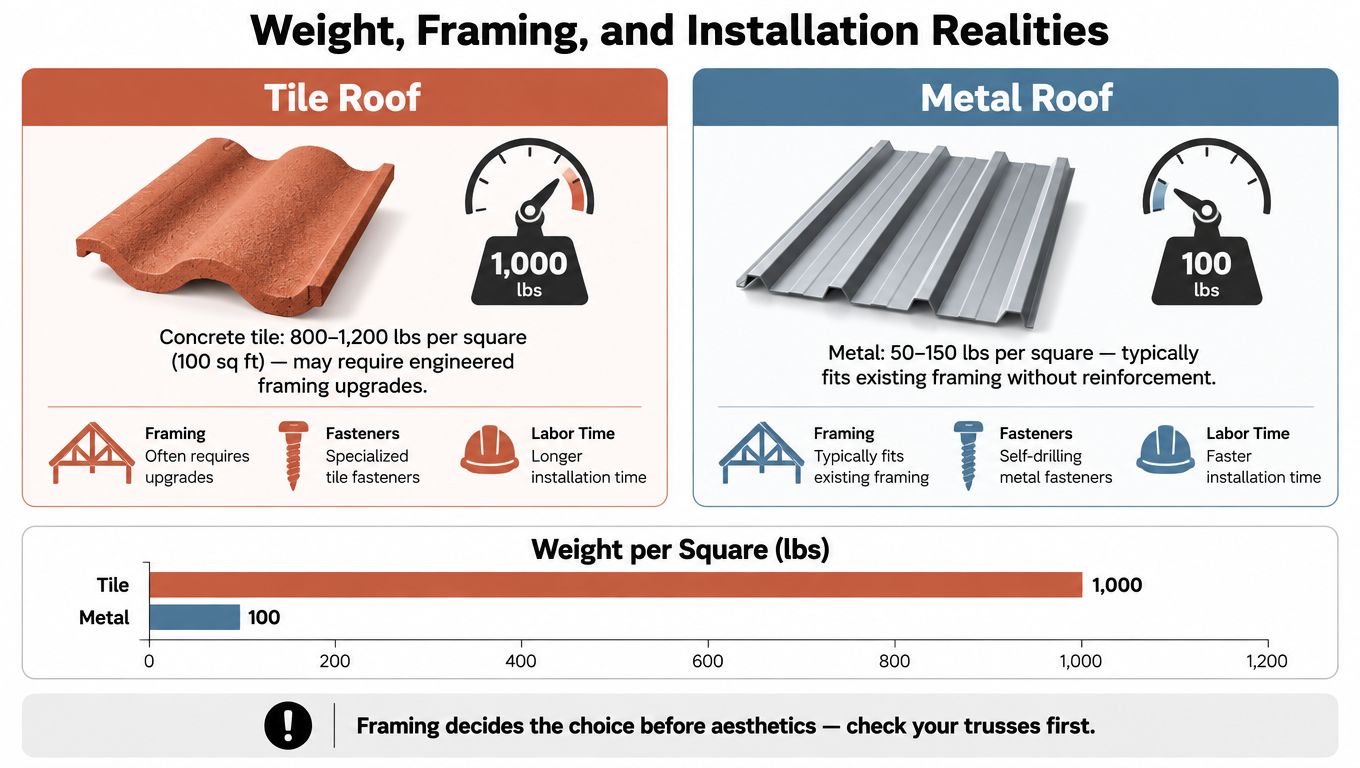
Weight often decides the tile roof vs metal roof question before appearance enters the discussion. Metal roofing commonly weighs about 50 to 150 pounds per roofing square, while concrete or clay tile can weigh about 800 to 1,500 pounds per square, according to this comparison of metal and tile roof weight. One roofing square equals 100 square feet.
That gap changes the engineering. An older Broward home that originally carried shingles or a built-up roof may not have framing designed for a tile load. A contractor may need an engineer to review the trusses, rafters, connections, and deck before anyone orders tile.
Framing comes first
A separate industry comparison reports concrete tile at about 600 to 900 pounds per square, clay tile at about 800 to 1,100 pounds, and standing-seam metal at about 50 to 150 pounds per square. The ranges vary by product, but the engineering conclusion doesn't change. Tile usually demands more structural capacity than metal. See the tile and metal framing comparison for another presentation of that difference.
A structural review can lead to added rafters, upgraded connections, or other reinforcement. It can also confirm that the existing structure is adequate, which is the result homeowners hope for. Skipping that review creates a problem that may surface during permitting, inspection, or installation.
Installation changes the project experience
Tile installation involves individual pieces, careful staging, approved attachment methods, and controlled foot traffic. Workers may use mortar or foam systems where approved, and they must protect the tiles while completing valleys, hips, ridges, and penetrations. That work is slower and more sensitive to breakage than placing large metal panels.
Standing-seam metal installs in larger sections and uses mechanical seaming or concealed clips, depending on the approved product. Panel alignment, clip placement, seam engagement, and flashing still require precision, but the crew isn't handling hundreds of individual tiles across the roof.
Those differences affect labor, site disruption, material staging, and schedule. A tile project can require more deck access and more care around occupied areas. Metal can reduce handling time, but it isn't automatically quiet or simple. Cutting, fastening, seaming, and moving long panels create their own disruption, so homeowners should ask how the crew will protect landscaping, vehicles, windows, and interior spaces.
Hurricane and Wind Performance
There's no honest universal winner in hurricane performance. The approved assembly and its installation details matter more than the label on the material. Both metal and clay or concrete tile can achieve Class A fire ratings when installed as tested assemblies, as explained in this roofing material fire-resistance comparison. Wind performance follows the same system-level principle.
One Florida-oriented comparison lists standing-seam metal at about 140 to 170-plus mph wind resistance, while concrete and clay tile are shown at roughly 120 to 150 mph in that source. A separate comparison lists tile systems reaching 150 to 180 mph in certain tested configurations. Review the Florida metal and tile wind comparison, and remember that those figures don't apply to every product or installation.
Attachment controls the result
Tile systems can use direct-deck fastening, battens, screws, or approved foam-set methods. The number and placement of fasteners, the type of adhesive, the condition of the deck, and the details at hips, ridges, eaves, and rakes all influence uplift resistance. Tile can perform very well when the complete system has been tested and installed exactly as approved.
Metal systems also vary sharply. A standing-seam roof uses concealed clips and mechanically connected seams, while a five-inch-rib exposed-fastener panel depends on visible screws, washers, laps, and the condition of the substrate. Clip spacing, panel width, seam design, screw placement, and perimeter reinforcement affect how the roof responds to repeated wind loading.
Read the approval, not the sales sheet
For Miami-Dade and Broward projects, request the current Miami-Dade NOA or Florida Product Approval for the exact roof assembly. Check the approved substrate, fastener pattern, underlayment, edge condition, and design pressures. A metal panel installed under a weaker or mismatched detail can underperform a properly attached tile assembly, just as an incorrectly fastened tile system can fail despite the tile's weight.
| Performance Factor | Tile Roof | Metal Roof |
|---|---|---|
| Wind resistance | Varies substantially by tile profile and attachment method | Varies by panel profile, clip spacing, seams, and perimeter fastening |
| Debris exposure | Individual pieces can crack or dislodge after impact | Panels can resist impact, but dents or punctures remain possible |
| Uplift behavior | Weight helps, but approved fastening and adhesive details control performance | Concealed clips and seaming can create a strong assembly when correctly engineered |
| Inspection focus | Tile attachment, underlayment, hips, ridges, and broken pieces | Clips, seams, fasteners, coatings, flashings, and penetrations |
| Best documentation | Exact tile assembly and approved installation method | Exact panel, clip, seam, and fastening approval |
Don't choose based on a generic wind number. Choose the assembly that your licensed contractor can document, permit, and install for the actual property.
Cost Comparison and Long-Term Value
The cheapest roof bid is often the least complete one. A South Florida proposal should separate the covering, tear-off, deck repairs, underlayment, flashings, ventilation, structural work, permits, inspections, and cleanup. If those items appear as vague allowances, you can't make a meaningful tile roof vs metal roof comparison.
Tile commonly carries a heavier installation burden because of its material weight, individual-piece handling, and potential framing work. Metal can reduce structural demands, but a high-quality standing-seam system, coastal-grade coating, approved clips, and detailed flashings still require skilled labor.
Compare line items, not slogans
| Cost Factor | Tile Roof | Metal Roof |
|---|---|---|
| Covering and labor | Often higher because of weight, handling, and installation detail | Often lower structural burden, though premium systems can be labor-intensive |
| Structural review | More likely to require engineering or reinforcement | Often less structural modification, subject to verification |
| Underlayment service | Hidden lifecycle expense because tile can outlast the waterproofing layer | Still requires attention, with access often more integrated into the assembly |
| Fastener maintenance | Tile attachment and replacement pieces need inspection | Exposed-fastener systems need closer attention to screw and washer condition |
| Deck repairs | May become extensive when tile is removed for underlayment work | Deck access remains important during reroofing and repairs |
| Permits and inspections | Required project costs in local jurisdictions | Required project costs in local jurisdictions |
| Insurance documentation | Wind mitigation, roof age, assembly, and condition matter | The same documentation matters, along with the specific metal system |
Before signing, use practical estimating guidance such as PropLab's roofing cost tips to check whether the proposal identifies the work that commonly gets omitted. You can also review this roof repair cost comparison image as a reminder to compare scope, not just the final total.

Insurance requires documentation
Citizens and private carriers can evaluate roof age, hip geometry, wind-mitigation features, impact-resistant certifications, secondary water barriers, and whether the roof has been updated to current code. Treatment varies by carrier and policy, so don't assume a material automatically produces a lower premium.
Ask your contractor which inspection reports, product approvals, and mitigation forms they'll provide. A roof that performs well but lacks usable documentation can be harder to underwrite than a comparable roof with a clear installation record.
Long-term value also depends on how long you'll own the property. Tile may suit an owner prioritizing architectural character and long surface life, while metal may suit someone who wants lower structural load and a more integrated replacement strategy. Neither choice eliminates maintenance, permitting, or storm inspection costs.
Best Matches for Different South Florida Properties
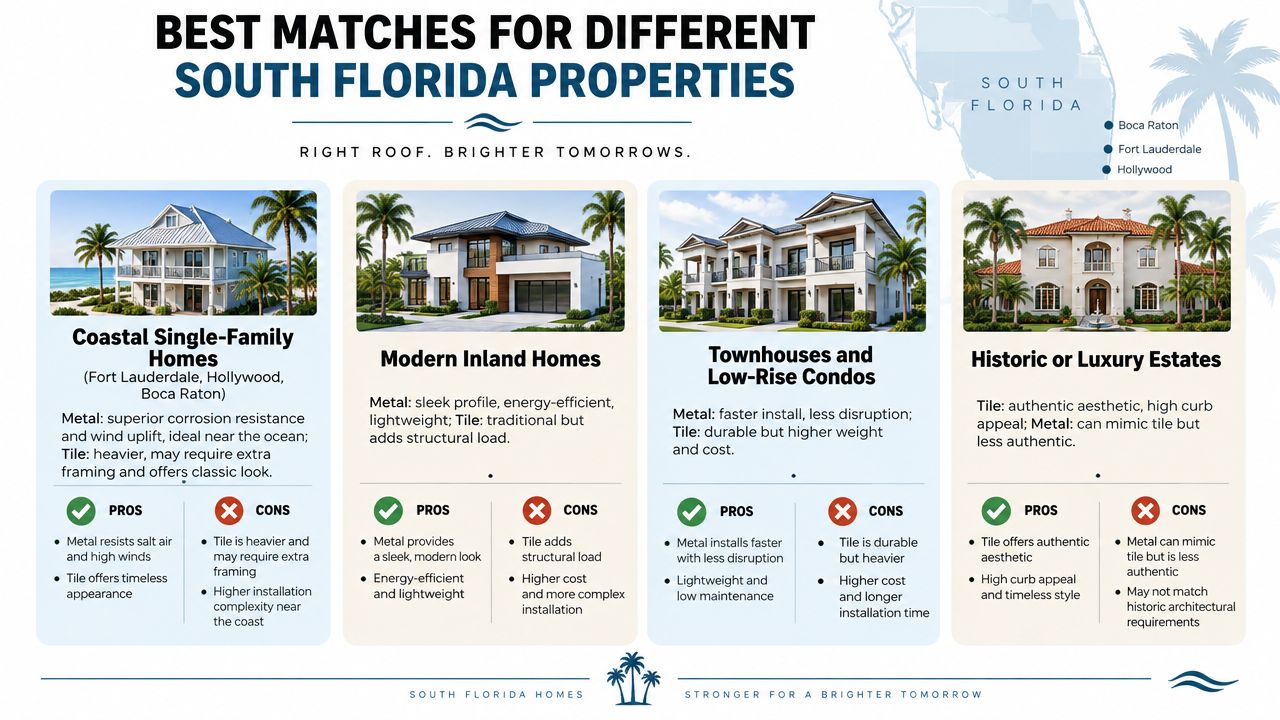
The right roof changes with the property. A coastal home in Fort Lauderdale has different exposure and design priorities from a Mediterranean residence in Coral Gables. Commercial owners also weigh access, tenant disruption, structural capacity, and maintenance logistics differently from homeowners.
Coastal single-family homes
In Fort Lauderdale, Hollywood, and Boca Raton, standing-seam metal often fits homes where salt exposure, lighter loading, and a clean profile matter. The coating and fastener package must be selected for the environment, and the installer should detail dissimilar-metal contact carefully.
Tile remains a sensible choice when the home's architecture depends on a substantial Mediterranean or Spanish appearance and the framing can support it. Near the coast, owners should plan for inspection of cracked pieces, underlayment condition, and corrosion around metal accessories.
Inland and architectural residences
Concrete or clay tile often suits Mediterranean and Spanish Colonial homes in Coral Gables, Pinecrest, and Weston. It preserves the established roofline, supports neighborhood character, and may align with resale expectations. The structure still needs verification before selection.
A modern inland home may favor metal for its clean lines and lighter load. That doesn't make metal the automatic choice. Roof pitch, drainage, skylights, solar plans, color restrictions, and the approved assembly still need review.
HOA communities and multifamily properties
Weston, Parkland, and parts of Boynton Beach can have rules governing profile, color, appearance, and material. Florida law and association documents are separate questions, so get the current written requirements before ordering a roof. A material may be legally permissible but still require an approval process for appearance or installation details.
For retail, office, and multifamily buildings, standing-seam metal or stone-coated steel may simplify structural planning and large-area installation. Tile can work on selected commercial designs, but its weight and access requirements can complicate reroofing while tenants or customers occupy the property.
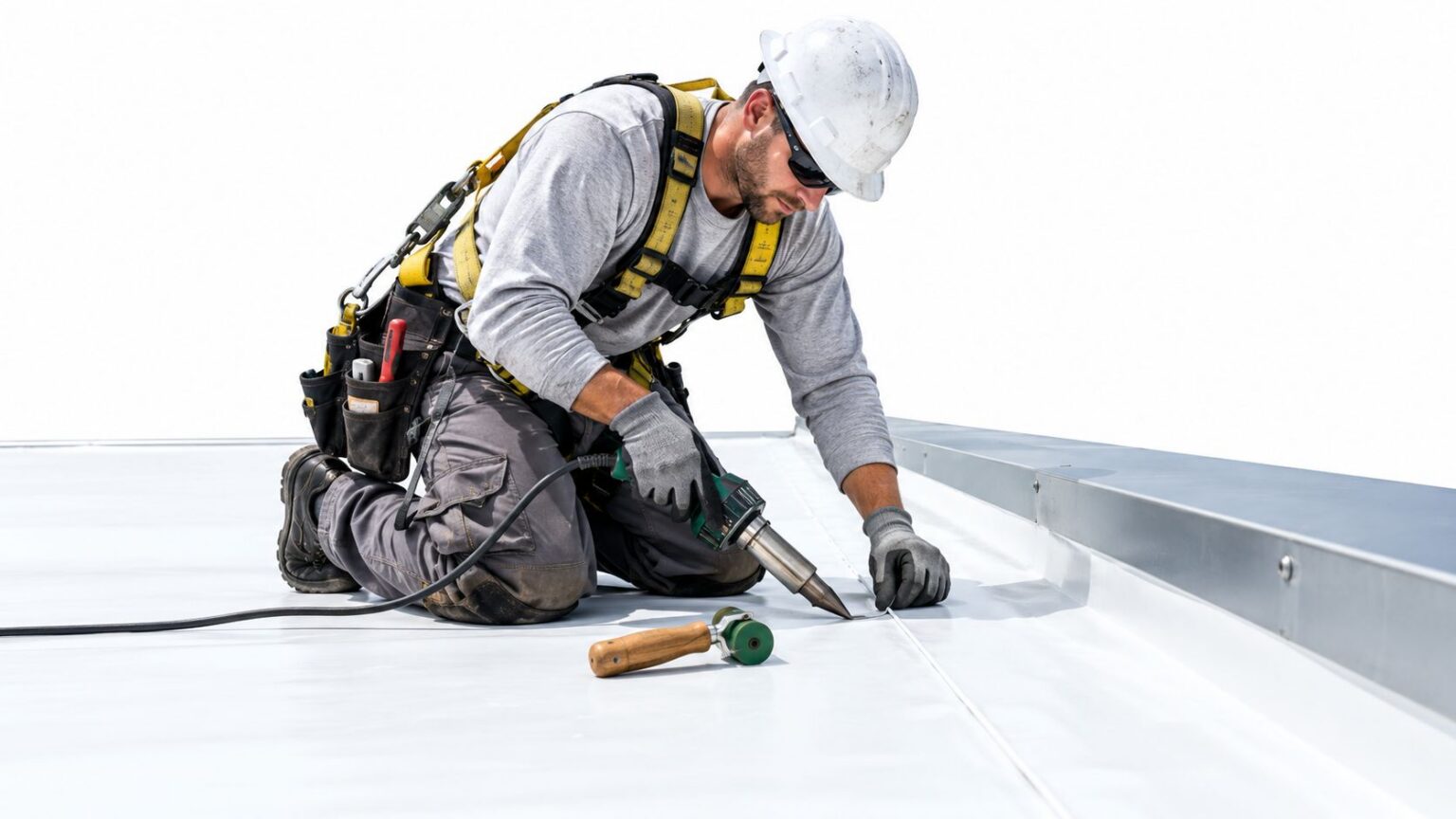
For a visual reminder of how installation context changes the decision, review this roof installation comparison image. The useful question isn't which material looks superior in isolation. It's which assembly fits the building's structure, appearance requirements, exposure, and maintenance access.
Making the Final Call for Your Roof
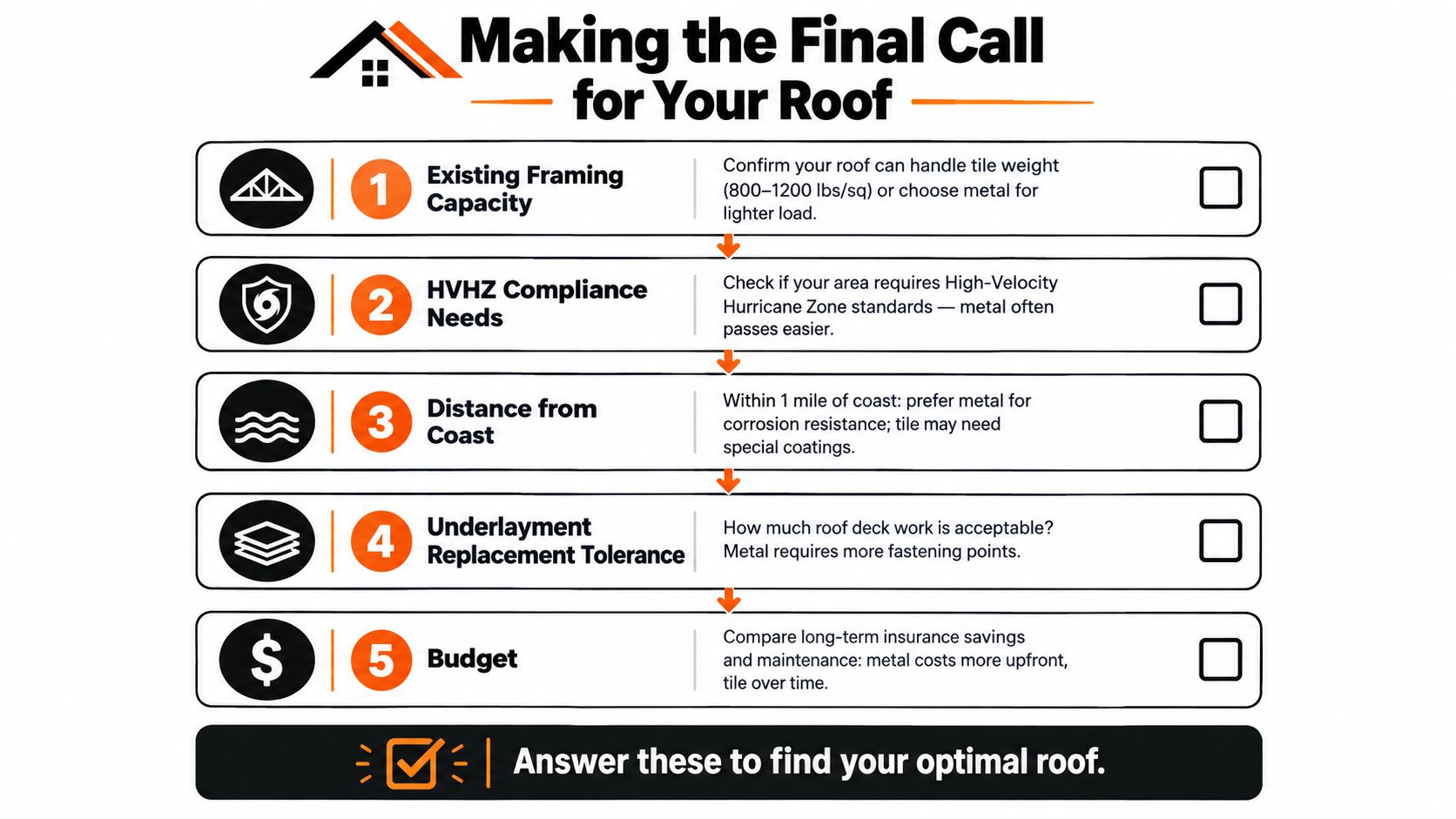
Use five filters, in this order. They narrow the field before you spend time choosing colors or profiles.
- Existing framing capacity. Confirm the trusses, rafters, connections, and deck can support the proposed system. Tile's much higher load may require engineering or reinforcement, while metal generally places less demand on the existing framing.
- HVHZ compliance. Determine which wind, impact, fastening, underlayment, and approval requirements apply to the address. The contractor should identify the exact NOA or Florida Product Approval, not just the manufacturer name.
- Coastal exposure. Salt air makes coating selection, fastener compatibility, flashing, and maintenance especially important. Ask how the proposed system handles corrosion risk and where dissimilar metals are separated.
- Underlayment tolerance. Decide how you feel about future access beneath a long-lived tile surface. If the tile remains serviceable but the waterproofing layer needs replacement, the project can still involve substantial removal and reinstallation.
- Budget horizon. Compare the installation scope and future maintenance plan, not merely the first contract total. Include structural work, deck repairs, permits, inspections, fasteners, flashings, and storm-related service.
Three common South Florida decisions
A 1990s Broward home with original wood trusses should start with a structural review. If the framing wasn't designed for tile, standing-seam metal may avoid reinforcement and reduce installation complexity.
A new Miami-Dade coastal concrete-block home may offer more flexibility, but the owner still needs an approved assembly suited to the site, coastal exposure, impact requirements, and HVHZ wind pressures. Metal may fit the lighter-load objective, while tile may remain appropriate if the design and attachment system are engineered for it.
A Palm Beach Mediterranean renovation may point toward tile when architectural continuity controls the decision. The owner should budget for the underlayment and verify the structure rather than treating the tile's long surface life as the entire ownership calculation.
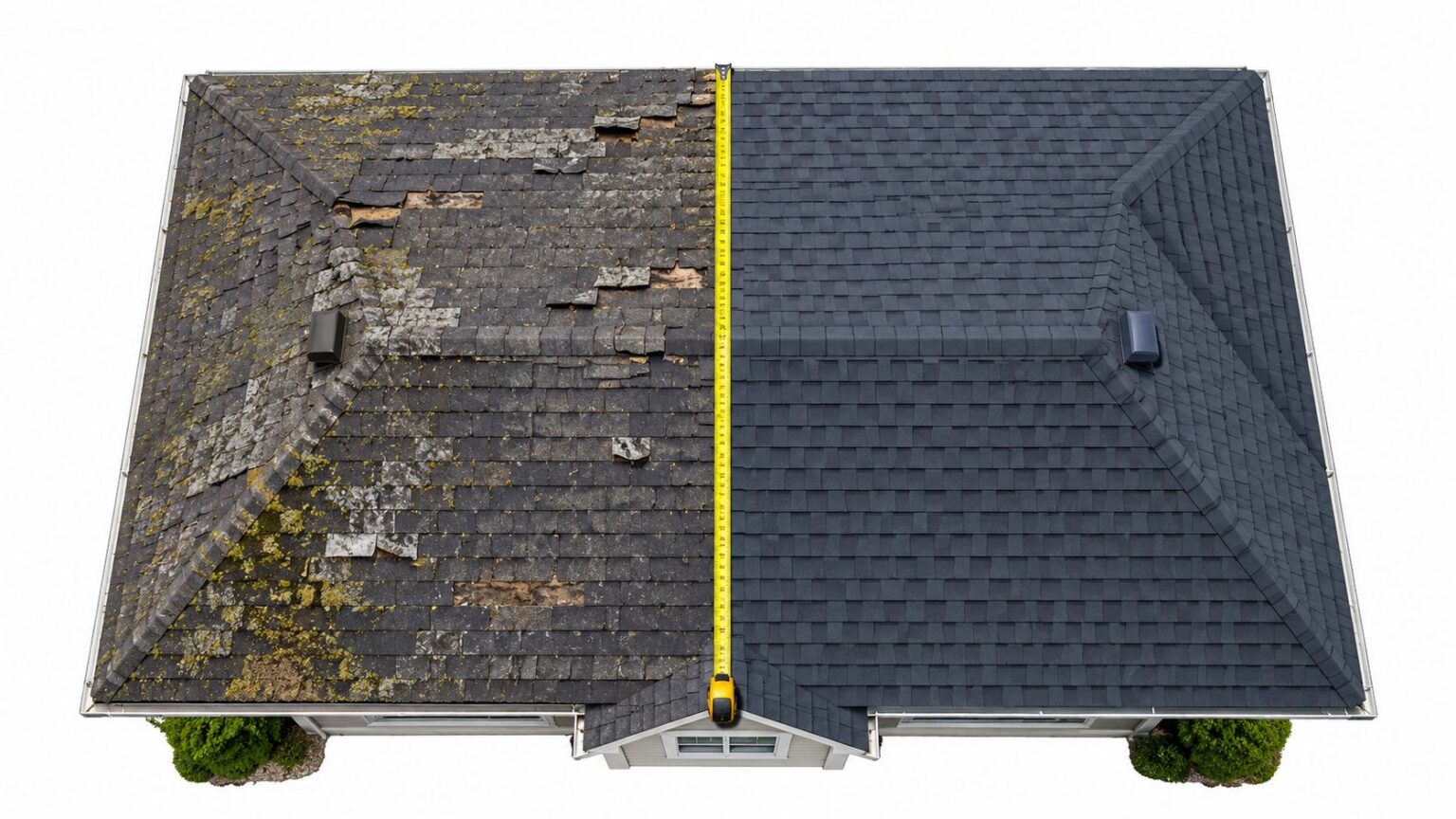
Paletz Roofing and Inspections provides inspections, repairs, replacements, and installations for tile and metal roofing across Broward, Miami-Dade, and Palm Beach counties. Request an on-site evaluation from a licensed South Florida roofer, and ask for the current NOA or Florida Product Approval for every assembly in the quote. This roof repair or replacement comparison image reinforces the decision you should make in person, after the structure and existing roof have been examined.
Schedule an on-site inspection with Paletz Roofing and Inspections to compare tile and metal assemblies for your property, including framing, underlayment, storm details, and approval documentation. Their team handles roof inspections, repairs, replacements, and installations across South Florida, so you can base the final choice on your actual home rather than a generic comparison chart.