
After a storm has rolled through Coral Springs, the first thing on every homeowner's mind should be the state of their roof. Your immediate priority is to look for damaged shingles—one of the most common and pressing problems that can lead to bigger issues down the road. It all starts with a safe, ground-level inspection to spot the obvious signs of trouble, followed by carefully documenting everything for your insurance company.
What To Do Immediately After A Coral Springs Storm
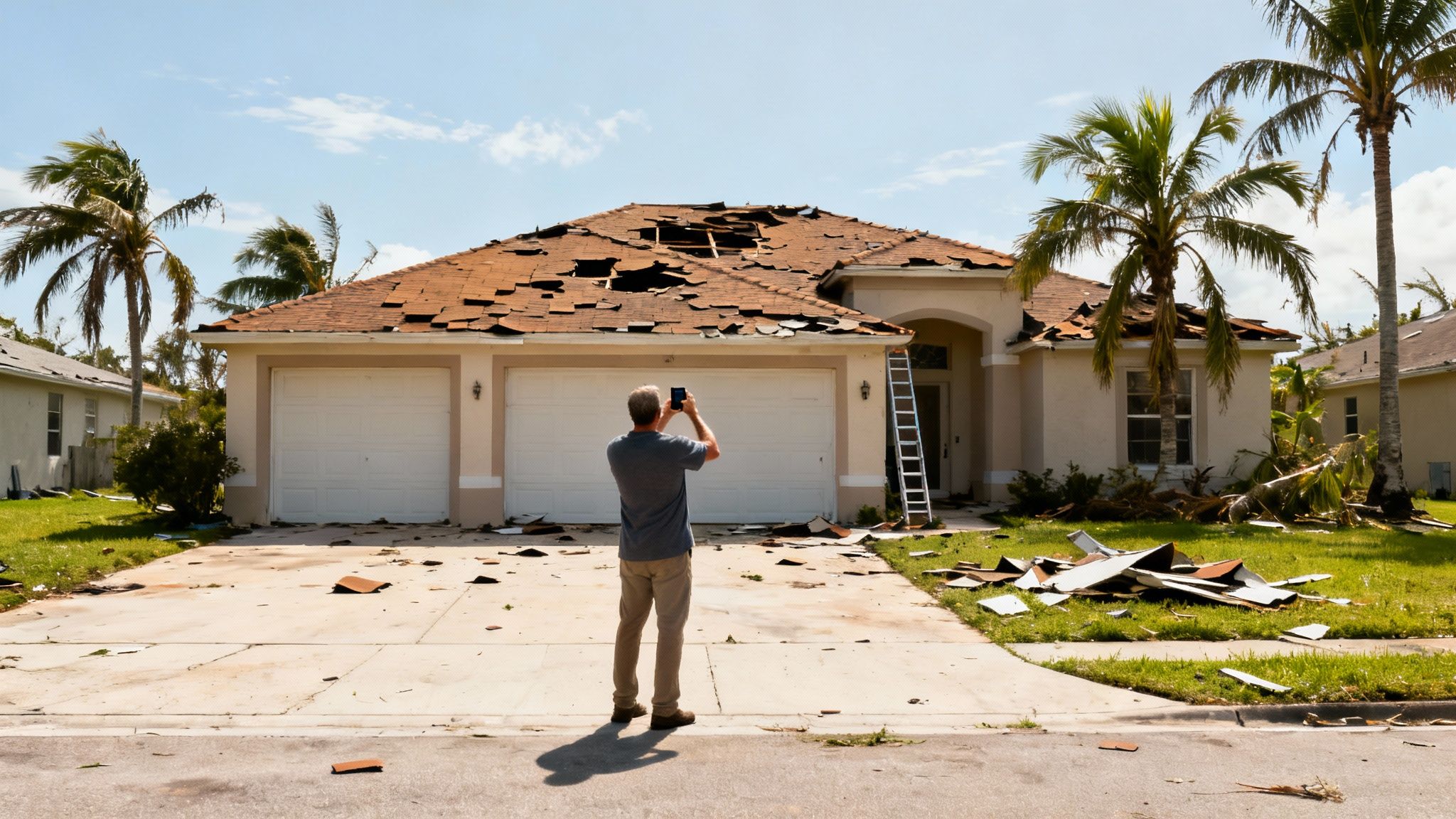
Those first few moments after a storm passes are absolutely critical. The winds might have died down, but if your roof's integrity is compromised, your home is still at risk. Your actions should boil down to two key things: safety and documentation. Whatever you do, never climb onto a wet or potentially unstable roof. You can—and should—do all your initial checks from the safety of the ground.
Your main goal right now is to get a clear picture of the most obvious damage. Take a slow walk around the perimeter of your house. Are there shingles or pieces of roofing material scattered in your yard or on the driveway? That's the most definitive sign you've got a problem that needs attention.
Performing A Safe Ground-Level Inspection
From a safe distance, grab a pair of binoculars if you have them and scan the entire surface of your roof. You’re looking for specific signs of trouble that are often visible without ever setting foot on a ladder.
- Missing Shingles: These are the easiest to spot. Look for patches where shingles are completely gone, exposing the darker underlayment.
- Flipped or Lifted Shingles: Strong winds love to get under the edges of shingles, causing them to lift, curl, or even flip over. These are extremely vulnerable and will likely be the next to go.
- Large Debris: A fallen tree limb or other storm debris sitting on your roof is a major red flag. It could easily have caused cracks, punctures, or structural damage you can't see.
- Clogged Gutters: If your gutters are packed with shingle granules—that sandy, gritty material from the surface of asphalt shingles—it's a sign of widespread wear and tear from the storm.
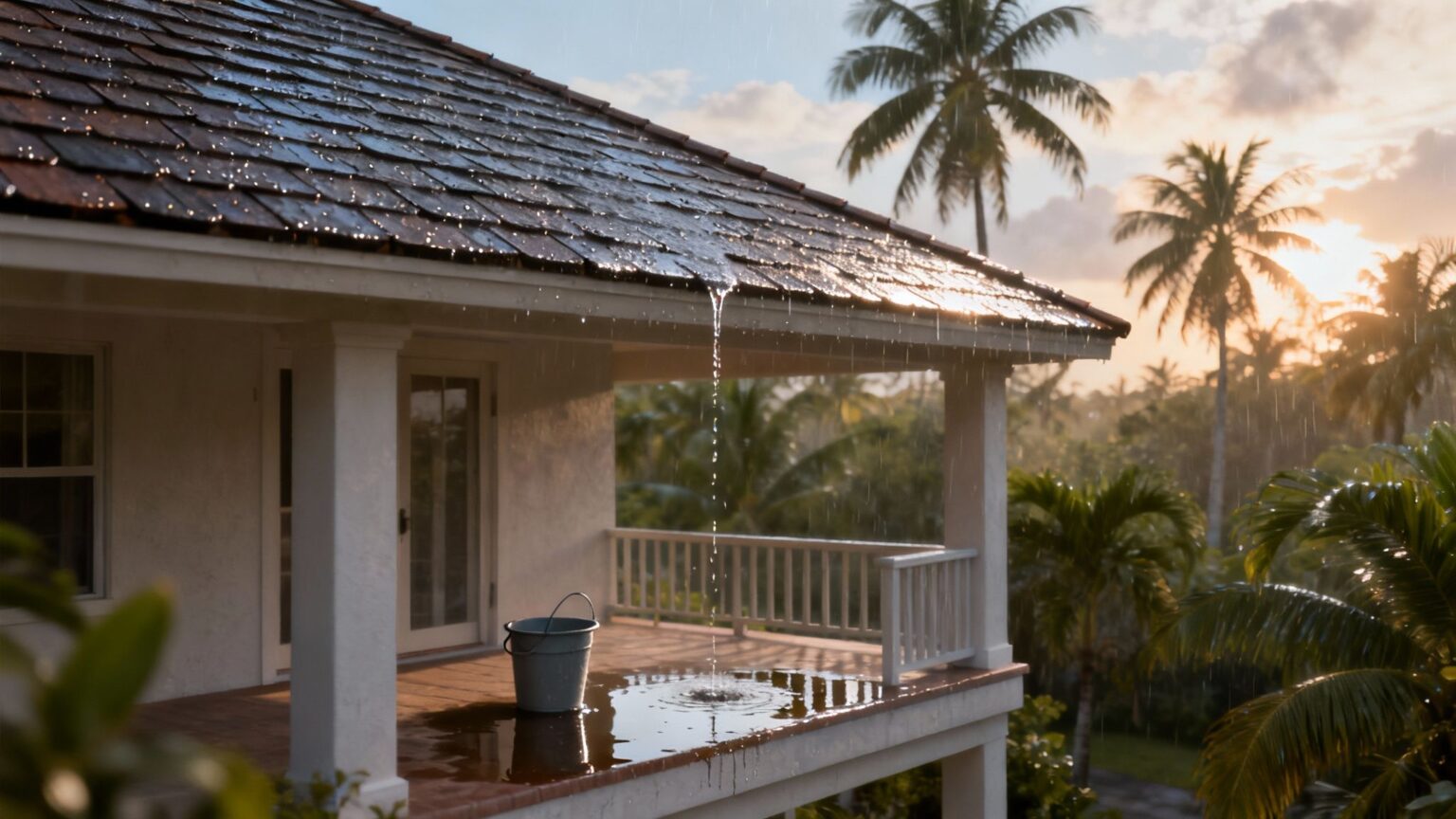
A critical but often overlooked step is to check your attic or the ceilings on your top floor. Scan for any new water spots, active drips, or drywall that looks damp or discolored. An active leak is an emergency that requires immediate action to prevent serious interior damage.
To help you stay organized, use this quick checklist from the ground.
Post-Storm Roof Assessment Checklist
Use this checklist to quickly assess potential shingle damage from the safety of the ground right after a storm.
| Damage Indicator | What to Look For From a Safe Distance | Next Step |
|---|---|---|
| Shingles in Yard | Any shingle pieces, tabs, or fragments on your lawn, driveway, or patio. | Document with photos; this is clear evidence of wind damage. |
| Visible Gaps on Roof | Dark or mismatched patches on the roof surface where shingles are missing. | Photograph the entire roof plane showing the missing sections. |
| Curled or Lifted Edges | Shingle edges that are bent upwards, curled, or look like they're peeling back. | Note the location; these are highly vulnerable to being torn off. |
| Granules in Gutters | A significant accumulation of sandy, black grit in your downspouts or gutters. | Indicates accelerated aging and loss of protection. |
| Interior Water Stains | New damp spots, discoloration, or active drips on ceilings or in the attic. | Call for emergency tarping or temporary repair immediately. |
This checklist isn't exhaustive, but it covers the most immediate red flags you can spot without putting yourself in danger.
Documenting For Your Insurance Claim
Once you've surveyed the exterior and interior, your next job is to document everything. Use your smartphone to take plenty of photos and videos from different angles on the ground. Be sure to get wide shots showing the whole roof, as well as close-ups of any specific damage you can see. Make a note of the date and time the storm hit.
Beyond the obvious roof issues, storms can cause subtle water intrusion that you might not notice right away. To fully protect your home, you might want to consider professional leak detection to uncover any hidden moisture problems. This kind of detailed evidence, like this example of documented damage, becomes invaluable when you file your insurance claim and start talking with an adjuster.
Uncovering Subtle Shingle Damage Most People Miss
It’s easy to know you have a problem when shingles are scattered across your lawn. But the truth is, the most financially damaging issues are often much harder to spot. After a Coral Springs storm, you have to think like a pro inspector and look beyond the obvious gaps on your roof. The real story is told in the subtle clues left by wind and hail—clues that many homeowners and even some insurance adjusters might overlook.
This hidden damage is sneaky because it doesn't cause an immediate leak. Instead, it quietly compromises your roof's protective layers. This drastically shortens its lifespan and sets you up for a catastrophic failure during the next big storm. Learning to spot these less obvious signs is the single best way to make sure your insurance claim covers the full extent of the damage.
Spotting Wind-Lifted and Creased Shingles
High winds don't always rip shingles clean off the roof. More often, they just lift the edges, breaking that crucial sealant strip that holds them down. This flapping action, even for just a few minutes, can create a distinct horizontal crease across the shingle tab.
That crease isn't just a cosmetic flaw; it's a fracture in the shingle's structural mat. That shingle is now permanently weakened and a prime candidate for being torn off completely in the next storm. When it's safe, look for shingles that seem a little raised or whose edges aren't sitting flush with the rest of the roof. You can see a clear example of this kind of creasing in our gallery of storm damage photos.
Identifying Hail Bruises and Granule Loss
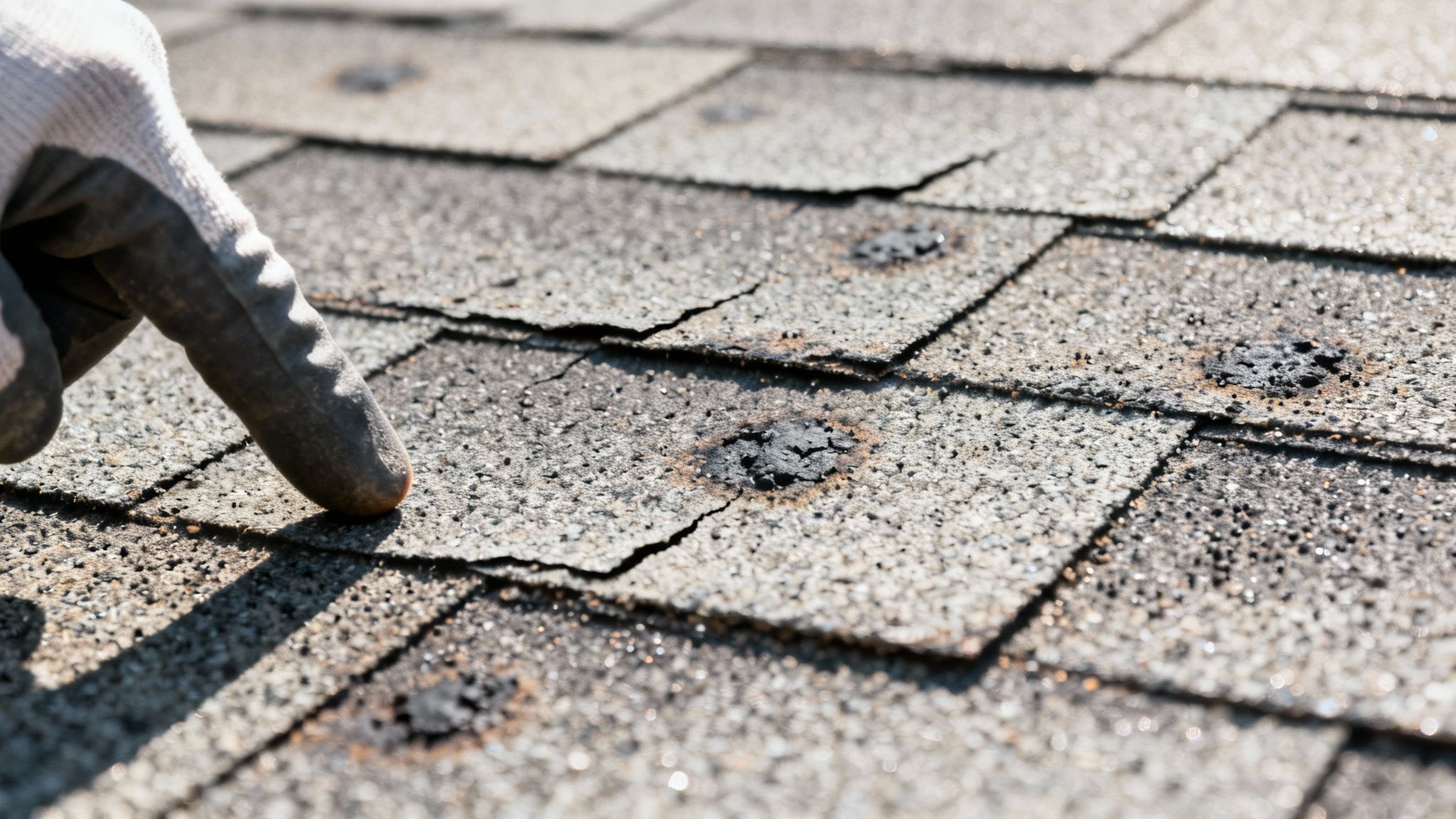
Hail damage is notoriously deceptive. It rarely punctures a shingle unless the hailstones are the size of golf balls. Instead, it creates "bruises"—small, often circular indentations where the impact has knocked the protective granules loose and fractured the asphalt and matting underneath.
From the ground, these bruises can look like simple dark spots or wet patches, which makes them easy to ignore. Get a closer look, though, and you might feel a soft, spongy spot, a lot like a bruised apple. This is a critical sign of damaged shingles after a storm in Coral Springs.
Another major red flag is widespread granule loss. Keep an eye out for:
- Bald Patches: Areas on the shingles that look bare or have lost their color.
- Granule Buildup: A heavy accumulation of that sandy, gravel-like material in your gutters and downspouts.
- Exposed Asphalt: The shiny, black asphalt layer showing through where the granules used to be.
Those granules are your roof's primary defense against UV radiation. Once they're gone, the sun starts to bake and degrade the asphalt, leading to cracks and rapid aging.
The Science of Wind Damage in Florida
It’s a common myth that only hurricane-force winds can wreck a roof. The reality is, the trouble starts much, much sooner. Wind speeds of just 45-60 mph, common in strong thunderstorms and tropical storms, can start lifting and damaging older or poorly installed shingles.
As winds climb to 61-74 mph, even standard 3-tab shingles are at serious risk. Once winds top 75 mph, the forces are strong enough to cause widespread lifting, cracking, and granule loss on almost any asphalt shingle roof. This context is absolutely crucial when an adjuster assesses your property because significant damage can happen well below the official hurricane-strength threshold.
Why Your Roof Ages Faster in Florida's Climate
Ever wonder why that "30-year" warranty on your shingles feels like a bad joke in Coral Springs? You’re not imagining things. A roof that might last for decades up north is lucky to give you a solid 10 years here. It’s not a defect; it’s the brutal reality of our local environment.
A roof in South Florida is in a constant, losing battle against a trio of aggressive elements that simply don't exist with the same intensity anywhere else. It’s a daily assault, not just an occasional hurricane.
The One-Two Punch of Sun and Humidity
The first enemy is the relentless, year-round ultraviolet (UV) radiation. Think of the sun as literally baking the life out of your shingles. It dries up the essential oils in the asphalt that keep them flexible and tough.
Once those oils are gone, the shingles become brittle and ready to crack. This process gets supercharged by our famous humidity. Moisture settles on your roof, and during our long, hot summers, it creates a perfect breeding ground for algae. Those ugly black streaks aren't just a cosmetic issue—they trap even more moisture and heat, speeding up the decay of the shingle's protective granules.
It's a lot like a car's dashboard. In a dry climate like Arizona, a dashboard just cracks from the heat. Here in Florida, it fades, gets sticky, and falls apart from the combination of intense sun and constant moisture. Your roof goes through a much more intense version of that every single day.
This is precisely why a 10-year-old roof in Coral Springs is far more vulnerable than a 10-year-old roof in a milder climate. It has already endured a lifetime of abuse, making it a prime target for damage when a storm finally rolls through.
When a Storm Meets a Weakened Roof
This pre-existing weakness is what turns a strong storm into a catastrophe for your home. A brittle, sun-scorched shingle can’t flex when hit by high winds—it just cracks or snaps off completely.
The bond holding the protective granules in place is already shot, so heavy rain easily washes them into your gutters. Once those granules are gone, the vulnerable asphalt layer underneath is exposed, and your roof's primary defense is gone.
This context is absolutely critical when dealing with insurance. An adjuster doesn't just see a "10-year-old roof." They see a roof that's been battered by a decade of Florida's unique climate, and they know it's not the same as a roof of the same age in North Carolina or Tennessee.
The 10-Year Mark: A Critical Turning Point
This isn't just our opinion; it's backed by some serious data. A landmark study on asphalt shingle durability in Florida drove this point home.
According to Michael Yaworsky, the Commissioner of the Florida Office of Insurance Regulation, shingles degrade so badly that after just 10 years, they no longer provide reliable protection against hurricane-force winds. The numbers are jarring: a roof of that age has a 25% chance of damage from 90 mph winds. At 100 mph, that risk jumps to a nearly 100% chance of damage.
You can dig into the findings yourself and see how Florida's climate hammers roof longevity in this detailed report.
Understanding this accelerated aging process explains why you might see damaged shingles after a storm in Coral Springs even if the winds didn't seem that bad. Your roof was likely already on its last legs, and the storm was just the final shove. This is why regular inspections aren't a luxury here—they're an absolute necessity.
How to Navigate Your Roof Damage Insurance Claim
Dealing with an insurance company after a storm can feel like you're weathering a second disaster. The process often seems intentionally confusing, but if you have a clear plan, you can get through it without pulling your hair out. It all boils down to methodical documentation and knowing how to communicate effectively with your provider.
Your very first call should be to your insurance company. The goal is simple: report the damage and get a claim number. When you talk to them, stick to the facts you’ve already documented. Describe the damaged shingles after a storm in Coral Springs and let them know about any interior leaks you've spotted. Don't speculate on the total cost or the full extent of the damage—that's what a professional inspection is for.
Initial Steps for a Strong Claim
Once you have that claim number, your mission shifts to building a rock-solid case for your claim. This goes way beyond just snapping a few pictures of missing shingles. You need to create a complete record that tells the clear story of the storm's impact on your home.
- Organize Your Photos: Don't just dump them in a folder. Group your pictures by area (e.g., "Front Slope," "Backyard Debris," "Living Room Ceiling Stain") and label them with the date and time.
- Keep a Communication Log: Every single time you talk to someone from the insurance company, write down their name, the date, and a quick summary of what you discussed. This log can be a lifesaver.
- Gather Pre-Storm Records: If you happen to have any photos of your home from before the storm—even just from a family barbecue—they can be incredibly powerful evidence to prove the damage is new and directly from this event.
Your goal is to leave zero room for ambiguity. An adjuster should be able to look at your file and immediately understand the timeline and severity of the damage without having to guess. This level of organization can make a huge difference in how quickly your claim moves forward.
The infographic below really puts into perspective how Florida's climate works against our roofs, which is a major factor insurers look at.
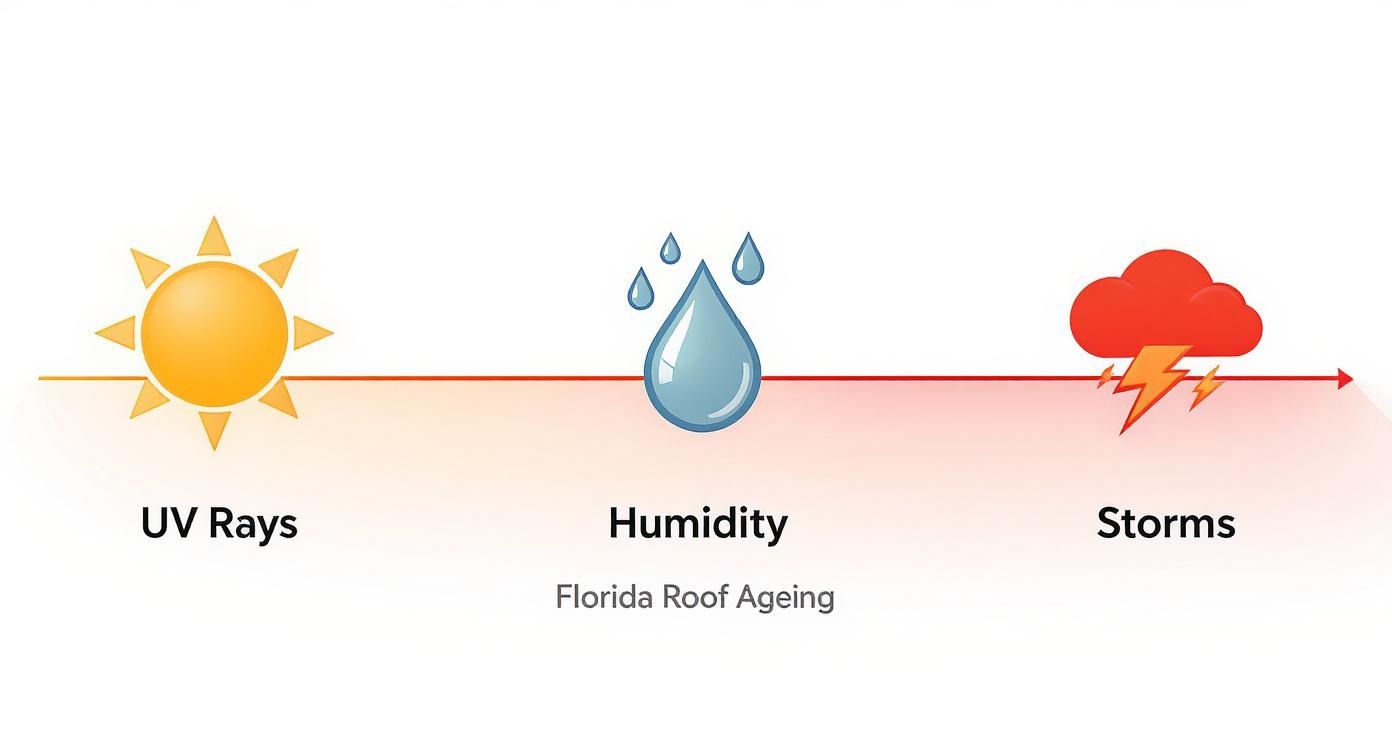
This shows just how the constant barrage of UV rays, high humidity, and powerful storms systematically weakens roofing materials over the years.
Working with Your Insurance Adjuster
The insurance adjuster is the key person who will assess the damage and ultimately decide the value of your claim. Here’s a pro tip: having a professional roofer, like someone from Paletz Roofing, present during the adjuster's inspection is one of the smartest things you can do.
Your roofer acts as your advocate on-site. They can point out subtle but significant damage the adjuster might otherwise miss, like hail bruises, lifted seals, or creased shingles that are compromised but not completely gone.
They can also provide a detailed, itemized estimate using the same industry-standard software that adjusters know and respect. This ensures the settlement offer you receive actually reflects the real-world cost of materials and labor right here in the Coral Springs market. Remember, the adjuster's initial offer is just that—an offer. If it feels low, you absolutely have the right to contest it with the evidence and estimate from your contractor.
It's also important to understand how your roof's age fits into this equation. A recent study found that asphalt shingle roofs over 10 years old have about a 50% probability of being damaged in the high-wind events we see all the time. This aging factor is a huge reason why some insurers are hesitant to cover older roofs; they know the practical lifespan in Florida's climate is much shorter than what the manufacturer might claim. You can learn more about these findings and how they're impacting insurance costs.
Finding a Trustworthy Roofer in Coral Springs
After a big storm blows through Coral Springs, the sound of chainsaws is almost always followed by a knock on the door. It’s the roofers. Unfortunately, many of these are opportunistic “storm chasers” who show up overnight, do questionable work, and then disappear just as fast, leaving you with even bigger headaches.
Finding a reputable, local expert is easily the most critical decision you'll make in getting your home back to normal.
Your first move should be to confirm they have a real, local presence. A legitimate Coral Springs roofer will have a permanent physical address in the area—not just a P.O. box or a pop-up office. You want a company that's part of the community, with a history you can actually check through local projects and reviews.
Vetting Your Potential Roofer
Before you even think about signing anything, it's time to do a little homework. Asking the right questions will quickly separate the pros from the pretenders.
- Licensing and Insurance: Always ask for their Florida state license number and proof of both general liability insurance and workers' compensation. Don't just take their word for it; you can and should verify these credentials online.
- Local Portfolio: A confident roofer will be more than happy to show you their work. Ask for addresses of recent jobs they've completed in or near Coral Springs.
- Subcontractor Use: It’s important to know who will actually be on your roof. Find out if they use their own employees or if they hire subcontractors. If they use subs, ask how they vet them to ensure quality control.
A huge red flag is any roofer who tries to pressure you. If they push you to sign a contract on the spot, offer to cover your insurance deductible, or demand a large upfront payment before any materials even show up, you should walk away. Immediately.
Beyond just collecting quotes, it's smart to understand how to find and vet a reliable contractor online to make sure you’re getting quality craftsmanship.
Questions to Ask Every Contractor
Once you've narrowed it down to a few candidates, it's time to dig a bit deeper. How they answer these questions will tell you a lot about their experience, professionalism, and commitment to doing the job right.
Ask them about their process for protecting your landscaping and property during the repair. What specific materials do they recommend for Florida's intense climate, and why? You also need to get clear on their warranty—what does it cover for both the materials and their labor?
A trustworthy company like Paletz Roofing, for instance, will gladly walk you through all of this and provide detailed answers. They'll show you their credentials, like those on display in our free inspection promotions, without hesitation. Partnering with a proven local expert ensures your damaged shingles after a storm in Coral Springs are not only fixed correctly but that your home is buttoned up and secure for whatever the next storm season brings.

Common Questions About Storm Damaged Shingles
After the wind and rain finally stop, the questions start swirling. That feeling of uncertainty can be just as stressful as the storm itself. Let's clear up some of the most common concerns we hear from Coral Springs homeowners dealing with damaged shingles.
How Long Do I Have to File an Insurance Claim?
This is one of the most critical, time-sensitive questions you'll face. The short answer is that Florida law generally gives you up to one year from the day the hurricane or storm made landfall to file a claim. But you should never wait that long.
Think of it this way: your insurance policy almost certainly has a clause requiring you to report damage "promptly" or "as soon as reasonably possible." If you wait weeks or months, the insurance company might argue that later weather events caused additional damage, which can seriously complicate your claim. The best move is always to notify your insurer within a few days of the storm.
Can I Repair the Roof Myself Before the Adjuster Arrives?
You should absolutely take steps to prevent further damage, but stick to temporary, emergency fixes. This means doing things like securing a tarp over a hole or fixing a piece of loose flashing to keep water out. Do not, under any circumstances, start permanent repairs or throw away any of the damaged materials.
Your damaged shingles, felt paper, and anything else torn from the roof are the primary evidence for your claim. If you get rid of them or start replacing sections before the adjuster sees the damage, you're essentially destroying the proof of your loss. This is a fast track to getting your claim denied.
Always take extensive photos and videos of the damage before you touch anything. This protects your home from more water intrusion and protects your financial interests during the claims process.
Will My Insurance Premiums Go Up if I File a Claim?
This is a fear we hear all the time, but Florida law provides some important protections. An insurance company can't legally single you out for a rate hike just because you filed a claim for damage from a natural disaster like a hurricane—what they call an "Act of God."
However, if a storm causes widespread devastation and a huge number of claims are filed across Coral Springs, the insurer might raise rates for everyone in the region to cover their massive losses. So while your individual claim won't directly cause your premium to jump, major local events can lead to higher rates for the whole community later on.
Deciding not to file a valid claim to avoid a potential rate increase is almost always a bad financial move. You'll end up paying thousands out of pocket for repairs that should have been covered, all to avoid a hypothetical future increase. It rarely makes sense when you're looking at significant damaged shingles after a storm in Coral Springs.
If you're staring at a damaged roof and feeling overwhelmed, you don't have to go through it alone. Paletz Roofing and Inspections has been helping the Coral Springs community navigate storm repairs and insurance claims for over 30 years. Contact us for a free, no-obligation inspection and get the expert advice you need.