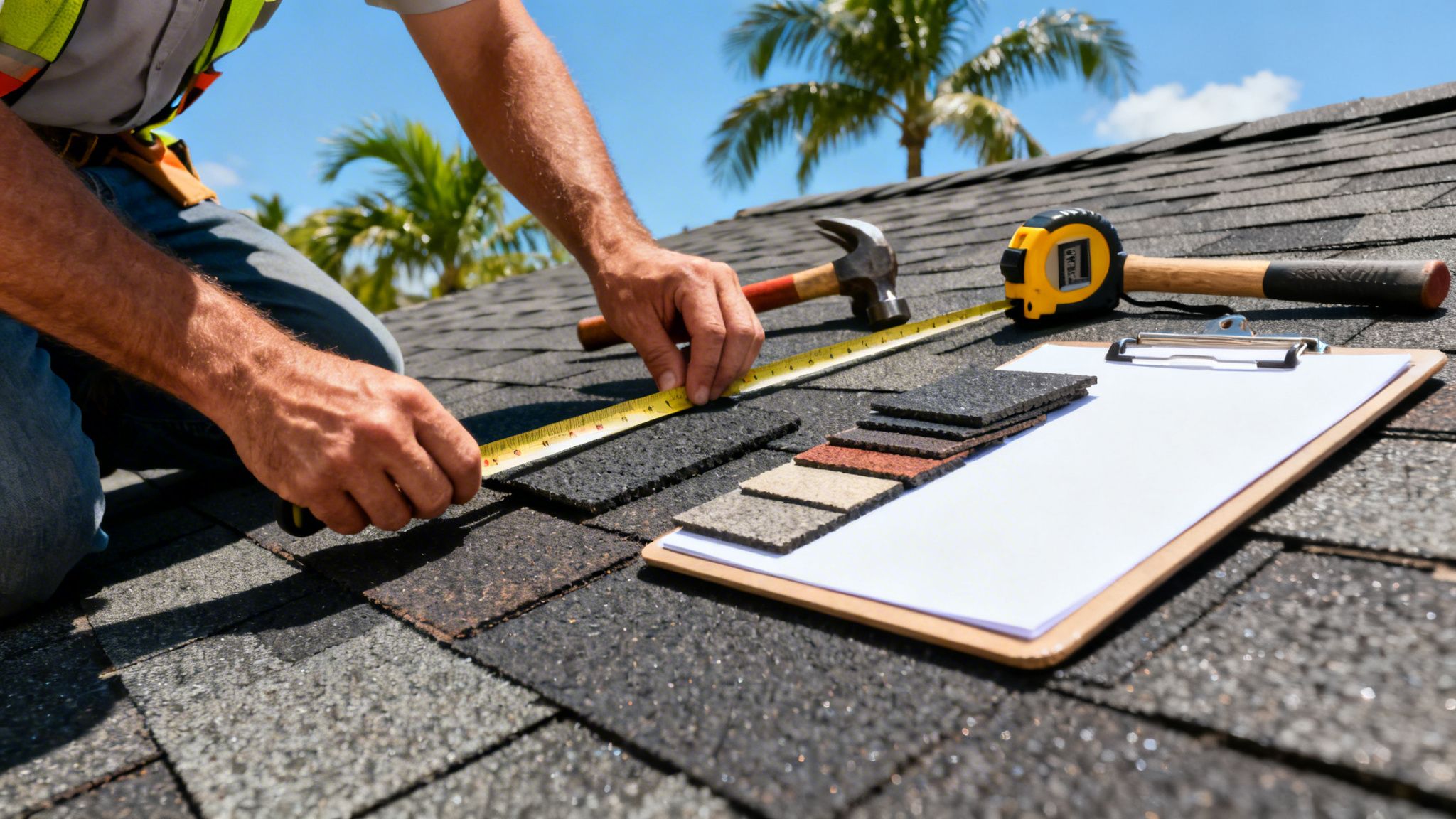
Let's get straight to the point. You want to know how much roof repair costs in South Florida, and the answer isn't always simple. For 2026, a minor shingle patch might start around $700, but significant damage to a tile or metal roof can easily reach several thousand dollars.
Your Guide to 2026 South Florida Roof Repair Costs
Trying to pin down the cost of a roof repair is a bit like budgeting for a car problem—the final price depends entirely on whether you need a quick tire patch or a full engine rebuild. The same idea applies to your roof.
A few missing shingles after a storm is a completely different ballgame than discovering extensive wood rot after a slow, hidden leak has been doing its dirty work for months. This guide is here to break down those costs for you, so you know what to expect.
First, let's establish a clear baseline. The infographic below shows the typical cost brackets for minor versus significant repairs, along with the projected annual cost increases we're seeing in the industry.

As you can see, while small fixes are relatively affordable, more substantial issues can become a serious investment. This really drives home the importance of catching problems early.
A Closer Look at Rising Repair Prices
Heading into 2026, the average cost for roof repairs has climbed noticeably. A simple shingle repair that might have cost you around $300 a few years ago now often falls in the $700 to $900 range.
This jump reflects broader trends in labor and material costs. In fact, a recent industry outlook projects a 3-5% annual increase in overall roofing costs through 2026. A big part of that is labor, which now makes up about 60% of total project expenses. This makes getting a small issue fixed today much smarter than waiting for it to become a huge bill tomorrow. You can find out more about these trends in the full roof replacement cost outlook.
The key takeaway for South Florida homeowners is this: The longer you wait to fix a small problem, the more expensive it gets. What starts as a simple patch can quickly escalate into a major structural repair if you ignore it.
Estimated South Florida Roof Repair Costs for 2026
To give you a more specific idea of what to budget, we've broken down some common repair costs you'll see in Miami-Dade, Broward, and Palm Beach counties. Think of this table as a starting point—a quick snapshot of what you might pay based on your roof type.
| Repair Type | Asphalt Shingle Cost | Clay/Concrete Tile Cost | Metal Roof Cost |
|---|---|---|---|
| Minor Leak Patching | $700 – $1,500 | $900 – $2,500 | $1,000 – $3,000 |
| Shingle/Tile Replacement | $750 – $1,800 | $1,200 – $3,500+ | N/A |
| Flashing Repair/Replacement | $600 – $1,200 | $800 – $2,000 | $900 – $2,200 |
These numbers clearly show how much material choice can affect your repair bill. In the rest of this guide, we'll unpack the specific factors behind these prices, turning you into an informed homeowner who understands every line on a roofer's quote.
What Really Drives Your Final Roof Repair Bill
Those average cost tables are a great starting point, but they never tell the whole story. Why might one roof repair quote be double the price of another for what seems like the same problem? To really understand the "why" behind your estimate, you need to know which variables a contractor is looking at.
Think of it like a mechanic's bill for your car. The final cost depends on whether you just need a quick fix, like a new tire, or if the mechanic has to tear things apart to diagnose a complex engine issue. Roof repair pricing works the same way—what you see on the surface often isn't the full picture.
The Scale and Severity of the Damage
The most direct cost driver is simply the extent of the problem. There's a world of difference between replacing a few shingles a strong gust of wind ripped off and tackling a slow, hidden leak that has been silently rotting the wooden deck under your roof for months.
- Minor Damage: This covers things like replacing a handful of missing or cracked shingles, sealing loose flashing around a vent pipe, or re-securing a single dislodged tile. These are often quick fixes with minimal material costs.
- Major Damage: This involves widespread issues. It could mean replacing an entire section of your roof, tearing out and replacing rotted wood sheathing, or addressing structural damage from a fallen tree. These repairs are far more labor-intensive and require a lot more material.
A huge factor driving up repair costs, especially here in South Florida, is dealing with the aftermath of hurricanes and tropical storms. Properly assessing and fixing this kind of severe weather damage is a specialized skill that will definitely impact the final price.
Your Roof's Material Type
As our cost table hinted, the material on your roof is a massive variable. Each type demands different materials, tools, and expertise, which directly influences the price you'll pay.
An asphalt shingle is relatively inexpensive and easy for a roofer to replace. A heavy, fragile clay tile, however, requires more skill, time, and care to remove and reset without breaking adjacent tiles, driving up labor costs.
Just look at the cost difference for a standard 10×10 foot repair area:
- Asphalt Shingles: Might cost $750 – $1,800 because the materials are affordable and the installation is fast.
- Clay/Concrete Tiles: Could range from $1,200 – $3,500 since the tiles themselves are more expensive and the labor is far more specialized.
- Standing Seam Metal: Repairing a damaged panel could be $1,000 – $3,000 or more, as it often requires custom fabrication and a high level of skill to ensure a perfect seal.
Labor, Accessibility, and Roof Complexity
You aren’t just paying for materials; you are paying for a roofer’s time and skill. In fact, labor is often the single biggest component of your bill, and it’s a crucial factor in understanding why repair costs can vary so much.
The latest industry trends show that labor costs are dominating roof repair expenses. In 2026, labor is projected to account for up to 60% of the total project budget, with rates ranging from $2 to $7 per square foot depending on how complex the job is. For South Florida, where steep-pitched roofs or the large flat roofs on commercial buildings are common, labor costs often land at the higher end of that spectrum. You can read the full 2026 industry report to see how these trends are affecting pricing.
Several factors make the labor portion of your bill go up:
- Roof Pitch: A very steep roof is more dangerous and difficult to work on. Roofers need extra safety equipment and have to move slower, which naturally increases labor hours.
- Accessibility: Is your roof easy to get to? If crews have to navigate around tight spaces, extensive landscaping, or multiple stories, it takes more time just to set up and transport materials.
- Permits: Many repairs in Broward, Miami-Dade, and Palm Beach counties require a permit. The process of pulling permits adds administrative time and fees to the total project cost, but it also ensures the work is done right and up to local hurricane codes.
Real-World South Florida Roof Repair Scenarios
All those numbers and estimates are helpful, but what do they actually look like on a real South Florida home? Let's break down three common repair jobs we see all the time in Broward, Miami-Dade, and Palm Beach. Seeing the story behind the invoice helps you understand exactly what goes into a professional repair and where your money is really going.

You'll see how problems that sound almost identical on the surface can have wildly different solutions and price tags, especially here in our unique coastal climate.
Scenario 1: The Post-Hurricane Shingle Fix
A family in a Broward County suburb spots a small, tell-tale water stain on their ceiling after a nasty tropical storm blows through. When we get up there, we find a 10×10 foot area where intense winds have lifted and creased a section of architectural shingles. The waterproof seal is broken, and water is getting in. Luckily, the damage is isolated, and the wood decking underneath is still solid.
This is exactly the kind of minor repair that needs urgent attention. The goal is to stop that small leak in its tracks before it can cause serious wood rot or a mold infestation. Because it's a single-story home with a low-pitched roof, access is straightforward, which helps keep the labor costs in check.
Here’s what a typical breakdown for this job looks like:
- Labor: Two roofers for about 4 hours ($600 – $800). This covers everything from setup and safety precautions to removing the bad shingles, checking the underlayment, and installing the new materials correctly.
- Materials: One bundle of matching architectural shingles, high-grade roofing cement, and proper fasteners ($150 – $250).
- Permit & Disposal Fees: The administrative side, including pulling a local permit and properly disposing of the old, damaged materials ($100 – $200).
Total Estimated Cost: $850 – $1,250
This example really highlights why even a "small" repair costs more than just a pack of shingles. You're paying for skilled labor and the necessary administrative steps that ensure the job is done right.
Scenario 2: Solving a Stubborn Tile Roof Leak
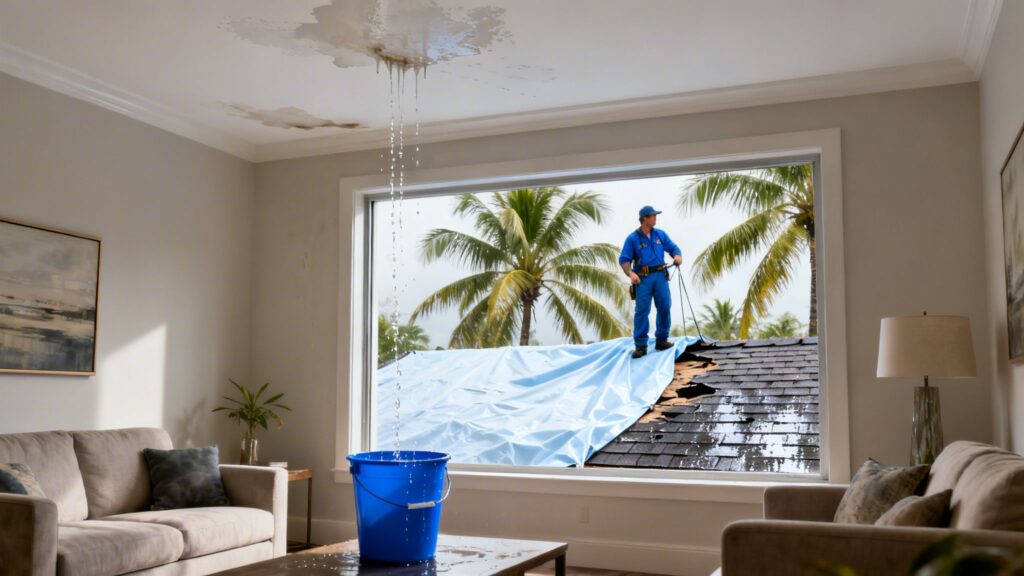
We get a call from a homeowner in a Miami-Dade community who’s been chasing a persistent leak in their den for months. They've had someone try to patch the clay tiles, but the problem keeps coming back. After a thorough inspection, we find the real culprit: the waterproofing membrane under the tiles has failed. Water is sneaking in, running down the roof deck, and then finally showing up on the ceiling.
This is a more moderate, and much more intricate, repair. It's not about just swapping a few tiles. Our crew has to carefully remove a large section of fragile clay tiles without breaking them, cut out and replace the rotted underlayment and decking, and then reinstall the original tiles perfectly so the repair is invisible. This is delicate, time-consuming work. You can get a better sense of this process by exploring our guide on clay tile roof repair.
- Labor: Two roofers for a full day ($1,200 – $1,600). The painstaking process of removing and reinstalling tiles without causing more damage adds significant time.
- Materials: New underlayment, a sheet of plywood decking, new flashing, and specialized tile mortar ($400 – $600).
- Contingency: We always budget for a few replacement tiles that might break during removal, no matter how careful we are ($100 – $200).
Total Estimated Cost: $1,700 – $2,400
Scenario 3: Replacing Corroded Metal Panels
Life on the coast in Palm Beach County is fantastic, but the salty air is relentless. A homeowner's standing seam metal roof is showing its age, with several panels near a vent pipe displaying serious surface rust and fastener corrosion. These spots have become weak points, vulnerable to leaks and wind uplift in the next storm.
This job is more extensive and borders on a partial roof replacement. It requires removing the compromised panels entirely, treating any surface rust on the surrounding areas, and then installing new, custom-fabricated panels that match the original roof profile and color precisely. Getting a watertight seal on a metal roof demands a high level of skill.
- Labor: A specialized metal roofing crew for 1.5 days ($2,000 – $2,800).
- Materials: Custom-cut standing seam metal panels, new corrosion-resistant fasteners, and a high-performance sealant designed for coastal environments ($1,000 – $1,500).
Total Estimated Cost: $3,000 – $4,300
When to Repair vs. Replace Your Roof
Every South Florida homeowner eventually hits a fork in the road with their roof: do I sink more money into another repair, or is it finally time for a full replacement? Continuing to patch up an aging roof can feel like throwing good money after bad, just delaying the inevitable.
Knowing when to stop the cycle of repairs and make the smarter long-term investment is a crucial decision. A useful benchmark many of us in the industry use is the “50% Rule.” It’s a straightforward way to look at the finances.
If a comprehensive repair job is going to cost you 50% or more of what a full roof replacement would, it’s almost always smarter to replace the whole thing. Pouring that much cash into a system that’s already on its way out is a poor investment.
This simple rule helps you avoid sinking thousands into a roof that might only have a few more years left in it anyway. It forces a clear-eyed look at the immediate cost versus the long-term value and peace of mind.
Beyond the 50% Rule: Key Factors to Watch
While cost is a big driver, it's not the only thing telling you it's time to stop asking "how much does roof repair cost" and start budgeting for a new one.
Your Roof's Age: Materials have a lifespan, but South Florida’s relentless sun and humidity are brutal. An asphalt shingle roof, for example, might be advertised to last 20-30 years, but we often see them start failing much sooner in our climate. If your roof is getting close to the end of its realistic service life, replacement is the wise move.
The Frequency of Repairs: Are you on a first-name basis with your roofer? If you find yourself calling for a fix after every major storm or at least once a year, that’s a huge red flag. Those frequent, smaller bills add up fast and signal a systemic failure that patching just can’t solve anymore.
The Hidden Financial Payoff of a New Roof
Pulling the trigger on a new roof isn't just about stopping leaks—it's a significant financial upgrade for your home, especially here in South Florida. A new roof, built to the latest hurricane codes, can actually unlock savings that offset the initial cost over time.
Think about these powerful incentives:
Massive Insurance Savings: We’ve seen homeowners watch their insurance premiums drop by 30-50%—or even more—after installing a new, properly permitted roof. Florida insurers offer huge discounts for roofs that meet modern wind mitigation standards because your home becomes a much lower risk.
Improved Energy Efficiency: Today's roofing materials, especially "cool roof" options, do a much better job of reflecting sunlight and absorbing less heat. This takes a major load off your air conditioning system, leading to lower monthly power bills, which is a welcome relief during our long, hot summers.
Ultimately, replacing an old, failing roof isn't just an expense. It's a true investment in your home's safety, its value, and your long-term financial health. That’s a level of security no small repair can ever provide.
Getting Accurate Quotes and Navigating Insurance Claims
Knowing what a roof repair might cost is the first step. Making sure you actually pay a fair price—and get the full support you’re owed from your insurance company—is a whole other ball game. This is where you need a solid action plan. Dealing with quotes and claims can feel overwhelming, but with the right approach, you can protect your home and your finances.

The first rule is simple: never, ever settle for a single quote. Your goal should be to gather at least three detailed, itemized estimates from different licensed and insured local roofing companies. This is your best defense against overpaying and your clearest path to finding a contractor you can trust.
Decoding a Legitimate Roofing Quote
A good quote is so much more than a final number. It’s a transparent roadmap for the entire project, telling you exactly what you’re paying for and protecting you from surprise charges down the line.
Think of it this way: would you accept a grocery receipt that just said "Food: $200"? Of course not. You'd want to see every item listed, and your roof is no different. A professional estimate, like the ones we provide at Paletz Roofing, will always include:
- A Clear Breakdown of Costs: Look for individual line items for labor, materials (with the specific brand and type listed), and any necessary permit fees.
- A Detailed Scope of Work: The quote must clearly explain what is being repaired, the methods the crew will use, and what’s included for cleanup and debris disposal.
- Proof of Licensing and Insurance: A contractor’s license number and proof of both liability and workers' compensation insurance should be easy to find.
- Warranty Information: It needs to spell out the warranty on both the roofing materials and the roofer’s own workmanship.
Be on the lookout for red flags like vague, one-line pricing, aggressive high-pressure sales tactics, or any contractor who seems hesitant to show you their credentials.
Navigating the Insurance Claim Maze
If a storm, high winds, or a fallen tree damaged your roof, your homeowners insurance should absolutely be involved. In fact, research shows that around 33% of all roof replacements are a direct result of storm damage, so this is a path many homeowners have to walk. Getting your claim approved, however, requires a careful and methodical approach.
The success of your insurance claim often comes down to one thing: documentation. The more evidence you have, the stronger your case will be. Your roofer can be your most powerful advocate in this process.
Here's a step-by-step plan to follow:
- Document Everything Immediately: Before anyone touches anything, take clear photos and videos of the damage. Get close-ups of broken tiles, torn shingles, or damaged flashing, then take wider shots from the ground to show the full context. Don't forget to document any interior leaks or water stains.
- File Your Claim Promptly: Call your insurance provider as soon as possible to report the damage and get the claims process started. They will assign an adjuster to your case.
- Get a Professional Inspection: This is critical. A reputable roofer like Paletz Roofing will perform a thorough inspection and give you a detailed report that documents the cause and extent of all damage. This professional assessment carries far more weight with an adjuster than your photos alone.
- Meet the Adjuster with Your Roofer: Whenever possible, schedule your roofer to be on-site when the insurance adjuster visits. Your roofer can point out specific damage the adjuster might otherwise overlook and provide expert context. They speak the same technical language and can justify the necessary repairs based on industry standards and local building codes, ensuring nothing gets missed.
By partnering with a professional roofer, you’re not just hiring someone to fix a problem; you're bringing on an ally. They provide the expert evidence needed to validate your claim, helping you secure the funds you are entitled to for a proper and complete repair. You can learn more about what to look for during this process by reviewing our guide on professional roof inspections.
Your Partner for Reliable South Florida Roofing
Figuring out the true cost of roof repair in South Florida can feel overwhelming, but you don’t have to go it alone. This is where Paletz Roofing and Inspections comes in. With over 30 years of hands-on experience serving homeowners across Broward, Miami-Dade, and Palm Beach counties, we bring genuine clarity and trusted expertise to every single project.
We live here, so we know firsthand the unique challenges posed by Florida’s intense weather. That’s why we are fully licensed, insured, and absolutely committed to using high-quality materials specifically engineered to stand up to our sun, rain, and hurricane-force winds.
Your Solution for a Secure Roof
Instead of leaving you with uncertainty, we provide direct, honest solutions. In an industry where responsiveness is everything, it’s good to know many top contractors now use advanced tools like the best AI receptionist for roofers to ensure no call ever goes unanswered. We’re just as focused on that level of reliable communication, and it’s built right into our core services:
- Free, No-Pressure Quotes: We’ll give you a clear, itemized estimate so you know exactly what to budget for. No hidden fees, no surprises.
- Expert Inspections: Our team gets to the root cause of any leak or damage, catching small issues before they become major structural headaches. This expert documentation is also a massive help with insurance claims.
- 24/7 Emergency Services: When a storm hits or a leak appears out of nowhere, you can’t afford to wait. Our crews are on standby around the clock to secure your property and stop the damage from getting worse.
You’ve learned what drives your roof repair costs and what to look for in a contractor. Now, it’s time to put that knowledge to work with a team that has proven its reliability in our community for decades.
Your next step is simple and comes with zero risk. Contact us to schedule your free inspection and quote. Let the team at 
Your Top Questions About Roof Repair Costs, Answered
Even after breaking down all the variables, you probably still have some specific questions buzzing around your head. It's completely normal. We get these questions from homeowners across South Florida all the time, so let's tackle them head-on with some straight-up answers.
What's the Real Cost to Fix a Small Roof Leak?
This is the classic "it depends" question, but I can give you a solid starting point. For a minor leak on a standard asphalt shingle roof that’s easy to get to, you’re likely looking at a bill between $400 and $900, based on what we're projecting for 2026.
But—and this is a big but—if that same leak is on a tile or metal roof, or if it’s been quietly damaging the wood decking underneath, the cost can easily jump past $1,500. The final price always comes down to the time it takes to hunt down the true source of the water and fix every bit of damage it caused along the way.
Can I Finance a Roof Repair?
Absolutely. Many reputable roofers, including us here at Paletz Roofing and Inspections, offer financing options. This can be a real lifesaver, especially for those bigger, unexpected repairs that weren't in the budget.
Financing allows you to turn a large, stressful expense into predictable monthly payments. It’s always smart to ask about the available plans when you get a quote, particularly for larger projects.
Will My Homeowners Insurance Actually Cover This?
This is where a lot of homeowners get into trouble. The short answer is: sometimes. In general, your insurance is there to cover damage from sudden, unexpected events—think hurricanes, major windstorms, or a tree crashing down on your house.
What insurance almost never covers is damage from old age, normal wear and tear, or neglect. This is why getting a professional inspection is so critical. A good roofer provides the expert documentation you need to prove the damage was from a covered event, which is the key to getting your claim approved.
Is It Cheaper to Repair My Roof in the Off-Season?
You'd think so, but the answer is generally no. While it might be easier to book a contractor during the drier months outside of Florida's official hurricane season (June through November), the pricing stays pretty consistent.
The real cost drivers are materials and labor, and those don't fluctuate much with the calendar. The best way to save money on a roof repair is to act fast. Fixing a small problem today, no matter the season, is always cheaper than dealing with the massive disaster it could become in a few months.
Ready to stop guessing and get a clear, honest answer about your roof? The team at Paletz Roofing and Inspections provides free, no-obligation quotes to give you the information you need to make the best decision for your home. Get in touch with us today.